
Home > Articles about Justice O'Connor > Equal opportunity finally goes to court

Equal opportunity finally goes to court

ITEM DETAILS
Type: Newspaper article
Author: Carol Kleiman
Collection: The Kauffman-Henry Collection
Date is approximate: No
equal_opportunity_to_court.jpg

DISCLAIMER: This text has been transcribed automatically and may contain substantial inaccuracies due to the limitations of automatic transcription technology. This transcript is intended only to make the content of this document more easily discoverable and searchable. If you would like to quote the exact text of this document in any piece of work or research, please view the original using the link above and gather your quote directly from the source. The Sandra Day O'Connor Institute does not warrant, represent, or guarantee in any way that the text below is accurate.

O’Connor: A Supreme case of equal opportunity

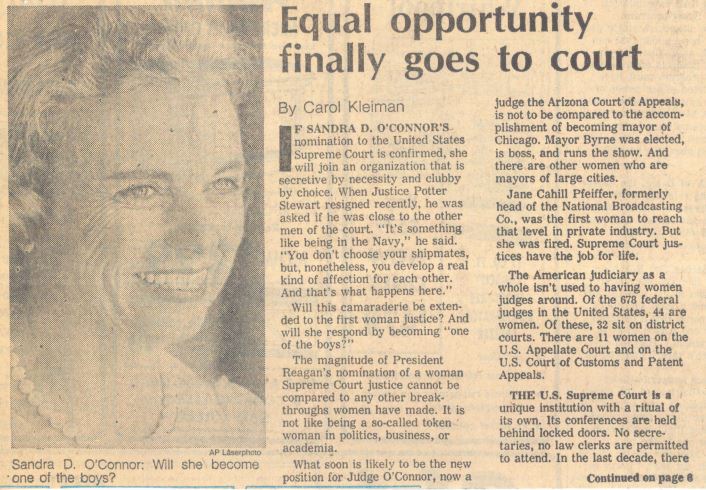
I F SANDRA D. O’CONNOR’S nomination to the United States Supreme Court is confirmed, she will join an organization that is secretive by necessity and clubby by choice. When Justice Potter Stewart resigned recently, he was asked if he was close to the other men of the court. “It’s something like being in the Navy,” he said. “You don’t choose your shipmates, but, nonethele.ss, you develop a real kind of affection for each other. And that’s what happens here.” Will this camaraderie be extended to the first woman justice? And will she respond by becoming “one of the boys?” The magnitude of President Reagan’s nomtnation of a woman Supreme Court justice cannot be compared to any other breakthroughs women have made. It is not like being a so-called token woman in politics, business, or academia. What soon is likely to be the new position for Judge O’Connor. now a judge the Arizona Court’of AppealH, is not to be compared to the accomplishment of becoming mayor of Chicago. Mayor Byrne was elected, is boss, and runs the show. Artd there are other women who are mayors of large cities. Jane Cahill Pfeiffer, formerly head of the National Broadcasting Co., was the first woman to reach that level in private industry. But she was fired. Supreme Court justices have the job for life. The American judiciary as a whole isn’t used to having women judges around. Of the 678 federal judges in the United States, 44 are women. Of these, 32 sit on district

© COPYRIGHT NOTICE: This Media Coverage / Article constitutes copyrighted material. The excerpt above is provided here for research purposes only under the terms of fair use (17 U.S.C. § 107). To view the complete original, please retrieve it from its original source noted above.