Media Coverage, Interviews, and Writings

Home > Articles about Justice O'Connor

Media Coverage, Interviews, and Writings by Others

As the first female Supreme Court Justice and the first female state majority leader, Justice O’Connor’s story has inspired many journalists, authors, cartoonists, and groups to celebrate her experience. This catalog explores the media coverage she received throughout her career.

O’Connor: A Dual Role — An Introduction

Law review article by Stephen J. Wermiel
January 1, 1991

O’Connor: A Dual Role – An Introduction

STEPHEN J. WERMIEL *

On September 21, 1981, as the U.S. Senate voted to approve her nomination to the United States Supreme Court, Sandra Day O’Connor lis tened in the Capitol hideaway office of Senator Strom Thurmond, the South Carolina Republican and then chairman of the Senate Judiciary Com mittee. When the vote was over and the tally of 99-0 was announced, she walked the short dis tance to the marble steps outside the Senate wing of the Capitol, looked across the vast plaza and beyond the fiery fall foliage to the Supreme Court, and declared, “I am absolutely overjoyed at the expression of support from the Senate. My hope is that ten years from now, after I’ve been across the street at work for a while they will all be glad that they gave me that wonderful vote.”1

When Justice O’Connor was nominated by President Ronald Reagan, two factors dominated both initial public reaction and subsequent state ments at her confirmation hearings: her historic role as the first woman to serve on the Court, and her views on abortion. Now that ten years have elapsed, these factors still top the list in most eval uations of her. However, this emphasis often ob scures a second distinctive role she has established: that of an independent conservative who influences the Court’s decisions by virtue of her position in the middle of the Court.

This Article examines these dual roles and concludes that they present sharply contrasting images of Justice

Justice O’Connor’s Pragmatic View of Coerced Self-Incrimination

Law review article by George C. Thomas III
January 1, 1991

Justice O’Connor’s Pragmatic View Of Coerced Self-Incrimination

by

GEORGE C. THOMAS III

Almost no one acknowledges it, but the Self incrimination Clause is empty of meaning. By that I mean that the clause generates no under standing of how it should operate beyond the very narrow understanding derived from its historical origins (and thus from outside the language of the clause itself). The Self-incrimination Clause can not generate meaning because its central con cept-

Justice O’Connor’s Intellectual Property Opinions: Currents and Crosscurrents

Law review article by Marci A. Hamilton
January 1, 1991

Justice O’Connor’s Intellectual Property Opinions: Currents and Crosscurrents*

by

MARCI A. HAMILTON**

On this tenth anniversary of Justice Sandra Day O’Connor’s tenure on the United States Supreme Court, it is fitting, though arguably pre mature, for us to ask the question: how will we remember Justice O’Connor’s contribution to the Court years from now? Justice O’Connor undeni ably has made important and interesting contri butions to the Court’s ongoing debate over issues involving the First Amendment, abortion, and federalism. She has developed a distinctive juris prudence in her Establishment Clause opinions and a striking voice in her affirmative action opinions.1 Probably few realize, however, that in the last several years she also has become a force in the intellectual property area, especially the copy right arena. Justice O’Connor has authored the Court’s major intellectual property opinion for each of the last three terms. Since 1985, she has authored four of the Court’s intellectual property opinions. Given that the Court only grants certi orari for one to two such cases each year, her con tribution accounts for a substantial percentage of the Court’s recent intellectual property jurisprudence. Thus, we may learn a great deal about the direction of the Court in this area if we examine her writings in detail.

Her opinions in Harper & Row Publishers, Inc. v. Nation Enterprises,2 Bonito Boats, Inc. v. Thunder Craft Boats, Inc.,3 Stewart v. Abend4, and

Justice O’Connor and Children and the Law

Law review article by Twila L. Perry
January 1, 1991

Justice O’Connor and Children and the Law

by

TWILA L. PERRY*

Legal disputes involving children often center around the issues of rights, protection and supervision. Most people probably agree that chil dren do and should have some rights; we all know that children need both protection and supervi sion. The difficulty arises in defining what these terms should mean in particular contexts. There is no consensus as to what rights children should have, or what rights should be accorded to them at particular ages.1 Nor is there consensus as to how we should balance children’s rights with the rights of others, or how we should balance chil dren’s need for supervision with their need to gradually experience the independence they will have as adults. Finally, we do not agree on how much protection children need, who they need to be protected from, or how we should deal with children who have committed serious crimes.

During Justice O’Connor’s tenure, the Supreme Court has decided a number of cases that bear on these issues. Decisions have been ren dered in cases involving students’ rights, juvenile justice, child abuse, children as witnesses in sex ual abuse cases, abortion, education and child support. Professors Sheppard and Roberts have already touched on a few of these areas in their presentations on family law and reproductive rights.2 My discussion, which focuses more specif ically on children’s rights, will address the contri butions of Justice O’Connor in four areas:

Affirmative Action: Will Justice O’Connor Author Its End?

Law review article by Rocco Potenza (student author)
January 1, 1991

AFFIRMATIVE ACTION: WILL JUSTICE O’CONNOR AUTHOR ITS END?

INTRODUCTION

WHEN faced with the issue of whether a governmentally employed race based affirmative action program violates the equal protection clause of the Constitution, the Supreme Court has been sharply divided. This sharp division was illustrated by the fact that the Court did not reach its first majority decision until May 1989, nearly eleven years after the first major decision dealing with a racial affirmative action program.1 Prior to 1989, the Court addressed three major cases dealing with the constitutionality of governmentally imposed affirmative action programs. In two cases, the Court invalidated the programs, and in the other the Court upheld the program.2 Failing to reach a majority, the Court delivered plurality opinions in each case.3 The failure to reach a majority opinion in those cases resulted from the justices’ disagreement on the appropriate judicial standard of review to be applied. 4

The Court reached a majority opinion in City of Richmond v. J.A. Croson Co., 488 U.S. 469 (1989), the first majority on the issue since first addressing it in Regents of Univ. of California v. Bakke, 438 U.S. 265 (1978).

Wygant v. Jackson Bd. of Educ., 476 U.S. 267 (1986) (invalidating the provision); Fullilove v. Klutznick, 448 U.S. 448 (1980) (upholding the provision); Regents of Univ. of California v. Bakke, 438 U.S. 265 (1978) (invalidating the special admissions program). See also United States v. Par

Sandra Day O’Connor, Conservative Discourse, and Reproductive Freedom

Law review article by Dorothy E. Roberts
January 1, 1991

Sandra Day O’Connor, Conservative Discourse, and Reproductive Freedom

by

DOROTHY E. ROBERTS*

INTRODUCTION

Discussion of Justice O’Connor’s role on the Supreme Court has focused primarily on her opinions concerning the right to abortion. Justice O’Connor has consistently voted with other con servative members of the Court to uphold state restrictions on abortion. She parted company with Justices Rehnquist, White, Kennedy, and Scalia, however, in the critical 1989 decision, Webster v. Reproductive Health Services.1 While her conservative brethren stated that they would vote to overturn Roe or severely modify it, O’Connor wrote a separate opinion to say it was unnecessary to reconsider the constitutional va lidity of Roe and suggested that any future reex amination be done “carefully.”2 Thus, O’Connor’s vote was seen as crucial to retaining women’s constitutional right to choose abortion. That pivotal role may have vanished with Justice Souter’s replacement of Justice Brennan. The Court’s most recent abortion decision, Rust

Sullivan 3, which upheld federal regulations

banning abortion counseling and referral in pub-

licly-funded family planning clinics, reflects the new balance on the Court. O’Connor’s vote in Rust to strike down the regulations, on the statu tory ground that they were not a reasonable inter pretation of Title X,4 was ineffectual in the face of the conservative majority that now included Jus tice Souter. The impotence of her vote in retain ing abortion

Feminist or Foe? Justice Sandra Day O’Connor, Title VII Sex-Discrimination, and Support for Women’s Rights

Law review article by Barbara Palmer
January 1, 1991

Feminist or Foe? Justice Sandra Day O’Connor, Title VII

Sex-Discrimination, and Support for Women’s Rights

BARBARA PALMER*

ABSTRACT: At the tenth anniversary of her ap pointment, it seems fitting to analyze what the first woman to sit on the Supreme Court has done in the area of sex discrimination. As a preliminary exploration of Justice Sandra Day O’Connor’s jurisprudence in this area of consti tutional law, this paper will focus on eight cases brought under Title VII of the 1964 Civil Rights Act as amended by th.e 1978 Pregnancy Dis crimination Amendment. Research on women judges, their attitudes about sex-discrimination and their votes suggests that Justice O’Connor would be more sympathetic to the promotion of women’s rights in sex-discrimination claims. A simple bloc analysis of these eight cases seems to confirm this proposition. A substantive analysis of these cases, however, reveals that Justice O’Connor’s support for women’s rights and feminism is, at best, mixed.

Happily, the last half of this century has witnessed a revolution in women’s legal and political status. My chambers window in Washington, D.C. commands a view of a small brick house, the head quarters of the National Women’s Party and the home of suffragist Alice Paul. It serves as a daily reminder to me that less than seventy years ago women had yet to obtain that most basic civil right, the right to vote.

At the tenth anniversary of her appointment, it

At the Crossroads of Civil Rights: Tension Between the Wartime Amendments in the Jurisprudence of Justice O’Connor

Law review article by Alfred Slocum
January 1, 1991

At the Crossroads of Civil Rights: Tension Between the Wartime Amendments in the Jurisprudence of Justice O’Connor

ALFRED SLOCUM*

Justice Sandra Day O’Connor was assured a place in history on the day she was appointed to the United States Supreme Court. She took a seat that no wqman in the history of that august bench had ever been allowed to occupy. However, although she flies on the wings of destiny as the first woman to enjoy such an honor, destiny’s path and destination are now hers to choose. Cer tainly in the area of civil rights much of that path will be determined by how she ultimately inter prets the Equal Protection Clause of the Four teenth Amendment, and how she ultimately rec onciles its language of evenhandedness with the Thirteenth Amendment’s mandate to eliminate the badges and indicia of slavery.

The whole concept of the badges and indicia of slavery requires a close look at the Thirteenth Amendment’s historical antecedents, while the plain language of the Fourteenth Amendment

-does not. It is impossible to eradicate the badges and indicia ofslavery without knowing what they are, and without understanding that the institu tion of slavery was founded on the notion of black inferiority-without, in short, an understanding that slavery was race-based. The claim of black inferiority is at the very heart of racial discrimina tion against blacks. So-called societal discrimina-

tion, manifested by varying degrees of black ex clusion from a host of activities,

Women Still Lack Power, Justice O’Connor Asserts

Newspaper article by Michael Tackett
November 15, 1990

With wit, a trait she rarely displays, and methodical documentation, which is her judicial signature, Supreme Court Justice Sandra Day…

Sandra Day O’Connor (Women of Achievement)

Book by Peter Huber
August 1, 1990

Federalism and Separation of Powers on a ‘Conservative’ Court: Currents and Cross-Currents from Justices O’Connor and Scalia

Law review article by M. David Gelfand & Keith Werhan
January 2, 1990

FEDERALISM AND SEPARATION OF POWERS ON A “CONSERVATIVE” COURT: CURRENTS AND CROSS-CURRENTS FROM JUSTICES O’CONNOR AND SCALIA

M. DAVID GELFAND* KEITH WERHAN**

This Essay analyzes the approaches taken during recent Supreme Court Terms by Justices Sandra Day O’Connor and Antonin Scalia to cases involving federalism and separation-of powers issues. These two Justices, who are key actors within the so-called “conservative bloc” on the Court, have been chosen because of their subtle, yet significant, differences respecting these two areas of constitutional law.

After brief biographical sketches of the two Justices, this Essay analyzes recent Supreme Court decisions. In this setting, Justices O’Connor and Scalia are, to some extent, mirror images of each other. Justice Scalia has been especially vocal and aggressive in advocating a formalist approach to separation of powers, while showing much less concern for the protection of federalism values. Justice O’Connor, on the other hand, has championed judicial protection of state and local governments against federal interference, while taking a measured approach to separation issues.

The Essay argues that these differences in the approaches to federalism and separation taken by Justices O’Connor and Scalia are explained, in part, by differences in their backgrounds and methods of constitutional interpretation. In particular, Justice O’Connor seems most comfortable with a contextual approach to these constitutional protections, while

Mugwump, Mediator, Machiavellian, or Majority? The Role of Justice O’Connor in the Affirmative Action Cases

Law review article by Thomas R. Haggard
January 1, 1990

MUGWUMP, MEDIATOR, MACHIAVELLIAN, OR MAJORITY?
THE ROLE OF JUSTICE O’CONNOR IN THE
AFFIRMATIVE ACTION CASES
by
THOMAS R. HAGGARD

I am sure that these questions [involving affirmative action]… are going to come back before the Court in a variety of forms. I do believe that litigation in the area of affirmative action is far from resolved, as I see it, and that we will continue to have cases in this area.

Sandra Day O’Connor Nomination Hearings September 9, 1981

It was a prophetic statement from the nominee. Since Justice O’Connor’s appointment in 1981, affirmative action has been back before the Court on ten occasions.2 The cases have generated forty separate opinions and fill over 450 pages of the reporters. Yet, the matter is far from resolved, from either a statutory or a

David W. Robinson, Chair, Professor of Law, University of South Carolina School of Law. B.A., University of Texas, 1964; LLB., University of Texas School of Law, 1967.

1 Nomination of Sandra Day O’Connor: Hearings Before the Committee on the Judiciary, United States

Senate, 97th Congress, 1st Sess. 84 (1981), reprinted in THE SUPREME COURT OF THE UNITED STATES: HEARINGS AND REPORTS ON SUCCESSFUL AND UNSUCCESSFUL NOMINATIONS OF SUPREME COURT JUSTICES BY THE SENATE Judiciary Committee, 1916-1981: 1983 Supplement 196 (compiled by R. Mersky & J. Jacobstein 1983) [hereinafter Hearings].

The prior affirmative action cases that she had reference to were: DeFunis v. Odegaard, 416 U.S. 312 (1974); Regents of the Univ. of Cal. v. Bakke, 438 U.S. 265 (1977); United Steelworkers v. Weber, 443 U.S. 193 (1979); and Fullilove v. Klutznick, 448 U.S. 448 (1980). In addition, the philosophical and constitutional progenitors of affirmative action had been established in the school desegregation cases, Green v. County School Bd., 391 U.S. 430 (1968), and Swann v. Charlotte-Mecklenburg Bd. of Educ., 402 U.S. 1 (1971). See generally, L. GRAGLIA, DISASTER BY DECREE: THE SUPREME COURT DECISIONS ON RAcE AND THE SCHOOLS (1976).

2 Metro Broadcasting, Inc. v. FCC, 110 S.Ct. 2997 (1990); Martin v. Wilks, 109 S. Ct. 2180 (1989); City of Richmond v. J.A. Croson Co., 109 S. Ct. 706 (1989); Johnson v. Transp. Agency, Santa Clara County, Cal., 480 U.S. 616 (1987); United States v. Paradise, 480 U.S. 149 (1987); Local 93, Int’! Ass’n of Firefighters v. Cleveland, 478 U.S. 501 (1986); Local 28, Sheet Metal Workers’ Int’! Ass’n v. EEOC, 478 U.S. 421 (1986); Wygant v. Jackson Bd. of Educ., 476 U.S. 267 (1986); Firefighters Local 1784 v. Stotts, 467 U.S. 56i (i984); Mississippi Univ. for Women v. Hogan, 458 U.S. 7i8 (i982) (not generaiiy regarded as an “affirmative action” case).

Justice Sandra Day O’Connor and the Supreme Court’s Reaction to Its First Female Member

Law review article by Karen O'Connor & Jeffrey A. Segal
January 1, 1990

Justice O’Connor’s Opinion in Feist Publications, Inc. v. Rural Telephone Service Co.: An Uncommon Though Characteristic Approach

Law review article by Marci A. Hamilton
January 1, 1990

JUSTICE O’CONNOR’S OPINION IN FEIST PUBLICATIONS, INC. v.

RURAL TELEPHONE SERVICE CO.: An Uncommon Though Characteristic Approach*

By MARCI A. HAMILTON**

Justice O’Connor’s developed jurisprudence is most forcefully stated in her Establishment Clause and affirmative action cases.1 Probably few realize that in the last several years she also has become a force in the intellectual property area, especially the copyright arena. In the last three Terms, she has authored the Court’s major intellectual property opinion for that Term. Since 1985, she has authored four of the Court’s intellectual property opin ions. Given that the Court only grants one to two such cases each year, her contribution accounts for a substantial percentage of the Court’s intellectual property jurisprudence. Thus, we may learn a great deal about the direction of the Court in this area if we examine her writings in detail.

Her opinions in Harper & Row Publishers v. Nation Enterprises,2 Bonito Boats, Inc. v. Thunder Craft Boats, Inc.,3 Stewart v. Abend,4 and this year’s Feist Publications, Inc. v. Rural Telephone Service Co.5 cover a wide range of subjects: fair use of unpublished works, preemption of state law affecting pat ents, rights of derivative work assignees following the death of the author before the commencement of the renewal term, and the copyrightability of telephone book white pages. Of course, the full range of this rich assortment of topics cannot fairly be addressed in a 15-minute talk.

All Eyes on Justice O’Connor

Magazine article by G. Hackett & A. McDaniel
May 1, 1989

When the nine Supreme Court justices convene in their imposing marble courtroom this Wednesday, more than 100 reporters will be there to record their every word, study every facial expression, scrutinize any perceived change in body language. The hourlong session is the only part of the court’s procedure carried out in public, and the journalists and small crowd of spectators will be searching for clues — however, speculative — that the court is leaning toward changing the law on abortion. No justice will be more carefully analyzed than Sandra Day O’Connor, the first woman to serve on the country’s highest court. With her male colleagues believed to be deadlocked 4 to 4 on abortion, O’Connor could be the pivotal voice in the current case. “If Justice O’Connor wants to continue protecting abortion rights, they will be protected,” says Prof. Walter Dellinger of Duke University Law School. “If she does not, they will not. It is her decision.”

Through a quirk of timing, the first woman justice in the 200-year-old history of the Supreme Court may be in a position to settle the most controversial women’s issue of the modern era. Since President Reagan appointed O’Connor eight years ago, her role in many divisive issues — thanks in part to the arrival of two additional conservatives — has evolved from that of habitual dissenter to that of frequent swing voter. Now she has become the focal point in the public’s battle to influence the court’s first critical abortion ruling in 16

Sandra Day O’Connor, Abortion, and Compromise for the Court

Law review article by Susan M. Halatyn (student author)
January 1, 1989

SANDRA DAY O’CONNOR, ABORTION, AND COMP’ROMISE FOR THE COURT

INTRODUCTION

The abortion controversy is the product of many issues. Legally, is there a fundamental right to privacy for a woman; is the fetus a person within the meaning of the fourteenth amendment due process clause; legally and morally, is abortion murder; socio-economically, should federal funds be used for abortions; if the abortion right is overturned, is it unjust that the rich will be able to secure safe, ille gal abortions, while the poor will again be forced into back-alley abortions?

These are all important questions; however, the most controversial aspects of the abortion right may be the medically based criteria set down in Roe v. Wade,1 establishing the right and standards for abortion.

Justice Sandra Day O’Connor, in a scathing dissent to Akron v. Akron Center for Reproductive Health, Inc.,2 said, “The Roe frame work… is clearly on a collision course with itself.”3 It is her opin ion that the guidelines for regulation of abortions and the parame ters of the right were illogically and improperly decided. Because of her views, she has become the hope of the factions that vow to over turn Roe v. Wade and the right to choose abortion.”

But where does Sandra Day O’Connor really stand on this point? As the most articulate dissenter on abortion and the only woman on the Court, her position is unique. By reason of these distinctions, as the abortion right struggles to remain alive, she will become the

Abortion Politics: Writing for an Audience of One

Law review article by Susan R. Estrich & Kathleen M. Sullivan
January 1, 1989

ABORTION POLITICS: WRITING FOR AN AUDIENCE OF ONE

SUSAN R. ESTRICHt AND KATHLEEN M. SULLIVANtt

INTRODUCTION: WEBSTER AND THE ART OF SPIN CONTROL “Spin doctors,” as they came to be known in the last presidential

campaign, practice a not-so-fine art of press manipulation. The goal is generally to make bad news hurt less (e.g., “third in Iowa, my God, we’re delighted; it’s a springboard for New Hampshire!”) and good news help more (e.g., “the real test will be in… [pick state where you’ve already spent twice as much as the opposition]”). The press generally knows the doctors are working (“what’s your spin?” or “spin me” the reporters say), but the process works anyway, particu larly if the spinners can look appropriate in the end (e.g., “aides were plainly pleased with their candidates third place finish “).
Lawyers, of course, have been “spinning” judicial decisions for years. In court, it’s called advocacy. Rarely, though, has a court decision been “spun” as forcefully and effectively as the United States Supreme Court’s decision last Term in Webster v. Reproductive Health Services. 1 The spin was, surprisingly, the same on both sides. The right-to-lifers said victory was at hand. The pro-choicers said the sky was falling.

What was most surprising about this, at least at first glance, was that it bore almost no relation to what had actually been decided in Webster. Which was, according to all sides of the Court, at least, not much. As Justice Blackmun put it, “[£]or today,

O’Connor, J., Concurring

Law review article by Alexander Wohl
January 1, 1989

Supreme Court Report

O’Connor, J., Concurring

BY ALEXANDER WOHL
Alexander Wohl is a freelance writer in Washington, D.C.

If Justice Oliver Wendell Holmes Jr. was “the great dissenter,” does that make Justice Sandra Day O’Connor “the great concurrer”?

In delicate areas of the law it has become almost commonplace for 5-4 rulings by the Court’s conservative bloc to be embroidered-and often limited-by an O’Connor concurrence. Even though none of the other justices agree completely with her views, they in effect become the law because of her position near the center of the Court’s ideological spectrum. In this sense she has assumed or at least draped over one shoulder the moderate mantle of retired Justice Lewis F. Powell Jr.

Steven Katlett, who clerked for O’Connor two years ago and is now an associate with Jones, Day, Reavis & Pogue in Columbus, Ohio, thinks that “she appreciates [Powell’s] views and for this reason, as well as her general philosophy, she won’t sign on to wholesale revamping of Warren and Burger Court decisions.”

Another former O’Connor clerk states that O’Connor “is concerned about judicial activism, not in a political sense, but in the real sense that the Court should not jump into an issue just because it is controversial, but should try to be somewhat stable and consistent until it is really confronted with a situation where it has to make a change.”

In Pembauer v. City of Cincinnati (475 U.S. 469 [1986]), for

Justice Sandra Day O’Connor: Law and Order Justice?

Law review article by Richter H. Moore
January 2, 1988

And a Child Shall Lead Them: Justice O’Connor, the Principle of Religious Liberty and Its Practical Application

Law review article by Benjamin D. Feder
January 1, 1988

Articles

And a Child Shall Lead Them:* Justice O’Connor, The Principle of Religious Liberty and Its Practical Application

Benjamin D. Federt

Introduction

In the more than forty years since the U.S. Supreme Court decided Everson v. Board of Education,1 lawyers, scholars, lay men, and judges have struggled to find a consistent, logical method for interpreting and applying the terse language of the religion clauses of the first amendment.2 Most of the attention (and controversy) has focused on the first of these, known as the establishment clause. After closely examining the cases, opin ions, and articles in this area, only one proposition may be confi-

This title stems from a comment made by Justice Sandra Day O’Connor in her concurring opinion in Wallace v. Jaffree, 105 S. Ct. 2479, 2496 (1985), in reference to her status then as the Court’s junior member.

t Associated with the firm of Shearman & Sterling in New York. B.A., 1981, Boston

University; J.D., 1985, Boston University. The views contained herein, for better and worse, are solely those of the author. I wish to thank Lawrence Sager, Neil Devins, and Robert Feder for their helpful suggestions and comments along the way. Josephine Fra gale provided all secretarial assistance. I wish to express special thanks to Archibald Cox, for his time and invaluable comments on an earlier version of this article. Finally, I must note my deep gratitude to Ira C. Lupu for both his strong support and his insightful critical analyses.

Cop

The Rhetoric of Dissent in Justice O’Connor’s Akron Opinion

Law review article by Kristine M. Bartanen
January 2, 1987

The Conservative as Liberal: The Religion Clauses, Liberal Neutrality, and the Approach of Justice O’Connor

Law review article by Donald L. Beschle
January 1, 1987

The Conservative as Liberal: The Religion Clauses, Liberal Neutrality, and the Approach of Justice O’Connor

Donald L. Beschle *

The past few years have seen a flurry of litigation involving the reli gion clauses of the first amendment. The Supreme Court has spoken on the subject as frequently as it did during the 1960s, when it created the current legal framework for dealing with claims under the establishment and free exercise clauses. But the recent cases, while numerous, have contributed little to the development of first amendment thought. Although individualjustices have suggested new approaches, the Court has generally confined itself to measuring the facts before it against ex isting analytical yardsticks.

The continued use of a particular framework for analysis may be

taken as evidence of its essential soundness. However, there is reason to believe that in the case of the religion clauses it more clearly reflects the Court’s failure to create satisfactory alternatives, despite the need for such alternatives. The dominant religion clause tests, particularly for the establishment clause, have been easy targets for academic critics and judges alike.

The principal fl.aw in establishment clause thought is the acceptance of “separation” of church and state as the clause’s ultimate goal. Given the ways in which both institutions have evolved in the two centuries since Jefferson’s use of the term, separation of church and state is.simply impossible. An unrealistic goal is

Rethinking Government Neutrality Towards Religion Under the Establishment Clause: The Untapped Potential of Justice O’Connor’s Insight

Law review article by Arnold H. Loewy
June 1, 1986

ESSAYS

RETHINKING GOVERNMENT NEUTRALITY TOWARDS RELIGION UNDER THE ESTABLISHMENT CLAUSE: THE UNTAPPED POTENTIAL OF JUSTICE O’CONNOR’S INSIGHT

ARNOLD H. LOEWYt

Traditional establishment clause analysis forbids any government actions whose purpose or effect is to advance or inhibit religion. In Lynch v. Donnelly Justice O’Connor recast the “advance or inhibit” test to focus on government “endorsement or disapproval” Professor Loewy emphasizes that this refined test prohibits the government from sending a message of either inferiority or superiority to those who adhere to par ticular religious beliefs. In light of Justice O’Connor’s newly formulated test, Professor Loewy re-evaluates past United States Supreme Court de cisions and current common practices in our society: the Supreme Court’s opening invocation, school prayer, the inclusion of the phrase “under God” in the flag salute, and the convening of student religious groups in public schools. Professor Loewy concludes that government neutrality towards religion, which the establishment clause mandates, can be achieved best by a serious application of the endorsement/disap proval test.

If ever a series of decisions needed rethinking, it is those in which govern ment has arguably breached its obligation of neutrality by sponsoring or de meaning religion.1 Although current establishment clause doctrine forbids any government actions whose purpose or effect is to advance or inhibit religion,2 it

t Professor of Law, The University

Justice O’Connor and the First Amendment 1981–84

Law review article by Edward V. Heck & Paula C. Arledge
January 2, 1986

Justice O’Connor and the

First Amendment

1981-84

EDWARD V. HECK*

and PAULA C. ARLEDGE**

With the exception of a presidential election few events can rival the significance for the American legal and political system of the ap pointment of a new Justice to the United States Supreme Court. For the President, a Supreme Court appointment offers an opportunity to reshape the Court “in his own image”1 and perhaps to extend his in fluence far beyond the end of his own tenure in office. 2 For the Court, each change in membership reconstitutes the mix of experi ence, legal :philosophy, and personality that shapes the Court’s colle gial interactions. Moreover, at least on those issues marked by close divisions within the Court, a new appointment enhances the possibil ity that the Court will reverse its prior decisions and set out in new directions.3 Thus, it is to be expected that any appointment to the Supreme Court (or even the prospect of such an appointment) will generate intense public interest. Such interest – and the importance of the appointment – is inevitably heightened when the incumbent President was elected on a platform pledging the use of the appoint-

Associate Professor of Political Science, San Diego State University. B.A., 1968 University of the South; M.A., 1971 University of Virginia; Ph.D., 1978 Johns Hopkins University.

•• Assistant Professor of Government, Nicholls State University. B.A., 1973 Lou isiana Tech University; M.A., 1980; Ph.D., 1983 University

Civic Virtue and the Feminine Voice in Constitutional Adjudication

Law review article by Suzanna Sherry
January 2, 1986

CIVIC VIRTUE AND THE FEMININE VOICE IN CONSTITUTIONAL ADJUDICATION

Suzanna Sherry*

A woman’s writing is always feminine; it cannot help being femi nine; at its best it is most feminine; the only difficulty lies in defm ing what we mean by feminine. 1

W

HAT is true of women’s writing is also true of women’s juris prudence. This article contends that modern men and women, in general, have distinctly different perspectives on the world and that, while the masculine vision parallels pluralist lib eral theory, the feminine vision is more closely aligned with classi cal republican theory, represented in its various forms by Aristotle, Machiavelli, and Jefferson. A feminine jurisprudence, evident, for example, in the decisions of Justice O’Connor, might thus be quite unlike any other contemporary jurisprudence. Emergence of a fem inine jurisprudence might therefore influence whether academic calls for new (or rather recycled) jurisprudential theories based upon our classical republican tradition will ultimately have little impact or will usher in a paradigm shift in moral, political, and

constitutional theory.

American political and jurisprudential theory has long repudi ated its classical republican origins in favor of a highly pluralist liberal vision. Contemporary constitutional interpretation is thus grounded on a thoroughly individualist liberal philosophy. Modern historians, however, have recently refocused attention on the less individualist republican spirit animating

Sandra Day O’Connor — Woman, Lawyer, Justice: Her First Four Terms on the Supreme Court

Law review article by Barbara C. Shea
January 1, 1986

Sandra Day O’Connor – Woman, Lawyer, Justice: Her First Four Terms on the Supreme Court

Barbara C.S. Shea•

INTRODUCTION

Nomination

Four short years ago, few people outside of Arizona had ever heard of San dra Day O’Connor. When President Ronald Reagan nominated her to be the first woman Justice on the Supreme Court in July of 1981, she was catapulted from the relative obscurity of an Arizona Appellate Court judgeship into na tional prominence.1 Almost overnight, her name became a household word.

In offering her nomination to replace retiring Supreme Court Justice Pot ter Stewart,2 Reagan accomplished several political objectives in one swift move. He appeased women’s rights groups who were unhappy with his failure to appoint more women to high-level government positions.8 He disavowed in deed, if not in word, the plank of the Republican National Party in the previ-

*Associated with White & Case, New York City; B.A., 1961, Trinity College; M.A., 1980, Fair field University; J.D., 1985, University of Bridgeport School of Law. The author gratefully ac knowledges the contribution of the UMKC Law Review staff.

Editor’s Note: This Article was written before the recent change in composition on the Su preme Court. On September 19, 1986, the Senate approved the appointment of William Rehnquist as Chief Justice, and of Antonin Scalia as Associate Justice of the United States Supreme Court. THE WEEK IN CoNGREss-CoNGRESSIONAL INDEX, at 1 (CCH Sept. 19, 1986). There has been much

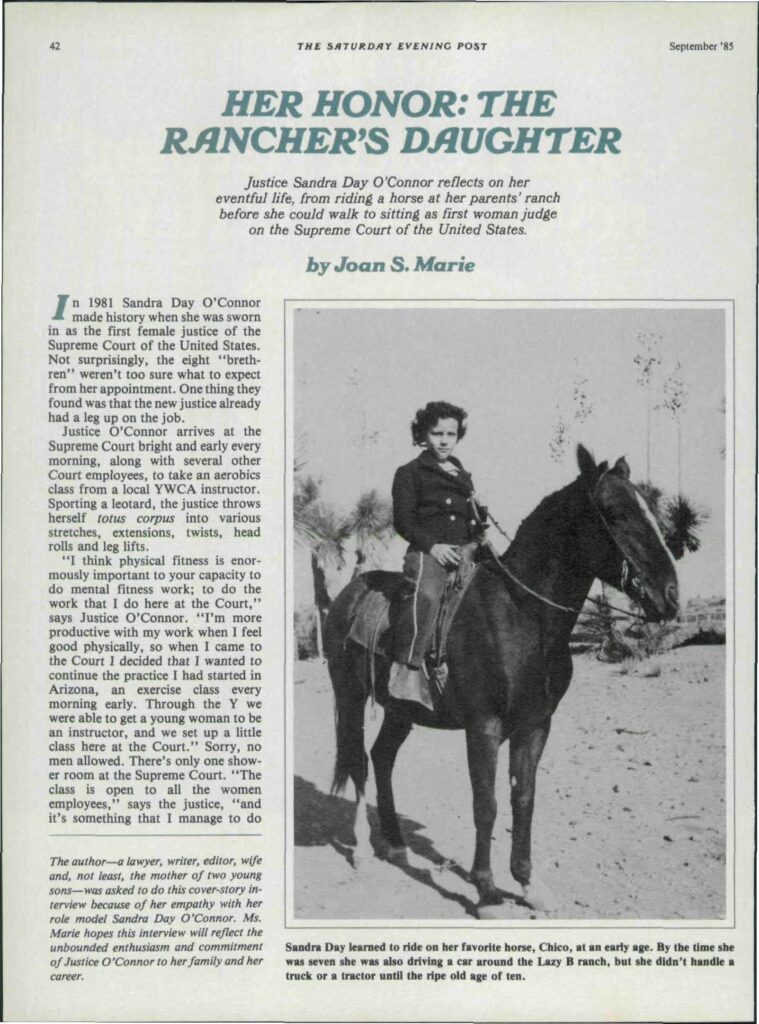
Her Honor: The Rancher’s Daughter

Law review article by Joan S. Marie
September 1, 1985

Justice Sandra Day O’Connor: Trends Toward Judicial Restraint

Law review article by Barbara Olson Bruckmann (student author)
September 1, 1985

NOTES

JUSTICE SANDRA DAY O’CONNOR: TRENDS TOWARD JUDICIAL RESTRAINT

Sandra Day O’Connor began her tenure on the United States Supreme Court without an extensive record as a jurist.1 The substantive impact O’Connor would make on Supreme Court decisions was uncertain when she took the bench. Prior to her nomination in 1981 to serve as an Associate Justice of the Supreme Court, however, O’Connor favored limiting the jurisdiction of federal courts and enhancing the states’ role in the federal system2. During her confirmation hearings before the United States Senate Committee on the Judiciary, O’Connor testified without reservation con cerning her judicial philosophy.3 In the confirmation hearings, O’Connor confirmed her support of federal judicial restraint.4 According to O’Connor, the Court should not function as a policy making body, but rather should interpret and apply the law.5 In O’Connor’s view, the Court should decide cases on narrow grounds6 and avoid unnecessarily deciding questions of constitutional law.7 O’Connor’s testimony on the proper role of the federal judiciary, however, was not limited to the role of the Court as a branch of the federal government, but extended to the relationship of the federal court system to state courts. In response to questions regarding an article8 written by O’Connor in which she explored the relationship between the state and federal courts, O’Connor clarified her belief in the capacity of state courts

l. See Nomination of Sandra Day

Equal Justice: A Biography of Sandra Day O’Connor

Book by Harold and Geraldine Woods
May 1, 1985

Justice Sandra Day O’Connor and the ‘Freshman Effect’

Law review article by John M. Scheb & Lee W. Ailshie
January 2, 1985

Wide IM>rld

Justice Sandra Day O’Connor and the ”Freshtnan Effect”

Contrary to expectations, the newest justice quickly adapted to her environment and almost immediately began participating fully in the work of the Court.

by John M. Scheb, II and Lee W. Ailshie

S

tudents of the judiciary have long been interested in the process by which new appointees are assim

. ilated into the United States Su preme Court.1 Some of the behavioral and biographical literature suggests the existence of a “freshman effect,” that is, a distinct pattern of behavior manifested by neophyte justices. The so-called fresh-

man effect entails behaviors one might expect from a newcomer to any group where the norms of the group are pecul iar to it and, at least initially, unknown to the newcomer. Such behaviors would be characterized by uncertainty, disorien tation and vacillation. J. Woodford How ard has suggested that it took Justice Frank Murphy three terms to overcome

just this kind of problem in adapting to the norms and business of the Supreme Court.2 On the other hand, Heck argues that Justice Brennan quickly overcame the freshman syndr ome. 3

The literature focuses on three aspects of the freshman effect: a subjective aspect manifested in the “feelings of the new justice himself about his new role,” 4 an

9

“effect manifested in the behavior of the chief justice and other senior justice with opinion assignment responsibili ties;”5 and, finally, an effect “manifested in the voting behavior

The Emerging Jurisprudence of Justice O’Connor

Law review article by Richard A. Cordray & James T. Vradelis student authors
January 1, 1985

COMMENTS

The Emerging Jurisprudence of Justice O’Connor

TABLE OF CONTENTS

THE ROLE OF THE COURT. 392

“Traditional” Judicial Restraint. 394

Stare Decisis 394

New York v. Quarles

City of Akron v. Akron Center for Repro ductive Health, Inc.

Statutory Construction 403

Immigration & Naturalization Service v.

Phinpathya

Securities Industry Association v. Board of Governors of the Federal Reserve System

Bowsher v. Merck & Co.

“Activist” Judicial Restraint. 408

Review of Agencies and Officials 409

Allen v. Wright

Block v. Community Nutrition Institute

Review of Legislation 417

ASARCO Inc. v. Idaho State Tax Com- mission

Zobel v. Williams

FEDERALISM AND THE COURT 423

Federal Legislation as a Limitation on State Power. 423

Tenth Amendment Limitations on Federal Power 423

Federal Energy Regulatory Commission v.

Mississippi

Garcia v. San Antonio Metropolitan Transit Authority

Federal Preemption of State Legislation 428

389

390 The University of Chicago Law Review

Southland Corp. v. Keating

Brown v. Hotel & Restaurant Employees In ternational Union Local 54

The Federal and State Judiciaries. 430

Exhaustion of State Remedies 430

Rose v. Lundy Engle v. Isaac

Adequate and Independent State Grounds. 433

Michigan v. Long

THE CALCULUS OF INTERESTS: PRIVATE RIGHTS

AND THE AUTHORITY TO GOVERN. 437

Deference to Government Interests: Criminal Procedure 438

Privacy Rights and Law Enforcement 438

United States v. Place Hudson v. Palmer

Double Jeopardy. 443

Thigpen

Justice Sandra Day O’Connor: Token or Triumph from a Feminist Perspective

Law review article by Margaret A. Miller student author
January 1, 1985

JUSTICE SANDRA DAY O’CONNOR: TOKEN OR TRIUMPH FROM A FEMINIST PERSPECTIVE

INTRODUCTION

When Justice Sandra Day O’Connor was sworn in as the 102nd Justice of the United States Supreme Court,1 she made history. O’Connor was the first woman to attain a seat on the Court in its 199 years of existence.2 She represented a symbolic reward for nearly 200 years of struggle by women for political and social recognition in America. Feminists3 applauded not only her symbolic achievement• but also the potential substan tive effect she could have on women’s ongoing legal battles. O’Connor gained entry into the most powerful and prominent judicial entity in the nation and would have a tremendous op-

N.Y. Times, Sept. 26, 1981, at 8, col. 1. Shortly after Justice Potter Stewart of fered his resignation from the Supreme Court in May, 1981, President Ronald Reagan announced his selection of Judge Sandra O’Connor of Arizona as Stewart’s replacement in July. She was approved 99-0 in the Senate and took her seat on the Supreme Court in October, 1981. For reaction to her nomination, see A Woman for the Court, NEWSWEEK, July 20, 1981, at 16; The Brethren’s First Sister, TIME, July 20, 1981, at 8.

The only other time a woman was considered for a position on the Supreme Court was during the New Deal-World War II era of Presidents Roosevelt and Truman. See Cook, Women as Supreme Court Candidates, 65 JUDICATURE 314 (1981-82) for a comparison of Judge O’Connor to Judge Florence Allen, the sole female

The Supreme Court’s First Woman Is Tough, Smart – And A Lady

Newspaper article by Vera Glaser
May 13, 1984

Her day begins in pre-dawn darkness. Switching on the lights, Supreme Court Associate Justice Sandra Day O’Connor dresses quickly and moves toward the kitchen. Every square foot of her highceilinged apartment is guarded. A step-down living room leads to a sunroom and outdoor balcony, three bedrooms, a study, and four baths, all secured by a private television channel through which she can identify any caller who presses the O’Connor button at street level outside a pair of locked wrought-iron doors. Over breakfast of half a grapefruit and a softboiled egg, she no longer has the time to enjoy several newspapers. Given the demands of the court, she does well to get through The Washington Post. By 7 a.m., the O’Connors ease their Honda out of the garage. She drops her husband, attorney John O’Connor, at the University Club for an early swim. At 7:30 she vanishes into the marble-pillared Supreme Court building. Ten hours later – hours of hearing arguments, writing decisions, conferring, and coping with stacks of mail – she emerges; carrying a briefcase of night reading, often tackled in the wee hours. “With Sandra O’Connor,” says a former colleague in the Arizona Legislature, “there ain’t no Miller time.” No branch of government is more remote from public scrutiny than the Supreme Court. Absolute secrecy sunounds its deliberations. “I do not talk to reporters at any time, at any place, on any subject,” Justice William J. Brennan Jr. has said. Socially, with few exceptions, the justices

Justice O’Connor, the Constitution, and the Trimester Approach to Abortion: A Liberty on a Collision Course with Itself

Law review article by Richard F. Duncan
January 2, 1984

JUSTICE O’CONNOR, THE CONSTITUTION, AND THE TRIMESTER APPROACH TO ‘ABORTION: A LIBERTY ON A COLLISION COURSE WITH ITSELF

RICHARD F. DUNCAN*

When the United States Supreme Court handed down its most re cent ukase on the abortion liberty in Akron v. Akron Center for Repro ductive Health, Inc.,1 I, like so many people concerned with the protec tion of the unborn, initially reacted with despair. The total victory of the abortion ideology over biological reality and human compassion appeared to be reflected in the Court’s intolerance for even the most insignificant restrictions on abortion passed by democratically elected state and local legislat ures.1 Indeed, the Akron case, which struck down a number of pro visions of a local ordinance regulating the performance of abortions in Akron, Ohio, seemed to declare the nearly absolute nature of the abortion liberty (and perhaps the ultimate extension of the culture of the “me gen eration”) when it invalidated, as impermissibly vague under the due pro cess clause of the fourteenth amendment, a provision of the ordinance requiring abortionists to “insure that the remains of the unborn child are disposed of in a humane and sanitary manner.”3 Astonishingly, not only

Associate Professor of Law, University of Nebraska College of Law.

1 462 U.S. 416 (1983). As Professor John T. Noonan, Jr. recently observed, the abortion clinic referred to in the title of the Akron case was “named with Orwellian aptness.” Noo nan, The Root and Branch of

Justice Sandra Day O’Connor

Book by Judith Bentley
September 1, 1983

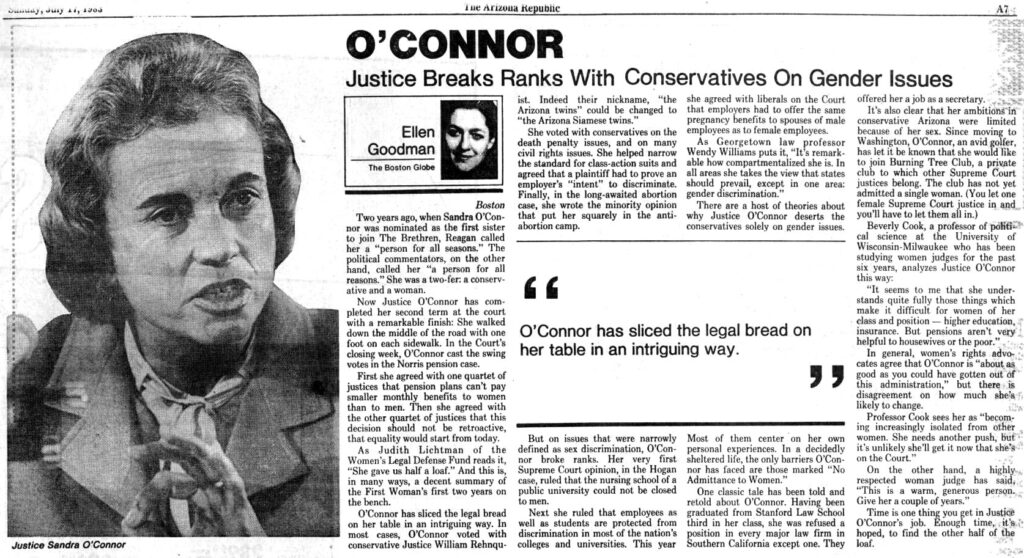
O’Connor Justice Breaks Ranks with Conservatives on Gender Issues

Op ed by Ellen Goodman / The Boston Globe
July 17, 1983

Two years ago, when Sandra O’Connor was nominated as the first sister to join The Brethren, Reagan called her a “person for all seasons.” The political commentators, on the other hand, called her “a person for all reasons.” She was a two-fer: a conservative and a woman. Now Justice O’Connor has completed her second term at the court with a remarkable finish: She walked down the middle of the road with one foot on each sidewalk. In the Court’s closing week, O’Connor cast the swing votes in the Norris pension case. First she agreed with one quartet of justices that pension plans can’t pay smaller monthly benefits to women than to men. Then she agreed with the other quartet of justices that this decision should not be retroactive, that equality would start from today. As Judith Lichtman of the Women’s Legal Defense Fund reads it, “She gave us half a loaf.” And this is, in many ways, a decent summary of the First Woman’s first two years on the bench. O’Connor has sliced the legal bread on her table in an intriguing way. In most cases, O’Connor voted with conservative Justice William Rehnquist.Indeed their nickname, “the Arizona twins” could be changed to “the Arizona Siamese twins.” She voted with conservatives on the death penalty issues, and on many civil rights issues. She helped narrow the standard for class-action suits and agreed that a plaintiff had to prove an employer’s “intent” to discriminate. Finally, in the long-awaited abortion case, she wrote the minority opinion

Sandra Day O’Connor: a report card

Editorial by Ellen Goodman / The Boston Globe
July 7, 1983

BOSTON – Two years ago, when Sandra Day O’Connor’ was nominated as the first sister to join The Brethren, Reagan called her a “person for all seasons.” The political commentators, on the other hand, called her “a person for all reasons.” She was a two-fer: a conservative and a woman. Now Justice Sandra Day O’Connor has completed her second term at the court with a remarkable finish: She walked down the middle of the road with one foot on each sidewalk. In the court’s closing week, O’Connor cast the swing votes in the Norris pension case. First she agreed with one quartet of justices that pension plans can’t pay smaller monthly benefits to women than to men. Then she agreed with the other quartet of justices that this decision should not be retroactive, that equality would start from today. As Judith Lichtman of the Women’s Legal Defense Fund reads it, “She gave us half a loaf.” And this is, in many ways, a decent summary of the First Woman’s first two years on the bench. O’Connor has sliced the legal bread on her table in an Intriguing way In most cases, O’Connor voted with conservative Justice William Rehnquist. Indeed their nickname , “the Arizona Twins” could be changed to the Arizona Siamese Twins.” She voted with conservatives on the death-penalty issues and on many civil rights issues. She helped narrow the standard for class-action suits and agreed that a plaintiff had to prove an employer’s “intent” to discriminate. Finally, in the long-awaited abortion case, I she wrote

O’Connor Stands Fast

Editorial
June 17, 1983

Anti-abortionists may be aghast over the U.S. Supreme Court’s decision against most state restrictions on abortion, but their worst fears about Justice Sandra O’Connor weren’t realized. What the nation saw once again in the first woman member of its highest court was a Jurist true to her principles.

Justice O’Connor dissented from the triple-case ruling. Although she refused to condemn abortion. she came down on the side of local govement and its right to decide whether to impose some regulations on a practice fraught with social and emotional problems. In the process, she remained firm in her faith in government closest to the people it touches. The abortion issue is a politically delicate one , she and Justices Byron White and William Rehnquist said, and local legislatures should have to face it. The court’s majority decided that Akron Ohio, had gone overboard with its 24-hr waiting period and “informed consent” impediments to abortion – impediments which prompt women to seek often-dangerous “underground” operations. A major issue in the cases was the requirement that second-trimester abortions be performed in hospitals. That makes little medical sense – and no economic sense at all with hospital costs already out of control. Sensibly enough. the court majority left states with the right to determine when a minor may have an abQrtion . But Justice Lewis Powell and the Supreme Court’s majority clearly confirmed – and even broadened – their 1973 commitment to women’s privacy

O’Connor dissents

Newspaper article by United Press International
June 16, 1983

WASHINGTON (UPI) -Justice Sandra Day O’Connor, whose nomination to the nation’s highest court was opposed by anti-abortion groups, Wednesday left no doubt that she adamantly opposes abortion. Dissenting from the high court’s rulings in three cases, Mrs. O’Connor, 53, squarely backed state limits on abortions and used her chance to write against the majority view as a platform to criticize the landmark 1973 Supreme Court ruling legalizing abortion. Mrs. O’Connor, the first woman on the high court, disagreed with most of her colleagues who declared an array of state restrictions on obtaining abortions are unconstitutional. Writing the dissent in a case from Akron, Ohio, she said the legislature is the “appropriate forum” for deciding such’ ‘extremely sensitive issues” as abortion. Such regulations as requiring abortions after the first three months be performed in a hospital are not “undue burdens” on a woman’s rights , she said. The majority, however, disagreed. Nominated to the court by President Reagan, Mrs. O’Connor provided one of only three votes the administration gained in its campaign to persmtde the justices that legistatures should make the final decisions on such politically controversial questions.

Court reaffirms abortion rights

Newspaper article by Jim Mann
June 16, 1983

WASHINGTON – In its most important pronouncement on abortion in a decade, the Supreme Court Wednesday strongly reaffirmed its 1973 decision that women have a constitutional right to end their pregnancies and struck down a far-reaching ordinance in Akron, Ohio, restricting that right. Led by President Reagan’s appointee, Justice Sandra O’Connor, three dissenters on the court made a frontal attack on Roe vs. Wade, the 10-year-old ruling. The nation’s first woman justice, who had not taken part in any of the court’s prior abortion rulings, contended that the government has a “compelling” interest in protecting “potential human life” at all stages of a woman’s pregnancy.

But O’Connor’s effort, supported by Justices William H. Rehnquist and Byron R. White, fell short. The rest of the court members pointed out that the Roe decision had been “considered with special care” before it was issued and said that they abide by it as a precedent under the doctrine of “stare decisis” (Latin for “let the decision stand”). The 6-3 decision, written by Justice Lewis Powell, appeared designed to lay to rest any speculation that the present Supreme Court will change its stance on abortion. The ruling was immediately denounced as a major disappointment by right-to-life groups and praised as a broad victory by groups supporting the right of women to choose an abortion. The justices ruled unconstitutional all the disputed provisions of the detailed anti-abortion ordinance enacted in 1978 in Akron,

Reaction here predictably split on rulings

Newspaper article by Richard DeUriate
June 15, 1983

Reaction in Arizona to today’s U.S. Supreme Court rulings on abortion was predictable, with opponents comforted somewhat by Justice Sandra O’Connor’s votes. “No question it is a bad day for those who are opposed to abortion,” said a despondent Rep. Jim Skelly, R-Scottsdale, one o~ the Arizona Legislature’s most outspoken rightto-life advocates. “The court has made it more difficult to take even limited steps to protect the lives of the unborn,” he said. Skelly described as “disgraceful” the high court’s vote to strike down the so-called “informed consent” provision of a 1978 Akron, Ohio, ordinance requiring a physician to tell a woman seeking an abortion “the unborn child is a human life from the moment of conception” and give her an anatomical description of the fetus in her womb. Pro-choice supporters, who had not seen the texts of the decisions, were heartened by the rulings. “It sounds as if the Supreme Court is affirming its 1973 decision,” said Gloria Feldt, executive director of Central and Northern Arizona Planned Parenthood. “They have affirmed that the decision about an abortion is one of a woman’s right to privacy, between a woman and her physician.” Feldt said the decision recognizes that abortion is more a “personal decision” than one involving the public interest. And she said that most of the provisions struck down in today’s rulings had been proposed by Skelly and others in anti – abortion bills offered in recent legislative sessions. Abortion foes were heartened

Court scraps restrictions on abortions

Newspaper article by Richard Carelli
June 15, 1983

WASHINGTON – The Supreme Court struck down today a set of state and local government regulations that could have made abortions more difficult to obtain, including a requirement that abortions for women more than three months pregnant be performed in hospitals. In separate decisions resolving controversies over abortion regulations in Virginia, Missouri and Ohio – the court struck down most of the regulations that had been challenged. } The justices said, however, that states and communities may require that abortions for women more than three months pregnant be performed in licensed abortion clinics or “outpatient hospitals.” In the Missouri case, the court upheld portions of a state law requiring the presence of a second physician during abortions for women in their last three months pregnancy, requiring minors to obtain the consent of a parent or a.. judge before an abortion and requiring a pathology report for every abortion performed. The court, building on its landmark 1973 decision that legalized abortion, struck down as an unconstitutional infringement of women’s rights to privacy any regulations that would have required: • Women to receive abortions in a “fullservice hospital” after their pregnancy has reached its second trimester . • Doctors to tell women seeking abortions about possible alternatives and to tell their patients that the fetus is “a human life.” • Doctors to wait at least 24 hours after a woman signs an abortion consent form before performing the requested

Powell, O’Connor richest justices

Newspaper article by United Press International
May 17, 1983

WASHINGTON (UPI) – Multimillionaire Justice Lewis Powell is the richest mem her of the Supreme Court, followed by Sandra Day O’Connor and Chief Justice Warren Burger, financial reports show. Powell is at least three times wealthier than either O’Connor or Burger, who are probable millionair.es themselves, the annual report on the justices’ finances disclosed Monday. • Rut millionaires are in the minority on the bench. At least a half-million dollars down the financial ladder are the other six justices, who supplement their $96,700 salaries with modest to substantial amounts of interest and dividends. At the bottom of the list is Thurgood Marshall, the only black on the court. The annual reports, which are reqoired under the Ethics in Goverment Act, showed no dramatic jumps or declines in the justices’ financial affairs compared to last , year . . Powell, 75, handily clung to his status as the high tribunal’s weal- ‘:’: thiest member, listing assets of …. between $2.6 million and $5.7 million for 1982, including property and .several family trusts. O’Connor, 53, and her lawyer husband reported 1982 assets of at -. least $876,000 and possibly more than $1.66 million, with investment . income ranging from $36,200 to a maximum of $117,000. O’Connor, who became the first woman on the high court in 1981, reported receiving a $350 gift of a “family quilt,” and both she and her husband invested at least $1,000 each in tax-deferred individual retirement accounts. Burger, 75, reported

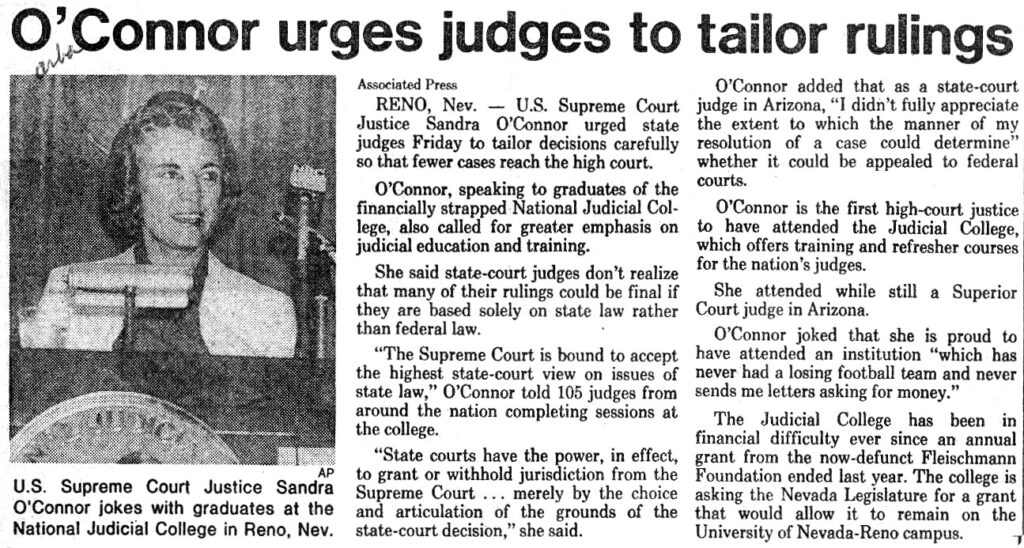
O’Connor urges judges to tailor rulings

Newspaper article by Associated Press
May 14, 1983

RENO, Nev. – U.S. Supreme Court Justice Sandra O’Connor urged state judges Friday to tailor decisions carefully so that fewer cases reach the high court. O’Connor, speaking to graduates of the financially strapped National Judicial College, also called for greater emphasis on judicial education and training. O’Connor added that as a state-court judge in Arizona, “I didn’t fully appreciate the extent to which the manner of my resolution of a case could determine” whether it could be appealed to federal courts. She said state-court judges don’t realize that many of their rulings could be final if they are based solely on state law rather than federal law. “The Supreme Court is bound to accept the highest state-court view on issues of state law,” O’Connor told 105 judges from around the nation completing sessions at the college. “State courts have the power, in effect, to grant or withhold jurisdiction from the Supreme Court . . . merely by the choice and articulation of the grounds of the state-court decision,” she said. O’Connor added that as a state-court judge in Arizona, “I didn’t fully appreciate the extent to which the manner of my resolution of a case could determine” whether it could be appealed to federal courts. O’Connor is the first high-rourt justice to have attended the Judicial College, which offers training and refresher courses for the nation’s judges. She attended while still a Superior Court judge in Arizona. O’Connor joked that she is proud to have attended

Rulings can be final, O’Connor tells judges

Newspaper article by Associated Press
May 14, 1983

Socialite: Justices’ reticence aside, Sandra O’Connor loves Washington parties

Newspaper article by Lois Romano
May 8, 1983

WASHING TON – Supreme Court Justice Sandra Day O’Connor hit the Washington party circuit hard, e•en before she received the Senate’s blessing to sit on the high bench 18 months ago. Since then she has been as visible on the social scene as canapes and cocktails. While she is most often in the majority in the court’s conservative opinions, and has a reputation for being I • well-prepared for court sessions, O’Connor has become a dissenter from its tradition of keeping a low profile. Supreme Court justices are a reserved lot, rarely keen on after -hours socializing with Washington’s ruling circles. Appointed for life, they are about as close as this town gets to royalty. They have no need to answer to anyone but themselves and, for the most part, have chosen isolation instead of the well-worn Washington paths from party to party. “She is very visible socially,” says retired justice Potter Stewart, who was quite visible himself during his years on the court. “She’s attractive and likable and, of course, the first woman on the Supreme Court. People want to see her.” : : Indeed, O’Connor and her husband, John, are considered a big draw by the big guns in the Washington , party whirl. Only the president, vice president or the . ~hief justice rate higher. She is a novelty: the court’s first . woman, young (53), a good dancer and the picture of self-containment, obviously confident enough not to worry that as a freshman justice, she should uphold the court’s stuffy demeanor. • . Perhaps

States forbidden to tax newspapers’ ink, paper

Newspaper article by Associated Press
March 29, 1983

States cannot tax the paper and ink used in publishing newspapers, the Supreme Court ruled today. By an 8-1 vote, the Justices struck down such a Minnesota tax as unconstitutional. Writing for the court, Justice Sandra Day O’Connor said the tax violates free-press rights protected by the Constitution’s First Amendment. “Differential taxation of the press places such a burden on the interests protected by the First Amendment that we cannot countenance such treatment unless the state asserts a counterbalancing interest of compelling importance that it cannot achieve without differential taxation,” O’Connor said. She said Minnesota authorities had produced no sue ‘compelling” interest. Minnesota’s “use” tax was levied only on ink and paper used by publishers. Other businesses that use thos products were not subject to the Non-publishers pay a state retail sales tax on goods they produce, and publishers are exempt from that sales tax. The _tax was challenged in 1975 by The Minneapolis Star and Tribune Co., which at the time published The Minneapolis Tribune and The Minneapolis Star newspapers. Last year, the Star was merged with the Tribune and ceased to exist as a separate paper. For a 17-month period beginning Jan. 1, 1974 the publishing company paid $874,265.04 in taxes on the ink and paper it consumed. Its suit sought a refund of that money and a halt to further imposition of the tax. Today’s Supreme Court ruling means the publishing company will receive its sought-after refund

O’Connor gives post her all

Editorial by Loyal Meek
March 3, 1983

EDITOR’S NOTE: Loyal Meek, editor of the Phoenix Gazette, recently visited Supreme Court Justice Sandra O’Connor at her office in Washington.

By LOYAL MEEK
The Phoenix Gazette

WASHINGTON Justice Sandra Day O’Connor sits on the tip of a marble iceberg.

“Are you enjoying it?” she is asked.

“That’s not the right word,” she
replies.

Nearly a year and a half after joining eight male colleagues on the Supreme Court of the United States, she says she finds the job interesting, challenging, demanding. The responsibilities, she indicates, are not the sort to be enjoyed.

Soon the interviewer finds himself answering more questions than he is asking as Madame Justice (“Please call me Sandra,” she said at our greeting) seeks information on what’s happening in Phoenix.

As the newest member of the high court, and more significantly, its first woman member, Justice O’Connor is under an especially penetrating scrutiny.

Those who observed her in action in the Arizona Legislature, the state superior and appeals courts and in such public arenas as Town Hall will not be surprised to hear that shoe is meeting the challenge with efficient aplomb.

If anything has dismayed her, it is probably how demanding the job is.

At the tip of the marble iceberg that is the nation’s court system from JPs on up, justice in America suffers from an overwhelming case load.

Some might suggest that the computer, with its fantastic word-processing, case-researching capabilities, may offer a means for the courts

O’Connor joins Burger in plea for new court

Newspaper article by Elizabeth Olson
February 8, 1983

NEW ORLEANS (UPI) -Arguing the quality of American justice is at stake, Chief Justice Warren Burger is asking Congress to create a new federal court to decide some of the Supreme Court’s cases . Burger said the flow of cases is so overwhelming that the court is threatened with a “breakdown of the system – or of some of the justices” and “patchwork remedies” cannot solve the problem. ” It is the most important single, immediate problem facing the judicial branch, ” he declared. Denying he was “crying wolf,” the nation’s top jurist recommended setting up a temporary panel of judges to settle conflicting rulings among the circuit courts of appeal, and perhaps disputes over federal statutes . Justice Sandra Day O’Connor, like Burger addressing tl-ie American Bar Association’s annual. mid-winter meeting Sunday, made a similar proposal for a new court. “There is no one single, permanent solution,” Mrs O’Connor said. “Ea ch time the court’s caseload increases , congressional action is necessary to make some significant change in th~ court’ s jurisdiction or_ its procedures to reduce the numbers . It’s been 58 years smce the last maj or changes .” Burger’s proposal, made in his annual State of the Judiciary address, was the first time he has endorsed such a major change to reduce th€’ court :,, case burdl’n – a topic that eight of the nme justice><; have spoken about publicly smce lac;tsummer Proposals tor a ne\, judicial layer between the appeals courts and the-Supreme Court have.

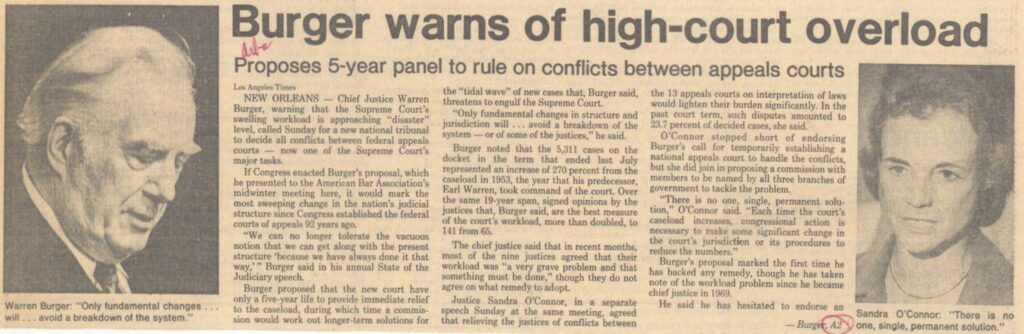
Burger warns of high-court overload

Newspaper article
February 7, 1983

Angeles Times NEW ORLEANS – Chief Justice Warren Burger, warning that the Supreme Court’s swelling workload is approaching “disaster” level, called Sunday for a new national tribunal to decide all conflicts between federal appeals courts – now one of the Supreme Court’s major tasks. If Congress enacted Burger’s proposal, which he presented to the American Bar Association’s midwinter meeting here, it would mark the most sweeping change in the nation’s judicial structure since Congress established the federal courts of appeals 92 years ago. “We can no longer tolerate the vacuous notion that we can get along with the present structure ‘because we have always done it that way,’ ” Burger said in his annual State of the Judiciary speech. Burger proposed that the new court have only a five-year life to provide immediate relief to the caseload, during which time a commission would work out longer-term solutions for the “tidal wave” of new cases that, Burger said, threatens to engulf the Supreme Court. “Only fundamental changes in structure and jurisdiction will … avoid a breakdown of the system – or of some of the justices,” he said. Burger noted that the 5,311 cases on the docket in the term that ended last July represented an increase of 270 percent from the caseload in 1953, the year that his predecessor Earl Warren, took command of the court. Ove; the same 19-year span, signed opinions by the justices that, Burger said, are the best measure of the court’s workload, more than

Burger proposes creating new court

Newspaper article by United Press International
February 7, 1983

NEW ORLEANS (UPI) – Arguing the quality of American justice is at stake, Chief Justice Warren Burger is asking Congress to creat e a new federal court to decide some of the Supreme Court’s cases. Burger said the flow of cases is so overwhelming the court is threatened with a ” breakdown of the system – or of some of the justices.” He said “patchwork remedies” cannot solve the problem. “It is the most important single, immediate problem facing the judicial branch ,” Burger declared. Denying he was “crying wolf,” the nation’ s top DAI LY jurist recommended setting up a temporary panel of judges to settle conflicting rulings among the circuit courts of appeal, and perhaps disputes over federal statutes. Justice Sandra Day O’Connor, who also addressed the American Bar Association’s annual midwinter meeting Sunday, made a similar proposal for a new court. “There is no one single, permanent solution,” O’Connor said. “Each time the court’s caseload increases, congressional action is necessary to make some significant change in the court’s jurisdiction or its procedures to reduce the numbers. It’s been 58 years since the last major changes.” Burger’s proposal, made in his annual State of the Judiciary address, was the first time he has endorsed such a major change to reduce the court’s case burden – a topic that eight of the nine justices have spoken about publicly since last summer. Proposals for a new judicial layer between the appeals courts and the Supreme Court have been floated

Justice Sandra Day O’Connor

Book by Mary Virginia Fox
February 1, 1983

Justice hails judge’s appointment

Newspaper mention
January 26, 1983

Justice O’Connor: A First Term Appraisal

Law review article by Robert E. Riggs
January 2, 1983

Justice O’Connor: A First Term Appraisal

Robert E. Riggs*

INTRODUCTION

The appointment of Judge Sandra Day O’Connor to the United States Supreme Court was one of the most widely-ac claimed acts of the new Reagan administration. Not yet six months into his term of office, the President fulfilled a campaign promise to nominate a woman to fill one of the first Supreme Court vacancies in his administration.1 The nomination was praised by women’s groups because she was a woman,2 by Republicans because of her sterling political credentials,3 by law yers because of her solid legal background,• by Senators because of her alert, self-possessed responses at the nomination hear ings,11 and even by Democrats because, “If you have to have a Republican on the court… she’s about the best we could hope for.”6 The only discordant notes came from the far right, where

Professor of Law, Brigham Young University. B.A., 1952, M.A., 1953, University of Arizona; Ph.D., 1955, University of Illinois; LL.B., 1963, University of Arizona. The author wishes to acknowledge the research assistance of Garry B. Wilmore.

N.Y. Times, July 8, 1981, at Al, col. 4; N.Y. Times, Oct. 15, 1980, at Al, coL 1.

N.Y. Times, July 8, 1981, at Al, col. 4; The Nomination of Sandra Day O’Connor of Arizona to Serve as an Associate Justice of the Supreme Court of the United States: Hearings Before the Senate Comm. on the Judiciary, 97th Cong., 1st Sess. 278-80 (1981) (statement of Kathy Wilson, National Women’s Political

Justice received hate mail following abortion decision

Newspaper article by Fred Barbash
December 5, 1982

O’Connor silent on abortions

Newspaper article by Elizabeth Olson
December 3, 1982

O’Connor stays quiet during court abortion arguments

WASHINGTON (UPI) – With the issue of abortion under consideration in the current Supreme Court term, Justice Sandra Day O’Connor is staying as quiet about her views on the subject as she did at confirmation hearings. Usually quick with questions, Mrs. O’Connor, 52, was silent during the first 35 minutes of oral arguments Tuesday. The first woman ever on the high court, Mrs. O’Connor took her seat in September 1981. Tuesday’s three-hour argument was the first she has heard on the abortion question. During Senate confirmation hearings, she steadfastly refused to say if she would repudiate the court’s historic 1973 decision legalizing abortion. . Her nomination to the court by President Reagan was warmly received in most quarters, but abortion opponents criticized her stand on the issue during her time as an Arizona legislator. Although she said abortion personally offends her, Mrs. O’Connor told senators she would not oppose allowing abortions to save the woman’s life and “possibly” for other reasons. In its 1973 ruling, the Supreme Court said protecting the woman’s health wruld justify state regulation of abortions in the second three months of pregnancy. Just how far states can go in !llch regulation is the question before the c,urt in cases from Virginia, Missouri and Akron, Ohio, Not until more than halfway throughthe first case did she speak up. By then, seven of the nine justices had raised questiom. Her first query tried

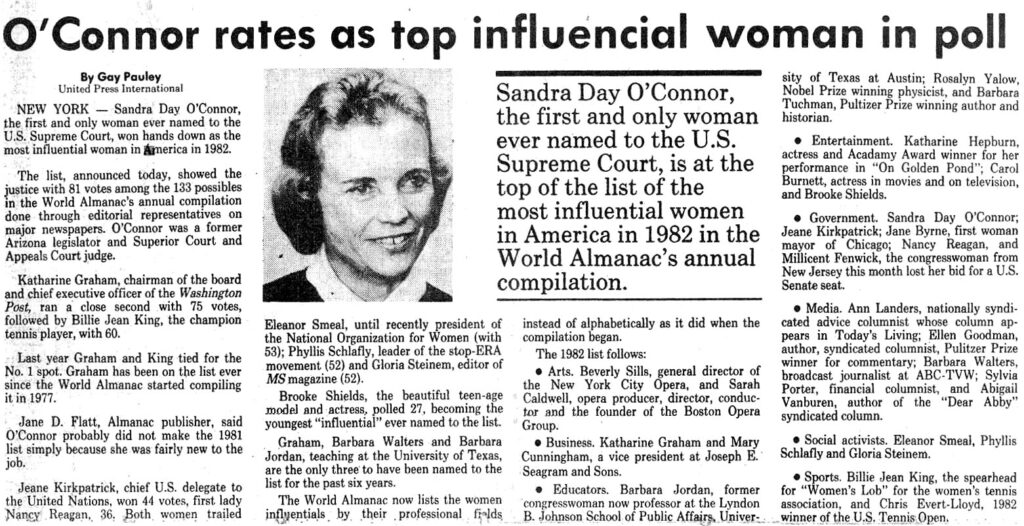
O’Connor rates as top influencial woman in poll

Newspaper article by Gay Pauley
November 11, 1982

ENEW YORK – Sandra Day O’Connor, the first and only woman ever named to the U.S. Supreme Court, won hands down as the most influential woman in America in 1982. The list, announced today, showed. the justice with 81 votes among the 133 possibles in the World Almanac’s annual compilation done through editorial representatives on major newspapers. O’Connor was a former Arizona legislator and Superior Court and Appeals Court judge. Katharine Graham, chairman of the board and chief executive officer of the Washington Post, ran a close second with 75 votes, followed by Billie Jean King, the champion tennis player, with 60. Last year Graham and King tied for the No. 1 spot. Graham has been on the list ever since the World Almanac started compiling it in 1977. Jane D. Flatt, Almanac publisher, said O’Connor probably did not make the 1981 list simply because she was fairly new to the job. Jeane Kirkpatrick, chief U.S. delegate to the United Nations, won 44 votes, first lady ]’J;,mc . R~a~a!I,. S6. )30th :”ome~ trailed Eleanor Smeal, until recently president of the National Organization for Women (with 53); Phyllis Schlafly, leader of the stop-ERA movement (52) and Gloria Steinem, editor of MS magazine (52).

Brooke Shields, the beautiful teen-age model and actress, polled 27, becoming the youngest “influential” ever named to the list.

Graham, Barbara Walters and Barbara Jordan, teaching at the University of Texas, are the only three to have been named to the list fro the past six years.

The

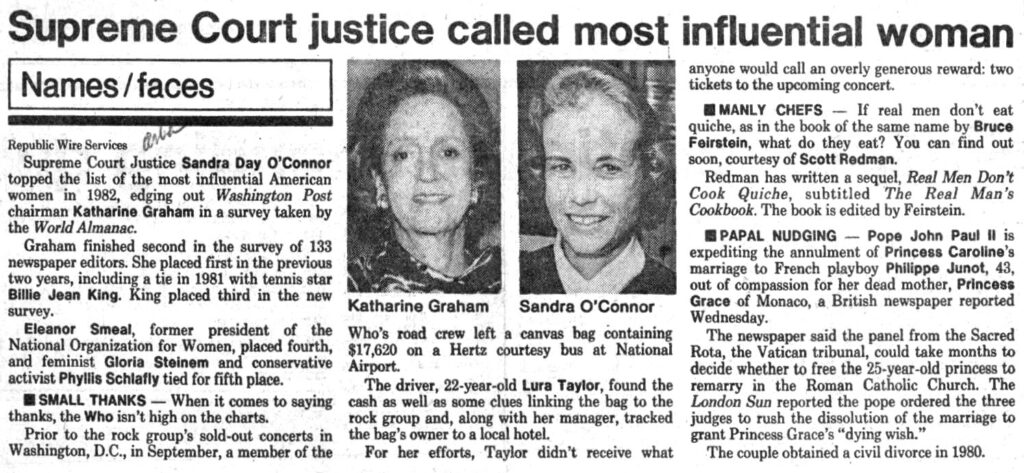
Supreme Court justice called most influential woman

Newspaper article
November 11, 1982

A Courtly discussion with Justice O’Connor

Newspaper article by Harold Jackson
October 3, 1982

There was a fantastic outpouring of enthusiasm from people all over this country, from all walks of life and, surprisingly enough, even from people from other countries. It
was very touching to see that excitement.
It doesn’t take long for the steeliness to emerge from Supreme Court Justice Sandra Day O’Connor’s apparently gentle manner. As the conversation strays onto a subject she dislikes, she firmly chops it off.
“I don’ think that would be appropriate,” she says, and a taut smiles ensures that, suddenly, you don’t think it would be, either.
Arizona’s favorite daughter already is setting a precedent by granting an interview, not encouraged among Supreme Court justices. But she almost is bound to be a trend setter: the 102nd person appointed to the highest judicial branch of U.S. government, and its first female.
Justice O’Connor’s record after a year in office is characterized primarily by its conservatism. Apart from Chief Justice Warren Burger, the principal voice from the right is that of the court’s other Arizonan, Justice William Rehnquist. In 139 decisions, O’Connor has concurred with him 123 times.
But she also has joined the court liberals on some decisions, notable in cases concerned with sexual discrimination.
She has attracted comment with her apparent leaning toward state power vs federal power.
What caught her most by surprise during her first year was the volume of mail that greeted her.
“I was inundated with it in the early months here,” she said, “far more than I had anticipated.”

Noted women talk about prayer

Newspaper article by Associated Press
October 2, 1982

By The Associated Press NEW ORIEANS – Life has its crossroads its searing intervals when a person momenta~ily isn’t sure which way to go or what to do, but in which the situation compels a choice. Out of experiencing such crises, four noted women say the answers come through prayer . “In faith , you turn to the source in times of stress and there’ll always be direction ,” says Coretta Scott King. “It may not be what you asked for, but it’s what God wants you todo.” She says that was the determining factor after a 1956 fire-bombing of her home where she and her first child were alone, that forged her initial fateful commitment to the civil rights cause led by her late husband, Martin Luther King.

Shaken directly by the danger of it, “I had to do some deep soul searching about my commitment to the struggle. I knew I would have to be as committed as my husband. ” Then and there, in earnest prayer, cradling her child outside their blasted bedroom, she made her commitment “prepared for whatever might take place.” ‘ “It ultimately did,” she adds of the 1968 assassination of King.

She and other women – including Supreme Court Justice Sandra O’CoMor – appeared on a panel at the recent Episcopal Church convention here, describing differing critical times in their lives when they say they found God’s guidance through prayer. Justice O’CoMor’s hour of decision came when the offer of the Supreme Court appointment came, the first ever to a woman. “It was like a ~underbolt,” she said.

In Senate hearing O’Connor defends abortion vote

Newspaper article by Associated Press
September 9, 1982

WASHINGTON (AP) – Supreme Court nominee Sandra Day O’Cormor said today she is opposed to abortion but that her personal views would not control her votes on the nation’s highest court. “My own view in the area of abortion is that I’m opposed to it,” O’Cormor told the Senate Judiciary Committee. But she emphasized her belief that judges should not let personal feelings dictate their decisions on constitutional issues. O’Connor, the first woman ever nominated to the Supreme Court, sought to explain and defend votes she cast while a member of the Arizona Senate from 1969 to 1975 which have been interpreted by political conservatives as “proabortion.” She portrayed those votes as not true reflections on abortion, itself, but on tangential legislative concerns. In response to other committee questions, O’Connor attempted to enhance her image as a judicial conservative. “I do well understand the difference between legislating and judging. . . . As a judge, it is not my function to develop social policy by means of making the law,” she said. O’Connor has been a state appeals court judge in Arizona since 1979, and was a state trial judge the previous four years. “I do not believe it is the function of the judiciary to step in and change the law because the times or social mores have changed,” she said. O’Connor promised the senators that, if confirmed as the 102nd member in the high court’s 191-year history, her job will be “one of interpreting and applying the law, not making it.” Keeping

O’Connor: The Individual often does make a difference in society

Editorial by Sandra Day O'Connor
July 20, 1982

“In every age, there comes a time when leadership suddenly comes forth to meet the needs of the hour. And so there is no man who does not find his time, and there is no hour that does not have its leader.” At first blush, this ancient saying suggests merely that there will always be a Moses when a Moses is needed. Yet, on further examination of the words, “there is no man who does not find his time,” we realiw that the message conveyed is that each of us, in our own individual lives and the crises we face, will have a time to lead. Whether we will lead only a family, or a handful of friends, and where and how we will lead, is up to us, our views and our talents. But the hour Vlill come for each of us, and, became we know this, we surely must also know that the very nature of humanity and society, regard~ss of its size or complexity, will alvays turn on the act of the individ1al and, therefore on the qualityof that individual. My ecperience in the executive, legislati,e, and judicial branches of governnent and my position on the Suprem, Court all point to this conclusim: an informed, reasoned effort ly one citizen can have dramatc impact on how someone, like a ~gislator, will vote and act. When ‘ was in the legislature, one person, sometimes with a direct interes in the matter, sometimes withou one, would on occasion persuale me by the facts, by the clarityof the explanation and by the rasoning, to do something which never would otherwise have done. have been at caucuses when

Drifting: Unlike the Warren court, the U.S. Supreme Court shows no tilt one way or the other

Op ed by James Kilpatrick
July 15, 1982

A year ago, at the end of the 1980 term, a consensus developed among observers of the U.S. Supreme Court: The court was drifting. With the end of the 1981 term, that view remains unchanged: The court is still drifting. This past term saw no new landmarks, no great beacons of the law. We had nothing to rank with the Brown case on school segregation, or the Miranda case on the rights of an accused, or the Miller case on pornog-‘ raphy. The court never painted with a broad brush on a big canvas. We wound up with small etchings, tightly framed. A simple explanation – it is not intended to be cynical – accounts for the situation. We pride ourselves on saying that

It is a myth, a shibboleth, a sham. , At the level of the Supreme Court, ours is emphatically not a government 1 of abstract law, but a government of eight very mortal men and one woman. As always, these nine human beings brought to their opinions the accumulated convictions, prejudices and attitudes of their lifetimes. Members of the court detest the journalist’s practice of putting them in ideological pigeonholes, but the custom gains in understanding more than it loses in precision. With few exceptions, the three conservatives (Burger, Rehnquist and O’Connor) came down on the side of judicial restraint and narrow construction. The three liberals (Brennan, Marshall and Blackmun) tended toward activism and expansion. The three centrists (White, Powell and Stevens) tilted the teeter-totter first here, then there. In a recent

O’Connor: After a year, showing a very conservative bent

Newspaper article by Kevin Costelloe
July 13, 1982

Sandra Day O’Connor, after her first term as a Supreme Court justice, is a solid member of the court’s conservative wing. In the session that ended July 2, Mrs. O’Connor voted to: v Give local school boards unlimit.ed power to remove books they find offensive from high school and junior high libraries. Her side lost. v Let Washington state voters bat a school busing plan voluntarily adopted by the city of Seattle to achieve racial balance. Again, she was on the losing end. v Allow states to execute “non-triggerman” ‘ criminals whose crimes resulted in a death even though they did not intend to take part in a killing. Another minority view. Mrs. O’Connor’s overall voting record indicates just how much she has joined the court’s conservative side since she was awom in last September. In the 31 cases decided by 6-4 votes – rulings that generally indicate the thorniest disputes between liberals and conservatives – Mrs. O’Connor sided with ultra-conservative justice William H. Rehnquist 27 times. She sided only four times in 5-4 decisions with Justice William J. Brennan, leader of the court’s liberals. Only once were the three justices on the same side in a 6-4 ruling, a relatively minor case. In other key cases during the just-complet.ed term, the 52-year-old Mrs. O’Connor voted to: .,,,, Bar all lawsuits seeking monetary damages from U.S. presidents for misconduct in office. Her side prevailed. .,,,, Deny illegal alien children a free public school education. A; minority view. v

Sandra for Veep?

Editorial
July 13, 1982

Where the rumor started, no one seems to know.. But now Baltimore Sun Washington correspondent Lyle Denniston has published what had been mere gossip among politicians. Denniston writes that it is “common speculation” that Justice Sandra O’Connor may be interested in running for vice president. At the risk of trying to speak for Justice O’Connor, we suspect the speculation is more wishful thinking by some eager Republican political matchmaker looking for a so-called dream ticket. Certainly none of Justice O’Connor’s intimates takes the report seriously, nor have they heard any interest by her about leaving the Supreme Court. In fact, Justice O’Connor is known to relish the potential of the career that lies ahead on the nation’s highest judicial body, which has more influence over national policy than the vice president does.

Moreover, Justice O’Connor chose long ago to abandon elective office in favor of the judiciary. When confronted with the opportunity some years ago of running for governor, she chose instead a career in the state court system. Presidential and vice presidential politics are a risky business. The American electorate is unpredictable, and there is no certainty that Republicans – of which Justice O’Connor is one – will retain the White House the next go-around in 1984. On the other hand, Justice O’Connor has a lifetime seat on the court. Speculation that she would leave that elegant position for the rowdy politics of a presidential campaign simply defy logic

Civil rights violations restricted to intentional bias, court rules

Newspaper article by Lyle Denniston
July 6, 1982

WASHINGTON – The Supreme Court has ruled that an 1866 law that protects the rights of blacks is violated only by racial bias that is intentional. The 7-2 decision June 29 strictly limits the scope of a law – now applying to jobs, housing and private schools – that had become a favorite of civil rights lawyers. As a result, the law, which had been viewed as an easier alternative than other forms of federal protection for blacks’ rights, loses some of its potential impact. The court said evidence a policy of a state or local government agency or a private institution had a heavier impact on blacks than on whites is not enough to prove a violation of the law. There must be proof that blacks were treated less well on purpose, the court added. The court also ruled that an organization or institution that does not discriminate intentionally on the basis of race has no legal duty under the law to assure that other groups with which it deals do not discriminate against blacks either. “The immediate evils with which Congress was concerned (after the Civil War) simply did not include practices that were neutral on their face, and even neutral in terms of intent,” Justice William H. Rehnquist said for the majority. The justices had been searching for a test case on the issue for several years, but the earlier cases they had chosen for review ended without a decisive ruling on the law’s reach. The two dissenting justices argued that the 116-yearold law had been adopted by Congress to “blot

O’Connor solid member of the conservative wing

Editorial by Kevin Costelloe
July 4, 1982

WASHINGTON – Sandra O’Connor, after her first term as a Supreme Court justice, is a solid member of the court’s conservative wing. In the session that ended Friday, O’Connor voted to: – Give local school boards unlimited power to remove books they find offensive from high school and junior high libraries. Her side lost. – Let Washington state voters bar a school busing plan voluntarily adopted by the city of Seattle to achieve racial balance. Again, she was on the losing end. – Allow states to execute “non-triggerman” criminals whose crimes resulted in a death even though they did not intend to take part in a killing. Another minority view. O’Connor’s overall voting record indicates just how much she has joined the court’s conservative side since she was sworn in last September. In the 31 cases decided by 5-4 votes – rulings that generally indicate the thorniest disputes between liberals and conservatives – O’Connor sided with ultra-conservative Justice William Rehnquist 27 wnes. She sided only four times in 5-4 decisions with Justice William Brennan, leader of the court’s liberals. Only once were the three justices on the same side in a 5-4 ruling, a relatively minor case. In other key cases during the just-completed term, the 52-year-old O’Connor voted to: – Bar all lawsuits seeking monetary damages from U.S. presidents for misconduct in office. Her side prevailed. – Deny illegal alien children a free public school education. A minority view. – Expand the power of police to

O’Connor’s first term places her in conservatives’ corner

Newspaper article by Kevin Costelloe
July 4, 1982

Justice O’Connor votes to end bias

Newspaper article by Knight-Ridder
July 2, 1982

O’Connor signs court opinion on sexual bias

Newspaper article by Kevin Costelloe
July 2, 1982

WASHING TON – The Supreme Court, with Justice Sandra Day O’Connor choosing the subject of unconstitutional sex bias to write her first opinion, says state-supported nursing schools cannot bar men from enrolling. Thursday’s 5-4 decision is a victory for Joe Hogan, who broke a 97-year tradition by becoming the first man to enroll at the Mississippi University for Women. Justice O’Connor, the court’s only female mem-• her, wrote for the majority that Hogan’s exclusion from the university’s nursing school violated the Constitution’s guarantee of “equal protection” of the laws. “Rather than compensate for discriminatory barriers faced by women, MUW’s policy of excluding males from admission to the school of nursing tends to perpetuate the stereotyped view of nursing as an exclusively woman’s job,” Justice O’Connor said. “By assuring that Mississippi allots more openings in its state-supported nursing schools to women than it does to men,” she wrote, “MUW’s admissions policy lends credibility to the old view that women, not men, should become nurses, and makes the assumption that nursing is a field for women a self-fulfilling prophecy.” The university, located in Columbus, Miss., is the nation’s only state-supported university for women. Hogan, a hospital nurse who lives with his wife in Columbus, wanted to attend the local university to obtain a bachelor’s degree in nursing. His application to the university was rejected because he is a man. Mississippi Attorney General Bill Allain

Individual has role: O’Connor

Newspaper article by Associated Press
June 1, 1982

Assets may top $1 million: Justice O’Connor bench’s 2nd richest

Newspaper article by United Press International
May 17, 1982

O’Connor tastes liberal assault

Newspaper article by Associated Press
April 6, 1982

Justice O’Connor on the right side

Newspaper article by Jeffrey Hart
April 5, 1982

When President Reagan nominated Sandra O’Connor for the Supreme Court last year, there was a good deal of grumbling. It turned out to be a political masterstroke that sailed through the confirmation process in the Senate, but conservatives weren’t so sure. Her record was sketchy, and what there was of it caused alarm among anti – abortion groups. , Afte~ Justice O’Connor’s six months on the Court, however, The New Republic concludes after an examination of her record that “her vote has not always been predict – able. But she has cast her lot often enough with lawschool classmate William Rehnquist and with Chief Justice Burger to help forge a clear conservative majority on a number of crucial issues … Mrs. O’Connor’s record so far suggests she will not alter the steady conservative momentum of the Court … And as the youngest member of the Supreme Court, Justice O’Connor may be with us until well into the 21st century.”

The key cases in her six-month record were not of the headline variety, but they do indicate that Justice O’Connor takes a restricted view of activist interventions by the Supreme Court. On January 12, for example, her vote helped provide a bare five-vote majority in a ruling that ordinary taxpayers could not sue in federal court to block the government from giving property to a religious group. The case was Valley Forge Christian College versus Americans United for Separation of Church and State. It turned on the issue of “standing,” that is, who is entitled

Inside High Court: O’Connor retains down-home warmth

Editorial by Pat Murphy
April 4, 1982

Appointment ups opportunities for women, O’Connor says

Newspaper article by Associated Press
March 20, 1982

Supreme Court Justice Sandra Day O’Connor says her appointment to the court has been seen as an indication that there are “virtually unlimited opportunities for women.” “I had no idea when I was apvointed how much it would mean to many people around the country,” she said in an interview in the April issue of the Ladies’ Home Journal published Tuesday. “It affected them in a very personal- way,” Mrs. O’Connor said. “People saw the appointment as signal that the,re are virtually unlimited opportunities for women. It’s important to mothers for their daughters and to daughters for themselves.” But Mrs. O’Connor said she does miss her former home in Phoenix, where she and her husband, John, had lived since the mid-1950s. “I miss the atmosphere of the desert, I miss the open vistas, the clear sky and the availablity of the outdoors,” she said. Her husband. a lawyer who has joined a Washington law firm, said in the Journal that his wife appointment has not . made his life difficult. ‘ “My life has become vastly broadened and vastly enriched by her appointment,” he said. “I am not only happy for Sandra because she is so competent and so deserving, but I am happy for myself and my family because all our lives have become more interesting. “Sandra’s accomplishments don’t make me a lesser man; they make me a fuller man.” For her part, Mrs. O’Connor said, “It may seem surprising, but my new position hasn’t really changed things in terms of how I deal with people. “There’s some nervousness

O’Connor urges state control in civil rights damage cases

Newspaper article by Lyle Denniston
March 16, 1982

WASHINGTON – A Supreme Court justice has hinted strongly to Congress that a key case will be decided in favor of keeping federal courts open for the growing volume of civil rights damage claims. The highly unusual hint came March 9 in testimony by the newest justice, Sandra Day O’Connor, before the House Appropriations Subcommittee that is studying the court’s $14.9 million budget request. The issue arises in a pending Florida case that has the potential of cutting off many civil rights cases. She did not say, in so many words, how the court would rule. But she did urge Congress to pass a law to achieve that result by requiring most civil rights cases to be pursued first with state agencies, instead of going directly to the federal courthouse. It would not be necessary for Congress to act, of course, if the justices were to interpret present law to give state agencies priority in handling such cases. Asked after the hearing if the issue she had discussed were not the same one now under review by the court in the Florida case, O’Connor replied: “I will rest on what I said.” Just two weeks ago, the court heard lawyers argue the case. Under normal procedures, the justices would have cast their preliminary vote on the case at their secret conference on Friday. O’Connor’s promotion of a federal law to shunt more civil rights cases to state agencies echoed a proposal she made in a law review article last summer, before she was chosen for the Supreme Court. An Arizona appeals court

Justice O’Connor may have ‘let cat out of bag’

Newspaper article by Associated Press
March 10, 1982

High court feels uneasy in school book-ban case

Newspaper article by Jim Mann
March 3, 1982

Justice O’Connor gets special honor

Newspaper mention by Associated Press
February 23, 1982

VALLEY FORGE, Pa. (AP) – Supreme Court Justice Sandra Day O’Connor, VisionQuest and a Flowing Wells High School graduate are a!Ilong the winners of the 1981 Freedoms Foundation at Valley Forge National Awards, the foundation announced. Mrs. O’Connor, a former Arizona Court of Appeals judge, won a Distinguished Award from the foundation. Jill Barber, a freshman political economy major at Hillsdale College in Michigan, won a “Youth Essay 1981” George Washington Honor Medal. She was valedictorian of the 1981 Flowing Wells graduating class. The VisionQuest wagon train program for troubled youths won the George Washington Honor Medal for “Community Program 1981” honors. The annual awards recognize individuals and organizations who support U.S. social, polit_ical and economic institutions and present solutions to contemporary problems. Joining Mrs. O’Connor as winners of Distinguished Awards were Beverly Sills, Pearl . Bailey, Arthur Ashe, Rod McKuen, Roger Staubach, the Special Olympics and, posthumously, Anwar Sadat. Freedoms Foundation at Valley Forge, whose honorary chairman is President Reagan, describes itself as a non-profit, non-sectarian and non-political organization that promotes American heritage.

Sandra O’Connor: Pulling a Competent Oar in A Storm-Tossed Boat

Op ed by James Kilpatrick, Universal Press
January 22, 1982

Nineteen opinions do not a full term make, but so far it looks as if Justice Sandra Day O’Connor will be joining the conservative bloc on the U.S. Supreme Court. The court’s first woman justice has sided with the liberals on only one of the 5-4 divisions to date. A paragraph probably should be inserted to acknowledge the irritation felt by the justices whenever they are thus labeled by the press. The high court is not a kind of judicial bench show, the collies here and the poodles there. Nevertheless, when the court divides narrowly, we generally find the “liberal” Justices Brennan and Marshall on one side and the “conservative” Chief Justice Burger and Justice Rehnquist on the other. Justice O’Connor seems to have suited up with the Burger-Rehnquist team. Through Jan. 21, the court had acted on 21 cases. Justice O’Connor had participated in 19 of these. Of the 19, only two were unanimous decisions, and in these two Justice O’Connor herself spoke for the court. In the other 17, the court fell apart like the one-hoss shay. I haven’t checked the statistics, but I suspect that some sort of record was set at this point in a term of court, when four of five decisions on Jan. 12 were reached by 5-4 divisions. This is not the most congenial court that ever came along. Justice Brennan has succeeded the late Justice Douglas as the most acerbic dissenter on the court. In one of the 5-4 decisions of Jan. 12, this one involving the gift of federal property to the Valley Forge Christian College

365 Days: ’81 brought moments of joy, anguish and humor to state

Newspaper article by Charles Kelly
January 3, 1982

In Arizona, 1981 started with a bang. A few minutes after the year had begun, Gilbert Dixon, 35, was walking in an alley next to a UTotem convenience store at 602 N. First Ave. Into the alley came a car, with one of its two occupants firing a pistol into the air. “Happy New Year,” Dixon cried, and the man with the gun shot him in the leg. In a way, 1981 was a year that both justified Dixon’s optimism and reflected his fate. On the bright side, a warrior came home from captivity to a hero’s welcome, an Arizonan made history by becoming the first woman member of the U.S. Supreme Court, and a Mesa woman survived a drastic heart-lung transplant. On the dark side, two men were convicted of a brutal contract killing that occurred on the eve of the new year, a Tucson bank was the target of the largest bank robbery in the nation’s history, and a valley in southern Arizona crackled with tension as longtime residents clashed with gun-toting members of a religious cult. It also was a year for offbeat items – topped by the story of true belitJvtrs who planned to end the year in heaven but who had to Republic. settle for Arizona. An oddball entry was one of the first in line for the year. In January, Granvel Downing, a 40- year-old Phoenix construction worker, said he had received a $500 settlement in a lawsuit that he filed after finding a lizard in a bottle of Coke on Sept. 7, 1978. The defendants were the Phoenix Coca-Cola Bottling Co. and Circle K Corp. Downing’s lawyer said one of the

O’Connor appointment tops state stories

Newspaper article by Neil Bibler / Associated Press
January 2, 1982

Sandra Day O’Connor’s appointment as the first U.S. Supreme Court justice easily led the I allot for the top Arizona news in 1981, but even ‘ ,en the vote was far from unanimous. Though not really in the running for the Top n, Arizona Associated Press member editors and news directors gave at least some consideration to such other events as the successful transcontinental SuperChicken balloon journey and the unsuccessful predictions in Tucson for “rapture,” the day when all Christians were to be taken up bodily into beaten. It was an eventful year and the diversity of the voting reflected the variation . But with a few exceptions, the events deemed the most newswor – thy over the past 12 months centered more on individuals than on situations. Arizona’s economy, the copper industry’s depression, an Apache Cowity tax revolt, a variety of natural gas leaks, plane crashes, murder trials, a group suicide and other deaths – these all drew a scattering of votes but wound up far down the list. • Second place went to the return of Marine Sgt. James Lopez, career diplomat Robert Ode and the other Americans held hostage in Iran for 444 days. A strong third was the Arizona lottery and its ticket sales that far exceeded expectations . The Orme Dam controversy and its resolution was No. 4 in the voting, followed by Arizona’s passage of its alternative to Medicaid. Eight of those voting gave top honors to the O’Connor story, and only the hostage return drew more than one first-place vote. Selected

Women as Supreme Court Candidates: From Florence Allen to Sandra O’Connor

Law review article by Beverly B. Cook
January 1, 1982

Women as Supreme Court candidates: From Florence Allen to Sandra Day O’Connor
By Beverly B. Cook

America was not ready for a woman on the Supreme Court when a well-qualified Florence Allen was available in the 1930s. But by Sandra O’Connor’s day, America had changed its mind.

In the years between Florence E. Allen’s New Deal-era candidacy for the United States Supreme Court and the appointment of Sandra Day O’Connor as the first woman associate justice in September 1981, the proportion of women lawyers qualified for the Court did not change; the number of viable women candidates remained very small. But what did change over the intervening 50 years was the nation’s social climate and political culture.

[Photo caption: U.S. Chief Justice Warren Burger swears in Sandra Day O’Connor on September 25. Her husband, John, holds two family Bibles.]

Allen’s active self-candidacy faltered against the resistance of public opinion and the disinterest of the president. The public did not accept a woman’s seat on the Court, and the politicians, the legal professionals and the justices themselves did not perceive women lawyers as eligibles in the candidate pool. O’Connor’s route to the Supreme Court was smoothed by the recent acceptability of women in high public positions. The new public opinion toward female roles and the increasing importance of the women’s vote encouraged President Reagan to create a woman’s seat and then to look into the small pool of eligible women to find the one most

Justice O’Connor Replaces Justice Stewart: What Effect on Constitutional Cases?

Law review article by Charles D. Kelso
January 1, 1982

Justice O’Connor Replaces Justice Stewart: What Effect On Constitutional Cases?

CHARLES D. KELSO*

Potter Stewart, a Republican from Ohio, was appointed to the Supreme Court of the United States in 1958 by President Eisenhower. By the time of his retirement in 1981, Justice Stewart had served through the Warren years and the first decade of the Burger era.1 Pres ident Reagan appointed Sandra Day O’Connor to fill the vacancy. A Republican from Arizona, she served in its legislature and on its Court of Appeals. Lawyers who follow decisions of the Court are asking what difference her appointment will make in constitutional cases.

The question can be approached by studying the most recent term of the Court. From the pattern of votes, particularly how Justice Stewart stood in the 5-4 decisions, some inferences can be drawn. Another ap proach is to look back at 5-4 decisions in previous years where Justice Stewart’s vote with the majority was crucial to the outcome. Both ap proaches will be explored in this article.

During its 1980-81 term, the Supreme Court decided and wrote opin ions in 70 cases where constitutional issues were presented. The pat tern of votes was as follows:

J.D., 1950 University of Chicago; LL.M. 1962 Columbia University; LL.D., 1966 John Marshall Law School: J.S.D., 1968 Columbia University. Law Clerk to Mr. Justice Minton, 1950- 51; Former Associate Dean and Professor of Law, University of Miami, 1966-68; Professor of Law Indiana University; Professor of

Reading’ Justice Sandra Day O’Connor

Law review article by Carl R. Schenker
January 1, 1982

“READING” JUSTICE SANDRA DAY O’CONNOR

Carl R. Schenker, Jr.•

On September 25, 1981, Judge Sandra Day O’Connor of the Court of Appeals of Arizona took the oath of office as an Associate Justice of the Supreme Court of the United States. Justice O’Connor’s elevation to the Court should be of great interest to state and local governments because her extensive prior involvement in local government should give her an unusual perspective in cases before the Court implicating state or local interests.

I. INTRODUCTION

Justice O’Connor has served previously as an assistant state attorney general, a state legislator, and a state trial and intermediate appellate court judge. Thus, her professional experiences have been intensely “local” and presumably have versed her thoroughly in many of the problems con fronting state and local governments. By contrast, most of the sitting Jus tices were working within a “federal” context at the time of appointment to the Court. When nominated, Chief Justice Burger and Justices Marshall, Blackmun, and Stevens were all sitting on United States Courts of Ap peals; Justices White and Rehnquist were serving as senior officials in the Department of Justice. And neither of the other members of the Court, Justices Brennan and Powell, had as wide a variety of experiences in state and local government as Justice O’Connor.

Popular publicity concerning Justice O’Connor has emphasized that she is the first woman to sit on the Court, rather than that her experience

First Woman Justice Tops Local News

Newspaper article by Kenneth Arline
January 1, 1982

Arizona’s No. 1 news story for 1981, as voted by the staff of The Phoenix Gazette, was a happy, precedentsetting event that also ranks among the top nationwide. . The news was the appointment of San4ra Day O’Connor of Arizona – a judge, politician, lawyer, wife, mother r. the first woman to sit as a justice Qt the United States Supreme Court. P-.esident Reagan announced her ppdintment July 7, and from then fnti after Justice O’Connor began t sking questions from the bench of _he nation’s highest court, the Arizoilan continued to be front page news. ‘ Justice O’Connor was serving on fhe Arizona Court of Appeals at the time of her nomination. She prefiously was a Maricopa County Superior Court judge. : The remaining nine 1981 stories on ‘fheGazette list, are the: ‘ • Shelving of the proposed Orme barn at the confluence of the Salt and Terde rivers in favor of a Waddell Dam on the Agua Fria. • Beginning of the Arizona Lottery, Its unprecedented success – and its J>ro~lems. 1 • Death of Bishop James Rausch of the Catholic Diocese of Phoenix and the appointment of Bishop Tom O’Brien as his successor. • . • Passage of a $5.8-billion transportation package – including an 8 percent gas tax based on the average retail price per gallon – and the initiative effort that will give voters a chance to turn down that increase. • Redistricting of the five congressional and 30 legislative districts to l;onform with one-man, one-vote manpates based on the 1980 census. : • Natural gas explosions,

Burger won’t block proposal by U.S. Steel to buy Marathon

Newspaper article
December 31, 1981

Chief Justice Warren Burger refused Wednesday to block U.S. Steel Corp.’s proposed takeover of Marathon Oil Co. Burger turned down an emergency request by rival bidder Mobil Corp. to postpone the Jan. 7 date that U.S. Steel expects to begin buying Marathon’s shares under its $125-a-share tender offer. But the chief justice’s action left open the chance that Mobil could return to him soon. Burger denied the request “without prejudice,” citing a Supreme Court rule that disallows such emergency motions that have not been denied first by appropriate lower courts. Mobil, the nation’s second-largest oil company, asked Justice Sandra O’Connor on Tuesday to freeze the takeover fight until the full Supreme Court has a chance to hear a formal appeal the company filed Tuesday. The appeal challenges a ruling by the 6th U.S. Circuit Court of Appeals preventing Mobil from buying Marathon stock. Last week, the appeals court ruled that Mobil’s aoouisition of Marathon probably would- violate federal antitrust laws. Justice O’Connor, who hand les all emergency matters coming to the high court from the states encompassed by the 6th circuit, disqualified herself. Following court custom, Justice O’Connor did not explain why she took herself out of the case. Justice O’Connor and her husband, attorney John J. O’Connor III, are spending part of the holidays at their Paradise Valley home. O’Connor, contacted by phone at their home, said he could not comment on court matters in which his wife is involved.

Law Clerk Praises New Justice

Newspaper article by Richard DeUriarte
December 29, 1981

~r, three mon~hs at her new job, Arizona s Sandra O Connor is working IO-hour days, lunching at her desk and has quickly become “one of the guys” on the U.S. Supreme Court. “Within the court itself, she has fit in very easily,” Justice O’Connor’s law clerk, Ruth V. McGregor, a Phoenix resident, said today. “On the world outside, though she is the first woman on the court’ and that is historic.” Mrs. McGregor, who was Justice O’Connor’s hand-picked choice for the prestigious one-year clerkship, told JUSTICE O’CONNOR RUTH McGREGOR The Phoenix Gazette the new justice has not aligned herself with any philosophical group on the ninemember high court. “SHE ANALYZES each case individually and very carefully,” said Mrs. McGregor, who was a partner in the Phoenix firm of Fennemore, Craig, von Ammon & Udall. In the 11 rulings already issued since Oct. 1, Justice O’Connor “has not lined up with the traditional liberal or traditional conservative bloc,” Mrs. McGregor said. If there has been a surprise for the 38-year-old attorney, a 1974 graduate of Arizona State University College of Law, it has been the heavy workload. “Most Americans think that since the court is in session 14 weeks a year, and hand down about 160 decisions, that they don’t work the rest of they year,” she said. “Actually, the workload is incredible, and the justices work very long hours,” Mrs. McGregor said . EACH WEEK, the court receives about 100 petitions for review, making for a three-foot-high stack of reading –

Supreme Court: The Justices Handle Heavy Caseload Without Succumbing to Activism

Op ed by James Kilpatrick, Universal Press
December 28, 1981

Before it recessed for the Christmas holidays, the Supreme Court had handed down 11 full-blown opinions and disposed of hundreds of cases with summary orders. As an old trend-spotter, I venture this observation: There are no trends to spot. The high court rocks . along as smoothly as those famous crewmen of the children’s round, who rowed, rowed, rowed their boat gently down the stream. The 1980-81 term saw no great leaps in the law. Nothing thus far in the new term suggests a lust for judicial innovation. The only difference in the present term lies in the presence on the bench of Justice Sandra .Day O’Connor, whose destiny is to go through life forever . hearing herself introduced as the first woman ever to be appointed, etc., etc. She has slipped into the life of the court as easily as a fireman slips into his boots. She has not hesitated to ask questions from the bench. She speaks her mind at the court’s weekly conferences. By every account she is a charming woman, but she is also a justice. She expects, and she gets, the same respect the others get; As Ronald Reagan’s first nominee, it was generally expected – hoped, perhaps – that Justice O’Connor would join the court’s conservative bloc. It hasn’t worked out quite that way, though the evidence is inconclusive. Mrs. O’Connor has participated in nine of the 11 plenary cases; she dissented from the majority’s reasoning in four of them. As a dissenter, she has sided with the liberals three times, the conservatives only once.

Justice O’Connor Still Independent of Court’s Blocs

Newspaper article by Kevin Costelloe, AP writer
December 28, 1981

WASHINGTON – As the Senate considered Sandra Day O’Connor’s nomination to the Supreme Court; Sen. Joseph Biden iold his colleagues that “all bets are of.r’ once a justice takes the oath of office .. The Delaware Democrat was right on target in his reminder last Septem ber that no one in the Senate can predict how a new member of the nation’s highest court will vote once he or she “dons that robe and walks into that sanctum across the way.” . ‘ After three months on the court, Justice O’Connor shows no signs of aligning herself with either its liberal or conservative bloc. SHE told the Senate last summer that her job would be “one of interpreting and applying the law, not making it.” That philosophy has led the high court’s first woman member on occasion to side with the cQurt’s liberals, its conservatives and sometimes mixtures of both. Since she was sworn in Sept. 25, Justice O’Connor: • Joined three of the court’s more conservative members in dissenting from part of a decision allowing most confidential secretaries and other workers with access to an employer’s confidential information to join labor unions. • Joined Justice John Paul Stevens and liberal Justices Thurgood Marshall and William J. Brennan in dissenting from a decision barring federal courts from hearing virtually all laws uas seeking money damages because of allegedly discriminatory property tax assessments. • Joined overwhelming majorities – made up of both liberals and conservatives – in several decisions

25 most intriguing people of 1981

Newspaper mention by Associated Press
December 23, 1981

~ HOENIX (AP)-The nation’s first female U.S. Supreme Court Justice – Sandra O’Connor of Phoenix-and University of Arizona astronaut Bradford Smith are among “the 25 most intriguing people of 1981” as listed by People magazine. Smith, 50, said he was surprised by his inclusion. He is noted for his work with the university’s Lunar and Planetary Laboratory and with Jet Propulsion Laboratory in Pasadena, Calif., as head of the photo-imagery team for the Voyager spacecraft missions to Jupiter and Saturn.

Scottsdale executive takes oath as envoy

Newspaper mention by Ben Cole
December 18, 1981

WASHINGTON – Broadcast executive Mark Evans Austad of Scottsdale was sworn in Thursday as ambassador to Norway for the Reagan administration. He was administered the oath of office by another Arizonan, Supreme Court Justice Sandra O’Connor, during a ceremony at the U.S. Capitol. The diplomatic appointment is the second for Austad, 62, vice president of Metromedia Inc., the nation’s largest independent broadcast company. He was ambassador to Finland for two years under the Nixon and Ford administrations. Before moving to Arizona, he was a radio and television personality in Washington, D.C., for nearly 25 years under the professional name of Mark Evans. Austad told The Arizona Republic his post in Norway will be one of considerable responsibility. As a NATO ally, Norway occupies a strategic place in the defense of Europe. It was the first country to open the North Sea oil fields and is located strategically on the North Atlantic, he said. More than 15,000 Americans live there.

Austad said President Reagan notified him in August of his nomination to the ambassadorial post. He said he told the president, “You are a man of destiny, and I am proud to play a little part in your administration.” The president replied, “Mr. Ambassador, Norway is not a little part of my administration,” Austad said. Deputy Secretary of State Walter J. Stoessel Jr., representing Secretary of State Alexander Haig, said Austad is “remarkably well-qualified” for the ambassadorship. Stoessel, former ambassador

Justice O’Connor first to question lawyers in sex-discrimination case

Newspaper article by United Press International
December 10, 1981

United Press International
WASHINGTON – Justice Sandra O’Connor, the first woman on the Supreme Court, was the first to questton attorneys Wednesday in a sex-discrimination case of intense interest to women’s rights advocates. The case, brought by two Connecticut school boards, tests the government’s powers to police the job practices of schools and colleges that receive federal funds and to cut off funding if sex discrimination is found. The chief point of controversy is whether Congress intended for the Department of Education to use its rules to weed out sex discrimination in the field of employment practices. In appealing a ruling that allows the government to act against them for allegedly discriminating against two female employees, the North Haven and Trumbull boards of education contend that Title IX of the Education Amendments of 1972 never was meant to apply to faculty, administrators and 1 teachers but only to students. They say the agency went beyond its authority in , adopting regulations covering employment and the rules should be declared invalid. Representing the government, Solicitor General Rex Lee defended the regulations as they apply to employment. But he also made a significant concession. Lee indicated that the Justice Department now ] acknowledges that Title IX cannot be applied as broadly as women’s rights groups might have liked. Retreating from a position held under the Carter administration, Lee said it is agreed the law can be used to penalize only

Justice O’Connor’s days in Charlottesville ‘idyllic’

Newspaper article by Eileen Meade
December 6, 1981

Sandra Day O’Connor, the Supreme Court’s first woman justice, and her husband, John J. O’Connor, lived in a towered Victorian house in Charlottesville for about 90 “idyllic” days in 1954. Justice O’Connor last week described the time she spent between February and May of that year in Charlottesville while her husband was a student at the U.S. Army Judge Advcate General’s School. • “We thoroughly enjoyed the three months we spent there in the spring,” she said. Mr. O’Connor, contacted in Phoenix, Ariz., where he is presently an attorney, said that he and his wife had lived in the solarium apartment of a large house at 620 Park Street, while he was a U.S. Army lieutenant in the basic class at JAG School. “We had only been married since Dec. 20, 1952; and neither of us had ever been East, so for us it was a very, very happy interlude. We loved Charlottesville, and we established some friendships at the JAG School which have lasted all these years,” Mr. O’Connor said. He recalled that a friend who had been in the previous JAG class was vacating the apartment on the comer of Park Street and Park Lane and recommended that they take it. He said he car-pooled to school with six other JAG students so their wives could always have a car. “We all got together and played charades – people don’t play that much anymore – and we went with friends to Williamsburg and Washington, D.C., never dreaming that someday that would be our ~anent.home. It was an ~e time in our lives,and 1 we developed

Justice O’Connor delivers her first written opinion

Newspaper article by United Press International
December 2, 1981

WASHINGTON – Sandra O’Connor’s first opinion as a Supreme Court justice – delivered Tuesday in an oil- and gas-leasing dispute – came on a unanimous vote. But it was nonetheless a controversial ruling that says the Interior Department need not try out different offshore-leasing arrangements that might provide more revenue for the government and less for oil companies. With Justice O’Connor reading her first decision from the bench, the high court by a 9-0 vote struck down a ruling that had ordered the government to “experiment” in leasing deals with oil firms that want to drill on the Outer Continental Shelf. The alternative leasing plans are intended to give small firms a better chance when competing against the biggest oil companies in bidding for drilling rights. Justice O’Connor, who promised at her confirmation hearings that her opinions would be “terse,” fulfilled that vow with a 17-page ruling that avoided flowery language. _ , Shortly after Tuesday’s session opened, Justice O’Connor – the first woman ever to sit on the nation’s highest court – delivered her opinion in a steady voice. Seated at the far right of the long mahogany bench, the customary spot for the court’s junior justice, she took five minutes to read parts of it to the near-capacity crowd in the marble-columned courtroom. Her opinion managed to cover the history of the dispute in just over seven pages. In the remaining 10, she discussed the arguments on both sides, concluding with the court’s analysis and

Justice Sandra D. O’Connor

Law review article by Alan A. Matheson
December 1, 1981

Justice Sandra Day O’Connor: Reflections of a Fellow Jurist

Law review article by Laurence Wren
December 1, 1981

TRIBUTE

Justice Sandra Day O’Connor: Reflections of a Fellow Jurist

Laurance T. Wren*

On the afternoon of September 25, 1981, I watched Sandra O’Connor sworn in as an Associate Justice of the Supreme Court of the United States. I marveled that an event so steeped in tradition would consume only a few minutes. She spoke no words, except her oath, followed by a smile at the President and a “welcome” from the Chief Justice. Yet, with this simple ceremony she began walking where no woman had ever walked before.

As Justice O’Connor took her seat to the far left of the Court, I felt great pride in being a member of the “obscure” Arizona court from which she came. The early morning announcement on July 7, 1981, that Presi dent Reagan had nominated her to the Supreme Court was not only to

change the course of American history, it was to have a tremendous im pact on Division One of the Arizona Court of Appeals, and even take some of its members to a reception. at the White House and the chambers of the United States Supreme Court.

The announcement also brought to our court scores of reporters, pho tographers, and television cameramen. We were deluged by hundreds of phone calls from all over the United States. As one of our judges com mented, it was as if we, too, had been vicariously appointed to the Court. As I write this, on the first Monday in October, the Court crier has again proclaimed that Supreme Court of the United States is in session, and Justice O’Connor has begun her

O’Connor proves justices can be popular

Newspaper article by Fred Barbash
November 30, 1981

It can be said of Supreme Court justices that most Americans would not know one when they saw one. This year, however, one made the cover of People magazine. Sandra Day O’Connor is stopped in public places and asked for autographs. It can be said of oral argument at the Supreme Court that it is not one of the most popular shows in town. But this year, attendance by the public in the first two months of the term increased 30 percent. The eight other justices seem socially invisible in this town. But there are so many requests for social commitments by O’Connor that she apparently does not have time to see fully what she is getting into. O’Connor recently found. herself contributing two autographed copies of the Decl8.l’ation of Independence to what turned out to be a fundraising auction for a legal defense fund. That is taboo for Supreme Court justices. A court spokesman said that being “flooded with requests, she was unaware” of the auction’s purpose. Nobody cares much about the comings and goings of, say, Justice Harry A. Blackmun. Nobody cared, for example, that Chief Justice Warren E. Burger rode a bicycle until an accident some years ago. This year, there have been several inquiries about where O’Connor takes her exercise class, an item and cartoon in the American Bar Association journal about how she was asked for check-cashing identification at a local supermarket and a mention in the Ear gossip column about how she was spotted unloading personal belongings from a UHaul

O’Connor Sees Lower Court Reform Needs. Justice Urges Action

Newspaper article by Richard DeUriarte
November 27, 1981

U.S. Supreme Court Justice Sandra Day O’Connor said today the time has come for Arizona “to buckle down and achieve a thorough reform1 ‘ of its lower court system. “Arizona has studied this problem long enough,” Justice O’Connor told an audience of about 400 at a conference on “Arizona’s Pe()ples Courts: Proposals for Improvement,” at the Arizona State University College of Law. SHE SAID the current judicial system creates “overlapping jurisdiction, duplication, disparity in workloads and cash-register justice.” Justice O’Connor, an Arizona appeals court judge before being named by President Reagan to the Supreme Court, was introduced by ASU law professor Willard Pedrick as the “Jackie Robinson” of the high court. Quoting Thomas Jefferson, she said, “Laws and institutions must change to keep pace with changing times.” She traced the history of court reform proposals back to 1906 and outlined successful court unification schemes in Kentucxky, Connecticut and Wisconsin. According to Justice O’Connor, any reform of municipal and justice courts should include: • A mechanism to remove incompetent judges at the local level. • Central court management and administration. “We need to reassign judges, relieve congestion and provide for central recordkeeping,” she said. • State financing of local courts. “People tum to courts when all else fails,” Justice O’Connor told the group, which was dotted with state Supreme Court justices, lawmakers and ASU law students. “Unfortunately they also

Sandra Day O’Connor Full of Tributes, Love

Newspaper article by John Kolbe
November 26, 1981

The novelist who once observed “you can’t go home again” never knew Sandra O’Connor. America’s first woman Supreme Court justice came home to Phoenix in grand style Wednesday for one last round of send-offs from the admiring friends and co-workers of a quartercentury climaxed by a glittering banquet attended by a veritable “who’s who” of the state’s business, civic, political and judicial establishment. IT WAS a poignant moment, for her new lifetime job in Washington never will allow her to be much more than a visitor to her native state. “She steps out of our midst,” said Gov. Bruce Babbitt, host for the $50- a-plate dinner which sold out in three days, “and into the pages of American Picture On Page A-4 history. We will all miss you very much.” But he added, the justice leaves behind an inspiration “that it’s still possible for the American dream to come true.” Although she had been plucked by President Reagan to a new home a continent away and the highest position ever held by an American woman, Justice O’Connor told the tuxedoed audience of 850 home is still where the – heart is. “ARIZON A IS a land of oppor- . tunity and happiness,” she said. “It is my home because it is where you are. I love Arizona, and I love all of you.” She pledged to spend “the rest of my professional life trying to do everything I can to justify the president’s confidence in me.” And with a reference to one of Reagan’s bestknown movie roles, she added, “I, too, want to win one for the Gipper.” In

Justice O’Connor credits success to ex-colleagues

Newspaper article by Venita Hawthorne
November 26, 1981

Supreme Court Justice Sandra O’Connor, honored as Arizona’s home-grown heroine in daylong festivities Wednesday, credited former colleagues and officials for their ability to look beyond her gender for her eventual rise to the high court. “I found in Phoenix not discrimination, but encouragement; not just an opportunity for women to follow, but an opportunity for women to lead,” the former state senator and Arizona Court of Appeals judge said. “It’s not Sandra O’Connor who brought honor to the state of Arizona, it’s the state of Arizona which has brought honor to Sandra O’Connor. And I thank all of you for the part you’ve played in that.” Justice O’Connor, the first…woman appointed to the Supreme Court, was applauded by a long list of dignitaries, including Sen. Dennis DeConcini., Rep. John Rhodes and Gov. Bruce Babbitt. Her day culminated with a lavish banquet at the Arizona Biltmore attended by 850 invited guests. She also was honored by her husband, John, .who voiced his pride. He also noted his own unique status in Washington when he told the audience that he’s the chief executive of the most exclusive men’s club – the Men’s Auxiliary of the Supreme Court. Earlier in the day, at the state Capitol Mall, Justice O’Connor received accolades and gifts from Babbitt, former legislative and judicial colleagues and Phoenix organizations. In her remarks, she praised Phoenix Mayor Margaret Hance, saying with a smile that the mayor is proof that “a woman can do a reasonably good

O’Connor on the Courts

Newspaper mention by Unknown
November 25, 1981

O’Connor on the Courts

Supreme Court Justice Sandra Day O’Connor will deliver the 9:15am keynote address at a one-day ASU College of Law conference entitled “Arizona’s People’s Courts: Proposals for Improvement” State political and judicial leaders will attend to learn the results of a six-month ASU study of Arizona’s municipal and justice court system. O’Connor is expected to urge state legislators to work towards lower court reform. Other speakers include Chief Presiding Judge William J. Carter, Jon M. Memmott (director of research for the Utah legislature), and Arizona Senators Jim Kolbe, Leo Corbet, and Jones Osborn. All sessions will take place in the Great Hall of the ASU Law Building. The conference is open to the public at no charge.

Politics makes familiar bedfellows in Washington

Newspaper article by Barbara Gamarekian / New York Times
November 25, 1981

WASHINGTON – At the age of 51, John J. O’Connor 3d found himself looking for a job. His wife, Sandra Day O’Connor, had been appointed to the Supreme Court, a lifetime job, and unless he planned to spend the rest of his days commuting back to Phoenix where he was a partner in a prestigious corporate law firm, it meant relocating.

Eight years ago John W. Schroeder, a Denver lawyer, faced a similar decision. But his wife did not have lifetime tenure. Patricia Schroeder had been elected to the House of Representatives and their future beyond the two-year term was a question mark.

Mr. O’Connor and Mr. Schroeder are two members of a growing Washington breed: political husbands. As a result of their wives’ election or appointment to office, they face the same problems that political wives have endured for years. Beyond the obvious disruptions of moving a household, finding new schools for the children and confronting career changes, there is the subtle and sensitive problem of suddenly taking second place behind a woman who has instant name recognition and upon whom attention is lavished. It helps to have a strong ego.

Making the Move

”There was really no alternative but to move to Washington,” Mr. Schroeder recalled. ”Our son, Scott, was 6, and our little girl was still in diapers, so it just wasn’t possible to think about trying to live in both cities.”
He turned his caseload over to his Denver partners, flew east on a weekend to buy a Washington home, and after his wife got

Capital Ceremony Kicks Off, Honors for Justice O’Connor

Newspaper article by John Kolbe
November 25, 1981

Justice O’Connor to be honored at ceremonies, luncheon, dinner

Newspaper article
November 25, 1981

Supreme Court Justice Sandra O’Connor will be the guest at the state Capitol today in a day designated by Gov. Bruce Babbitt to honor her. Justice O’Connor, the first female justice, will attend a welcoming ceremony on the Capitol grounds, a luncheon and a black-tie dinner. Mayor Margaret Hance will be host for the luncheon, and Babbitt will have the same role at the dinner, which will be telecast live on Channel 8 beginning at 9 p.m. Babbitt, Arizona Chief Justice Fred Struckmeyer Jr. and legislators will greet .Justice O’Connor at a ceremony at 9:30 a.m. on the Capitol mall. Babbitt will present a proclamation to the former state senator and Arizona Court of Appeals judge naming today Sandra O’Connor Day. At noon, representatives of the Maricopa County Bar Association, Junior League, National Conference of Christian and Jews and the Soroptimist Club of Phoenix will deliver brief remarks at a luncheon at the Lath House in Heritage Square. Justice O’Connor, the 102nd Supreme Court justice, also will speak, according to the mayor’s office. About 400 people are expected to attend the luncheon, she said. The $50-a-plate dinner at the Arizona Biltmore will be preceded by a reception at 6:30 p.m. About 850 guests are expected to attend, the governor’s office reported.

O’Connor says Arizona brought honor to Supreme Court Justice

Newspaper article by Associated Press
November 25, 1981

PHOENIX (AP) – The nation’s first woman U.S. Supreme Court justice told a crowd of admirers at the state Capitol today that it “was not Sandra Day O’Connor who brought honor to Arizona, but Arizona that brought honor to Sandra Day O’Connor.” Gov. Bruce Babbitt, Arizona Chief Justice Fred C. Struckmeyer Jr. and legislative leaders joined her on the podium under cloudy skies as about 200-300 persons gathered in the Capitol Mall to offer their tribute. Babbitt formally presented a proclamation declaring the occasion Sandra Day O’Connor Day. “Never in my wildest dreams did I ever dream that I’d be standing here in the Capitol Mall on a day proclaimed as Sandra Day O’Connor Day,” she said. Wearing a white coat against the morning chill, Mrs. O’Connor said she was proud to be allArizona, recalling her career as an assistant attorney general, a state senator and a judge before her nomination to the Supreme Court. “It was this state and this city that gave me a job when there weren’t too many jobs for women,” she said. “It was not just an opportunity to work but to lead.” She said she was hired by a male attorney general as-an assistant and her first assignment was as counsel to the cosmetology board. “I guess they thought I needed to improve my appearance,” she said. When a vacancy occurred in the Arizona Senate, Mrs. O’Connor said, “It was an all-male board of supervisors that appointed me.” “If you think you know your family well, you should try the Legislature when you’re working

Babbitt declares day for O’Connor

Newspaper article by Associated Press
November 25, 1981

PHOENIX (AP) – The nation’s first woman U.S. Supreme Court justice told a crowd of admirers at the state Capitol today that it “was not Sandra Day O’Connor who .brought honor to Arizona, but Arizona that brought honor to Sandra Day O’Connor.” Gov. Bruce Babbitt, Arizona Chief Justice ired C. Struckmeyer Jr. and legislative leaders joined her on the podiwn wider cloudy skies as about 200-300 persons gathered in the Capitol Mall to offer their tribute. Babbitt fonnally presented a proclamation declaring the occasion Sandra Day O’Connor Day. “Never in my wildest dreams did I ever dream that I’d be standing here in the Capitol Mall on a day proclaimed as Sandra Day O’Connor Day,” she said. Wearing a white coat against the morning chill, Mrs. O’Connor said she was proud to be an Arizona, recalling her career as an assistant attorney general, a state senator and a judge before her nomination to the Supreme Court. “It was this state and this city that gave me a job when there weren’t too many jobs for women,” she said . “It was not just an opportunity to work but to lead.” She said she was hired by a male attorney general as an assistant and her first assignment was as counsel to the cosmetology board. “I guess they thought I needed to improve my appearance,” she said. When a vacancy occurred in the Arizona Senate, Mrs. O’Connor said, “It was an all-male board of supervisors that appointed me.”

Dinner to honor O’Connor

Newspaper mention by Associated Press
November 25, 1981

PHOENIX (AP) – About 850 persons are expected to attend a $50-~- plate dinner being held m Phoenix tonight in honor of Sandra O’Connor, the first woman justice on the C.S Supreme Court. The black-tie dinner at the Arizona Biltmore is to be televised by KAET TV in the Phoenix area . During the morning ceremony, Babbitt planned to present a proclamation to the justice naming today Sandra O’Connor Day. Phoenix [Mayor] Margaret Hance is hosting the Iuncneon and Babbitt has the same role for the dinner .

The Hot Spot

Op ed, Newspaper mention by Jeff Lettow
November 19, 1981

“‘ 1 first “di scovered ” snow four years ago wh en friends invi~_ed me to the Snowbowl. we had been gettin g the bus iness from our s~ung friends for two seasons about how great the sp ort was, bu t l~k~ most non -skiers , we were convinced these snow-chic snobs ?nly did 1t so th ey could wear their new $500 outfits around the campfire . Two tiring but constructive Mondays lat er , we wer e hooked , bless ed th short lift lines a ba se of 100 inches (with fresh, packed powder, of :~urse) and crystal 1 ctear skies. Growin g up in Illinois , snow was something to sh ovel : in Arizona. it was heaven. we began planning this week ‘s Ticket skiing issue about a month 0 when the weather was still very much in the summer mode. Then , ~f;as easy to handle . But now, as the snow and ski season is on the verg e of rea lity , the wait seems too much to bear. I can only run around the house with my Nordicas on for so long . . So, if the heavens ar e listenin g, let it snow, let it snow, let 1t snow. Who better to display their artwork at an event hono~ng our _ne’!I’ U.S. Sup reme court Justice than Arizona’s foremost pamter, Fntz Scholder? , th H d A recent black tie event honoring Sandra O Connor at e ea~ Museum was gr aced by four paintin gs from Scholder’s flower senes. complimented by a “garden room ” at the Heard . . The first time the series was seen here was last year a~ ~anly~. Butler Fine Art in Scottsdale . The centerpiece for the exh1b1t was Pur – ple Rose No. l.” th The series

Justice O’Connor to address panel

Newspaper article
November 19, 1981

O’Connor disqualifications puzzling

Editorial by Lyle Denniston
November 15, 1981

WASHING TON -As a Supreme Court justice , Sandra D. O’Connor was expected to draw special attention. She is doing so for an unusual reason: for the things she is not doing. She is declining to participate in court cases at a higher rate than any other justice. Her pattern of frequent self-disqualification appears to be well set after less than six weeks on the bench . So far, the court has held full-scale hearings on 38 cases, and O’Connor stayed off the bench for five of them. That rate of so-called “refusal” is especially high. She also has refused to participate in 18 other cases the court has handled. Following the custom that nearly every justice has adopted, she has refused to explain the disqualifications. The court announces the fact that a justice is out of a case, but usually nothing else is said about it, on or off the record. As in O’Connor’s recent actions, there has been no hint that any disqualifications involved anything illegal or improper. The issue arose fresh for O’Connor last week after her lawyer husband, John J . O’Connor III, signed on as a partner with a Washington law firm. His search for a partnership here apparently involved efforts to avoid an affiliation that would complicate his wife’s judicial life. A member of the firm of Miller & Chevalier said there had been some discussion about how few cases the firm handles in the Supreme Court. It would be automatic for the justice to stay out of any appeal involving her husband ‘s firm . All federal judges

New justice lacks favor of lawyers, but has ‘gumption’

Newspaper article by Steven Brill
November 15, 1981

Former Arizona Supreme Court Justice Renz Jennings is one Phoenix lawyer who isn’t thrilled that Sandra O’Connor has been elevated to the U.S. Supreme . Court. He doesn’t like her. In 1978, Jennin_gs, by then having returned lo private practice, stood m open court as O’Connor, the trial Judge, told Jennings’ client that Jennings was representing him so poorly that he should get a new lawyer. Not content lo stop there, O’Connor reportedly complained to the state bar disciplinary board that Jennings then 79 years old, was senile and should be remov~d from practice. “For Sandra to do that took a lot of gumption,” says Barry Silverman, a Maricopa County commissioner who was then a prosecutor assigned to O’Connor’s court. “Jennings’ problem – missing deadlines, mishandling cases – was something all of us had winked at. But here was a trial court judge publicly declaring that a former supreme court judge was incompetent.” Sandra O’Connor’s record is that of a woman who winks at nothing. Often that has made her formal even rigid,, in demeanor. But more often, and more iinporlant, 1_t has made her a strong, sometimes gutsy judge who rigidly respects the legal process and is intolerant of those who take it less seriously. Ask defense lawyer Lionel Estrada. “She embarrassed me terribly,” he says, referring to a case in which O’Connor sentenced his client to 30 to 50 years for rape and sodomy and then vacated the conviction because Estrada had, she said, handled the case incompetently.

O’Connor to keynote

Newspaper mention
November 13, 1981

TEMPE – U.S. Supreme Court Justice Sandra Day O’Connor will be the keynote speaker Nov. 27 at a College of Law conference at Arizona State University, ASU officials have announced. The conference is designed to hear findings of a six-month ASU study of the state’s municipal and justice court system. Justice O’Connor’s speech is entitled “Don’t Just Stand There,” and is expected to urge state lawmakers to take action on improvements in lower courts.

Justice O’Connor will speak at ASU

Newspaper mention by Associated Press
November 13, 1981

TEMPE (AP ) – Justice Sandra Day O’Connor of the U.S. Supreme Court will be the keynote speaker Nov. 27 at a College of Law conference at Arizona State University, the school announced Wednesday. The conference is designed to hear findings of a six-month ASU study of the state’s municipal and justice court system . Justice O’Connor’s speech is entitled , “Don’t Just Stand There,” and is expected to urge state lawmakers to take action on improvements in lower courts . Others listed speakers include state senators Jones Osborn, Jim Kolbe and Leo Corbet; Presiding Judge William J. Carter of the Phoenix City Court and Jon M. Memmott, research director of the Utah Legislature .

A Black Tie Event

Newspaper mention
November 13, 1981

A black tie event honoring the new U.S. Supreme Court Justi ce Sandra O’Connor at the Heard Museum was highlighted by four paintings by Arizona artist Fritz Scholder. The ima ges in the series are a rose done in reds and purples, a simple white blossom edged in purples on a green background, a tulip in blues, yellows and grays, and a dahlia in white with green edges against an oxblood background. . . The series may be seen at Maril yn Butler Fme Art, 7157 E. Main St. , for the coming two montl-is .

O’Connor expected to urge court reform

Newspaper article
November 13, 1981

Supreme Court Justice Sandra Day O’Connor is expected to urge state lawmakers to take action on lower court reform when she addresses an Arizona State University College of Law conference Nov. 27. O’Connor will the keynote speaker for the oneday session on “Arizona’s People’s Courts: Proposals for Improvement.’ ‘ Leaders from Arizona’s political and judicial arenas will attend the conference to hear findings of a six-month ASU study of the state’s municipal and justice court system . The $48,000 study was funded by the Arizona Legislative Council, a legislative committee, with the objective of providing politically workable suggestions for lower court reform, according to study director Dr. Jo Ann G. Pedrick. Justice O’Connor’s ties to the matter go back to 1974, when she was state senator and was appointed by the Arizona Supreme Court to chair an ad hoc committee on the topic. The ASU study is a cooperative effort between the College of Law and the Center of Criminal Justice in the College of Public Programs . Study co-directors are Willard Pedrick , ASU law professor and founding Law College dean, and Dr, Peter Haynes, ASU criminal justice professor. Pedrick chairs the Arizona State Bar : Committee on Lower Courts. For the research, 91 percent of the state’s lower court judges and 78 percent of selected attorneys practicing in the system completed questionnaires. More than 125 individuals who have had cases heard in justice or city courts were interviewed by telephone. The

New Job for O’Connor

Newspaper article by Associated Press
November 12, 1981

WASHINGTON (AP) – Like his wife, John J. O’Connor III has a new job in Washington . O’Connor , now a partner in a Phoenix law firm is moving to Washington to join the firm of Miller’ & Chevalier. His new firm says O’Connor won’t have much call to represent client s before the Supreme Court – a good thing for O’Connor and wife Sandra Day O’Connor . Mrs. O’Connor is the newest justice on the Supreme Court, and_ would have to disqualify herself from any case m which her husband was involved. O’Connor ha s been commuting from Phoenix since his wife was confirmed Sept. 21. He start s his new job Jan. 1.

Justice O’Connor’s husband will take position with legal firm in Washington

Newspaper article by Bruce N. Tomaso
November 12, 1981