Sandra Day O’Connor: The Making of a Precedent
November 11, 1981
As the first female Supreme Court Justice and the first female state majority leader, Justice O’Connor’s story has inspired many journalists, authors, cartoonists, and groups to celebrate her experience. This catalog explores the media coverage she received throughout her career.
On September 25, 1981, Sandra Day O’Connor raised her hand in Washington, D.C. and, within a few moments, made history as the nation’s 102nd Supreme Court justice and as the first woman ever to sit on the country’s highest tribunal. And at that moment, Stanford Law School became the first law school to seat two members of the same class on the winged bench in the Supreme Court’s colonnaded courtroom.
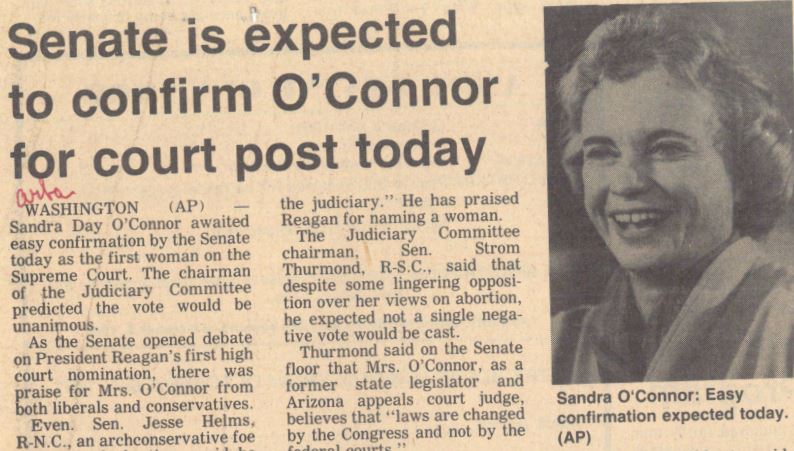
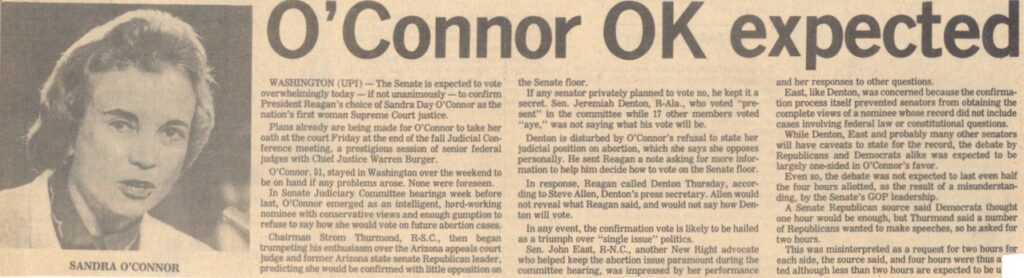
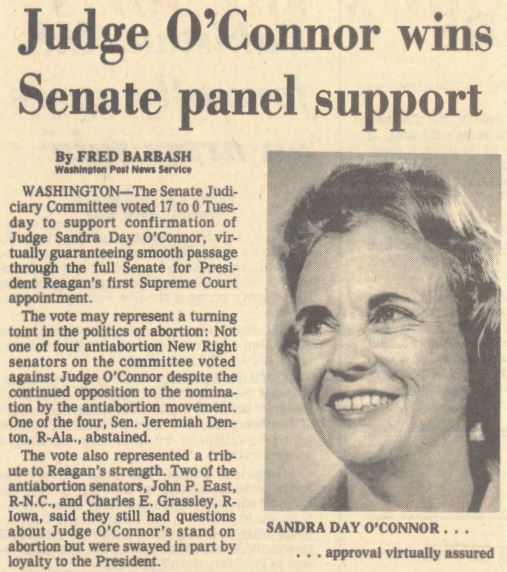
When President Reagan announced O’Connor’s nomination, he lauded her as “a person for all seasons.” In the days that followed, Reagan’s nominee received enthusiastic endorsement from liberals, moderates, and conservatives alike. Indeed, with the exception of ultra-conservative groups, such as The National Right to Life Committee and The Moral Majority, support for the first female justice was nationwide. An Associated Press-NBC poll revealed that 65% of the country supported O’Connor’s appointment.
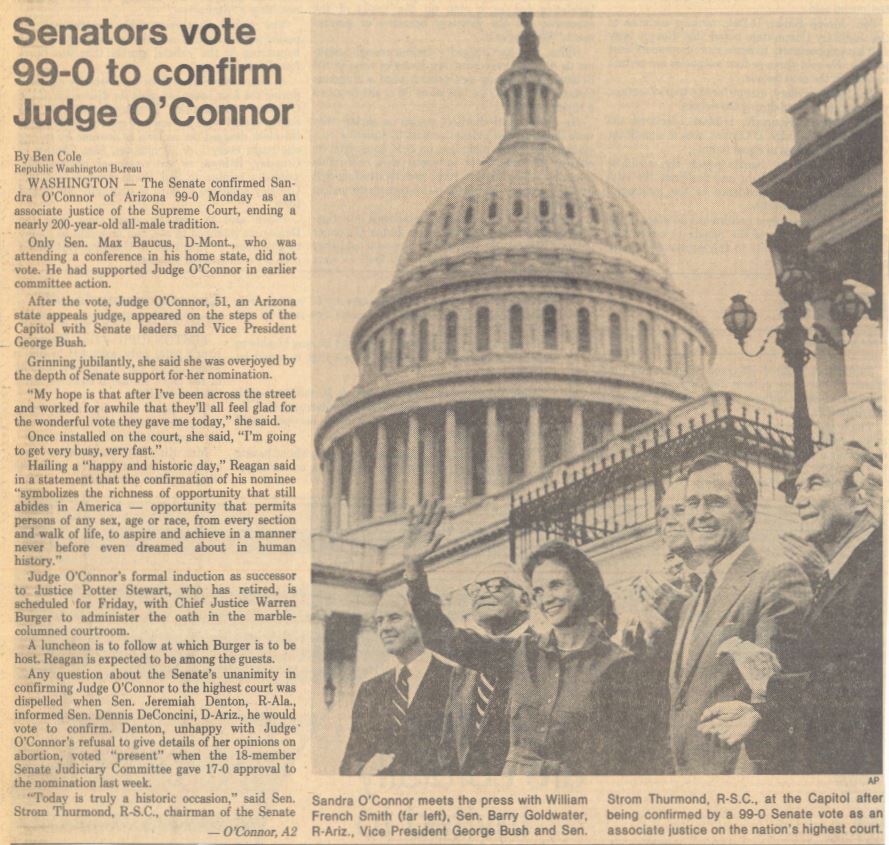
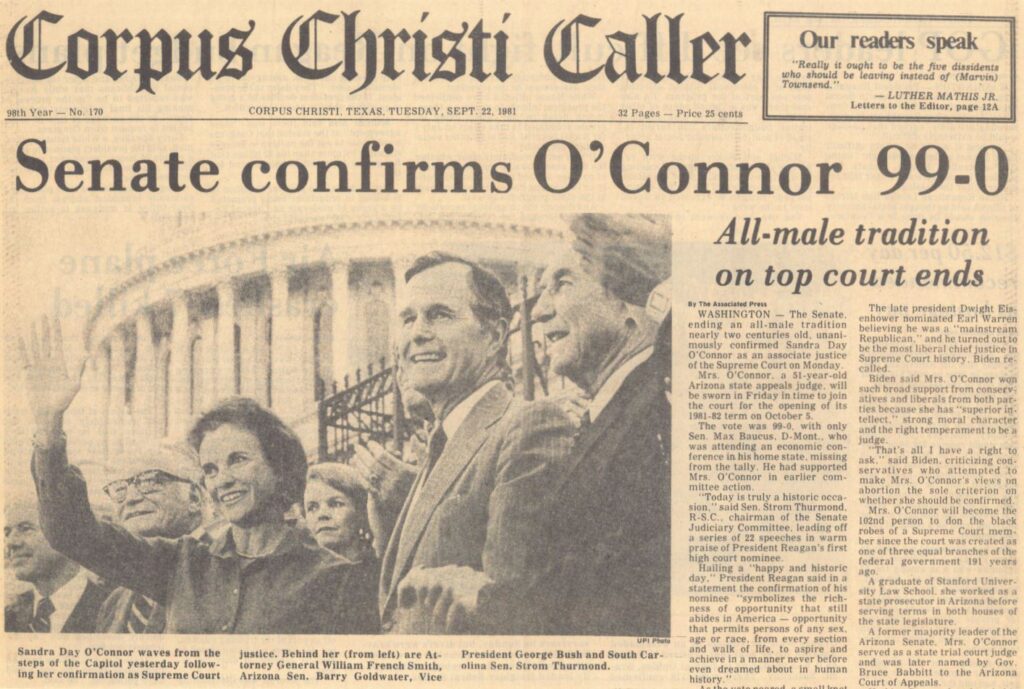
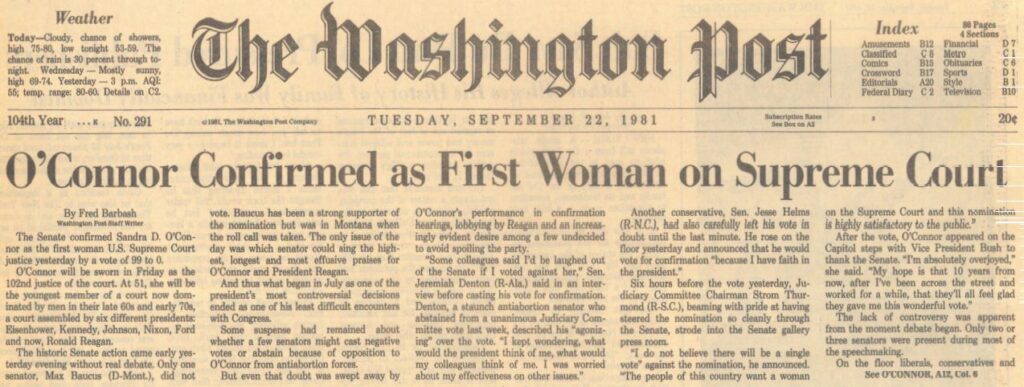
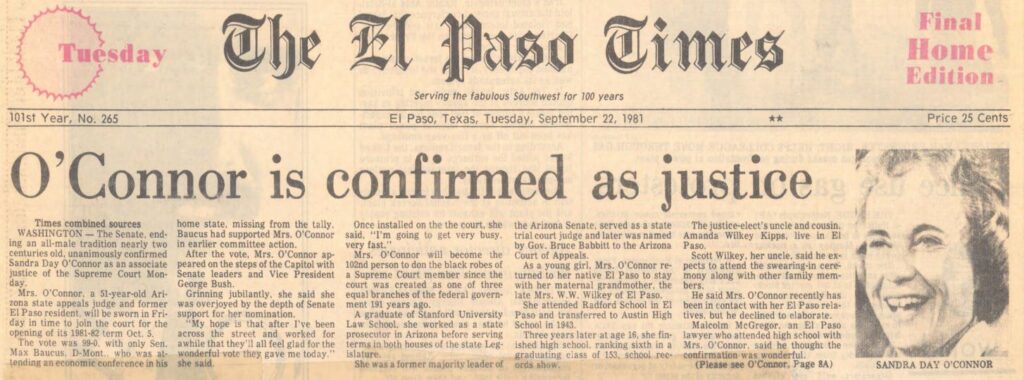
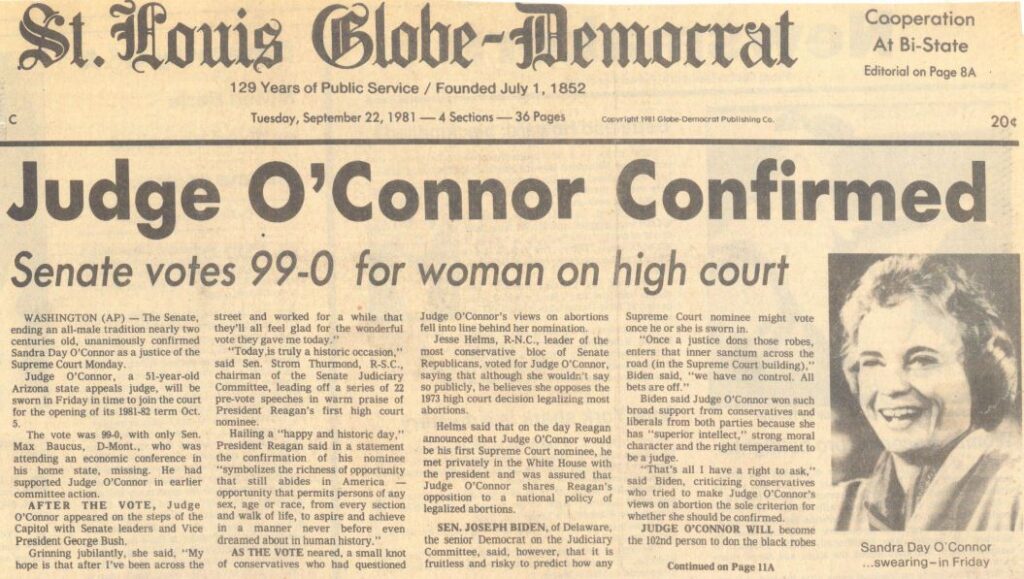
When the time came for the Senate to give its crucial assessment, O’Connor was confirmed 99-0. And, with that vote, a 191-year-old tradition was broken; the brethren finally had a sister.
Who is Sandra Day O’Connor? What unique set of experiences and circumstances guided her walk into history? What will her appointment mean for the Court?
Shortly after O’Connor’s nomination was announced a Presidential aide involved in the search for the first woman justice observed: “She [O’Connor] really made it easy. She was the right age, had the right philosophy, the right combination of experience,
W ASHINGTON – After a while, you begin to wonder , why we get ourselves into suqi a state every time we make a breakthrough that should have come years before. It makes no sense. The most significant thing about wai<:hing Supreme Court Justice Sandra Day O'Connor sitting at the far enl of the U.S. Supreme Court bench he(e Monday was that it all seemed so perfectly natural. justice O'Connor wore the same type of black robe that the other eight jualices wore. Her questions were every bit as probing. Her demeanor wu every bit as serious. If anything, th• new justice appeared even more ~ive in her pursuit of details, more interested in the cases up for con1ideration than some veteran me)n.bers of the court - who sat back and let her do the probing. With its marble pillars, red velvet baekdrop, heavy wooden benches and wine-colored carpets, the Supreme ' Thursday, November 12, 1981 Tom Fitzpatrick Court is more than a little impressive. Each time the court goes into session, long lines form. Lawyers from all parts of the country, law students and tourists wait patiently outside the building, hoping to gain entrance to the limited and always packed seating area. Monday was no exception. The mood of the court was somber. The case under consideration was a death penalty given to a 16-year-old by an Oklahoma court. The question that brought the case of Monty Lee Eddings this far was whether the imposition of the death penalty on a 16-year-old constituted "cruel and unusual punishment."
FORMER ARIZONA Supreme Court Justice Renz Jennings is one Phoenix lawyer who isn’t thrilled that Sandra O’Connor has been elevated to the U.S. Supreme Court. He doesn’t like her. In 1978, Jennings, by then having returned to private Is Actually One Tough Cookie practice, stood in open court as O’Connor, the trial judge, told Jennings’ client that Jennings was representing him so poorly that he should get a new lawyer. Not content to stop there, O’Connor reportedly complained to the state bar disciplinary hoard that Jennings, then 79 years old, was senile and should be removed from practice.
“For Sandra lo do that took a lot of gumption,” says Barry Silverman, a Maricopa County commissioner who was then a prosecutor assigned to O’Connor’s court. “Jennings’ problem – missing deadlines, mishandling cases – was something all of us had winked at. But here was a trial court judge publicly declaring that a former supreme court judge was incompetent.”
Sandra O’Connor’s record is that of a woman who winks at nothing. Often that has made her formal, even rigid, in demeanor. But more often, and more important, it has made her a strong, sometimes gutsy judge who rii;- idly respects the legal process and is intolerant of those who take it less seriously.
Spurred by references in the national media to her supposedly limited credentials and to the middling ratings she had been given in local bar association surveys, I went to Phoenix the month before O’Connor’s confirmation expecting to
Reagan Appoints First Woman to U.S. Supreme Court
WASHINGTON , D. C.- Next week (October 5) the U .S . Supreme Court will-for the first time-gain a woman ‘s touch . After 191 years and 101 male members, the Court is expected to welcome Sandra Day O’Connor as an Associate Justice. President Reagan has appointed her to take the place of Justice Potter Stewart , who retired . The President’ s nomination of Judge O’Connor , which came last July, fulfilled a campaign promise. But President Reagan made it clear that keeping the promise wasn’t his main reason for the appointment. “[I did not pledge] I would appoint a woman merely to do so,” he told reporters . ” Rather , I pledged to appoint a woman who meets the very high standards I demand of all Court appointees .” ‘Smart, Fair’ At the age of 5 I, Sandra O’Con – nor comes to the Supreme Court with a distinguished background . She grew up on her parents’ Lazy B ranch in Arizona but went to private school in El Paso, Tex . During summers, she says, she went back to the ranch and “fixed windmills and repaired fences .” At the age of 17 she entered Stanford University and graduated with honors . She finished Stanford Law School among the top ten in her class. Judge O’Connor was married shortly after graduating from law school to John Jay O’Connor, also a lawyer . They have three sons. From 1965 through 1968 she served as assistant attorney general of Arizona. Then she was elected to the state senate and became senate majority leader
PHOENIX (AP) – U.S. Postal inspectors and Secret Service agents are investigating the mailing this week of dozens of letters, most containing a bullet taped to a picture of President Reagan. A postal inspector in Phoenix, R.D. Kanoy, said the letters are almost identical to a batch sent out in July, allegedly by a Scottsdale man. They were addressed to several Phoenix judges, some U.S. congressmen, Sen. Dennis DeConcini, D-Ariz., and several newspapers, including the Scottsdale paily Progress. Mailing explosives is a federal crime, pwiishable by up to 20 years in prison and a $100,000 fine. The author of the latest letters listed a return address of a Tucson post office box and said they were from “Mr. A. Melvin McDonald,” officials said. McDonald is U.S. Attorney for Arizona. The Scottsdale man who allegedly sent similar letters did so in an apparant attempt to be readmitted to the Air Force after being discharged because of mental problems , Kanoy said. The latest three-page letters included a photocopied photo of Supreme Court Justice Sandra D. O’Connor appears to be dripping blood, The Tucson Citizen said. The words “Kill Ronald Reagan” were coming from her mouth. Blood also was shown dripping from a photo of Reagan, with a .22 caliber bullet taped to his chin.
At the age of 24, Scott O’Connor will bring both youth and experience to the town of Paradise Valley Planning and Zoning Commission. He was recently appointed to serve on the commission by the Town Council. O’Connor, who grew up in the town, said he knows the community well and believes he can do a good job. He also is “glad to be a part of the group” and does not believe his youth will be a problem. O’Connor said he hopes he does not “come off as seeming like a smart aleck young kid” and added that he appreciates the time the other commission members have put in and their experience. O’Connor will attend his first meeting when the planning commission meets at 7 tonight in the Town Hall, 6401 E. Lincoln Drive. O’Connor noted that he has a “fairly good sense of the town.” He is proud of the town’s preservation of open space and hillsides and the “quality of development” in the community. O’Connor also believes in maintaining the town’s “residential character.” He moved to the area as an infant with his parents John and Sandra Day O’Connor. His mother recently became the first woman to be appointed to the U.S. Supreme Court. O’Connor attended Phoenix Country Day School, Brophy Preparatory …
[Photo caption: SCOTT O’CONNOR, 24, will be the youngest member present at tonight’s meeting of the town of Paradise Valley Planning and Zoning Commission. O’Connor is the son of U.S. Supreme Court Justice Sandra O’Connor. ]
Supreme Court J ustice Sandr a Day O’Connor received a new addition to her wardrobe this week. The chemise in question is a T -shirt depicting one woman justice and her eight male colleagues. T he capt ion under the group reads: “One down, eight to go.” Thirty students at the Woman’s Law Caucus of Northern Kent ucky University’s Chase Law School sent the i,hirt to O’Connor. In reply, she wrote, “The T-shirt is terrific. Forgive me if I don’t wear it around my colleagues just yet, but it will be nice to get some female companions m the future.”
WASHINGTON (AP) – Supreme Court Justice Sandra Day O’Connor is refusing to participate in three of the 11 cases argued during the first week of the court’s 1981-82 term. The newest justice has disqualified herself from the three cases, a member of her staff said Friday, but Justice O’Connor will not say why she stepped aside. The three cases – involving insurance law, worker compensation and federal election financing, are to be decided by next June or July. Federal law and a judicial code of conduct requires federal judges to remove themselves from cases in which it might appear they have a conflict of interest. There are no hard rules for most such disqualifications. Many are left up to individual conscience. But a 1974 law requires disqualification from cases in which a judge has any direct financial interest, no matter how small. From information supplied by Justice O’Connor to the Senate Judiciary Committee during her confirmation hearings last month, no financial reason for disqualification is apparent. Justice O’Connor told the committee she. would disqualify herself from all cases in which her husband ‘s Phoenix law firm “had ever participated as legal counsel for a party concerning the matter.”
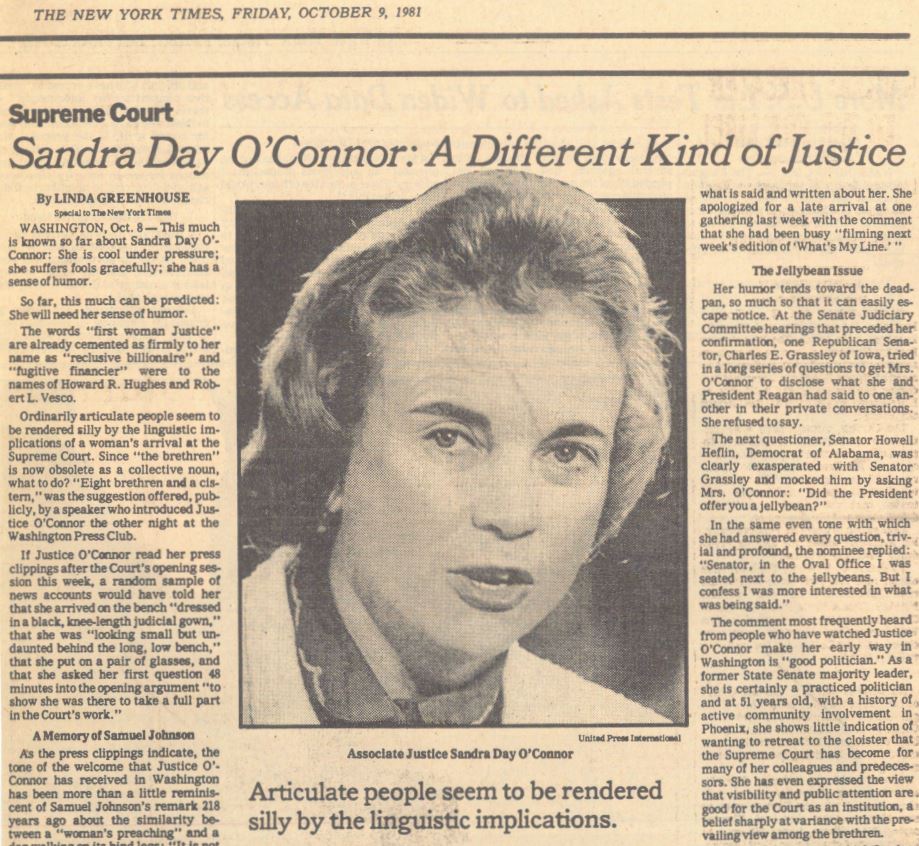
WASHINGTON, Oct. 8 – This much is known so far about Sandra Day O’Connor: She is cool under pressure; she suffers fools gracefully; she has a sense of humor.
So far, this much can be predicted: She will need her sense of humor. The words “first woman Justice” are already cemented as firmly to her name as “reclusive billionaire” and “fugitive financier” were to the names of Howard R. Hughes and Robert L. Vesco.
Ordinarily articulate people seem to be rendered silly by the linguistic implications of a woman’s arrival at the Supreme Court. Since “the brethren” is now obsolete as a collective noun, what to do? “Eight brethren and a cistern,” was the suggestion offered, publicly, by a speaker who introduced Justice O’Connor the other night at the Washington Press Club.
If Justice O’Connor read her press clippings after the Court’s opening session this week, a random sample of news accounts would have told her that she arrived on the bench “dressed in a black, knee-length judicial gown,” that she was “looking small but undaunted behind the long, low bench,” that she put on a pair of glasses, and that she asked her first question 48 minutes into the opening argument “to show she was there to take a full part in the Court’s work.”
A Memory of Samuel Johnson
As the press clippings indicate, the tone of the welcome that Justice O’Connor has received in Washington has been more than a little reminiscent of Samuel Johnson’s remark 218 years ago about the similarity between a “woman’s
WASHINGTON (UPI) – Sandra O’Connor, the Supreme Court’s first woman justice, disqualified herself from three of the 15 cases argued before the court during her first three days on the bench.
Following court custom, Judge O’Connor gave no reason for excusing herself from the cases that were the subject of oral arguments, court spokesman Barrett McGurn said Wednesday.
It is not uncommon for a justice to occasionally disqualify himself from a case, possibly because of a conflict of interest. But three disqualifications by the same judge in three days is highly unusual.
McGurn said: “The tradition is not to state a reason – just to step aside. There are a variety of reasons why justices stand aside, sometimes because of old law firm associations or some other personal contact or other.”
Before joining the court, Judge O’Connor was an Arizona state appeals court judge. Before that, she was the Republican leader of the Arizona state Senate. Her husband practices law in Phoenix.
One of the three cases Judge O’Connor did not sit on the bench for involves an effort by Common Cause to get the court to uphold a $1,000 limit on spending by independent political action committees to support a candidate who accepts public money for his campaign.
It pits Common Cause, a self-styled “citizens’ I lobby,” and the Federal Elections Commission against Sen. Harrison Schmitt, R-N.M., and three political action committees that backed President Reagan.
In her first major public action as a Supreme
WASHINGTON (AP) – It was a dramatic moment in American history the first time a woman has served on the bench of the U.S. Supreme Court – but Sandra Day O’Connor handled it with the same aplomb she exhibited during her Senate confirmation hearings. As the court began its new term Monday, the 51-year-old former Arizona appeals court judge showed no reluctance in making her public debut as a working Supreme Court justice. Her first inquiry from the bench – regarding a complex offshore oil and natural gas leasing case – came little more than a half hour into the first oral argument. “Mr. Silard, may I ask a question ?” Justice O’Connor said at 10: 46 a.m, John Silard, arguing on behalf of the Energy Action Educational Foundation, already had asked several other justices to delay their questions until he finished a point. He did the same with the court’s 102nd justice, saying: “Just a minute, your honor.” After answering a previous question from the bench, Silard invited O’Connor to proceed. “It isn’t clear, is it, that even if California wins here, that the secretary (of the Interior) would use the bidding system California prefers,” she asked. “The secretary would still be free to use other experiments.” Her question referred to California’s bid in the case to obtain an offshore oil and natural gas leasing system that would yield greater revenue for the state. The views of the educational foundation Silard represents are essentially the same as those held by the state of California.
WASHINGTON – The Supreme Court on Monday refused to review lower court decisions barring voluntary prayer at “optional” assemblies in the Chandler Unified School District south of Phoenix. Chandler High School Principal Howard Conley said he was disappointed by the decision. “I would suppose this is the end of the prayer issue. You can’t go any higher than the Supreme Court. We’ll certainly abide by the Supreme Court,” he said. The high court, by refusing to review the case, upheld a 1979 court ruling. Prayers were prohibited on constitutional grounds by U.S. District Judge Carl A. Muecke, who cited a 1962 Supreme Court ruling that outlawed school sponsorship of prayers. Muecke’s ruling was upheld by the 9th U.S. Circuit Court last May. The Chandler controversy originated in 1978 when Theresa Collins, the mother of two students, challenged the school’s practice of allowing the student council to open school assemblies with a prayer. The practice of opening the morning assemblies with voluntary prayer went on at the school from at least 1976-77, when Conley took over as principal, to March 1979 when the District Court made its ruling. Conley said he thought the Supreme Court might allow the prayers in Chandler High School because of the “different way” they were presented at the school. Prayers were given during non-mandatory assemblies by decision of the students, he said. “Our assemblies are organized, developed and administered by students. “It was not a state prayer, Methodist
WASHINGTON (AP) – Sandra Day O’Connor, in her public debut as a working Supreme Court Justice, wasted little time Monday in asking her first question from the high court bench. “Mr. Silard, may I ask a question?” the court’s first woman member said at 10:46 a.m., a little more than one-half hour into the first oral argument of the new term. John Silard, arguing a complex offshore oil and natural gas leasing case on behalf of the Energy Adion Educational Foundation, shot back: “Just a minute, your honor.” Silard, who also had asked several other justices to hold up on questions while he finished a point, went on to complete his answer to a previous question ltom the bench. Then he beckoned to Justice O’Connor, who said “It isn’t .clear, is it, that even if California wins here, that the secretary (of the Interior) would use the bidding system California prefers. The secretary would still be free to use other experiments.” Her query referred to California’a bid in the case to obtain an offshore oil and natural gas leasing system that would yield greater revenue for the state. Silard, Waving his finger in the air at Mrs. O’Connor to make his points, then elaborated at length on the various leasing systems available Without specifically agreeing or disagreeing with Mrs. O’Connor’s line of reasoning.
After several questions from other justices, Silard wound up his argument by looking directly at Justice O’Connor and saying he hoped the court’s decision would grant “a new life to
WASHINGTON (AP) – Sandra Day O’Connor , in her public debut as a working Supreme Court Justice, wasted little time Monday in asking her first question from the high court bench . “Mr. Silard, may I ask a question?” the court’s first woman member said at 10:46 a .m. , a little more than one-half hour into the first oral argument of the new term . John Silard, arguing a complex offshore oil and natural gas leasing case on behalf of the Energy Action Educational Foundation, shot back : “Just a minute, your honor .” Silard , who also had asked several other justices to hold up on their questions while he finished a point, went on to complete his answer to a previous question from the bench. Then he beckoned to Justice O’Connor . “It isn’t clear, is it, that even if California wins here, that the secretary (of the Interior) would use the bidding system California prefers?” she asked. “The secretary would still be free to use other experiments.” Her question referred to California’s bid in the case to obtain an offshore oil and natural gas leasing system that would yield greater revenue for the state . Silard, waving his finger in the air at Mrs. O’Connor to make his points, then elaborated at length on the various leasing systems available without ever specifically agreeing or disagreeing with Mrs. O’Connor’s line of reasoning . After several questions from other justices , Silard wound up his argument by looking directly a t Justice O’ Connor and saying he hoped the court’s decision
WASHINGTON – Justice Sandra Day O’Connor, newly sworn in as the first woman to serve on the Supreme Court, picked a gathering of reporters for her initial step into the Washington social scene, accepting an invitation to swear in Carol Richards of Gannett News Service as the new president of the Washington Press Club – a club, by the way, which didn’t allow any men as members until 10 years ago.
Everything was moving along smoothly until the afternoon of the event when a White House staffer called Richards to report that Justice O’Connor was “quite adamant” that her remarks at the gathering be off the record – despite the fact that she was invited as “guest speaker” for an audience of more than 300 working journalists. The White House aide said he would do his best to get her to change her mind but a short time later called back to say the judge “simply has to go off the record.”
Before the program got under way, Richards tried to strike a compromise, suggesting that Justice O’Connor put part of her remarks on the record “just to give these people something to report,” and then go off the record for the remainder of her comments. But the judge said absolutely not.
Interestingly, her speech was brief, light and humorous – hardly the substantive, candid stuff of most off-the-records.
Rep. Barber Conable, R-N.Y., the master of ceremonies, also tried – and failed – to change Justice O’Connor’s mind, but his conversation with her may explain her reasoning.
“This is not a smart
No sooner than Sandra Day O’Connor won confirmation by the Sena te than she said she plans to be ” ver y bus y, very fast ,” after she is sworn in later this week . Well, I should hope to kiss a cow. After nearly 200 years, this male bas – tion can use the services of a woman . Oh, I doubt the other eigh t Supreme Court justices will allow her to take part in any judical proceedings because , after all , she is a woman . Hut, idle hands are the Devil ‘s pla y”ma tc, and that ‘s an adage that has ~ell stood the test of time . So I would as sume that her offic e would include kitchen facilities , wher e ,’w could whip up some sn,1cks to ser ve at a cot1ee break for her deliberating eolh•..igUl’S fte r all , ju st ice travels on its stomach. as the saying goes. Justice O’Connor could also earn her money by dusting off the law books and performing other household chores around the court. And, I would strongly suggest Sandra take a course in shorthand so that she can take the minutes of the meetings , and read them back for corrections, additions, and deletions at the next meeting. Speaking of earn ing her mone y, I can only hope the y are not going to pay her as much as they do the male jus tices . A r ecent government survey showed that women , in general receive only 60 as much money as males for doing the same job. Tha t should not surpr ise an ybody, because that ‘s as it should be, and all men will dri nk to tha t. So, I propose Justice O’ Connor re cieve 60 percent of the
High court won’t review death term in Tison case Appeals not exhausted for Randy Greenawalt The U.S. Supreme Court refused Monday to review the conviction and death sentence of Randy Greenawalt in the case of a Yuma family shotgunned to death during a gang rampage in 1978. Justice Sandra O’Connor of Phoenix, on her first day as an associat,e justice of the Supreme Court, joined the 7-2 majority that declined to review the case. Justices William Brennan and Thurgood Marshall dissented. Greenawalt’s attorney, Robert C. Brown of Casa Grande, said the appeal process is not over. Greenawalt still can take his appeal to the high court by appealing through lower federal courts. Brown said he had not talked with Greenawalt but assumed the appeal would be pursued. Greenawalt and Ricky and Raymond Tison were sentenced to death in 1979 for the murders of Marine Sgt. John F. Lyons; his wife, Donnelda; his 22-month-old son Christopher; and his niece, Teresa Jo Marie Tyson of Las Vegas, Nev. The four were killed aft.er Raymond, Ricky and their brother, Donald, helped their father, Gary, and Greenawalt escape from Arizona State Prison on July 30, 1978. The Tison gang committed the murders north of Yuma to obtain the Lyons’ car after the gang’s car had been disabled. Donald Tison was killed in a shootout near Casa Grande on Aug. 11, 1978. His father died of exposure in the desert while trying to elude pursuers. Brown said Greenawalt’s appeal was based on more than 20 legal questions including
In her first day as an associate justice of the U.S. Supreme Court, Sandra O’Connor of Phoenix joined the majority in declining to review the death sentence of convicted Arizona murderer Randy Greenawalt, a court spokesman said. …
Mark Henning, banker, Phoenix
My heroine is Sandra O’Connor. I’ve read so much about her since her nomination to the Supreme Court, and she really persevered to get where she is today. I read that when she got out of law school and applied for a job, she was offered a secretarial position. Imagine that.
Where does the Senate, the Moral Majority or anyone get their nerve to insist that an appointee to the Supreme Court or to any position has to agree with them on every issue whether it be abortion or anything else? The deficiencies in our form of government were obvious after witnessing the extreme pressure put on Sandra O’Connor from a bunch of idiots who insist that everyone has to think their way. And these people were appointed by us to preserve our rights and freedoms!
HAIG LORDIGYAN Paradise Valley
WASHINGTON – Sandra Day O’Connor today served her first working day on the bench as the first woman on the United States Supreme Court. The 51-year-old former Arizona appeals court judge, state court trial judge and Arizona Senate majority leader, took her oath of office Sept. 25. She promised then to be “very busy, very fast” and spent last week reviewing cases with the court’s other justices. But today was her first working day on the bench hearing arguments. Justice O’Connor – as she will be addressed by her eight brethren on the nation’s highest court – occupies the seat traditionally taken by the court’s most junior justice, to the far right of the bench u viewed from the courtroom. After Mrs . O’Connor’s swearing-in ceremony, Chief Justice Warren E. Burger announced that she would take over the supervisory duties of the 6th U.S. Circuit Court of Appeals, which covers Kentucky, Michigan, Ohio and Tennessee. Mrs. O’Connor was confirmed by the Senate Sept. 21 In a victory both for her and for Ronald Reagan the first president to nomirmte a woman to the Supreme Court. Although there had been considerable debate before the confirmation vote, particularly on Mrs. O’Connor’s previous position on abortion, when the day came she was approved unanimously .
The hottest ticket in town next month is likely to be one for the shindig Gov. Bruce Babbitt is tossing for Supreme Court Justice Sandra O’Connor Nov. 25 at the Arizona Biltmore. About 2,000 invitations have been sent out for the black-tie gala, but only 850 can be accepted. It is a first-come, first-seated affair, and letters of regret have already been prepared for those not acting fast enough. Organizers of the banquet are privately hoping President Reagan sends regards only and stays m Washington for the holidays. The security arrangements for a presidential visit would toss a monkey wrench in the best-laid plans, which were hush-hush – until now, at least. The dinner will cap a daylong Phoenix and Arizona celebration honoring the first woman to serve on the high court. Plans are in the works for a ceremony in the state Capitol, where Justice O’Connor once served as a state senator, and a combined city of Phoenix and Junior League luncheon at the Lath House, which is next to the Rosson House in Heritage Square.
Editor:
I could not help but think of Arizona’s Sandra O’Connor and how she must have felt, honored by the president of the United States, a Rose Garden reception, and a White House luncheon. This great and most deserved honor, could only be topped by the endorsement of the great Jerry Falwell. Personally, I would rather be bitten by a Cobra. MEL WILLIAMS Mesa
WASHINGTO N – When the Supreme Court begins its 1981-82 term Oct. 5, it will ag, n find itself poised on the cuttmg edge between the status quo and a new political order. As the Reagan administration moves to reduce the sweep of much of the landmark legislation enacted in the 1960s and 1970s, the court will review many of those same laws in the 102 cases already set for argument in the new term. The justices also are likely to address a number of perennially touchy issues, including school busing, church-state separation, the death penalty and the obligation of a state to educate children of illegal aliens. President Reagan’s policies are not directly at issue in most of the cases, but the way in which the justices resolve the issues could accelerate or brake the administration’s momentum in certain areas. Historically, the court has served as a balance wheel within the federal system . It has moved to the “conservative ” side when Congress or the president shifted sharply to the left, as in the early New Deal days. And the rulings in the last term indicate the court may be taking a more liberal stance on certain issues as the Reagan administration and the 97th Congress move to the right. For example, in the last term, the justices ruled repeatedly in favor of broad federal regulatory power – directly countering a major administration thrust . The Reagan regime already has sharply reversed the government ‘s position on two key issues before the court , school busing and the education
Sandra O’Connor, formally resigning from the Arizona Court of Appeals, attributed her appointment as the first woman U.S. Supreme Court justice to Gov. Bruce Babbitt and the women “of yesterday and today.” O’Connor, whose nomination to the Supreme Court was confirmed 99-0 by the Senate Sept. 21, resigned, effective immediately, in a letter submitted to Babbitt. She recalled Babbitt, a Democrat, appointed her to the Appeals Court on Dec. 4, 1979 and said she doubted she would have received the Supreme Court nomination had it not been for that appointment. “You appointed me to the office I now leave,” she told Babbitt. “You appointed me not only despite the [act that we belong to two different political parties, but fully aware that my appointment did not seem politic to certain of your advisors. “I believe I would not have been named to the United States Supreme Court unless I had been a sitt_ing appellate court judge. Thus, but for your action, I would today be a Superior Court judge in Maricopa County rather than a United State Supreme Court justice in Washington. “If, indeed I will walk across the pages of history, then you played a most vital role in starting me on my journey. I thank you for that start.” O’Connor, a Superior Court judge from 1975 until she was appointed by Babbitt to the Appeals Court said she was accepting her new position and resigning from old one with mixed emotions. “I have been greatly honored by my appointment to the Supreme Court,” she said. “I have
BOSTON – Last Friday, Sandra O’Connor joined The Brethren. And an elite sisterhood . Last Friday, Sandra O’Connor became the 102nd Supreme Court Justice . And the rirst woman Justice. As all the speeches about barrier-breaking, history-making, inner-circle-integrating end. she is settling down to two of the hardest roles in the cowitry: Supreme Court Justice and First Woman. IN SOME WAYS, this woman who won her robe with the unanimous consent of thf – ate and the goodwill of the people, wi1 ” approval of conservatives and the best wishe:. of the women’s rights activists, faces the issues shared by any woman who has ever been the first, the exception, the only, the other . How do you deal with the extra burdens? How do you live with the attention and the expectations? With the demands of conscience and history? O’Connor wants to be remembered as a good Justice, but she will be judged, in large part, as a Woman Justice . Her opinions will be scrutinized for signs of her sex; her behavior will be analyzed for clues of her kind . Like every other first woman , she will be visible and vulnerable, the one Justice in the photograph whom everyone can name . She will be criticized if she doesn’t ” think like a male Justice” and criticized if she does . Someone will surely want her to prove that a woman on the bench makes a difference, and someone else will want her to prove that women on the bench are no different It is, as Margaret Hennig, dean of the Graduate School of Business Management
WASHINGTON (AP) -Somewhere, logic got lost in the debate over Justice Sandra Day O’Connor’s appointment to the Supreme Court. She is, after all, a conservative Republican, her conservative detractors notwithstanding. She takes to the court a conservative’s reverence for precedent and letterof-the Constitution-interpretation of the law. Yet conservatives who claim to share that philosophy were critical of her nomination, and some remained skeptical even as they joined in unanimous Senate confirmation of the first woman justice. Single-issue politics-in this case, the issue was abortion-can distort a debate that way. AFTER failing to get Mrs. O’Connor’s assurance that she would act to …
proximately 200 years of the court, has been accurately able to predict what a justice of the Supreme Court would be like,” said Sen. Joseph Biden Jr., DDel. Biden said the debate unfolded as it did because nowadays it is liberals, not conservatives, who want strict constructionists on the federal bench. That’s because liberals do not want to overturn decisions of the Warren Court. He said what Helms and his conservative allies really want is activist judges. “If Judge O’Connor is not an activist, she has problems , because she is not going to be overturning the decisions that they-and I on occasion-sometimes find odious, obnoxious or totally reprehensible, ” said Biden, who also opposes the abortion decision. Judicial conservatism and political conservatism , particularly that of the New Right
A ccording to Sandra O’Connor, the first woman justice of the Supreme Court, “a court’s duty is to interpret laws and test them against the constitution – not to usurp the duties of the legislative and executive branches.” Similarly, this newspaper’s role in the community is to report facts and opinions which reflect the wide spectrwn of interests. Our industry is referred to as a fourth estate, a quasi branch of gov~rnment. Thomas Jefferson went so far as to say, “Given a choice between a government .without a newspaper or a newspaper without a government, I would not hesitate for a moment to choose the latter.” !o fulfill our community responsibility of reporting the news, this newspaper must be accessible both to low-profile groups and the community movers and shakers. !he. ~irst group, which includes the elderly, handicapped, mmorities, youth, and the unborn, often do not get a fair shake because they have difficulty obtaining access to media sources. In contrast, the movers and shakers have no difficulty with media access and are heard from often. In the interest of fairness, I feel it is our responsibility to assist as o~ten ~s we c~ th~e ~orities which find it difficult to get a public voice. This attitude IS part of our commwlity responsibility and does not represent a preference on our part for any particular group or organization.
Last Friday , Sandra O’Connor j(,>ined The Brethren. And an elite sisterhood. Last Friday, Sandra O’Connor became the 102nd Supreme Court Justice. And the first woman Justice. As. all the speeehes about barrierbreaking, history-makiRg, inner-circle-integrating enu, she is settling down to two of the hardest roles in the country: Supreme Court Justice and First Woman. In some ways, this woman who won her robe with the unanimous consent of the Senate and the goodwill of the people, with the approval of conservatives and the best wishes of the women’s rights activists, faces the issues shared by any woman who has ever been the first, the exception, the only, the other. How do you deal with the extra burdens? How do you live with the attention and the expectations? With the demands of conscience and history? Fine service O’Connor wants to be remembered as a good justice, but she will be judged, in large part, as a Woman Justice. Her opinions will be scrutinized for signs of her sex; her behavior will be analyzed for clues of her kind. Like every other first woman, she will be visible and vulnerable, the one justice in the photograph whom everyone can name. She will be criticized if she doesn’t “think like a male justice” and criticized if she does. Someone will surely want her to prove that a woman on the bench makes a difference, and someone else will want her to prove that women on the bench are no different. It is, as Margaret Hennig, dean of the Graduate School of Business Management
WASHINGTON (AP) – Her place in American history secure, Sandra Day O’Connor gets down to work Monday, her public notoriety as the first woman on the Supreme Court giving way to the private, workaday life of her eight fellow justices. Sworn in Friday as the high court’s 102nd member, she will meet with her colleagues Monday for a week of closed-door deliberations in anticipation of the Oct. 5 opening of the 1981-82 term. Even before she joined the court, Justice O’Connor told reporters she expected to become “very busy, very fast” in trying to master the 102 cases already scheduled for full study and decision. In addition, the court on Oct. 5 is expected to issue orders – most of them grants or denials of review for appeals left pending last July or those that arrived during the summer recess – in as many as 1,000 cases. Justice O’Connor inherits three law clerks who have spent most of the summer previewing those cases. As of Friday, the three young lawyers selected nearly a year ago to spend the coming term working for now-retired Justice Potter Stewart will work for Justice O’Connor. She has hired a lawyer from her husband’s Phoenix law firm to be a fourth clerk. Justice O’Connor also inherits some direct responsibility from the man she succeeds in the lifetime post. She will serve as circuit justice for the 6th federal judicial circuit, handling emergency matters from Kentucky, Michigan, Ohio and Tennessee. Justice O’Connor is moving into the chambers used until recently by
The elevation of a woman, Sandra Day O’Connor, to the U.S. Supreme Court for the first time has sparked renewed concern as to whether women judges can be objective on the bench, particularly in dealing with such highly emotional and female-oriented issues as abortion and rape. Even the chief justice of that high court is alleged to have expressed reservations in this regard. This erroneous and presumptuous apprehension is premised on sexually stereotypical thinking which historically has permeated so much of our male-dominated culture, including the legal and judicial professions. Women judges, like those of the male sex, have the intellect, education and experience to decide the thousands of civil and criminal cases that come before them on the facts and the applicable law. Indeed, being acutely aware of their high visibility, women are particularly sensitive to their judicial role. Women judges are thus less likely than entrenched and secure male judges to indulge biases in deciding cases. It is a startling revelation that over the decades so few among us have questioned the objectivity of white Anglo-Saxon male judges who have been presiding over us all, male and female, of every color and ethnic background. Two male law professors who had the temerity to address the subject in the N.Y.U. Law Review in 1971 found, as might be expected, that male judges bring to the bench a variety of prejudices stemming from their sexual, ideological, cultural, ethnic, religious, economic
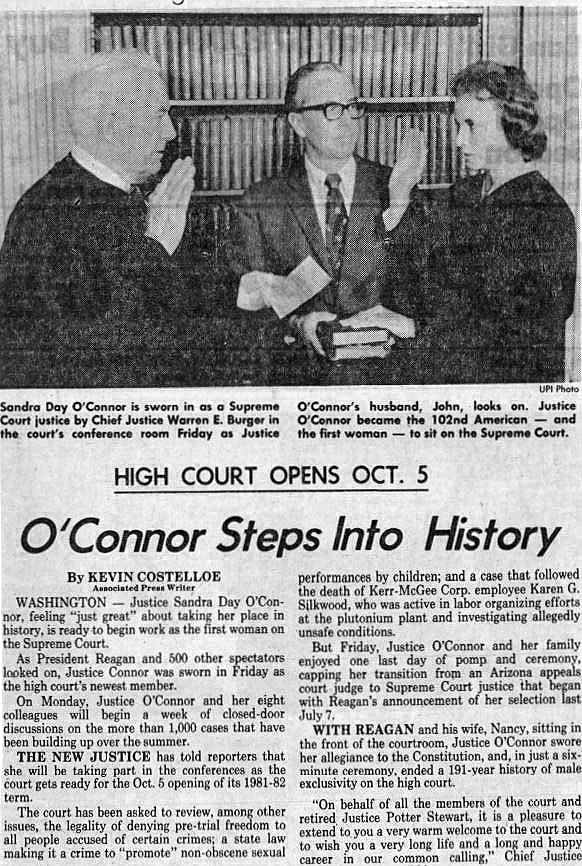
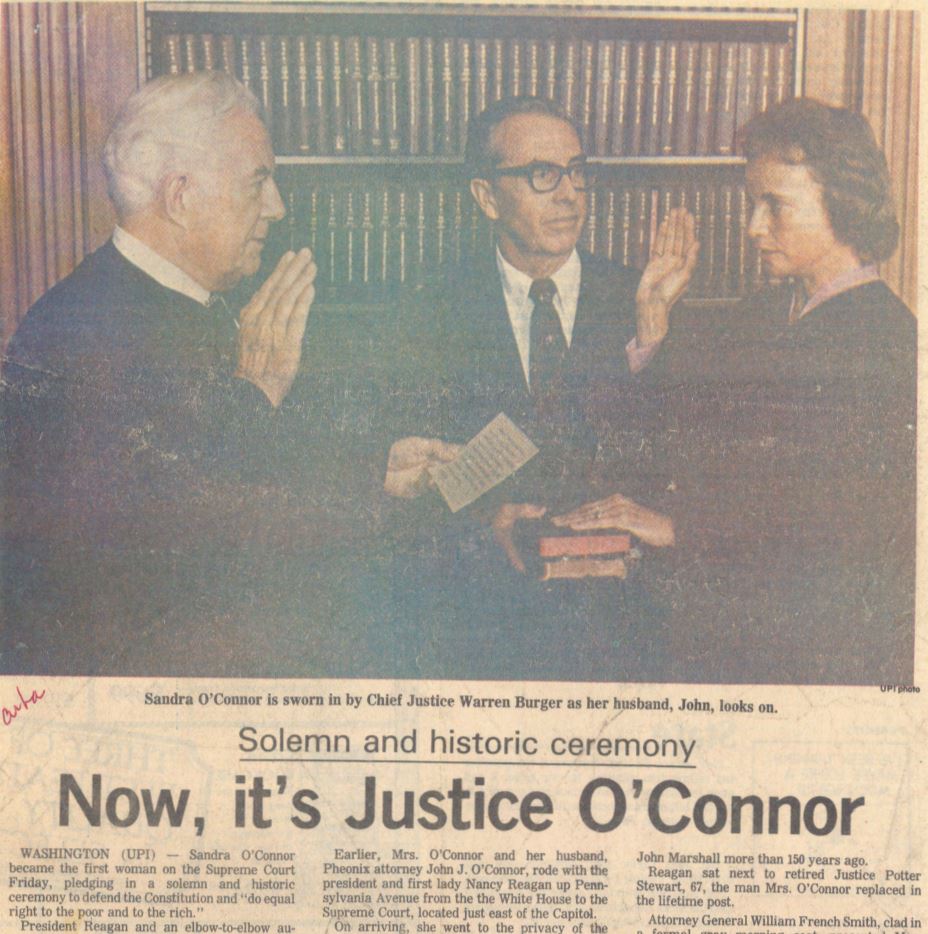
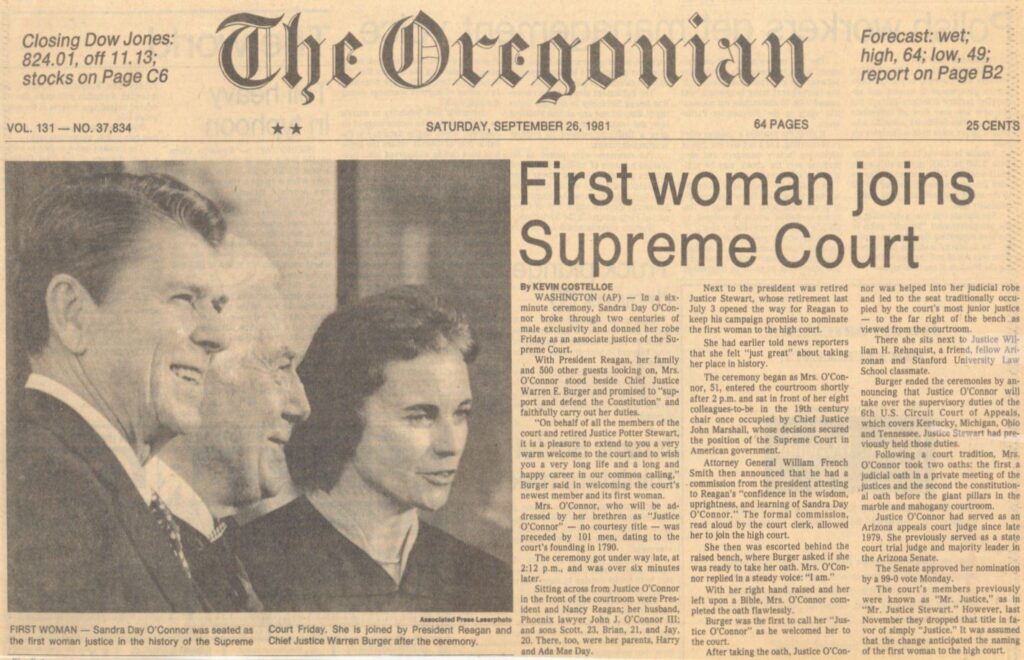
WASHINGTON – In a six-minute ceremony, Sandra Day O’Connor broke through two centuries of male exclusivity and donned her robe Friday as an associate justice of the Supreme Court. With President Reagan, her family and 500 others watching, O’Connor stood beside Chief Justice Warren E. Burger and promised to “support and defend the Constitution” and faithfully carry out her duties. “Justice O’Connor, welcome to the court,” Burger said at the conclusion of the oath. “I wish you a long life and a long and happy career in our common calling.” 9’Connor, who will be addressed by her brethren as “Justice _O’Connor” – no courtesy title – was preceded by 101 men, dating to the court’s founding in 1790. The court’s members were previously known as “Mr. Justice,” as in “Mr. Justice Stewart.” However, last November they dropped that title in favor of simply “Justice.” It was assumed that the change anticipated the naming of the first woman to the high court. . EARLIER, O’CONNOR and her husband, Pheonix attorney John J. O’Connor III, rode with the president and first lady Nancy Reagan up Pennsylvania Avenue from the White House to the Supreme Court, just east of the Capitol. The short ceremony started late, at 2:12 p.m. Sitting across from Justice O’Connor in the front of the courtroom were the Reagans, O’Connor’s husband and O’Connor sons Scott, 23, Brian, 21, and Jay, 20. Nearby were her parents, Harry and Ada Mae Day. Next to the president was Potter Stewart, whose retirement last July
WASHINGTON – Justice Sandra Day O’Connor, feeling “just great” about taking her place in history, is ready to begin work as the first woman on the Supreme Court. As President Reagan and 500 other spectators looked on, Justice Connor was sworn in Friday as the high court’s newest membei.:. On Monday, Justice O’Connor and her eight colleagues will begin a week of closed-door discussions on the more than 1,000 cases that have been building up over the summer. THE NEW JUSTICE has told reporters that she will be taking part in the conferences as the court gets ready for the Oct. 5 opening of its 1981-82 term. The court has been asked to review, among other issues, the legality of denying pre-trial freedom to all people accused of certain crimes; a state law making it a crime to “promote” non-obscene sexual performances by children; and a case that followed the death of Kerr-McGee Corp. employee Karen G. Silkwood, who was active in labor organizing efforts 1 at the plutonium plant and investigating allegedly unsafe conditions. But Friday, Justice O’Connor and her family enjoyed one last day of pomp and ceremony, capping her transition frolll an Arizo!)a appeals court judge to Supreme Court justice that began ‘ with Reagan’s announcement of her selection last July 7. WITH REAGAN and his wife, Nancy, sitting in 1 the front of the courtroom, Justice O’Connor swore her allegiance to the Constitution, and, in just a six• minute ceremony, ended a 191-year history of male exclusivity on the
…
Maybe Congress could appropriate some money, Burger sugeested To some onlookers, the scene was life imitating art, a scene out of “First Monday In October .” a cur – rent comic film about the first woman justice . O’Connor, at 51, also is the youngest justice on a court dominated by men well past normal retirement age. Five of the nine justices, appointed by Presidents Dwight Eisenhower. Lyndon Johnson and Richard Nixon, are over 70. O’Connor, having won the confirmation plaudits of the Senate Judiciary Committee and the full Senate by votes of 17–0 and 99-0, will find little unanimity among her new male colleagues on the most controversial issues of the day. For years. the justices have been split, often with a sinele vote -separ ating them, on cases involving school desegregation, affirmative J action, abortion, state aid to reli- – gion, obscenity , government regula- , tion and the death penalty 1 A conservative on many issues, O’Connor is expected to make little difference in the court’s fraeile balance because she replaces the retired Potter Stewart, who voted conservatively on school busing, affirmative action, school prayer, health and safety regulations and other bitterly debated subjects .
WASHING TON (UPI) – Sandra O’Connor became the first woman on the Supreme Court Friday, pledging in a solemn and historic ceremony to defend the Constitution and “do equal right t? the ~r and to the rich.” President Reagan and an elbow-to-elbow audience of 400 people jamme~ the courtroom to watch Chief Justice Warren Burger swear in the Mrs. O’Connor as an associate justice of the nation’s highest court . “Justice O’Connor, welcome to the court,” Burger said at the conclusion of the oath. “I wish you a long life and a long and happy career in our common calling.” Earlier, Mrs. O’Connor and her husband, Pheonix attorney John J . O’Connor, rode with the president and first lady Nancy Reagan up PeMsylvania Avenue from the the White House to the Supreme Court, located just east of the Capitol. , On arriving, she went to the privacy of the . ~ustices’ oak-paneled conference room, where the j shf took a Judicial Oath from Burger. There she pledged, in part, ‘i~~P.f. justice without ~ spect to p~nmns, and do equal right to 1:/1! 911or I.Ind to fl)~ nch.” A Sl)ecial session of the high court followed, COrunencing – as always – with the sharp rap of tile gavel by Court Marshal Alfred Wong and the entrance of the black -robed justices. John Marshall more than 150 years ago. Reagan sat next to retired Justice Potter Stewart, 67, the man Mrs. O’Connor replaced in the lifetime post. Attorney General William French Smith , clad in a formal gray morning coat, presented Mrs . O’Connor’s commission
WASIIlNGTON – In a six-minute ceremony, Arizona Judge Sandra Day O’Connor broke through two centuries of male exclusivity and donned her robe Friday as an associate justice of the Supreme Court. With President Reagan, her family and 500 guests looking on, O’Connor stood beside Chief Justice Warren E. Burger and promised to “support and defend the Constitution” and faithfully carry out her duties. “On behalf of all the members of the court and retired Justice Potter Stewart, it is a pleasure to extend to you a very wann welcome to the court and to wish you a very long life and a long and happy career in our common calling,” Burger said in welcoming the court’s newest member and its first woman. O’Connor, who will be addressed by her brethren as “Justice O’Connor” – no courtesy title – was preceded by 101 men, dating to the court’s founding in 1790. Sitting across from Justice O’Connor in the front of the courtroom were President and Nancy Reagan, her husband, Phoenix lawyer John J. O’Connor III, and sons Scott, 23, Brian, 21, and Jay, 20. There, too, were her parents, Harry and Ada Mae Day. She earlier had told news reporters that she felt “just great” about taking “‘ler place in history. ceremony began as O’Connor, 51, entered the courtroom shortly after 2 p.m. and sat m front of her eight colleagues-to-be in the 19th~entury chair once occupied by Chief Justice John Marshall, whose decisions secured the position of the Supreme Court in American government. Attorney General William
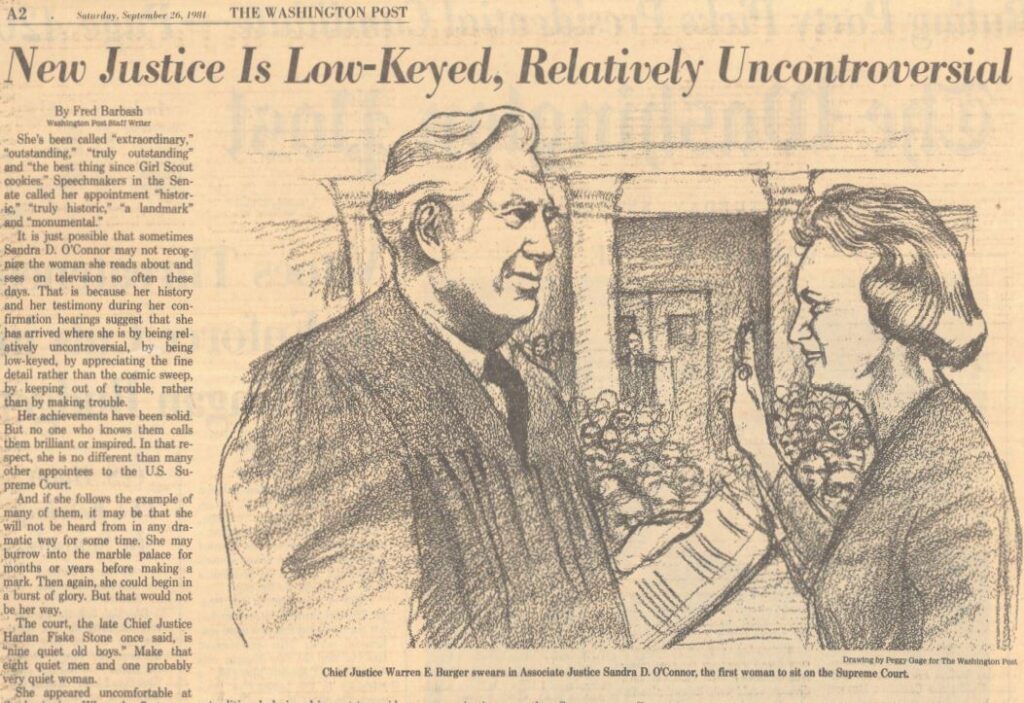
She’s been called “extraordinary,” “outstanding,” “truly outstanding” and “the best thing since Girl Scout cookies.” Speechmakers in the Senate called her appointment “historic,” “truly historic,” “a landmark,” “monumental.” It is just possible that sometimes Sandra D. O’Connor may not recognize the woman she reads about and sees on television so often these days. That is because her history and her testimony during her confirmation hearings suggest that she has arrived where she is by being relatively uncontroversial, by being low-keyed, by appreciating the fine detail rather than the cosmic sweep, by keeping out of trouble, rather than by making trouble. Her achievements have been solid. But no one who knows them calls them brilliant or inspired. In that respect, she is no different than many other appointees to the U.S. Supreme Court. And if she follows the example of many of them, it may be that she will not be heard from in any dramatic way for some time. She may burrow into the marble palace for months or years before making a mark. Then again, she could begin in a burst of glory. But that would not be her way. The court, the late Chief Justice Harlan Fiske Stone once said, is “nine quiet old boys.” Make that eight quiet men and one probably very quiet woman. She appeared uncomfortable at the beginning. When she first came to town, she seemed visibly stunned, even a bit shaken, by all the attention she was getting. “I’ve never seen so many reporters, cameras, all in one
Sandra Day O’Connor took her seat today as the 102nd Justice and the first woman to serve on the United States Supreme Court.
President Reagan, who fulfilled a campaign promise to name a woman to the Court by nominating the 51-year-old Arizona judge, attended the brief ceremony in the courtroom. It was the first time a President had visited the Supreme Court since President Ford attended Associate Justice John Paul Stevens’ swearing-in ceremony in 1975.
President Reagan and Judge O’Connor entered the courtroom simultaneously but from opposite sides a few minutes past 2 o’clock. Judge O’Connor was escorted to a ceremonial chair, in the well of the courtroom below the bench, that was used in the Court’s early years by Chief Justice John Marshall. The eight members of the Court took their seats on the bench moments later. Spectators Fill Courtroom
The ceremony, formally known as an investiture, lasted barely 10 minutes. The courtroom was filled well beyond its 400-seat capacity with Judge O’Connor’s family and friends and with Government officials, including a number of Senators. The Senate confirmed Judge O’Connor on Tuesday by a vote of 99 to 0.
Potter Stewart, whose retirement from the Court in July paved the way for today’s event, watched from a seat at the side of the courtroom.
Attorney General William French Smith presented to the Court the official document, signed by President Reagan, commissioning Judge O’Connor as an Associate Justice. Alexander L. Stevas, clerk of the
WASHINGTON (AP) – In a six-minute ceremony, Sandra Day O’Connor broke through two centuries of male exclusivity and donned her robe Friday as an associate justice of the Supreme Court. With President Reagan, her family and 500 other guests looking on, Mrs. O’Connor stood beside Chief Justice Warren E. Burger and promised to “support and defend the Constitution” and faithfully carry out her duties. “On behalf of all the members of the court and retired Justice Potter Stewart, it is a pleasure to extend to you a very warm welcome to the court and to wish you a very long life and a long and happy career in our common calling,” Burger said in welcoming the court’s newest member and its first woman. Mrs. O’Connor, who will be ad dressed by her brethren as “Justice O’Connor” – no courtesy title – was preceded by 101 men, dating to the court’s founding in 1790. The ceremony got under way late, at 2:12 p.m., and was over six minutes later. Sitting across from Justice O’Connor in the front of the courtroom were President and Nancy Reagan; her husband, Phoenix lawyer John J. O’Connor III; and sons Scott, 23, Brian, 21, and Jay, 20. There, too, were her parents, Harry and Ada Mae Day. Next to the president was retired Justice Stewart, whose retirement last July 3 opened the way for Reagan to keep his campaign promise to nominate the first woman to the high court. She had earlier told news reporters that she felt “just great” about taking her place in history. The ceremony began as Mrs.
WASHINGTON – The consensus was that Sandra Day O’Connor’s judicial robe, black and simple, was simply too short . The robe, one from her days as an Arizona Appeals Court judge, demurely covered the knee. But observers – read that the cynical members of the Washington press corps – judged the robe as too short for a member of the nation’s highest court. For one thing, the robe was just a hair shorter than her dress, allowing a fraction of her pink hem to peek from beneath the austere garment. Secondly, the robe looked strangely mini as Justice O’Connor posed for pictures with her family, President and Mrs. Reagan and Chief Justice Warren E. Burger and his wife, Elvera. In contrast, Burger looked immensely judicial. His sweeping black robe comes to midcalf.
…
Then followed the special session of the high court, which began with the traditional rap of the gavel by Court Marshal Alfred Wong and the entrance of the eight black-robed justices. Mrs. O’Connor sat in the “well” of the courtroom at the start of the ceremony, in a chair used by Chief Justice John Marshall more than 150 years ago. Reagan sat on the other …
Harry Day, left his wheelchair and walked with the aid of a cane. Wearing the black, knee-length robe from her days as an Arizona appeals court judge, Mrs. O’Connor smiled at well-wishers on her historic day. Under her judicial robes she wore a pink, long-sleeved dress and a gold choker. Asked about the robe, Mrs. O’Connor replied : “I’ ll buy a new one eventually, when this one gets frayed. They do, you know.” The 52-year-old Arizona jurist carved her place in American history in the dramatic setting of the solemn, velvet-draped, marble-columned courtroom where sit the nine justices who ma~e up the Supreme Court of the United States. Viewing the historic moment were more than 300 dignitaries – led by Ronald Reagan, the man who broke the male-only tradition with his nomination of Mrs. O’Connor to the highest tribunal. She became the 102nd member of the 191-year-old court, replacing Potter Stewart, 67, who resigned from the bench in July and gave Reagan the opportwiity to fuliill his campaign promise to appoint a woman. In addition to Reagan and his wife Nancy, others invited included Vice President George Bush; Stewart
Arizona is justly proud of Sandra Day O’Connor, the first woman justice of the U.S. Supreme Court. She made it clear during her nomination hearing that the nation can count on her to judge cases fairly, on their merits, according to law and not by preconceived notions. It is especially heartening to note that not all the zealous opposition by radical-right, Moral Majority and anti-abortion factions that wanted her defeated carried the slightest might. Her praises rang through the Senate chamber, and the senators unanimously confirmed her nomination. O’Connor’s opponents objected to her support of women’s issues such as the Equal Rights Amendment, removal of sexual distinctions from all state laws, and public money for family planning services. Yet at the same time, she has expressed doubts about busing for racial desegregation and the exclusionary rule, which bars the use at trial of illegally obtained evidence, and she finds abortion personally unacceptable. Whatever her personal views, as a judge she calls them as she sees them. O’Connor stressed at the hearings the importance of not allowing personal inclinations to enter decisions. Sandra O’Connor follows in a line of distinguished “firsts” for Arizona women. Arizona produced the first woman to serve as a chief justice on a state supreme court, Loma Lockwood. Mary Anne Richey of Tucson was the first woman appointed as a U.S. attorney. She now is a federal District Court judge. -O’Connor’s appointment as Supreme Court justice
Proponents and opponents of the nomination of Sandra Day O’Connor to the U.S. Supreme Court may debate her qualifications, but no one can dispute the symbolic significance of her appointment. Just like the “black seat'” and the “Jewish seat,” today, when O’Connor is sworn in to join the eight male justices. there will be a “woman’s seat” on the highest court in the land. As the first of her sex to hold such a position, she will be under tremendous pressure probably for as long as she sits on the court. While it would be nice to think otherwise, no one really expects there to be more than one woman on the Supreme Court for a long time. Although the concept of a woman as judge in this country has taken 200 years to become a reality at the top of the judiciary system, women have been dispensing justice in the nations courts for more than 100 years. Esther Morris, remembered by posterity as a “plain-spoken shopkeeper’s wife.” was the nation’s first female magistrate. She was appointed a justice of the peace in 1870 in Wyoming, where the year before history was also made when the territorial legislature voted in the nation’s first women’s suffrage. Things went somewhat more slowly in San Francisco. where a woman was not appointed ‘to sit on the bench until 1930. Mary Wetmore. secretary to a State Supreme Court justice. was sworn into office as a Municipal Court judge in July of that year. However, she died of appendicitis little more than a month later. Her replacement, Theresa Meikle
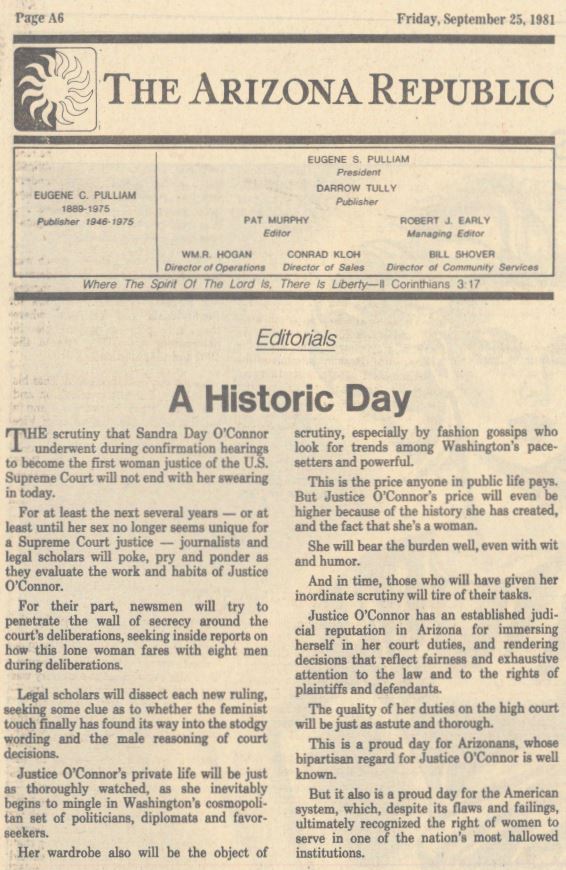
THE scrutiny that Sandra Day O’Connor underwent during confirmation hearings to become the first woman justice of the U.S. Supreme Court will not end with her swearing in t.oday. For at least the next several years – or at least .until her sex no longer seems unique for a Supreme Court justice – journalists and legal scholars will poke, pry and ponder as they evaluate the work and habits of Justice O’Connor. For their part, newsmen will try to penetrate the wall of secrecy around the court’s deliberations, seeking inside reports on how this lone woman fares with eight men during deliberations. Legal scholars will dissect each new ruling seeking some clue as to whether the feminist touch finally has found its way into the stodgy wording and the male reasoning of court decisions. Justice O’Connor’s private life will be just as thoroughly watched, as she inevitably begins to mingle in Washington’s cosmopolitan set of politicians, diplomats and favorseekers. Her wardrobe also will be the object of scrutiny, especially by fashion gossips who look for trends among Washington’s pacesetters and powerful. This is the price anyone in public life pays. But Justice O’Connor’s price will even be higher because of the history she has created, and the fact that she’s a woman. She will bear the burden well, even with wit and humor. And in time, those who will have given her inordinate scrutiny will tire of their tasks. Justice O’Connor has an established judicial reputation in Arizona for immersing
Sandra D. O’Connor became an associate justice of the Supreme Court yesterday, the first woman in U.S. history to bear that title. Chief Justice Warren E. Burger administered the constitutional oath of office at 2:16 p.m. before about 400 dignitaries and friends of the O’Connor family who packed the mammoth Supreme Court chamber. “Justice O’Connor, welcome,” Burger said simply. Then, after peing helped into her black judge’s robe, O’Connor took the chair assigned to her by seniority, the one on the end of the bench to Burger’s extreme left. Sitting next to her was her Stanford law school classmate, Justice William H. Rehnquist. From the raised bench, where no woman has sat in the 191-year history of the Supreme Court, she smiled down on President Reagan just below her. O’Connor is the 102nd justice and the first appointment to the court by Reagan. At 51, O’Connor is the youngest member of the court, which has five justices over 70. Her first public appearance at the court came at noon yesterday. She and Burger, his snow-white hair glistening in the sun, descended the front steps to pose for pictures. Burger clutched her arm and commented to reporters that “You’ve never seen me with a better-looking justice.” O’Connor’s husband, three sons and mother and father joined them on the court plaza for the pictures. She shouted to a friend to take pictures of the photographers for her scrapbook. She then went inside to take her first oath of the day, the “judicial oath,” which calls
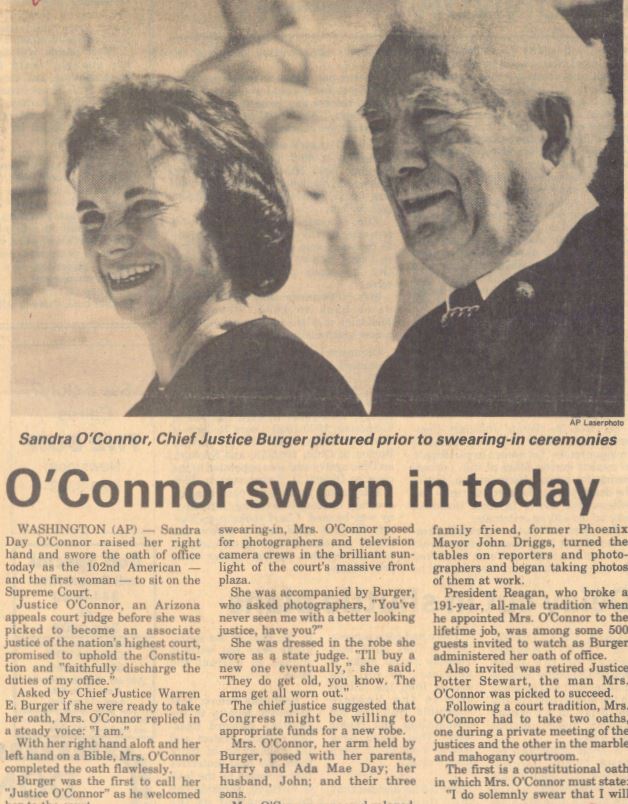
WASHINGTON (AP) – Sandra Day O’Connor raised her right hand and swore the oath of office today as the 102nd American – and the first woman – to sit on the Supreme Court. Vowing to “do equal right to the poor and to the rich,” the former Arizona legislator and appeals court judge became Justice O’Connor during a brief ceremony in the marble and mahogany courtroom of the nation’s highest court. President Reagan, who broke a 191-year tradition when he appointed O’Connor to the lifetime position, was among the 500 guests who watched Chief Justice Warren E. Burger administer the oath of office. Also on hand was retired associate justice Potter Stewart, whom O’Connor replaced. Two hours earlier, O’Connor had posed for photographers and television camera crews in the brilliant sunlight of the court’s massive front plaza. Burger, who accompanied her, asked photographers, “You’ve never seen me with a better looking justice, have you?” Asked how she felt on the threshold of history, O’Connor smiled and replied, “Just great.” She was dressed in the robe she wore as a state judge. “I’ll buy a new one eventually,” she said. “They do get old, you know. The arms get all worn out.” Burger suggested Congress might be willing to appropriate funds for a new robe . O’Connor, her arm held by Burger, posed with her parents , Harry and Ada Mae Day; her husband, John; and their three sons . O’Connor appeared relaxed, and laughed heartily as a close family friend, former Phoenix Mayor John Driggs ,
WASHINGTON (AP) – Sandra Day O’Connor raised her right hand and swore the oath of office today as the 102nd American – and the first woman – to sit on the Supreme Court. Justice O’Connor, an Arizona appeals court judge before she was picked to become an associate justice of the nation’s highest court, promised to uphold the Constitution and “faithfully discharge the duties of my office.” Asked by Chief Justice Warren E. Burger if she were ready to take her oath, Mrs. O’Connor replied in a steady voice: “I am.” With her right hand aloft and her left hand on a Bible, Mrs. O’Connor completed the oath flawlessly. Burger was the first to call her “Justice O’Connor” as he welcomed her to the court. Two hours before her swearing-in, Mrs. O’Connor posed for photographers and television camera crews in the brilliant sunlight of the court’s massive front plaza. She was accompanied by Burger, who asked photographers, “You’ve never seen me with a better looking justice, have you?” She was dressed in the robe she wore as a state judge. “I’ll buy a new one eventually,” she said. “They do get old, you know. The arms get all worn out.” The chief justice suggested that Congress might be willing to appropriate funds for a new robe. Mrs. O’Connor, her arm held by Burger, posed with her parents, Harry and Ada Mae Day; her husband, John; and their three sons. Mrs. O’Connor appeared relaxed, and laughed heartily as a close family friend, former Phoenix Mayor John. Driggs, turned the tables on reporters
WASHINGTON (AP) – Sandra Day O’Connor raised her right hand and swore the oath of office today as the first woman to sit on the Supreme Court. Vowing to “do equal right to the poor and to the rich,’ ‘ the former Arizona legislator and appeals court judge became Justice O’Connor during a brief ceremony in the marble and mahogany courtroom of the nation’s highest court. President Reagan was among the 500 guests who watched Chief Justice Warren Burger administer the oath of office. Also on hand was retired associate justice Potter Stewart, whom Mrs. O’Connor replaced. Following a court tradition, Mrs. O’Connor took two oaths, one at a private meeting of the justices and the other in the courtroom. The timing of her swearing in allows her to participate in the week-long conference the justices will start Monday in anticipation of the Oct. 5 opening of the court’s 1981-82 term. Reagan broke a 191-year, all-male tradition when he appointed Mrs . O’Connor to the lifetime job.
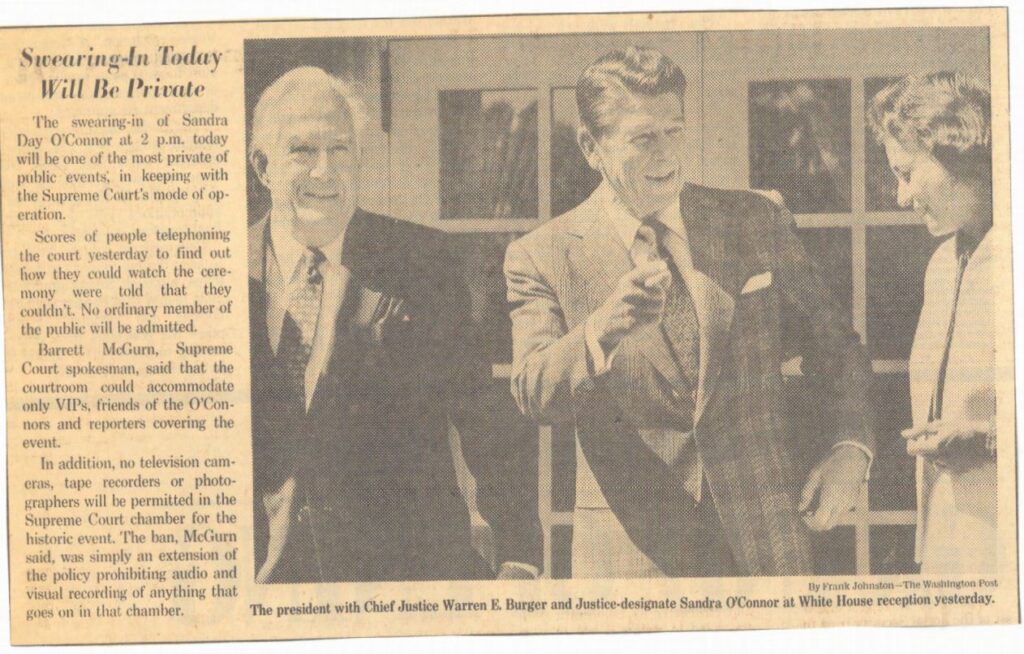
WASHINGTON – Sandra O’Connor, on the eve of her historic ascendancy to the nation’s highest court; was honored Thursday by President Reagan during a Rose Garden reception and at a White House luncheon. Judge O’Connor – who today will become the 102nd member and first woman on the Supreme Court – stood beaming in the brilliant sunshine outside the Oval Office as Reagan promised he will strive to “enhance the prestige and quality of the federal bench.” Judge O’Connor will take two oaths today from Chief Justice Warren Burger, the first a “constitutional oath” in the justices’ conference room – the private sanctum where the members of the court meet to hammer out the nuances of the law of the land. That will be followed by a “judicial oath” administered in a public ceremony at 2 p.m. in the huge, marble-columned courtroom which will be filled with court personnel, the O’Connor family, reporters, and dignitaries, including the president.
WASHINGTON – Sandra Day O’Connor raised her right hand and swore the oath of office today as the 102nd American – and the first woman – to sit on the Supreme Court.
Vowing to “do equal right to the poor and to the rich .” the former Arizona legislator and appeals court judge became .Justice O’Connor during a brief ceremony in the marble and mahogany courtroom of the nation’s highest court. President Reagan. who broke a 191-year tradition when he appointed Mrs. O’Connor to the lifetime position. was among the 500 guests who watched Chief Justice Warren E. Burger administer the oath of office. Also on hand was retired associate justice Potter Stewart, whom Mrs . O’Connor replaced. Two hours earlier, Mrs. O’Connor had …
Burger. who accompanied her. asked photographers . “You’ve never seen me with a better looking justice. have you?” …
:-,ne was dressed in the robe she wore as a state judge. “I’ll buy a new one eventually,” she said . ‘”They do get old. you know. The arms get all worn out.” Burger suggested Congress might be willing to appropriate funds for a new robe. Mrs. O’Connor, her arm held by Burger, posed with her parents. Harry and Ada Mae Dav : her husband . .John; and their three sons
Th e sweari ng-in of Sandra Day O’Connor at 2 p.m. today will he one of the most private of public events , in keeping with the Supreme Court’ s mode of operati on. Scores of people telephonin g t he courl yesterd ay to find out l1ow they could watch the ceremony were told that they couldn ‘t . No ordinary memb er of the publi c will be admitted. Barret t McGum , Suprem e Court spokesman, said that the comtroom could accommodat e only VIPs , friend8 of the O’Con – nors and repmtet’S covering the event. ln addi tion, no television cameras, tap e recorders or photographe1s will he permitted in the Supr eme Court chambet for the historic event. ‘l’h e ban, McGum said , was simply an extension of the policy prohibiting audio and vistutl recmding of anything that goes on in tha t chamber. [Photo caption: The president with Chief Justice Warren E. Burger and Justice-designate Sandra O’Connor at White House reception yesterday]
WASHINGTON (AP) – Sandra W.R JON Day O’Connor raised her right hand and swore the oath of office today as the 102nd American – and the first woman – to sit on the Supreme Court. Justice O’Connor, an Arizona appeals court judge before she was picked to become an associate justice of the nation’s highest court, promised to uphold the Constitution and “faithfully discharge the duties of my office.” Asked by Burger if she were ready to take her oath, Mrs. O’Connor replied in a steady voice: “I am.” With her right hand aloft and her left hand on a Bible, Mrs. O’Connor completed the oath flawlessly. Burger was the first to call her “Justice O’Connor” as he welcomed her to the court. President Reagan, who broke a 191-year, all-male tradition when he appointed Justice O’Connor to the lifetime job, was among more than 500 people present as Chief Justice Warren E. Burger administered the oath of office. The ceremony began as Mrs. O’Connor was ushered into the marble and mahogany courtroom and was seated before the bench in a chair used by Chief Justice John Marshall during his 1801- 1835 tenure. After taking the oath, Justice O’Connor was helped into her judicial robe and led to the seat traditionally occupied by the court’s most junior justice – to the far right of the bench as viewed from the courtroom. In a switch from the 1975 swearing-in of Justice John Paul Stevens, the oath administered in the courtroom to Mrs. O’Connor was one Stevens and at least two of his predecessors had
Editor: Frances R. Haye’s letter about Judge Sandra O’Connor’s stand on abortion states that “abortion on demand is wrong, or it isn’t.” I cannot agree that the issue is so clear-cut or so simple. For instance when it is a case of a young woman taking drugs, paying no attention to good nutrition rules for pregnancy, and absolutely not wanting the baby, the chances are very slim that that baby will be normal at birth or will ever be wanted as an adoptive child. Therefore, it will most likely always have to be cared for by government institutions. Does she want that? MRS. FRANK P. WALKER Sun City
Editor: We Arizona folks are mighty proud of our “native” daughter Sandra O’Connor. She is the epitome of a lady fully capable to don the robes of the Supreme Court with dignity and honor. RUTH DEMOPLOS Phoenix Editor: The fumings of the senatorial lunatic fringe against Mrs. O’Connor’s nomination, and that of the more idiotic gang of so-called witnesses remind me of a paragraph in Robinson & Breasted’s history book which I read at high school ‘way back in 1914. The authors tell of a plumber on a visit to the Parthenon . . He was so busy criticizing the faulty drains that he missed entirely the majesty and loftiness of the architecture. SYLVANUS PETERS Sun City
HOLLYWOOD, Fla. – Moral Majority leader Jerry Falwell said Thursday night he thinks Judge Sandra O’Connor will make a good addition to the U.S. Supreme Court. “I may grow to rue these words, but (from) what I heard in the (Senate) hearings and what my friends op the panel said, I think she is going to make a good justice,” Falwell said. The controversial religious-political leader was in southern Florida to deliver a speech to a meeting of the Baptist Bible Fellowship International. Asked to comment on Sen. Barry Goldwater’s attack on him in a recent speech, Falwell said the Arizona Republican’s problem is that “he’s getting older” and “no longer is the leading conservative in the United States.” “When he (Goldwater) says that religion has no part of public policy, he’s contradicting statements made by Thomas Jefferson,” Falwell added. “He is reacting adversely to someone else taking away where the mantle used to be. I think instead of kicking his constituents in the posterior, he should be writing his memoirs.” After his Hollywood appearance, Falwell planned to fly to Freeport, Bahamas, where the Moral Majority is meeting to map a nationwide anti-pornography campaign.
WASHINGTON (AP) – Sandra Day O’Con nor ra ised her ri ght ha nd an d swo re the oath of offic e today as the 102nd Americ an – and the first woman – to sit on the Supreme Court. Vowing to “do equal right to the poor and to the r ich ,” the former Ari zona legisla tor and appeals court judge be came Justice O’Conn or dur ing a br ief ceremony in the marble and mahogan y courtroom of the nati on ‘s highes t cou rt. Presiden t Reagan , who broke a 191- year trad ition when he appo inted Mrs. O’Connor to the lifetime positio n, was a mong the 500 gues ts wh o wa tc h ed Chief Justice Warren E. Bur ger adm inister the oath of office , Also on hand wa s retired as soci a te ju sti ce Potter Stewart , whom Mrs . O’Connor repla ced . Two hours earlier , Mrs. O’Con nor had posed for-photographers an d tele vi• sion camera crews in the brillian t sun• light of the court’s mass ive fron t plaza. Burger, who accompan ied her , asked photographers , “Yo u’v e ne ve r seen me with a better looking jus ti ce , have you ?” Asked ho w sh e felt on the thresh- . old of histor y, Mr s. O’Connor sm iled and rep lied , “Jus t gre at.” She was dre ssed in the robe she wore as a state ju dge. “I’ ll bu y a new on e even tually ,” she said. “They do get old, you know . The arm s get a ll worn out.” Burger sugge sted Congress migh t be willi ng to appr opr iat e fun ds for a new robe . Mr s. O’Con no r , he r a r m held by Burge r, posed with her parents , Ha rry and Ada Mae Da y; her hu sband , J
WASHINGTON (UPI) – President Reagan hosted a Rose Garden reception today for federal judges and the newest member of the Supreme Court, pledging to do all he can to “enhance the prestige and quality of the federal bench.” Chief Justice Warren Burger and Sandra Day O’Connor, who will be sworn in Friday as the high court’s first woman justice, were on hand for the reception. – Judge O’Connor, formerly on the • Arizona Court of Appeals bench, • was beaming as she and Reagan : strode from the Oval Office into : tbe brilliant sunlight that bathed the garden nearby. : Speaking to about 150 judges : from federal district and appellate : benches, Reagan said he was thankful for their daily reassurance “that our ideals of liberty and justice are alive and well in the United States.” The presiden t
PHOENIX (AP) – Applications will be accepted until Oct. 30 for persons wishing to fill the Arizona Court of Appeals vacancy created by the resignation of Sandra O’Connor.
Appeals Court Chief Judge Lawrence Wren said Wednesday the state’s judicial selection committee for appeals courts will forward between three and 10 names to Gov. Bruce Babbitt.
Mrs. O’Connor resigned Tuesday, the day after the Senate voted 99-0 to confirm her appointment to the U.S. Supreme Court.
“My hairdo, right or wrong.”
An admirable credo, we admit. We just wish we could say the same for Judge Sandra O’Connor’s coiffure. We recently overheard someone say, “She looks so wholesome, it’s hard to believe she’s in favor of abortion.” We couldn’t agree more. Since there’s never been a woman Supreme Court Justice, we don’t exactly know what one should look like. But somehow, we don’t think she should look like she’s about to tell a classful of 1955 third graders to get under their desks for an atomic bomb drill.
No one doubts that the Judge is a busy woman. Reviewing-briefs, absorbing
testimony and issuing death row reprieves take a lot out of a person. But you’d think Her Honor could find time to drop in at the Pennsylvania Avenue Cut ‘N Curl for an estimate. Then again, maybe she can’t.
So in the interest of good grooming in high places, we took it upon ourselves to survey hometown hairdressers in hopes of lending the judge some tonsorial first aid.
Unfortunately, we didn’t get far. Evidently there exists among beauticians a code every bit as strict as the Hypocritic [sic] Oath and to pass judgment on someone’s do for a third party is akin to cosmetic treason. The receptionist at the Add-A-Curl Beauty Salon merely passed the buck, telling us to call back later and talk to someone – anyone – else. At the Purple Wig, the spokeswoman pled the fifth. “Oh, we’ve never done her. We’d have nothing to say about this issue.”
Off the record, it was a different story. A
WASIIlNGTON (UPI) – The Senate voted unanimously Monday to confirm Sandra Day O’Connor as the nation’s first woman justice of the Supreme Court in a vote hailed as a turning point in U.S. political history. The vote was 99-0. Sen. Max Baucus, D-Mont., was the only absentee. Cautioned against any demonstration, spectators thronging the Senate gallery kept silent during the 20-minute roll call and the announcement of the outcome. But outside the Capitol, a huge crowd greeted Mrs. O’Connor with cheers as she arrived with Attorney General William French Smith and posed for pictures with Vice President George Bush and Senate leaders. “I’m absolutely overjoyed with the expression of support from the Senate and my hope is that 10 years from now, after I’ve been across the street at work for awhile, they will feel glad they gave me the wonderful vote they did today.” Mrs. O’Connor said. “I’ll certainly work hard to make that happen.” President Reagan promptly issued a statement saying, “This is truly a happy and historic day for America,” and expressing gratitude for the unanimous vote He called Mrs. O’Connor “a very warm and brilliant woman” and said he is sure “the court and the nation will benefit both from her lifetime of work, service and experience in the legal profession, and from her solid grasp of ow Constitution, ivhich she reveres.” Mrs. O’Connor is tentatively scheduled to be sworn in Friday and will be on the bench when the high court opens its 1981-82 term Oct. 5. After
WASHING TON – The Senate confirmed Sandra O’Connor of Arizona 99-0 Monday as an associate justice of the Supreme Court, ending a nearly 200-year-old all-male tradition. Only Sen. Max Baucus, D-Mont., who was attending a conference in his home state, did not vote. He had supported Judge O’Connor in earlier committee action. After the vote, Judge O’Connor, 51, an Arizona state appeals judge, appeared on the steps of the Capitol with Senate leaders and Vice President George Bush. Grinning jubilantly, she said she was overjoyed by the depth of Senate support for-her nomination. “My hope is that after I’ve been across the street and worked for awhile that they’ll all feel glad for the wonderful vote they gave me today,” she said. Once installed on the court, she said, “I’m going to get very busy, very fast.” Hailing a “happy and historic day,” Reagan said in a statement that the confirmation of his nominee “symbolizes the richness of opportunity that still abides in America – opportunity that permits persons of any sex, age or race, from every section and walk of life, to aspire and achieve in a manner never before even dreamed about in human history.” Judge O’Connor’s formal induction as successor to Justice Potter Stewart, who has retired, is scheduled for Friday, with Chief Justice Warren Burger to administer the oath in the marblecolumned courtroom. A luncheon is to follow at which Burger is to be host. Reagan is expected to be among the guests. Any question about the Senate’s
WASHINGTON (AP) – Sandra Day O’Connor, confirmed by a unanimous Senate as the first woman justice on the Supreme Court, promises to be “very busy, very fast” after she is sworn in later this week. There is no clear indication, however, how she will vote on social and constitutional issues that come before the court. The 51-year-old Arizona appeals judge won a 99-0 endorsement in the Senate on Monday as the 102nd justice in the 191-year history of the nation’s highest court. She will be youngest of the nine members. Mrs. O’Connor will be sworn in for her lifetime position in ceremonies Friday afternoon at the Supreme Court building. But because the ceremony will be conducted in the courtroom itself, the recording for posterity will be ‘limited. ” As is the court practice, there will be no TV, no photographs and no tape recordings,” court spokesman Barrett McGurn today said in a printed statement released today. Reporters and artists will be admitted to the ceremony, as they are for all court sessions. There will be no public admission, however, except by invitation. Two “picture opportunities” are scheduled shortly after the 15- minute ceremony. McGurn said official court photographers would be on hand but added, “I know of no plan to have any photograph taken in the courtroom ( during the ceremony).” Chief Justice Warren E. Burger will administer Mrs. O’Connor’s oath of office, and White House officials said President Reagan may attend the Friday ceremony. “My hope is that
WASHINGTON (AP) -Sandra Day O’Connor, confirmed by a unanimous Senate as the first woman justice on the Supreme Court, promises to be “very busy, very fast” after she is sworn in later this week. There is no clear indication, however, how she will vote on social and constitutional issues that come before the court. The 51-year-old Arizona appeals judge won a 99-0 endorsement in the Senate on Monday as the 102nd justice in the 191-yea’r history of the nation’s highest court. She will be youngest of the nine members. Mrs. O’Connor will be sworn in for the lifetime appointment in ceremonies Friday in the Supreme Court building. “My hope is that 10 years from now, after I’ve been across the street and worked for a while, that they’ll all feel glad for the wonderful vote they gave me today,” a smiling Mrs. O’Connor said at an appearance on the Capitol steps. Once installed on the court, which opens its 1981-82 term Oct. 5, “I’m going to get very busy, very fast,” Mrs. O’Connor said. Reagan hailed a “happy and historic day” and said in a statement that Mrs. O’Connor’s confirmation “symbolizes the richness of opportunity that still abides in America – opportunity that permits persons of any sex, age or race, from every section and walk of life, to aspire and achieve in a manner never before even dreamed about in human history.” The vote, following four hours of laudatory speeches by conservatives and liberals alike, was a vic-tory for Reagan as well as Mrs. O’Connor. Opposition to Mrs.
WASHINGTON (AP) – The Senate ending an all-male tradition nearly two centuries old, unanimously confirmed Sandra Day O’Connor as an associate justice of the Supreme Court on Monday. O’Connor, 51-year-old Arizona state apeals Judge, Will be sworn in Friday in time to JOID the court for the opening of its 1981-82 term on October 5. The vote was 99-0, with only Sen. Max Baucus, D-Mon!,, ~ho was attending an economic conference in his home state, missing from the tally. He had supported O’Connor in earlier committee action. After the vote, O’Connor appeared on the steps of the Capitol with Senate leaders and Vice President George Bush. Grinning jubilantly, she said she was overjoyed by the depth of Senate support for her nomination. “My hope is that after I’ve been across the street and worked for a while that they’ll all feel glad for the wonderful vote they gave me today,” she said. Once installed on the the court, she said,”l’m going to get very busy, very fast.” Today is truly a historic occasion,” said Sen. Strom Thurmond, R-S.C., chairman of the Senate Judiciary Committee leading off a series of 22 speeches in warm praise of President Reagan’s first high court nominee. Hailing a “happy and historic day,” Reagan said in a statement the confirmation of his nominee “symbolizes the.richness of opportunity that still abides in America – opportunity that permits persons of any sex, age or race, from every section and walk of life, to aspire and achieve in a manner never before even
Editor’s note: By a vote of 99-0, the U.S. Senate Monday confirmed appointment of Sandra Day O’Connor to the Supreme Court. She will be administered the oath of office Friday , thus becoming the first woman on the high court .
To most people, Sandra Day O’Connor, who will be sworn in Friday as the nation ‘s first woman Supreme Court justice, is a picture on the cover of Time magazine. But those aren’t the pictures Medford real estate agent Calista Handwerg thinks of. As one of Mrs. O’Connor’s close college friends, Mrs. Handwerg has a photo album that shows other sides of the woman who will make the first feminine inroad into the 192-year-old institution. The album shows pictures of Mrs. O’Connor as a young Stanford University Law School student playing in the snow with her girlfriends at Crater Lake. There are pictures of a newly wed Mrs. O’Connor walking along the Applegate River with her husband, Bill. In the early 1950s, while at Stanford University, Mrs. Handwerg was a member of a clique of four friends, including Mrs. O’Connor. They met as housemates at a graduate woman student’s cooperative on campus. Mrs. Handwerg and another member of the Stanford group will attend the swearing in for Mrs. O’Connor in Washington, D.C., Friday . In recalling her college years, Mrs. Handwerg says she was attracted to Mrs. O’Connor because “she was a different person, not like anyone I ever knew before. ” She describes Mrs. O’Connor as having a keen intellect and an ability to cut to the
WASHINGTON-The Senate unanimously approved the nomination of Arizona Appeals Court Judge Sandra O’Connor to the Supreme court. Mrs. O’Connor, who is scheduled to be sworn in Friday, will be the 102nd Justice of the high court and its first woman member. She will succeed Justice Potter Stewart, who retired. In more than four hours of debate, Senators largely praised the nomination. A handful raised questions about the extent to which Judge O’Connor opposes abortion. Sen. Jesse Helms (R., N.C.) said President Reagan assured him that Mrs. O’Connor is a foe of abortion. “I have no valid reason to believe Mrs. O’Connor would allow the President to be misled,” he said. Among the high court’s current members, Justices John Stevens and Harry Blackmun were approved unanimously by the Senate and Justices Byron White and William Brennan were confirmed on voice vote without recorded opposition. There were 26 voters against William Rehnquist, one against Lewis Powell, three against Chief Justice Warren Burger and 11 against Thurgood Marshall.
WASHINGTON (AP) -The Senate, ending an all-male tradition nearly two centuries old, unanimously confirmed Sandra Day O’Connor as an associate justice of the Supreme Court on Monday. Mrs. O’Connor, a 51-year-old Arizona state appeals judge, will be sworn in Friday as the 102nd associate justice in the 191-year history of the court , in time to join the court for the opening of its 1981-82.term on October 5. “Today is truly a historic occasion,” said Sen. Strom Thurmond, R-S.C., chairman of the Senate Judiciary Committee, leading off a series of 22 speeches.
WASHING TON (AP) – The Senate, ending an all-male tradition nearly two centuries old, unanimously confirmed Sandra Day O’Connor as an associate justice of the Supreme Court yesterday. O’Connor, a 51-year-old judge of the Arizona Court of Appeals, will be sworn in Friday in time to join the court for the opening of its 1981-82 term on Oct. 5. The vote was 99-0, with only Sen. Max Baucus, D-Mont., who was attending an economic conference in his home state, missing from the tally. He had supported O’Connor in earlier committee action. After the vote, O’Connor appeared on the steps of the Capitol with Senate leaders and Vice President George Bush. Grinning jubilantly, she said said she was overjoyed by the depth of Senate support for her nomination. “My hope is that after I’ve been across the street and worked for a while that they’ll all feel glad for the wonderful vote they gave me today,” she said. Once installed on the the court, she said, “I’m going to get very busy, very fast.” “Today is truly a historic occasion,” said Sen. Strom Thurmond, R-S.C., chairman of the Senate Judiciary Committee, leading off a series of 22 speeches in warm praise of President Reagan’s first high-court nominee. Hailing a “happy and historic day,” Reagan said in a statement that the confirmation of his nominee “symbolizes the richness of opportunity that still abides in America – opportunity that permits persons of any sex, age or race, from every section and walk of life, to aspire and achieve in
WASHINGTON (UPI) – In a vote hailed as a turning point in U.S. political history, the Senate voted unanimously Monday to confirm Sandra Day O’Connor as the nation’s first woman justice of the Supreme Court. The vote was 99-0. Sen . Max Baucus, D-Mont., was the only absentee. Cautioned against any demonstration, spectators thronging the Senate gallery kept silent during the 20-minute roll call and the announcement of the outcome . Outside the Capitol, a huge crowd greeted Judge O’Connor with cheers as she arrived with Attorney General William French Smith and posed for pictures with Vice President George Bush and Senate leaders. “I’m absolutely overjoyed with the expression of support from the Senate, and my hope is that 10 years from now, after I’ve been across the street at work for a while, they will feel glad they gave me the wonderful vote they did today,” Judge O’Connor said. “I’ll certainly work hard to make that hl!.ppen.” President Re&gan promptly issued a statement saying, “This is truly a happy and histor~c day fof America,” and expressmg gratitude for the unanimous vote. He called Judge O’Connor “a very warm and brilliant woman” and said he is sure “the court and the nation will benefit both from her lifetime of work, service ~nd experience in the legal profession, …
WASHINGTON (AP) -Sandra Day O’Connor, confirmed by a unanimous Senate as the first woman justice on the Supreme Court, promises to be “very busy, very fast” after she is sworn in later this week. There is no clear indication, however, how she will vote on social and constitutional issues that come before the court. The 51-year-old Arizona appeals judge won a 99-0 endorsement in the Senate on Monday as the 102nd justice in the 191-year history of the nation’s highest court. She will be youngest of the nine members. Mrs. O’Connor will be sworn in for her lifetime position in ceremonies Friday afternoon at the Supreme Court building. But because the ceremony will be conducted in the courtroom itself, the recording for posterity will be limited. “As is the court practice, there will be no TV, no photographs and no tape recordings,” court spokesman Barrett McGurn today said in a printed statement released today. Reporters and artists will be admitted to the ceremony, as they are for all court sessions. There will be no public admission, however, except by invitation. McGurn said official court photographers would be on hand but added, “I know of no plan to have any photograph taken in the courtroom.” Cruet Justice Warren E. Burger will administer Mrs. O’Connor’s oath of office, and White House officials said President Reagan may attend the Friday ceremony. “My hope is that 10 years from now, after I’ve been across the street and worked for a while, that they’ll all feel glad for the
WASHINGTON – (AP) – Sandra Day O’Connor, confirmed by a unanimous Senate as the fn-st woman justice on the United States Supreme Court, promises to be “very busy, very fast” after she is sworn in later this week. There is no clear indication, however, how she will vote on social and constitutional issues that come before the court. The 51-year-old Arizona appealscourt judge won a 99-0 endorsement in the Senate yesterday as the 102nd justice in the 191-year history of the nation’s highest court. She will be youngest of the nine members. Judge O’Connor will be sworn in for her lifetime position in ceremonies Friday afternoon. “My hope is that 10 years from now after I’ve been across the street and worked for a while, that they’ll all feel glad for the wonderful vote they gave me today,” a smiling Judge O’Connor said after the vote. Once installed on the court, which opens Its 1981-82 term October 5, “I’m going to get very busy, very fast,” Judge O’Connor said. The vote, following four hours of laudatory speeches by conservatives and liberals alike, was a victory for Mr. Reagan as well as Mrs. O’Connor. Opposition to Judge O’Connor’s views on abortion melted when Senator Jesse Helms, North Carolina Republican, leader of the most conservative wing of the Senate, said he would support the nomination “because I have faith in the President.” Helms said he believed Mr. Reagan’s views against legalized abortion were too strong to permit him to nominate someone who supports the 1973 _Supreme
All-male tradition on top court ends
WASHINGTON – The Senate , ending an all-male tradition nearly two centuries old. unanimously confirmed Sandra Day O’Connor as an associate justice of the Supreme Court on Monday. Mrs . O’Connor, a 51-year-old Arizona state appeals judge , will be sworn in Friday in time to join the court for the opening of its 1981-82 term on October 5. The vote was 99-0. with only Sen. Max Baucus. D-Mont .. who was attending an economic conference in his home state, missing from the tally. He had supported Mrs. O’Connor in earlier committee action. “Today is truly a historic occa- sion,” said Sen. Strom Thurmond, R-S.C., chairman of the Senate Judiciary Committee, leading off a series of 22 speeches in warm praise of President Reagan’s first high court nominee. Hailing a “happy and historic day,” President Reagan said in a statement the confirmation of his nominee “symbolizes the richness of opportunity that still abides in America – opportunity that permits persons of any sex, — age or race, from every section and walk of life. to aspire and achieve in a manner never before even dreamed about in human history.” As the vote neared. a small knot of conservatives who had questioned Mrs. O’Connor’s views on abortions fell into line behind her nomination. Jesse Helms. R-N.C .. leader of the most conservative bloc of Senate Republicans. voted for Mrs . O’Connor. saying he talked to the president and was assured that Mrs. O’Connor shares Reagan’s opposition to
BARRY GOLDWATER is bound to lose his fight with the self-styled Moral Majority and other religious groups that have injected themselves into politics. This will not deter him. Goldwater has fought losing fights before. The fact remains that religious groups have always taken part in politics in this country. They have as much a right to under the Constitution as anyone else. Sometimes, they have served the nation well. The Right-to-Life movement never wearies of comparing itself with the abolitionist movement. In the light of history, the abolition movement was a noble one. The same can hardly be said of the campaign led by the Women’s Christian Temperance Union. Prohibition gave birth to organized crime. Religious groups that engage in politics are frequently offensive because they presume to have a pipeline to God. The liberal National Council of Churches is just as sure as the conservative Moral Majority that it speaks for God. AB. leader of the Moral Majority, the Rev. Jerry Falwell pretends to know even how God stands on the nomination of Sandra O’Connor to the.Supreme Court. Goldwater, who supports the nomination, is rightly outraged by this. “Mr. Conservative” also is rightly outraged by Falwell’s gall in lecturing him on how a conservative should vote in the Senate. Many find the very name, the Moral Majority, offensive, since it clearly implies that anyone who disagrees with Falwell is a moral leper. Actually, polls show that most Americans don’t go all the way with
WASHINGTON (AP) Sandra Day O’Connor, confirmed bv a unanimous Senate as the first woman justice on the Supreme Court, promises to be “very busy, very fast” after she is sworn in later this week. There is no clear indication, however, how she will vote on social and constitutional issues that come before the court . The 51-year-old Arizona appeals judge won a 99-0 endorsement in the Senate on Monday as the 102nd justice in the 191-year history of the na – tion’s highest court. She will be youngest of the nine members. Mrs. O’Connor will be sworn in for her lifetime position in ceremonies Friday afternoon at the Supreme Court building. But because the ceremony will be conducted in the courtroom itself, the recording for posterity will be limited. “As is the court practice, there will be no TV, no photographs and no tape recordings, ” court spokesman Barrett McGurn today said in a printed statement released today . Reporters and artists will be admitted to the ceremony , as they are for all court sessions. There will be no public admission , however , except by invitation. Two “picture opportunities ” are scheduled shortly after the 15-minute ceremony, McGurn said official court photographers would be on hand but added, “I know of no plan to have any photograph taken in the courtroom < during the ceremony)." Chief Justice Warren E. Burger will administer Mrs. O'Connor's oath of office, and White House officials said Pres - ident Reagan may attend the Friday ceremony. "My hope is
WASHINGTON – Women across America should take a moment to celebrate the Senate’s confirmation of Sandra Day O’Connor to the Supreme Court. Appointments of women to the federal judiciary aren’t likely to be a recurring feature of the Reagan administration. Though the president has made history by appointing the 51-year-old Arizonan as the first woman to the High Court, he’s now under far greater pressure to nominate those of his own persuasion and sex. • Sandra O’Connor: Her appointment to the Supreme Court doesn’t let the ‘ Reagan administration off the hook. Among other radical changes in its first nine months, the Reagan administration has reshuffled the way federal judges are selected. Reagan has muted the importance given to women and minority appointments during the Carter years. It’s almost as if the Reagan staff took literally the new movie “First Monday in October.” Their actions echo the sentiments of actor Walter Matthau who, as a feisty liberal justice, displays his distaste that a woman is on the bench by telling a law clerk, “It’s eight of us against all of her.” So far, of the 12 new federal district and circuit judges nominated by Reagan, all are male; none are black or Hispanic. There are, of course, still about 60 judgeships to fill nationwide. A-411iurs., Sept. 24, 1981 CO 77,e Pboeaii Cazette But we’re not staying up nights waiting for women to get the nod. Here’s why: Traditionally, senators in the majority party have suggested candidates from their states
WASHINGTON ( AP)-Sandra Day O’Connor, confirmed by a unanimous Senate as the first woman justice on the Supreme Court, promises to be “very busy, very fast” after she is sworn in Friday. There is no clear indication, however, how she will vote on social and constitutional issues that come before the court. The 51-year-old Arizona appeals judge won a 99-0 endorsement in the Senate on Monday as the 102nd justice in the 191-year history of the nation’s highest court. She will be youngest of the nine members. MRS. O’CONNOR WILL be sworn in for her lifetime position in ceremonies Friday afternoon in the Supreme Court but ding. But because the ceremony Related story, A3 will be conducted in the courtroom itself, the recording for posterity will be limited. . “As is the court practice, there will be no TV, no photographs and no tape recordings,” court spokesman Barrett McGurn said in a printed statement released today. Reporters and artists will be admitted to the ceremony, as they are for all court sessions. There will be no public admission, however, except by invitation. CHIEF JUSTICE Warren Burger will administer Mrs. O’Connor’s oath of office. “My hope is that 10 years from now, after I’ve been across the . street and worked for a while, that they’ll all feel glad for the wonderful vote they gave me today ” a smiling Mrs . O’Connor said at a~ appearance on the Capitol steps with Vice President George Bush and Senate leaders. . Once installed on the court, which opens its 1981-82
Arizona’s Sandra Day O’Connor, with the Senate’s unanimous backing in her pocket, will tak~ ~e oath as America’s first woman Justice on the Supreme Court Friday. But the appellate judg~’s {?reparations for her hist.ory-makmg 111$tallation were interrupted today by a mission of personal sadness as _she returned to Phoenix from Washington’s celebratory mood to attend memorial services late today for her . mother-in-law. MEANWHILE, the White House announced President Reagan will attend the Friday investiture of Judge O’Connor. The president also will host a White House reception Thursday for 160 members of the federal judiciary and hold a private luncheon for Judge O’Connor and the justices of the Supreme Court. Here at home, the mood among friends and longtime associates was one of quiet pride in Judge O’Con- . nor’s confirmation. Surprise was not in evidence; most said they had expected the easy approval. JUDGE O’CONNOR won confirmation Monday on a 99-0 Senate vote. Only Montana Democrat Max Baucus, who supported her when her nomination was endorsed 17-0 by the Judiciary Committee, was absent from the floor. He was attending a meeting in his home state. Even Alabama Republican Jeremiah Denton, who had quizzed the judge on her abortion ~tan~e and abstained from the committee s vote, went along on the fmal confirmation . “Some colleagues said I’d be laughed out of the Senate if I voted against her,” he said. “I _kept w~ndering what would the president thmk of me what would my colleagues
The Senate confirmed Sandra D. O’Connor as the first woman U.S. Supreme Court justice yesterday by a vote of 99 to 0. O’Connor will be sworn in Friday as the 102nd justice of the court. At 51, she will be the youngest member of a court now dominated by men in their late 60s and early 70s, a court assembled by six different presidents: Eisenhower, Kennedy, Johnson, Nixon, Ford and now, Ronald Reagan. I. The historic Senate action came early yesterday evening without real debate. Only one senator, Max Baucus (D-Mont.), did not THE WASHINGTON POST vote. Baucus has been a strong supporter of the nomination but was in Montana when the roll call was taken. The only issue of the day was which senator could sing the highest, longest and moet effusive praises for O’Connor and President Reagan. And thus what began in July as one of the president’s moet controversial decisions ended as one of his least difficult encounters with Congress. Some suspense had remained about whether a few senators might cast negative votes or abstain because of opposition to O’Connor from antiabortion forces. But even that doubt was swept away by O’Connor’s performance in confirmation hearings, lobbying by Reagan and an increasingly evident desire among a few undecided to avoid spoiling the party. “Some colleagues said I’d be laughed out of the Senate if I voted against her,” Sen. Jeremiah Denton (R-Ala.) said in an interview before casting his vote for confirmation. Denton, a staunch antiabortion senator who
WASHINGTON – The Senate, ending an all-male tradition nearly two centuries old, unanimously confirmed Sandra Day O’Connor as an associate justice of the Supreme Court Monday. Mrs. O’Connor, a 51-year-old Arizona state appeals judge and former El Paso resident. will be sworn in Friday in time to join the court for the opening of its 1981-82 term Oct. 5.
The vote was 99-0, with only Sen. Max Baucus, D-Mont., who was attending an economic conference in his home state, missing from the tally. Baucus had supported Mrs. O’Connor in earlier committee action.
After the vote, Mrs. O’Connor appeared on the steps of the Capitol with Senate leaders and Vice President George Bush.
Grinning jubilantly, she said she was overjoyed by the depth of Senate support for her nomination. “My hope is that after I’ve been across the street and worked for awhile that they’ll all feel glad for the wonderful vote they gave me today.” she said.
Once installed on the the court, she said, “I’m going to get very busy, very fast.”
Mrs. O’Connor will become the 102nd person to don the black robes of a Supreme Court member since the court was created as one of three equal branches of the federal government 191 years ago.
A graduate of Stanford University Law School, she worked as a state prosecutor in Arizona before serving terms in both houses of the state Legislature.
She was a former majority leader of the Arizona Senate, served as a state trial court judge and later was named by Gov. Bruce Babbitt to

Senate votes 99-0 for woman on high court WASHINGTON (AP) -The Senate, ending an all-male tradition nearly two centuries old, unanimously confirmed Sandra Day O’Connor as a justice of the Supreme Court Monday. Judge O’Connor, a 51-year-old Arizona state appeals judge, will be sworn in Friday in time to join the court for the opening of its 1981-82 term Oct. 5. The vote was 99-0, with only Sen. Max Baucus, D-Mont., who was attending an economic conference in his home state, missing. He had supported Judge O’Connor in earlier committee action. AFTER THE VOTE, Judge O’Connor appeared on the steps of the Capitol with Senate leaders and Vice President George Bush. Grinning jubilantly, she said, “My hope is that after I’ve been across the street and worked for a while that they’ll all feel glad for the wonderful vote they gave me today.” “Today is truly a historic occasion,” said Sen. Strom Thurmond, R-S.C., chairman of the Senate Judiciary Committee, leading off a series of 22 pre-vote speeches in warm praise of President Reagan’s first high court nominee. Hailing a “happy and historic day,” President Reagan said in a statement the confirmation of his nominee “symbolizes the richness of opportunity that still abides in America – opportunity that permits persons of any sex, age or race, from every section and walk of life, to aspire and achieve in a manner never before even dreamed about in human history.” AS THE VOTE neared, a small knot of conservatives who had questioned Judge
WASHINGTON (AP) -Sandra Day O’Connor awaited easy confirmation by the Senate today as the first woman on the Supreme Court. The chairman of the Judiciary Committee predicted the vote would be unanimous. As the Senate opened debate on President Reagan’s first high court nomination , there was praise for Mrs. O’Connor from both liberals and conservatives. Even. Sen. Jesse Helms , R-N.C., an archconserva tive foe of legalized abortions , said he would vote for Mrs. O’Connor. He said he had been personally assured by the president that . Mrs. O’Connor believes the 1973 Supreme Court decision legalizing abortion was wrong . “I will vote for the confirma – tion of Mrs. O’Connor because I have faith in the president of the United States ,” Helms said . And liberal Democrat Edward M. Kennedy, D-Mass., said that , “by • this vote the Senate rejects the would-be tyranny of the New Right and reaffirms the vital principal of the independenc~ of the judiciary .” He has praised Reagan for naming a woman. The Judiciary Committee chairman, Sen. Strom Thurmond , R-S.C., said that despite some lingering opposition over her views on abortion, he expecte d not a single negative vote would be cast. Thurmond said on the Senate floor that Mrs. O’Connor, as a former state legislator and Arizona appeals court judge , believes that “laws are changed by the Congress and not by the federal courts .” Sen. Barry Goldwater , R-Ariz., said those who sought to block Mrs. O’Connor’s nomination be- •Cause of her
The perfonnance of Supreme Court nominee Sandra O’Connor during Congressional hearings on her nomination clearlr w~ convincing to Tribune readers who responded to last week s Opinion Poll. O’Connor an Arizona appellate court justice and former state legislator, ~cored a 76 percent favorable rating to.~ ques~on which asked if she had effectively answered her cntics durmg the hearings. Only 12 percent of those responding to the poll sa!d. she had not been effective while another 12 percent had no opmion. Majorities also voiced a perference for staying out of problems in other countries judged by their answers to two other questions. Fifty three percent of those responding wer~ opposed to off~ring aid to Poland if that country should be invaded by Soviet troops while 76 percent said the United States shouldn’t ~upport rebels fighting the government in Iran. “We should mmd our own business,” one respondent wrote. However, Poland had some supporters with 47 percent saying the U.S. should provide help if that country is invade~. Readers also cast a skeptical eye on spending for high school sports and Kirlian photography. . . Fifty-three percent said too much mone~ s~nt ?n. high school sports compared to 41 percen_t ~ho dido t think it is excessive and 6 percent who had no opmion. . Only 24 percent said Kirlian photography, bi~ed as war to determine a person’s bio-energy field or aura, is a valid scientific field of study compared to 47 percent who said no and 29 percent who had no
WASHINGTON – Sandra Day O’Connor awaited confirmation by the Senate today as the first woman on the Supreme Court. The chairman of the Judiciary Committee predicted the vote would be unanimous. As the Senate opened debate on President Reagan’s first high court nomination, there was praise for …
tion on abortion, Goldwater said, it . probably would have tainted her ability to vote on the issue as a coan associate justice. — ; “They would have denied themselves a future anti-abortion vote,” Goldwater said. Liberals and conservatives alike have praise …
Liberal Sen. Howard Metzen – baum, D-Ohio, for example, said he was troubled by Mrs. O’Connor’s conservative views on whether poor defendants in criminal cases should be guaranteed a lawyer . Nonetheless, Metzenbaum said a rC1minee never should be rejected because of personal views.
WASHINGTON (UPl)-The Senate is expected to vote overwhelmingly today – if not unanimously – to confirm President Reagan’s choice of Sandra Day O’Connor as the nation’s first woman Supreme Court justice. Plans already are being made for O’Connor to take her oath at the court Friday at the end of the fall Judicial Conference meeting, a prestigious session of senior federal judges with Chief Justice Warren Burger. O’Connor, 51, stayed in Washington over the weekend to be on hand if any problems arose. None were foreseen. In Senate Judiciary Committee hearings week before last, O’Connor emerged as an intelligent, hard-working nominee with conservative views and enough gumption to , refuse to say how she would vote on future abortion cases. Chairman Strom Thurmond, R-S.C., then began trumpeting his enthusiasm over the Arizona appeals court judge and former Arizona state senate Republican leader, predicting she would be confirmed with little opposition on the Senate floor. If any senator privately planned to vote no, he kept it a secret. Sen. Jeremiah Denton, R-Ala., who voted “present” in the committee while 17 other members voted “aye,” was not saying what his vote will be. Denton is disturbed by O’Connor’s refusal to state her judicial position on abortion, which she says she opposes personally. He sent Reagan a note asking for more information to help him decide how to vote on the Senate floor. In response, Reagan called Denton Thursday, according to Steve Allen, Denton’s press
WASHINGTON – Arizona Judge Sandra Day O’Connor appeared headed toward unanimous Senate confirmation today as the nation’s first woman Supreme Court justice. Senate Judiciary Committee Chairman Strom Thurmond, R-S.C., told reporters an early challenger of the nomination , conservative Jeremiah Denton, R-Ala., had pledged an “aye” vote on confirmation. Denton voted “present” when Thurmond’s commit – tee recommended her confirmation. Thurmond mentioned other New Right abortion foes who had been persuaded to support President Reagan’s nominee and added : “I’m hoping to get a unanimous vote. I think that will he the case.” THE FOUR-HOUR Senate debate period ended without a single indication of opposition to Judge O’Connor ‘s nomination. The period was used largely for “quorum calls” ordered when there was no senator on the floor to make a speech. Often an orator had only the presiding officer, staff members and sparsely-filled galleries for. his audience. The confirmation vote was scheduled for this evening. The evaporation of conservative opposition was cheered by Democratic orators, who matched Republicans in calling for a unanimous vote – while denouncing the “single issue” (abortion) politics that had troubled some Republicans. Sen . Howard Metzenbaum, D-Ohio , said he differs with Judge O’Connor on many issues but thinks she is qualified and should not he defeated on the basis of one issue. “I hope that today there won’t be a single vote cast against her confirma – tion,” Metzenbaum
LYNCHBURG, Va. – The Moral Majority said ,Thursday it still is concerned about Judge Sandra O’Connor’s views on abortion but neither will ‘support nor oppose her confirmation as the nation’s first woman Supreme Court justice. The Senate is expected to confirm her Monday. When President Reagan announced her nomination July 7, the Moral Majority called it a mistake and announced a campaign to oppose her, saying she had voted to legalize abortion and had supported the Equal Rights Amendment, which the Moral Majority opposes. Television evangelist Jerry Falwell, who founded the Lynchburg-based conservative political group, changed that position. On July 17, Falwell said he would decline an invitation to testify before the Senate Judiciary Committee and would remain neutral until after its hearings, which ended Tuesday. The Moral Majority, in a statement Thursday from its headquarters here, said it remains concerned about Judge O’Connor’s views on “the law as it related to unborn life.” “At the same time, Moral Majority remains convinced of President Reagan’s strong personal integrity and commitment to ending abortion on demand in this country,” the statement added .
WASHINGTON (AP) – Sandra Day O’Connor, her confirmation as the first woman on the Supreme Court expected in a Senate vote Monday, likely will be sworn in next Friday. The Senate Judiciary Committee voted 17-0 earlier this week in favor of confirmation. A White House spokesman said O’Connor had expressed a preference for the Friday swearing-in, to be held at the Supreme Court. It is not known whether President Reagan plans to attend the ceremony. O’Connor , a 51-year-old Arizona appeals court judge, would become the 102nd member in the Supreme Court’s 191-year history. She would replace retired Justice Potter Stewart. Sen. Strom Thurmond, R-S.C., chairman of the Judiciary Committee, had hoped to schedule the Senate vote today, but on Wednesday the vote was set for Monruiy
Confirmation virtually assured
…
provide any legal opinion regarding the 1973 decision.
East said hearing O’Connor express personal support for the death penalty and opposition to busing for racial desegregation convinced him that. “we have found a conservative woman of conservative instincts.” He said he also voted for O’Connor “because she is a nominee of Ronald Reagan …. I suspect he knows things that I don’t know.” Sen. Strom Thurmond, R-S.C. the committee chairman, said O’Connor had demonstrated during her testimony all of the “good qualities” needed to become a good Supreme Court justice . Though the Judiciary Committee represents a broad spectrum of political opinion, O’Connor drew general praise from liberals and conservatives alike. But Denton said abortion is such an important issue that there was nothing wrong with making it the lone criteria in deciding whether to confirm O’Connor.
During last week’s hearings, the nominee said that she did not want to prejudice any rulings she might make on the court, and so gave the committee little insight as to how she might vote on specific issues likely to reach the nine justices.
As a result, Denton said, “I know very little about Judge O’Connor’s opinions on the great legal issues of the day.” If he had become convinced O’Connor supported the court’s 1973 abortion ruling, Denton said he would have voted against her confirmation. Without some firm idea of how she might vote if the issue reaches the court again, he
WASHINGTON – The Senate Judiciary Committee Tuesday recommended by 17 to 0 that the Senate confirm Sandra Day O’Connor to be the Supreme Court’s first woman justice, with Sen. Jeremiah Denton CR-Ala.) abstaining on grounds he was uncertain about her position on abortion. Sen. Strom Thurmond (R-S.C.), the committee chairman, said after the panel’s vote that O’Connor could win the unanimous backing of the Senate when it votes on the nomination, possibly as early as Friday. Denton Undecided An aide to Denton said the senator, who ranked the abortion issue as overshadowing “virtually all other considerations,” has not made up his mind on how he will vote in the full Senate. “He’s really wrestling with this one ,” the aide said. Two other committee Republicans who expressed concern over how O’Connor would vote on the abortion question as a Supreme Court justice, Sens. John P. East of North Carolina and Charles E. Grassley of Iowa, said they based their committee votes for her partly on the belief that President Reagan knows more about her abortion views than the committee. “I suspect he (Reagan) knows some things I don’t,” East said. “I feel down in my heart of hearts that had she been on the court she would have joined Justices (William H.) Rehnquist and (Byron R.) White” in dissenting from the 1973 Supreme Court decision that held that women have a qualified constitutional right to abortion. Last week, O’Connor told the committee she generally is opposed to abortion and admitted
WASlllNGTON (AP) – Sen. Barry Goldwater, R-Ariz., pledged Tuesday to “fight every step of the way” against efforts by such groups as the Moral Majority and Pro-Life to “dictate their moral convictions to all Americans.” Goldwater, the 1964 Republican candidate for president and a leading congressional conservative, said in a Senate speech that such “single issue religious groups . . . are not using their religious clout with wisdom.” . “Just who do they think they are?” he asked. “And from where do they presume to claim the right to dictate their moral beliefs to me?” Goldwater specifically mentioned the Moral Majority and Pro-Life, an anti-abortion group known also as March for Life. Nellie Gray, national chairman of March for Life, responded: “Shall I dictate my moral views? Yes, I shall. Just as the abolitionists stood up against slavery so the pro-life people shall stand up against the slaughter of the innocents. That’s who I am.” The Rev. Jerry Falwell, head of the fundamentalist and conservative Moral Majority, could not immediately be reached for comment on Goldwater’s speech. Goldwater said the Moral Majority, Pro-Life and similar groups are often referred to as elements of “the new conservatism.” But he said, “I can say with conviction that the religious issues of these groups have little or nothing to do with conservative or liberal politics. “The uncompromising position of these groups is a divisive element that could tear apart the very spirit of our representative
A~LL t~t remains before Sandra Day •. O’Connor dons the robe of an associate justice of the U.S. Supreme Court is the formality cif a confirmation vote in the full US.Senate. ‘ The Senate Judiciary Committee’s 17-0 vo1f Tuesday recommending her confirmation indicates that the full Senate might even cast a UQIUlllDOUS vote. Not even the sternest critics of Judge O’Connor’s legislative record on the Senate committee oould bring themselves to cast a “nay 1 ‘ vote when they rec.>mmended her confirmation. Judge O’Connor underwent some of the most gruelling interrogation that Washington has seen in yiears. ‘ In the end, however, her performance at the confipnation hearings was virtuoso. Her poise under fire, her skillful grasp of law and her unyielding professional refusal to be baited into second~essing court rulings clearly established Judge O’Connor as a person with exceptional personal and legal credentials and character . This time a few months ago Sandra Day O’Connor was an obscure state appeals judge, known outside Arizona only by a few members of the legal community. Today, she is an historic personality, known throughout the land and in many countries abroad. Her nomination to the court was a stro1re of genius by President Reagan. Of all the judges he could have selected for the high court, the president could not have found one with such diversity of experience – as an honored law student, as an assistant state attorney general, as a state legislator, and as a judge in two
WASHINGTON (AP ) – Sandra Day O’Connor , pas sing the first test with no one against her, is just one vote away from taking her plac e among eight men on the Supreme Court . That should be out of the way by the end of the week . The Senat e Judicia r y Committee recomm ended Tuesday that the full Senate confi rm the 51-ye ar -old Arizona appeals court judge to succeed retired Justice Pott er Stewart. The vote was 17-0, with one lead ing anti- abortion senator supportin g Mrs. O’Connor and another abstaining. Sen . Strom Thurmond , RS. C., th e com m itt ee chair man, sai d he would attempt to schedule the final vote in th e Se nate for Frid ay, allowing her to be sworn in Sept. 25 in time for th e court ‘s fall se ssion starting Oct. 5. The onl y committ ee member who didn’t vote for Mrs. O’Connor was Alaba ma Rep ubli ca n J ere m iah Denton. He voted ” present,” saying he did not know enough about her views on abortion or other “great lega l issues of the day” to either support or oppose her . “I appreciate his point of view,” Mrs . O’Connor said after wa rd . Aides to Denton said he has not yet decided if he will cast an identic al vote when the nominatien comes to the Senate floor. If Denton votes yes, Mrs . O’Connor ‘ s confirmation could be unanim ous . Tuesday’ s committee vote reflected Mrs. O’Connor’ s support from conservative s and liberals alike . .
The Senate Judiciary Committee approved the nomination of Sandra Day O’Connor to the U.S. Supreme Court by a vote of 17-0 Tuesday. Only Sen. Jeremiah Denton of Alabama kept it from being unanimous by abstaining.
It is an honor which O’Connor richly deserves , for she ha s an outstanding record of public service. It is a position for which she is eminently qualified on the basis of her knowledge of law , her objectivity and her brilliant mind. Friday the full Senate is scheduled to approve the nomination . Then the woman who grew up on a ranch in eastern Arizona will become the first female member of the court and its 102nd member.
The committee hearings were fascinating to follow. They demons tr ate d O’Connor’s grasp of legal details and concepts, as well as her ability to field difficult and provocative questions.
Opposition was essentially limited to a small but strident group of senators and witnesses who wanted O’Connor to take an unequivocal position against abortion.
Perhaps the best answer to the opponents came when Sen. Howard Metzenbaum, D-Ohio, declared that although he did not agree with the nominee on every issue, he recognized her total qualifications. He told witness Dr. Carolyn Gerster of Arizona, that judicial qualifications had to be considered on more than a single narrow issue.
For the most part, committee questions were not hostile, although individual members obviously did not agree with every answer. They did, however, agree with the Metzenbaum philosophy.
WASHINGTON-The Senate Judiciary Committee voted 17 to O Tuesday to support confirmation of Judge Sandra Day O’Connor, virtually guaranteeing smooth passage through the full Senate for President Reagan’s first Supreme Court appointment. The vote may represent a turning toint in the politics of abortion: Not one of four antiabortion New Right senators on the committee voted against Judge O’Connor despite the continued opposition to the nomination by the antiabortion movement. One of the four, Sen. Jeremiah Denton, R-Ala., abstained. The vote also represented a tribute to Reagan’s strength. Two of the antiabortion senators, John P. East, R-N.C., and Charles E. Grassley, RIowa, said they still had questions about Judge O’Connor’s stand on abortion but were swayed in part by loyalty to the President. Judge O’Connor’s name is expected to go Friday to the Senate floor, where an equally overwhelming vote for confirmation is expected. Her swearing-in is scheduled for Sept. 25. Tuesday’s committee’s action was never in doubt, but the degree of unanimity was. East, Grassley, and Denton, who have built their reputations on opposition to abortion, complained repeatedly during the confirmation hearings about Judge O’Connor’s unwillingness to be specific on how she viewed the Supreme Court’s 1973 legalization of abortion. They repeated those complaints Tuesday, but East and Grassley then voted for her and Denton responded “present” when his name was called. Grassley said he was convinced by