O’Connor Friends: Justice Burger and Mary Crisp
August 1, 1981
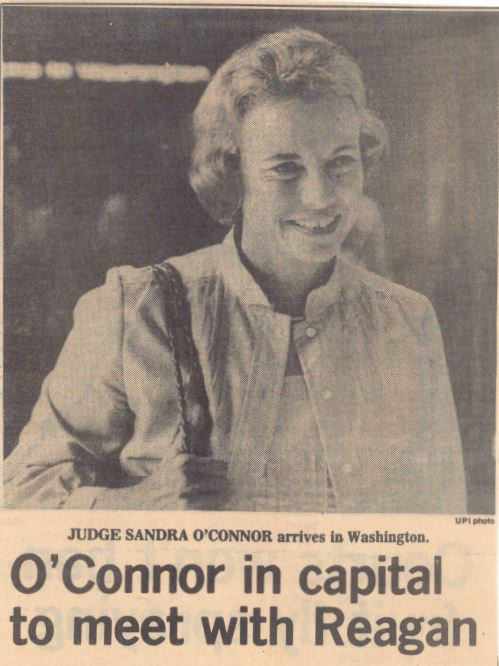
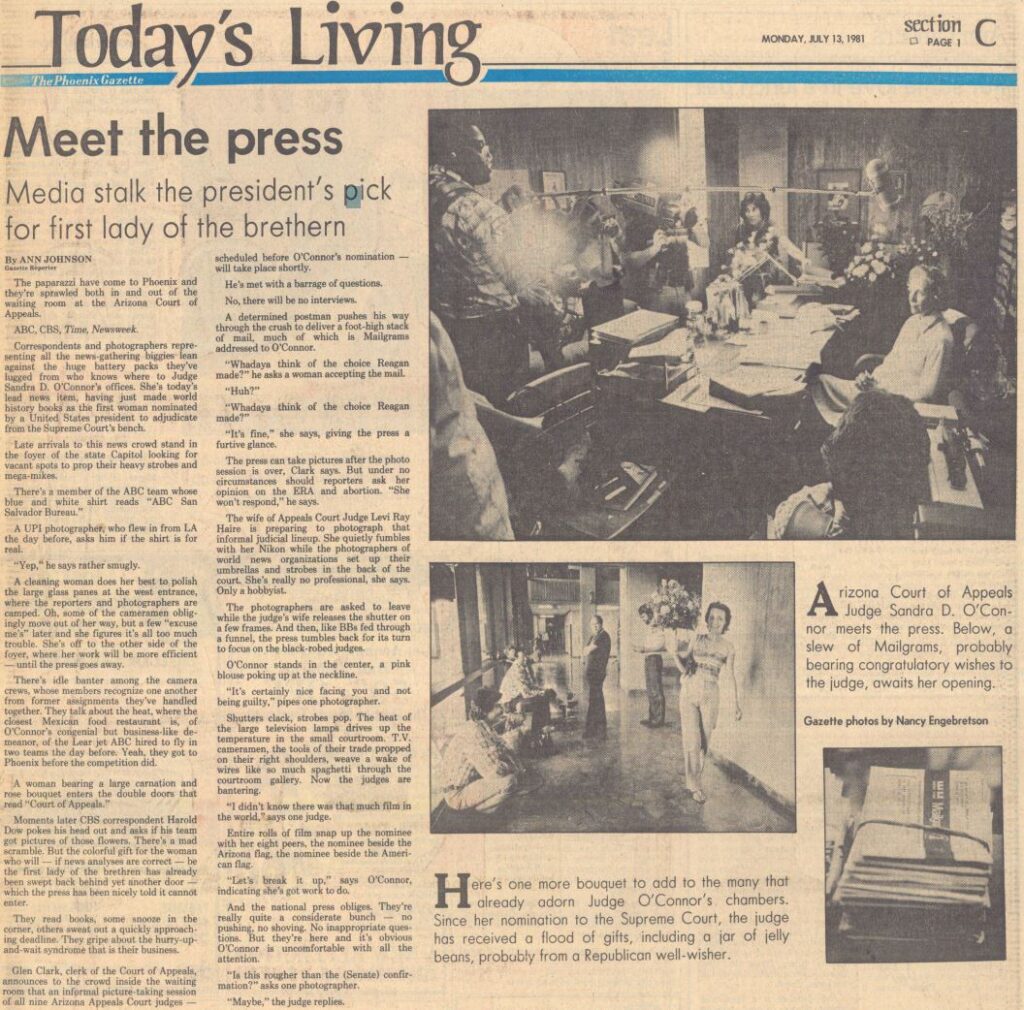
As the first female Supreme Court Justice and the first female state majority leader, Justice O’Connor’s story has inspired many journalists, authors, cartoonists, and groups to celebrate her experience. This catalog explores the media coverage she received throughout her career.
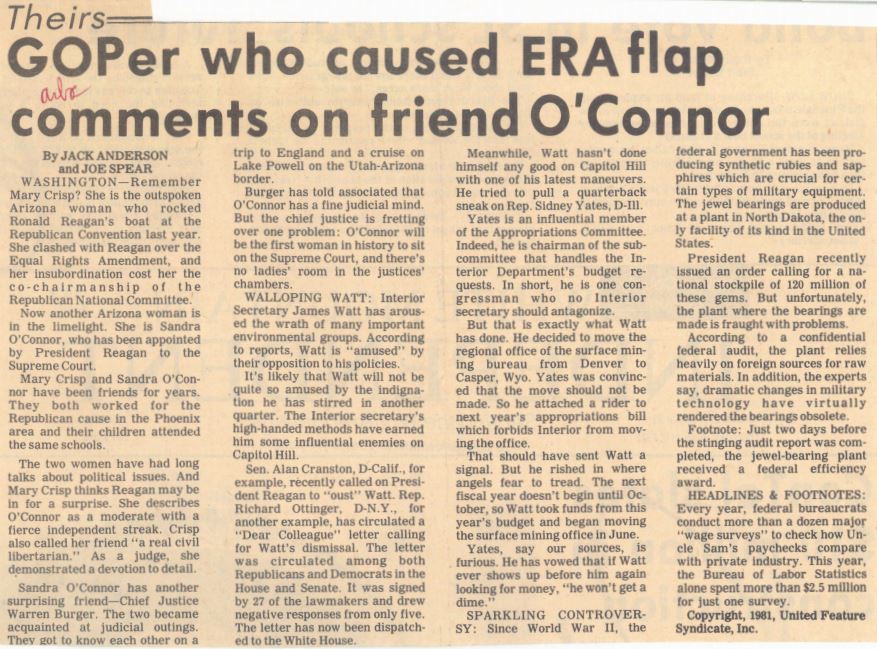
Remember Mary Crisp? She is the outspoken Arizona woman who rocked Ronald Reagan’s boat at the Republican National Convention last year. She clashed with Reagan over the Equal Rights Amendment, and her insubordination cost her the cochairmanship of the Republican National Committee. Now anot~er Arizm)a woman is in the limelight. She is Sandra D. O’Connor, who has been nominated by President Reagan to the Supreme Colll’t. Mary Crisp and Sandra O’Connor have been friends for years. ‘f hey both worked for the Republican cause in the Phoenix area and their children attended the same schools. The two women have had long talks about political issues. And Mary Crisp thinks Reagan may be in for a surprise. She describes O’Connor as a moderate with a fiercely independent streak. Crisp also called her friend “a real civil libertarian.” As a judge, she demonstrated a devotion to detail. Sandra O’Connor has another surprising friend: Chief ,Justice Warren R Bur!!er. ‘I’he two became acquainted at judicial outing8. They got to know each other on a trip to England and a cruise on Lake Powell on the Utah-Arizona border. Burger has told associates that O’Connor has a fine judicial mind. But the chief justice is fretting over one problem: O’Connor will be the first woman in history to sit on the Supreme Court, and there’s no ladies’ room in the justices’ chambers. Walloping Watt ‘- Interior Secretary James G. Watt has aroused the wrath of many important environmental grot1ps. According to repqrts,
Sen. Barry Goldwater recommended Judge Sandra O’Connor for the Supreme Court and was unamused when the Rev. Jerry Falwell of Moral Majority criticized her as not far enough right. With the blunt language of the Southwest, Goldwater growled, “Every good Christian ought to kick Jerry Falwell right in the ass.” That caused a bit of heartburn in the news business because Goldwater’s little word is listed as vulgar in the dictionary. Even so, three TV networks and many ;newspapers quoted Goldwater verbatim. The Christian Science Monitor, with its usual firmness, reported that Goldwater had said something “not printable in this newspaper.” The New York Times faced a dilemma: It wanted to run the story but it had to protect its genteel audience from a rude word. The Times could have written, “right in the a-” It used this dodge when President Carter threatened to whip Ted Kennedy’s a–. Or it could have slipped into indirect quotation, saying that Goldwater urged the faithful to chastise Falwell in the seat, rear or duff. Instead the Times wrote, “Every good Christian ought to kick Falwell in the posterior.” Now this may seem a minor fudge but it isn’t. Every journalism student learns to put within direct quotes only what a person actually said. Worse yet, the Times is reputed to be the nation’s newspaper of record and is much consulted by librarians, historians and other dusty types. Someday one of them will come across the bowdlerized quotation and write a book proving that Goldwater
All of Arizona should be very proud of President Reagan’s choice of Judge Sandra O’Connor for the position of associate justice of the U.S. Supreme Court. Judge O’Connor is the first woman so selected and she is from Arizona, but this selection is more importantly of a person whose intelligence, integrity and judicial capability is not dependent on her sex. A qualified person has been selected for a position that can only be enhanced by the demonstrated qualities of the candidate. The president is demonstrating what has made America great. -We are strong and great because we find the right person at the right time. Advancemen t is spurred by the many single-minded and vocal pressure groups , but people like Judge O’Connor demonstrate the courage and intelligence that stabilizes Amer• ica so that our advances can be real and lasting. Let us take pride and joy as Arizonans, as people, as American citizens, that again we have found the right person. MARILOU COY Phoenix
If Judge Sandra O’Connor is confirmed by the United States Senate as the first woman on the Supreme Court, she will go down in history as one of our most esteemed pioneers. We may even find her picture on a postage stamp someday. And to hear all the babble of nit-picking that is arising makes one wonder if even the motives of heaven would be questioned and subjected to the third degree. Mrs. O’Connor is a credit to the women of America. She is an example of that rare womankind who can carry a pitcher of water on both shoulders, an excellent mother, an excellent lawyer and a compassionate and brilliant human-being who has arisen to the height.a of awesome honor. Isn’t it about time that we look at personal integrity in out officials and have faith in their judgment instead of gagging on gnat.a and swallowing elephant.a? May we have more of Sandra O’Connor and her kind! CHARLOTTE ELDRIDGE SUTTER, Phoenix
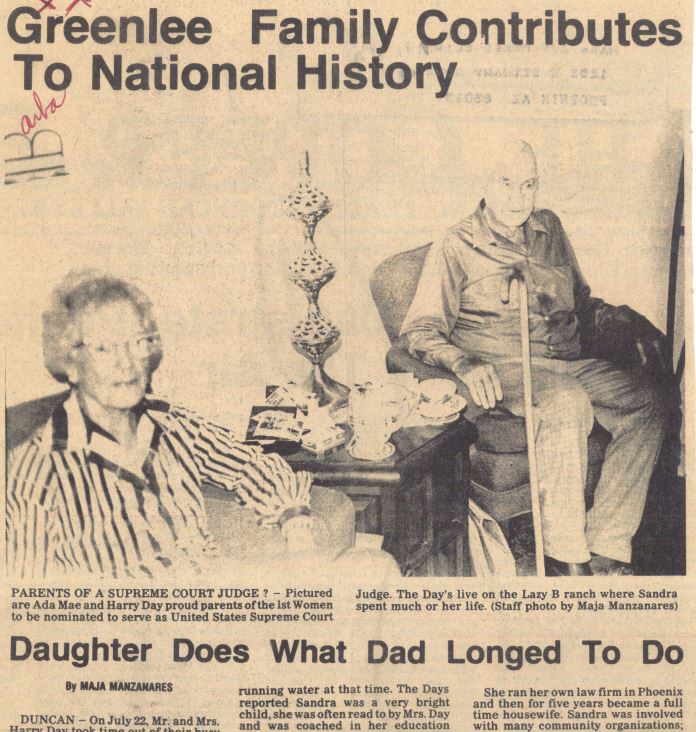
DUNCAN – On July 22. Mr. and Mrs. Harry Day took time out of their busy s~hedule to be interviewed at their hbme on the Lazy B Ranch. Needless to say Harry and Ada Mae are very proud and overwhelmed with the honor that has been bestowed on their daughter Judge Sandra Day O’Connor. “The word spread quickly June 28 through Greenlee County and the entire nation, that Judge O’Connor had been nominated by President Reagan u the 1st women to be nominated to serve on the United States Supreme Court. Judge O’Connor spent many or her ‘ happiest days on the ranch riding horses and roping steers. Her parents Harry and Ada are natives of Arizona, they operate a 260 square mile cattle spread straddling the Arizona and New Mexico border. The LazyB Ranch has been in the Day family since 1881, thtree decades before Arizona became a State. Mr. Day said his father traveled from Vermont where he operated the Lazy B which is 670/o public domaine. The name was acquired because of the brand that was on the cattle when Sandra’s Grandfather purchased them in Mexico, the “B” lying down created the ‘ nnme Lazy B for the ranch. Four gEinerations have lived on the Lazy B during its 100 years. The Days hosted Crentennial celebration last year for tl!1e community of Duncan, Sandra was hr:>me for the festive occasion. Mr. and Mrs. Day were married in Las Cruces in 1929, Ada Mae was born in Douglas and Harry was delivered by a midwife on a ranch. Education seems to be a tradition in the family as Mrs. Da1
CHEERS AND JEERS FOR O’CONNOR
The rave reviews of Jana Bommersbach, Southern Arizona ranch hands et alia are not enough. Sandra O’Con’nor just isn’t much to get excited about – even excited enough to support her nomination. Remember the folks who made that nomination
Sure she’s no Rehnquist. Somebody broke that mold soon after his birth. But she is still quite conservative. And people have known for 10 or 20 years that a conservative woman can rise to fairly great heights in the good old U.S.A. The point is people like Sandra O’Connor do not have a coherent view of society that they will try to put forward such that people, especially female people, can be liberated in a meaningful sense of the word.
The questions are these: should she have received the nomination if she hadn’t had a pretty wealthy start in life, including horses (note the plural), prep school and Stanford Law? Could she have risen so high in Arizona politics without the connections offered by her family and her marriage? Would she have been so respected if she had remained childless? (Or if her sons hadn’t gone to Brophy Prep?) Would she have advanced in the Arizona Judiciary if she had made any public statements regarding the injustice, racism, sexism, and general anti-democratic (note small d) sentiment in Arizona state government? Would she be so popular if she hadn’t joined (and led) the Right women’s clubs? And why were they single-sex clubs anyway? Finally, regarding endorsements, how much respect
There are several questions which beg answers for many folk across this nation. Questions that needed to be raised in order to let the Judiciary Committee know that many of us are concerned about the two areas which Mrs. O’Connor refused to answer because they were “substantive” issues not to be discussed. THE ARIZONA REPUBLIC On the question of abortion, the fact is that Mrs. O’Connor has actively supported legislation . on abortion. One can explain away her vote on the rider of the university bill but not her “aye,, vote in committee and again in caucus for an unlimited abortion-on-demand bill. Again, she voted “no” on a Memorial to Congress to extend protections to unborn babies by prohibiting abortion. She also cosponsored a Family Planning Act which provided for medical procedures, information and contraceptives for anyone regardless of sex, race, age, etc. Physicians could furnish these services to minors without the consent of parents or guardians. The issue becomes even broader – it involves parent.s’ right.s and responsibilities. It has been reported that Mrs. O’Connor changed her mind on the Equal Right.s Amendment after she introduced it by special permission to the Senate. That was not Mrs. O’Connor but Bess Stinson and myself. Mrs. O’Connor continued to support it throughout her term in office and there is nothing to indicate a reversal of her support. When the Judiciary Committee meet.s, I’m sure the “substantive” questions will be answered. AB someone said; “It
NATIONAL-The American Bar Association is taking a long, hard look at Sandra O’Connor’s qualifications to sit on the U.S. Supreme Court
But the U.S. Senate that is expected to routinely confirm O’Connor before the court’s fall session begins in October will know what the ABA thinks of the Arizona Court of Appeals judge before the_public does. The Reagan administration apparently has ordered the ABA’s Standing Committee on the Federal Judiciary to keep the report under wraps until the hearings.
Chairwoman Brooksley Landau, a Washington lawyer, is refusing to say if Reagan has authorized the ABA to release the report when it’s completed – a polite way of saying it won’t be. Reagan waited until the last minute to inform the ABA he was nominating O’Connor, coming perilously close to ignoring a Presidential tradition of seeking a pre-nomination imprimatur from the nation’s largest association of lawyers, but the national press doesn’t seem interested in asking why.
Some skeptics in the legal community are suggesting the committee might designate O’Connor as a judicial lightweight, whose relatively brief trial court tenure doesn’t give her the length and depth in constitutional law expected of justices. O’Connor doesn’t have as many years on the bench as Reagan’s other female finalists, the skeptics note.
On the other hand, O’Connor brings to the court the kind of nuts-and-bolts trial experience ~at could keep the Supremes from wandering too often into legal esoterica that reads
Usually, in this trade, there is somebody at the other end of the telephone who can give you the answer to any question save possibly what the Aztecs were trying to say on their calendar stone. The morning paper even reveals that Shy Di’s uncle, or somebody serving the dynastic concerns of Great Britain, acknowledged that a discreet examination established that she could bear a successor to the throne. As the people in Silicon Valley are fond of saying, “It’s all a problem of software In hardNare, there are no more problems,” Well, I’m still in search of a definite body of knowledge on the question: What exactly can you legitimately ask someone who has been named to the Supreme Court? There are apparenily no hard rules. Such as there are depend for their effect on plausibility. For instance: • Sen. Jones: Mrs. O’Connor, if the Human Life bill is passed into law and its constitutionality is challenged before the court. how would you vote? Mrs. O’Connor: Senator. I don’t think it proper to say how I would vote on a pending matter. For one thing, I would want to study the briefs. hear the oral argum ents and perhaps even ask a question of my own. J : Does that mean that you can 1, make up your mind on the question whether the Congress of the United States has the constitutional right, to cll•dare at what point a biological organism becomes entith •d to the protPciion of the 14th …
WASHINGTON (AP) – President Reagan has named a woman to the Supreme Court and has promised to campaign from the White House against state laws that discriminate against wommmen. Still, though, hrs political problem with women voters hasn ‘t been solved. It showed up on Election Day, and it is still there. Reagan fulfilled a campaign promise wher, he decided to nominate Arizona Appeals Court judge Sandra D. O’Connor to the Supreme Court. Now he is fulfilling another, with a drive for repeal of discriminat:ory state laws. He has appointed an aide, Judy Peachee, to work on that project and has written governors asking their help “to identify and correct state laws and regulations which discriminate on the basis of sex.” As campaigner and as president, Reagan has firmly opposed ratification of the Equal Rightti Amendment. His campaign pledges on the court appointment and the drive to erase discriminatory laws were offered aa. antidotes to criticism stemming from his position against the ERA. But on Eleeiion Day~ Reagan won overwhehning- ly among male vot.ers, narrowly among females. The difference of opinion persists. The polls show that men still are mere im.pres.ted than women with Reagan’s pert’o~ ae preeident; although the majority is favorable in both caees Women – and men – strong backing for the nomination of Mrs. O’Connor. But, aa they have for month,, women hold a generally lower opini(m of Reapri, troat him _…_, give him a lower job rating and feel he is less compassionate
Apparently trying to quell the rising waters of discontent among groups on the right, White House chief of sta~ James A. Baker III has established a regular pipeline for communications with several conservative groups that are upset about the nomination of Sandra Day O’Connor to the Supreme Court. ! Baker acknowledged yesterday that, in a recent meeting with representatives of several conservativei groups, he establ.ished a regular pro-j cess to permit the groups to bring, their views on sensitive issues to the White House. Paul Weyrich, head of the Free Congress Research and Education. Foundation, who was present at the’ luncheon meeting in Baker’s office, said many conservative groups are still extremely upset by the admin-, stration’s action in the Supreme Court nomination. “I tried to explain to Jim Baker the damage that had been done to the coalition” of Republicans, religious groups, and activists on conservative causes, Weyrich said, adding that he was not sure Baker understands the extent of the rift. Baker and the representatives of five conservative groups agreed to establish a regular memo channel into the White House so that groups on the right could alert the White House to their concern on some selected issues. “It was a meeting to establish and maintain lines of communication,” Baker said yesterday. “It was designed to make it clear that in appointing Sandra O’Connor the president went to great lengths to satisfy himself on her views … that in making this nomination
The savage attacks on Supreme Court nominee Sandra Day O’Connor by right-wing groups reveal a dangerously distorted idea of how the U. S. government should work. In this country, Congress enacts the legislation; the courts determine its conformity with the organic law of the land, the Constitution, and define its application to specific cases. The fact that groups such as the Moral Majority and the National Right to Life Committee supported President Reagan in the last electi0n gives them no right to have a representative on the Supreme Court or any other branch of the judiciary. When the Senate holds hearings on confirmation of the O’Connor appointment, it should review her record as a lawyer, state legislator, and appeals court judge in Arizona . It should not try to extract a commitment about how she will vote in cases involving abortion, the issue that her critics consider crucial. And it should ignore the demands of lobbyists who want it to demonstrate to President Reagan that “his next court appointment had better be pro-life.” Abortion is only one of the many controversial issues the Supreme Court will have to consider in the years ahead. Vacancies on the court should be filled with appointees who are distinguished for their wisdom and their judicial temperament, not for their blind accept – ance of the doctrines of any group. Associate Justice Oliver Wendell Holmes made his reputation as a gre_at judge by defending . the right of the government – whether federal or state-to
WASHINGTON -The issue that finally sank Andrew Young as the Carter administration’s ambassador to the United Nations was his meeting with representatives of the Palestine Liberation Organization and, more to the point politically, the angry reaction it caused in the Jewish community . Two years later that same reaction seems to be haunting Young in his campaign for mayor of Atlanta. After several months of campaigning Young has been able to raise less than $100,000, while Atlanta’s substantial Jewish community is pouring money into one of his prime rivals, state legislator Sidney Marcus. The Marcus campaign concedes it is likely to have $500,000 to spend, and other sources suggest it may be as much as $700,000. One result is that Marcus advertising is already running on television, and has been for weeks, although the election is not until Oct. 6. Marcus is not Young’s only problem. Some Atlanta political professionals say they believe that Reginald Eaves, a controversial former public safety commissioner, has been making significant progress in winning the support of low-income blacks who credit him with halting police brutality against them. At this point, however, there are no opinion poll figures to support that thesis. * • * The White House, well aware of the unhappiness among leauing conservative and anti-abortion groups over the nomination of Sandra O’Connor to the Supreme Court, has upgraded its stroking of the New Right. James A. Baker , the White House chief of staff
It was bound to happen sooner or later, and with his unexpectedly early opportunity to make his mark on the composition of the Supreme Court, it is turning out to be sooner. President Reagan’s nomination of Sandra Day O’Connor to replace retired Justice Potter Stewart has , as you must certainly be aware unless you have sworn off the front pages entirely for the summer, brought out an important segment of his constituency “in strident opposition. . O’Connor would appear to have everything to qualify as a quality appointee – political and judicial experience, an impressive academic record and a reputation in public office as a principled conservative who has won the respect of both ideological allies and opponents. But the newly powerful new right says it won’t have her, thereby appearing to confirm the predictions of those who have been saying – hopefully or otherwise – that President Reagan would never be able to satisfy the demands of the assortment of special-interest groups that candidate Reagan had attracted to his cause. In the case of the O’Connor nomination the interest is CJ)position to abortion. But in judging that nomination unacceptable on the basis of votes cast while she was a member of the Arizona legislature, her conservative critics are reacting both hastily and in disregard of some basic Supreme Court history. The abortion issue was not all that clearly defined in the legislation under scrutiny. And as you may by now be weary of being informed, attempting to
PHOENIX – The Arizona Senate Friday approved by a 29-1 vote a House memorial endorsing the nomination of Arizona Appeals Court Judge Sandra O’Connor to the U.S. Su~reme Court. The memorial said O’Connor is “an eminently qualified jurist, having served as a trial court judge, and is presently serving as an appellate court Judge.” Sen. Manuel Pena, D-Phoenix, cast the dissenting vote.
W~ If!NGTON – Confirmation hearings on the ~,.., n~mmatton of Sandra Day O’Connor to the Supreme Court “,ti will be Sept. 9-11, Sen. Strom Thunnond, R-S.C., chairman ‘ of the Senate Judicary Committee, said. O’Connor, a state appe’.118 court judge in Arizona, has been nominated by President Reagan to succeed Justice Potter Stewart who retired_ this month. If confirmed, the Paradise Valley’ resident will be the first woman ever to serve on the nation’s highest court.
THE NEW RIGHT is wrong in launching a campaign to deny Judge Sandra O’Connor a seat on the U.S. Supreme Court. , It is wrong because Judge O’Connor’s judicial record is clearly one of balance that defies activist or biased labels. It is wrong because the 51-year-old Arizo- ~ . is a strict constructionist – making her “~ aecisions on legal precedent, not trying to :~: I 4!?~ate law herself. u .. .. , f.,-.,~It is wrong in attributing certain abortion ~: ~ws to Judge O’Connor while she has made ~If if clear not only that she is personally opposed tQ ,oortion but that her position has been ~–•~rsimplified and she will clarify her legisla- c,~1t,i~ voting record on the subject in testimony .before the U.S. Senate. c,V’• ‘, ~ •, tis wrong because the judge deserves the ~!.~op~rtunity – indeed, has the legal and 111 , n’S,otal right – to state her qualifications and, aÂ¥. li “necessary, defend her record before the ;~, ~te without being prejudged. .. ; i …. it is wrong because there is nothing in either O’Connor’s professional or personal life to suggest she is a radical feminist although she is concerned about women’s right.s. It is wrong to challenge the Arizonan on ideology rather than her qualifications to judge subst.antive, legal issues. It is wrong for the New Right to assume it was the dominating factor in the election of President Reagan and, therefore, has a singular or special role in guiding the administration because such an electoral assumption is clearly inaccurate.
WASHINGTON – A major conservative fundraiser – declaring the New Right is not “a paper tiger” – vowed Wednesday to enter the fray to keep Sandra O’Connor from winning Senate confirmation as a Supreme Court jUBtice …
said committee Chairman Strom Thurmond, RS.C., told him the nomination is expected to clear the com.mittee and be reported out to the full Senate by Sept. 15. Fundamentalist preacher Carl McIntire, singling ont Judge O’Connor’s views on the rights of religious broadcasters and church ownership of property, said, “We believe (that} in the area of First Amendment rights, she’s very dangerous.” Viguerie served notice, while speaking to the Washington Press Club, of an all-out battle to convince senators to vote against her. “These senators have to be shown a tremendoUB outpouring at the grass-roots level” before they will oppose Judge O’Connor, said Viguerie, who has raised millions of dollars for conservative candidates and causes across the nation. Viguerie said the New Right – an informal coalition united by ultraconservative views on both social and economic issues – has to wage a battle against Judge O’Connor’s record on the abortion issue or else the White House “will just think we are a paper tiger.” But the White House repeated the administration•~ belief that she will be confirmed – perhaps unanunously. Meanwhile, Carolyn Gerster, former Right to Life president and longtime acquaintance of Judge O’Connor, was asked if she believes President Reagan was duped
Wai;hington A major conservative fund-raiser ,owed :resterday to enter the fray to keep Sandra O’Connor from winning Senate confirmation as a Supreme Court justice. The declaration by direct-mail “izard Richard Viguerie came as fundamentalist opponents to O’Connor opened a new First Amendment front and other foes of the Arizona judge continued to attack her record on abortion. Fundamentalist preacher Carl :’ltclntire, singling out O”Connor’s iews on the rights of religious broadcasters and church ownership of property. said, “We believe. in the area of First Amendment rights, she s very dangerous.” And Viguerie sened notice, while speaking to the Washington Press Club, of an all-out battle to convince members of the Senate to vote against the selection. “These senators have to be shown a trem<'ndous outpouring at the gras5 roots level" before they will oppose O'Connor, said Viguerie. who has raised millions of dollars for conservatie candidates and cam,es across the nation. He refused to say specifically \ hat kind of campaign is being organized, saying only: "\,'e're going to have some big events in a 'ery public way dealing with some of these religious leaders." Viguerie said the New Right - an informal coalition united by ultraconservative views on both ~ocial and economic issues - has to wage a battle against O'Connor's record on the abortion issue, or else the White House ''\ill just think we are a paper tiger." l1clntire, who described R~Jgan's choice as "a dark
WASHINGTON (AP) – Conservative Richard Viguerie says his direct-mail organization is working nearly “around the clock” to block Sandra D. O’Connor’s nomination as a Supreme Court justice . But with Senate confirmation hearings scheduled to start Sept. 8, Viguerie hints that it’s the principle – not necessarily a victory – that counts. “The only way we’re going to lose this is if we fail to fight the fight,” Viguerie said Wednesday. The White House would view the conservatives as “paper tigers” if they did not mount their opposition, he said, adding, “It’s a battle that has to be waged.” Senate leaders from both parties have predicted the 51-year-old Arizona appeals court judge will win easy confirmation, despite conservatives’ claims that she supports abortion and the Equal Rights Amendment. Viguerie refused to predict whether the coalition’s efforts would succeed. He said the fight against the nomination would be aimed at reminding President Reagan of the conservative coalition that helped elect him last fall. He charged that the White House staff has not been considering the grass -roots support that Reagan received – particularly when it came to the Supreme Court nomination. “We are working around the clock, almost, to generate support,” for the opposition to Mrs. O’Connor, Viguerie said. “These senators have to be shown there is grass -roots support.” “We’re going to have some big events before the nomination takes place,” he said, adding that the opposition to Mrs. O’Connor
S andra O’Connor, President Reagan’s nominee to the Supreme Court, has won the endorse- _ ment of a couple of “gun lobby” groups in Yashington, but so far the National Rifle Association has been silentconcerning her nomination. For what it is worth, I am sure the NRA also a~proves_ of her _no~ination based on her record as a fm and unpartial Judge, one with the courage to be to~h _when toughness is called for, and her legislative record as a state senator. I was covering the state Senate during most of O’Connor’s service there, and I worked closely with her as a citizen on an important firearms bill. Th~t bill was described by the Washington lob~yists as measure “that would have made it easier for ArJZOna residents to obtain permits to carry concealed weapons.” That statement is 100 percent wrong. There never h~ been any such thing in Arizona as getting a permit to carry concealed weapons. In states w~e~e such pe~ts can be obtained, it seems that cnmmals sometimes wind up with permits easier than honest citizens. At my request – as a citizen who has worked for many years to see to it that Arizona has reasonable and enforceable firearms-control laws – O’Connor h_e~ped me rewrite state statutes to protect honest citizens from harassment or unwarranted arrest on concealed-weapons charges. We undertook to do that by detailing out in the law how firearms could be legally carried. During that period I learned a lot about O’Connor’s philosophy and character, because we debated the
Editor: Re: Rep. Jim Skelly. I have not always agreed with Jim Skelly, but I have always known exac~y where he stands on issues. Because of his honesty with the people, he is refreshing and a rarity in politics today. . It is good to know that one man rn politics will not compromise his principles for the sake of political expediency or big business.
Before the U.S. Supreme Court became an equal opportunity employer, there was Florence Allen. Wheµ she was 7 years old, her father said, “If Florence were a boy, I’d make her into a lawyer.” When she was grown, three U.S. presidents said that if Flprence were a man, she’d be a Supreme Court Justice. Florence Ellinwood Allen. Published _poet. Concert pianist. First woman to pronounce the death sentence . First woman judge on the U.S. Court of Appeals, and for three decades, best bet to become the first female on the nation’s highest bench. Two weeks ago, President Reagan nominated Sandra D. O’Connor for that honor and Florence Allen, who died in 1966, would have been as pleased as all the other women jurists __ who have struggled for the day a woman would get invited to join Washington’s most exclusive male club. When Reagan cho!’e O’Connor, a 51-year-old Arizona Appellate Court justice, to sit with those who “leave their footprints on the sands of time,” the president fulfilled a campaign pledge to nominate a woman to the Supreme Court. The historic value of the move was not lost on this president who, despite his opposition to the Equal Rights Amendment, cheerfully praised O’Connor as the equal of “the 101 ‘brethren’ who have preceded her.” Between Allen and O’Connor, there have been at least a dozen women judges publicly mentioned for justice jobs. But few of them have even come close to a seat on the big bench.
…
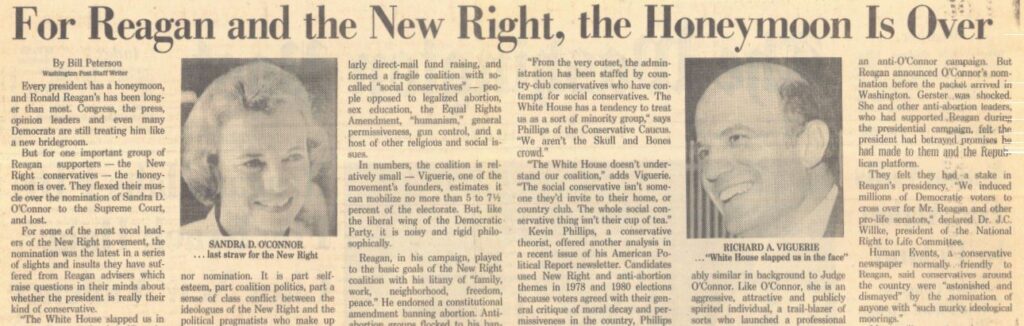
Every president has a honeymoon, and Ronald Reagan’s has been longer than most. Congress, the press, opinion leaders and even many Democrats are still treating him like a new bridegroom. • But for one important group of Reagan supporters – the New Right conservatives – the honeymoon is over. ‘I’hey flexed their muscle over the nomination of Sandra D. O’Connor to the Supreme Court, and lost. For some of the most vocal leaders of the New Right movement, the nomination was the latest in a series of slights and insults they have suffered from Reagan advisers which raise questions in their minds about whether the president is really their kind of conservative. “The White House slapped us in the face,” says Richard A. Viguerie, the conservative direct-mail expert. “‘I’he White House is saying you don’t have a constituency we’re concerned about. We don’t care about you.” “Thel’e’s been a challenge issued,” explains Viguerie. “It is something we can’t ignore. We either fight this one, or we aren’t leaders.” Viguerie and his cohorts on the New Right have done just that. They have f urned and fussed. They’ve launched a series of pointed’ attacks on O’Connor in their publications and in thousands of letters and telegrams sent to their supporters around the country. But after two weeks, they have yet to persuade a single senator to come out against O’Connor, the first woman ever appointed to the Supreme Court. They plan to continue what they now see as an all but hopeless fight if only
One more Sandra O’Connor story …. The woman who is the president’s pick to serve as the first female Supreme Court justice didn’t always find her legal skills in demand. After she graduated from Stanford Law School with high marks and impeccable credentials, private law firms in California still closed their doors to her. “They had never hired a woman,” she said in a 1978 interview with Today’s Living. “They weren’t prepared to change. I was offered a job as a secretary provided I could type well.” So instead, she went to work as a deputy county attorney in San Mateo. Now for a chorus of Who’s sorry now?
During his 11 yean in the Arizona Legislature, Rep. Jim Skelly has earned a reputation as a staunch opponent of abortion and a fervent defender of the free enterprise system. It was Skelly who sponsored the bill that put a course on free enterprise economics in Arizona high schools. He has also backed numerous measures to protect unborn life. Because of his deep conviction that abortion is morally wrong Skelly has f!J>Oken out against the appointment of Sandra O’Connor to the U.S. Supreme Court. Skelly and Mrs. O’Connor cast opposing votes on the issue when Mrs. O’Connor was in the Legislature. . “l \ifi You ._r Skelly is apparently too outspoken for the Greyhound Corporation for whom he worked as a customer representative. Upset with his views on the O’Connor nomination, Greyhound asked Skelly to tone down his opposition. Unable to compromise his principles, Skelly resigned. Skelly’s stand is all the more courageous because he knows that it will have no influence on whether Mrs. O’Connor is confirmed by the U.S. Senate. She enjoys overwhelming support from Arizona and in Washington. That Skelly should be treated so shabbily by a major representative of the free market system he so ardently defends is indeed ironic.
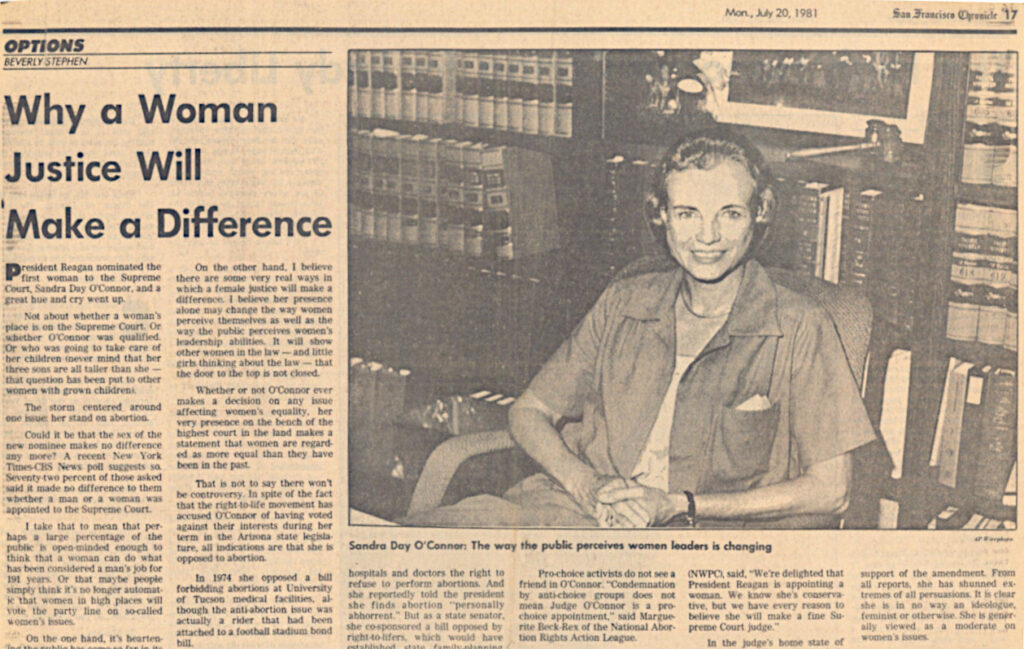
President Reagan nominated the first woman to the Supreme Court, Sandra Day O’Connor, and a great hue and cry went up. , Not about whether a woman’s place is on the Supreme Cou~–Or wJletber O’Connor was quahf1ed. Or who was going to take care of 1 her clllldreo (never mind that her three sons are all taller than she – that question has been put to other women with grown children). The storm centered around one issue: her stand on abortion. Could it be that the sex of the new nominee makes no difference any more? A recent New York Times-CBS News poll suggests so. Seventy-two percent of those asked said it made no difference to them whether a man or a woman was appointed to the Supreme Court.
I take that to mean that per• haps a large percentage of the public is open-minded enough to think that a woman can do what has been considered a man’s job for 191 years. Or that maybe people simply think it’s no ‘?nger autom~tic that women in high .places will ,ote the party line on so-called women’s issues. On the one band. it’s heartening the public has come so far in its acceptance of female leadership.
On the other hand, I believe there are some very real ways in which a female justice will make a difference. I believe her presence alone may change the way women perceive themselves as well as the way the public perceives ~omen’s leadership abilities. It will s~ow other women in the law – and little girls thinking about the law – that the door to the top is not closed. Whether or not
Five years ago I heard the commencement address made by Judge Sandra Day O’Connor at the Orme School, in Arizona. When someone told me that an Arizona woman had been nominated to the Supreme Court vacancy, I felt quite sure that it must be she. When the news confirmed my judgment, a lump of patriotism rose in my throat. It isn’t often that one feels secure in judging anyone, least of all a judge, by one meeting. Judge O’Connor is an exception to that need for prudence. She exudes competence and integrity a degree impossible to fake. She radiates simple, uncomplicated honesty, while, at the same time, exhibiting all of the sophistication necessary in dealing with political sophistry. In my view, nothing in the Reagan administration’s actions is more significant than this appointment which should do more to cool off government by faction than any certain other move which can be imagined. One is tempted to predict that she will disarm even the liberals.
CHARLES R. LA DOW San Diego
So much euphoria reigns over the nomination of Judge Sandra Day O’Connor for a Supreme Court apP01!1tment t~at maybe nobody will notice much if an old sourpuss slips a mite of cynicism into the goingson, just for the heck of it. The thing is that the politics of deception – another term for the end justifying the means – doesn’t go down easily unless greased with cynicism. Ideally, too, it should be a first-class grade of cynicism – the kind that’ll provide a slippery coat for whatever it is we’re bent on swallowing, so that, once it’s down, we won’t even know the cynicism was there in the first place. Now that’s good cynicism. It has utility. I’ve a hunch that Judge O’Connor may be the best Supreme Court appointment in the past couple of dec- ades. But doesn’ t it mean anything at all that President Reagan – when he. was candida~e Reagan – promised – promised! – the antiabortion folks he would not name to the highest court in the land anyone whose views on abortion countered theirs? He sought out the endorsement of the National Right to Life Committee and, in return for that support, pledged Carolyn Gerster, co-founder in Phoenix of that organization, that he would not name a pro-abortionist to the high court. So she says anyway. Maybe there’ll be a denial. But she fills in her story with some rather vivid detail, including the claim that, to turn the tide of support last summer in Iowa that was building among Republicans for George Bush, Reagan told her, “It will mean a lot
COVER STORY
The Brethren’s First Sister
A Supreme Court nominee-and a triumph for common sense Ronald Reagan lived up to a campaign pledge last week, and the nation cheered. At a hastily arranged television appearance in the White House press room, the President referred to his promise as a candidate that he would name a woman to the Supreme Court, explaining: “That is not to say I would appoint a woman merely to do so. That would not be fair to women, nor to future generations of all Americans whose lives are so deeply affected by decisions of the court. Rather, I pledged to appoint a woman who meets the very high standards I demand of all court appointees.”
So saying, he introduced his nominee to succeed retiring Associate Justice Potter Stewart as “a person for all seasons,” with “unique qualities of temperament, fairness, intellectual capacity.” She was Sandra Day O’Connor, 51, the first woman to serve as majority leader of a U.S. state legislature and, since 1979, a judge in the Arizona State Court of Appeals. O’Connor’s name had been floated about in rumors ever since Stewart, 66, announced his intention to retire last month, but her nomination, which must be approved by the Senate in September, was a stunning break with tradition.
In its 191- year history, 101 judges have served on the nation’s highest court, and all have been men. By giving the brethren their first sister, Reagan provided not only a breakthrough on the bench but a powerful push forward in the shamefully
Editor: Keith Akins’ cartoon of Sandra O’Connor directing redecorating of the Supreme Court chambers is not funny-it’s ludicrous! This woman has spent 30 years turning herself into an excellent, well-respected jurist. Let’s recognize that fact as we would for any high court nominee, and quit dragging out the old 1950’s sitcom cliches. Diana K. Jaquette Mesa
Back to Sandra O’Connor. A number of my fellow conservatives remain unhappy about the lady’s Supreme Court nomination. They claim she’s soft on abortion and the F,qual Rights Amendment. I’m not going to belabor those issues. If I had been in the Arizona Legislature when she was, I might have tried to duck the abortion question, too. And as for the Equal Rights Amendment, it doesn’t seem to be going anywhere, so why get too upset? What strikes me about the O’Connor nomination.are two things: 1) the slipshod nature of White House preparation for coping with a breach of the 1980 Republican platform commitment to select judicial nominees on abortion-linked criteria (the breach itself was probably inevitable); and 2) the new male-female double standard that has been applied in the O’Connor selection process. Point one is Machiavellian. There are well-positioned people in the administration, mostly former George Bush campaign aides, who dote on seeing President Reagan sour his relations with the right-to-life crowd. The more they can widen the breach, the less influence the new right and right-to -lifers will have in the future to block a future Bush presidential nomination. Point two hasn’t received enough attention. The old male-female double standard is that a woman couldn’t be nominated for the U.S. Supreme Court. That’s gone, of course. The new double standard is that when a woman is nominated, she doesn’t have to meet the same standards of prior experience or undergo the same
WASHINGTON (AP) -Almost singlehandedly, Sandra D. -O’Connor seems to ha~e.defused any serious conservative opposition to her becoming the first woman on the Supreme Court. In four days of sometimes helter- skelter meetings on Capitol Hill, O’Connor has drawn praise from senators normally on opposite sides of almost any political issue. “I’m convinced that Judge O’Connor will receive confirmation by an overwhelming if not a unanimous Senate,” said Sen. Edward M. Kennedy, D-Mass., the principal Democratic liberal voice in the Senate and a major ideological opponent of the Reagan administration. Kennedy is as enthusiastic on O’Connor’s behalf as conservative stalwart Barry Goldwater, the Republican senator who is the nominee’s home-state sponsor. Other key conservatives, such as Republicans Orrin Hatch of Utah and Strom Thurmond of South Carolina have said they will support the quiet-s~ken graduate of Stanford University Law School. Thus far, no senator has come out in opposition. In all, O’Connor met with 24 of the 100 members of the Senate. Most meetings ended or began with a photograph that will no doubt find its way into mail to voters in each senator’s state. Constantly trailed by a band of reporters and television crews, O’Connor seemed amused at only one point in her Washington visit, when she and a few aides and reporters were briefly trapped in a crowded, stubborn elevator that refused to stop at the proper floor. O’Connor’s travels through the Senate recalled one of Reagan’s
Difficult questions about age fill the mail this week. Mr. C.S. of Chester, Pa., for example, writes that since the 1930’s the Supreme Court has often been referred to as ”nine old men” and asks:
”If Sandra O’Connor’s appointment is confirmed, will it be correct thereafter to refer to the Court as eight old men and an old woman?”
No, Mr. C.S., ”eight old men and an old woman” will not do. In the first place, since Mrs. O’Connor is only 51 years old the phrase would strike most people over the age of 29 as viciously overloaded with youth bias. To people in their 20’s a female Justice of 51 may be an ”old woman,” but people old enough to remember Chief Justice Charles Evans Hughes might just as reasonably think of a woman of 51 as a ”spring chicken.”
Do we want to refer to the Supreme Court as ”eight old men and a spring chicken”? Of course not. Even in America, vulgarity must have its limits. How about ”eight old men and a lady”? Out of the question – feminists have declared ”lady” a taboo word. They prefer the word ”person,” which would give us ”eight old men and a person.”
Unfortunately, this construction calls attention to Mrs. O’Connor’s femininity and may, therefore, be objectionable as a ”sexist” phrase. Are the eight old men, after all, not persons too, just as Mrs. O’Connor is a person? If Mrs. O’Connor were older we could solve the problem simply with ”nine old persons.” Under the circumstances, however, the only possible phrase is ”eight old
Public glimpses fail to capture traits nominee shows in private contacted me about arrangements for her golf lessons, and I’m not planning on moving to Washington. She’ll probably have the best handicap on the court.” committal smile is known only to her circle of friends and her family. Supporters speak of her integrity, intelle ct, energy and capacity for hard work. By Chuck Hawley Republic Staff Steve Dunning may be the only person in the United States who doesn’t believe Arizona Court of Appeals Judge Sandra O’Connor will accept her nomination to the U.S. Supreme Court. Dunning, a former assistant golf pro at Paradise Valley Country Club, has tutored the judge’s golf game for two years. His tongue-in-cheek comment was one of many insights on the first woman nominated to the Supreme Court . Even negative comments seem to have an element of grudging praise – demanding, intense, aloof, severe. . “I don’t care what t&e press says,” Dunning said. “I won’t believe she’s going to accept the nomination until I hear from her. She has not Despite the intensity of official and press scrutiny, the person behind that pleasant but nonBy now, her childhood, schooling, career, marriage, political positions and voting record are matters of record – a record compiled and then scrutinized by White House staff, the FBI, proponents, opponents and reporters. Time and Newsweek have devoted a total of 14 pages to the story. In Arizona. it’s become a classic tale of “local girl makes good.” The thousands
RATHER than alter or abandon his criticism of Supreme Court Justicenominee Sandra O’Connor, state Rep. Jim Skelly quit his job with the Greyhound Corp. In so doing, he not only showed the courage of his convictions, but he also struck _ a blow for a legislative process free of unwarrant.ed pressures. His bosses, concerned that the public might confuse Skelly’s legislative role with his Greyhound customer-relations role, attempted to moderate his public utterances on Judge O’Connor’s nomination. Skelly, who still seethes over Judge O’Connor’s votes in the early 1970s on abortion when she served in the state senate, is outraged by her nomination. He fmds it diametrically opposed to “the welfare of the innocent unborn.” During more than five years with Greyhound, Skelly undoubtedly has said or done things as a legislator that weren’t totally to the company’s liking. Meanwhile, most of the community probably was unaware that he even worked for Greyhound. Why the company felt the need to control his views on Judge O’Connor is difficult to underst.and. Neither U.S. Sen. Jesse Helms, R-N.C., nor any national group st.ands a chance of blocking her confirmation, much less a state representative. By leaning on Skelly the way it did, Greyhound bas given itself a black eye, and has done no great favor to business in general The company is correct when it says Judge O’Connor is “one of the most level-headed, intelligent justices, male or female, ever to serve on the bench.” But it does
Two centuries of national history suggest that Sandra O’Connor will be confirmed in due time and take her seat on the U.S. Supreme Court unless a continuing investigation unearths something wholly unexpected. Her nomination by President Reagan has given the political far right and opponents of abortion per se another megaphone, which will be exploited thoroughly. However, her conservative credentials are nearly impeccable and, after all, didn’t Mr. Reagan himself sign an bill permitting abortion when he was governor of California? After the thunder on the right diminishes, the U.S. Senate will confront an inexorable historical fact: Except in rare cases, only egregious-, ly unqualified persons have been rejected and O’Connor clearly is qualified. Since 1787, U.S. presidents have nominated 139 persons to the court. Only 26 were considered unfit by the Senate. Most recently denied confirmation were Clement F. Haynsworth in 1969 and G. Harrold Carswell in 1970, both named by President Nixon. It’s a reasonable assumption that the Senate will not compound President Reagan’s historic landmark by rejecting the first female court appointee over a single issue. So speculation deepens on how O’Connor’s presence will influence the court. Published analyses suggest that O’Connor will have more understanding of state and local issues and problems, given her background in the Arizona legislature and on the Arizona bench. President Reagan apparently believes that O’Connor will “interpret !he_
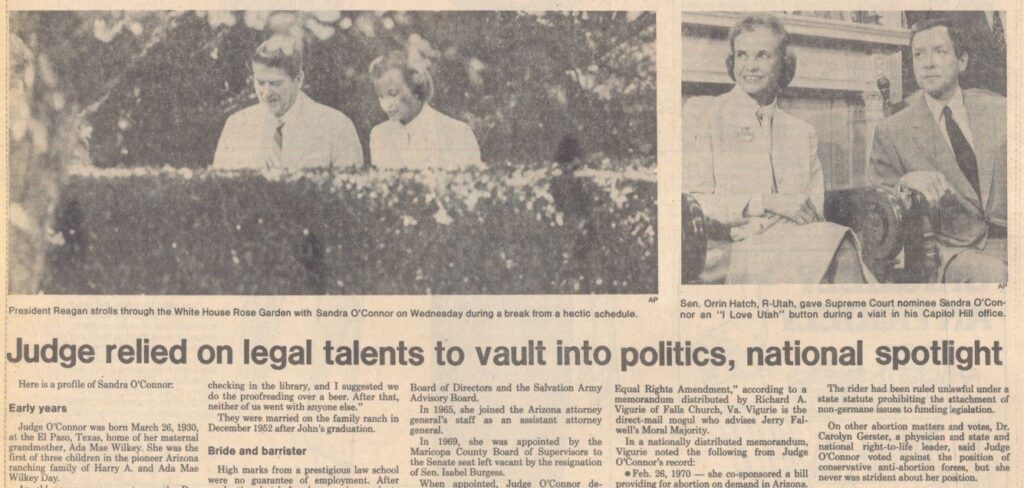
Early years I I 1 Judge O’Connor was born March 26, 1930, at the El Paso, Texas, home of her maternal grandmother, Ada Mae Wilkey. She was the Bride and barrister first of three children in the pioneer Arizona I ranching family of Harry A. and Ada Mae Wilkey Day. 1 An old newspaper account says the Day 1 family’s 162,000-acre Lazy-B Ranch was “the first in southeastern Arizona.” She went to school in El Paso, where she 1 lived with her grandmother, because there were no suitable schools near the ranch. She attended the Radford School for girls and graduated from Austin High School, which she attended for her senior year. ‘ She has a sister, Ann, now 43 and married to former state Sen. Scott Alexander, and a brother, Alan, 41, who manages the ranch. ‘ Matriculation to marriage • : After high school, she enrolled at Stanford : University, majoring in economics and grad1 uated “with great distinction.” Admitted to Stanford Law School, she had a distinguished classmate in Supreme Court Justice William Rehnquist. An early report that they graduated third and first, respectively, has been discounted. But Judge O’Connor does have substantial academic credentials. She was a member of the Order of the Coif – a national honor society restricted to law students in the top 10 percent of their classes. It was at Stanford that she met her husband, John J. O’Connor III, another law student and Stanford Law Review staffer. “We were assigned to work together _ (editing a Review article) one
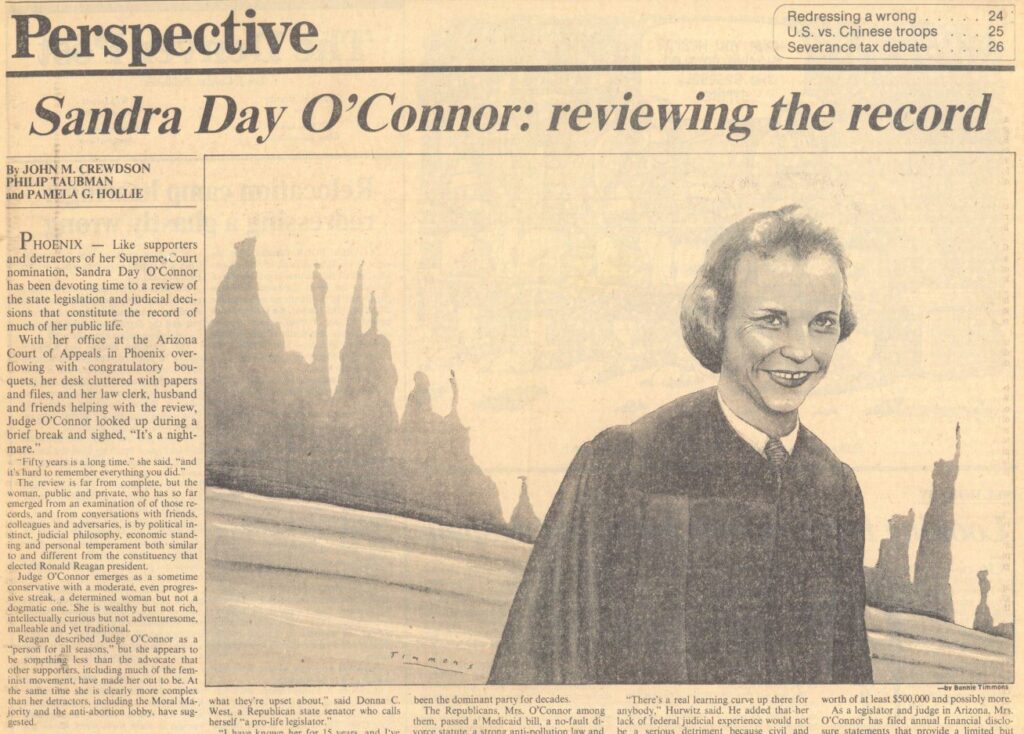
Like supporters and detractors of her Supreme Court nomination, Sandra Day O’Connor devoted the better part of this week to a review of the state legislation and judicial decisions that constitute the record of much of her public life.
With her office at the Arizona Court of Appeals here overflowing with congratulatory bouquets, her desk cluttered with papers and files, and her law clerk, husband and friends helping with the review, Judge O’Connor looked up at a brief break yesterday morning to sigh, “It’s a nightmare.”
“Fifty years is a long time,” she said, “and it’s hard to remember everything you did.”
Differences of Temperament
The review is far from complete, but the woman, public and private, who has so far emerged from an examination of of those records, and from conversations with friends, colleagues and adversaries, is by political instinct, judicial philosophy, economic standing and personal temperament both similar to and different from the constituency that elected Ronald Reagan President.
Judge O’Connor emerges as a sometime conservative with a moderate, even progressive streak, a determined woman but not a dogmatic one. President Reagan described her as a “person for all seasons,” but she appears to be something less than the advocate that other supporters, including many in the feminist movement, have made her out to be. At the same time she is clearly more complex than her detractors, including Moral Majority and the anti-abortion lobby, have suggested.
WHEN PRESIDENT REAGAN nominated Judge Sandra O’Connor to become the first woman Supreme Court Justice, Steve Dunnmg took it hke the pro he is. “I was teaching her according to a four-year plan, and we’d only completed two,”‘ he said. ” As my pupil, I would have expected her to consult me about whether she should accept such a Job. But, I guess, opportunities hke this don’t come along every day, do they?” Dunning, a droll fellow of 34, is a golf instructor – and a good one – at the Glen View Club, an arboretum in Golf, Ill., which embraces some of God’s greenest acres. This is one course so beautifully manicured that you hate to see anybody take a divot, and so classy that even the birds stop chirpmg when a member is about to putt. During the wmter, when even Glen View isn’t playable, Dunnmg irons out slices m Arizona. Judge O’Connor works there, and Dunning was hired to tutor her when she chose to swing a 7-iron rather than a gavel. “AN OUTSTANDING PERSON, in t!!e top one per cent of the people I’ve ever taught,” said Dunning, who despite his age, has been a golf guru for more than a decade. ” Because of the demands on her time, she didn’t have a lot of time to play, but she pretty much kept to a routine She and her husband John would take a lesson from me every Saturday, then play nine holes, then come back and play 18 holes on Sunday. Last winter when I left there. I believe her handicap was in the low 20s. Not bad considering she only played 27 holes a week. When O’Connor
Washington Judge Sandra O’Connor, President Reagan’s favorite nominee at this point, privately explained her views to key senators this week, particularly those on abortion. That’s good. Judge O’Connor’s reputation for integrity will only be strengthened after she clarifies her record and views on this controversial question. Last week, I criticized those in the Pro-Life and Moral Majority movements who used extravagant rhetoric to denounce Judge O’Connor’s record. At that point, I had no evidence that she deserved to be excoriated in such fashion. I still support the O’Connor nomination, and also urge those in the Pro-Life movement to be more measured in their estimate of Judge O’Connor. I also agree with ProLifers who raise two questions about her record. On this score, I am more interested in how she answers these questions than in her pro- or antiabortion “record.” The first concerns a memo prepared in the Justice Department for the attorney general in response to early criticism of O’Connor by ProLifers. The memo, written by Counselor Kenneth W. Starr, reports that Judge O’Connor indicated 11that she has no recollection of how she voted” in 1970 as a member of the Arizona State Judiciary Committee on a bill to remove all legal sanctions on abortion in that state. The committee majority favored the bill, though the vote was not recorded. But a reporter for The Arizona Republic was present, and his published story listed Sandra O’Connor as voting for the bill to legalize abortion.
The grumbles largely turned to pledges of support last week as Sandra Day O’Connor made her way, judiciously, around Capitol Hill. She apparently assuaged supporters of restrictions on abortions by declaring that she personally opposed the medical procedure.
At the same time, moderate-to-liberals were pleased to hear her declare that, for Justices of the High Court, legal prececents should outweigh personal beliefs. ”I think she’ll be confirmed” as the first woman on the United States Supreme Court, said Senator Strom Thurmond of South Carolina, Judiciary Committee chairman. ”I expect to support her.”
The Moral Majority might or might not remain in the minority on the nomination. At one point, a spokesman said that the group’s initial opposition to Mrs. O’Connor was a mistake, adding: ”We should have shut up and not said anything.” After apparently concluding that he shouldn’t have said anything again, he later denied that the group was dropping its objections. At weeks’s end, the Rev. Jerry Falwell said he hadn’t made up his mind yet, apparently because conservative Senator Jesse Helms, an ally of the lobbying group, hasn’t made his mind up either.
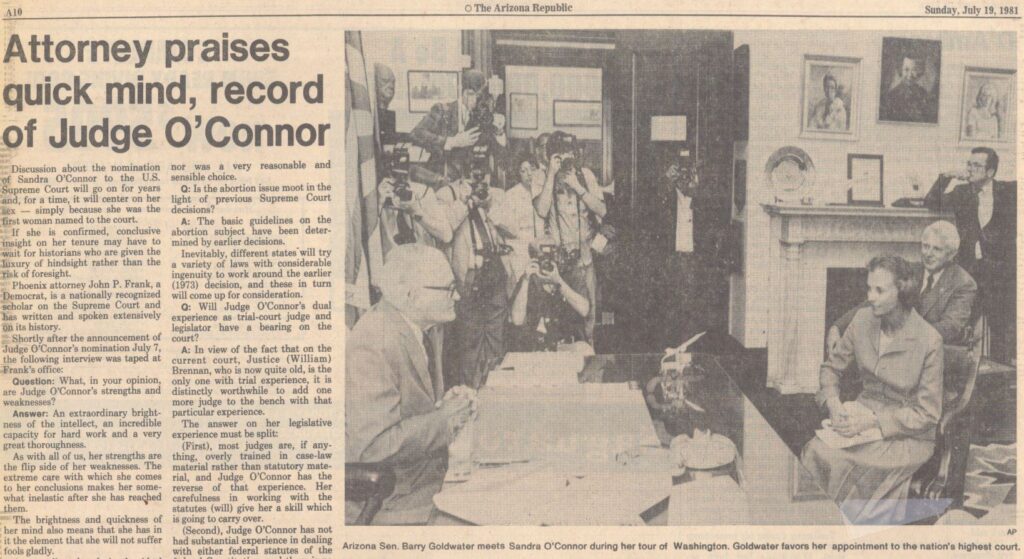
Discussion about the nomination of Sandra O’Connor to the U.S. Supreme Court will go on for years and, for a time, it will center on her sex – simply because she was the first woman named to the court. If she is confirmed, conclusive insight on her tenure may _have to wait for historians who are given the luxury of hindsight rather than the risk of foresight. Phoenix attorney John P. Frank, a Democrat, is a nationally recognized scholar on the Supreme Court and lias written and spoken extensively on its history. Shortly after the announcement of Judge O’Connor’s nomination July 7, the following interview was taped at Frank’s office: Question: What, in your opinion, are Judge O’Connor’s strengths and weaknesses? Answer: An extraordinary brightness of the intellect, an incredible capacity for hard work and a very great thoroughness. As with all of us, her strengths are the flip side of her weaknesses. The extreme care with which she comes to her conclusions makes her somewhat inelastic after she has reac.,hed them. The brightness and quickness of her mind also means that she has in it the element that she will not suffer fools gladly. An appellate bench is the ideal place for this composite of talents and limitations because she won’t have to suffer many fools for very long Q: Is Judge O’Connor truly a “distinguished jurist” as some have , called her? : A: Judge O’Connor is qualified for ,this position. The president wanted to keep his promise to put a woman on the Supreme
LYNCHBURG, Va. – The Rev. Jerry Falwell said Friday that he probably will wait until after Senate conf’mnation hearings before decid- ing whether to support or oppose Judge Sandra O’Connor’s nomination to the Supreme Court. But Falwell, leader of the Moral Mtajority, a conservative lobbying group, said he still hopes for a Reagan-appointed court that will reverse a 1973 decision legalizing abortion. Falwell had planned to decide his position on the nomination of Judge O’Connor after conAulting Sen. Jesse Helms, R-N._C., a Moral Majority ally who met With Judge O’Connor on Thursday evening. However, Helms declined to take a position on her nomination, saying one 40-minute meeting was not enough to make a decision. Falwell, after talking with Helms’ aides, also remained uncommitted. “We are not opposing Judge O’Connor’s nomination ” Falwell said. “We are not supporting Judge O’Connor’s nomination. We will wait until all the facts are in and probably the hearings are conducted.” The Senate Judiciary Committee probably will conduct its confirmation hearings in September.
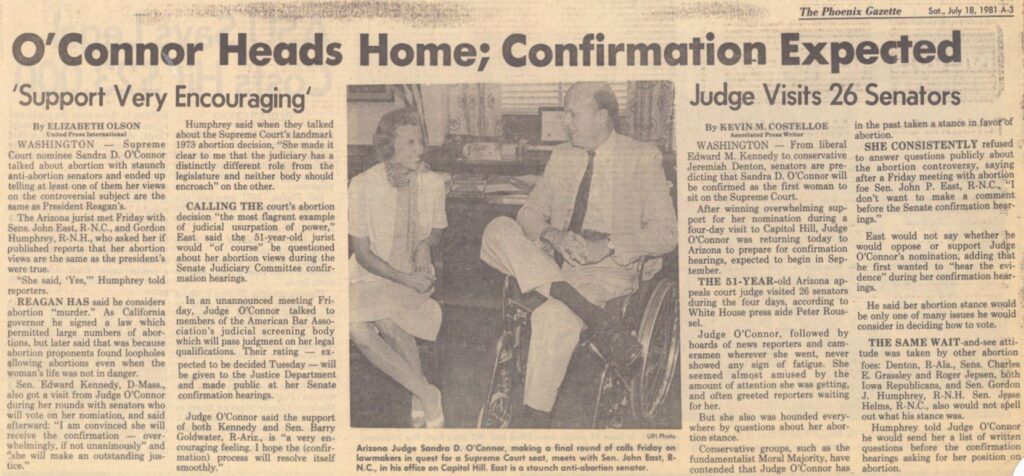
WASHINGTON – Supreme Court nominee Sandra D. O’Connor talked about abortion with staunch anti-abortion senators and ended up telling at l~ast one of them her views on the controversial subject are the same as President Reagan’s. The Arizona jurist met Friday with Sens. John East, R-N.C., and Gordon Humphrey, R-N.H., who asked her if published reports that her abortion views are the same as the president’s were true. ”She said, ‘Yes,”‘ Humphrey told reporters. REAGAN BAS said he considers abortion “murder.” As California governor he signed a law which permitted large numbers of abortions, but later said that was because abortion proponents found loopholes allowing abortions even when the woman’s life was not in danger. Sen. Edward Kennedy, D-Mass., also got a visit from Judge O’Connor during her rounds with senators who will vote on her norniation, and said afterward: “I am convinced she will receive the confirmation – overwhelmingly, if not unanimously” and “‘she will make an outstanding justice.” Humphrey said when they talked about the Supreme Court’s landmarl. 1973 abortion decision, “She made it clear to me that the judiciary has a distinctly different role from the legislature and neither body should encroach” on the other. CALLING THE court’s abortion decision “the most flagrant example of judicial usurpation of power,” East said the 51-year-old jurist would “of course” be questioned about her abortion views during the Senate Judiciary Committee confirmation hearings.
WASHINGTON – Ending the first round of her campaign to win approval as the Supreme Court’s first woman justice, Sandra O’Connor said Friday that her views on abortion are the same as President Reagan’s.
The Arizona Court of Appeals judge met with staunch anti-abortion Sens. John East, R-N.C., and Gordon Humphrey, R-N.H., who asked her about published reports that her abortion views were comparable to Reagan’s. “She said, ‘Yes,’ ” Humphrey told reporters. But East said he was “reserving the right” to make his decision until after the confirmation hearings be- , fore the Senate Judiciary Committee, of which he is a member. The : panel is expected to take up her nomination in September. • “I did not ask her her personal .. views on abortion,” East said after a 30-minute meeting with Judge • O’Connor. Asked whether he questioned her ,. about her legal viewpoint on the 1973 Supreme Cciurt• decision giving women the right to an abortion during the first- six months of pregnancy, East replied, “No, I did ‘ not. “It’s not the litmus test,” he said of the abortion ruling. East has said he could not support , any Supreme Court nominee who r agreed with the 1973 decision, which ‘. baa become the precedent for other abortion rulings. East said Friday that a Supreme Court nominee who thought the 1973 decision was “good constitutional law” would have “grave problems” in the confirmation process. He said the abortion issue would : be “one of a host of things” that could be used to explore
PHOENIX – Sandra Day O’Connor dedicó mu-::ho tiempo la semana pasada a revisar las leyes estatales y las decisiones judiciales que _constituyen el historlal de gran parte de su vida publica. Su oflcina en el Tribunal de Apelaciones de Arizona estaba llena de ramos de flores enviados tras el anuncio de su nombramiento al estrado del Tribunal Supremo. “Cincuenta aiios es mucho tiempo”, dilo durante una interrupcion de su revision, “y es diffcil recordar todo lo que se ha hecho”. Dlferenclas de temperamento La revision no ha terminado todavra, pero la mujer que ha surgido del examen de ese historial y de conversaciones que se han sostenido con amigos, colegas y adversarias, resulta a la vez similar y diferente de la gran mayorfa de los votantes que eligieron al Presidente Ronald Reagan. Estas diferencias y similitudes se pueden encontrar en su instinto polftico, en su filosoffa judicial, en su posición económica yen su temperamento personal. La Juez O’Connor es una cc:,nservadora la mayor parte del tiempo, aunque con ciertos visos moderados y aun progresistas; una mujer decidida pero no dogmatica. Es acomodada, pero no rica; con una gran curiosidad intelectual, aunque no exactamente osada en este terreno y maleable a la vez que tradicional. El Presidente Reagan describió a la Juez O’Connor como “una persona para todos los tiempos’ pero sin embargo parece ser menos activista de lo que han dicho los que la apoyan dentro del movimiento feminista. Al mismo tiempo es mucho mas complela
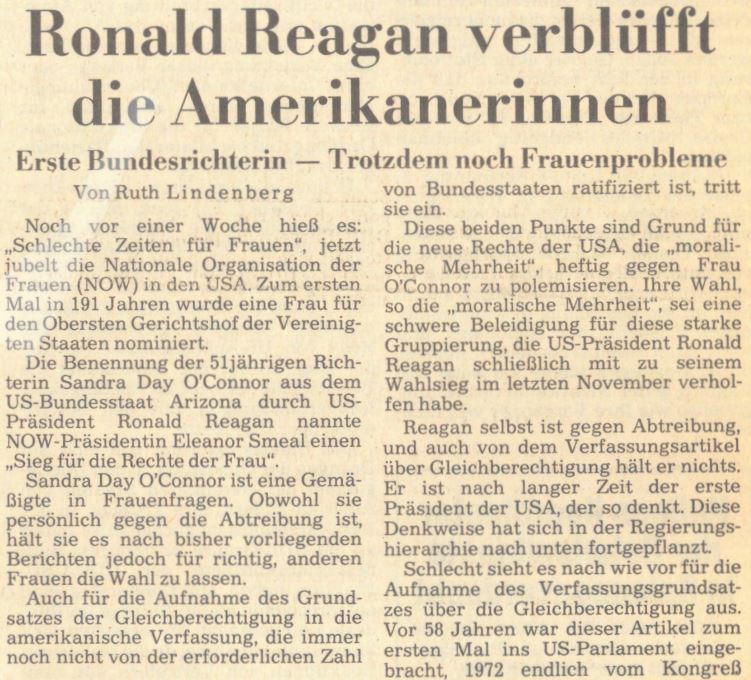
Erste Bundesrichterin – Trotzdem noch Frauenprobleme Noch vor einer Woche hieß es: ,,Schlechte Zeiten für Frauen”, jetzt jubelt die Nationale Organisation der Frauen (NOW) in den USA. Zum ersten Mal in 191 Jahren wurde eine Frau für den Obersten Gerichtshof der Vereinigten Staaten nominiert.
Die Benennung der 5ljährigen Richterin Sandra Day O’Connor aus dem US-Bundesstaat Arizona dunch US-Präsident Ronald Reagan nannte NOW-Präsidentin Eleanor Smeal einen ,,Sieg für die Rechte der Frau”.
Sandra Day O’Connor ist eine Gemäßigte in Frauenfragen. Obwohl sie persönlich gegen die Abtreibung ist, hält sie es nach bisher vorliegenden Berichten jedoch für richtig, anderen Frauen die Wahl zu lassen.
Auch für die Aufnahme des Grundsatzes der Gleichberechtigung in die amerikanische Verfassung, die immer noch nicht von der erforderlichen Zahl von Bundesstaaten ratifiziert ist, tritt sie ein.
Diese beiden Punkte sind Grund für die neue Rechte der USA, die ,.moralische Mehrheit”, heftig gegen Frau O’Connor zu polemisieren. Ihre Wahl, so die moralische Mehrheit”, sei eine schwere Beleidigung für diese starke Gruppierung, die US-Präsident Ronald Reagan schließlich mit zu seinem Wahlsieg im letzten November verholfen habe.
Reagan selbst ist gegen Abtreibung, und auch von dem Verfassungsartikel über Gleichberechtigung hält er nichts. Er ist nach langer Zeit der erste Präsident der USA, der so denkt. Diese Denkweise hat sich in der Regierungshierarchie nach unten fortgepflanzt.
Schlecht sieht
WASHINGTON – President Reagan’s chief of staff conceded Thursday that the administration has been slow in appointing women and members of minorities to high-level jobs. James A. Baker also was concerned ab?ut reports of “squabbling and turf fighting on foreign policy.” But Baker, one of tl}.e top three ~ite Ho’:18e staffers said the president successfully 18 changmg the fa~ of the federal government in what he termed the start of the “Reagan Revolution.” Speaking at the National Press Club, Baker said the administration has accelerated its efforts to place women in upper-level jobs. . “To the president, the selection of fine, distinguished people like Sandra O’Connor,” the president’s nominee for the U.S. Supreme Court, “will not be the exception, but the trademark, of this administration.” “To be sure we have had our frustrations and disappointmen’ts,” he said, pointing to the controversy over Reagan’s proposals to revise the Social Security system. “We could have done a better job in the appointments process – both in the timeliness of the appointments and in the numbe~ of women and minorities in high posts,” Baker srud. “All of us, from the president on down, wo~d have been far happier had we see_n fewer stor_1es about squabbling and turf fightmg on foreign policy.” . During a question-and-answer sess1~n, Baker was critical of suggestions that he, ~1te House counselor Edwin Meese and deputy chief of st.aff Michael K. Deaver are running the government, and that Reagan is a
As you can see at a glance, this is pretty much a Sandra O’Connor page today . But hold it! Don’t be too hasty in turning away on grounds that you’ve read and heard enough about Judge O’Connor awreddy. It is true that we have used a lot of copy in the Tucson Citizen lately concerning President Reagan’s nomination of Arizona’s Sandra D. O’Connor to become the first woman ever to serve on the Supreme Court. It is a big story, an event of some historical significance, and we’ve covered it as such. We don’t intend to chase you away with a constant barrage of O’Connor, but we feel that the information and comment o~ his page today is somewhat special in that it is the best of the best, culled from an awesome flood of copy as the world’s columnists jumped on the O’Connor theme. There is our “lede” story by Chris Collins of the Citizen’s Washingto~ Bureau , Gannett News Service. Ms. Collins is a former Citizen reporter who returned to home base long enough to find out what makes makes Mrs. O’Connor tick as a judge, a woman, a mother, a warm, breathing human being who can sit steely-eyed and humorless on the bench, then cry later over the effect of her decision. You might be interested to learn that this remarkable Phoenix jurist is a well-to-do country club woman who can strike a tennis ball or golf ball with great precision or cook a gourmet meal. Or that she will pay less than she can afford for a dress, then show it to her husband for his approval. Then there is the sober, well-reasoned
PHOENIX (AP) – Scottsdale Republican Rep. Jim Skelly says he has resigned his Greyhound Corp. job rather than knuckle down to pressure from Greyhound Chairman Gerald Trautman over Skelly’s criticism of the Sandra O’Connor Supreme Court nomination. Skelly, 47, a long-time abor- tion foe who earned $18,700 a year as a Greyhound customer relations representative in addition to his annual $15 000 legislative salary, said Thu~ay he quit after Trautman called him on Wednesday to complaint ~t Skelly’s remarks in opposition to the nomination “were intemperate.” He said Trautman especially objected to a published report that Skelly had said he was outraged by ~agan’s choice. When Trautman “put pressure on me to tone down my criticism of Sandra,” Skelly said, “I pointed out that ‘outraged’ was not in quotes, but that it might as well be because that’s the way I felt. “I told him I can’t tone down my remarks and said I was resigning,” Skelly added. He said Trautman told him, “Don’t resign, just take a week to think it over” but that “I told him I could thin,k about it till doomsday and it wouldn’t make any difference.” Trautman could not be reached, but Dorothy Lorant, vice president for public relations, issued this statement: ‘”We at Greyhound feel that Judge O’Connor is one of the most level-headed, intelligent justices, male or female, ever to serve on the bench, and that her appointment to the U.S. Supr~me Court would enhance that body. “Jim Skelly is a fine man and a conscientious
We are about to witness the biggest plus of the Reagan adminstration thus far – the end of unisex facilities at the Supreme Court • • • The nomination of Judge Sandra O’Connor to the court should end all that nonsense about the administration being anti-Irish. .. . . Reagan had found a black, female, Jewish Republican judge for the court, but her Hispanic husband Ernesto didn’t vant to quit his job as a preacher for the Moral Majo1 Â¥ to move to Washington. • • • It’s not in our nature a~ a pPople to be pacified by the nomination of a woman for the Supreme Court. We’ll no doubt be hearing crie~ of “Only one?”, “Hohum, another white” and “No justice, we say, until a justice is gay!”
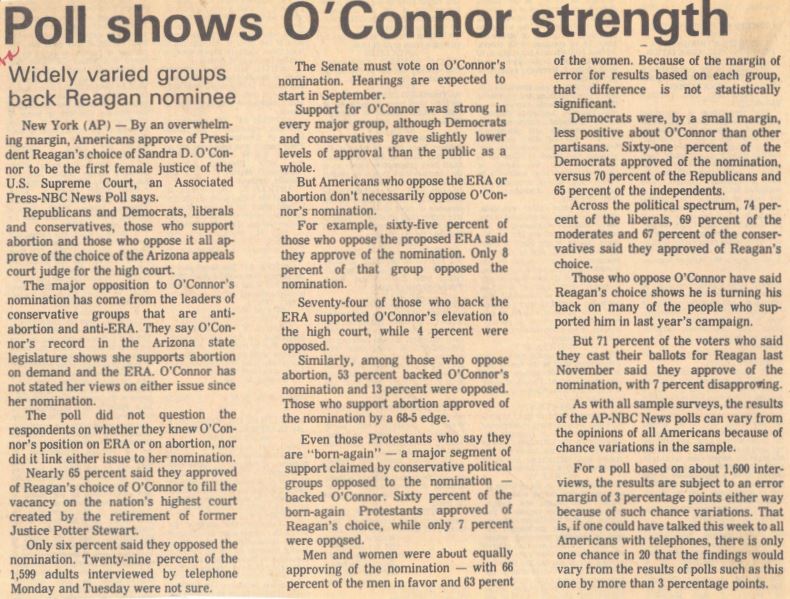
NEW YORK – By an overwhelming margin, Americans approve of President Reagan’s choice of Judge Sandra O’Connor to be the first female justice of the Supreme Court, an Associated Press-NBC News Poll says.
Republicans and Democrats, liberals and conservatives, those who support abortion and those who oppose it all approve of the choice of the Arizona Court of Appeals judge for the high court.
The major opposition to Judge O’Connor’s nomination has come from the leaders of conservative groups that oppose abortion and the Equal Rights Amendment. They say Judge O’Connor’s record in the Arizona Legislature shows she supports abortion on demand and the ERA. Nearly two-thirds of those questioned – 65 percent – said they approved of Reagan’s choice of Judge O’Connor to fill the vacancy on the nation’s highest court created by the retirement of former Justice Potter Stewart. Only 6 percent said they opposed the nomination.
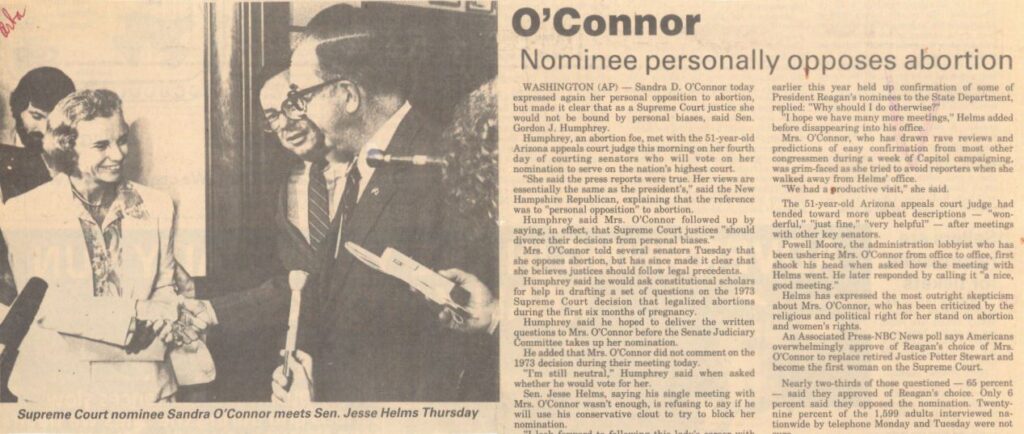
WASHINGTON – Sen. Jesse Helms, R-N.C., the chief Senate crusader against abortion, Thursday called Sandra O’Connor a “very fine lady” but declined to say if he will oppose her confirmation as the first woman Supreme Court justice. After a 35-minute meeting with President Reagan’s choice for the high court, Helms – who has declined to “prejudge” Judge O’Connor despite opposition to her from his right-wing allies across the country – was careful in mnswering reporters’ questions. When Helms and Judge O’Connor emerged from his office to have their pictures taken, Helms was asked about the meeting, and the usually articulate senator, searching for the right words, replied, “Well, I hope we have many more meetings. I look forward to following this lady’s career.” Asked if he is going to help her career he replied, “Why should I do othe~? She’s a very fine lady.” But he would not say whether be will vote to confirm her or lead any opposition. When reporters pressed Helms for elaboration, the senator retreated foto bis office without answering, and aides shut the door on reporters. Judge O’Connor would say only, “We had a productive meeting.” Before meeting with Judge O’Connor, Helms met at the White House with Reagan, a Helms aide confirmed Thursday. The aide would not say if Helms discussed the O’Connor nomination with Reagan. But the president has urged Helms repeatedly not to oppose the nomination, the aide said, and there has been widespread speculation that White House aides
WASHINGTON (AP) – Sandra D. O’Connor today expressed again her personal opposition to abortion, but made it clear that as a Supreme Court justice she would not be bound by personal biases, s•aid Sen. Gordon J. Humphrey. Humphrey, an abortion foe, met with the 51-year-old Arizona appeals court judge this morning on her fourth day of courting senators who will vote on her nomination to serve on the nation’s highest court. “She said the press reports were true. Her views are essentially the same as the president’s,” said the New Hampshire Republican, explaining that the reference was to “personal opposition” to abortion. Humphrey said Mrs. O’Connor followed up by saying, in effect, that Supreme Court justices “should divorce their decisions from personal biases.” Mrs. O’Connor told several senators Tuesday that she opposes abortion, but has since made it clear that she believes justices should follow legal precedents. Humphrey said he would ask constitutional scholars for help in drafting a set of questions on the 1973 Supreme Court decision that legalized abortions during the first six months of pregnancy. Humphrey said he hoped to deliver the written questions to Mrs. O’Connor before the Senate Judiciary Committee takes up her nomination. He added that Mrs. O’Connor did not comment on the 1973 decision during their meeting today. “I’m st ill neutral,” Humphrey said when asked whether he would vote for her . Sen. Jesse Helms, saying his single meeting with Mrs. O’Connor wasn’t
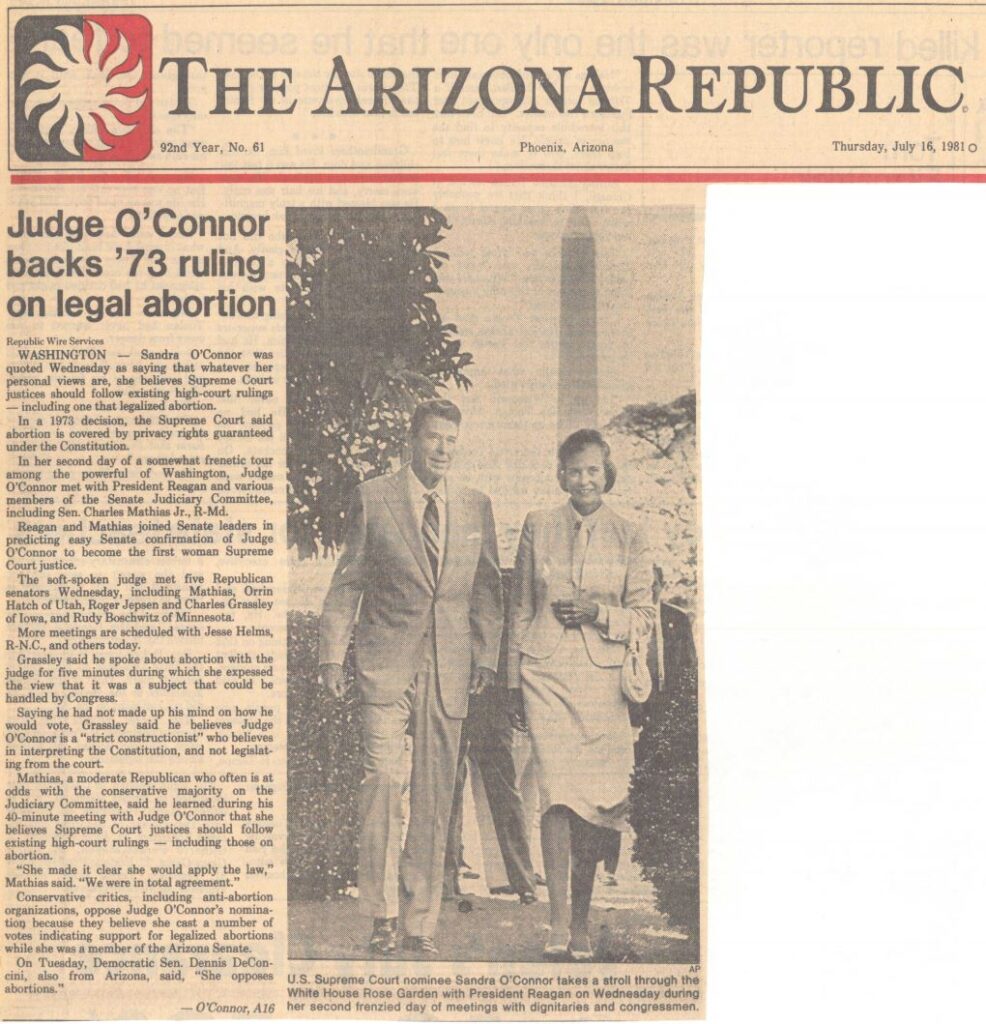
WASHING TON – Sandra O’Connor was quoted Wednesday as saying that whatever her personal views are, she believes Supreme Court justices should follow existing high-court rulings – including one that legalized abortion. In a 1973 decision, the Supreme Court said abortion is covered by privacy rights guaranteed under the Constitution. In her second day of a &0mewhat frenetic tour among the powerful of Washington, Judge O’Connor met with President Reagan and various members of the Senate Judiciary Committee, including Sen. Charles Mathias Jr., R-Md. Reagan and Mathias joined Senate leaders in predicting easy Senate confirmation of Judge O’Connor to become the first woman Supreme Court justice. The soft-spoken judge met five Republican senators Wednesday, including Mathias, Orrin Hatch of Utah, Roger Jepsen and Charles Grassley of Iowa, and Rudy Boschwitz of Minnesota. More meetings are scheduled with Jesse Helms, R-N.C., and others today. Grassley eaid he spoke about abortion with the judge for five minutes during which she expessed the view that it was a subject that could be handled by Congress. Saying he had not made up his mind on how he would vote, Grassley eaid he believes Judge O’Connor is a “strict constructionist” who believes in interpreting the Constitution, and not legislating from the court. Mathias, a moderate Republican who often is at odds with the conservative majority on the Judiciary Committee, eaid he learned during his 40-minute meeting with Judge O’Connor that
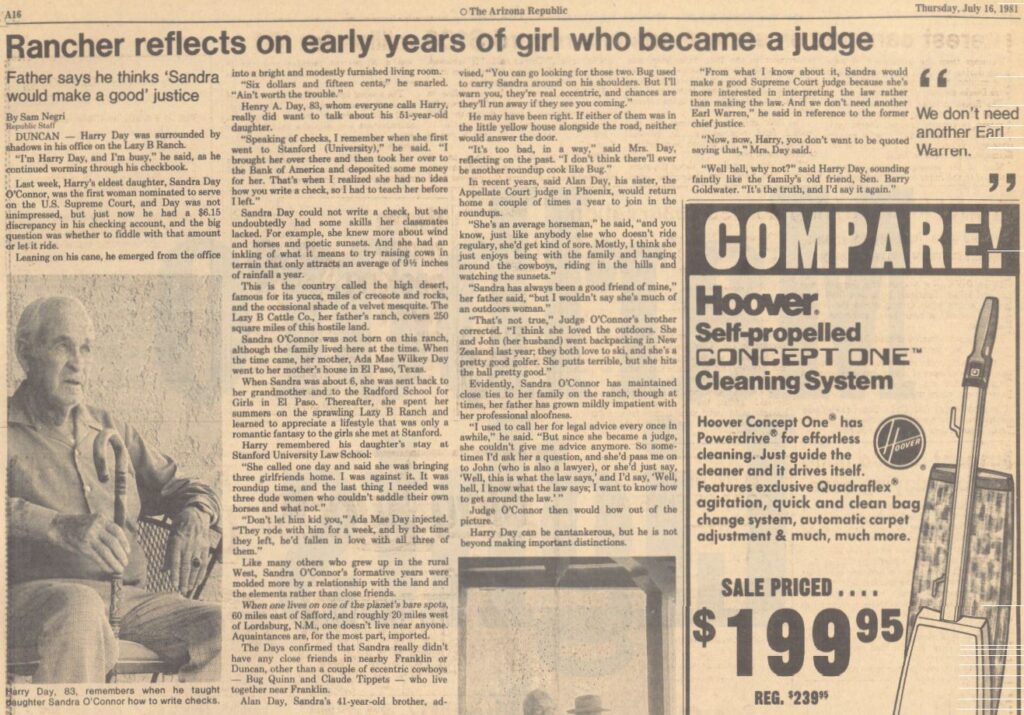
Father says he thinks ‘Sandra would make a good’ justice
DUNCAN – Harry Day was surrounded by shadows in his office on the Lazy B Ranch. “I’m Harry Day, and I’m busy,” he said, as he continued worming through his checkbook. Last week, Harry’s eldest daughter, Sandra Day O’Connor, was the first woman nominated to serve on the U.S. Supreme Court, and Day was not unimpressed but just now he had a $6.15 discrepancy in his checking account, and the big question was whether to fiddle with that amount or let it ride. leaning on his cane, he emerged from the office into a bright and modestly furnished living room. “Six dollars and fifteen cents,” he snarled. “Ain’t worth the trouble.” Henry A. Day, 83, whom everyone calls Harry, really did want to talk about his 51-year-old daughter.
…
Like many others who grew up in the rural West, Sandra O’Connor’s formative years were molded more by a relationship with the land and the elements rather than close friends. When one lives on one of the planet’s bare spots, 60 miles east of Safford, and roughly 20 miles west of Lordsburg, N.M., one doesn’t live near anyone. Acquaintances are, for the most part, imported.
The Days confirmed that Sandra really didn’t have any close friends in nearby Franklin or Duncan, other than a couple of eccentric cowboys – Bug Quinn and Claude Tippets – who live together near Franklin. Alan Day, Sandra’s 41-year-old brother, advised…
[Photo caption: Harry Day, 83, remembers when he taught daughter Sandra
WASHINGTON – Supreme Court nominee Sandra D. O’Connor of Phoenix slowed her round of courtesy visits with members of Congress to a walk today. On her schedule were only seven calls, two of which were with fellow Arizonans. The first stop on Capitol Hill was a meeting with Sen. John C. Stennis, D-Miss. Visits with Sen. James A. McClure, R-Wyo., and Sen. Howard Metzenbaum, D-Ohio, followed. THE THREE men expressed their appreciation for her visits, and each posed for pictures with her outside his office. “She’ll be a welcome addition to the Supreme Court,” Metzenbaum said after meeting Judge O’Connor. He said they did not discuss abortion but did discuss areas of civil rights, civil liberties and antitrust. He said he was impressed, “particularly by her independence of spirit and her feistiness.” FOR LUNCH, Mrs. Dennis DeConcini, wife of the Tucson Democratic senator, was hostess in a private Capitol dining room, where wives of other Senate Judiciary Committee members met the justicedesignate. Judge O’Connor has been accompanied on her three-day tour of congressional offices by White House aides and Assistant Attorney General Robert McConnell, who formerly practiced law in Phoenix. This afternoon Judge O’ Connor was to visit Sen. Arlen Specter, R-Pa., and Arizona Democratic Reps. , Bob Stump and Morris K. Udall. BOTH ARIZONANS have offered strong endorsements of Judge O’Connor’s nomination as the first woman to serve on the Supreme Court. Her last call of the day could prove to
WASHINGTON – Moral Majority, the con- :lervative lobbying group, said Wednesday it bas :Jiot softened its position on Judge Sandra -O’Connor and that it still has “substantive ..concerns” about her nomination to the Supreme o.urt. : Cal Thomas, vice president of the organi7.lltion, ~ed a statement reasserting Moral Majority’s ppsition after reports that it was falling into line behind President Reagan’s selection of Judge Pi’Connor for the high court. r, ~eanwbile, two religious journals criticized P..resident Reagan for conferring with Moral Majority leader Jerry Falwell about the nominatio~. t Falwell, of Lynchburg, Va., has said Reagan 1elephoned him and talked for almost an hour on the day Judge O’Connor was announced as ~an’s choice. The fundamentalist preacher has • ked the president to let him question Judge O’Connor about her views on feminism and ~rtion . ~Y such concessions on Reagan’s part would be ~ e height of irresponsibility,” said Spurgeon Dunnam III, editor of the Dallas-based Tezas Methodist-United Methodist Reporter, a national publication serving the 9.6 million-member United Methodist Church and churches of other denominations. “I’m bothered, personally, by the type of religious folks Mr. Reagan tends to liaten to,” Dunnam wrote in this week’s edition. “Mr. Falwell epitomw.es a very narrow, legalistic and not always Christian. from my understanding of the Scriptures, point of view.” Dr. Presnall Wood, editor of the Baptist Standard, the Dallas-based voice
“The legislature is a political arena where you’re always out in the open getting shot at,” says House Majority Leader Burton Barr. “She’s better suited to the judicial area where things are more relaxed and more scholarly. That’s a snug fit for her.” Few people leave the legislature when they’re m the position of majority leader. O’Connor did in 1974 to run for a seat on the Maricopa County Superior Court. She quickly developed a reputation for being tough on attorneys – some say the way she could “dress down” an unprepared barrister was masterful and devastating. It was in that setting that she solidified a judicial temperament that has been lauded by the president: she believes in interpreting the law, not making it. While conservatives were spreading the word that O’Connor had been “tough on criminals” in her trial court days, liberals were noting her major mark was one of fairness. Arizona courts are notorious for making political rulings. They’re the last chance to keep a controversial issue off the ballot or an unpopular politician from a recall move. They’re a last chance that is often used. So when a controversial initiative challenging the safety of nuclear power was ready to go on the b~ot, a contingent of heavy-duty movers and shakers went into Judge O’Connor’s court to squash the effort. Observers note she had plenty of opportunity to follow the political winds and find a loophole to keep the issue from a public vote. She didn’t. One “fan” of her trial court days
WASHINGTON (AP) – With a personal hand from Attorney General William French Smith and optimistic predictions from Senate leaders, Sandra Day O’Connor yesterday began a personal campaign to assure her confirmation as the first female Supreme Court justice. O’Connor met for four hours with Smith and other Justice Department officials and then moved on to Capitol Hill for meetings with more than a dozen influential members of the House and Senate. Among them were Senate Majority Leader Howard Baker and Sen. Strom Thurmond, R-S.C., chairman of the Senate Judiciary Committee. “A great number of senators have expressed support, some publicly, some privately,” Baker said. “None has expressed opposition.” Later in the week, the Arizona appeals court judge is to meet with conservative senators including Jesse Helms, R-N.C., , ‘ . who have questioned O’Connor s views on legalized abortion. But Baker played down the importance of the issue in the confirmation process, which he said should be over before the Supreme Court begin~ i~ Octobe~ session. “I am convinced this 1s not an issue that should be significant in considering her confirmation,” Baker said. Thurmond, meanwhile, predicted easy confirmation by the Senate, although he advised O’Connor there were some potential votes against her. “She is a very impressive lady, a very intelligent lady,” Thurmond said after a half-hour meeting in his Senate office. “I told her there was some opposition to her.” O’Connor later met with Baker and
The Phoenix City Council passed a resolution Tuesday urging the confirmation of Arizona Appeals Judge Sandra O’Connor to the U.S. Supreme Court . Copies of the resolution were sent to Senate leaders and members of the Senate Judiciary Committee, which will hold hearings on the nomination. Council members said Judge O’Connor’s work as a staff member of the Arizona Attorney General’s Office, the Maricopa County Superior Court and the Appeals Court qualify her for the appointment .
Sandra Day O’Connor made up the list of her lifetime accomplishments last week; a resume to satisfy the hunger for information on this first woman ever nominated to the U.S. Supreme Court. Her list was one page long. More of her life – both professional and personal – was left off the list than put on. To understand this historic woman, you have to know some of the things that weren’t on that list. Things like … A REPUBLICAN DARLING BECOMES A POLITICAL HOT POTATO
While some blasted O’Connor’s lukewarm support for ERA, feminists looked at her stance and forgave her. The first woman ever nominated to the U.S. Supreme Court couldn’t even get a Credit card in her own name in Arizona just eight years ago. As far as Arizona laws were concerned, Sandra Day O’Connor was just a “Mrs.” in 1973 – not the majority leader of the Arizona Senate; not the highly-honored law graduate of Stanford; not the former assistant attorney general. When she married her law school classmate. John Jay O’Connor III, she simply became a Mrs. who couldn’t hold title to her own property, ouy her own car or have her own credit without her husband’s name and approval. Sandra O’Connor helped change those laws; as a member of the highest court in the nation, she will spend the rest of her career changing or upholding the laws of the country. As a jurist, she is expected to be a “strict constructionist” who will bring to the high court the same qualities she showed in the county and appeals courts of Arizona:
LYNCHBURG, Va. – The conservative lobbying group Moral Majority eased back Tuesday from its attack on President Reagan’s nomination of Sandra O’Connor to the Supreme Court. Spokesman Cal Thomas said that although the group remains concerned about Judge O’Connor’s record on the Arizona Appeals Court, “We think the potential is there for the Moral Majority to support Judge O’Connor pending further information.” But Thomas, the organization’s vice president for communications, said the Moral Majority is “not on the verge of supporting Judge O’Connor.” “We want to support the president,” he said. “We’re desirous of seeing a woman on the court . We think it’s long overdue. Let’s not rush to judgment . • “We are still awaiting further information about her abortion position and, pending the reception of that information, we are withholding judgment either pro or con.” Ronald Godwin, vice president and chief operations officer for the Moral Majority, said Tuesday his group’s position remains unchanged. “We still have grave doubts and ‘ reservations,’ ‘ he said. Thomas said he hopes Judge O’Connor will express her views on abortion in talks with Senate leaders. “Some of our friends in the Senate , conservative members, will be asking questions of Judge O’Connor that bad concerned us and will be communicating her answers to the public and, of course, to us as well,” he said. Last week, Thomas called the nomination “a mistake” and said the Moral Majority would oppose it, basing the decision
Sandra Day O’Connor sat down between Senators Howard H. Baker Jr. and Robert C. Byrd this afternoon and immediately scored a political point.
“Senator Byrd,” Judge O’Connor said, addressing the minority leader, a man who considers himself an authority on the Senate, “tell me a little about the history of this great institution.”
Senator Baker, the majority leader, broke into laughter, saying, “Judge, you don’t know what you’ve just asked!” Senator Byrd just smiled. Then he congratulated Judge O’Connor, not on her nomination to the Supreme Court but on her confirmation by the Senate, “which I feel will be forthcoming.”
The Courtesy Ritual
In her first afternoon on Capitol Hill, Judge O’Connor, who if confirmed would be the first woman to serve on the Supreme Court, proved herself particularly adept at a peculiar Washington ritual: the courtesy call.
This is the custom that requires nominees of the executive and judicial branches to travel to Capitol Hill to woo members of the legislative branch, particularly those who sit on pertinent committees. It is a time for smiles and handshakes, not for substantive discussions.
“It’s going just fine, thank you,” Judge O’Connor, of the Arizona Court of Appeals, said as she breezed down a Capitol hallway this afternoon, her heels clicking on the marble floor. On her right was William French Smith, the Attorney General. On her left was Senator Baker.
Also accompanied by a mob of photographers and reporters, Judge O’Connor visited, among

With the nomination of Judge Sandra O’Connor to the Supreme Court , controversy has arisen from those objecting to abortion . Whether a woman can handle the job. or will be a “proper “‘ representative , also has been floating around the atmosphere of some conservatives . O’Connor is the first woman ever nominated for a position as Associate Justice of the Supreme Court. thus you can see the reasoning for doubt – tradition. Evidently the reason President Ronald Reagan chose her wasn’t because she was a woman, but because she was the best qualified for the position . Conside ring she is from Arizona expands the spotlight of att ention in this state ‘s press. But, what do the people from Arizona think ? Was it a wise choice for Reagan to nominate her? We asked some-westside people their opinions. and the reaction was completely positive Joan Hogue : ” I think it’ s wonderful. rm glad to see a woman have a chance to get in.”
Josett Dobbs: “I think it’s good.”
Mike O’Keefe: ” I think it’s good to have a woman representative on t he Supre me Court. Women can make decisions just as well as men.”
Tina Engel: ” I think it’s OK, as long as she’s qualified. There’s nothing wrong wit h a woman being appointed.” Jules Ketcham : ” Well. I’ m not rea l qualified – issues I heard her opinions about make me favor her .” Russe ll Par ker: ” l think it”s great. Sure. there’s nothing wrong with a woman being in there.”
Legislators are predicting easy sailing for nominee New York Tim es WASHINGTON – Sandra O’Connor, President Reagan’s choice to sit on the Supreme Court, sat between Sens. Howard Baker and Robert Byrd on Tuesday afternoon and immediately scored a political point. “Senator Byrd,” Judge O’Connor said, addressing the minority leader, a man who considers himself an authority on the Senate, “tell me a little about the history of this great institution.” Baker, the majority leader, broke into laughter, saying, “Judge, you don’t know what you’ve just asked!” Byrd just smiled. Then he congratu – lated Judge O’Connor, not on her nomination to the Supreme Court but on her confirmation by the Senate, “which I feel will be forthcoming.” . In her first afternoon on Capitol Hill, “‘ Judge O’Connor, who if confirmed would be the first woman to serve on the Supreme Court, proved particularly adept at a peculiar Washington ritual: the courtesy call. This is the custom that requires nominees of the executive and judicial branches to travel to Capitol Hill to woo members of the legislative branch, particularly those who sit on pertinent committees. It is a time for smiles and handshakes, not for substantive discussions.
“It’s going just fine, thank you,” said Judge O’Connor of the Arizona Court of Appeals as she breezed down a Capitol hallway, her heels clicking on the marble floor. On her right was William French Smith, the attorney general. On her left was Baker.
Accompanied by a mob of
The tough, powerful, male leader of the Arizona House was telling the tough, powerful, female leader of the Arizona Senate how they were going to push a bill through that night in 1973, no matter how long it took. “No we aren’t,” Sandra Day O’Connor told Burton Barr, a man who doesn’t hear “no” very often.” My boys are going to camp tomorrow and I’m going home to be sure they’ve packed everything.”
When that kind of thing happened at the Arizona Legislature under its first and only female leader, Barr would muse, “Sandra is human. This brilliant thing that moves around is human.”
A lot of people were asking themselves last week if O’Connor – who had chalked up a half dozen “firsts” before President Reagan made her the first woman ever considered for the U.S. Supreme Court – was human.
Reporters from the country’s largest newspapers made frantic calls to Phoenix the day of the announcement, compiling reams on her public record, but asking in plaintive voices, “but what about O’Connor as a PERSON?” Their stories the next day showed they didn’t find much.
It’s not because there’s nothing to find.
“Sandra O’Connor once told me that people have to focus on what they want in life and go after that,” an old friend said the night of her appointment.” If you spread yourself too thin, she says, you won’t accomplish much of anything. She believes if you focus, you can have what you want. I guess she’s right.” Many feel Sandra O’Connor, a privileged Arizona cowgirl who can still ride
WASHING TON – Hoping to head off any serious opposition to her Supreme Court nomination from conservatives, the White House has arranged for Sandra D. O’Connor to meet with several key senators, including Sen. Jesse Helms, R-N.C. President Reagan’s choice to replace retiring Supreme Court Justice Potter Stewart was scheduled to arrive in Washington late Monday. Among others , the Arizona appeals court judge will meet with Sen. Strom Thurmond, R-S.C., chairman of the Senate Judiciary Committee; Senate Majority Leader Howard Baker of Tennessee; various members of the judiciary panel; Helms, a conservative Republican leader in the Senate, and Sen. John East, R-N.C., a leader among abortion opponents. Judge O’Connor planned to visit the Justice Department Tuesday for a meeting with Atty. Gen. William French Smith. Later, she was to be escorted by Arizona Sens. Barry Goldwater, a Re• publican, and Democrat Dennis DeConcini, a Democrat, to Capitol Hill, where talks were planned with Baker and Senate Minority Leader Robert Byrd. Sources said there was a tentative plan for Judge O’Connor to meet the steering committee, a group of about 20 conservative senators including Helms and Thurmond, to persuade the members that her views on abortion and other social issues are in line with their own. The fundamentalist Moral Majority and various anti-abortion organizations have expressed militant opposition to Judge O’Connor’s nomination because they believe she supports legalized abortions and
WASHINGTON – Judge Sandra O’Connor went directly to the White House on Monday after arriving in Washington for a series of crucial meetings on her nomination to become the first woman on the Supreme Court. Judge O’Connor was met at Washington National Airport by Attorney General William French Smith and driven to the White House. A spokesman called the Monday gathering a “preliminary, get-to-know-you” session. It involved Smith and members of the president’s congressional liaison staff. She was to begin a round of meetings with Justice Department officials and key members of the Senate this morning and will meet with the president Wednesday. Judge O’Connor, a member of the Arizona Court of Appeals, has been attacked for her record on abortion and for support of the Equal Rights Amendment. But Sen. Barry Goldwater, R-Ariz. – her leading backer – issued a statement Monday that lauded the 51- year-old judge for having the “basic conservative philosophy” needed on the high court. Judge O’Connor told reporters at the airport that she hopes to end the controversy surrounding her selection. As she has in the past, the judge declined to discuss the substance I of questions raised about her nomination. White House spokesman Larry Speakes said that after the morning meeting today, Judge O’Connor will go to Capitol Hill to confer with her home-state senators – Goldwater and Democrat Dennis DeConcini. In his statement Monday, Goldwater said she is tough on criminals, a strong defender of
A president’s overriding responsibility in selecting a nominee for the United States Supreme Court is to choose someone whose talent, temperament and experience most qualify for service on the nation’s highest court. Measured against this demanding criteria, President Reagan’s choice of Arizona Appeals Court Judge Sandra O’Connor can be called meritorious, perhaps even distinguished. That the judge is also a woman, the first nominated in the 191-year history of the United States Supreme Court, lends Mr. Reagan’s choice a historical significant that is as momentous as it is obvious. By all accounts, Judge O’Connor has compiled an excepti?nally fine record in a succession of iegal and iudicial posts: assistant state attorney general, superior court judge, and, most recently, a member of Arizona’s second highest court. Her written opinions, described by colleagues as lucid and brilliantly reasoned, reportedly reflect Mr. Reagan’s philosophical preference for judicial decisions that interpret the law rather than make it. Judge O’Connor’s academic background is every bit as solid as her subsequent achievements. In 1952, she graduated from Stanford law school along with William H. Rehnquist, now among the Supreme Court’s most respected justice. The one obvious gap in Judge O’Connor’s qualifications is her lack of experience at the federal court level. But this need hardly be a significant drawback for a nominee possessing so many other worthy attributes. In Judge O’Connor’s case,
PHOENIX (AP) – Sandra O’Connor, the first woman nominated to the U.S. Supreme Court, has the firm support of 26 Arizona legislators who have consistently voted for a constitutional convention in behall of a Right-to-Life amendment banning abortions. Several stand ready to go to Washington to testify for her. Rep. Pete Corpstein, R-Paradise Valley, said Monday that letters in her behall have been sent to U.S. Senate Judiciary Chairman J. Strom Thurmond, R-S.C.; Senate Majority Leader Howard Baker and Sens. Orrin Hatch, R-Utah, and Jesse Helms, R-N .C. “We’re doing this to lay to rest some of the unfounded rumors and innuendos about her stand on abortion,” Corpstein said. O’Connor has been attacked by national Right-to-Life and moral majority leaders for her voting record on abortion in the Arizona Senate, in which she served as majority leader in 1973-74. “I wish hall the people in the moral majority had hall the morality and christianity of O’Connor,” Corpstein said. Rep. Donna Carlson West, a Mesa Republican and leader of the anti-abortion and anti-Equal Rights Amendment movements in Arizona, also gave her unqualified support to O’Connor. “I’ve had a number of calls from around the country from people who claim she’s anti-religion, pro-gun control, proabortion and was keynote speaker at the International Women’s Conference,” said Carlson West. “None of that is true.”
The comparison between Ronald Reagan, coalition builder, and FDR, made in this space many times, may be in need of review. . With its handling of the Sandra O’Connor affair, the White House bas given every indication it does not understand, or does not care, about nurturing the coalition Reagan put together over a dozen years, which put him in the White House. • UJl ‘ White House aides – not for attribution, of course – are using the identical mocking terms to describe the alienated conservatives that the press used about them until around Nov. 4, 1980. Have they forgotten why Ronald Reagan – not George Bush – was nomina~ and elected? As Barry Goldwater demonstrated in that impossible Republican year, 1964, the party nomination is worth , automatically, 40 percent of the national vote. The key to the White House is to fmd the formula for adding the crucial 10 percent – the decisive swing vote – without jeopardizing the Republican-conservative base . After some years of experimentation, Reagan mastered the formula, brilliantly, and astonished this politically purblind city with the magnitude of his triumph. They still don’t quite comprehend what happened. Stated simply, the formula was to weld to his new economic conservatism a touch of nationalism (Panama Canal) and social traditionalism which provides him with political reach into Democratic precincts of the South and the Northern cities, among folks who voted for John Kennedy and Lyndon Johnson and who have, historically, distrusted
WASHING TON – The nation’s capital is giving Arizona Court of Appeals Judge Sandra D. O’Connor red carpet treatment usually reserved for visiting dignitaries. What was supposed to be a routine round of meetings to smooth her confirmation process as a Supreme Court justice turned into a roadshow of phot.ographers, reporters, government employees and tourists trying to get a glimpse of the Phoenix woman. Wearing a lavender suit and smiling broadly, Judge O’Connor seemed t.o be enjoying the attention. MOST OF Judge O’Connor’s morning was spent in conference with Attorney General William French Smith and his assistants. Judge O’Connor and Smith met privately for an hour. Afterwards, the att.omey general told reporters there no problems are likely when the Senate considers her confirmation. , Smith speculated her confirmation vote may be unanimous. Judge O’Connor waa applauded by bystanders when she entered and left the Justice Department. AMONG THOSE at the morning meeting was Robert O’Connell, a former Phoenix attorney who now is assistant attorney general for legislative affairs. He and Judge O’Connor are longtime friends. Also at the session with Smith were White House lawyer Fred Fielding and Powell Moore, Reagan’s legislative assistant for Senate affairs. At the White House, some critics representing a group called March for Life demonstrated outside. PROTESTERS carried signs saying, “O’Connor – a person for all liberals,” “Va. says no to ‘0,’” and, “Mr. President, your staff
BOSTON- You might have called it an eye-opening week. First President Reagan. a man notoriously myopic toward women, actually found one to nominate for the Supreme Court. Sandra O’Connor was not only a woman, he said, she was a •µerson for all ~ea~ons.” Then we watched as controversy over this person brewed between the extreme right and the merely right. ‘l’o see Barry Goldwater representing the moderate middle was enough to clarify anyone’s vision. The coalition of groups alternately labeled “pro-family” or “moral majority” disapproves of Sandra O’Connor. They maintain that her voting record as majority leader in the Arizona Senate was not pure enough to pass the test of the Republican Party Platform. That platform, you may recall, demanded judges who “respect traditional family values and the sanctity of innocent human life.” But anti -abortion groups, t.he Moral Majority, fnc., and others criticized O’Connor as suspiciously pro-abortion and.pro-ERA. This attitude was enough to put Goldwater’s famous jaw out of joint. “I’m getting a little tired of people in this country raising hell because they don’t happen to subscribe to every thought that person has,” he said. “You could offer the Lord’s name for some of these positions and you’d find some of these outfits objecting … ” In any case, it was quite a stroke for Reagan, in the midst of all the budget cuts, to find an appointment criticized as too “liberal.” Meanwhile, O’Connor’s real record turned out to be about as middle-ofthe-
“I am extremely happy and honored to have been nominated by President Reagan for a position on the United States Supreme Court. If confirmed, I will do my best to serve the Court and this nation in a manner that will bring credit to the President, to my family and to all the people of this great nation.” -Sandra O’Connor Rumor and sketchy reports had already traveled from Washington to Phoenix. Electricity and excitement had begun to build. Law clerks _and fellow jurists clutching legal documents and research materials joined newsmen in a first floor courtroom of Phoenix’s State Capitol building. The already-crowded room spilled with people into an adjacent hallway, the clerk’s office and outside lobby as the press conference began. Court of Appeals Judge Sandra D. O’Connor, dressed conservatively in a blue dress, walked nervously to the platform . Behind her followed her family and John Rousell, deputy press secretary for the president. O’Connor stood at the podium in front of an elevated bench bearing her name. As she read her brief prepared remarks, each word was punctuated by the strobe flashes and staccato shutter release of news cameras. Her husband, Phoenix attorney John J. O’Connor III, and their three sons accompanied her to the brief July 7 morning news conference in the Court of Appeals courtroom. The judge, who was applauded warmly upon completion of her opening remarks, said she was greatly honored to be nominated to the Supreme Court, but “never thought it would
You might have called it an eyeopening week. First President Reagan, a man notoriously myopic toward women, actually found one to nominate for the Supreme Court . Sandra O’Connor was not only a woman, he said, she was a “person for all seasons.” Then we watched as controversy over this person brewed between the extreme right and the merely right. To see Barry Goldwater representing the moderate middle was enough to clarify anyone’s vision. The coalition of groups alternately labeled “pro-family” or “moral majority” disapproves of Sandra O’Connor. They maintain that her voting record as majority leader in the Arizona Senate was not pure enough to pass the test of the Republican Party Platform. That platform, you may recall, deiwmded judges who “respect traditio11al family values and the sanctity of innocent human life.” But antiH)lt . . ” …. abortion groups, the Moral Majority Inc., and others criticized Judge O’Connor as suspiciously pro-abortion and pro-ERA. This attitude was enough to put Goldwater’s famous jaw out of joint. “I’m getting a little tired of people in this country raising hell because they don’t happen to subscribe to every thought that person has,” he said. “You could offer the Lord’s name for some of these positions and you’d fmd some of these outfits objecting ,, In any case, it was quite a stroke for Reagan, in the midst of all the budget cuts, to find an appointment criticized as too “liberal.” Meanwhile, Judge O’Connor’s real record turned out to be about
WASlllNGTON (AP)-Sandra D. O’Connor, still silent on abortion and other substantive questions, is courting the nation’s political leaders In hopes of defusing any opposition to her Supreme Court nomination. ‘lbe 51-year-old Arizona appeals court judge, whose past stances on abortion and women’s rights have come under fire from conservative groups, was scheduled to meet with several key senators on Capitol Hill this afternoon, after a morning visit with Attorney General William French Smith at the Justice Department.
After their meeting, O’Connor and Smith spoke briefly to reporters. “We’re In planning my schedule for the week,” she said, adding, “It’s a great pleasure to have the opportwrity to meet with so many members of the Senate.” O’Connor was asked about the issue of abortion. She acknowledged that it was a “sensitive area,” but declined further comment. Smith said, “We don’t anticipate there should be any problem at all” with O’Connor’s confirmation. He said controversial issues, such as abortion, will be addressed “in due course.” After meeting reporters, Smith said, O’Connor was to be introduced to senior staff members of the Justice Department. Then, accompanied by the attorney general, she was to begin her courtesy calls on Capitol Hill. “I’ve tried to be candid and will continue to try to be so” in Senate Judiciary Committee hearings that now may be delayed until september, O’Connor said Monday at an airport news conference arranged by White Hous aides. “I
Strange, euphoric days have de- ‘ scended upon the Executive Tower at the State Capitol. The halls of the Arizona Court of Appeals buzz with excitement and incredulity. One of theirs is now the center of attention of the nation’s press, Senate, White House, religious groups and judiciary. Sandra Day O’Connor, presiding judge of the Appeals Court’s Department C, is the focal point of the excitement . Two weeks ago, O’Connor’s name suddenly appeared as a leading prospect for the seat on the U.S. Supreme Court after Justice Potter Stewart, a veteran of 23 years on that bench, officially announced his retirement. Then, on July 7, President Reagan announced to the nation in a televised speech that he had selected O’Connor as the first woman nominee for the high court in the 191 years of the court’s existence, thus keeping the promise he made during his campaign last year. The selection process itself is one of interesting perspectives. The White House kept the selection process cloaked in secrecy, right down to the location where candidates were to be interviewed to prevent the press from interrupting proceedings. The Justice Department and administration officials began their search when Stewart informed the White House he was retiring in March, even though those officials were not aware that the vacancy was imminent. Stewart asked the White House not to announce his decision until mid-June. He made the announcement June 18. The secret location, still unrevealed, was used on the
“I don’t buy this idea that a justice of the Supreme Court has to stand for this, that or the other thing. And I’m getting a little tired of people in this country raising hell because they don’t happen to subscribe to every thought that person has.” SEN BARRY GOLDWATER — “I’ve known Judge O’Connor for many, many years, having worked with her professionally as far back as 1965 before she was in the state senate and on the bench ‘ . . . She is conservative and I think she meets all the criteria the president has had in mind.” SEN DENNIS DECONCINI — “I am confident that Sandra O’Connor will distinguish herself as a member of the Supreme Court. President Reagan is to be congratulated for making an outstanding selection. Her judicial temperment, knowledge of the law and her willingness to work long and hard are the perfect blend of qualities for a member of the Supreme Court. She will serve America well.” GOV. BRUCE BABBITT — ”President Reagan has selected the best person for the job. Judge O’Connor will make an outstanding Supreme Court justice. She has established a distinguished record of public and community service in Arizona. Our country will be fortunate to have the benefit of her knowledge and integrity in service on the Supreme Court.” ‘ MAYOR MARGARET HANCE
WASHINGTON (UPI) – Judge Sandra O’Connor went directly to the White House Monday upon arriving in Washington for a series of crucial meetings on her nomination to become the first woman on the Supreme Court. O’Connor, President Reagan’s choice to fill the first high court vacancy in six years, was met at National Airport in late afternoon by Attorney General William French Smith and driven to the White House. A White House spokesman called the Monday gathering a “preliminary, get-to-know-you” session. It involved Smith and members of the president’s congressional liaison staff charged with shepherding her nomination through the Senate. Judge O’Connor was to begin a round of meetings with Justice Department officials and key members of the Senate this morning and meet with the president on Wednesday. O’Connor, a member of the Arizona Court of Appeals, has been attacked for her record on abortion and for supporting the Equal Rights Amendment. But Sen. Barry Goldwater – her leading backer – issued a statement Monday lauding the 51-year-old judge for having the “basic conservative philosophy” . needed on the high court. She told a brief airport news conference she hopes to lay to rest controversy generated by her selection during her visits with Senate leaders and members of the Senate Judiciary Committee, which will pass judgment on her nomination. “I am advised this is customary for a nominee to the court,” she said shortly after arriving from her home in Phoenix. O’Connor said
WASHINGTON – The ruckus touched off between the Reagan White House and the new right by the U.S. Supreme Court nomination of Arizona Court of Appeals Judge Sandra Day O’Connor is a tempest in a teapot. Even so, it’s a sign of tensions that could play a key role in the politics of the early 1980s. There will be no great fight. Mrs. O’Connor embodies all of the Republican virtues – affluence, tennis, the presidency of the Junior League of Phoenix, a husband who belongs to the World Affairs Council of Phoenix and serves as president of the Phoenix-Scottsdale United Way. Judge O’Connor herself is also a former ma• jority leader of the Arizona Senate. Democrats have breathed a sigh of relief: The Reagan revolution does not extend to the Supreme Court. The new right is angry, though, predicating its anger on Mrs. O’Connor’s alleged softness on the abortion and Equal Rights Amendment issues. Tactically at least, they have a point. Although the New Right doesn’t have a prayer of defeating Mrs. O’Connor’s nomination, she is so clearly not one of them, so clearly an establishment Republican, that if they don’t skirmish on the nomination, they signal weakness – and they are too skilled a group of politicians to do that. So what they will do is “Mau-Mau” the issue: Yell a lot, make a lot of noise, shake their fists, brandish a few weapons, but not mount a knockdown fight. This Mau-Mauing should make clear to the administration that the new right feels aggrieved, and that new and additional
Goldwater’s blunt defense of O’Connor nomination draws line By JJllia Malone Staff correspondent of The Christian Science :lonitor Washington He has been called “Mr. Conservative.” “You may remember some of the things Barry Goldwater said in his [1964 presidential[ campaign honest, true, blunt things,” writes New Right strategist Richard A. Viguerie, who credited the Arizona Hepub lican senator with giving “vitality” to conservatism. But now Senator Goldwater is hurling some of that “blunt” language at Mr. Viguerie’s New Right for its outcry against Judge Sandra Day O’Connor. President Reagan’s choice for the US Supreme Court. “A lot of foolish claptrap has been written and spoken” about Judge O’Connor. said Goldwater last week on the Senate floor. (Earlier he had said other things, not printable in this newspaper, about Moral Majority ‘s opposition to Judge O’Connor. an Arizonan.) The flap over Mr. Reagan’s nominee, the first woman ever designated for the Supreme Court and an apparent moderate on women’s rights and abortion, has brought out the cracks in the conservative coalition . While conservatives unite on cutting government spending, they divide on the importance of the “social issues” like abortion. In fact, there are several strains of conservatives. according to Herb B. Berkowitz. spokesman for the Heritage Foundation, a think tank that tries to span all of the groups on the right of the political spectrum Goldwater and columnist William F. Buckley Jr. re present the
JUDGE SANDRA DAY O’Connor of Arizona has become the first woman to be nominated to the Supreme Court, and every indication is that she will be confirmed with a minimum of trouble. However, there is potential trouble waiting for her when she actually arrives in Washington to join the court as a justice. It has to do with a centuries-old tradition of the Supreme Court. It wouldn’t make any difference, if she weren’t a woman; but she is, and it is likely that the male justices are fretting over what to do about it. Specifically, it’s this: When the justices of the Supreme Court meet to deliberate, no one else is allowed in the room. No one: no secretaries, no assistants, no clerks. This is how it has been down through the years, and this is how the justices like it. Actually, in an age when every underassistant press secretary has a flock of aides, it’s kind of nice that the Supreme Court justices like to do things all by themselves,- BUT THIS is where the problem comes in. Since there are no secretaries or assistants, any menial tasks that come up during deliberations have to be done by one or another of the justices. And, traditionally, the junior member of the court has been assigned to be the “gofer”-the person who has to do the annoying dirty work. It’s part of the fraternity atmosphere of the court. When you’re the new boy you do the menial work, and then when another spot opens up, you get to have the menial work done for you. It’s always been that way. Except now we are
PHOENIX – Resonding to early warning signs of op- . position to her nomination to the U.S. Supreme Court, Sandra Day O’Connor headed for Washington, D.C., today and a meeting with such key senators as Jesse Helms, RN.C. Among others, the Arizona appeals court judge was to met with Sen. Strom Thurmond, R-8.C., chairman of the Senate Judiciary Committee; Senate Majority Leader Howard Baker and other Senate leaders; various members of the judiciary panel, and Helms, a leader of Republican conservatives in the Senate.
“Arizona Judge Sandra O’Connor, Nominated for Supreme Court, Will Be First Woman Justice,” the headlines say, and my phone rings a little more these days. “Who is she, what is she like, and what does this mean for the court and for the political future of Ronald Reagan?” I’ll try to shed some light. I’m a lawyer and a fellow Arizonan, and while I’m not a close friend of the nominee, we are acquaintances. I know her through her reputation and her very successful career in public service and as a community leader. When people as politically diverse as Barry Goldwater, John Rhodes, Ted Kennedy and I can all support a Supreme Court nominee, it’s got to be remarkable. But she will be opposed. The New Right, the Moral Majority and Phyllis Schlafly will go after her with a vengeance that is their particular trademark. Nevertheless, I expect Mrs O’Connor will, and ought to be, confirmed. To understand some of what I have to say, you must understand some basic things about the Arizona Republican Party. A moderate Republican friend of mine told me in Tucson not long ago that the party had split into two camps: conservative and very conservative. “The very conservative believe nothing should be done for the first time,” he said, “and the conservatives believe that a few things should be done for the first time, but not now.” The point of this is that Sandra O’Connor is a conservative Arizona Republican, but she is a sensible conservative, and in her career in the Arizona Legislature she
Media stalk the president’s pick for first lady of the brethren
The paparazzi have come to Phoenix and they’re sprawled both in and out of the waiting room at the Arizona Court of Appeals. ABC, CBS, Time, Newsweek. Correspondents and photographers representing all the news-gathering biggies lean against the huge battery packs they’ve lugged from who knows where to Judge Sandra D. O’Connor’s offices. She’s today’s lead news item, having just made world history books as. the first woman nominated by a United States president to adjudicate from the Supreme Court’s bench. Late arrivals to this news crowd stand in the foyer of the state Capitol looking for vacant spots to prop their heavy strobes and mega-mikes. There’s a member of the ABC team whose blue and white shirt reads “ABC San Salvador Bureau.” A UPI photographer, who flew in from LA the day before, asks him if the shirt is for real. “Yep,” he says rather smugly. A cleaning woman does her best to polish the large glass panes at the west entrance, where the reporters and photographers are camped. Oh, some of the cameramen obligingly move out of her way, but a few “excuse roe’s” later and she figures it’s all too much trouble. She’s off to the other side of the foyer, where her work will be more efficient – until the press goes away. There’s idle banter among the camera crews, whose members recognize one another from former assignments they’ve handled together. They talk .about the heat, where the closest Mexican food restaurant
Gazette Washington Bureau
WASHINGTON – A review of the 29 published opinions of Arizona Court of Appeals Judge Sandra O’Connor , Supreme Court justice-designate, attests to her “exceptionally high professional qualifications,” Sen. Barry M. Goldwater, R-Ariz., said. Goldwater last week told the Senate he and his staff have studied the opinions the judge prepared, and said: “It is quite clear from reading her decisions that she is unusually thorough, reasoned, detailed and logical in her decision making. She takes careful account of all sides of an issue and always makes a pains – taking analysis of the case.”
GOLDWATER said that in his opinion, Judge O’Connor is “a strict constructionist both of case law and statutory interpretation.” “Throughout all her opinions, Judge O’Connor is fair,” the statement continued.” In a high number of cases, she ruled with little people fighting against big institutions, such as cases involving small citizens defending themselves against large corporations or governmental agencies.”
Goldwater said that in the furor over President Reagan’s appointment of Judge O’Connor to the Supreme Court her legal abilities have been overlooked. For the record, he cited some of her opinions. “TO BEGIN, I will call attention to the case of Fernandez v. United Acceptance Corp. Here Judge O’Connor made a finding that a citizen’s freedom of privacy had been invaded by the undue harassment of a creditor in attempting to collect a debt,” Goldwater