Media Coverage, Interviews, and Writings

Home > Articles about Justice O'Connor

Media Coverage, Interviews, and Writings by Others

As the first female Supreme Court Justice and the first female state majority leader, Justice O’Connor’s story has inspired many journalists, authors, cartoonists, and groups to celebrate her experience. This catalog explores the media coverage she received throughout her career.

O’Connor’s Senate visits appear to end opposition

Newspaper article by Associated Press
July 19, 1981

WASHINGTON (AP) -Almost singlehandedly, Sandra D. -O’Connor seems to ha~e.defused any serious conservative opposition to her becoming the first woman on the Supreme Court. In four days of sometimes helter- skelter meetings on Capitol Hill, O’Connor has drawn praise from senators normally on opposite sides of almost any political issue. “I’m convinced that Judge O’Connor will receive confirmation by an overwhelming if not a unanimous Senate,” said Sen. Edward M. Kennedy, D-Mass., the principal Democratic liberal voice in the Senate and a major ideological opponent of the Reagan administration. Kennedy is as enthusiastic on O’Connor’s behalf as conservative stalwart Barry Goldwater, the Republican senator who is the nominee’s home-state sponsor. Other key conservatives, such as Republicans Orrin Hatch of Utah and Strom Thurmond of South Carolina have said they will support the quiet-s~ken graduate of Stanford University Law School. Thus far, no senator has come out in opposition. In all, O’Connor met with 24 of the 100 members of the Senate. Most meetings ended or began with a photograph that will no doubt find its way into mail to voters in each senator’s state. Constantly trailed by a band of reporters and television crews, O’Connor seemed amused at only one point in her Washington visit, when she and a few aides and reporters were briefly trapped in a crowded, stubborn elevator that refused to stop at the proper floor. O’Connor’s travels through the Senate recalled one of Reagan’s

Will the Court Consist of Eight Old Men and an Old Woman?

Op ed by Russell Baker, New York Times
July 19, 1981

Difficult questions about age fill the mail this week. Mr. C.S. of Chester, Pa., for example, writes that since the 1930’s the Supreme Court has often been referred to as ”nine old men” and asks:
”If Sandra O’Connor’s appointment is confirmed, will it be correct thereafter to refer to the Court as eight old men and an old woman?”
No, Mr. C.S., ”eight old men and an old woman” will not do. In the first place, since Mrs. O’Connor is only 51 years old the phrase would strike most people over the age of 29 as viciously overloaded with youth bias. To people in their 20’s a female Justice of 51 may be an ”old woman,” but people old enough to remember Chief Justice Charles Evans Hughes might just as reasonably think of a woman of 51 as a ”spring chicken.”
Do we want to refer to the Supreme Court as ”eight old men and a spring chicken”? Of course not. Even in America, vulgarity must have its limits. How about ”eight old men and a lady”? Out of the question – feminists have declared ”lady” a taboo word. They prefer the word ”person,” which would give us ”eight old men and a person.”
Unfortunately, this construction calls attention to Mrs. O’Connor’s femininity and may, therefore, be objectionable as a ”sexist” phrase. Are the eight old men, after all, not persons too, just as Mrs. O’Connor is a person? If Mrs. O’Connor were older we could solve the problem simply with ”nine old persons.” Under the circumstances, however, the only possible phrase is ”eight old

Judge O’Connor leaves ‘stuffy’ image at office

Newspaper article by Chuck Hawley
July 19, 1981

Public glimpses fail to capture traits nominee shows in private contacted me about arrangements for her golf lessons, and I’m not planning on moving to Washington. She’ll probably have the best handicap on the court.” committal smile is known only to her circle of friends and her family. Supporters speak of her integrity, intelle ct, energy and capacity for hard work. By Chuck Hawley Republic Staff Steve Dunning may be the only person in the United States who doesn’t believe Arizona Court of Appeals Judge Sandra O’Connor will accept her nomination to the U.S. Supreme Court. Dunning, a former assistant golf pro at Paradise Valley Country Club, has tutored the judge’s golf game for two years. His tongue-in-cheek comment was one of many insights on the first woman nominated to the Supreme Court . Even negative comments seem to have an element of grudging praise – demanding, intense, aloof, severe. . “I don’t care what t&e press says,” Dunning said. “I won’t believe she’s going to accept the nomination until I hear from her. She has not Despite the intensity of official and press scrutiny, the person behind that pleasant but nonBy now, her childhood, schooling, career, marriage, political positions and voting record are matters of record – a record compiled and then scrutinized by White House staff, the FBI, proponents, opponents and reporters. Time and Newsweek have devoted a total of 14 pages to the story. In Arizona. it’s become a classic tale of “local girl makes good.” The thousands

Skelly’s Principle

Editorial
July 19, 1981

RATHER than alter or abandon his criticism of Supreme Court Justicenominee Sandra O’Connor, state Rep. Jim Skelly quit his job with the Greyhound Corp. In so doing, he not only showed the courage of his convictions, but he also struck _ a blow for a legislative process free of unwarrant.ed pressures. His bosses, concerned that the public might confuse Skelly’s legislative role with his Greyhound customer-relations role, attempted to moderate his public utterances on Judge O’Connor’s nomination. Skelly, who still seethes over Judge O’Connor’s votes in the early 1970s on abortion when she served in the state senate, is outraged by her nomination. He fmds it diametrically opposed to “the welfare of the innocent unborn.” During more than five years with Greyhound, Skelly undoubtedly has said or done things as a legislator that weren’t totally to the company’s liking. Meanwhile, most of the community probably was unaware that he even worked for Greyhound. Why the company felt the need to control his views on Judge O’Connor is difficult to underst.and. Neither U.S. Sen. Jesse Helms, R-N.C., nor any national group st.ands a chance of blocking her confirmation, much less a state representative. By leaning on Skelly the way it did, Greyhound bas given itself a black eye, and has done no great favor to business in general The company is correct when it says Judge O’Connor is “one of the most level-headed, intelligent justices, male or female, ever to serve on the bench.” But it does

Her Gender Will Mean Less than Her Legal Skills

Editorial by Edward Nichols
July 19, 1981

Two centuries of national history suggest that Sandra O’Connor will be confirmed in due time and take her seat on the U.S. Supreme Court unless a continuing investigation unearths something wholly unexpected. Her nomination by President Reagan has given the political far right and opponents of abortion per se another megaphone, which will be exploited thoroughly. However, her conservative credentials are nearly impeccable and, after all, didn’t Mr. Reagan himself sign an bill permitting abortion when he was governor of California? After the thunder on the right diminishes, the U.S. Senate will confront an inexorable historical fact: Except in rare cases, only egregious-, ly unqualified persons have been rejected and O’Connor clearly is qualified. Since 1787, U.S. presidents have nominated 139 persons to the court. Only 26 were considered unfit by the Senate. Most recently denied confirmation were Clement F. Haynsworth in 1969 and G. Harrold Carswell in 1970, both named by President Nixon. It’s a reasonable assumption that the Senate will not compound President Reagan’s historic landmark by rejecting the first female court appointee over a single issue. So speculation deepens on how O’Connor’s presence will influence the court. Published analyses suggest that O’Connor will have more understanding of state and local issues and problems, given her background in the Arizona legislature and on the Arizona bench. President Reagan apparently believes that O’Connor will “interpret !he_

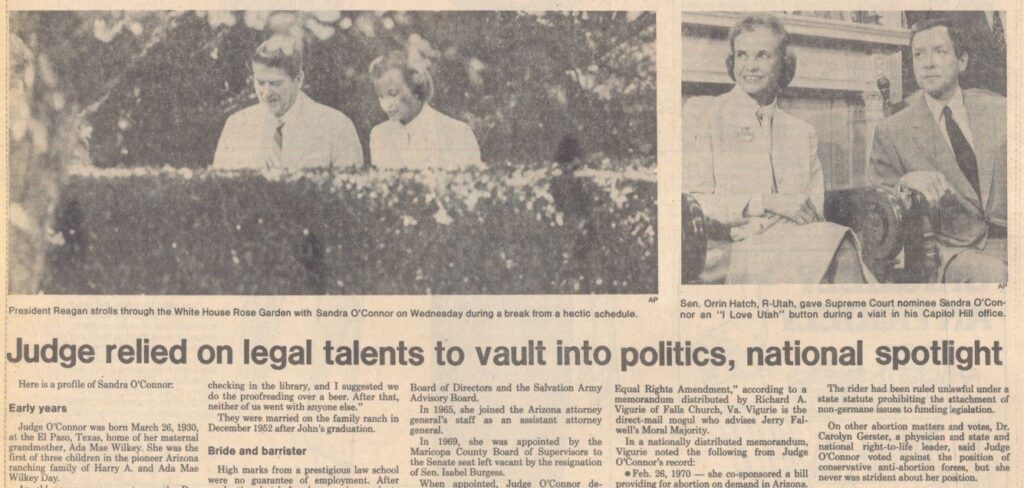
Judge relied on legal talents to vault into politics, national spotlight

Newspaper article
July 19, 1981

Early years I I 1 Judge O’Connor was born March 26, 1930, at the El Paso, Texas, home of her maternal grandmother, Ada Mae Wilkey. She was the Bride and barrister first of three children in the pioneer Arizona I ranching family of Harry A. and Ada Mae Wilkey Day. 1 An old newspaper account says the Day 1 family’s 162,000-acre Lazy-B Ranch was “the first in southeastern Arizona.” She went to school in El Paso, where she 1 lived with her grandmother, because there were no suitable schools near the ranch. She attended the Radford School for girls and graduated from Austin High School, which she attended for her senior year. ‘ She has a sister, Ann, now 43 and married to former state Sen. Scott Alexander, and a brother, Alan, 41, who manages the ranch. ‘ Matriculation to marriage • : After high school, she enrolled at Stanford : University, majoring in economics and grad1 uated “with great distinction.” Admitted to Stanford Law School, she had a distinguished classmate in Supreme Court Justice William Rehnquist. An early report that they graduated third and first, respectively, has been discounted. But Judge O’Connor does have substantial academic credentials. She was a member of the Order of the Coif – a national honor society restricted to law students in the top 10 percent of their classes. It was at Stanford that she met her husband, John J. O’Connor III, another law student and Stanford Law Review staffer. “We were assigned to work together _ (editing a Review article) one

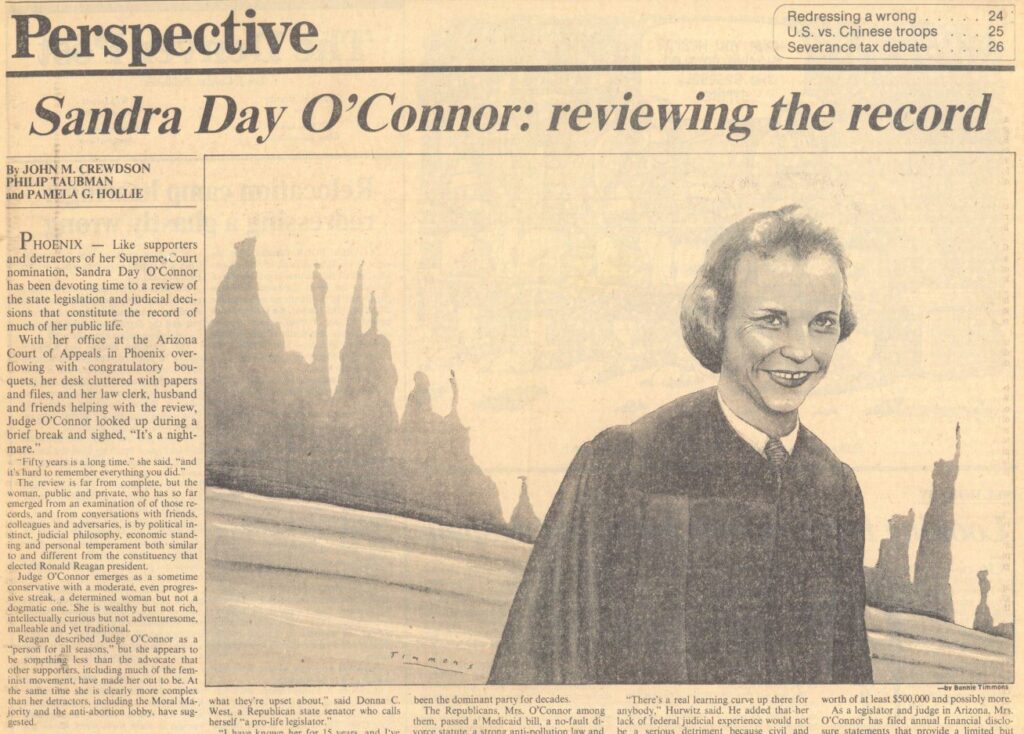
Sandra Day O’Connor: reviewing the record

Newspaper article by John M. Crewdson, Philip Taubmana & Pamela G. Hollie / New York Times
July 19, 1981

Like supporters and detractors of her Supreme Court nomination, Sandra Day O’Connor devoted the better part of this week to a review of the state legislation and judicial decisions that constitute the record of much of her public life.

With her office at the Arizona Court of Appeals here overflowing with congratulatory bouquets, her desk cluttered with papers and files, and her law clerk, husband and friends helping with the review, Judge O’Connor looked up at a brief break yesterday morning to sigh, “It’s a nightmare.”

“Fifty years is a long time,” she said, “and it’s hard to remember everything you did.”

Differences of Temperament

The review is far from complete, but the woman, public and private, who has so far emerged from an examination of of those records, and from conversations with friends, colleagues and adversaries, is by political instinct, judicial philosophy, economic standing and personal temperament both similar to and different from the constituency that elected Ronald Reagan President.

Judge O’Connor emerges as a sometime conservative with a moderate, even progressive streak, a determined woman but not a dogmatic one. President Reagan described her as a “person for all seasons,” but she appears to be something less than the advocate that other supporters, including many in the feminist movement, have made her out to be. At the same time she is clearly more complex than her detractors, including Moral Majority and the anti-abortion lobby, have suggested.

There are a couple of questions the Judge will have to answer

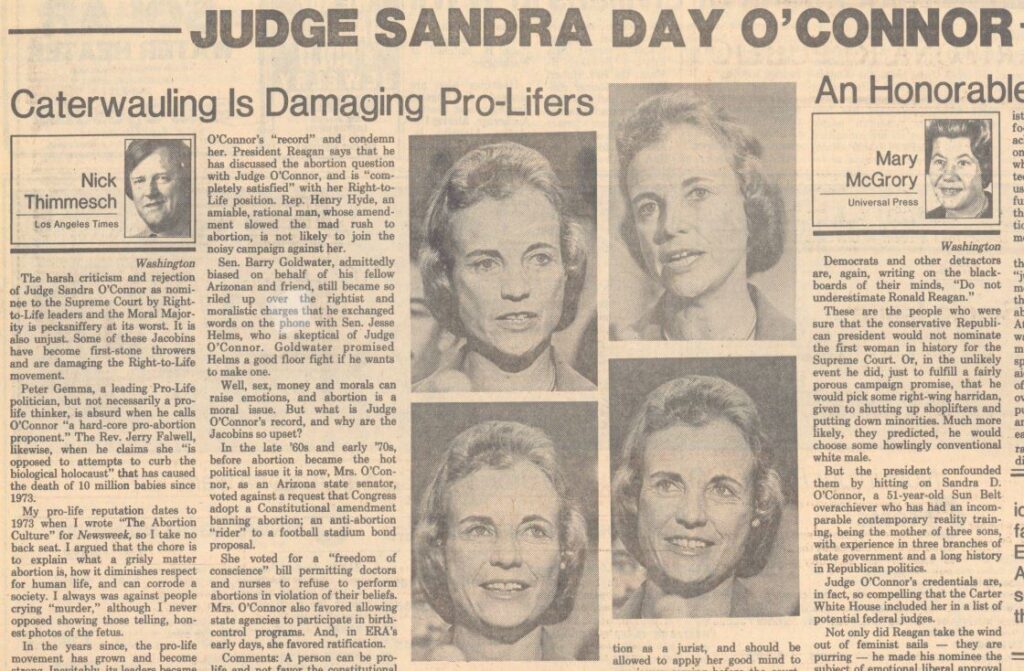
Op ed by Nick Thimmesch, Los Angeles Times
July 19, 1981

Washington Judge Sandra O’Connor, President Reagan’s favorite nominee at this point, privately explained her views to key senators this week, particularly those on abortion. That’s good. Judge O’Connor’s reputation for integrity will only be strengthened after she clarifies her record and views on this controversial question. Last week, I criticized those in the Pro-Life and Moral Majority movements who used extravagant rhetoric to denounce Judge O’Connor’s record. At that point, I had no evidence that she deserved to be excoriated in such fashion. I still support the O’Connor nomination, and also urge those in the Pro-Life movement to be more measured in their estimate of Judge O’Connor. I also agree with ProLifers who raise two questions about her record. On this score, I am more interested in how she answers these questions than in her pro- or antiabortion “record.” The first concerns a memo prepared in the Justice Department for the attorney general in response to early criticism of O’Connor by ProLifers. The memo, written by Counselor Kenneth W. Starr, reports that Judge O’Connor indicated 11that she has no recollection of how she voted” in 1970 as a member of the Arizona State Judiciary Committee on a bill to remove all legal sanctions on abortion in that state. The committee majority favored the bill, though the vote was not recorded. But a reporter for The Arizona Republic was present, and his published story listed Sandra O’Connor as voting for the bill to legalize abortion.

Golf pro found O’Connor to be supremely qualified

Op ed by Bob Verdi
July 19, 1981

WHEN PRESIDENT REAGAN nominated Judge Sandra O’Connor to become the first woman Supreme Court Justice, Steve Dunnmg took it hke the pro he is. “I was teaching her according to a four-year plan, and we’d only completed two,”‘ he said. ” As my pupil, I would have expected her to consult me about whether she should accept such a Job. But, I guess, opportunities hke this don’t come along every day, do they?” Dunning, a droll fellow of 34, is a golf instructor – and a good one – at the Glen View Club, an arboretum in Golf, Ill., which embraces some of God’s greenest acres. This is one course so beautifully manicured that you hate to see anybody take a divot, and so classy that even the birds stop chirpmg when a member is about to putt. During the wmter, when even Glen View isn’t playable, Dunnmg irons out slices m Arizona. Judge O’Connor works there, and Dunning was hired to tutor her when she chose to swing a 7-iron rather than a gavel. “AN OUTSTANDING PERSON, in t!!e top one per cent of the people I’ve ever taught,” said Dunning, who despite his age, has been a golf guru for more than a decade. ” Because of the demands on her time, she didn’t have a lot of time to play, but she pretty much kept to a routine She and her husband John would take a lesson from me every Saturday, then play nine holes, then come back and play 18 holes on Sunday. Last winter when I left there. I believe her handicap was in the low 20s. Not bad considering she only played 27 holes a week. When O’Connor

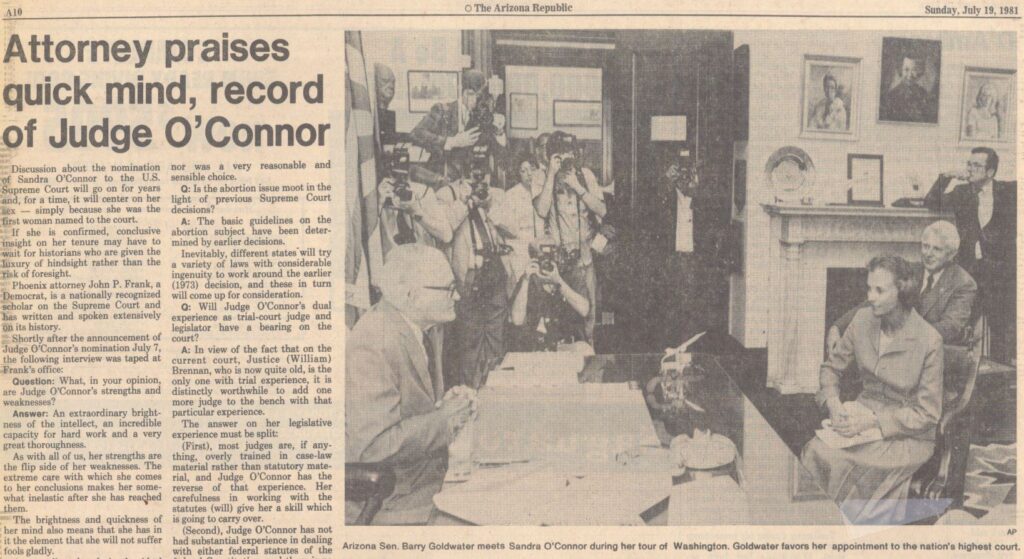
Attorney praises quick mind, record of Judge O’Connor

Newspaper article
July 19, 1981

Discussion about the nomination of Sandra O’Connor to the U.S. Supreme Court will go on for years and, for a time, it will center on her sex – simply because she was the first woman named to the court. If she is confirmed, conclusive insight on her tenure may _have to wait for historians who are given the luxury of hindsight rather than the risk of foresight. Phoenix attorney John P. Frank, a Democrat, is a nationally recognized scholar on the Supreme Court and lias written and spoken extensively on its history. Shortly after the announcement of Judge O’Connor’s nomination July 7, the following interview was taped at Frank’s office: Question: What, in your opinion, are Judge O’Connor’s strengths and weaknesses? Answer: An extraordinary brightness of the intellect, an incredible capacity for hard work and a very great thoroughness. As with all of us, her strengths are the flip side of her weaknesses. The extreme care with which she comes to her conclusions makes her somewhat inelastic after she has reac.,hed them. The brightness and quickness of her mind also means that she has in it the element that she will not suffer fools gladly. An appellate bench is the ideal place for this composite of talents and limitations because she won’t have to suffer many fools for very long Q: Is Judge O’Connor truly a “distinguished jurist” as some have , called her? : A: Judge O’Connor is qualified for ,this position. The president wanted to keep his promise to put a woman on the Supreme

Mrs. O’Connor Makes the Scene

Newspaper mention
July 19, 1981

The grumbles largely turned to pledges of support last week as Sandra Day O’Connor made her way, judiciously, around Capitol Hill. She apparently assuaged supporters of restrictions on abortions by declaring that she personally opposed the medical procedure.

At the same time, moderate-to-liberals were pleased to hear her declare that, for Justices of the High Court, legal prececents should outweigh personal beliefs. ”I think she’ll be confirmed” as the first woman on the United States Supreme Court, said Senator Strom Thurmond of South Carolina, Judiciary Committee chairman. ”I expect to support her.”

The Moral Majority might or might not remain in the minority on the nomination. At one point, a spokesman said that the group’s initial opposition to Mrs. O’Connor was a mistake, adding: ”We should have shut up and not said anything.” After apparently concluding that he shouldn’t have said anything again, he later denied that the group was dropping its objections. At weeks’s end, the Rev. Jerry Falwell said he hadn’t made up his mind yet, apparently because conservative Senator Jesse Helms, an ally of the lobbying group, hasn’t made his mind up either.

Leader of Moral Majority to decide after hearings: Falwell reserves judgment on Supreme Court Nominee

Newspaper mention by Associated Press
July 18, 1981

LYNCHBURG, Va. – The Rev. Jerry Falwell said Friday that he probably will wait until after Senate conf’mnation hearings before decid- ing whether to support or oppose Judge Sandra O’Connor’s nomination to the Supreme Court. But Falwell, leader of the Moral Mtajority, a conservative lobbying group, said he still hopes for a Reagan-appointed court that will reverse a 1973 decision legalizing abortion. Falwell had planned to decide his position on the nomination of Judge O’Connor after conAulting Sen. Jesse Helms, R-N._C., a Moral Majority ally who met With Judge O’Connor on Thursday evening. However, Helms declined to take a position on her nomination, saying one 40-minute meeting was not enough to make a decision. Falwell, after talking with Helms’ aides, also remained uncommitted. “We are not opposing Judge O’Connor’s nomination ” Falwell said. “We are not supporting Judge O’Connor’s nomination. We will wait until all the facts are in and probably the hearings are conducted.” The Senate Judiciary Committee probably will conduct its confirmation hearings in September.

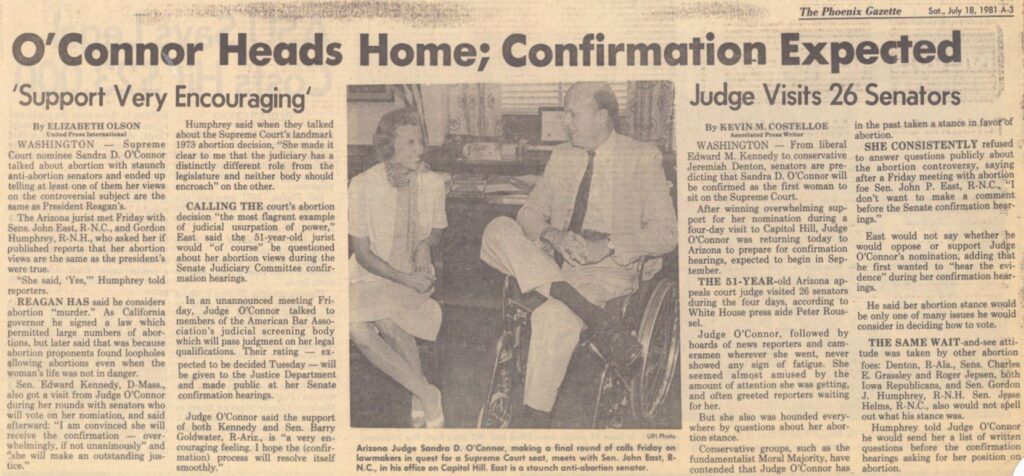
O’Connor Heads Home; Confirmation Expected. ‘Support Very Encouraging’

Newspaper article by Elizabeth Olson
July 18, 1981

WASHINGTON – Supreme Court nominee Sandra D. O’Connor talked about abortion with staunch anti-abortion senators and ended up telling at l~ast one of them her views on the controversial subject are the same as President Reagan’s. The Arizona jurist met Friday with Sens. John East, R-N.C., and Gordon Humphrey, R-N.H., who asked her if published reports that her abortion views are the same as the president’s were true. ”She said, ‘Yes,”‘ Humphrey told reporters. REAGAN BAS said he considers abortion “murder.” As California governor he signed a law which permitted large numbers of abortions, but later said that was because abortion proponents found loopholes allowing abortions even when the woman’s life was not in danger. Sen. Edward Kennedy, D-Mass., also got a visit from Judge O’Connor during her rounds with senators who will vote on her norniation, and said afterward: “I am convinced she will receive the confirmation – overwhelmingly, if not unanimously” and “‘she will make an outstanding justice.” Humphrey said when they talked about the Supreme Court’s landmarl. 1973 abortion decision, “She made it clear to me that the judiciary has a distinctly different role from the legislature and neither body should encroach” on the other. CALLING THE court’s abortion decision “the most flagrant example of judicial usurpation of power,” East said the 51-year-old jurist would “of course” be questioned about her abortion views during the Senate Judiciary Committee confirmation hearings.

Judge O’Connor Agrees with Reagan on Abortion

Newspaper article by Republic Wire Services
July 18, 1981

WASHINGTON – Ending the first round of her campaign to win approval as the Supreme Court’s first woman justice, Sandra O’Connor said Friday that her views on abortion are the same as President Reagan’s.

The Arizona Court of Appeals judge met with staunch anti-abortion Sens. John East, R-N.C., and Gordon Humphrey, R-N.H., who asked her about published reports that her abortion views were comparable to Reagan’s. “She said, ‘Yes,’ ” Humphrey told reporters. But East said he was “reserving the right” to make his decision until after the confirmation hearings be- , fore the Senate Judiciary Committee, of which he is a member. The : panel is expected to take up her nomination in September. • “I did not ask her her personal .. views on abortion,” East said after a 30-minute meeting with Judge • O’Connor. Asked whether he questioned her ,. about her legal viewpoint on the 1973 Supreme Cciurt• decision giving women the right to an abortion during the first- six months of pregnancy, East replied, “No, I did ‘ not. “It’s not the litmus test,” he said of the abortion ruling. East has said he could not support , any Supreme Court nominee who r agreed with the 1973 decision, which ‘. baa become the precedent for other abortion rulings. East said Friday that a Supreme Court nominee who thought the 1973 decision was “good constitutional law” would have “grave problems” in the confirmation process. He said the abortion issue would : be “one of a host of things” that could be used to explore

Judge Visits 26 Senators

Newspaper article by Kevin M. Costelloe, Associated Press
July 18, 1981

Lawmakers back Skelly for resigning from firm

Newspaper mention by Associated Press
July 18, 1981

La juez O’Connor, mujer decidida pero no dogmática

Newspaper article by John M. Crewdson, Philip Taubmana & Pamela G. Hollie
July 17, 1981

PHOENIX – Sandra Day O’Connor dedicó mu-::ho tiempo la semana pasada a revisar las leyes estatales y las decisiones judiciales que _constituyen el historlal de gran parte de su vida publica. Su oflcina en el Tribunal de Apelaciones de Arizona estaba llena de ramos de flores enviados tras el anuncio de su nombramiento al estrado del Tribunal Supremo. “Cincuenta aiios es mucho tiempo”, dilo durante una interrupcion de su revision, “y es diffcil recordar todo lo que se ha hecho”. Dlferenclas de temperamento La revision no ha terminado todavra, pero la mujer que ha surgido del examen de ese historial y de conversaciones que se han sostenido con amigos, colegas y adversarias, resulta a la vez similar y diferente de la gran mayorfa de los votantes que eligieron al Presidente Ronald Reagan. Estas diferencias y similitudes se pueden encontrar en su instinto polftico, en su filosoffa judicial, en su posición económica yen su temperamento personal. La Juez O’Connor es una cc:,nservadora la mayor parte del tiempo, aunque con ciertos visos moderados y aun progresistas; una mujer decidida pero no dogmatica. Es acomodada, pero no rica; con una gran curiosidad intelectual, aunque no exactamente osada en este terreno y maleable a la vez que tradicional. El Presidente Reagan describió a la Juez O’Connor como “una persona para todos los tiempos’ pero sin embargo parece ser menos activista de lo que han dicho los que la apoyan dentro del movimiento feminista. Al mismo tiempo es mucho mas complela

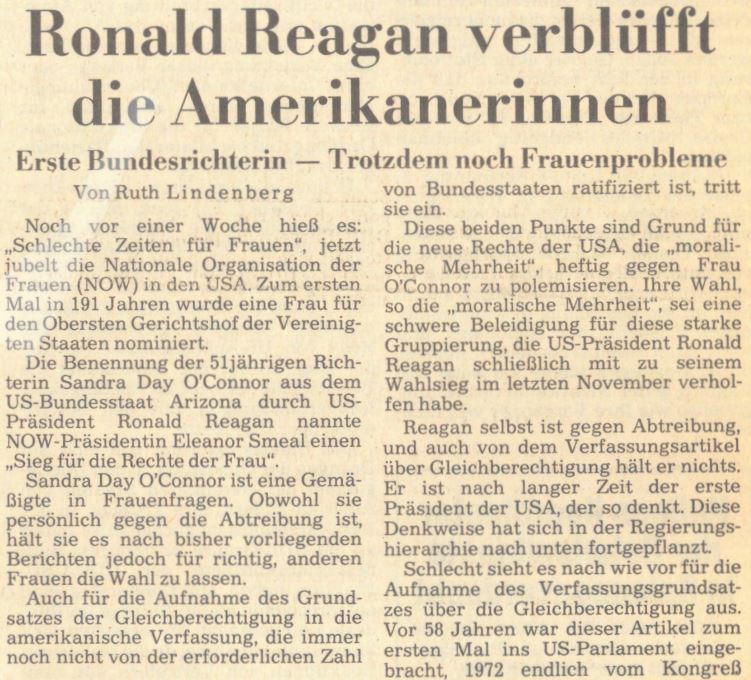
Ronald Reagan verblüfft die Amerikanerinnen (Ronald Reagan astonishes the Americans)

Newspaper article by Ruth Lindenberg
July 17, 1981

Erste Bundesrichterin – Trotzdem noch Frauenprobleme Noch vor einer Woche hieß es: ,,Schlechte Zeiten für Frauen”, jetzt jubelt die Nationale Organisation der Frauen (NOW) in den USA. Zum ersten Mal in 191 Jahren wurde eine Frau für den Obersten Gerichtshof der Vereinigten Staaten nominiert.

Die Benennung der 5ljährigen Richterin Sandra Day O’Connor aus dem US-Bundesstaat Arizona dunch US-Präsident Ronald Reagan nannte NOW-Präsidentin Eleanor Smeal einen ,,Sieg für die Rechte der Frau”.

Sandra Day O’Connor ist eine Gemäßigte in Frauenfragen. Obwohl sie persönlich gegen die Abtreibung ist, hält sie es nach bisher vorliegenden Berichten jedoch für richtig, anderen Frauen die Wahl zu lassen.

Auch für die Aufnahme des Grundsatzes der Gleichberechtigung in die amerikanische Verfassung, die immer noch nicht von der erforderlichen Zahl von Bundesstaaten ratifiziert ist, tritt sie ein.

Diese beiden Punkte sind Grund für die neue Rechte der USA, die ,.moralische Mehrheit”, heftig gegen Frau O’Connor zu polemisieren. Ihre Wahl, so die moralische Mehrheit”, sei eine schwere Beleidigung für diese starke Gruppierung, die US-Präsident Ronald Reagan schließlich mit zu seinem Wahlsieg im letzten November verholfen habe.

Reagan selbst ist gegen Abtreibung, und auch von dem Verfassungsartikel über Gleichberechtigung hält er nichts. Er ist nach langer Zeit der erste Präsident der USA, der so denkt. Diese Denkweise hat sich in der Regierungshierarchie nach unten fortgepflanzt.

Schlecht sieht

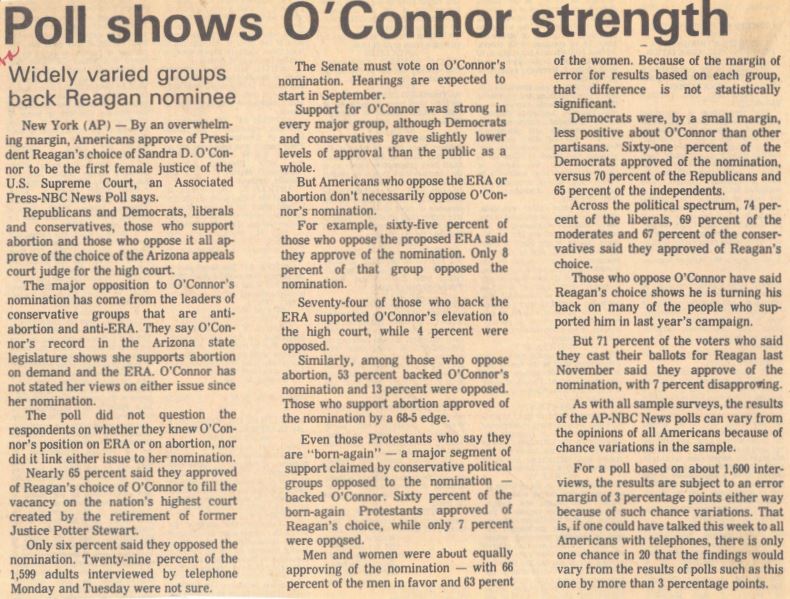
Poll shows O’Connor strength

Newspaper article by Associated Press
July 17, 1981

Hiring of women admittedly slow, Reagan aide says

Newspaper mention by Associated Press
July 17, 1981

WASHINGTON – President Reagan’s chief of staff conceded Thursday that the administration has been slow in appointing women and members of minorities to high-level jobs. James A. Baker also was concerned ab?ut reports of “squabbling and turf fighting on foreign policy.” But Baker, one of tl}.e top three ~ite Ho’:18e staffers said the president successfully 18 changmg the fa~ of the federal government in what he termed the start of the “Reagan Revolution.” Speaking at the National Press Club, Baker said the administration has accelerated its efforts to place women in upper-level jobs. . “To the president, the selection of fine, distinguished people like Sandra O’Connor,” the president’s nominee for the U.S. Supreme Court, “will not be the exception, but the trademark, of this administration.” “To be sure we have had our frustrations and disappointmen’ts,” he said, pointing to the controversy over Reagan’s proposals to revise the Social Security system. “We could have done a better job in the appointments process – both in the timeliness of the appointments and in the numbe~ of women and minorities in high posts,” Baker srud. “All of us, from the president on down, wo~d have been far happier had we see_n fewer stor_1es about squabbling and turf fightmg on foreign policy.” . During a question-and-answer sess1~n, Baker was critical of suggestions that he, ~1te House counselor Edwin Meese and deputy chief of st.aff Michael K. Deaver are running the government, and that Reagan is a

Why the O’Connor blitz? Read on…

Op ed by Ted Craig
July 17, 1981

As you can see at a glance, this is pretty much a Sandra O’Connor page today . But hold it! Don’t be too hasty in turning away on grounds that you’ve read and heard enough about Judge O’Connor awreddy. It is true that we have used a lot of copy in the Tucson Citizen lately concerning President Reagan’s nomination of Arizona’s Sandra D. O’Connor to become the first woman ever to serve on the Supreme Court. It is a big story, an event of some historical significance, and we’ve covered it as such. We don’t intend to chase you away with a constant barrage of O’Connor, but we feel that the information and comment o~ his page today is somewhat special in that it is the best of the best, culled from an awesome flood of copy as the world’s columnists jumped on the O’Connor theme. There is our “lede” story by Chris Collins of the Citizen’s Washingto~ Bureau , Gannett News Service. Ms. Collins is a former Citizen reporter who returned to home base long enough to find out what makes makes Mrs. O’Connor tick as a judge, a woman, a mother, a warm, breathing human being who can sit steely-eyed and humorless on the bench, then cry later over the effect of her decision. You might be interested to learn that this remarkable Phoenix jurist is a well-to-do country club woman who can strike a tennis ball or golf ball with great precision or cook a gourmet meal. Or that she will pay less than she can afford for a dress, then show it to her husband for his approval. Then there is the sober, well-reasoned

O’Connor foe won’t back down, quits job

Newspaper article by Associated Press
July 17, 1981

O’Connor courts Senate Members

Newspaper article by Tribune staff and wire reports
July 17, 1981

Skelly quits job rather than curtail criticism of nominee

Newspaper article by Associated Press
July 17, 1981

PHOENIX (AP) – Scottsdale Republican Rep. Jim Skelly says he has resigned his Greyhound Corp. job rather than knuckle down to pressure from Greyhound Chairman Gerald Trautman over Skelly’s criticism of the Sandra O’Connor Supreme Court nomination. Skelly, 47, a long-time abor- tion foe who earned $18,700 a year as a Greyhound customer relations representative in addition to his annual $15 000 legislative salary, said Thu~ay he quit after Trautman called him on Wednesday to complaint ~t Skelly’s remarks in opposition to the nomination “were intemperate.” He said Trautman especially objected to a published report that Skelly had said he was outraged by ~agan’s choice. When Trautman “put pressure on me to tone down my criticism of Sandra,” Skelly said, “I pointed out that ‘outraged’ was not in quotes, but that it might as well be because that’s the way I felt. “I told him I can’t tone down my remarks and said I was resigning,” Skelly added. He said Trautman told him, “Don’t resign, just take a week to think it over” but that “I told him I could thin,k about it till doomsday and it wouldn’t make any difference.” Trautman could not be reached, but Dorothy Lorant, vice president for public relations, issued this statement: ‘”We at Greyhound feel that Judge O’Connor is one of the most level-headed, intelligent justices, male or female, ever to serve on the bench, and that her appointment to the U.S. Supr~me Court would enhance that body. “Jim Skelly is a fine man and a conscientious

Pro-life’ Rep. Skelly quits job rather than keep quiet on O’Connor

Newspaper article by Associated Press
July 17, 1981

Mark Russell

Op ed by Mark Russell
July 17, 1981

We are about to witness the biggest plus of the Reagan adminstration thus far – the end of unisex facilities at the Supreme Court • • • The nomination of Judge Sandra O’Connor to the court should end all that nonsense about the administration being anti-Irish. .. . . Reagan had found a black, female, Jewish Republican judge for the court, but her Hispanic husband Ernesto didn’t vant to quit his job as a preacher for the Moral Majo1 Â¥ to move to Washington. • • • It’s not in our nature a~ a pPople to be pacified by the nomination of a woman for the Supreme Court. We’ll no doubt be hearing crie~ of “Only one?”, “Hohum, another white” and “No justice, we say, until a justice is gay!”

Blunt Barry

Newspaper article
July 17, 1981

65% in survey back nominee; 6% are opposed

Newspaper mention by Associated Press
July 17, 1981

NEW YORK – By an overwhelming margin, Americans approve of President Reagan’s choice of Judge Sandra O’Connor to be the first female justice of the Supreme Court, an Associated Press-NBC News Poll says.

Republicans and Democrats, liberals and conservatives, those who support abortion and those who oppose it all approve of the choice of the Arizona Court of Appeals judge for the high court.

The major opposition to Judge O’Connor’s nomination has come from the leaders of conservative groups that oppose abortion and the Equal Rights Amendment. They say Judge O’Connor’s record in the Arizona Legislature shows she supports abortion on demand and the ERA. Nearly two-thirds of those questioned – 65 percent – said they approved of Reagan’s choice of Judge O’Connor to fill the vacancy on the nation’s highest court created by the retirement of former Justice Potter Stewart. Only 6 percent said they opposed the nomination.

Skelly Quits Bus Firm in Flap over O’Connor

Newspaper article by Richard DeUriarte
July 17, 1981

Helms calls Judge O’Connor fine lady, is silent on support

Newspaper article by United Press International
July 17, 1981

WASHINGTON – Sen. Jesse Helms, R-N.C., the chief Senate crusader against abortion, Thursday called Sandra O’Connor a “very fine lady” but declined to say if he will oppose her confirmation as the first woman Supreme Court justice. After a 35-minute meeting with President Reagan’s choice for the high court, Helms – who has declined to “prejudge” Judge O’Connor despite opposition to her from his right-wing allies across the country – was careful in mnswering reporters’ questions. When Helms and Judge O’Connor emerged from his office to have their pictures taken, Helms was asked about the meeting, and the usually articulate senator, searching for the right words, replied, “Well, I hope we have many more meetings. I look forward to following this lady’s career.” Asked if he is going to help her career he replied, “Why should I do othe~? She’s a very fine lady.” But he would not say whether be will vote to confirm her or lead any opposition. When reporters pressed Helms for elaboration, the senator retreated foto bis office without answering, and aides shut the door on reporters. Judge O’Connor would say only, “We had a productive meeting.” Before meeting with Judge O’Connor, Helms met at the White House with Reagan, a Helms aide confirmed Thursday. The aide would not say if Helms discussed the O’Connor nomination with Reagan. But the president has urged Helms repeatedly not to oppose the nomination, the aide said, and there has been widespread speculation that White House aides

Rep. Jim Skelly Quits Job Because of O’Connor Remarks

Newspaper article by United Press International
July 17, 1981

Old boys’ in a fix over ‘new boy’

Newspaper article by Bob Greene
July 17, 1981

Predicts Approval: Kennedy Supports O’Connor

Newspaper article by Kevin M. Costelloe
July 17, 1981

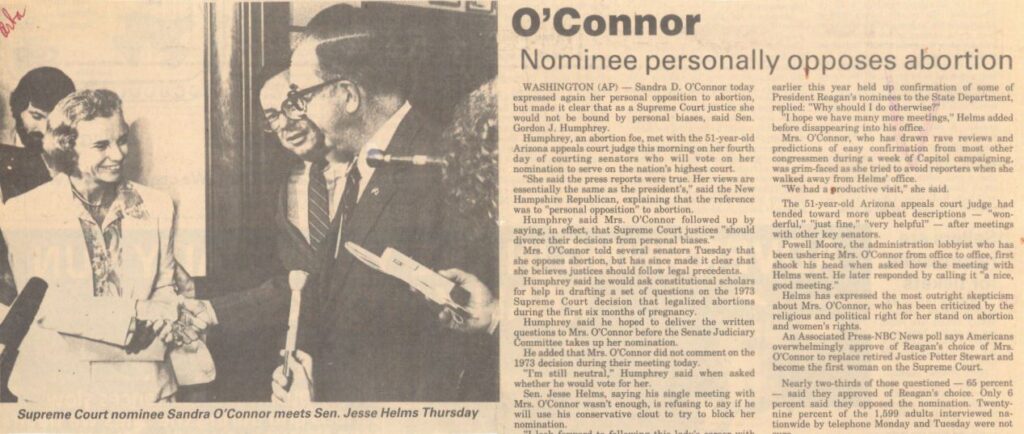
O’Connor Nominee personally opposes abortion

Newspaper article by Associated Press
July 17, 1981

WASHINGTON (AP) – Sandra D. O’Connor today expressed again her personal opposition to abortion, but made it clear that as a Supreme Court justice she would not be bound by personal biases, s•aid Sen. Gordon J. Humphrey. Humphrey, an abortion foe, met with the 51-year-old Arizona appeals court judge this morning on her fourth day of courting senators who will vote on her nomination to serve on the nation’s highest court. “She said the press reports were true. Her views are essentially the same as the president’s,” said the New Hampshire Republican, explaining that the reference was to “personal opposition” to abortion. Humphrey said Mrs. O’Connor followed up by saying, in effect, that Supreme Court justices “should divorce their decisions from personal biases.” Mrs. O’Connor told several senators Tuesday that she opposes abortion, but has since made it clear that she believes justices should follow legal precedents. Humphrey said he would ask constitutional scholars for help in drafting a set of questions on the 1973 Supreme Court decision that legalized abortions during the first six months of pregnancy. Humphrey said he hoped to deliver the written questions to Mrs. O’Connor before the Senate Judiciary Committee takes up her nomination. He added that Mrs. O’Connor did not comment on the 1973 decision during their meeting today. “I’m st ill neutral,” Humphrey said when asked whether he would vote for her . Sen. Jesse Helms, saying his single meeting with Mrs. O’Connor wasn’t

O’Connor Choice Draws Bouquets and Brickbats

Newspaper article by Marjorie Hyer
July 17, 1981

Letters: More on Judge Sandra O’Connor

Letter to the editor by various
July 17, 1981

Applause… and a sigh of relief

Op ed by Paul Greenberg
July 17, 1981

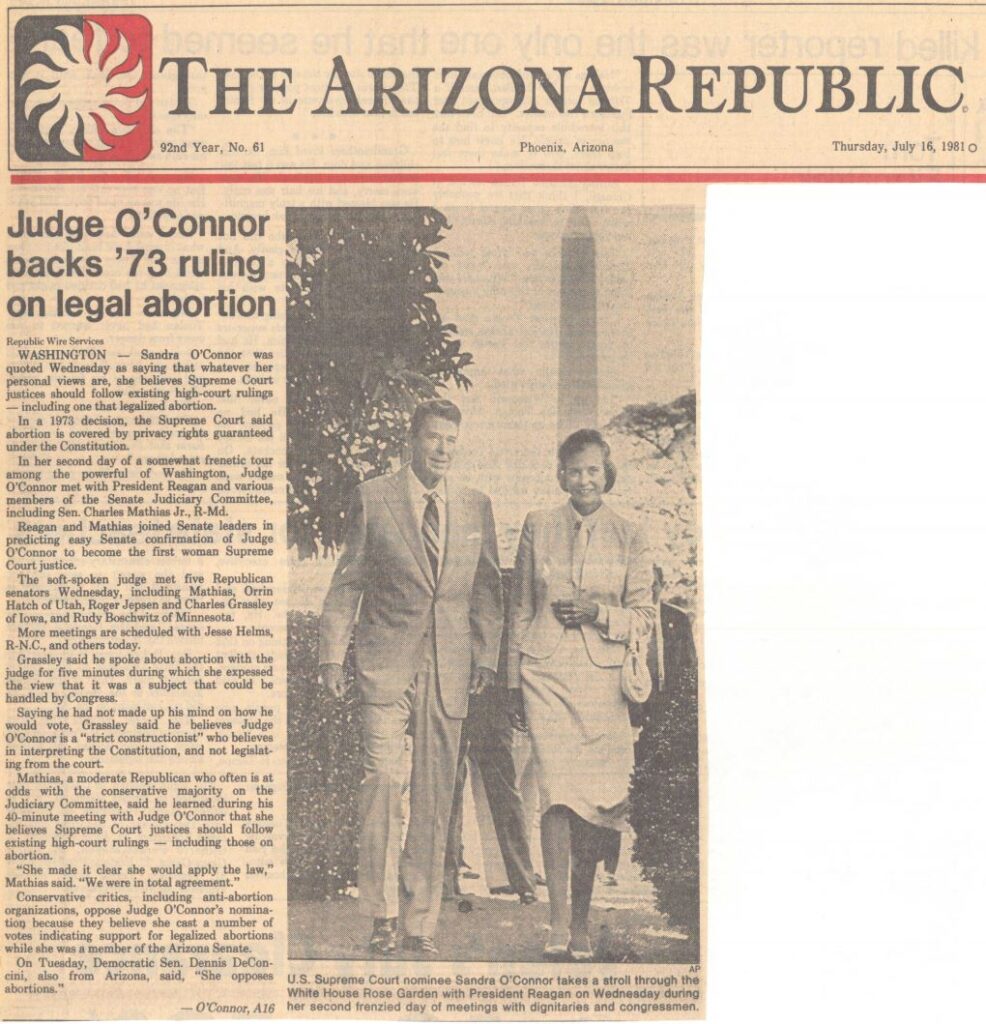
Judge O’Connor backs ’73 Ruling on legal abortion

Newspaper article by Republic Wire Services
July 16, 1981

WASHING TON – Sandra O’Connor was quoted Wednesday as saying that whatever her personal views are, she believes Supreme Court justices should follow existing high-court rulings – including one that legalized abortion. In a 1973 decision, the Supreme Court said abortion is covered by privacy rights guaranteed under the Constitution. In her second day of a &0mewhat frenetic tour among the powerful of Washington, Judge O’Connor met with President Reagan and various members of the Senate Judiciary Committee, including Sen. Charles Mathias Jr., R-Md. Reagan and Mathias joined Senate leaders in predicting easy Senate confirmation of Judge O’Connor to become the first woman Supreme Court justice. The soft-spoken judge met five Republican senators Wednesday, including Mathias, Orrin Hatch of Utah, Roger Jepsen and Charles Grassley of Iowa, and Rudy Boschwitz of Minnesota. More meetings are scheduled with Jesse Helms, R-N.C., and others today. Grassley eaid he spoke about abortion with the judge for five minutes during which she expessed the view that it was a subject that could be handled by Congress. Saying he had not made up his mind on how he would vote, Grassley eaid he believes Judge O’Connor is a “strict constructionist” who believes in interpreting the Constitution, and not legislating from the court. Mathias, a moderate Republican who often is at odds with the conservative majority on the Judiciary Committee, eaid he learned during his 40-minute meeting with Judge O’Connor that

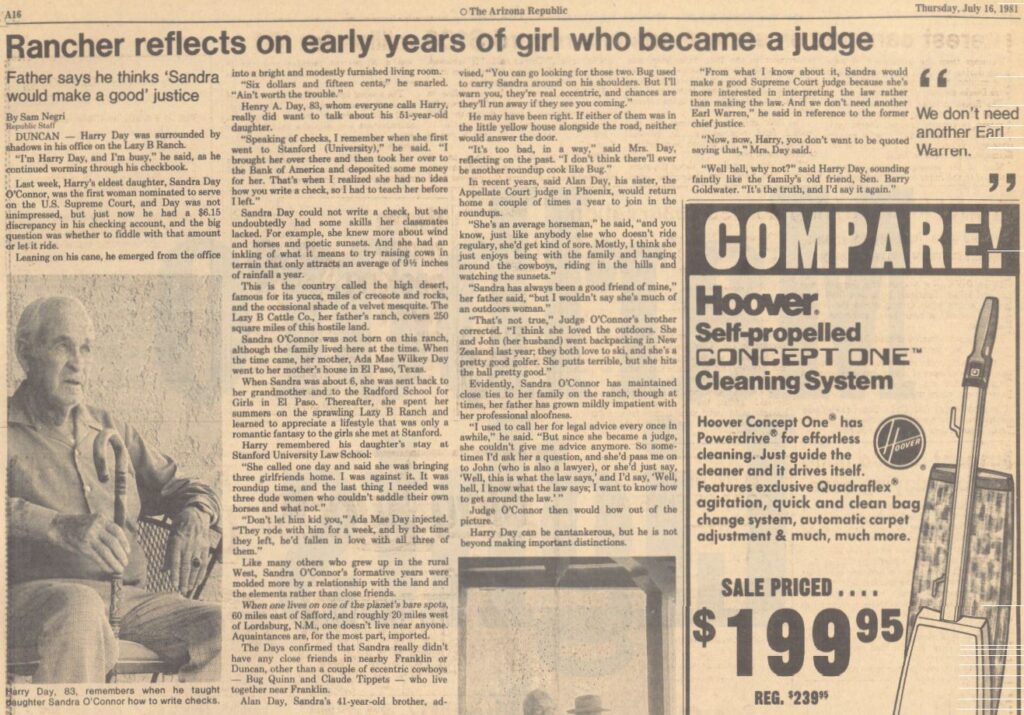
Rancher reflects on early years of girl who became a judge

Newspaper article by Sam Negri
July 16, 1981

Father says he thinks ‘Sandra would make a good’ justice

DUNCAN – Harry Day was surrounded by shadows in his office on the Lazy B Ranch. “I’m Harry Day, and I’m busy,” he said, as he continued worming through his checkbook. Last week, Harry’s eldest daughter, Sandra Day O’Connor, was the first woman nominated to serve on the U.S. Supreme Court, and Day was not unimpressed but just now he had a $6.15 discrepancy in his checking account, and the big question was whether to fiddle with that amount or let it ride. leaning on his cane, he emerged from the office into a bright and modestly furnished living room. “Six dollars and fifteen cents,” he snarled. “Ain’t worth the trouble.” Henry A. Day, 83, whom everyone calls Harry, really did want to talk about his 51-year-old daughter.

Like many others who grew up in the rural West, Sandra O’Connor’s formative years were molded more by a relationship with the land and the elements rather than close friends. When one lives on one of the planet’s bare spots, 60 miles east of Safford, and roughly 20 miles west of Lordsburg, N.M., one doesn’t live near anyone. Acquaintances are, for the most part, imported.

The Days confirmed that Sandra really didn’t have any close friends in nearby Franklin or Duncan, other than a couple of eccentric cowboys – Bug Quinn and Claude Tippets – who live together near Franklin. Alan Day, Sandra’s 41-year-old brother, advised…

[Photo caption: Harry Day, 83, remembers when he taught daughter Sandra

O’Connor Slows Pace in Capital

Op ed by Lou Hiner
July 16, 1981

WASHINGTON – Supreme Court nominee Sandra D. O’Connor of Phoenix slowed her round of courtesy visits with members of Congress to a walk today. On her schedule were only seven calls, two of which were with fellow Arizonans. The first stop on Capitol Hill was a meeting with Sen. John C. Stennis, D-Miss. Visits with Sen. James A. McClure, R-Wyo., and Sen. Howard Metzenbaum, D-Ohio, followed. THE THREE men expressed their appreciation for her visits, and each posed for pictures with her outside his office. “She’ll be a welcome addition to the Supreme Court,” Metzenbaum said after meeting Judge O’Connor. He said they did not discuss abortion but did discuss areas of civil rights, civil liberties and antitrust. He said he was impressed, “particularly by her independence of spirit and her feistiness.” FOR LUNCH, Mrs. Dennis DeConcini, wife of the Tucson Democratic senator, was hostess in a private Capitol dining room, where wives of other Senate Judiciary Committee members met the justicedesignate. Judge O’Connor has been accompanied on her three-day tour of congressional offices by White House aides and Assistant Attorney General Robert McConnell, who formerly practiced law in Phoenix. This afternoon Judge O’ Connor was to visit Sen. Arlen Specter, R-Pa., and Arizona Democratic Reps. , Bob Stump and Morris K. Udall. BOTH ARIZONANS have offered strong endorsements of Judge O’Connor’s nomination as the first woman to serve on the Supreme Court. Her last call of the day could prove to

Falwell group denies softening on justice nomination

Newspaper article by Republic Wire Services
July 16, 1981

WASHINGTON – Moral Majority, the con- :lervative lobbying group, said Wednesday it bas :Jiot softened its position on Judge Sandra -O’Connor and that it still has “substantive ..concerns” about her nomination to the Supreme o.urt. : Cal Thomas, vice president of the organi7.lltion, ~ed a statement reasserting Moral Majority’s ppsition after reports that it was falling into line behind President Reagan’s selection of Judge Pi’Connor for the high court. r, ~eanwbile, two religious journals criticized P..resident Reagan for conferring with Moral Majority leader Jerry Falwell about the nominatio~. t Falwell, of Lynchburg, Va., has said Reagan 1elephoned him and talked for almost an hour on the day Judge O’Connor was announced as ~an’s choice. The fundamentalist preacher has • ked the president to let him question Judge O’Connor about her views on feminism and ~rtion . ~Y such concessions on Reagan’s part would be ~ e height of irresponsibility,” said Spurgeon Dunnam III, editor of the Dallas-based Tezas Methodist-United Methodist Reporter, a national publication serving the 9.6 million-member United Methodist Church and churches of other denominations. “I’m bothered, personally, by the type of religious folks Mr. Reagan tends to liaten to,” Dunnam wrote in this week’s edition. “Mr. Falwell epitomw.es a very narrow, legalistic and not always Christian. from my understanding of the Scriptures, point of view.” Dr. Presnall Wood, editor of the Baptist Standard, the Dallas-based voice

“The judicial area is a snug fit for her,” Barr says

Newspaper article
July 15, 1981

“The legislature is a political arena where you’re always out in the open getting shot at,” says House Majority Leader Burton Barr. “She’s better suited to the judicial area where things are more relaxed and more scholarly. That’s a snug fit for her.” Few people leave the legislature when they’re m the position of majority leader. O’Connor did in 1974 to run for a seat on the Maricopa County Superior Court. She quickly developed a reputation for being tough on attorneys – some say the way she could “dress down” an unprepared barrister was masterful and devastating. It was in that setting that she solidified a judicial temperament that has been lauded by the president: she believes in interpreting the law, not making it. While conservatives were spreading the word that O’Connor had been “tough on criminals” in her trial court days, liberals were noting her major mark was one of fairness. Arizona courts are notorious for making political rulings. They’re the last chance to keep a controversial issue off the ballot or an unpopular politician from a recall move. They’re a last chance that is often used. So when a controversial initiative challenging the safety of nuclear power was ready to go on the b~ot, a contingent of heavy-duty movers and shakers went into Judge O’Connor’s court to squash the effort. Observers note she had plenty of opportunity to follow the political winds and find a loophole to keep the issue from a public vote. She didn’t. One “fan” of her trial court days

Council Oks resolution backing Judge O’Connor

Newspaper mention
July 15, 1981

The Phoenix City Council passed a resolution Tuesday urging the confirmation of Arizona Appeals Judge Sandra O’Connor to the U.S. Supreme Court . Copies of the resolution were sent to Senate leaders and members of the Senate Judiciary Committee, which will hold hearings on the nomination. Council members said Judge O’Connor’s work as a staff member of the Arizona Attorney General’s Office, the Maricopa County Superior Court and the Appeals Court qualify her for the appointment .

O’Connor Visits Key Lawmakers

Newspaper article by Associated Press
July 15, 1981

WASHINGTON (AP) – With a personal hand from Attorney General William French Smith and optimistic predictions from Senate leaders, Sandra Day O’Connor yesterday began a personal campaign to assure her confirmation as the first female Supreme Court justice. O’Connor met for four hours with Smith and other Justice Department officials and then moved on to Capitol Hill for meetings with more than a dozen influential members of the House and Senate. Among them were Senate Majority Leader Howard Baker and Sen. Strom Thurmond, R-S.C., chairman of the Senate Judiciary Committee. “A great number of senators have expressed support, some publicly, some privately,” Baker said. “None has expressed opposition.” Later in the week, the Arizona appeals court judge is to meet with conservative senators including Jesse Helms, R-N.C., , ‘ . who have questioned O’Connor s views on legalized abortion. But Baker played down the importance of the issue in the confirmation process, which he said should be over before the Supreme Court begin~ i~ Octobe~ session. “I am convinced this 1s not an issue that should be significant in considering her confirmation,” Baker said. Thurmond, meanwhile, predicted easy confirmation by the Senate, although he advised O’Connor there were some potential votes against her. “She is a very impressive lady, a very intelligent lady,” Thurmond said after a half-hour meeting in his Senate office. “I told her there was some opposition to her.” O’Connor later met with Baker and

More Judges Due

Newspaper article
July 15, 1981

Getting to Know the Judge – A Republican Darling Becomes a Political Hot Potato

Newspaper article by Jana Bommersbach
July 15, 1981

Sandra Day O’Connor made up the list of her lifetime accomplishments last week; a resume to satisfy the hunger for information on this first woman ever nominated to the U.S. Supreme Court. Her list was one page long. More of her life – both professional and personal – was left off the list than put on. To understand this historic woman, you have to know some of the things that weren’t on that list. Things like … A REPUBLICAN DARLING BECOMES A POLITICAL HOT POTATO

While some blasted O’Connor’s lukewarm support for ERA, feminists looked at her stance and forgave her. The first woman ever nominated to the U.S. Supreme Court couldn’t even get a Credit card in her own name in Arizona just eight years ago. As far as Arizona laws were concerned, Sandra Day O’Connor was just a “Mrs.” in 1973 – not the majority leader of the Arizona Senate; not the highly-honored law graduate of Stanford; not the former assistant attorney general. When she married her law school classmate. John Jay O’Connor III, she simply became a Mrs. who couldn’t hold title to her own property, ouy her own car or have her own credit without her husband’s name and approval. Sandra O’Connor helped change those laws; as a member of the highest court in the nation, she will spend the rest of her career changing or upholding the laws of the country. As a jurist, she is expected to be a “strict constructionist” who will bring to the high court the same qualities she showed in the county and appeals courts of Arizona:

Moral Majority eases stand on Judge O’Connor

Newspaper article by Republic Wire Services
July 15, 1981

LYNCHBURG, Va. – The conservative lobbying group Moral Majority eased back Tuesday from its attack on President Reagan’s nomination of Sandra O’Connor to the Supreme Court. Spokesman Cal Thomas said that although the group remains concerned about Judge O’Connor’s record on the Arizona Appeals Court, “We think the potential is there for the Moral Majority to support Judge O’Connor pending further information.” But Thomas, the organization’s vice president for communications, said the Moral Majority is “not on the verge of supporting Judge O’Connor.” “We want to support the president,” he said. “We’re desirous of seeing a woman on the court . We think it’s long overdue. Let’s not rush to judgment . • “We are still awaiting further information about her abortion position and, pending the reception of that information, we are withholding judgment either pro or con.” Ronald Godwin, vice president and chief operations officer for the Moral Majority, said Tuesday his group’s position remains unchanged. “We still have grave doubts and ‘ reservations,’ ‘ he said. Thomas said he hopes Judge O’Connor will express her views on abortion in talks with Senate leaders. “Some of our friends in the Senate , conservative members, will be asking questions of Judge O’Connor that bad concerned us and will be communicating her answers to the public and, of course, to us as well,” he said. Last week, Thomas called the nomination “a mistake” and said the Moral Majority would oppose it, basing the decision

Judge O’Connor Makes Courtesy Call on Capitol

Newspaper article by Lynn Rosellini
July 15, 1981

Sandra Day O’Connor sat down between Senators Howard H. Baker Jr. and Robert C. Byrd this afternoon and immediately scored a political point.

“Senator Byrd,” Judge O’Connor said, addressing the minority leader, a man who considers himself an authority on the Senate, “tell me a little about the history of this great institution.”

Senator Baker, the majority leader, broke into laughter, saying, “Judge, you don’t know what you’ve just asked!” Senator Byrd just smiled. Then he congratulated Judge O’Connor, not on her nomination to the Supreme Court but on her confirmation by the Senate, “which I feel will be forthcoming.”

The Courtesy Ritual

In her first afternoon on Capitol Hill, Judge O’Connor, who if confirmed would be the first woman to serve on the Supreme Court, proved herself particularly adept at a peculiar Washington ritual: the courtesy call.

This is the custom that requires nominees of the executive and judicial branches to travel to Capitol Hill to woo members of the legislative branch, particularly those who sit on pertinent committees. It is a time for smiles and handshakes, not for substantive discussions.

“It’s going just fine, thank you,” Judge O’Connor, of the Arizona Court of Appeals, said as she breezed down a Capitol hallway this afternoon, her heels clicking on the marble floor. On her right was William French Smith, the Attorney General. On her left was Senator Baker.

Also accompanied by a mob of photographers and reporters, Judge O’Connor visited, among

Your Opinion: John Q. Public offers approval of Judge O’Connor

Newspaper mention by Various
July 15, 1981

With the nomination of Judge Sandra O’Connor to the Supreme Court , controversy has arisen from those objecting to abortion . Whether a woman can handle the job. or will be a “proper “‘ representative , also has been floating around the atmosphere of some conservatives . O’Connor is the first woman ever nominated for a position as Associate Justice of the Supreme Court. thus you can see the reasoning for doubt – tradition. Evidently the reason President Ronald Reagan chose her wasn’t because she was a woman, but because she was the best qualified for the position . Conside ring she is from Arizona expands the spotlight of att ention in this state ‘s press. But, what do the people from Arizona think ? Was it a wise choice for Reagan to nominate her? We asked some-westside people their opinions. and the reaction was completely positive Joan Hogue : ” I think it’ s wonderful. rm glad to see a woman have a chance to get in.”

Josett Dobbs: “I think it’s good.”

Mike O’Keefe: ” I think it’s good to have a woman representative on t he Supre me Court. Women can make decisions just as well as men.”

Tina Engel: ” I think it’s OK, as long as she’s qualified. There’s nothing wrong wit h a woman being appointed.” Jules Ketcham : ” Well. I’ m not rea l qualified – issues I heard her opinions about make me favor her .” Russe ll Par ker: ” l think it”s great. Sure. there’s nothing wrong with a woman being in there.”

Applauding Nomination of O’Connor

Letter to the editor by Various
July 15, 1981

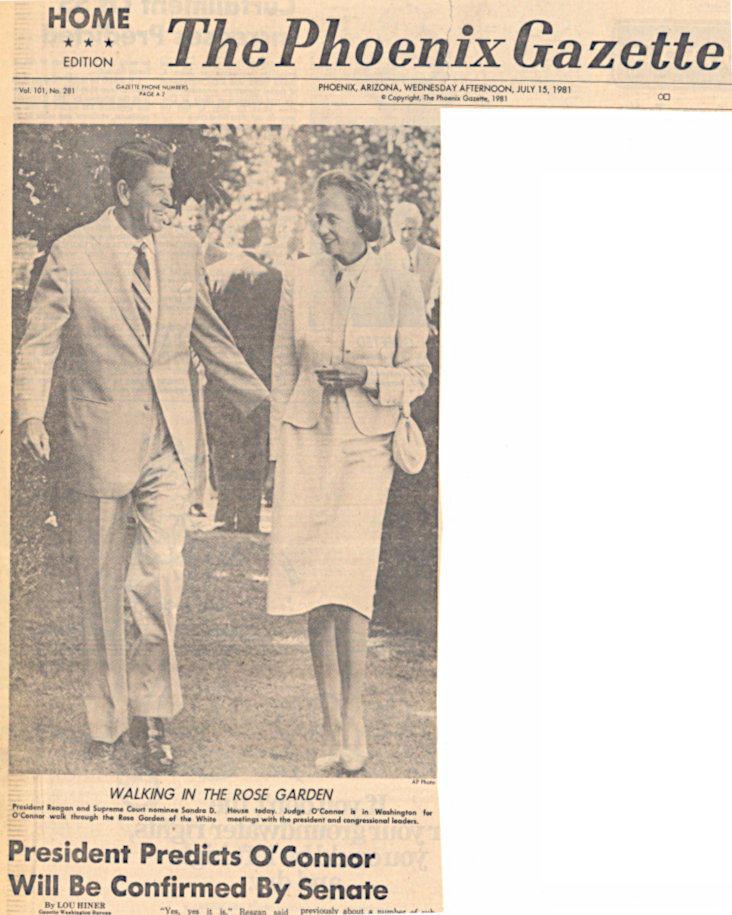
President Predicts O’Connor Will Be Confirmed By Senate

Newspaper article by Lou Hiner
July 15, 1981

A court of many issues

Editorial
July 15, 1981

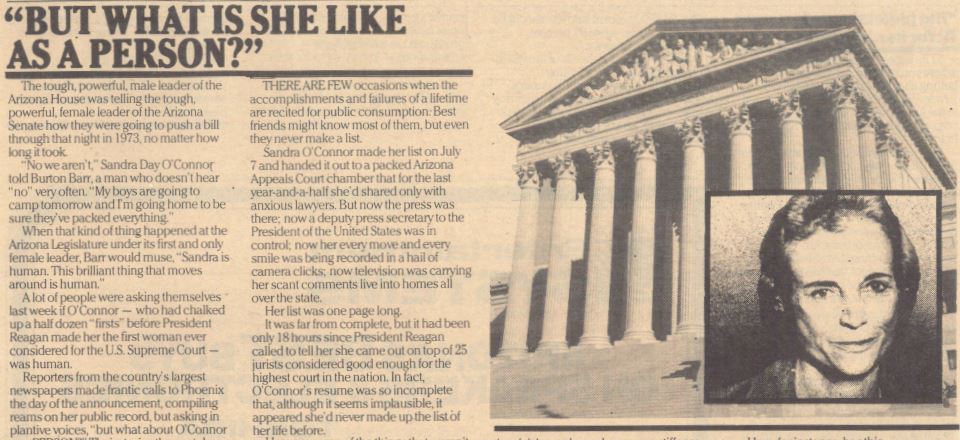
But what is she like as a person?

Newspaper article by Jana Bommersbach
July 15, 1981

The tough, powerful, male leader of the Arizona House was telling the tough, powerful, female leader of the Arizona Senate how they were going to push a bill through that night in 1973, no matter how long it took. “No we aren’t,” Sandra Day O’Connor told Burton Barr, a man who doesn’t hear “no” very often.” My boys are going to camp tomorrow and I’m going home to be sure they’ve packed everything.”

When that kind of thing happened at the Arizona Legislature under its first and only female leader, Barr would muse, “Sandra is human. This brilliant thing that moves around is human.”

A lot of people were asking themselves last week if O’Connor – who had chalked up a half dozen “firsts” before President Reagan made her the first woman ever considered for the U.S. Supreme Court – was human.

Reporters from the country’s largest newspapers made frantic calls to Phoenix the day of the announcement, compiling reams on her public record, but asking in plaintive voices, “but what about O’Connor as a PERSON?” Their stories the next day showed they didn’t find much.

It’s not because there’s nothing to find.

“Sandra O’Connor once told me that people have to focus on what they want in life and go after that,” an old friend said the night of her appointment.” If you spread yourself too thin, she says, you won’t accomplish much of anything. She believes if you focus, you can have what you want. I guess she’s right.” Many feel Sandra O’Connor, a privileged Arizona cowgirl who can still ride

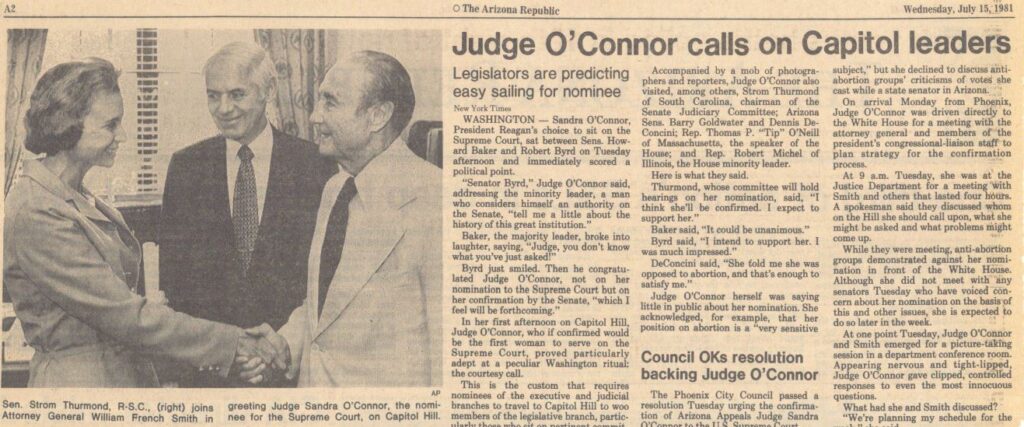
Judge O’Connor calls on Capitol leaders; O’Connor

Newspaper article by New York Times
July 15, 1981

Legislators are predicting easy sailing for nominee New York Tim es WASHINGTON – Sandra O’Connor, President Reagan’s choice to sit on the Supreme Court, sat between Sens. Howard Baker and Robert Byrd on Tuesday afternoon and immediately scored a political point. “Senator Byrd,” Judge O’Connor said, addressing the minority leader, a man who considers himself an authority on the Senate, “tell me a little about the history of this great institution.” Baker, the majority leader, broke into laughter, saying, “Judge, you don’t know what you’ve just asked!” Byrd just smiled. Then he congratu – lated Judge O’Connor, not on her nomination to the Supreme Court but on her confirmation by the Senate, “which I feel will be forthcoming.” . In her first afternoon on Capitol Hill, “‘ Judge O’Connor, who if confirmed would be the first woman to serve on the Supreme Court, proved particularly adept at a peculiar Washington ritual: the courtesy call. This is the custom that requires nominees of the executive and judicial branches to travel to Capitol Hill to woo members of the legislative branch, particularly those who sit on pertinent committees. It is a time for smiles and handshakes, not for substantive discussions.

“It’s going just fine, thank you,” said Judge O’Connor of the Arizona Court of Appeals as she breezed down a Capitol hallway, her heels clicking on the marble floor. On her right was William French Smith, the attorney general. On her left was Baker.

Accompanied by a mob of

Court nominee plans to confer with senators

Newspaper article by Associated Press
July 14, 1981

WASHING TON – Hoping to head off any serious opposition to her Supreme Court nomination from conservatives, the White House has arranged for Sandra D. O’Connor to meet with several key senators, including Sen. Jesse Helms, R-N.C. President Reagan’s choice to replace retiring Supreme Court Justice Potter Stewart was scheduled to arrive in Washington late Monday. Among others , the Arizona appeals court judge will meet with Sen. Strom Thurmond, R-S.C., chairman of the Senate Judiciary Committee; Senate Majority Leader Howard Baker of Tennessee; various members of the judiciary panel; Helms, a conservative Republican leader in the Senate, and Sen. John East, R-N.C., a leader among abortion opponents. Judge O’Connor planned to visit the Justice Department Tuesday for a meeting with Atty. Gen. William French Smith. Later, she was to be escorted by Arizona Sens. Barry Goldwater, a Re• publican, and Democrat Dennis DeConcini, a Democrat, to Capitol Hill, where talks were planned with Baker and Senate Minority Leader Robert Byrd. Sources said there was a tentative plan for Judge O’Connor to meet the steering committee, a group of about 20 conservative senators including Helms and Thurmond, to persuade the members that her views on abortion and other social issues are in line with their own. The fundamentalist Moral Majority and various anti-abortion organizations have expressed militant opposition to Judge O’Connor’s nomination because they believe she supports legalized abortions and

For O’Connor

Newspaper article by Associated Press
July 14, 1981

Judge O’Connor, officials meet at White House

Newspaper article by United Press International
July 14, 1981

WASHINGTON – Judge Sandra O’Connor went directly to the White House on Monday after arriving in Washington for a series of crucial meetings on her nomination to become the first woman on the Supreme Court. Judge O’Connor was met at Washington National Airport by Attorney General William French Smith and driven to the White House. A spokesman called the Monday gathering a “preliminary, get-to-know-you” session. It involved Smith and members of the president’s congressional liaison staff. She was to begin a round of meetings with Justice Department officials and key members of the Senate this morning and will meet with the president Wednesday. Judge O’Connor, a member of the Arizona Court of Appeals, has been attacked for her record on abortion and for support of the Equal Rights Amendment. But Sen. Barry Goldwater, R-Ariz. – her leading backer – issued a statement Monday that lauded the 51- year-old judge for having the “basic conservative philosophy” needed on the high court. Judge O’Connor told reporters at the airport that she hopes to end the controversy surrounding her selection. As she has in the past, the judge declined to discuss the substance I of questions raised about her nomination. White House spokesman Larry Speakes said that after the morning meeting today, Judge O’Connor will go to Capitol Hill to confer with her home-state senators – Goldwater and Democrat Dennis DeConcini. In his statement Monday, Goldwater said she is tough on criminals, a strong defender of

26 pro-life lawmakers support judge

Newspaper article by AP
July 14, 1981

PHOENIX (AP) – Sandra O’Connor, the first woman nominated to the U.S. Supreme Court, has the firm support of 26 Arizona legislators who have consistently voted for a constitutional convention in behall of a Right-to-Life amendment banning abortions. Several stand ready to go to Washington to testify for her. Rep. Pete Corpstein, R-Paradise Valley, said Monday that letters in her behall have been sent to U.S. Senate Judiciary Chairman J. Strom Thurmond, R-S.C.; Senate Majority Leader Howard Baker and Sens. Orrin Hatch, R-Utah, and Jesse Helms, R-N .C. “We’re doing this to lay to rest some of the unfounded rumors and innuendos about her stand on abortion,” Corpstein said. O’Connor has been attacked by national Right-to-Life and moral majority leaders for her voting record on abortion in the Arizona Senate, in which she served as majority leader in 1973-74. “I wish hall the people in the moral majority had hall the morality and christianity of O’Connor,” Corpstein said. Rep. Donna Carlson West, a Mesa Republican and leader of the anti-abortion and anti-Equal Rights Amendment movements in Arizona, also gave her unqualified support to O’Connor. “I’ve had a number of calls from around the country from people who claim she’s anti-religion, pro-gun control, proabortion and was keynote speaker at the International Women’s Conference,” said Carlson West. “None of that is true.”

O’Connor: More than just keeping a campaign promise

Editorial
July 14, 1981

A president’s overriding responsibility in selecting a nominee for the United States Supreme Court is to choose someone whose talent, temperament and experience most qualify for service on the nation’s highest court. Measured against this demanding criteria, President Reagan’s choice of Arizona Appeals Court Judge Sandra O’Connor can be called meritorious, perhaps even distinguished. That the judge is also a woman, the first nominated in the 191-year history of the United States Supreme Court, lends Mr. Reagan’s choice a historical significant that is as momentous as it is obvious. By all accounts, Judge O’Connor has compiled an excepti?nally fine record in a succession of iegal and iudicial posts: assistant state attorney general, superior court judge, and, most recently, a member of Arizona’s second highest court. Her written opinions, described by colleagues as lucid and brilliantly reasoned, reportedly reflect Mr. Reagan’s philosophical preference for judicial decisions that interpret the law rather than make it. Judge O’Connor’s academic background is every bit as solid as her subsequent achievements. In 1952, she graduated from Stanford law school along with William H. Rehnquist, now among the Supreme Court’s most respected justice. The one obvious gap in Judge O’Connor’s qualifications is her lack of experience at the federal court level. But this need hardly be a significant drawback for a nominee possessing so many other worthy attributes. In Judge O’Connor’s case,

O’Connor Courts Political Leaders

Newspaper article by Associated Press
July 14, 1981

Reagan has shattered his coalition with his Supreme Court nomination

Op ed by Patrick Buchanan
July 14, 1981

The comparison between Ronald Reagan, coalition builder, and FDR, made in this space many times, may be in need of review. . With its handling of the Sandra O’Connor affair, the White House bas given every indication it does not understand, or does not care, about nurturing the coalition Reagan put together over a dozen years, which put him in the White House. • UJl ‘ White House aides – not for attribution, of course – are using the identical mocking terms to describe the alienated conservatives that the press used about them until around Nov. 4, 1980. Have they forgotten why Ronald Reagan – not George Bush – was nomina~ and elected? As Barry Goldwater demonstrated in that impossible Republican year, 1964, the party nomination is worth , automatically, 40 percent of the national vote. The key to the White House is to fmd the formula for adding the crucial 10 percent – the decisive swing vote – without jeopardizing the Republican-conservative base . After some years of experimentation, Reagan mastered the formula, brilliantly, and astonished this politically purblind city with the magnitude of his triumph. They still don’t quite comprehend what happened. Stated simply, the formula was to weld to his new economic conservatism a touch of nationalism (Panama Canal) and social traditionalism which provides him with political reach into Democratic precincts of the South and the Northern cities, among folks who voted for John Kennedy and Lyndon Johnson and who have, historically, distrusted

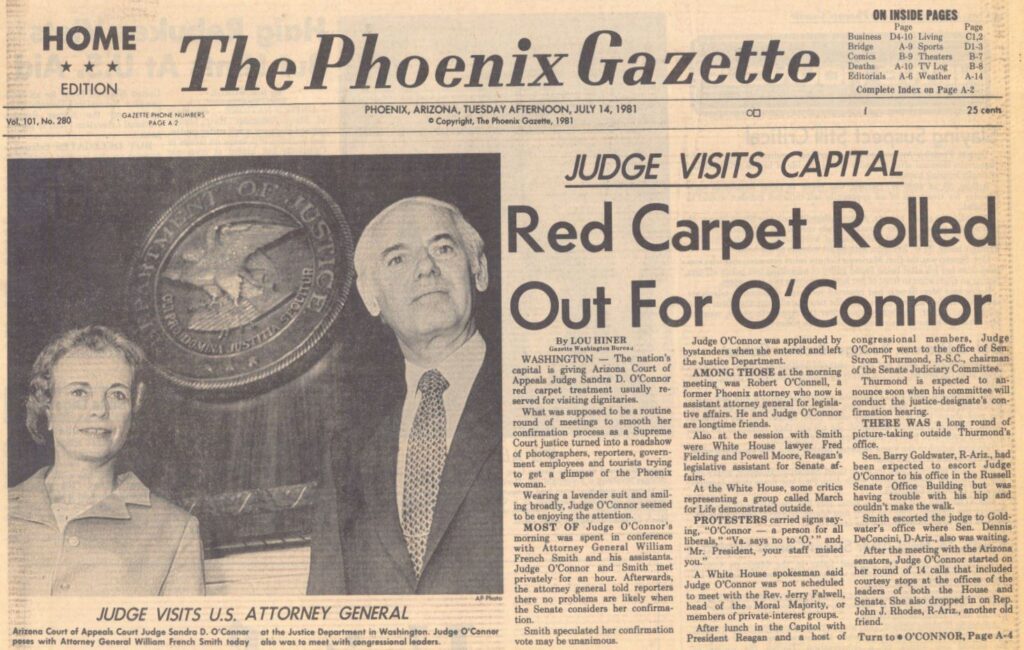
Judge Visits Capital: Red Carpet Rolled Out for O’Connor

Newspaper article by Lou Hiner
July 14, 1981

WASHING TON – The nation’s capital is giving Arizona Court of Appeals Judge Sandra D. O’Connor red carpet treatment usually reserved for visiting dignitaries. What was supposed to be a routine round of meetings to smooth her confirmation process as a Supreme Court justice turned into a roadshow of phot.ographers, reporters, government employees and tourists trying to get a glimpse of the Phoenix woman. Wearing a lavender suit and smiling broadly, Judge O’Connor seemed t.o be enjoying the attention. MOST OF Judge O’Connor’s morning was spent in conference with Attorney General William French Smith and his assistants. Judge O’Connor and Smith met privately for an hour. Afterwards, the att.omey general told reporters there no problems are likely when the Senate considers her confirmation. , Smith speculated her confirmation vote may be unanimous. Judge O’Connor waa applauded by bystanders when she entered and left the Justice Department. AMONG THOSE at the morning meeting was Robert O’Connell, a former Phoenix attorney who now is assistant attorney general for legislative affairs. He and Judge O’Connor are longtime friends. Also at the session with Smith were White House lawyer Fred Fielding and Powell Moore, Reagan’s legislative assistant for Senate affairs. At the White House, some critics representing a group called March for Life demonstrated outside. PROTESTERS carried signs saying, “O’Connor – a person for all liberals,” “Va. says no to ‘0,’” and, “Mr. President, your staff

He’s Done it Again

Op ed by Ellen Goodman
July 14, 1981

BOSTON- You might have called it an eye-opening week. First President Reagan. a man notoriously myopic toward women, actually found one to nominate for the Supreme Court. Sandra O’Connor was not only a woman, he said, she was a •µerson for all ~ea~ons.” Then we watched as controversy over this person brewed between the extreme right and the merely right. ‘l’o see Barry Goldwater representing the moderate middle was enough to clarify anyone’s vision. The coalition of groups alternately labeled “pro-family” or “moral majority” disapproves of Sandra O’Connor. They maintain that her voting record as majority leader in the Arizona Senate was not pure enough to pass the test of the Republican Party Platform. That platform, you may recall, demanded judges who “respect traditional family values and the sanctity of innocent human life.” But anti -abortion groups, t.he Moral Majority, fnc., and others criticized O’Connor as suspiciously pro-abortion and.pro-ERA. This attitude was enough to put Goldwater’s famous jaw out of joint. “I’m getting a little tired of people in this country raising hell because they don’t happen to subscribe to every thought that person has,” he said. “You could offer the Lord’s name for some of these positions and you’d find some of these outfits objecting … ” In any case, it was quite a stroke for Reagan, in the midst of all the budget cuts, to find an appointment criticized as too “liberal.” Meanwhile, O’Connor’s real record turned out to be about as middle-ofthe-

Rep. Skelly refuses to join fellow lawmakers in support for Sandra O’Connor

Newspaper article by Tom Fitzpatrick
July 14, 1981

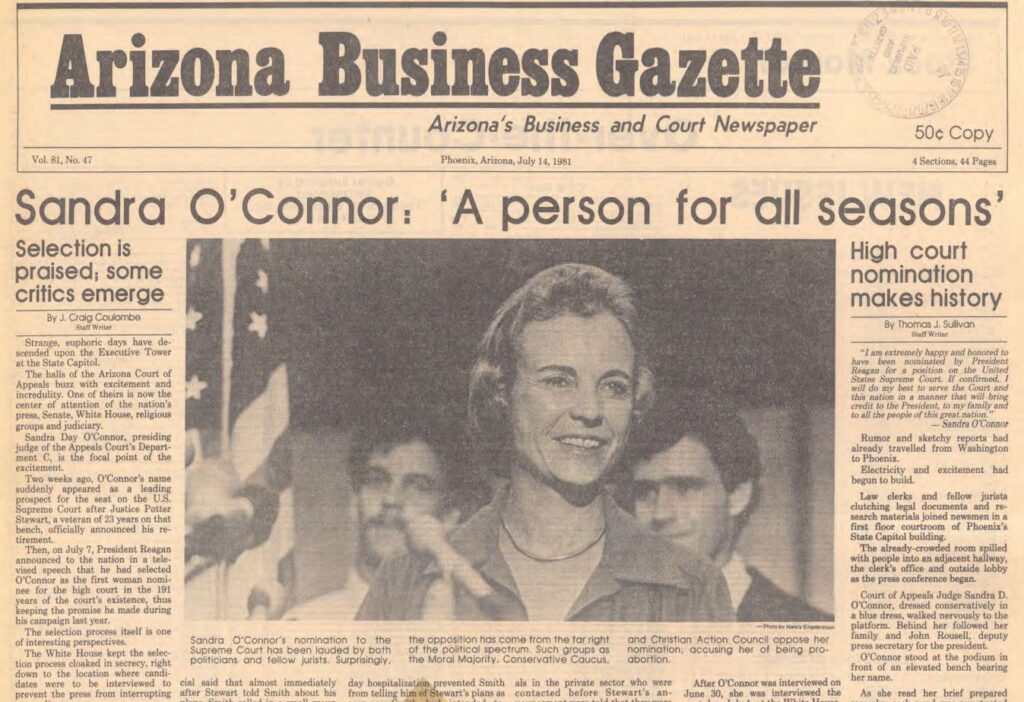
Sandra O’Connor: ‘A person for all seasons’. High court nomination makes history

Newspaper article by Thomas J. Sullivan
July 14, 1981

“I am extremely happy and honored to have been nominated by President Reagan for a position on the United States Supreme Court. If confirmed, I will do my best to serve the Court and this nation in a manner that will bring credit to the President, to my family and to all the people of this great nation.” -Sandra O’Connor Rumor and sketchy reports had already traveled from Washington to Phoenix. Electricity and excitement had begun to build. Law clerks _and fellow jurists clutching legal documents and research materials joined newsmen in a first floor courtroom of Phoenix’s State Capitol building. The already-crowded room spilled with people into an adjacent hallway, the clerk’s office and outside lobby as the press conference began. Court of Appeals Judge Sandra D. O’Connor, dressed conservatively in a blue dress, walked nervously to the platform . Behind her followed her family and John Rousell, deputy press secretary for the president. O’Connor stood at the podium in front of an elevated bench bearing her name. As she read her brief prepared remarks, each word was punctuated by the strobe flashes and staccato shutter release of news cameras. Her husband, Phoenix attorney John J. O’Connor III, and their three sons accompanied her to the brief July 7 morning news conference in the Court of Appeals courtroom. The judge, who was applauded warmly upon completion of her opening remarks, said she was greatly honored to be nominated to the Supreme Court, but “never thought it would

Pro-lifers’ endorse court pick

Newspaper article
July 14, 1981

Not only a person for all seasons but a person for all reasons

Op ed by Ellen Goodman, The Boston Globe
July 14, 1981

You might have called it an eyeopening week. First President Reagan, a man notoriously myopic toward women, actually found one to nominate for the Supreme Court . Sandra O’Connor was not only a woman, he said, she was a “person for all seasons.” Then we watched as controversy over this person brewed between the extreme right and the merely right. To see Barry Goldwater representing the moderate middle was enough to clarify anyone’s vision. The coalition of groups alternately labeled “pro-family” or “moral majority” disapproves of Sandra O’Connor. They maintain that her voting record as majority leader in the Arizona Senate was not pure enough to pass the test of the Republican Party Platform. That platform, you may recall, deiwmded judges who “respect traditio11al family values and the sanctity of innocent human life.” But antiH)lt . . ” …. abortion groups, the Moral Majority Inc., and others criticized Judge O’Connor as suspiciously pro-abortion and pro-ERA. This attitude was enough to put Goldwater’s famous jaw out of joint. “I’m getting a little tired of people in this country raising hell because they don’t happen to subscribe to every thought that person has,” he said. “You could offer the Lord’s name for some of these positions and you’d fmd some of these outfits objecting ,, In any case, it was quite a stroke for Reagan, in the midst of all the budget cuts, to find an appointment criticized as too “liberal.” Meanwhile, Judge O’Connor’s real record turned out to be about

O’Connor courts key officials to defuse opposition

Newspaper article by AP
July 14, 1981

WASlllNGTON (AP)-Sandra D. O’Connor, still silent on abortion and other substantive questions, is courting the nation’s political leaders In hopes of defusing any opposition to her Supreme Court nomination. ‘lbe 51-year-old Arizona appeals court judge, whose past stances on abortion and women’s rights have come under fire from conservative groups, was scheduled to meet with several key senators on Capitol Hill this afternoon, after a morning visit with Attorney General William French Smith at the Justice Department.

After their meeting, O’Connor and Smith spoke briefly to reporters. “We’re In planning my schedule for the week,” she said, adding, “It’s a great pleasure to have the opportwrity to meet with so many members of the Senate.” O’Connor was asked about the issue of abortion. She acknowledged that it was a “sensitive area,” but declined further comment. Smith said, “We don’t anticipate there should be any problem at all” with O’Connor’s confirmation. He said controversial issues, such as abortion, will be addressed “in due course.” After meeting reporters, Smith said, O’Connor was to be introduced to senior staff members of the Justice Department. Then, accompanied by the attorney general, she was to begin her courtesy calls on Capitol Hill. “I’ve tried to be candid and will continue to try to be so” in Senate Judiciary Committee hearings that now may be delayed until september, O’Connor said Monday at an airport news conference arranged by White Hous aides. “I

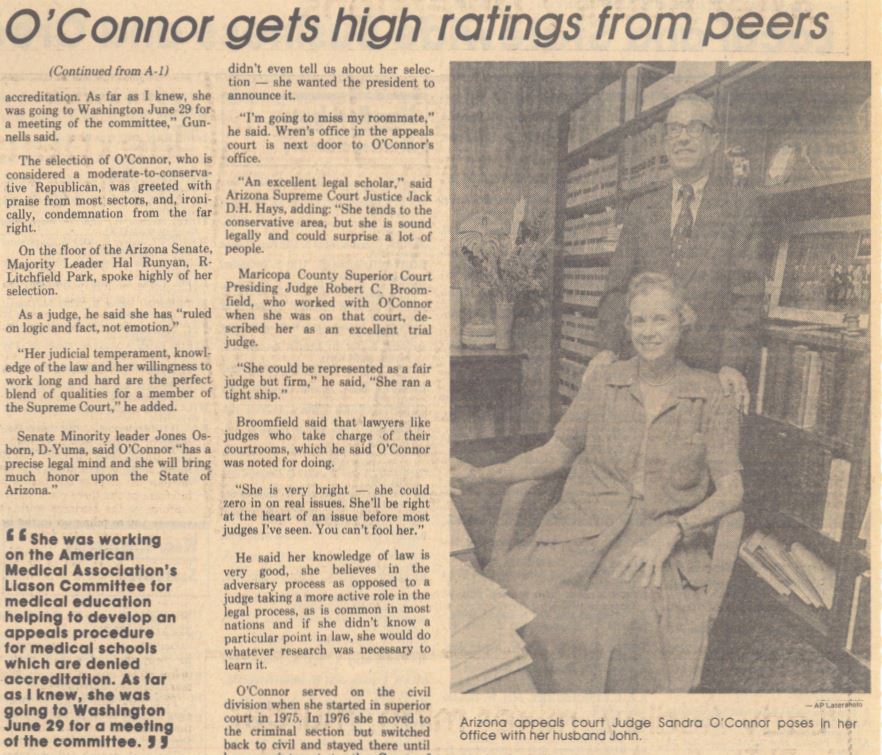
Selection is praised; some critics emerge. O’Connor gets high ratings from peers

Newspaper article by Craig Coulombe
July 14, 1981

Strange, euphoric days have de- ‘ scended upon the Executive Tower at the State Capitol. The halls of the Arizona Court of Appeals buzz with excitement and incredulity. One of theirs is now the center of attention of the nation’s press, Senate, White House, religious groups and judiciary. Sandra Day O’Connor, presiding judge of the Appeals Court’s Department C, is the focal point of the excitement . Two weeks ago, O’Connor’s name suddenly appeared as a leading prospect for the seat on the U.S. Supreme Court after Justice Potter Stewart, a veteran of 23 years on that bench, officially announced his retirement. Then, on July 7, President Reagan announced to the nation in a televised speech that he had selected O’Connor as the first woman nominee for the high court in the 191 years of the court’s existence, thus keeping the promise he made during his campaign last year. The selection process itself is one of interesting perspectives. The White House kept the selection process cloaked in secrecy, right down to the location where candidates were to be interviewed to prevent the press from interrupting proceedings. The Justice Department and administration officials began their search when Stewart informed the White House he was retiring in March, even though those officials were not aware that the vacancy was imminent. Stewart asked the White House not to announce his decision until mid-June. He made the announcement June 18. The secret location, still unrevealed, was used on the

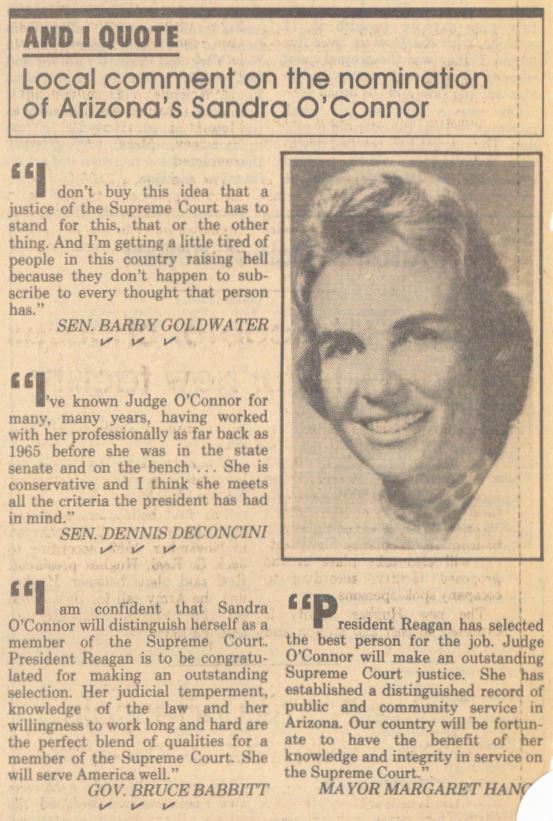
Local comment on the nomination of Arizona’s Sandra O’Connor

Newspaper article by Various
July 14, 1981

“I don’t buy this idea that a justice of the Supreme Court has to stand for this, that or the other thing. And I’m getting a little tired of people in this country raising hell because they don’t happen to subscribe to every thought that person has.” SEN BARRY GOLDWATER — “I’ve known Judge O’Connor for many, many years, having worked with her professionally as far back as 1965 before she was in the state senate and on the bench ‘ . . . She is conservative and I think she meets all the criteria the president has had in mind.” SEN DENNIS DECONCINI — “I am confident that Sandra O’Connor will distinguish herself as a member of the Supreme Court. President Reagan is to be congratulated for making an outstanding selection. Her judicial temperment, knowledge of the law and her willingness to work long and hard are the perfect blend of qualities for a member of the Supreme Court. She will serve America well.” GOV. BRUCE BABBITT — ”President Reagan has selected the best person for the job. Judge O’Connor will make an outstanding Supreme Court justice. She has established a distinguished record of public and community service in Arizona. Our country will be fortunate to have the benefit of her knowledge and integrity in service on the Supreme Court.” ‘ MAYOR MARGARET HANCE

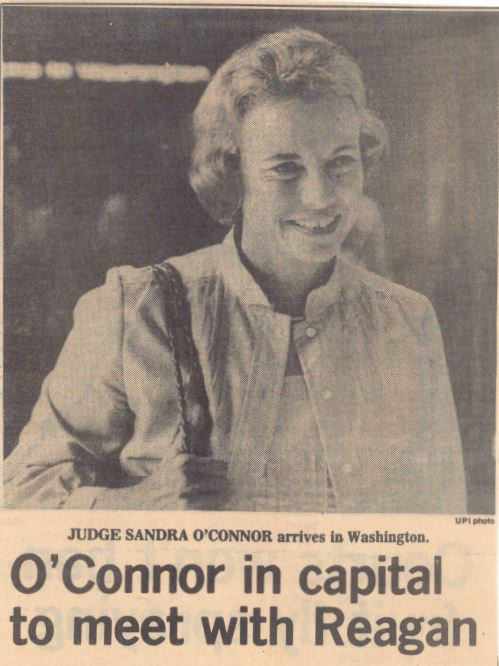
O’Connor in capital to meet with Reagan

Newspaper article by United Press International
July 14, 1981

WASHINGTON (UPI) – Judge Sandra O’Connor went directly to the White House Monday upon arriving in Washington for a series of crucial meetings on her nomination to become the first woman on the Supreme Court. O’Connor, President Reagan’s choice to fill the first high court vacancy in six years, was met at National Airport in late afternoon by Attorney General William French Smith and driven to the White House. A White House spokesman called the Monday gathering a “preliminary, get-to-know-you” session. It involved Smith and members of the president’s congressional liaison staff charged with shepherding her nomination through the Senate. Judge O’Connor was to begin a round of meetings with Justice Department officials and key members of the Senate this morning and meet with the president on Wednesday. O’Connor, a member of the Arizona Court of Appeals, has been attacked for her record on abortion and for supporting the Equal Rights Amendment. But Sen. Barry Goldwater – her leading backer – issued a statement Monday lauding the 51-year-old judge for having the “basic conservative philosophy” . needed on the high court. She told a brief airport news conference she hopes to lay to rest controversy generated by her selection during her visits with Senate leaders and members of the Senate Judiciary Committee, which will pass judgment on her nomination. “I am advised this is customary for a nominee to the court,” she said shortly after arriving from her home in Phoenix. O’Connor said

GOP O’Connor criticism rings false

Op ed by Kevin Phillips
July 13, 1981

WASHINGTON – The ruckus touched off between the Reagan White House and the new right by the U.S. Supreme Court nomination of Arizona Court of Appeals Judge Sandra Day O’Connor is a tempest in a teapot. Even so, it’s a sign of tensions that could play a key role in the politics of the early 1980s. There will be no great fight. Mrs. O’Connor embodies all of the Republican virtues – affluence, tennis, the presidency of the Junior League of Phoenix, a husband who belongs to the World Affairs Council of Phoenix and serves as president of the Phoenix-Scottsdale United Way. Judge O’Connor herself is also a former ma• jority leader of the Arizona Senate. Democrats have breathed a sigh of relief: The Reagan revolution does not extend to the Supreme Court. The new right is angry, though, predicating its anger on Mrs. O’Connor’s alleged softness on the abortion and Equal Rights Amendment issues. Tactically at least, they have a point. Although the New Right doesn’t have a prayer of defeating Mrs. O’Connor’s nomination, she is so clearly not one of them, so clearly an establishment Republican, that if they don’t skirmish on the nomination, they signal weakness – and they are too skilled a group of politicians to do that. So what they will do is “Mau-Mau” the issue: Yell a lot, make a lot of noise, shake their fists, brandish a few weapons, but not mount a knockdown fight. This Mau-Mauing should make clear to the administration that the new right feels aggrieved, and that new and additional

Where New Right and Old Right Diverge

Newspaper mention by Julia Malone
July 13, 1981

Goldwater’s blunt defense of O’Connor nomination draws line By JJllia Malone Staff correspondent of The Christian Science :lonitor Washington He has been called “Mr. Conservative.” “You may remember some of the things Barry Goldwater said in his [1964 presidential[ campaign honest, true, blunt things,” writes New Right strategist Richard A. Viguerie, who credited the Arizona Hepub lican senator with giving “vitality” to conservatism. But now Senator Goldwater is hurling some of that “blunt” language at Mr. Viguerie’s New Right for its outcry against Judge Sandra Day O’Connor. President Reagan’s choice for the US Supreme Court. “A lot of foolish claptrap has been written and spoken” about Judge O’Connor. said Goldwater last week on the Senate floor. (Earlier he had said other things, not printable in this newspaper, about Moral Majority ‘s opposition to Judge O’Connor. an Arizonan.) The flap over Mr. Reagan’s nominee, the first woman ever designated for the Supreme Court and an apparent moderate on women’s rights and abortion, has brought out the cracks in the conservative coalition . While conservatives unite on cutting government spending, they divide on the importance of the “social issues” like abortion. In fact, there are several strains of conservatives. according to Herb B. Berkowitz. spokesman for the Heritage Foundation, a think tank that tries to span all of the groups on the right of the political spectrum Goldwater and columnist William F. Buckley Jr. re present the

When the high court gets new ‘low man’

Op ed by Bob Greene
July 13, 1981

JUDGE SANDRA DAY O’Connor of Arizona has become the first woman to be nominated to the Supreme Court, and every indication is that she will be confirmed with a minimum of trouble. However, there is potential trouble waiting for her when she actually arrives in Washington to join the court as a justice. It has to do with a centuries-old tradition of the Supreme Court. It wouldn’t make any difference, if she weren’t a woman; but she is, and it is likely that the male justices are fretting over what to do about it. Specifically, it’s this: When the justices of the Supreme Court meet to deliberate, no one else is allowed in the room. No one: no secretaries, no assistants, no clerks. This is how it has been down through the years, and this is how the justices like it. Actually, in an age when every underassistant press secretary has a flock of aides, it’s kind of nice that the Supreme Court justices like to do things all by themselves,- BUT THIS is where the problem comes in. Since there are no secretaries or assistants, any menial tasks that come up during deliberations have to be done by one or another of the justices. And, traditionally, the junior member of the court has been assigned to be the “gofer”-the person who has to do the annoying dirty work. It’s part of the fraternity atmosphere of the court. When you’re the new boy you do the menial work, and then when another spot opens up, you get to have the menial work done for you. It’s always been that way. Except now we are

A Master Stroke’

Op ed by Morris Udall
July 13, 1981

“Arizona Judge Sandra O’Connor, Nominated for Supreme Court, Will Be First Woman Justice,” the headlines say, and my phone rings a little more these days. “Who is she, what is she like, and what does this mean for the court and for the political future of Ronald Reagan?” I’ll try to shed some light. I’m a lawyer and a fellow Arizonan, and while I’m not a close friend of the nominee, we are acquaintances. I know her through her reputation and her very successful career in public service and as a community leader. When people as politically diverse as Barry Goldwater, John Rhodes, Ted Kennedy and I can all support a Supreme Court nominee, it’s got to be remarkable. But she will be opposed. The New Right, the Moral Majority and Phyllis Schlafly will go after her with a vengeance that is their particular trademark. Nevertheless, I expect Mrs O’Connor will, and ought to be, confirmed. To understand some of what I have to say, you must understand some basic things about the Arizona Republican Party. A moderate Republican friend of mine told me in Tucson not long ago that the party had split into two camps: conservative and very conservative. “The very conservative believe nothing should be done for the first time,” he said, “and the conservatives believe that a few things should be done for the first time, but not now.” The point of this is that Sandra O’Connor is a conservative Arizona Republican, but she is a sensible conservative, and in her career in the Arizona Legislature she

O’Connor to meet senators

Newspaper mention
July 13, 1981

PHOENIX – Resonding to early warning signs of op- . position to her nomination to the U.S. Supreme Court, Sandra Day O’Connor headed for Washington, D.C., today and a meeting with such key senators as Jesse Helms, RN.C. Among others, the Arizona appeals court judge was to met with Sen. Strom Thurmond, R-8.C., chairman of the Senate Judiciary Committee; Senate Majority Leader Howard Baker and other Senate leaders; various members of the judiciary panel, and Helms, a leader of Republican conservatives in the Senate.

Meet the Press

Newspaper article by Ann Johnson
July 13, 1981

Media stalk the president’s pick for first lady of the brethren

The paparazzi have come to Phoenix and they’re sprawled both in and out of the waiting room at the Arizona Court of Appeals. ABC, CBS, Time, Newsweek. Correspondents and photographers representing all the news-gathering biggies lean against the huge battery packs they’ve lugged from who knows where to Judge Sandra D. O’Connor’s offices. She’s today’s lead news item, having just made world history books as. the first woman nominated by a United States president to adjudicate from the Supreme Court’s bench. Late arrivals to this news crowd stand in the foyer of the state Capitol looking for vacant spots to prop their heavy strobes and mega-mikes. There’s a member of the ABC team whose blue and white shirt reads “ABC San Salvador Bureau.” A UPI photographer, who flew in from LA the day before, asks him if the shirt is for real. “Yep,” he says rather smugly. A cleaning woman does her best to polish the large glass panes at the west entrance, where the reporters and photographers are camped. Oh, some of the cameramen obligingly move out of her way, but a few “excuse roe’s” later and she figures it’s all too much trouble. She’s off to the other side of the foyer, where her work will be more efficient – until the press goes away. There’s idle banter among the camera crews, whose members recognize one another from former assignments they’ve handled together. They talk .about the heat, where the closest Mexican food restaurant

Judge’s Record Impresses Goldwater

Newspaper article by Lou Hiner
July 13, 1981

Gazette Washington Bureau

WASHINGTON – A review of the 29 published opinions of Arizona Court of Appeals Judge Sandra O’Connor , Supreme Court justice-designate, attests to her “exceptionally high professional qualifications,” Sen. Barry M. Goldwater, R-Ariz., said. Goldwater last week told the Senate he and his staff have studied the opinions the judge prepared, and said: “It is quite clear from reading her decisions that she is unusually thorough, reasoned, detailed and logical in her decision making. She takes careful account of all sides of an issue and always makes a pains – taking analysis of the case.”

GOLDWATER said that in his opinion, Judge O’Connor is “a strict constructionist both of case law and statutory interpretation.” “Throughout all her opinions, Judge O’Connor is fair,” the statement continued.” In a high number of cases, she ruled with little people fighting against big institutions, such as cases involving small citizens defending themselves against large corporations or governmental agencies.”

Goldwater said that in the furor over President Reagan’s appointment of Judge O’Connor to the Supreme Court her legal abilities have been overlooked. For the record, he cited some of her opinions. “TO BEGIN, I will call attention to the case of Fernandez v. United Acceptance Corp. Here Judge O’Connor made a finding that a citizen’s freedom of privacy had been invaded by the undue harassment of a creditor in attempting to collect a debt,” Goldwater

You’ve come a long way, baby, to get Reagan’s nod for the highest U.S. bench

Editorial
July 12, 1981

: Reflecting the thinking of most 19th-century American voters – almost all of whom were male – the supreme Court ruled in 1873 that Illinois had a perfect right to deny a lawyer’s license to a woman. ”Civil law, as well as nature lierself, has always recognized a wide difference in the respective spheres and destinies of The man and woman,” Uafioft ~hree jus_ti?es held ff• m an opm1on that concurred with the majority decision by Justice Samuel Miller. “Man is, or should be, woman’s protector and defender,” the opinion said. “The natural and proper timidity and delicacy which belongs to the female sex evidently unfits it for many of the occupations of civil life. The constitution of the family organization, which is founded in divine ordinance as well as in the nature of things, indicates the domestic sphere as that which properly belongs to the domain and functions of womanhood.” Now, 108 years and scores of lawsuits later, Arizona Court of Appeals Judge Sandra O’Connor, 51, is in line to become the first woman among the 101 people to reach the high bench. In announcing that he would nominate Judge O’Connor, President Reagan fulfilled a campaign pledge to name the first woman to the high court, and he won admiring applause from rival politicians for a masterful political stroke as well as a strong judicial choice. Although senators on both sides of the political fence, such as Arizona Democrat Dennis DeConcini and Republican Barry Goldwater, reacted favorably, Judge O’Connor

O’Connor will do well, her colleagues say

Newspaper article by Richard Carelli
July 12, 1981

Phoenix, Ariz. Those who know her best are convinced sandra Day O’Connor is well suited to become a national symbol – the first woman on the U.S. Supreme Court. “None could have met that challenge better than she,” said Superior Judge Robert Broomfield, with whom O’Connor served as a trial judge for four years. Her colleagues and acquaintances use similar phrases in describing sandra Day O’Connor – the judge, lawyer, state legislator, civic activist, mother of three. Phrases like “stem but fair,” “dedicated perfectionist,” “highly organized” are some. Nominated by President Reagan last week as “a person for all seasons,” O’Connor would fill the vacancy created by Potter Stewart’s retirement. Senate confirmation of her unique place In the court’s 191-year history appears assured, despite opposition from antiabortion forces. But who Is this 51-year-old woman who was unknown on the national scene until two weeks ago? Ada Mae Day remembers her daughter sandra, the oldest of three children, as “an active child, very fast and willing to accept responsibility” on the family’s sprawling cattle ranch In southeast Arizona, hard by the New Mexico border. As a child, her mother recalls, Sandra liked both to read and to help the Lazy B’s ranch hands do some of their toughest chores . When she en tered her teens, Sandra returned to El Paso, Texas, her birthplace, to live with her maternal grandmother and attend the Radford School for girls, called a “f inishing school” back then . She

Newspapers around the country comment on O’Connor nomination

Op ed by Associated Press
July 12, 1981

“This precedent-setting appointment … marks another welcome advance for equal treatment of women under the law. A final judgment on Mrs. O’Connor’s qualifications must await the Senate confirmation process. But it can already be said that in acting t.o end the male-only monopoly on the Supreme Court, President Reagan has achieved a longneeded first for America.” Buffalo Evening News “President Reagan has shown great courage and a sense of balance . The president refused t.o be bullied by the nation’s far right and pro-life groups who fear that Judge O’Connor will not bend the law in their direction. The president has made a wise choice in Sandra O’Connor. She appears t.o be well qualified and it is long past time for a woman to take a seat on the Supreme Court.” Fort Lauderdale News . “Mrs. O’Connor’s political beliefs are probably more conservative than we would like; after all, she is a Republican . But indications are that she is nuly a ‘class’ person who can handle the challenge. Her being the first woman nominated t.o the Supreme Court . , . – is historic, but more important than her sex is that she be qualified for the job. At this time, she surely appears to be.” Atlanta Constitution “President Reagan’s choice … fulfills Mr. Reagan’s campaign pledge t.o put a woma.n on the nation’s highest tribunal. Americans will hope that the appoint – ment represents something more and there is reason t.o believe it does. Judge O’Connor commands legal and judicial credentials that

Caterwauling is damaging pro-lifers

Op ed by Nick Thimmesch, Los Angeles Times
July 12, 1981

The harsh criticism and rejection of Judge Sandra O’Connor as nominee t.o the Supreme Court by Rightt.o-Life leaders and the Moral Majority is pecksniffery at it.s worst. It is also unjust. Some of these Jacobins have become first-st.one throwers and are damaging the Right-to-Life movement. Peter Gemma, a leading Pro-Life politician, but not necessarily a prolife thinker, is absurd when he calls O’Connor “a hard-core pro-abortion proponent.” The Rev. Jerry Falwell, likewise, when he claims she “is opposed t.o attempt.s t.o curb the biological holocaust”. that has caused the death of 10 million babies since 1973. My pro-life reputation dates t.o 1973 when I wrote “The Abortion Culture” for Newsweek, so I take no back seat. I argued that the chore is t.o explain what a grisly matter abortion is, how it diminishes respect for human life, and can corrode a society. I always was against people crying “murder,” although I never opposed showing those telling, honest phot.os of the fetus. In the years since, the pro-life movement has grown and become strong. Inevitably, its leaders became obsessed with political power, highspeed computer mailings, “hit” list.s and a narrowness which could only please severe Calvinist.s, Madame Defarge or Menachem Begin. Like the cost-benefit-analysis martinet.s that they should scorn, some pro-life zealots pick over Judge. O’Connor’s “record” and condemn her. President Reagan says that he has discussed the abortion question with Judge O’Connor, and

An Honorable Choice

Op ed by Mary McGrory
July 12, 1981

Justice Rehnquist: Firm Ways, Witty Means

Op ed by Linda Greenhouse
July 12, 1981

Throughout the speculation that preceded President Reagan’s selection of Sandra Day O’Connor for the Supreme Court last week, the prediction most often heard was that, regardless of gender, Mr. Reagan was looking for “another Rehnquist.” Despite similarities in origins and education – both Judge O’Connor and Justice Rehnquist practiced law in Arizona and were classmates at Stanford law school – it is too early to tell if that is what the President has found. But there is little doubt as to what “another Rehnquist” means.
William H. Rehnquist is a symbol. People who have trouble naming all nine Supreme Court Justices quickly identify him as its doctrinaire, right-wing anchor, the very model of a Reagan appointment. In many respects, the image is not far off the mark. After nine and a half years, Justice Rehnquist is the Court’s most predictably conservative member, using his considerable intelligence, energy and verbal facility to shape the law to his vision of the proper relationship between the states and Washington, legislatures and judges, citizens and government. In one respect, however, the image is inaccurate. President Reagan said he wants Justices who “interpret” rather than “make” law. But as one of the Court’s creative users – some say abusers – of precedent, Justice Rehnquist has done more than his share of “law-making,” in the sense of leading the Court into new areas of doctrine.
Unlike Judge O’Connor, William Rehnquist was a known quantity at the moment President

O’Connor Asks Restrictions on Federal Civil Rights Suits

Newspaper article by Associated Press
July 12, 1981

WASHINGTON (AP) – Judge Sandra O’Connor, by President Reagan for a Supreme Court ,eat. bas suggested that Congress act to restrict the Dumber of federal civil rights suits against states and munidpallties. In an article in the summer 1981 issue of the William and Mary Law Review, O’Connor suggested that federal courts should defer to state courts in IOme cases on constitutional questions. She also noted “acute confrontations” between ltate and federal courts in some school busing cases and said tensions between the two judicial systems could increase in some areas. The 51-year-old Arizona appeals court judge wrote the article before Tuesday’s announcement of lier nomination to the Supreme Court, which must be confirmed by the senate. O’Connor’s nomination bas come under heavy attack from conservative and anti-abortion groups, for what they perceive to be ber stands on abortion and the proposed Equal Rights Amendment They argue that Reagan betrayed th em by lelecting O’Connor for the court. HOWEVER, her statements in the article re nect • conservattve theme shared by the president: the move to give states more freedom from the federal aovernment. “It is a step in the right direction to defer to the courts and give finality to their judgments on ral constitutional questions where a full and fair udication bas been given in the state court,” ‘Connor wrote in the article, titled “trends in the tionship Between the Federal and State Courts m the Perspective of a State Court Judge.”

Nominee for High Court: A Record Defying Labels

Newspaper article by Mr. Crewdson
July 12, 1981

Like supporters and detractors of her Supreme Court nomination, Sandra Day O’Connor devoted the better part of this week to a review of the state legislation and judicial decisions that constitute the record of much of her public life.

With her office at the Arizona Court of Appeals here overflowing with congratulatory bouquets, her desk cluttered with papers and files, and her law clerk, husband and friends helping with the review, Judge O’Connor looked up at a brief break yesterday morning to sigh, ”It’s a nightmare.”

”Fifty years is a long time,” she said, ”and it’s hard to remember everything you did.”

Differences of Temperament

The review is far from complete, but the woman, public and private, who has so far emerged from an examination of of those records, and from conversations with friends, colleagues and adversaries, is by political instinct, judicial philosophy, economic standing and personal temperament both similar to and different from the constituency that elected Ronald Reagan President.

Judge O’Connor emerges as a sometime conservative with a moderate, even progressive streak, a determined woman but not a dogmatic one. President Reagan described her as a ”person for all seasons,” but she appears to be something less than the advocate that other supporters, including many in the feminist movement, have made her out to be. At the same time she is clearly more complex than her detractors, including Moral Majority and the anti-abortion lobby, have suggested.

Jurist broke tradition for law career, too

Newspaper article by New York Times
July 12, 1981

New York Times

Judge O’Connor was born Sandra Day on March 26, 1930, in El Paso, Texas, but she spent her earliest years on her family’s 162,000-acre ranch, the Lazy B, which her grandfather founded a century ago near Duncan in southeastern Arizona.

Because there were no schools in Duncan that suited her parents, Harry and Ada Mae Day, as a young girl Judge O’Connor was sent to live with her maternal grandmother in El Paso and attend school there.

She did well, graduating from high school at age 16. She then entered Stanford University, with which she has maintained a lifelong affiliation, most recently as a trustee.

At a time when most women at Stanford were majoring in education, Judge O’Connor won a bachelor’s degree in economics, awarded with great distinction, and a law degree. She obtained both in six years.

Her sophomore roommate, Marilyn Brown, remembers her as a “very shy” young woman who spoke with the soft accents of western Texas but who seemed more than equal to university life.

Although Judge O’Connor’s biography lists her as an Episcopalian, a
friend said neither she nor her husband are active churchgoers.

What to Ask Judge O’Connor

Editorial
July 12, 1981

Some of the objections to Sandra O’Connor are about as relevant to her fitness for the Supreme Court as abortions are relevant to stadiums. The right-t~life movement seems to think that abortion is germane to everything, so it can’t understand why Judge O’Connor, when she was the majority leader of the Arizona State Senate, opposed an anti-abortion rider to a football stadium bill because it seemed non-germane. We’d be troubled if she had seen a connection. But zealotry is not the only basis for raising questions about nominees for the Supreme Court. Their long-run philosophical positions are generally wholly unpredictable. Yet a President’s most lasting legacy may reside in the mind and manner of the Justices he appoints. The Senate has a duty to explore both responsibly. At first glance, her record is appealing. But much more needs to be known about her and about the depth and nature of her conservatism. How Judge O’Connor handles herself under questioning also will tell much about the quality of the President’s choice. The art of getting confirmed is openness where possible – and circumspection when the _ questions get too close to prejudging issues that may come before the Court. • Some questions arise from the uniqueness of the nomination; Judge O’Connor follows 101 male justices. Others arise from the simple fact that so little is known of her outside Arizona, where she gained prominence as an assistant state attorney general, legislator, judge and civic leader. What does

Pragmatist: Judge O’Connor seems issue-oriented

Newspaper article by New York Times
July 12, 1981

New York Times

Like supporters and detractors of her Supreme Courtnomination, Sandra O’Connor devoted the better part of last week to a review of the state legislation and judicial decisions that constitute the record of much of her public life. I With her office at the Arizona Court of Appeals overflowing with congratulatory bouquets, her desk cluttered with papers and files, and her law clerk, husband and friends helping with the review, Judge O’Connor looked up during a brief break Friday morning to say with a s1 igh, “It’s a nightmare.” “Fifty years is a long time,” she said, “and it’s hard to remember everything you did.” In addition to being a state appellate judge, Sandra O’Connor was, in no particular order, president of the local Heard Museum, a board member of the local Salvation Anny, a director of the Phoenix chapter of the National Conference of Christians and Jews, a director of the local YMCA, a national vice president of the Soroptimist Club, a former trustee of Stanford University, a board member of the Arizona State University Law School and a lay member of the national accrediting body for medical schools. The review is far from complete, but the woman, public and private, who has so far emerged from an examination of those -records and from conversations with friends, colleagues and adversaries, is by political instinct, judicial philosophy, economic standing and personal temperament both similar to and different from the constituency that elected Ronald

Reagan scores hit with women but dismays ‘moral majority’

Newspaper article by Henry Brandon
July 12, 1981

Henry Brandon reports on the row over the first woman member of America’s Supreme Court ‘Controversy over Sandra O’Connor is about abortion’

WHEN Barr y Goldwater , who considers himself one of the most conservative members of the Senate , angrily explained last week : ” I think every good Christian ought to kick Falwell in the ass,” it was quite obvious that something had gone wrong in the kingdom of Republican conservatism. The Arizona senator was excoriating the leader of the extreme right-wing Moral Majority movement, Jerry Falwell because he had condemned President Reagan’s choice of Sandra Day O’Connor to fill a vacancy on the US supreme court . Mrs. O’Connor, a judge on the Arizona court of appeals, will become the first woman to serve on the court . Presidents like to make history and Reagan used this opportunity skilfully. He not only reassured the women’s movements that he is not the male chauvinist they think he is, but he also softened his image as a right-wing conservative by selecting a conservative with an open mind – as a friend of Mrs O’Connor described her-and not a doctrinaire ideologue.

It will not necessarily garner him a windfall of vote s among women , but as representative Morris Udall the liberal Democrat from Arizona , put ‘it : ” The fact that he appointed someone as moderate and as close to the centre of the Republican Party as she is, is really stunning. It erases stereotype opposition to Reagan .” It also created an unexpected opportunity for the

Votes by Women in G.O.P. attacked

Newspaper mention by Adam Clymer
July 12, 1981

Political Caucus Asked to End Its Support of Legislators Who Back Budget Cuts

By ADAM CLYMER

Special To The New York Times

ALBUQUERQUE, N.M., July 11 – Leading officials of the Democratic Party today challenged the National Women’s Political Caucus, one of the country’s two largest feminist political groups, to stop supporting Republican women in Congress who vote for the Reagan Administration’s budget cuts.

Polly Baca Barragan, a Colorado State Senator who is vice chairman of the Democratic National Committee, told Democrats in the caucus that they should push for a re-evaluation of the organization’s willingness to back such Republicans. ”Even the Congresswomen who were elected with feminist support,” she said, ”had to toe the party line and vote against the economic survival of the women of this country.”

In an interview, Kathy Wilson, a Republican from Alexandria, Va., who is slated to be elected the national chairman of the caucus tomorrow, said that Senator Baca Barragan’s approach would weaken both the caucus and the ability of Republican feminists to alter their party’s policy. ”I want my party back,” she declared.

Senator Baca Barragan’s demand brought into the open a critical tension within this influential group. Among feminist political organizations, the caucus’s 55,000 members place it second only to the National Organization for Women, which has 125,000 members, and its active Washington office and roster of experienced politicians in its membership

O’Connor adds new perspectives

Newspaper article by Elizabeth Olson, United Press International
July 12, 1981

Feminine view on family law, bias

WASHINGTON – The first woman on the Supreme Court probably won’t sway many cases. But she will bring new perspectives to legal questions – especially in the areas of family law and discrimination. If Sandra O’Connor is confirmed and takes her seat on the bench this fall, she will face touchy legal issues ranging from what states must prove in order to remove neglected children from parents to whether the government may bar colleges from discriminating on the basis of sex. The court – composed of male lawyers, five of whom are 72 or older – has been criticized as lacking experience, understanding and compassion when it comes to sex discrimination in employment and other areas of society. Women’s groups say recent court rulings – particularly excluding females from draft registration, and probably the draft – are particularly harmful to women. More importantly, these groups charge, some of the justifications for the court rulings reflect hopelessly outdated views of woman’s place in society. They cite the ruling that allowed California to punish only males for having sexual relations with minors of the opposite sex, which the court said was justified by the state’s need to protect unwed women from pregnancy . Judge O’Connor has shown sensitivity to women’s rights – perhaps because despite graduating third in her class from Stanford Law School, her only job offer was as a legal secretary. At 51, she also will be the youngest justice. But her rulings

Republican Women Assailed on Votes

Newspaper article by Adam Clymer
July 12, 1981

ALBUQUERQUE, N.M., July 11 – Leading officials of the Democratic Party today challefW!d the National Women’s Political Caucus, one of the country’s two largest feminist political groups, to stop supporting Republican COngressWomen who YOte for the R .. gan Administration’s budget cuts. Polly Baca Barragan, an Arizona State Senator who Is vice chairman of the Democratic National Committee, told Democ.rats In the caucus that they should push for a re-evaluation of the orgamzation’s willingness to back such Republicans. “Even the Congress.. women who were elected. with feminist support,” she91.ld, “bad to toe the party line and vote against the economic surYiftl of the women of this country.•’ In an interview, Kathy Wil9oll, a Republican from AJeundrta, Va., who Is slated to be elected the national chairman of the caucw. tomouow, 9atd that senator Baca Barnpn’s approach would weaken both the caucus and the ability of Republican feml.aists to alter their party’s policy. “I want my party back.” she declared. Senator Bec:a Banagan’s demand brought into the open a crttk:al temton within this influential group. Among feminist political cqanJzattons. the caucus’s 55,000 members place it second only to the Natione.l 0rpnizatkln for women, which has 125,000 members, and its acti-,e Wasblnglon office and ro&- ter of experienced polltlctam in its membership ha-,e made it important in the capital. Stralal Wltldn ea– For years the caucus bas bad a distinettve blpartilansbip, but that characteristi

Reagan has betrayed his most ardent allies

Op ed by Patrick Buchanan / Chicago Tribune, N.Y. News
July 12, 1981

That sound you hear, beneath the loud reveling at the president’s precedent-shattering nomination of a woman t.o the Supreme Court, is the cracking apart or Ronald Reagan’s Great Coalition. The White House boys have just made the most basic mistake you can make in politics: They have compromised the vital interests of the president’s most ardent followers, t.o score brownie points with their political enemies. A frivolous campaign promise has been kept, and a solemn written commitment violated. Political adultery. Eighteen months ago, in the Iowa caucuses, the Right-t.o-Life movement saved Ronald Reagan from a carefully prepared ambush by his now-vice president – a defeat which could have made Ronald Reagan a footnote in the hist.ory books. A month later, in New Hampshire, the Right to Lifers provided a significant share of that ast.onishing margin of vict.ory which gave candidate Reagan irresistible momentum through the early, conclusive primaries. In return, the movement asked Mr. Reagan for a surprisingly small return. Only that Reagan support their Human Life Amendment and its progeny; that his Supreme Court nominees – be they black, white, yellow, brown, red, male or female – share the president’s internalized belief that the unborn child has the God-given right t.o live. As politics goes, this was a simple, inexpensive bargain. The candidate would get the volunteer labors of thousands, the allegiance of millions, in return for remaining true t.o his stated convictions.

Other Views

Editorial by Boston Globe
July 12, 1981

RONALD REAGAN did what he had to do and named a woman to the Supreme Court. From all accounts , Sandra Day O’Connor is a conservative who is respected by conservatives and liberals alike as an able judge, a thoughtful legal scholar and a clear writer. Her political background – she was the first and only woman to serve as majority leader in the Arizona state senate – could be an asset in a job where nine individuals must come to a consensus on a regular basis. That she is a mother of three means that she will bring a perspective to the job that differs significantly from that of the men who have preceded her. That she is a woman may change the dynamic of the current court in subtle, possibly even dramatic, ways. Although Reagan denied he was naming a woman merely to do so, he had no other choice politically . His record on women’s issues is weak, so weak that even conservative Republican women have criticized him pub- licly in recent weeks for failing to name siJnificant numbers of women to positions tn the administration. The absence of a woman from the Supreme Court bas symbolically and sometimes effectively disenfranchised the women of this country for the past two centuries. In recent years the high court has been criticized, and rightly so, as an institution with limited un- derstanding of women and their roles in the family and society. O’Connor, who was offered a job as a legal secretary after graduating third in her class from Stanford Law School, bas bad firsthand experience

Jurist broke tradition for law career, too

Newspaper article by New York Times
July 12, 1981

Only Ultras Fight Mrs. O’Connor for the High Court

Editorial
July 12, 1981

“Honored and happy,” Sandra Day O’Connor was also silent and circumspect on questions of her judicial philosophy last week after President Reagan nominated her as an associate justice of the United States Supreme Court. The 51-year-old Arizona state judge would be the first woman on the Court. Her interpretation of the Constitution, Judge O’Connor said, must await the Senate confirmation hearings now likely in September. This discreet silence, coupled with ambiguity In some aspects of her legislative and judicial biography, allowed for enough different interpretations to prompt qualified support from feminist groups while touching off connect within the President’s own conservative camp. Despite the dustup, however, early predictions had her taking former Justice Potter Stewart’s seat on the Court by the October term. A conservative Justice was what President Reagan wanted, particularly one who would exercise restraint and deference to the legislative branch In making law and shaping social policy. ( Justice Rehnquist, the Court’s resident conservative, page22.) “She’s establishment Republican,” said a leading Democratic politician, adding, however, that she was not “of the knee-jerk mold.” An Arizona Assistant Attorney General from 1965 through 1968, Judge O’Connor joined the state Senate in 1969 and became the first woman to serve as majority leader. She compiled a record of mainstream, conservative Republicanism that helped her win election as a Superior Court judge In 1975

Reagan’s Shift to the Center Raises Clamor on the Right

Newspaper article by Howell Raines
July 12, 1981

FOR seasoned watchers of President Reagan, his mid-week speech in Chicago was a familiar scene gone slightly, and tellingly, awry. His trusty index cards had given way to a teleprompter. The crisp cadences of his off-the-cuff orations were replaced by long and harshly partisan sentences that visibly wearied both Mr. Reagan and his audience. Despite the last-minute effort by aides to correct a ”mistake” in the speech text, Mr. Reagan admitted that his appointment of Judge Sandra Day O’Connor to the United States Supreme Court culminated a ”search for a highly qualified woman.”

Thus, with a phrase, Mr. Reagan contradicted the official White House position that selection of the nation’s first female justice had nothing to do with her sex. Mr. Reagan’s slip was an uncustomary admission of political reality, and in regard to such realities, this was a jolting week for the White House team. They face a short, hot July full of threats to Mr. Reagan’s popularity, to his effort to tone down his reputation as an ideologue while holding on to his conservative base, and to the remarkable legislative gains made so far in his term.

The O’Connor appointment brought unaccustomed praise from liberals and women’s groups, but it sparked an open revolt among some New Right and conservative Christian leaders. The White House gambled Mr. Reagan’s prestige in a Mississippi Congressional race and lost. Meanwhile, despite Administration efforts to downplay the ”social issues” on which Mr.

No Single Issue

Editorial
July 12, 1981

SENATE confirmation of Judge Sandra O’Connor to the U.S. Supreme Court should not depend on whether, 10 years ago, she voted for or against a facet of the abortion issue. She was not acting in a judicial capacity back then, nor is the record clear as to whether one vote was triggered by opposition to a rider or by opposition to the main bill. In any event, Judge O’Connor reportedly told President Reagan that “she is personally opposed to abortion” and that it was especially abhorrent to her. What is important, in deciding whether the O’Connor nomination should be confirmed, is whether her Supreme Court decisions would be based on law. Judging from the record, they will be. Even the most extreme of the anti-abortion groups admits that Judge O’Connor is a strict constitutionalist who acts in accordance with the law and who believes, perhaps owing to her own legislative experience , that the Supreme Court’s job is to interpret the law, not to make it. .Justices quite obviously need a wide and varied background, which is an excellent reason for not using a single issue to decide a person’s qualifications. The pro-life people, best exemplified by Rev. Jerry Falwell and his Moral Majority, have a tendency to focus on the single issue of abortion. It was this tendency that led Sen. Barry Goldwater, who said he had “supported right-to-life groups all the way down the line,” to tell a reporter that “every good Christian ought to kick Jerry Falwell right in the ass.” Such heated hyperbole

National

Newspaper mention
July 12, 1981

Sandra O’Connor’s record shows a mix of political sfaiids during the Biz years she spent as a member of the Arizona state senate, three of them as Republican majority leader. The records of the Arizona legislature disclose several occasions in which Mrs. O’Connor, President Reagan’s nominee to the Supreme Court, voted in favor of making aborticm more _!ftdely available. The Reagan Adminlstraticn moved swiftly to minimize the eJltellt of her support for abortion.

Judge O’Connor Viewed as Tough, Fair, Flexible

Newspaper article by Gaylord Shaw/Bob Secter
July 12, 1981

PHOENIX-Judge Sandra Day O’Connor smiled as a gaggle of repo rier s and photographers swarmed into her book-lined chambers at the Arizona Court of Appeals. It was a photo session arranged by a White House aide the day after President Reagan announced her selection as the first woman justice of the Supreme Court. The journalists were told in advance that she would answer no questions, but the questions came anyway. Was that jar of jellybeans on her desk a gift from the jellybean-loving President? No, she said with a smile, it came from “a close friend.” What about the complaints of ultraconservative groups about her record on abortion? She declined to answer and, although she still was smiling, her expression seemed to stiffen. The 51-year-oldjudge had gotten a brief taste of the sometimes painful process that traditionally follows the nomination of a Supreme Court Justice. Already, her views on legal and social issues, her judicial and legislative background, her personal life and personal finances are being subjected to intense scrutiny-by the FBI, the American Bar Assn., journalists and special-interest groups. It is a process that will continue through Senate confirmation hearings later this summer, but a tentative portrait of O’Connor can be drawn after several days of inquiries in this sunbaked desert metropolis . Those inquiries found that O’Connor is: -A jurist who in the last six years on the. state bench has handed out harsh sentences but l!_as also protected criminal

Hill Courtesy Calls Planned By O’Connor, Bid Meant to Defuse Opposition on Right

Newspaper article by Allan Dodds Frank and Jeremiah O'Leary
July 11, 1981

O’Connor Sets Visit to Senate Panelists

In an outing expected to help de• fuse pockets of opposition to her nomination to the Supreme Court, Arizona Court of Appeals Judge San• dra D. O’Connor will pay informal courtesy calls to President Reagan and Senate Judiciary Commitee members next week, administration spokesmen said yesterday. After Reagan nominated O’Connor , 51, on Tuesday to replace Justice Potter Stewart , the nomination has been generally well re ceived but has come under attack from some con- servative groups and abortion opponents. White House spokesman David Gergen said yesterday that O’Connor was asked by the White House office of legislative affairs to visit infor• mally with the senators after seemg Reagan on Monday. Both Gergen and Justid Depart• ment spokesman Thomas DeCair said they . expect O’Connor will be asked some substantive questions by senators about her record as a judge and as former majority leader of the Arizona State Senate. but that they do not expect any full-fledged inter – rogations of her before her confir• mation hearings. Senate Majority Howard Baker said he expects O’Connor to be “easily” confirmed despite the . vocal _opposition from the ant1-abortton groups and a “new right” coalition of 21 groups. Baker said he knows of no senators opposed to her nomma• hon . An Associated Press poll of 98 senators produced 33 already commit ted to supporting O’Connor, 20 ,leading toward sup_porting her and 45 undecided. An mformal poll of the Judiciary

About Washington: An Occupation of Civil Life

Newspaper mention by Francis X. Clines
July 11, 1981

WASHINGTON, July 10 – There was great change in the nation in 1873, when the men of the Supreme Court sat together and ruled on Bradwell v. Illinois. It was an era when the slaves had been freed, the frontier was retreating and women were fighting for the constitutional right to practice law, tinally reaching the highest court with their case. “God designed the sexes to occupy different spheres of action.” the ma- jority ruled. “It belongs to men to make, apply and execute the law.” Thus did Myra Bradwell suffer defeat and the State of Illinois enjoy vic- tory in its law banning women lawyers. If Myra Bradwell sought comfort in a separate opinion, she found none in the concurrence of Mr. Justice Bradley, who felt the majority’s language too weak. “Man is, or should be, woman’s p~ tector,” he said, finding that the “deli,, cacy which belongs to the fair sex evidently unfits it for many of the occupations of civil life.” “This is the law of the Creator,” declared the man. Time has passed by Mr. Justice Bradley. But he is not forgotten by the successors of Myra Bradwell, particularly as they prepare for the coming Senate inquiry into the nomination of Judge Sandra Day O’Connor as the first woman member of tfie Supreme Court. In the hours after Judge O’Connor’s nomination, this city’s phenomenal predilection for reducing eftnts to quick-fix, white-hot iSsues threatened to make her a mere adjunct to the endless abortion dispute, as more than a dozen anti-abortion lobbying groups found

Judge O’Connor plans to travel to Washington to meet key senators

Newspaper article by Marilyn Taylor
July 11, 1981

Rep. West Claims Judge O’Connor’s Legislative Votes are Misinterpreted

Newspaper article by John Kolbe
July 11, 1981

Rep. Donna Carlson West, RMesa, a leader of Arizona’s pro-life and anti-ERA forces, has mounted a strong defense of Judge Sandra O’Connor against the attacks of right-wing groups. In a letter Friday to Senate Majority Leader Howard Baker, RTenn., the five- term lawmaker said she was “deeply distressed” at the anti-abortion and anti- ERA opposition to Mrs. O’Connor’s Supreme Court nomination, and insisted there was nothing on her record “that warrants the many unfounded, untrue charges that are being raised .” Mrs. West explained several of the votes cast by Mrs. O’Connor as a state senator from 1970-74 were being misinterpreted by her rightist foes. SHE ‘l’O~D the Phoen-ix GÂ¥ette ……… — her conclusions were based on a recent conversation with Judge O’Connor, in which she sought to clear up the jurist’s positions on several issues. While the judge backed a resolution aimed at ratifying the Equal Rights Amendment, she conceded, so did two other conservative Republicans – Trudy Camping and Bess Stinson, both of Phoenix – who later became ardent foes. “Since 1975, Sandra has been on the bench and has not spoken out for or against the ERA,” Mrs. West wrote Baker. Judge O’Connor’s legislative opposition to various anti-abortion proposals was often for other reasons, Mrs. West added. She voted against one measure to ban abortions at Tucson’s Univer!ity Hospital be- • cause it was not germane to the original bill, a..1d opposed a pro-life memorial to Congress because of her “general

Conservative Arizona lawmaker backs Judge O’Connor

Newspaper mention
July 11, 1981

Rep. Donna Carlson West, R-Mesa, an ardent opponent of the Equal Rights Amendment and a pro-life advocate, threw her support Friday behind Judge Sandra O’Connor, a U.S. Supreme Court nominee. In a letter to Senate Majority Leader Howard Baker, R-Tenn., Rep . Carlson W~t laid she was deeply distressed by opposition to the Arizona Court of Appeals judge’s historic nomination. “I have known Sandra for many years, as a member of the Legislature and member of the judiciary,” Mrs: Carlson West said, “and I am convinced that there is nothing in her record in either capacity that warrants the many unfounded, untrue charges that are being raised in opposition to her nomination as the first woman justice of the Supreme Court.” She conceded that Mrs. O’Connor and two other conservative women legislators had introduced a resolution to ratify the ERA in Arizona. But many legislators and states have changed their minds on ERA since Congress passed it in 1972, Rep. Carlson West said. On the abortion issue, Judge O’Connor cast couple of votes as a legislator with which R Carlson West said she disagreed, “but I do kno that she is personally opposed to abortion.” Rep. Carlson West, immediate past chairman of the American Legislative Exchange Council. national organization of conservative legislator labeled as “untrue” allegations that Judge O’Connor is “pro-gun control, anti-religion and anti-capital punishment.”

O’Connor OK Likely, poll shows

Newspaper article by Republic Wire Services
July 11, 1981

public Wire Services WASHING TON – Barring major negative disclosures in the background of Sandra O’Connor, the Arizona judge appears headed for easy Senate confirmation as the first female Supreme Court justice, according to an Associated Press survey. Four days after her nomination was announced by President Reagan, 33 senators are committed to voting for Judge O’Connor, and an additional 20 are leaning toward supporting her when the nomination is considered, probably in September. Arizona’s senators, Republican Barry Goldwater and Democrat Dennis DeConcini, both support the nomination. The survey found no votes opposing her nomination. Forty-seven senators indicated that are undecided, saying they do not know enough about Judge O’Connor’s legal experience or constitutional views from initial reports about her career as a judge and state legislator. A majority vote of the 100-memher Senate is required for confirmation. Meanwhile, a White House spokesman said Friday that Reagan is aware of conservative opposition to Judge O’Connor and is “fully satisfied” with her views and record. In the face of rising opposition from abortion opponents to the appointment, David Gergen, White House communications director, said Reagan “had reassured himself again” of her views in a fmal telephone conversation before he offered her the post. Reagan interviewed Judge O’Connor in the Oval Office on July 1 and offered her the judicial post of retiring Justice Potter Stewart in a July 6 telephone

Humbug?

Editorial by Murray J. Gart
July 11, 1981

When Mount Goldwater erupts, the fallout of hot ash ( and hot air) is usually spectacular. It is also, in a way, refreshing . The senior senator from Arizona, once the doyen of the American conserva,tive movenment , is a great fan of Mrs. Sandra D. O’Connor, President Reagan’s Supreme <:ourt nominee. As such he is outraged by the clamor of antiabortionist fundamentalists against her. So Senator Goldwater tells us not only that the Rev. Jerry Falwell of Moral Majority, the leader of that clamor, should be "kicked in the ass" by all right-thinking Christians (a not uninviting idea), but that abortion is a "humbug issue" distracting Congress from more manageable matters. The senator isn't likely to have many takers on the latter proposition, although there is some practical sense in what he says. The abortion issue is legislatively intractable, and the grating moralism of the "social conservative" right and its drive to theocratize politics are both tiresome and threatening. But one reason they seem threatening , as the distinguished novelist Walker Percy has observed, is that in their outrage over pro• miscuous abortion the Falwells and tfleir allies prick the bad conscience of American society. When abortions begin to balance live births in certain jurisdictions, the state of the law needs re-examination. It does not need and, in our view will not profit from, the superficial re-examination envisaged in the so-called "human life" bill reported this week by the Hatch subcommittee

Of Judge O’Connor and Her Enemies

Op ed by William F. Buckley Jr.
July 11, 1981

Concerning Mr. Reagan’s choice for the Supreme Court, a few obser• vations : 1) To favor Mrs. O’Connor’s con• firmation is not the same as saying that there wasn’t a better qualified jurist around. But that much can said at almost any moment any president is called on to make a selection. Clearly Mr. Reagan’s thought was dominated by his anxiety to name a woman. While skeptical of the proposition that the Supreme Court should be sexually (or racially) representative, in fact the presence of a woman in the court serves two purposes. The first is to demonstrate that Mr. Reagan’s political promises are not mere campaign oratory. These~- ond is to demonstrate that a president who opposes the Equal Rig~ts Amendment is not for that reason insensitive to the desire of women to demonstrate that there are no political boundaries to their ascendancy. The Abortion Question 2) On the question of whether Mrs. O’Connor is for or against abortion, we are told by the president that she opposes abortion. Presumably_ he had this confidence from her, smce Mrs. O’Connor has hardly been volu• ble on the subject, one way or an• other. Her opponents point especially to her blocking, in 1973 in the Arizona legislature, a resolution that _was proposed as an appendag~ to a p1~ce of legislation, a resolution callmg for a constitutional amendment to prohibit abortion. But Mrs. O’Connor pointed out that her opposition was procedural. Because under Arizona 1aw, nongermane resolutions are forbidden. She was

O’Connor Class Rank Not All that Certain

Newspaper mention by United Press International
July 11, 1981

STANFORD, Calif. (UPI) – Stanford University officials said yester• day -that Sandra D. O’Connor , Presi• dent Reagan ‘s .choice for the Supreme Court, may not have been No. 3 in her law school class after all. When the name of the Arizona judge was first mentioned for the post last week, it was reported she ranked third in the Stanford Law School class of 19S2, the year Justice William Rehnquist ranked first. The school issued a press release dated July 7 that reiterated this information – “a clear error in editorial judgment on our part” because the information was not checked, Stanford News Service Director Robert Beyers said yesterday. Law School Dean Charles Meyers said he has “no notion” of the indi vidual rankings and that O’Connor told him she “never knew what her class standing was.” Beyers said all that is certain is that O’Connor was one of 10 from that class elected to the Order of Coif, which comprises the top 10 per• cent of the class . He said at least three people have claimed to have finished second in that class , and that Rehnquist does not claim first place listing in the bi ography he filed with the Supreme Court.

Lobbyist against gun control praises choice for high court

Newspaper mention by United Press International
July 11, 1981

WASHINGTON – A lobbyist Friday commended Arizona Court of Appeals Judge Sandra O’Connor, President Reagan’s choice for the Supreme Court, for what he said was an anti-gun-control record. Judge O’Connor is strongly opposed by the Moral Majority and anti-abortion groups. They believe her record favors abortion rights and the Equal Rights Amendment. But John M. Snyder, chief lobbyist for the Citizens Committee for the Right to Keep and Bear Arms, said Judge O’Connor “so far looks pretty good.” “As a state senator,” Snyder said, “she signed a resolution opposing more federal gun control, and she also voted for a measure to make it easier for Arizona residents to obtain concealed-weapons permits. “This could be very important because there may be a case involving the Morton Grove, Ill., ban on handgun possession coming before the court within the next couple of years,” he said. Snyder refened to a Morton Grove City Council vote June 8 to make handgun possession and sales a misdemeanor punishable by a $500 fine and six months in jail.

Reagan nominates O’Connor to Supreme Court

Newspaper article
July 11, 1981

President Reagan this week named Arizona Appeals Court Judge Sandra D. O’Connor to become the first woman justice in the 191 years of the Supreme Court. O’Connor, 51, a Paradise Valley resident, would fill the vacancy created by Justice Potter Stewart’s retirement. The nomination was saluted by the National Organization of Women and the National Women’s Political Caucus. But opposition brewed among the far right. Some conservatives object to her support, as a state senator several years ago, for a measure legalizing abortion, and for another which would have submitted the Equal Rights Amendment to Arizona’s voters. Reagan said he was completely satisfied with Judge O’Connor’s record on right to life issues. Deputy White House press secretary Larry Speakes said she had told the president “she is personally opposed to abortion and that it was especially abhorent to her. She also feels the subject of the regulation of abortion is a legitimate subject for the legislative area.” Senate Majority Leader Howard Baker, RTenn., joined with Sen. Barry M. Goldwater, RAriz., in defending O’Connor’s abortion record. Baker said she had never supported the concept of abortion on demand, and predicted the conservative attacks would not stand in the way of her confirmation. Goldwater, in a Senate speech, labeled the conservative criticism “a lot of foolish claptrap” from “people who do not know what they are talking about.”

Nominee’s article suggests restricting civil-rights suits

Newspaper article by Associated Press
July 11, 1981

Associated Press WASHINGTON Sandra O’Connor, chosen by President Reagan for a Supreme Court seat, is suggesting that Congress act to restrict the number of federal civilrights suits against states and municipalities. In an article in the Summer 1981 issue of the William and Mary Law Review, Judge O’Connor suggested that federal courts should defer to state courts in some cases on COD&titutional questions. She also noted “acute confron- , tions” between state and federal courts in some school-busing cases and said tensions between the two judicial systems could increase in some areas. The judge wrote the article before the announcement of her nomination. Judge O’Connor’s statements in the article reflect a conservative theme shared by the president: the move to give states more freedom from the federal government. “It is a step in the right direction .to defer to the state courts and give finality to their judgments on federal constitutional questions where a full and fair adjudication has been given in the state court,” Judge O’Connor wrote in the article, titled “Trends in the Relationship Between the Federal and State Courts from the Perspective of a State Court Judge.” She said thousands of lawsuits against state and municipal officials are being filed in federal court under an 1871 federal civil-rights law. “In view of the great caseload increase in the federal courts and the expressed desire of the Reagan administration to hold down the federal budget, one would think

Classmates Recall Nominee’s Husband

Newspaper mention by Michael Grieg
July 10, 1981

Genesis II, the alumni quarterly issued by St. Ignatius College Preparatory School in San Fran<'isco, recently published a photograph of a self-assured 17-year-old with two classmates and asked if anyone could identify them. John Jay O'Connor III, Class of 47 and husband of the first woman nominated for the U.S. Supreme Court , knew at once. He was that 17-year-old. His classmates were Jim Fitzpatrick and Joe Boyd, and they were all members of the school's debating society at the time , the 51-year-old attorney wrote from his hume m Phoenix . Other classmates included the late Mayor George Moscone and attorney Charles Clifford, former president of the California Bar Association. "l have many wonderful memories of St. Ignatius and will always be deeply indebted to the faculty there for the superb educational experience they provided," O'Connor said in his letter. Word that O'Connor's wife, Sandra Day O'Connor, had been nominated by President Reagan for the nation's highest judicial office is also stirring memories of him among friends and classmates here of more than 30 years ago. O'Connor. who dated his future wife when they were students at Stanford and served as fellow editors of the Stanford Law Review. is a member of a distinguished San Francisco family. He was born in San Francisco on January 10, 1930. O'Connor's late father, Dr. John Jay O'Connor, was a member of the St. Francis Hospital board of trustees and previously a resident physician at the hospital before going

… With no Apologies to Aristophanes

Op ed by Carl T. Rowan
July 10, 1981

Aristophanes’ ashes must have erupted like Mt. St. Helens when President Reagan named a woman to the U.S. Supreme Court. Some 411 years before Christ, Aristophanes was writing in “Lysistrata” that, “There is no animal more invincible than a woman, nor fire either, nor any wildcat so ruthless.” Images arise of Sandra Day O’Connor clawing at the eyes of Chief Justice Burger as he tries to impose some argum ent upon the rest of the Court. And Shakespeare’s bones must have beaten each other like castanets , muffling out even the strident protests of the Rev. Jerry Falwell. It was Shakespeare, after all, who wrote: “Frailty, thy name is woman!” Can’t you just see tears cascading down Mrs. O’Connor’s black robe as frailty prevents her from dealing with some absurd opinion by her old Stanford classmate, Justice William Rehnquist? Reagan Praised Whether he chose Mrs. O’Connor to keep a campaign promise, or because he has been catching unmitigated hell from Republican women who say he hasn’t given enough decent jobs to females, President Reagan deserves high praise for naming Mrs. O’Connor to the nation’s highest tribunal. After 191 years of wallowing in the inanities of Aristophanes and Shakespeare, and assorted chauvinisms in between, it is good to see Mr. Reagan respond to the principle that America’s commitment to justice is deepened when women sit on the Court. We go back and forth from the trifling to the vulgar in our assertions that women are “different” from men. It is time that

From Myra Bradwell to Sandra Day O’Connor…

Op ed by James J. Kilpatrick
July 10, 1981

It was just the other day that I was invoking the 19th-century shade of Myra Bradwell, but with the nomination of Sandra Day O’Connor to the Supreme Court, the old story takes on an especially poignant meaning . From Mrs. Bradwell to Mrs. O’Connor, it’s been a long, uphill climb for ladies in the law. Myra Bradwell, may she rest in peace, was a native of Vermont who moved to Chicago sometime in the mid-1850s. Not long after ratification of the FourteEjnth Amendment in 1868, she did a most audacious, unfeminine thing: She applied for a license to practice law. Curiously, she did not rely upon the equal protection clause but rather upon the privileges and immunities clause, but in any event the Supreme Court of Illinois summarily turned her down. No women were to be allowed in court. Mrs. Bradwell appealed. In April 1873, the U.S. Supreme Court also gave her the brush-off. !t “‘.as wi~hi~ the police powers of Ilhn01s to hm1t membership in the bar to males only. Only Chief Justice Salmon P. Chase dissented, and he didn’t say why. Justice Joseph P. Bradley was so shocked by the whole astonishing idea that he wrote a flaming concurring opinion in which two other justices joined. History, nature, the common law, and “the usages of Westminster Hall from time immemorial” argued against the proposition. Bradley felt impelled to expand upon the wide difference in the spheres and destinies of man and woman. “Man is, or should be, woman’s protector and defender. The natural and proper timidity

Judge her by her enemies

Op ed by Charlie Waters
July 10, 1981

I have to admit when Sandra O’Connor first was mentioned as a possible U.S. Supreme Court Justice nominee, I was a bit skeptical. I had hoped President Reagan would nominate a qualified woman – and there are many – for the position. but I was concerned with Judge O’Connor’s limited ( 18 months> appellate court experience. Several factors have changed my concern to total acceptance. The first was learning more about her background and reputation. Second was the class she has shown before and since her nomination. Third was the praise heaped upon her by Arizona Appeals Court Judge Jack Ogg of Prescott, a man whom I and manv others in this state hold in high regard . The real clincher. however. came when it was announced that her nomination was opposed bv the KKKK. . Not to be confused with the Ku Klux Klan. this newer and more visible group is the Kneejerk ( K >nitpicking ( K >neandcrthal (KJnuts. ~onsisting of such a rightthmkers as the Moral Majority ‘s ~ev. Jerry_ Falwell (“Everything 1s a Satamc or Communist plot. send in the bucks.”> and Richard Viguerie of the National Conservative Political Action Committee (“Forget the truth. people will believe anything they see on television.”>. the new KKKK most likely would not be satisfied with any nominee less conservative than Atilla the Hun. . _Ju~ge O’Connor’s record. qual1f1cations and character are impeccable. That’s probably bothering them. what”s If you happen to be one of those folks who loves growth and congestion, hit your

Class Ranks are unverified for justice, nominee

Newspaper article by Marilyn Taylor
July 10, 1981

Stanford University Law School administrators Thursday withdrew their claim that Supreme Court Justice William Rehnquist ranked first and nominee Sandra O’Connor third in the school’s 1952 law class. The rankings were reported in a July 7 Stanford press release but cannot be documented, said Robert Beyers, director of Stanford’s public-information office.

Beyers said the release was based on a July 2 article in the San Francisco Chronicle, which quoted a Washington Post story.

“We failed to verify the information prior to issuing the release, and it’s all turned into a big can of worms,” a Stanford spokeswoman said. “We got burned.”

Judge O’Connor, an Arizona appellate judge who was nominated for the Supreme Court on Tuesday by President Reagan, told university officials Wednesday she never was informed by Stanford of her ranking and does not know what it was, Beyers said.

“The ranking did not come from anything release by Judge O’Connor,” said Nancy White, a spokeswoman in the judge’s Phoenix office.

“In fact, she was never even told what her ranking was and had nothing to do with the Stanford press release,” Ms. White told an Arizona Republic reporter Thursday.

Her law-school ranking is not listed on a biography Judge O’Connor released during a press conference in Phoenix on Tuesday.

The biography does list Judge O’Connor as a member of the Order of the Coif, a group restricted to the top 10 percent of law-school graduates.

Rehnquist, also an Arizonan, does not list