Of Judge O’Connor and Her Enemies
July 11, 1981
As the first female Supreme Court Justice and the first female state majority leader, Justice O’Connor’s story has inspired many journalists, authors, cartoonists, and groups to celebrate her experience. This catalog explores the media coverage she received throughout her career.
Concerning Mr. Reagan’s choice for the Supreme Court, a few obser• vations : 1) To favor Mrs. O’Connor’s con• firmation is not the same as saying that there wasn’t a better qualified jurist around. But that much can said at almost any moment any president is called on to make a selection. Clearly Mr. Reagan’s thought was dominated by his anxiety to name a woman. While skeptical of the proposition that the Supreme Court should be sexually (or racially) representative, in fact the presence of a woman in the court serves two purposes. The first is to demonstrate that Mr. Reagan’s political promises are not mere campaign oratory. These~- ond is to demonstrate that a president who opposes the Equal Rig~ts Amendment is not for that reason insensitive to the desire of women to demonstrate that there are no political boundaries to their ascendancy. The Abortion Question 2) On the question of whether Mrs. O’Connor is for or against abortion, we are told by the president that she opposes abortion. Presumably_ he had this confidence from her, smce Mrs. O’Connor has hardly been volu• ble on the subject, one way or an• other. Her opponents point especially to her blocking, in 1973 in the Arizona legislature, a resolution that _was proposed as an appendag~ to a p1~ce of legislation, a resolution callmg for a constitutional amendment to prohibit abortion. But Mrs. O’Connor pointed out that her opposition was procedural. Because under Arizona 1aw, nongermane resolutions are forbidden. She was
STANFORD, Calif. (UPI) – Stanford University officials said yester• day -that Sandra D. O’Connor , Presi• dent Reagan ‘s .choice for the Supreme Court, may not have been No. 3 in her law school class after all. When the name of the Arizona judge was first mentioned for the post last week, it was reported she ranked third in the Stanford Law School class of 19S2, the year Justice William Rehnquist ranked first. The school issued a press release dated July 7 that reiterated this information – “a clear error in editorial judgment on our part” because the information was not checked, Stanford News Service Director Robert Beyers said yesterday. Law School Dean Charles Meyers said he has “no notion” of the indi vidual rankings and that O’Connor told him she “never knew what her class standing was.” Beyers said all that is certain is that O’Connor was one of 10 from that class elected to the Order of Coif, which comprises the top 10 per• cent of the class . He said at least three people have claimed to have finished second in that class , and that Rehnquist does not claim first place listing in the bi ography he filed with the Supreme Court.
WASHINGTON – A lobbyist Friday commended Arizona Court of Appeals Judge Sandra O’Connor, President Reagan’s choice for the Supreme Court, for what he said was an anti-gun-control record. Judge O’Connor is strongly opposed by the Moral Majority and anti-abortion groups. They believe her record favors abortion rights and the Equal Rights Amendment. But John M. Snyder, chief lobbyist for the Citizens Committee for the Right to Keep and Bear Arms, said Judge O’Connor “so far looks pretty good.” “As a state senator,” Snyder said, “she signed a resolution opposing more federal gun control, and she also voted for a measure to make it easier for Arizona residents to obtain concealed-weapons permits. “This could be very important because there may be a case involving the Morton Grove, Ill., ban on handgun possession coming before the court within the next couple of years,” he said. Snyder refened to a Morton Grove City Council vote June 8 to make handgun possession and sales a misdemeanor punishable by a $500 fine and six months in jail.
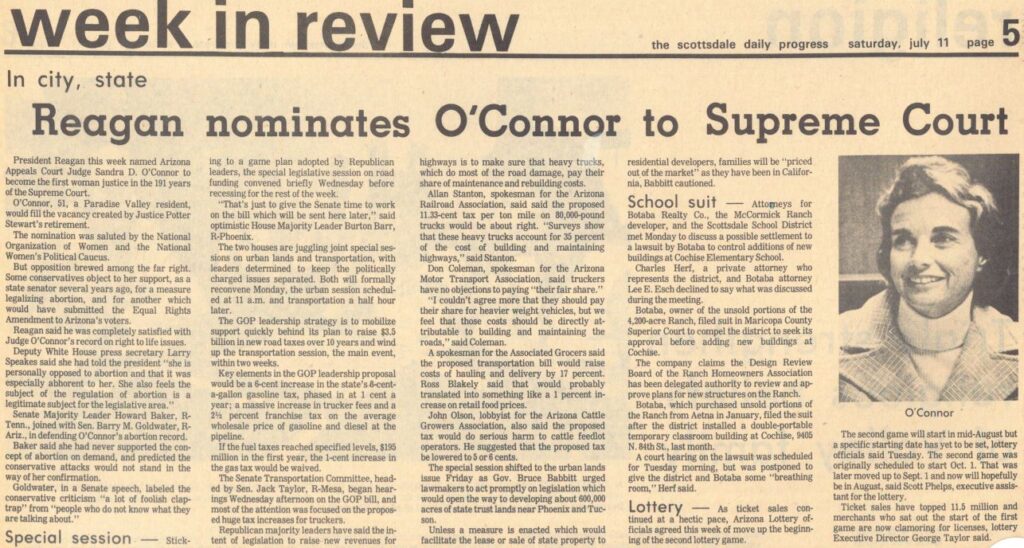
President Reagan this week named Arizona Appeals Court Judge Sandra D. O’Connor to become the first woman justice in the 191 years of the Supreme Court. O’Connor, 51, a Paradise Valley resident, would fill the vacancy created by Justice Potter Stewart’s retirement. The nomination was saluted by the National Organization of Women and the National Women’s Political Caucus. But opposition brewed among the far right. Some conservatives object to her support, as a state senator several years ago, for a measure legalizing abortion, and for another which would have submitted the Equal Rights Amendment to Arizona’s voters. Reagan said he was completely satisfied with Judge O’Connor’s record on right to life issues. Deputy White House press secretary Larry Speakes said she had told the president “she is personally opposed to abortion and that it was especially abhorent to her. She also feels the subject of the regulation of abortion is a legitimate subject for the legislative area.” Senate Majority Leader Howard Baker, RTenn., joined with Sen. Barry M. Goldwater, RAriz., in defending O’Connor’s abortion record. Baker said she had never supported the concept of abortion on demand, and predicted the conservative attacks would not stand in the way of her confirmation. Goldwater, in a Senate speech, labeled the conservative criticism “a lot of foolish claptrap” from “people who do not know what they are talking about.”
Associated Press WASHINGTON Sandra O’Connor, chosen by President Reagan for a Supreme Court seat, is suggesting that Congress act to restrict the number of federal civilrights suits against states and municipalities. In an article in the Summer 1981 issue of the William and Mary Law Review, Judge O’Connor suggested that federal courts should defer to state courts in some cases on COD&titutional questions. She also noted “acute confron- , tions” between state and federal courts in some school-busing cases and said tensions between the two judicial systems could increase in some areas. The judge wrote the article before the announcement of her nomination. Judge O’Connor’s statements in the article reflect a conservative theme shared by the president: the move to give states more freedom from the federal government. “It is a step in the right direction .to defer to the state courts and give finality to their judgments on federal constitutional questions where a full and fair adjudication has been given in the state court,” Judge O’Connor wrote in the article, titled “Trends in the Relationship Between the Federal and State Courts from the Perspective of a State Court Judge.” She said thousands of lawsuits against state and municipal officials are being filed in federal court under an 1871 federal civil-rights law. “In view of the great caseload increase in the federal courts and the expressed desire of the Reagan administration to hold down the federal budget, one would think
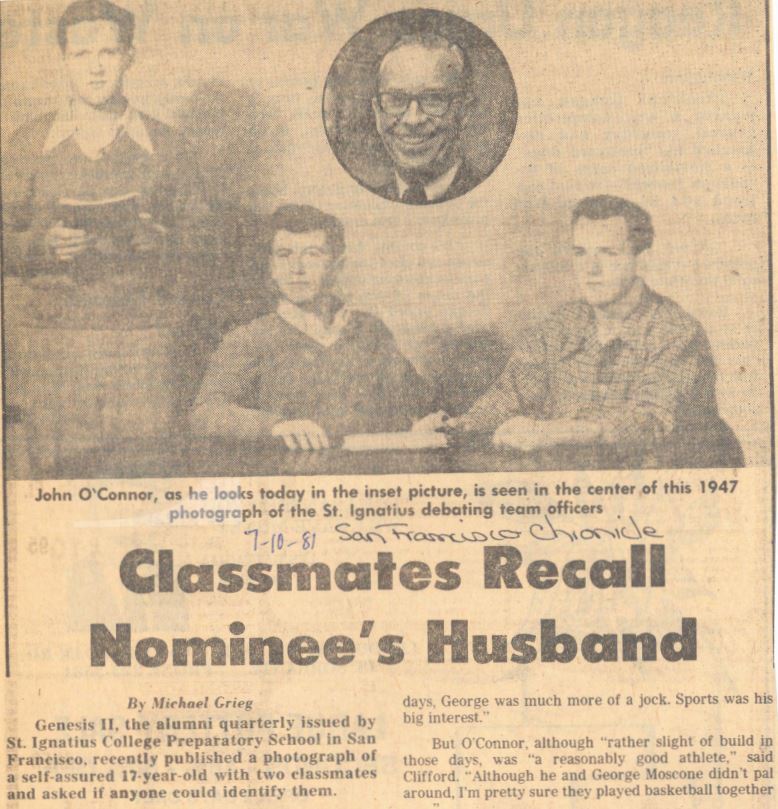
Genesis II, the alumni quarterly issued by St. Ignatius College Preparatory School in San Fran<'isco, recently published a photograph of a self-assured 17-year-old with two classmates and asked if anyone could identify them. John Jay O'Connor III, Class of 47 and husband of the first woman nominated for the U.S. Supreme Court , knew at once. He was that 17-year-old. His classmates were Jim Fitzpatrick and Joe Boyd, and they were all members of the school's debating society at the time , the 51-year-old attorney wrote from his hume m Phoenix . Other classmates included the late Mayor George Moscone and attorney Charles Clifford, former president of the California Bar Association. "l have many wonderful memories of St. Ignatius and will always be deeply indebted to the faculty there for the superb educational experience they provided," O'Connor said in his letter. Word that O'Connor's wife, Sandra Day O'Connor, had been nominated by President Reagan for the nation's highest judicial office is also stirring memories of him among friends and classmates here of more than 30 years ago. O'Connor. who dated his future wife when they were students at Stanford and served as fellow editors of the Stanford Law Review. is a member of a distinguished San Francisco family. He was born in San Francisco on January 10, 1930. O'Connor's late father, Dr. John Jay O'Connor, was a member of the St. Francis Hospital board of trustees and previously a resident physician at the hospital before going
Aristophanes’ ashes must have erupted like Mt. St. Helens when President Reagan named a woman to the U.S. Supreme Court. Some 411 years before Christ, Aristophanes was writing in “Lysistrata” that, “There is no animal more invincible than a woman, nor fire either, nor any wildcat so ruthless.” Images arise of Sandra Day O’Connor clawing at the eyes of Chief Justice Burger as he tries to impose some argum ent upon the rest of the Court. And Shakespeare’s bones must have beaten each other like castanets , muffling out even the strident protests of the Rev. Jerry Falwell. It was Shakespeare, after all, who wrote: “Frailty, thy name is woman!” Can’t you just see tears cascading down Mrs. O’Connor’s black robe as frailty prevents her from dealing with some absurd opinion by her old Stanford classmate, Justice William Rehnquist? Reagan Praised Whether he chose Mrs. O’Connor to keep a campaign promise, or because he has been catching unmitigated hell from Republican women who say he hasn’t given enough decent jobs to females, President Reagan deserves high praise for naming Mrs. O’Connor to the nation’s highest tribunal. After 191 years of wallowing in the inanities of Aristophanes and Shakespeare, and assorted chauvinisms in between, it is good to see Mr. Reagan respond to the principle that America’s commitment to justice is deepened when women sit on the Court. We go back and forth from the trifling to the vulgar in our assertions that women are “different” from men. It is time that
It was just the other day that I was invoking the 19th-century shade of Myra Bradwell, but with the nomination of Sandra Day O’Connor to the Supreme Court, the old story takes on an especially poignant meaning . From Mrs. Bradwell to Mrs. O’Connor, it’s been a long, uphill climb for ladies in the law. Myra Bradwell, may she rest in peace, was a native of Vermont who moved to Chicago sometime in the mid-1850s. Not long after ratification of the FourteEjnth Amendment in 1868, she did a most audacious, unfeminine thing: She applied for a license to practice law. Curiously, she did not rely upon the equal protection clause but rather upon the privileges and immunities clause, but in any event the Supreme Court of Illinois summarily turned her down. No women were to be allowed in court. Mrs. Bradwell appealed. In April 1873, the U.S. Supreme Court also gave her the brush-off. !t “‘.as wi~hi~ the police powers of Ilhn01s to hm1t membership in the bar to males only. Only Chief Justice Salmon P. Chase dissented, and he didn’t say why. Justice Joseph P. Bradley was so shocked by the whole astonishing idea that he wrote a flaming concurring opinion in which two other justices joined. History, nature, the common law, and “the usages of Westminster Hall from time immemorial” argued against the proposition. Bradley felt impelled to expand upon the wide difference in the spheres and destinies of man and woman. “Man is, or should be, woman’s protector and defender. The natural and proper timidity
I have to admit when Sandra O’Connor first was mentioned as a possible U.S. Supreme Court Justice nominee, I was a bit skeptical. I had hoped President Reagan would nominate a qualified woman – and there are many – for the position. but I was concerned with Judge O’Connor’s limited ( 18 months> appellate court experience. Several factors have changed my concern to total acceptance. The first was learning more about her background and reputation. Second was the class she has shown before and since her nomination. Third was the praise heaped upon her by Arizona Appeals Court Judge Jack Ogg of Prescott, a man whom I and manv others in this state hold in high regard . The real clincher. however. came when it was announced that her nomination was opposed bv the KKKK. . Not to be confused with the Ku Klux Klan. this newer and more visible group is the Kneejerk ( K >nitpicking ( K >neandcrthal (KJnuts. ~onsisting of such a rightthmkers as the Moral Majority ‘s ~ev. Jerry_ Falwell (“Everything 1s a Satamc or Communist plot. send in the bucks.”> and Richard Viguerie of the National Conservative Political Action Committee (“Forget the truth. people will believe anything they see on television.”>. the new KKKK most likely would not be satisfied with any nominee less conservative than Atilla the Hun. . _Ju~ge O’Connor’s record. qual1f1cations and character are impeccable. That’s probably bothering them. what”s If you happen to be one of those folks who loves growth and congestion, hit your
Stanford University Law School administrators Thursday withdrew their claim that Supreme Court Justice William Rehnquist ranked first and nominee Sandra O’Connor third in the school’s 1952 law class. The rankings were reported in a July 7 Stanford press release but cannot be documented, said Robert Beyers, director of Stanford’s public-information office.
Beyers said the release was based on a July 2 article in the San Francisco Chronicle, which quoted a Washington Post story.
“We failed to verify the information prior to issuing the release, and it’s all turned into a big can of worms,” a Stanford spokeswoman said. “We got burned.”
Judge O’Connor, an Arizona appellate judge who was nominated for the Supreme Court on Tuesday by President Reagan, told university officials Wednesday she never was informed by Stanford of her ranking and does not know what it was, Beyers said.
“The ranking did not come from anything release by Judge O’Connor,” said Nancy White, a spokeswoman in the judge’s Phoenix office.
“In fact, she was never even told what her ranking was and had nothing to do with the Stanford press release,” Ms. White told an Arizona Republic reporter Thursday.
Her law-school ranking is not listed on a biography Judge O’Connor released during a press conference in Phoenix on Tuesday.
The biography does list Judge O’Connor as a member of the Order of the Coif, a group restricted to the top 10 percent of law-school graduates.
Rehnquist, also an Arizonan, does not list
What impact will the appointment of Sandra O’Connor have on the Supreme Court? Asked in downtown Phoenix
Marty Bender, artist, Prescott. She’ll be a welcomed relief from all those other fuddy-duddies on the Supreme Court, that’s for sure. I think she’ll make a good justice. She said she’d interpret the laws, not make them and a woman’s opinion is needed on the Supreme Court. I don’t think that it’ll affect the passage of the ERA amendment one way or the other though.
Doug Jardine, written communications supervisor, Scottsdale. I would expect that Justice O’Connor would formulate her rulings on the basis of her profession rather than strictly as a woman. In fact, she might bend over backwards to show that being a woman won’t influence her decisions. Her appointment will benefit women and all Americans. Having a woman on the Supreme Court is long overdue.
Aletha Frazier, steno, Phoenix. Her appointment to the Supreme Court might open the eyes of the other justices to the fact that women are as capable as men. A woman’s opinion in a judicial situation is important and it’s time they realized that. I think she’ll help other women realize their potential too by showing them that they can hold responsible positions of authority. Bob Silverman, minerals company land man, Albuquerque, New Mexico. I don’t think there will be any great impact right away. Her views seem a little more liberal than the other Supreme Court justice from Arizona, William Rehnquist. I think Reagan’s appointment
WASHINGTON (AP) – Here are results of The Associated Press survey of the Senate on Sandra Day O’Connor’s nomination as the first woman Supreme Court justice. Democrats for (13): _Cranston, Calif.; Deconcini, Ariz.; Dixo_n, Ill.; Hart, Colo.; Heflin, Ala.; Hollmgs, S.C.; Inouye, Hawaii; Long, La.; Matsunaga, Hawaii; Melcher M?nt.; Mo~nih~n, N. Y.; Riegle: Mich.; Stenms, Miss. Republicans for (20): Abdnor, S.D.; Baker, Tenn.; Cochran, Miss.; Domenici, N.M.; Duren – berger, Minn.; Goldwater, Ariz.; Gorton, Wash.; Hayakawa, Calif.; -La.xalt, Nev.; L~gar, Ind .; Maddingly, ,Ga.; Murkowsk1, Alaska; Packwood, -Ore.; Percy, Ill.; Simpson, Wyo.; Stafford, Vt.; Stevens, Alaska; Thurv mon~, S.C.; Wallop, Wyo.; Warner, a. Democrats leaning for (8): Biden, Del.; Bumpers, Ark.; Byrd, W.Va.; Eagleton, Mo.; Pell, R.I.; ~ryor, Ark.; Tsongas, Mass.; Wil- liams, N.J. Republicans leaning for (12): Andrews, N.D .; Chafee, R.I.; ~hen, Maine; Dole, Kan.; Hatch , Utah; Hatfield, Ore.; Heinz, Pa.; Kassebaum, Kan .; Quayle, Ind.; Schmitt, N.M.; Tower, Texas; Weicker, Conn. Democrats undecided (26): Baucus, Mont.; Bentsen, Texas; Boren, Okla.; Bradley, N.J.; Burdick, N.D.; Byrd, Va.; Cannon, Nev.; Chiles, Fla.; Dodd, Conn.; Exon, Neb.; Ford, Ky.; Glenn, Ohio; Huddleston, Ky.; Jackson, Wash.; John – ston, La.; Kennedy, Mass.; Leahy Vt.; Levin, Mich.; Metzenbaum ‘ Ohio; Mitchell, Maine; Nunn, Ga.; Proxmire, Wis.; Randolph, W.Va.; Sarbanes, Md.; Sasser, Tenn.; Zorinsky, Neb. Republicans undecided (19): Boschwitz,

Republic Wire Services W ASIDNGTON – Conservative groups intensified their attack on Supreme Court nominee Sandra O’Connor on Thursday despite Republican predictions of victory and Sen. Barry Goldwater, R-Ariz., telling them to “back off.” Goldwater, Judge O’Connor’s leading supporter, declared in a Senate speech that “a lot of foolish claptrap” has been circulated about her positions OD issues. Though supporters of Judge O’Connor tried to shield her from criticism on the volatile abortion issue, a conservative coalition suggested that a cover-up of sorts may have colored the decision to pick her as the first woman on the high court. The coalition said that because of an “apparent cover-up,” the president did not find out about what it contends was Judge O’Connor’s vote in favor of abortions on demand and her support of the Equal Rights Amendment during her term as an Arizona state senator. The group claimed that a Justice Department memo by Kenneth Starr, counselor to Attomey General William French Smith, who led the search for a new Supreme Court justice, failed to acknowledge Judge O’Connor’s voting record. President Reagan is said to have relied heavily on that memo in choosing Judge O’Connor to succeed retired Justice Potter Stewart. “The information we have on her abortion record, when compared with the memorandum … shows an apparent prima facie cover-up, either on the part of Mrs. O’Connor or on the part of the attorney general’s office, or both .. !’ charged Kathleen
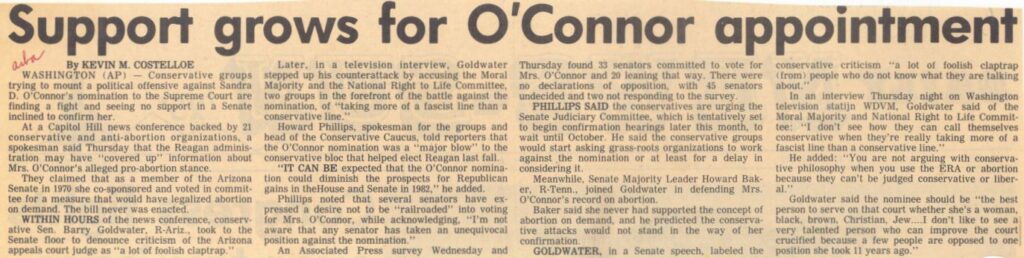
WASHINGTON (AP) – Conservative groups trying to mount a political offensive against Sandra D. O’Connor’s nomination to the Supreme Court are finding a fight and seeing no support in a Senate inclined to confirm her. At a Capitol Hill news conference backed by 21 conservative and anti-abortion organizations, a spokesman said Thursday that the Reagan administration may have “covered up” information about O’Connor’s alleged pro-abortion stance. They claimed that as a member of the Arizona Senate in 1970 she co-sponsored and voted in committee for a measure that would have legalized abortion on demand. The bill never was enacted. Within hours of the news conference, conservative Sen. Barry Goldwater, R-Ariz., took to the Senate floor to denounce criticism of the Arizona appeals court judge as “a lot of foolish claptrap.” Later, Goldwater stepped up his counterattack by accusing the Moral Majority and the National Right to Life Conunittee, two groups in the forefront of the battle against the nomination, of “taking more of a fascist line than a conservative line.” Howard Phillips, spokesman lor the groups and head of the Conservative Caucus, told reporters that the O’Connor non_lination was a “major blow” to the conservative bloc that helped elect Reagan last fall. “It can be expected that the O’Connor nomination could diminish the prospects for Republican gains in the House and Senate irl 1982,” he added. Phillips noted that several senators have expressed a desire not to be “railroaded”
BALTIMORE -Geography is destiny, as Freud said, or was that Rand & McNally? Anyway, everybody’s paying a lot of attention to the fact that President Reagan has nominated a woman to the Supreme Court and overlooking the fact that he has nominated an Arizonan, which is also significant. If she is confirmed, Sandra O’Connor will be only the eighth justice from west of the 100th meridian, which is where the West begins. Two of the others are still on the court – Rehnquist of Arizona and White of Colorado – so the contemporary court is a third Western, for the first time. Geography was an important criteria in selecting the early justices. George Washington picked half from the North and half from the South. From 1789 till 1932 there was a “New England seat.” There was a “New York seat” from 1806 till 1890. There was a “Maryland-Virginia seat” from 1789 until lhe Civil War. In this century, geography has been less honored. There have been some extreme imbalances. On the famous “nine old men” court that President Franklin D. Roosevelt attacked in 1937, three of the nine justices had been New York City lawyers, a fourth was from Massachusetts, a fifth from Pennsylvania. The Nine Old Men were 61, 64, 66, 70, 74, 74, 75, 77 and 80. Within a year after FDR’s attack on them, four had retired and one died. Today’s eight justices are 56, 60, 64, 72, 73, 73, 73 and 75. Ronald Reagan may get to name two or three more justices. The person second on the list O’Connor was first on was J . Clifford
Rev. Jerry Falwell and the Moral Majority have entered the dangerous religio-political area. They want to dictate the choice of a U.S. Supreme Court justice.
Mr. Falwell has suggested he talk to Arizona’s Judge Sandra O’Connor about abortion. Then, presumably, if he deems her views on it acceptable, the Senate can approve her nomination.
There has been a concentrated letter effort by the Moral Majority and others, on the single issue of abortion, to defeat her nomination. The arrogance of this action should anger Americans who believe that more is involved than that one issue.
We can’t let single-issue politics dictate the choice of a judge or any other public servant. The demands that the nomination be turned down must be countered by a flood of letters urging the Senate to decide no the basis of ability, background, experience and potential.
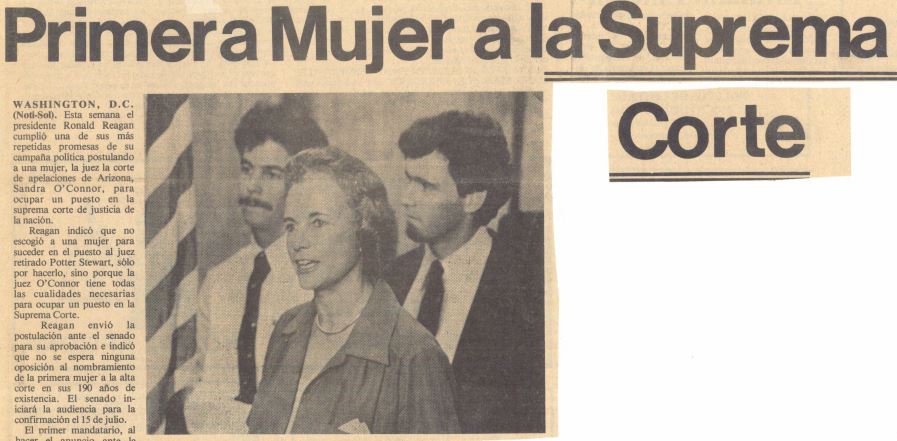
WASHINGTON, D.C. (Noti-Sol). Esta semana el presidente Ronald Reagan cumplió una de sus mas repetidas promesas de su campafia politica postulando a una mujer, la juez la corte de apelaciones de Arizona, Sandra O’Connor, para ocupar un puesto en la suprema corte de justicia de la nación. Reagan indicó que no escogió a una mujer para suceder en el puesto al juez retirado Potter Stewart, sólo por hacerlo, sino porque la juez O’Connor tiene todas las cualidades necesarias para ocupar un puesto en la Suprema Corte. Reagan envió la postulación ante el senado para su aprobación e indicó que no se espera ninguna oposición al nombramiento de la primera mujer a la alta corte en sus 190 años de existencia. El senado iniciará la audiencia para la confirmación el 15 de julio. El Primer mandatario, al hacer el anuncio ante la televisión nacional, dijo que las investigaciones sobre el desempeño de su carrera de la juez O’Connor, realizadas por el FBI como dicta la ley, habian sido completadas y que era de gran satisfacción el dar a conocer que postulaba a la señora O’Connor para el puesto en la Suprema Corte de la nación. Agregó que ella es una persona completa que posee todas las cualidades de justicia, temperamento, capacidad intelectual y devoción por el bien público que caracterizaron a los 101 jueces que la precedieron en el puesto en la suprema carte. Agregó el presidente “la encorniendo a ustedes para que el senado ratifique la pos tulación y le perrnita tomar su puesto pronto en la
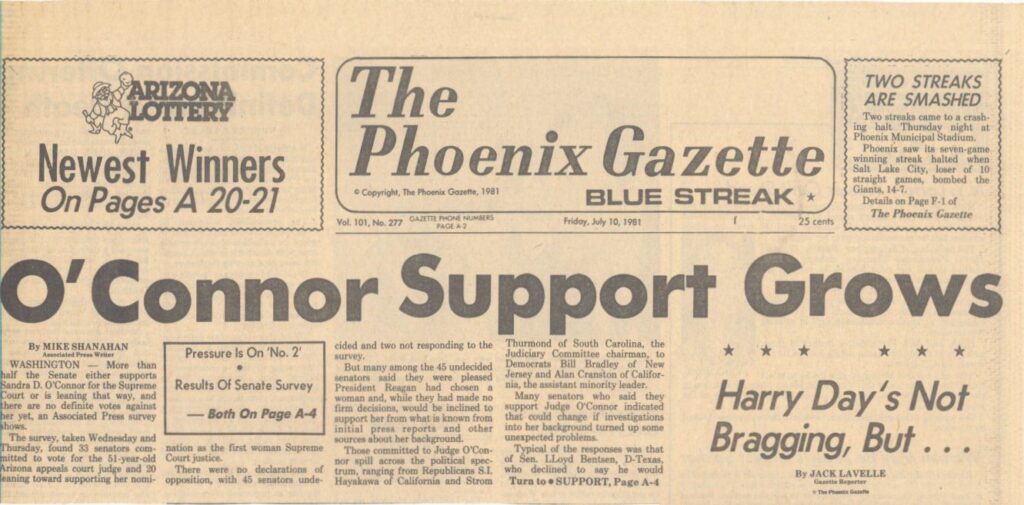
WASHINGTON – More than half the Senate either supports andra D. O’Connor for the Supreme ourt or is leaning that way, and here are no definite votes against her yet, an Associated Press survey hows The survey, taken Wednesday and Thursday, found 33 senators committed to vote for the 51-year-old Arizona appeals court judge and 20 leaning toward supporting her nomination as the first woman Supreme Court justice. There were no declarations of opposition, with 45 senators undecided and two not responding to the survey.
But many among the 45 undecided senators said they were pleased President Reagan had chosen a woman and, while they had made no firm decisions, would be inclined to support her from what is known from initial press reports and other sources about her background . Those committed to Judge O’Connor spill across the political spectrum, ranging from Republicans S.I. Hayakawa of California and Strom Thurmond of South Carolina, the Judiciary Committee chairman , to Democrats Bill Bradley of New Jersey and Alan Cranston of California, the assistant minority leader. Many senators who said they support Judge O’Connor indicated that could change if investigations into her background turned up some unexpected problems.
Typical of the responses was that of Sen. LLoyd Bentsen, D-Texas, who declined to say he would definitely vote for Judge O’Connor. “I don’t know much about the nominee, but I commend the president for his decision to name the first woman to sit on the highest
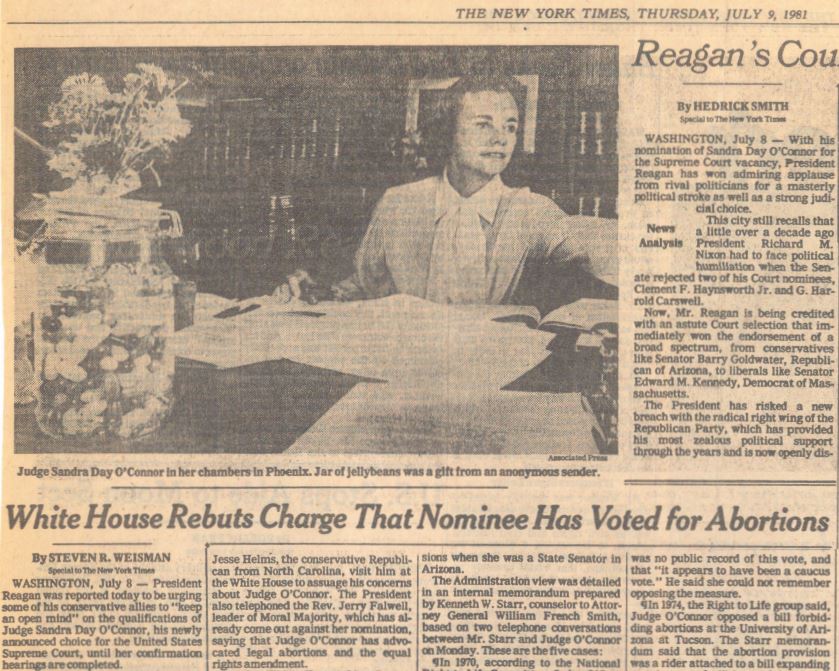
WASHINGTON, July 8 – President Reagan was reported today to be urging some of his conservative allies to “keep an open mind” on the qualifications of Judge Sandra Day O’Connor, his newly announced choice for the United States Supreme Court. until her Confirmation hearings are completed. Faced with the possibility of a vigorous campaign by antiabortion groups against Judge O’Connor, meanwhile, the White House attempted a counterattack by directly rebutting the charge that she voted on several occasions in favor of abortions. White House spokesmen asserted further that Judge O’Connor bad never been an activist on any issues related to feminism. David R. Gergen. the senior White House Spokesman, quoted the Arizona judge on the subject of the proposed equal rights amendment to the Constitution as being “neither as enthusiastic as some proponents nor as alarmed by it as some opponents.” Judge O’Connor, who has been described by the White House as person. ally opposed to abortions, has said that she will not discuss her views until her confirmation hearings. White House officials acknowledge that the judge regards abortion a legitimate matter for regulation by the legislative branch. By the end of the day, Administration officials said that they were encouraged by the prospects for confirmation of Judge O’Connor in the Senate. Yesterday, Mr. Reagan had Senator Jesse Helms, the conservative Republican from North Carolina, visit him at the White House to assuage his concerns about Judge
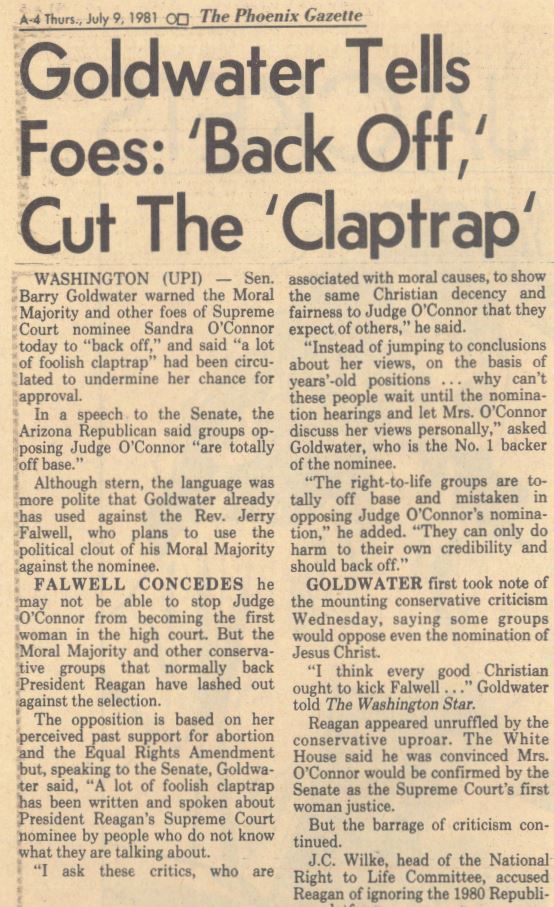
WASHINGTON (UPI) – Sen. Barry Goldwater warned the Moral Majority and other foes of Supreme Court nominee Sandra O’Connor ‘ today to “back off,” and said “a lot of foolish claptrap” had been circulated to undermine her chance for approval. In a speech to the Senate, the Arizona Republican said groups opposing Judge O’Connor “are totally off base.” Although stern, the language was more polite that Goldwater already has used against the Rev. Jerry , Falwell, who plans to use the political clout of his Moral Majority against the nominee. FALWELL CONCEDES he may not be able to stop Judge O’Connor from becoming the first woman in the high court. But the Moral Majority and other conservative groups that normally back -President Reagan have lashed out .against the selection. The opposition is based on her perceived past support for abortion and the Equal Rights Amendment but, speaking to the Senate, Goldwater said, “A lot of foolish claptrap has been written and spoken about President Reagan’s Supreme Court nominee by people who do not know what they are talking about. “I ask these critics, who are associated with moral causes, to show the same Christian decency and fairness to Judge O’Connor that they expect of others,” he said. “Instead of jumping to conclusions about her views, on the basis of years’-old positions … why can’t these people wait until the nomination hearings and let Mrs. O’Connor discuss her views personally,” asked Goldwater, who is the No. 1 backer of the nominee.
PHOENIX (AP) – A conservative Republican legislator with a record as one of the most persistent sponsors of anti-abortion bills gave unqualified suppo rt Thursday to the nomination of Arizona Appeals Court Judge Sandra O’Connor to the U.S. Supreme Court. “Those who have attacked her have done more damage to the right-to-life cause than anybody else could do,” said Rep. Tony West, R-Phoenix. “I’m just furious about their attack on a woman who will be the best thing that ever r happened to the high court.” West’s attitude about abortions has not changed. He has sponsored countless proposals to ban abortions, including resolutions to put the prohibition in the U.S. ,Constitution.
STANFORD, Calif. (UPI) – A Stanford classmate of Sandra Day O’Connor, President Reagan’s nominee for the U.S. Supreme Court, remembers her as “a complete person, interested in everything.” Mrs. O’Connor received her bachelor’s degree in economics from Stanford in 1950 and her law degree in 1952, ranking third in a class in which Supreme Court Justice William Rehnquist was first. She met her future husband, John Jay O’Connor III, a 1951 graduate of Stanford, on the school’s prestigious Law Review board of editors. And she was elected to serve as a trustee of the university from 1976 to 1980. San Francisco attorney Atherton Phleger, a fellow law student, said he remembered her brilliance and the fact that she never isolated herself from anything. ” She was a complete person, interested in everything and not cloistered,” Phleger said. Stanford President Donald Kennedy said, “We’re very proud of her.” “It’s a superb appointment,” Stanford Law School Dean Charles Meyer said. “She’s a woman of great ability, tremendous balance and good political understanding .” Mrs. O’Connor went to work in the district attorney ‘s office in San Mateo County, Calif., after she graduated from law school, first as a law clerk and later as an assistant district attorney working in civil law. She went on to win election to the Arizona state Senate, becoming the first woman in the nation to serve as a majority leader in a state legislature, was elected a Superior Court judge and was appointed to the Arizona
President Reagan’s history-making Supreme Court nomination is not likely to dramatically tilt the nation’s highest bench in one political direction, Arizona Appeals Court Judge Sandra O’Connor’s staunch admirers in the feminist community could end up a little disappointed, while her virulent critics – mostly right-to-life and anti-ERA activists – could find her to be something less than the ogre they’re now portraying. THAT’S the conclusion based on a careful review of Mrs. O’Connor’s five-year tenure in the Arizona Senate, the most likely lode of clues to her political leanings, which she has so far politely declined to discuss with newsmen. What Senate records – busily being examined by reporters from across the country this week – reveal is a moderate-to-conservative lawmaker with a fairly regular Republican voting record, and special concerns for improving the law enforcement system and services to the disadvantaged. They do not show a woman carrying a banner on standard women’s issues, such as the Equal Rights Amendment, abortion and family planning. “I’VE NEVER heard her express a strong opinion one way or the other Analysis on those things,” said fellow Appeals Court jurist Lawrence Wren. “I don’t think she can be stereotyped on those issues at all.” In fact, critics blasting her “consistent” pro-abortion voting record will find little in official records to document the claim. In her five years in the Senate, abortion-related bills only reached the Senate floor twice.
Geography is destiny, as Freud said – or was that Rand & McNally? Anyway, everybody ‘s paying a lot of attention to the fact that President Reagan has nominated a woman to the Supreme Court and overlooking the fact that he has nominated an Arizonan, which is also significant. If she is { {,nl1r med, Sandra O’Connor will I,{ 111ily the eighth justice from west of the 100th meridian, which is where the West begins. Two of the others are still on the court – Rehnquist of Arizona and White of Colorado – so the contemporary court is a third Western, for the first time. Geography was an important criteria in selecting the early justices. George Washington picked half from the North and half from the South. From 1789 till 1932 there was a ” New England seat.” There was a “New York seat” from 1806 till 1890. There was a “Maryland -Virginia seat” from 1789 till the Civil War. In this century, geography has been less honored. There have been some extreme imbalances. On the famous “nine old men” court that President Franklin D. Roosevelt attacked in 1937, three of the nine justices had been New York City lawyers, a fourth was from Massachusetts, a fifth from Pennsylvania. The Nine Old Men were 61, 64, 66, 70, 74, 74, 75, 77 and 80. Within a year after FDR’s attack on them, four had retired and one died. Today’s eight justices are 56, 60, 64, 72, 73, 73, 73 and 75. Ronald Reagan may get to name two or three more justices. The person second on the list O’Connor was first on was J. Clifford
Sen. Barry Goldwater of Arizona, for more than two decades a darling of Republican conservatives, has warned anti-abortionists and fundamentalist religious groups that he is ready to fight them to help win Senate confirmation of Sandra D. O’Connor as a Supreme Court justice. Judge O’Connor is an appellate judge in Goldwater’s home district. Goldwater, angered by opposition to President Reagan’s choice from anti-abortion groups and especially by the Rev. Jerry Falwell, head of the Moral Majority, said Wednesday, “I think every good Christian ought to kick Falwell right in the-.” Goldwater, who is of Jewish ancestry and an Episcopalian, said anyone who wants to fight Judge O’Connor’s confirmation will have to fight him. “You could offer the Lord’s name for some of these position and you’d find some of these outfits objecting even to him being appointed to anything,” said Goldwater. ” I don’t buy this idea that a justice of the Supreme Court has to stand for this, that or the other thing. And I’m getting a little tired of people in this country raising hell because they don’t happen to subscribe to every thought that person has ” I am probably one of tlie most conservative members of the Congress and I don’t like to get kicked around by people who call themselves conservatives on a non-conservative matter. It is a question of who is best for the court. “If it’s going to take a fight, they’re going to find old Goldy fighting like hell.” The Senate was in recess when Reagan
President Reagan made it plain that he would seek a conservative jurist to fill any vacan cy on the Supreme Court. He has now selected a respected judge; the fact that she is a woman is secondary . In Judge Sandra O’Connor he seems to have found a candidate who reflects his philosoph y that the cour t should interpret law rather than sh a pe it. Academically, Judge O’Connor is superbly quali- .fied. After earning a degree in economics, sh e was graduated from Sta nford University law school with highest honors and was a n edito r of the Stanford Law Review . She stood thi r d in a class that held Justice William Rehnquist and her husband, John Jay O’Con – nor III. She fulfilled he r early pr omise in a rapidly rising career by becoming depu ty coun ty a tto rney for San Mateo Count y, Ca lif ., as sistant attorney general of Arizona, an Arizona state senator , senate majority leader and superior court judge. E ighteen months ago she was appointed to t he Ari zona Court of Appeals by a Democratic governor . Arizona justices pronounce her leg a lly sound . Sen . Barr y Goldwater is one of her steadfast supporters . O’Connor’s written decisions suggest th a t she is no ideologue, but rather judges ea ch cas e on its mer its , Her childhood on a cattl e ranch northw est of El Paso , a cousi n a nd fr iend in Houst on says , m a de her self -sufficie nt , a voracio us r ea der, a nd “peopl e-orien ted rather than male- or fema le-or ien te d.” Judge O’Conno r would bring L1. remar
WASHING TON-Aristophanes’ ashes must have erupted like Mt. St. Helens when President Reagan named a woman to the U.S. Supreme Court. Some 411 years before Christ, Aristophanes was writing In “Lysistrata” that, “There Is no animal more invincible than a woman, nor fire either, nor any wildcat so ruthless.” Images arise of Sandra Day O’Connor clawing at the eyes of Chief Justice Burger as he tries to Impose some argument upon the rest of the court. And Shakespeare’s bones must have beaten each other like castanets, muffling out even the strident protests of the Rev. Jerry Falwell. It was Shakespeare, after all, who wrote: “Frailty, thy name is woman!” Can’t you just see tears cascading down O’Connor’s robe as frailty prevents her from dealing with some absurd opinion by her old Stanford classmate, Justice William Rehnquist? Whether he chose O’Connor to keep a campaign promise, or because he has been catching unmitigated hell from Republican women who say he hasn’t given enough decent jobs to females, President Reagan deserves high praise for . naming O’Connor to the nation’s highest tribunal. After 191 years of wallowing In the lnanities of Aristophanes and Shakespeare, and assorted chauvinisms In between, it is gOOd to see Reagan respond to the principle that America’s commitment to justice is deepened when women sit on the court. We go back and forth from the trifling to the vulgar in our assertions that women are “different” from men. It Is time that we faced the reality that
Abortion issue splits conservatives over O’Connor’s appointment
WASHINGTON – President ReagBD kept one campaign promise this week by nominating a woman for the Supreme Court, but he might have broken another pledge when he failed to seek the advice of the American Bar Association in making his decision. The president’s selection of Judge Sandra O’Connor, 51, of the Arizona Court of Appeals to succeed Justice Potter Stewart fulfills Reagan’s campaign vow last year to nominate a woman to fill one of the ftrst vacancies occurring on the high court. Richard Collins, a spokesman for the American Bar .Association, said the association was not consult.ed before the president’s announcement of his choice Tuesday, although Reagan promised last fall to seek advice from the 280,000- …
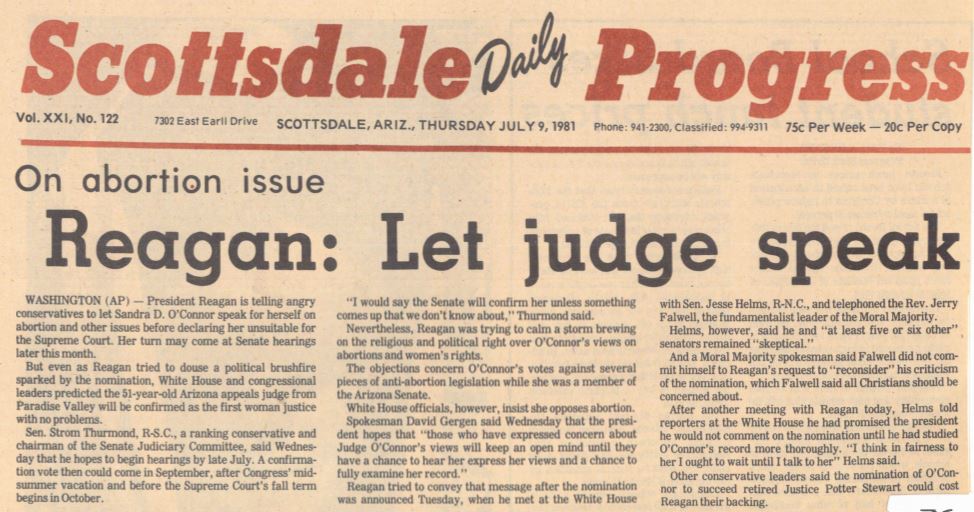
WASHINGTON (AP) – President Reagan is telling angry conservatives to let Sandra D. O’Connor speak for herseH on abortion and other issues before declaring her unsuitable for the Supreme Court. Her turn may come at Senate hearings later this month. But even as Reagan tried to douse a political brushfire sparked by the nomination, White House and congressional leaders predicted the 51-year-old Arizona appeals judge from Paradise Valley will be confinned as the first woman justice with no problems. Sen. Strom Thwmond , R-S.C., a ranking conservative and chairman of the Senate Judiciary Committee, said Wednesday that he hopes to begin hearings by late July. A confirmation vote then could come in September, after Congress’ midswruner vacation and before the Supreme Court’s fall term begins in October. “I would say the Senate will confirm her unless something comes up that we don’t know about,” Thurmond said. Nevertheless, Reagan was trying to calm a storm brewing on the religious and political right over O’Connor’s views on abortions and women’s rights. The objections concern O’Connor’s votes against several pieces of anti-abortion legislation while she was a member of the Arizona Senate. White House officials, however, insist she opposes abortion. Spokesman David Gergen said Wednesday that the president hopes that “those who have expressed concern about Judge O’Connor’s views will keep an open mind until they have a chance to hear her express her views and a chance to fully examine
PHOENIX – Sandra Day O’Connor loves to cook, but the 51-year-old judge hasn’t had much time for that or other hobbies since President Reagan nominated her to the U.S. Supreme Court. “We’ve practically given up eating,” she said ruefully on Wednesday as she she tried to juggle work, picture-taking sessions and helping FBI agents who are checking her background. The sign on her door said: “Open – Come In,” and it seemed like everybody wanted to do just that. It wasn’t just flowers, calls and visitors, though. Secretaries and aides kept popping in from neighboring offices to offer new supplies of paper cups or gawk at the White House press aide shuffling newspaper clippings in a corner of the three-room office. “This is the wildest experience of my life,” O’Connor said as she greeted former colleagues from her days as I state Senate majority leader. I wasn’t able to get through on the telephone, so I came over,” explained Republican state Sen. Ray Rottas of Phoenix, one of those she greeted warmly. Flowers overflowed from her private office. Case folders and legal papers competed for space on every tabletop and filing cabinet with orchids, carnations and dozens of long-stemmed red and yellow roses, wrapped in American flag ribbons or displayed in vases. A jar of jelly beans stood in the center of O’Connor’s desk, minus about a fifth of the candies that were in it when it arrived from a well-wisher on Tuesday. Family pictures and an oriental print hung on the walls, and the judge’s
WASHING TON – President Reagan sought to calm the religious and political right Wednesday over his nomination of Arizona’s Sandra O’Connor to the Supreme Court, and a key senator predicted that she will be confirmed without difficulty. Aside from outraged cries from anti-abortion groups, there was no firm opposition to Judge O’Connor where it count.s – among the 98 men and two women in the Senate who finally will decide whether she will be the first woman to serve on the high court. But the White House said that because speculation on the possibility of her nomination began last week, early mail and telephone calls were running against the nomination. Telegrams and Mailgrams were 290 pro and 2,573 against, and phone calls were 263 pro and 1,554 against. Despite opposition by such groups as the Moral Majority, Judge O’Connor was backed by Senate Judiciary _Committee Chairman Strom Thurmond, R-S.C., a key conservative leader . “I expect to support her,” Thurmond said. “I would say the Senate will confirm her unless something comes up that we don’t know about.” His view was echoed by Senate Democratic leader Robert Byrd and assistant Republican leader Ted Stevens, who said they know of no senators expressly against Judge O’Connor. The president hopes for – and expect.s – quick confirmation of his nominee. On his return from horseback riding Wednesday at Quantico Marine Base in Virginia, he was asked about Senate confirmation of Judge O’Connor. “I expect it,” he said. Senate GOP
With his nomination of Sandra Day O’Connor for the Supreme Court vacancy, President Reagan has won admiring applause from rival politicians for a masterly political stroke as well as a strong judicial choice.
This city still recalls that a little over a decade ago President Richard M. Nixon had to face political humiliation when the Senate rejected two of his Court nominees, Clement F. Haynsworth Jr. and G. Harrold Carswell.
Now, Mr. Reagan is being credited with an astute Court selection that immediately won the endorsement of a broad spectrum, from conservatives like Senator Barry Goldwater, Republican of Arizona, to liberals like Senator Edward M. Kennedy, Democrat of Massachusetts.
The President has risked a new breach with the radical right wing of the Republican Party, which has provided his most zealous political support through the years and is now openly dismayed over Mr. Reagan’s Court choice.
Blunts Democrats’ Charge
But in the process, several members of Congress commented, the President has blunted the right-wing stereotype that Democrats were beginning to use against him in the increasingly partisan battle over economic issues.
House Speaker Thomas P. O’Neill Jr., Democrat of Massachusetts, who has been in a toe-to-toe battle with Mr. Reagan on the budget and taxes, called a truce long enough to hail Judge O’Connor’s nomination as ”the best thing he’s done since he was inaugurated.” Meanwhile, right-wing leaders were accusing the President of betraying the
STANFORD, Calif. – Sandra O’Connor once replied to a Stanford University alumni survey by describing her work as “attempting to administer oldtime justice in a modern age.” Judge O’Connor received her bachelor’s degree in economics from Stanford in 1950 and her law degree in 1952, ranking third in a class in which Supreme Court Justice William Rehnquist was first. She met her future husband, John .Jay O’Connor III, a 1951 graduat.e of Stanford, on the school’s prestigious Law Review board of editors. She was elected to serve as a trust.ee of the university from 1976 to 1980. “We’re very proud of her,” Stanford President Donald Kennedy said. “It’s a superb appointment,” Stanford Law School Dean Charles Meyer said. Judge O’Connor went to work in the district attorney’s office in San Mateo County, Calif., after she graduated from law school, first 88 a law clerk and later as an assistant district attorney working in civil law. She went on to win election to the Arizona Senate, becoming the first woman in the nation to serve as a majority leader in a state legislature, was elected a Superior Court judge and was appointed to the Arizona Court of Appeals. Gerald Gunther, a constitutional scholar at Stanford, said he was pleased the Reagan administration took the “high road” in filling the Supreme Court vacancy. “Perhaps the best thing that’s happened is the right-to-life people oppose O’Connor,” Gunther said. “She seems by all report.a to be a perfectly qualified, conservative-philosophy
WASHINGTON- President Ronald Reagan. trying to calm the outcry on the right, has launched a personal campaign to win Senate approval of Sandra Day O’Connor as the first woman on the US Supreme Court. While Reagan wooed Rev. Jerry Falwell, leader of the Moral Majority, and conservative Sen . Jesse Helms (R-N .C.) even his critics were hailing his choice and its timing. Despite opposition from conservative groups that have questioned her views on abortions and the equal rights amendment , most analysts predicted O’Connor would be confirmed. Senate Judiciary Chairman Strom Thurmond (R-S.C.) declared yesterday he expects O’Connor to be confirmed without difficulty. “I expect to support her,” said Thurmond. a key conservative leader. “I would say the Senate will confirm her unless something comes up that we don’t know about. ” Reagan met at the White House with Helms and telephoned Rev. Falwell, asking both to “keep an open mind” about his selection. As Helms left the White House, he said he and “at least five or six other” members of the Senate remained “skeptical.” spokesman for Falwell said he did not commit himself despite the President’s request that he “reconsider .” White House spokesman David R. Gergen said that the overall reaction to the nomination “has generally been very positive.” He said the President hopes that “those who have expressed concern about Judge O’Connor’s views will keep an open mind until they have a chance to hear her express her views and a chance
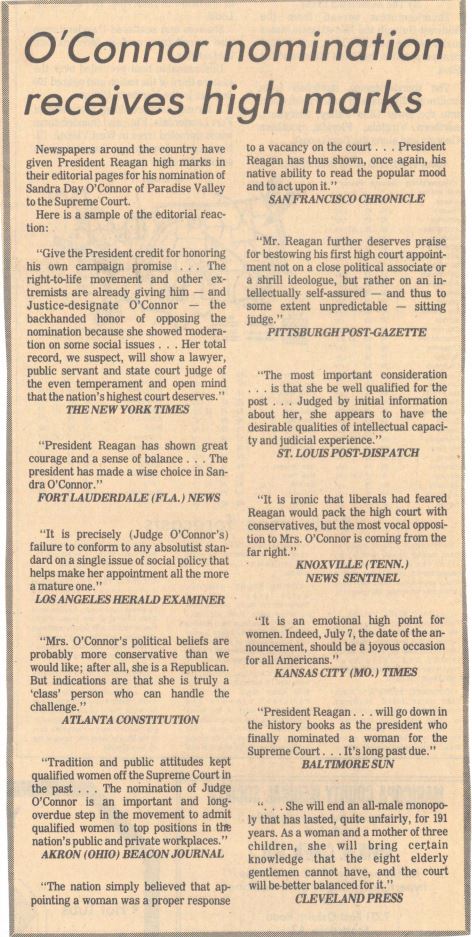
Newspapers around the country have given President Reagan high marks in their editorial pages for his nomination of Sandra Day O’Connor of Paradise Valley to the Supreme Court. Here is a sample of the editorial reaction: . “Give the President credit for honoring his own campaign promise . . . The right-to-life movement and other extremists are already giving him – and Justice-designate O’Connor – the backhanded honor of opposing the nomination because she showed moderation on some social issues . . . Her total record, we suspect, will show a lawyer, public servant and state court judge of the even temperament and open mind that the nation’s highest court deserves. ” THE NEW YORK TIMES “President Reagan has shown great courage and a sense of balance . . . The president has made a wise choice in Sandra O’Connor.” FORT LAUDERDALE (FLA.) NEWS “It is precisely (Judge O’Connor’s ) failure to conform to any absolutist standard on a single issue of social policy that helps make her appointment all the more a mature one.” WS ANGELES HERALD EXAMINER “Mrs. O’Connor’s political beliefs are probably more conservative than we would like; after all, she ls a Republican. But indications are that she is truly a ‘class’ person who can handle the challenge.” ATLANTA CONSTITUTION “Tradition and public attitudes kept qualified women off the Supreme Court in the past . .. The nomination of Judge O’Connor is an important and longoverdue step in the movement to admit qualified women to top positions
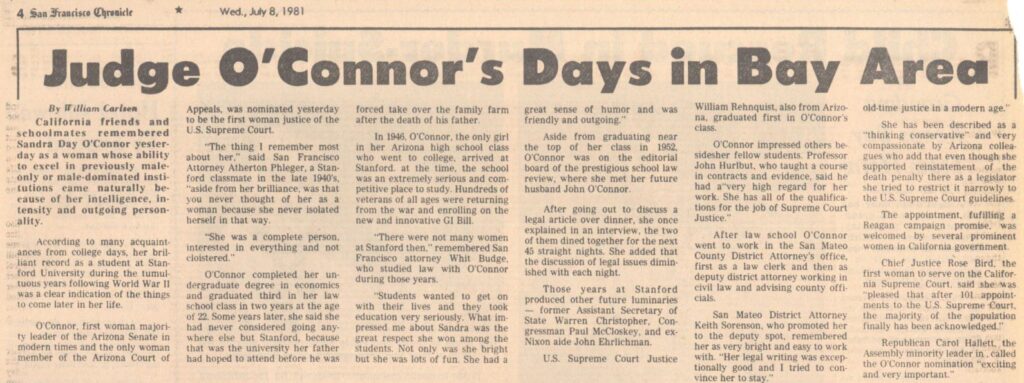
California friends and schoolmates remembered Sandra Day O’Connor yesterday as a woman whose ability to excel in previously male-only or male-dominated institutions came naturally because of her intelligence, intensity and outgoing personality. According to many acquaintances from college days, her brilliant record as a student at Stanford University during the tumultuous years following World War II was a clear indication of the things to come later in her life. O’Connor. first woman majority leader of the Arizona Senate in modern times and the only woman member of the Arizona Court of Appeals, was nominated yesterday to be the first woman justice of the U.S. Supreme Court. “The thing I remember most about her,” said San Francisco Attorney Atherton Phleger, a Stanford classmate in the late 1940’s, “aside from her brilliance. was that you never thought of her as a woman because she never isolated herself in that way. “She was a complete person. interested in everything and not cloistered.” O’Connor completed her undergraduate degree in economics and graduated third in her law school class in two years at the age of 22. Some years later, she said she had never considered going anywhere else but Stanford, because that was the university her father had hoped to attend before he was forced take over the family farm after the death of his father. In 1946, O’Connor. the only girl in her Arizona high school class who went to college, arrived at Stanford. at the time. the school was
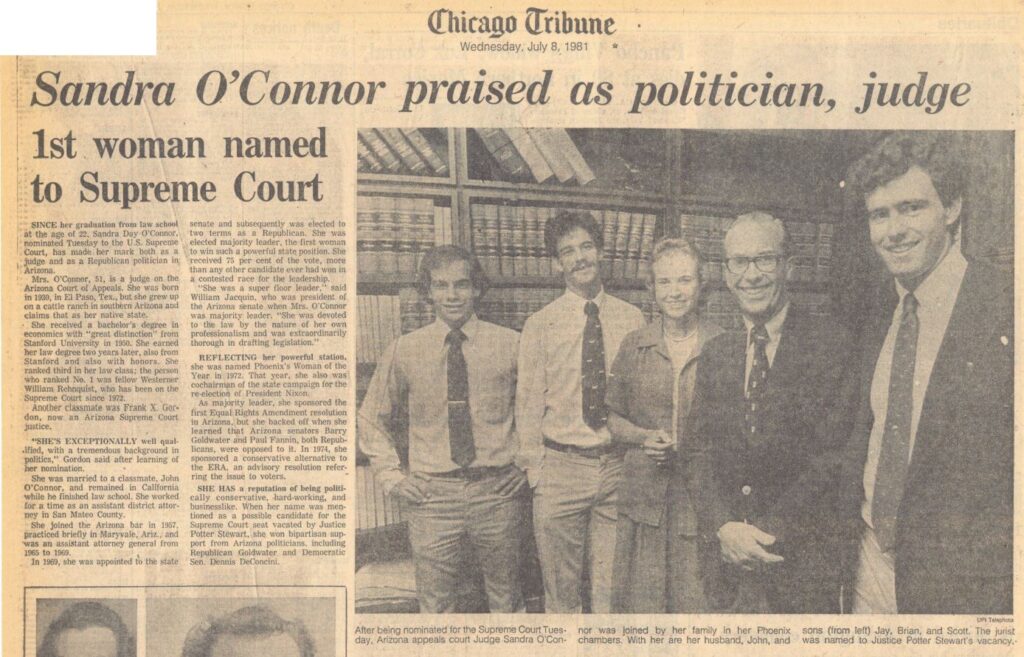
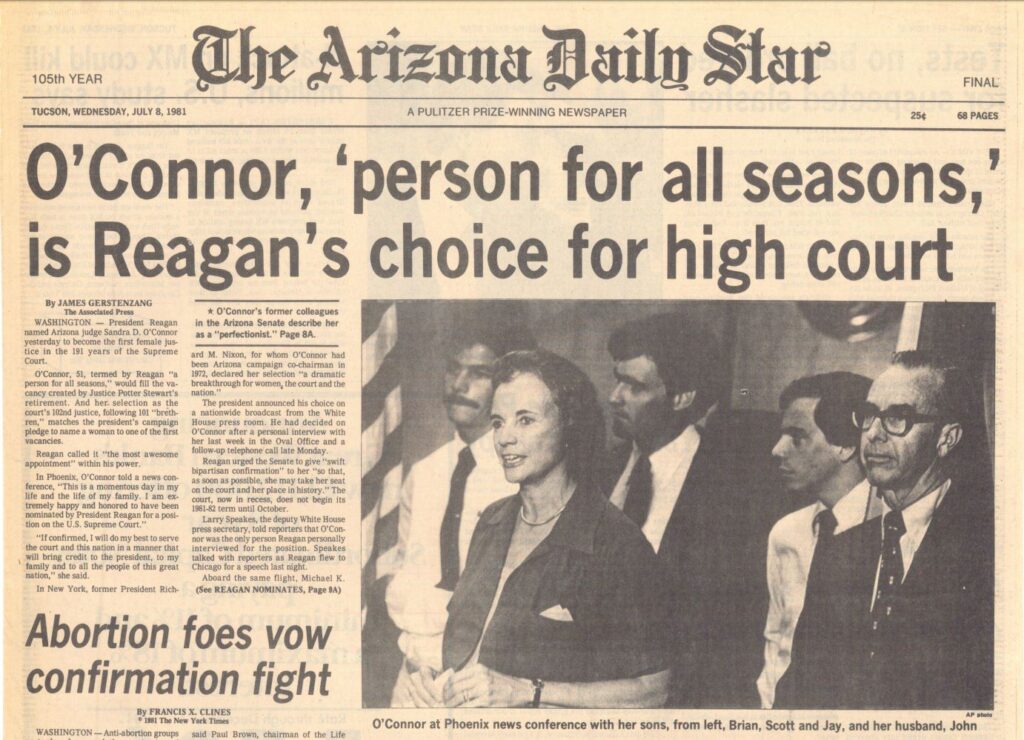
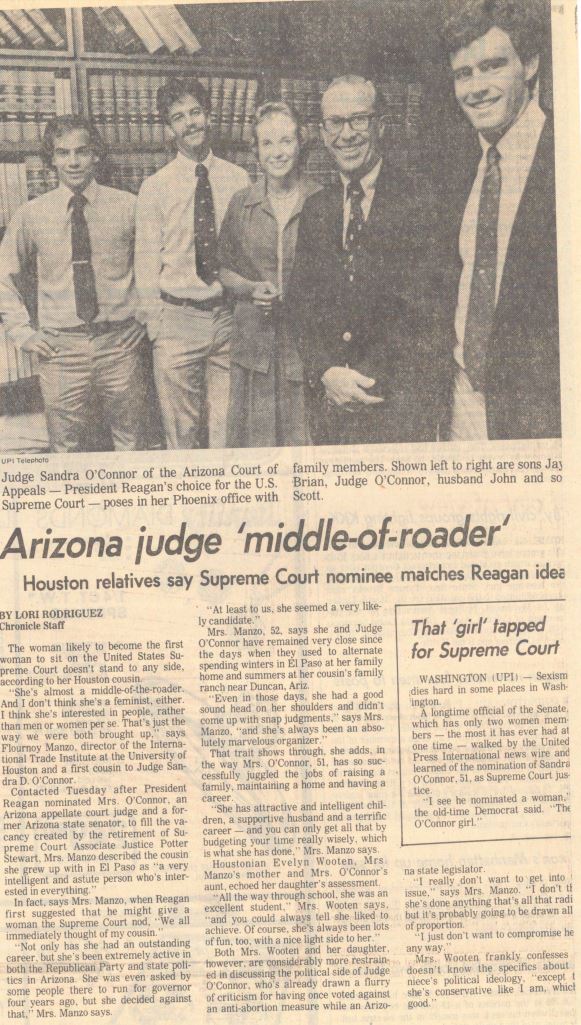
PHOENIX – Supreme Court Justicedesignate Sandra O’Connor was depicted yesterday by former legislative colleagues as a perfectionist who often was frustrated with t.be lawmaking process when she served in the Arizona Senate. But she also was fair, intelligent, brilliant, terrific, thoughtful, moderately conservative, rational, gracious and “a great gal,” according to those who know her. The consensus of her former colleagues was that her perfectionism will serve her well on the Supreme Court. O’Connor herself, at a morning news conference in a jampacked Court of Appeals courtroom, was nearly silent, staying completely away from discussing such substantive issues as her stands on the Equal Rights Amendment and abortion. Protectively watched by a White House deputy press secretary, O’Connor said that to answer substantive questions before reporters would “pre-empt the confirmation process before the (U.S.) Senate.” She read a two-sentence statement saying she was honored to have been chosen and pledging to “do my best to serve the court and this nation in a manner that will bring credit to the president, to my family and to all the people of this great nation.” O’Connor appeared at the news conference with her husband, John Jay O’Connor III, a prominent Phoenix attorney, and her three sons, Scott, 23, Brian, 21, and Jay, 19. At the conclus!on of her short state- ment, her judicial colleagues and the employees of the Court of Appeals broke into sustained applause. In the state Senate,
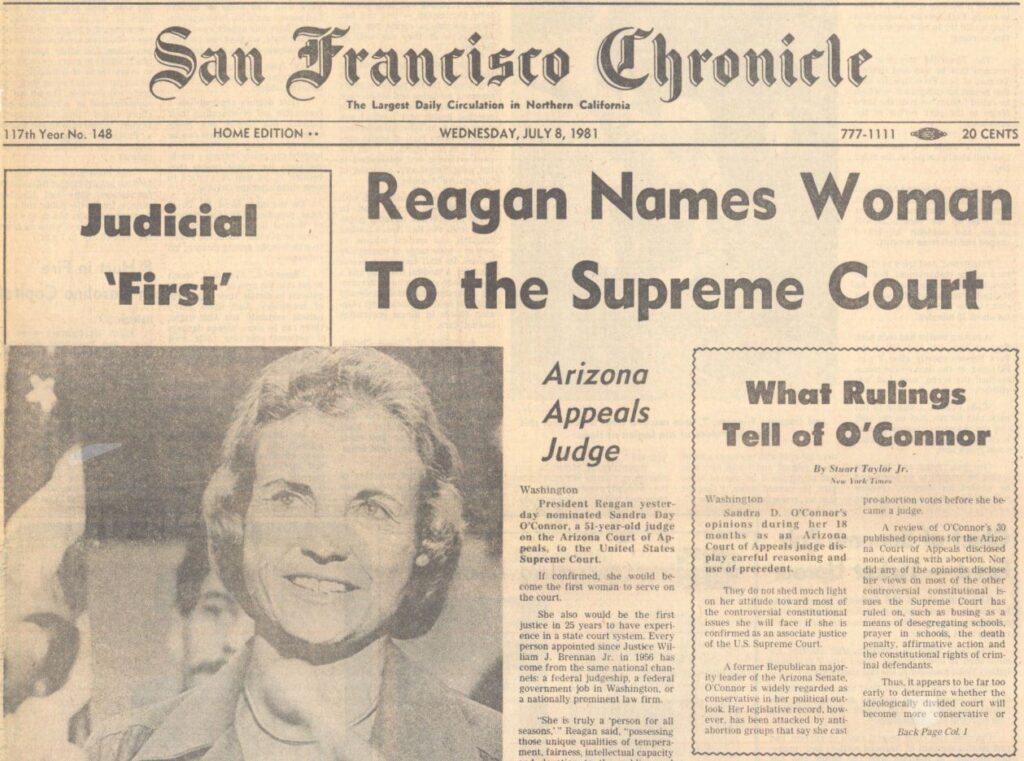
President Reagan yesterday nominated Sandra Day O’Connor, a 51-year-old judge on the Arizona Court of Appeals, to the United States Supreme Court. If confirmed, she would become the first woman to serve on the court. She also would be the first justice in 25 years to have experience in a state court system. Every person appointed since Justice William J. Brennan Jr. in 1956 has come from the same national channels: a federal judgeship, a federal government job in Washington, or a nationally prominent law firm. “She is truly a ‘person for all seasons.’ ” Reagan said, “possessing those unique qualities of temperament. fairness, intellectual capacity and devotion to the public good which have characterized the 101 ‘brethren’ who have preceded her.” White House and Justice Department officials expressed confidence that O’Connor’s views are compatible with those espoused over the years by Reagan, who has been highly critical of past Supreme Court decisions on the rights of defendants, busing, abortion and other matters. However, her record of favoring the Equal Rights Amendment, as well as her record on the abortion issue, provoked opposition to her confirmation by the National Right to Life Committee and the Moral Majority. Reagan, who is opposed to abortion, said in response to a question that he was “completely satisfied” with O’Connor’s position on that issue. O’Connor was appointed I to Arizona’s second-highest court in 1979 by Governor Bruce Babbitt, a Democrat, after five years
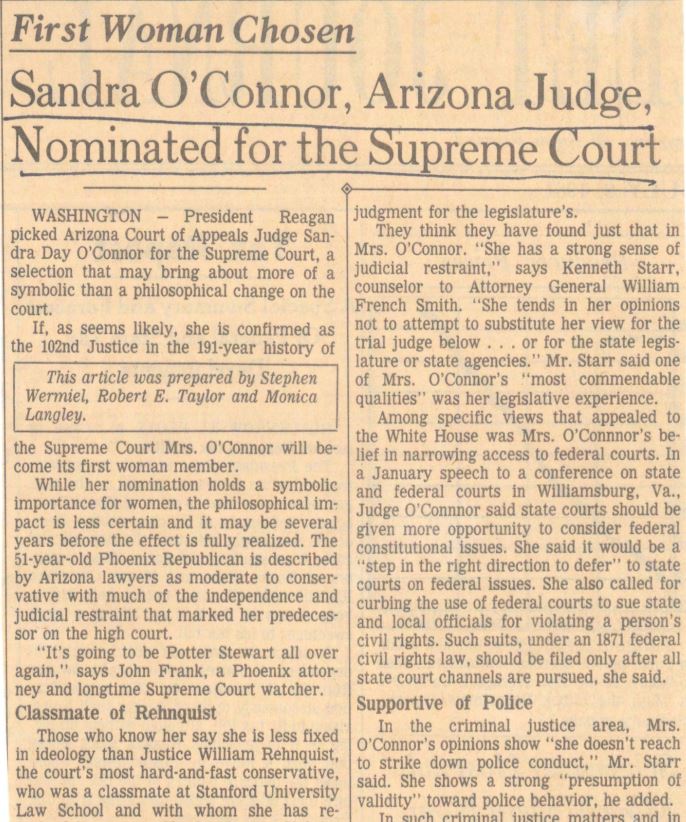
WASHINGTON – In Sandra D. O’Connor, President Reagan has chosen a United States Supreme Court justice whose views are moderately conservative to the extent that her views can be discerned at all. As one of nine judges of the middle-level Arizona Court of Appeals since 1979, Judge O’Connor, 51, has written no opinions that reveal either a political
News analysis
ideology or a judicial philosophy, according to Arizona lawyers. As a member of the state legislature for seven years before that, state Sen. O’Connor was conservative, as are nearly all Arizona Republicans, but she was not predictably conservative on every issue. This could explain why moderates and liberals joined most conservatives Tuesday in praising Mrs. O’Connor’s intelligence, qualifications, and fairness. “IF YOU’RE going to have a Ronald Reagan appointment, you’re not going to do any better,” said Rep. Morris Udall
Woman in a Hurry Juggled Career and Home Life
WASHINGTON . Professionally, Sandra Day O’Connor, the first woman ever nominated for the U.S. Supreme Court, is a paragon of the modern woman, juggling a successful legislative and judicial career with a home, a family and an active role as a civic leader. “You get the feeling when you’re talking to her that she’s always between trams,” said GeraId M. Caplan, a former Arizona State University law professor who has worked with her. Her roots, however, hem a far different world. She grew up in a turn-of-the-century adobe house near Duncan, Ariz. on the 250-square-mile Lazy B cattle ranch that her grandfather started 100 years ago. The ranch, in the southeastern corner of the state near the New Mexico border, is a world of empty rangeland, dry creekbeds and distant mountains, where the biggest events art:’ the spring and fall roundups. The closest neighbor and nearest post office are 20 miles away. ‘l’he nearest dependable water is often 800 feet or More straight down. There are miles and miles of unpopulated territory,” said June Lackey, the wife of Duncan’s mayor. “We’re big country-with few people.” The isolation of the Lazy B, where O’Connor’s parents still live, is one reason Harry Day sent his eldest daughter away to a girls’ school in El Paso, Tex., when she was a child. She lived there with a maternal grandmother during the school months, but spent her summers and vacations on the ranch. “She had a very good mind and we wanted
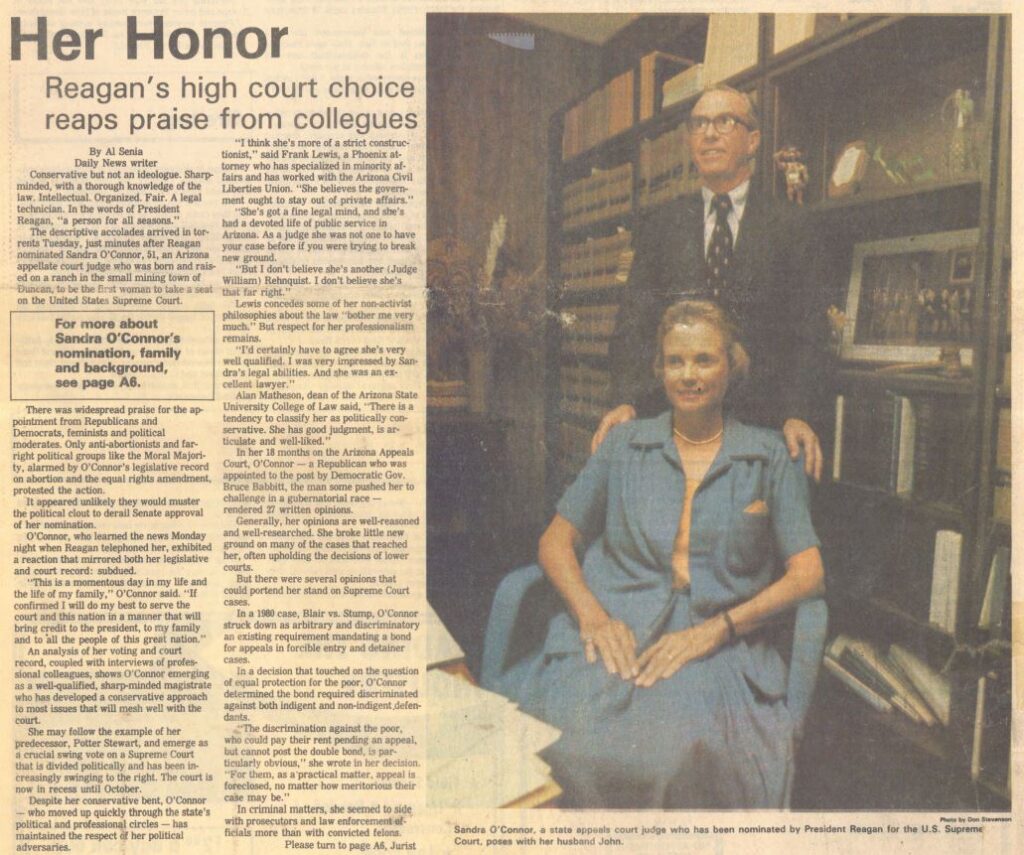
“She is truly a person for all seasons, possessing those unique qualities of temperament, fairness, intellectual capacity and devotion to the public good.” – President Ronald Reagan By J. Patterson O’Neill Daily News writer “Multifaceted” might be a better way to describe Sandra O’Connor, the nation’s first female Supreme Court nominee. She’s managed to master the difficult roles of wife, mother and professional,. apparently without a hitch. She’s also socially and athletically active. O’Connor has shot the rapids of several Western rivers, helped build her own home, raised three children and handled the pressures of a fulltime career. She’s a member of the board of directors of several non-profit Arizona organizations and belongs to at least one country club. O’Connor lives with her husband John, a Phoenix attorney, and a son in a sprawling rustic-contemporary Paradise Valley ranch house. The home is secluded and quiet, as is O’Connor. The couple built much of it themselves ahnost 3J yean ago, and her fingerprints still can be seen on the adobe walls. Her son Jay, 19, is & freshman at Stanford; Brian, 21, is a senior at Colorado College in Colorado Springs, Colo.; and Zi-year-old Scott is a Stanford graduate, and, as O’Connor put it, “now happily among the employed.” She plays tennis regularly, is an excellent golfer and reads extensively in her spare time, which she manages carefully Friends call O’Connor loyal, thoughtful and considerate. She shuns elaborate social functions
It didn’t taken Sandra O’Connor long to make a good impression on her colleagues. President Reagan yesterday broke two centuries of male exclusivity by naming O’Connor to replace retired Justice Potter Stewart. In the 18 months she ~t on the Arizona Court of Appeals, she won the respect of her male colleagues, who showered her with praise when her name was mentioned as a possible Supreme Court nominee. O’Connor, 51, is a former Republican state legislator and superior court judge. She was appointed to the state appeals court in December 1979.
During her years in the Senate, she promoted a modernized mental treatment and commitment law, pushed for constitutional spending limits and supported open-meeting laws. She voluntarily left the Legislature in 1974 and was elected Maricopa County Superior Court judge, a position she held until moving on to the Appeals Court. Majority leader “She has a razor-sharp mind which, combined with a steady temperament, makes her well~ted for the tough questions that would be presented to U.S. Supreme Court justices,” said Appeals Court Judge Donald Froeb. A leader in Arizona GOP politics, she was co-chair of the state committee to re-elect Richard Nixon In 1972. ”She. not only Is an outstanding person In all respects, but she is exceptionally well qualified in the legal field,”‘ Froeb said. Sb first was appointed to the Arizona Senate In 1969, was elected twice to that body and In 1973-74 served,.” as majority .leader .,..;. first . woman in the
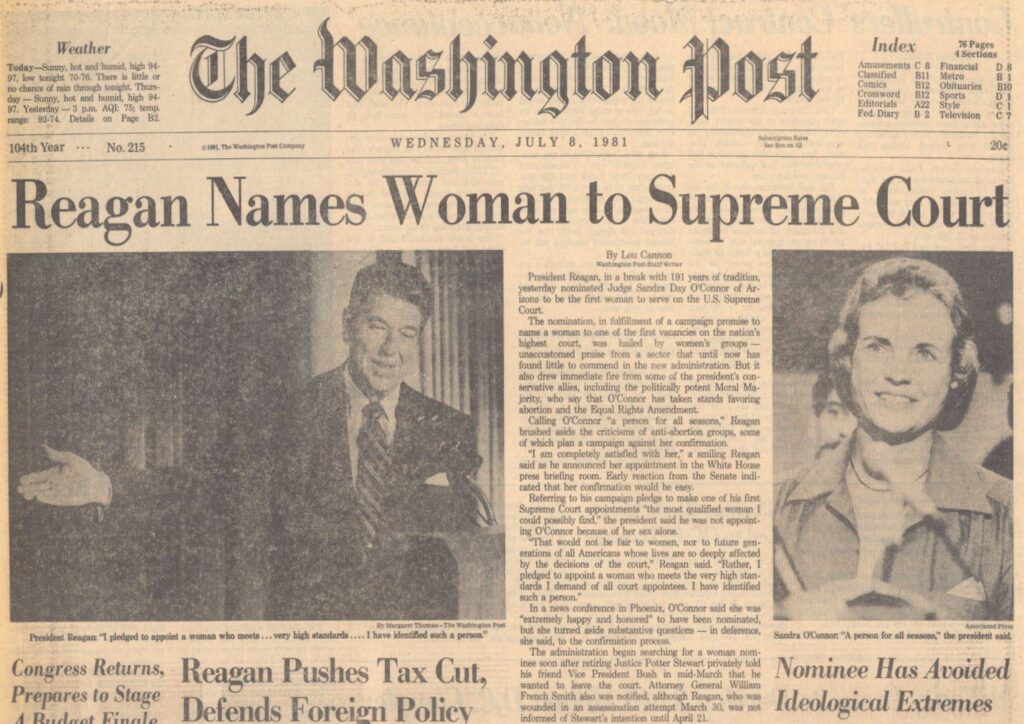
President Reagan, in a break with 191 years of tradition, nominated Arizona state Court of Appeals Judge Sandra Day O’Connor to be the first woman to serve on the U.S. Supreme Court. Reaction to the Tuesday nomination, in fulfillment of a campaign promise by Reagan to llame a woman to one of the first vacancies on the nation’s highest court, was ironic: He was condemned by conservatives who have long sup- O’Connor ported him, but praised by liberals and feminists who have found little to commend in his administration. The Rev. Jerry Falwell, head of New Right lobby Moral Majority, said that the nomination was a “disaster.” The National Right to Life Committee, a major antiabortion group, pledged an all–0ut fight against her confirmation because of “her consistent support for legal abortion.” In contrast, the National Organization for Women hailed the nomination as a “victory for women’s rights.” Eleanor C. Smeal, president of the organization, contended that increasing political pressure from women’s groups and a drop in poll ratings among women had forced Reagan to the choice of Judge O’Connor. She rated the judge as “sensitive to women’s rights, a moderate on women’s rights.” In Phoenix, Ariz., Judge O’Connor said, “This is a momentous day in my life and the life of my family. I am extremely happy and honored to have been nominated by President Reagan for a position on . the U.S. Supreme Court. “If confirmed, I will do my best to serve
When he announced his intention yesterday to name Sandra O’Connor to the U.S. Supreme Court, President Reagan seems to have fulfilled not one but both of his long-standing commitments on the subject. First , of course , he had promised to search for a qualified woman to fill a vacancy ; not surprisingly, it appears he has easily found one. But second, it looks like the nominee meets the ideological test Mr. Reagan said he would apply-not the test of political conservatism , but the test of belief in a philosophy of judicial restraint. Mr. Reagan is fed up with the imperial judiciary . So are a lot of people . So is the Supreme Court itself . The question is whether they are fed up for the right reasons . About five years ago commentators began to notice that a new kind of judicial activism was abroad in the land . It involved a certain role reversal: The traditionally conservative courts seemed now to be fighting the Executive and Legislature in behalf of the liberal principle of extending government’s protective scope. Moreover , the new activism seemed on its way to becoming entrenched so that it could not be easily reversed by elections or swings of opinion. The courts were operating by expanding the definitions of basic constitutional concepts like standing and due process; such ground once broken is difficult to abandon. The courts also had a seemingly ever-growing field of overall government activity and public interest lawyers to cope with ; this , too, seemed a near irreversib
DUMMERSTON, Vt. – Retired Supreme Court Justice Potter Stewart said Tuesday that he was “delighted” with President Reagan’s nomination of Arizona Appeals Court Judge Sandra O’Connor to succeed him. “She is not only good, she is very, very good,” said Stewart, who officially stepped down Friday after nearly 23 years as a justice. Stewart, traveling through Vermont on his way to his vacation home near Franconia, N.H., said he heard of the appointment on his car radio. Upon arriving at his daughter’s home in Dummerston, Stewart said, he got a call from the White House and “I told the President I was pleased with his choice.” Reagan had tried to reach Stewart before the official announcement was made, said Elliot Gerson, one of Stewart’s law clerks. The White House switchboard placed calls to the Connecticut house where Stewart spent Monday night, to his daughter’s house and to his son’s law office in Brattleboro. Stewart called Mrs. O’Connor “a very well qualified person, a fme choice,” and said he is not surprised that a woman had been chosen to succeed him.
President Reagan has appointed Mrs Sandra O'Connor to the Supreme Court, ending two centuries of male exclusivity. Announcing her appointment…
THE DECISION of President Reagan to nominate Sandra Day O’Connor of Arizona for a seat on the Supreme Court is far more than the fulfillment of a campaign commitment. It marks the end of a long road for all those women who have ever practiced or aspired to practice law. Just 109 years ago, the court on which Judge O’Connor will sit if the Senate confirms this nomination upheld the power of the states to prevent women from becoming lawyers. The vestiges of the thinking that produced that now unthinkable discrimination linger on. But the ascension of Judge O’Connor to the nation’s highest court would help eliminate more of them, regardless of how she votes on constitutional questions. The fact that a woman has, at long last, been selected for one of these seats of great power will make the continuance of sexual barriers in lesser jobs more difficult to justify. In some ways, when you think of it, it is incredible .that this should have to come as such a momentous event in 1981, that it should have this aspect of novelty and “breakthrough” to it. And we hasten to suggest that it will merely compound the grotesque thinking that has created such a situation if the great ‘legal and political powers-that-be regard a seat on, the court for one female as some kind of equity. Female justices should not be considered as some oneof-a-kind token or representative or quota-filler. Mr. Reagan has helped redeem the shame of his predecessors who wouldn’t quite dare to do what he has done. He
WASHINGTON – Antiabortion groups yesterday denounced the nomination of Judge Sandra D. O’Connor to the Supreme Court and vowed to fight her confirmation, but no Senate members immediately stepped forward to lead such a fight and the initial reaction to the nomination was favorable. “I commend the President for the courage of his decision,” said Sen. Howard H. Baker Jr., the majority leader. “I am delighted with his choice, and I pledge my full support for her confirmation by the full Senate.” The National Right to Life Committee, an amalgam of anti-abortion lobbying groups, said it would mobilize its members to “prevail upon senators to oppose this nomination” on the ground that O’Connor was “pro-abortion” as a member of the Arizona Legislature. “We feel betrayed by the President,” said Paul Brown, chairman of the Life Amendment Political Action Committee, who contended that Mr. Reagan violated a campaign pledge to support anti-abortion positions and appointees. In contrast, the National Organization for Women hailed the nomination as a “victory for women’s rights.” Eleanor C. Smeal, president of the organization, rated the judge as “sensitive to women’s rights, a moderate on women’s rights.” The only sitting Supreme Court justice to comment was Harry Blackmun. Blackmun said the appointment “has been anticipated for some time.” He said he did not know O’Connor personally, but had heard “very favorable” reports about her. Any ‘Senate opposition was thought likely to be led by
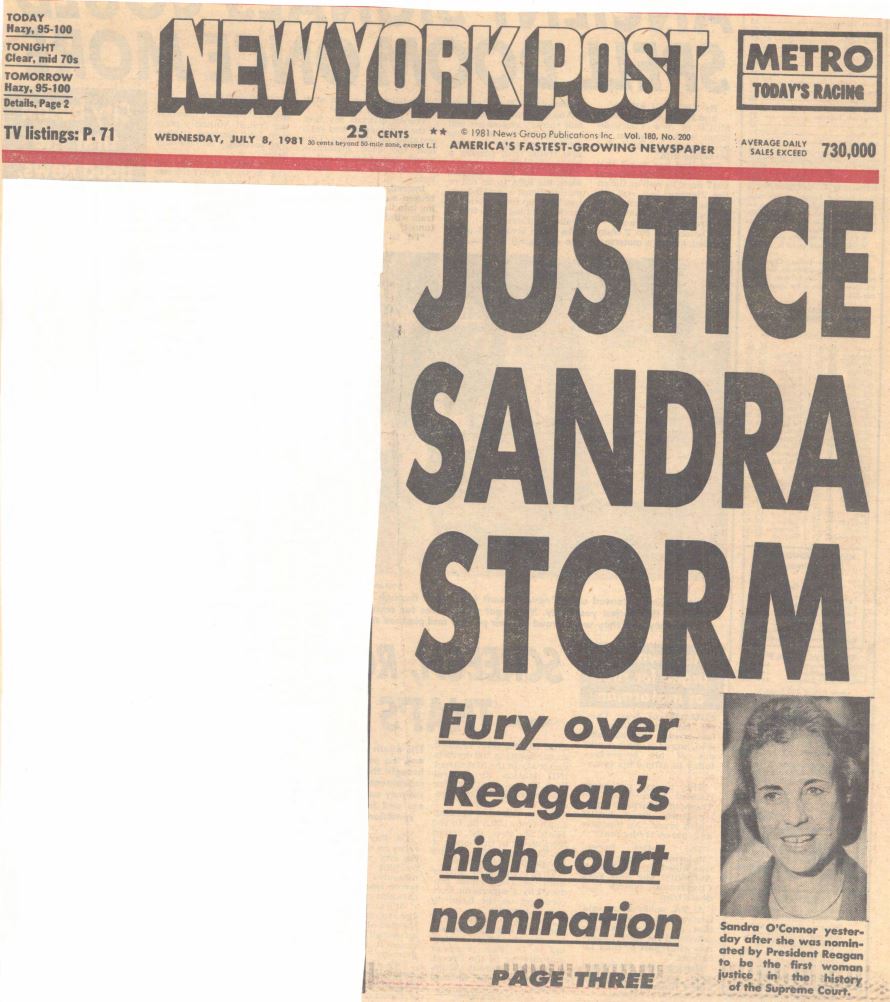
WASHING TON – A furious storm of criticism exploded yesterday over President Reagan’s nomination of Arizona judge Sandra D. O’Connor as the first woman in history to serve on the Supreme Court. Outraged conservatives said they would move to block her confi1matio n because of her pa.c;t record of supporting abortio n and the Equal Rights Am , , 1ent. Conserv .,.t1 e groups, including the Rev. Jerry Fal- well’s Moral Majority and the Right-to-Life movement, flooded the White House with more than 5000 telegrams and phone calls protesting the state Appeals Court judge’s nomination. “This is going to be one tough fight,” Richard Viguerie, who runs one of the most sophisticated political direct-mail operations in the nation backing conservative causes, told The Post.
“We’ve been insulted and we’ve been betrayed and I’d rather take a physical beating than fight the President. But this is what we’re going to have to do,” said Viguerie, who has raised tens of millions of dollars.
“President Reagan’s nomination is a mistake. Either the President did not have sufficient information about her background in the area of social issues or chose to ignore that information,” Falwell said.
“Her record indicates she is not an opponent of abortion on demand and is opposed to attempts to curb this biological holocaust which has taken the lives of more than 10 million innocent babies since 1973.”
Reagan named O’Connor yesterday to fill the Supreme Court seat being vacated by retired Justice Potter
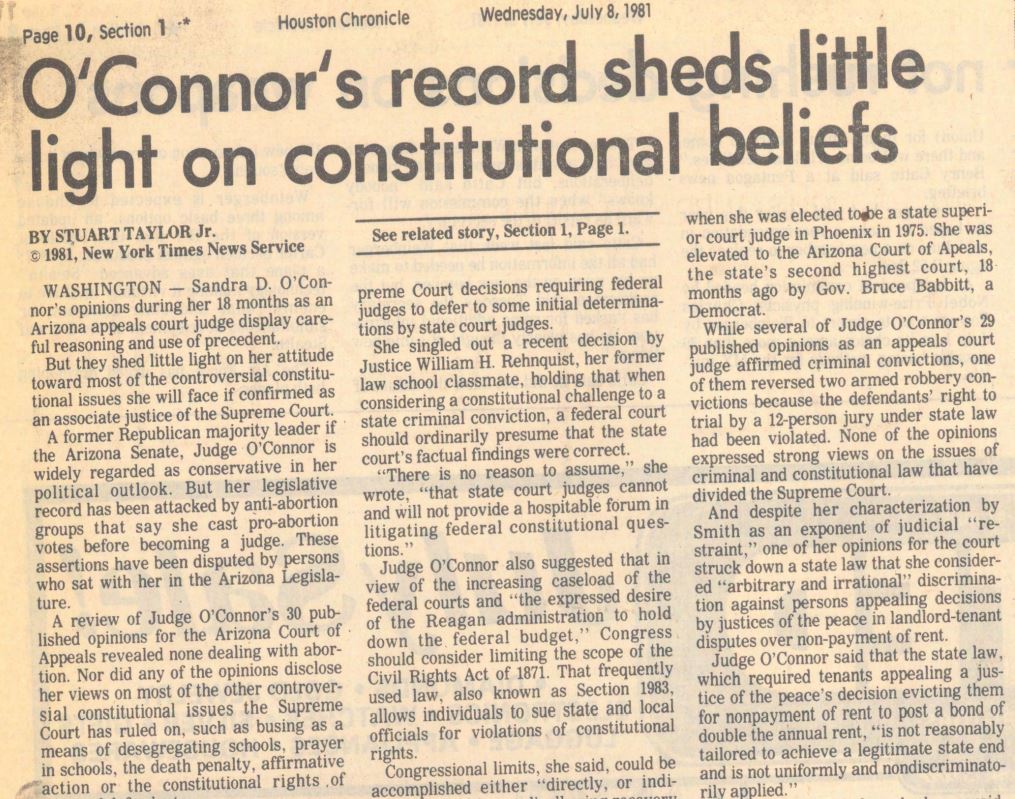
WASHINGTON, July 7 – Sandra Day O’Connor’s opinions in her 18 months as an Arizona appeals court judge display careful reasoning and use of precedent. But they shed little light on her attitude toward most of the controversial constitutional issues she will face if she is confirmed as an Associate Justice of the Supreme Court. Judge O’Connor, a former Republican majority leader of the Arizona State Senate, is widely regarded as conservative in her political outlook. Her legislative record has been attacked by anti-abortion groups that say she cast pro-abortion votes before she became a judge, but those assertions have been disputed by people who sat with her in the Arizona Legislature.
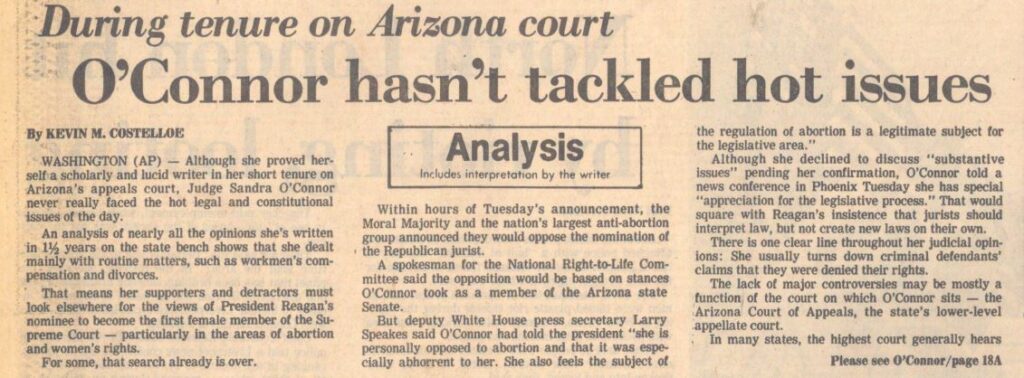
A review of Judge O’Connor’s 29 published opinions for the Arizona Court of Appeals disclosed none dealing with abortion. Nor did any of the opinions disclose her views on most of the other controversial issues that the Supreme Court has ruled on, such as busing as a means of desegregating schools, prayer in schools, the death penalty, affirmative action and the constitutional rights of criminal defendants.
The White House indicated tonight that Judge O’Connor was a supporter of the death penalty. Michael K. Deaver, the President’s deputy chief of staff, said that Judge O’Connor had been the author of an Arizona law providing for the death penalty and had sentenced at least one person under the law. However, no one has been executed in Arizona since she first became a Superior Court judge there
Arizonans Praise Record, Say Stands Hard to Predict
Her benchside manner is so st.em, her stare so penetrating, that some young lawyers call her “laser eyes.” Her written opinions tick off the law, tick off the precedents and fit in the facts, all without rhetoric or aside§. They are the work of a technician, not an ideologue. In a stat.e where ideological extremes flourish, Sandra D. O’Connor has shown a knack for avoiding them throughout her career as a lawyer, state senator and judge. As a politician, she has been on either side of the Equal Rights Amendment and the abortion issue. As a judge, she is described as a tough sentencer, capable of imposing the death penalty. . But as she demonstrated in a 1978 murder case, she is just as capable of wiping out her own sentence and ordering a new trial when she thinks something has gone wrong in the process of criminal justice. For these reasons, her nomination was endorsed by virtually all those who know her in Arizona, from conservative Sen. Barry Goldwater to the head of the Arizona American Civil Liberties Union. At the same time, the state’s lawyer have given her consistently high marks in the bar association’s ratings of judges in the state. And for the same reasons, most lawyers said it would be risky t.o predict how she might vote on many of the controversial issues that will confront the Supreme Court. At 51 she is young for a Supreme Court justice, and her term of service could carry her far beyond any of the current
In naming the first woman to be on the nation’s highest court, President Reagan has picked a well-regarded Arizona judge who is widely praised for her scholarship, common sense and reluctance to allow personal opin ions sway her interpretation of the law. Colleagues in the home state of Sandra Day O’Connor, 51, a judge on the state’s intermediate-level Court of Appeals, described her as a jurist who would not be an activist for social change, but nonetheless would make her presence known among the eight rnen on the Supreme Court. “She is obviously a conservative,” said one Phoenix attorney who asked not to be identified, “but she’s a thinking conservative who is compassionate and very concerned about people.” Among friends and foes alike, the consen sus appeared to be that O’Connor would be an “excellent” addition to the court who is well-qualified to replace retiring Justice Potter Stewart regardless of her sex. As to where she would fit on the nine-member court, most of her peers and colleagues declined to speculate, although her conservative background made it clear that she would not be joining the dwindling liberal bloc on the court. ‘One Can Never Tell’ One former Arizona law professor who has
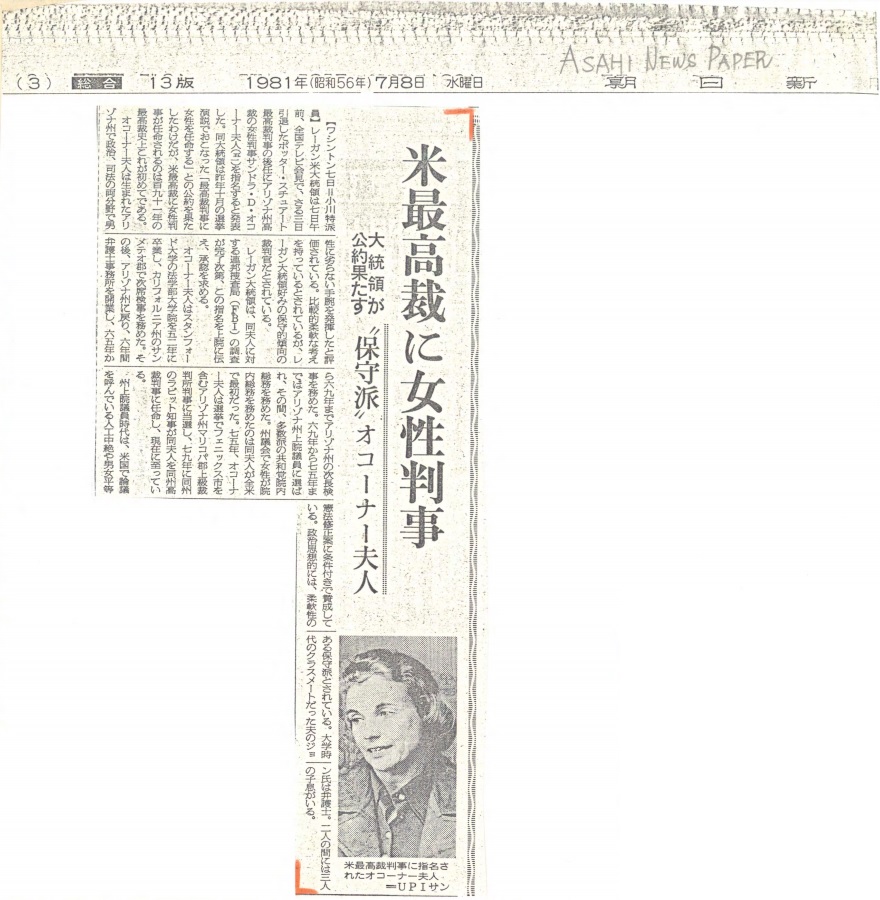
米最高裁に女性判事 大統領公約果たす “保守派”ォコーナー夫人 【ワシントン七日ll小川特派員】レーガン米大統領は七日午前、全国テレビ会見で、さる三日引退したポッター.スチユアー卜 最高裁判事の後任にアリゾナ州高裁の女性判事サンドラ.D.オコーナー夫人(五一) を指名すると発表した。同大統領は昨十月の選挙演説でおこなった「最高裁判事に女性を任命する」との公約を果たしたわけだが、米最高裁に女性判事が任命されるのは百九十一年の最高裁史上これが初めてである。 オコーナー夫人は生まれたアリゾナ州で政治、司法の両分野で男性に劣らない手腕を発揮したと評価されている。比軟的柔軟な考えを持っているとされているが、レーガン大統頜好みの保守的傾向の裁判官だとされている。 レーガン大統頜は、同夫人に対する連邦捜査局(FBI)の調査が完了次第、この指名を上院に伝え、承認を求める。オコーナー夫人はスタンフォード大学の法学部大学院を五二年に卒業し、力リフォル二ア州のサンメテオ郡で次席検事を務めた。その後、アリゾナ州に庚り、六年間弁護士事務所を開業し、六五年から六九年までアリゾナ州の次長検事を務めた。六九年から七五年まではアリゾナ州上院議員に選ばれ、その間、多数派の共和党院内総務を務めた。州議会で女性が院内総務を務めたのは同夫人が全米で最初だった。七五年、オコーナー夫人は選挙でフェニックス市を含むアリゾナ州マリコパ郡上級裁判所判事に当選し、七九年に同州のラビッ卜知事が同夫人を同州高裁判事に任命し、現在に至っている。州上院議員時代は、米国で論議を呼んでいる人工中絶や男女平等憲法修正案に条件付きで賛成している。政洽思想的には、柔軟性のある保守派とされている。大学時代のクラスメートだった夫のジョン氏は弁護士。二人の間には三人の子息がいる。
T . H_ E nomination of Arizona state Appeals Court Judge Sandra O’Connor to the U.S. Supreme Court bo~ors the wom~n of America, the people of Arizona and the Judge herself. lf approved by the Senate, as she should be Judge O’Connor will be the 102nd m~mber of the land’s highest court and the first woman justice in the court’s 191-year history. She will give the court its second sitting member from Arizona, truly an amazing accomplishment for a small state. The other Arizonan is Justice William Rehnquist, a law school classmate of Judge O’Connor. Finally, elevation to ~he Supre~e Col!rt will be the crowning achievement m the hfe of the ranch girl from Duncan who climbed the ladder of public service through the state attorney general’s office, the state Legislature, the Superior Court system and the Arizona Court of Appeals. Sandra O’Connor has helped the state in many extra-judicial ways. As a board member she persuaded Ariiona’s Blue Cross and Blue Shield to unite, before the national organizations did so. As president of the Heard Museum, she helped Arizona’s Indian tribes to achieve the recognition they deserve. As a director of the Arizona Academy, she motivated an effective statewide Town Hall unique in America. Judge O’Connor has some rough days ahead. Her every act will be under public scrutiny. There will be a lot of discussion and ex~ination of Judge O’Connor’s feminist views, which perhaps have best been described by a long-time friend. “She never lets you forget she’s
Arizona Sen. Barry Goldwater, who sponsored Judge Sandra O’Connor of his home state , for an appointment as the first woman U.S. Supreme Court Justice, said in El Paso that news of her nomination by President Reagan was “wonderful.” Goldwater flew into Fort Bliss for about a four-hour visit Tuesd&y with no notice to the media and Fort Bliss officials said they were unable to release any details of his visit. GOLDWATER, GRINNING BROADLY when asked about Mrs. O’Connor’s appointment, said “It is just wonderful, I talked to President Reagan about it Monday. I have known her ever since she has been in Phoenix and I told the president he couidn’t find a better person to fill the post.” Goldwater said “I could find a hundred competent woman lawyers but none that could do the job she will do.” The Arizona senator, a long time member of the Senate Armed Forces Committee of which Texas Sen. John Tower, a fellow Republican, is chairman, said of his visit to Fort Bliss, “I am just trying to get reacquainted with the army. I used to be an infantry officer before joining the Air Force and I am now visiting U.S. Army bases to reacquaint myself with their missions.” GOLDWATER IS A RETIRED U.S. Air Force Reserve general. Fort Bliss Public Affairs Officer Lt. Col. Edward McDonald told the Herald-Post Goldwater was on the base but said he could not give any more details. The Senator arrived and left in one of the Military Airlift Command airplanes that is based at Andrews Air Force Base in Washington,
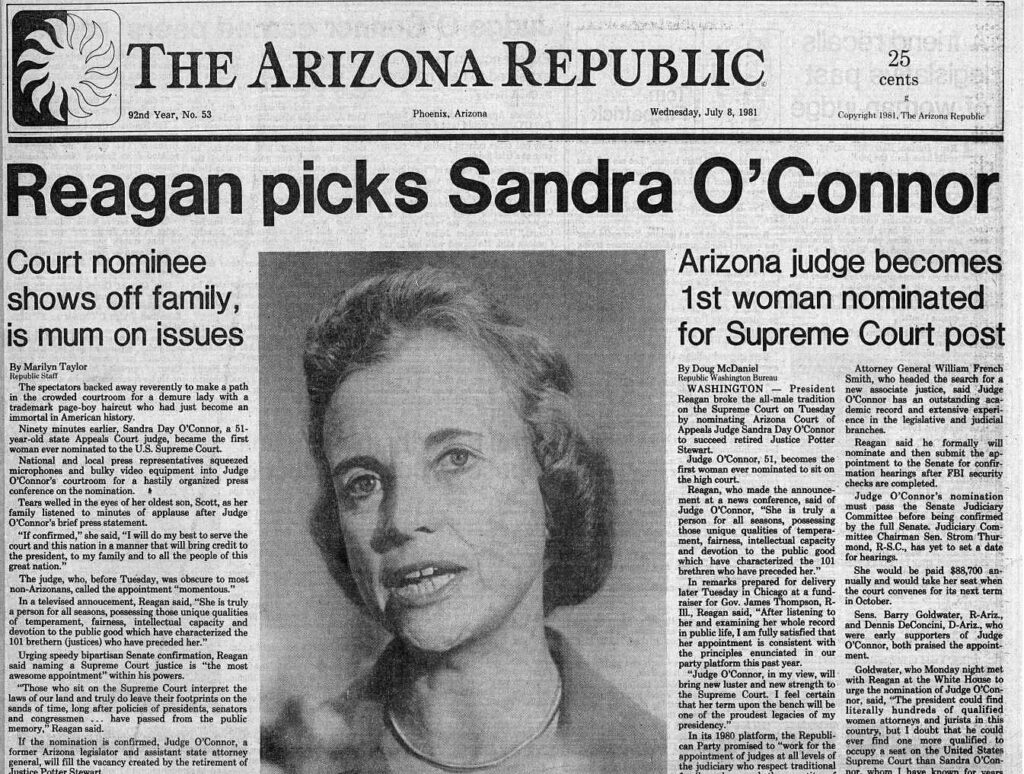
WASHINGTON -President Reagan announced Tuesday that he will nominate Arizona Court of Appeals Judge Sandra Day O’Connor to the Supreme Court, the first woman to be chosen for the nation’s highest tribunal in its 191-year history. Reagan described the 51-year-old jurist, former state legislator and Republican activist as “truly a person for all seasons” who possesses the “unique qualities of temperament, fairness, intellectual capacity and devotion to the public good which have characterized the 101 (Supreme Court) brethren who have preceded her.” in selecting O’Connor, the President fulfilled a promise. he made during the 1980 presidential election campaign-to appoint a woman to the court. In doing so, he won the praise of women’s groups that. have opposed many of his policies. But his choice drew the wrath of some conservatives and anti-abortion. The public’s view of women on the bench has changed sharply over the years. Story, Page 5. lion groups, which vowed to fight O’Connor’s confirmation by the Senate because of what they consider to be her pro-abortion votes as an Arizona legislator. White House spokesman Larry Speakes, however, reported that O’Connor had told the President when he interviewed her in the Oval Office last tednesd~y that “she is personally opposed to abor- .. lion and it is especially abhorrent to her.” , White House deputy chief of staff Michael K. Deaver, who sat in on . the presidential interview, said Reagan was particularly impressed by O’Connor as
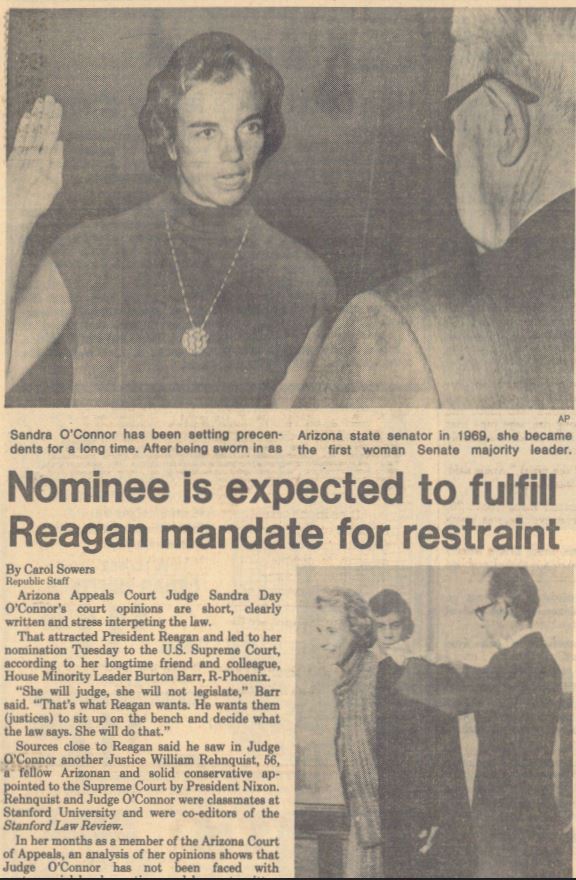
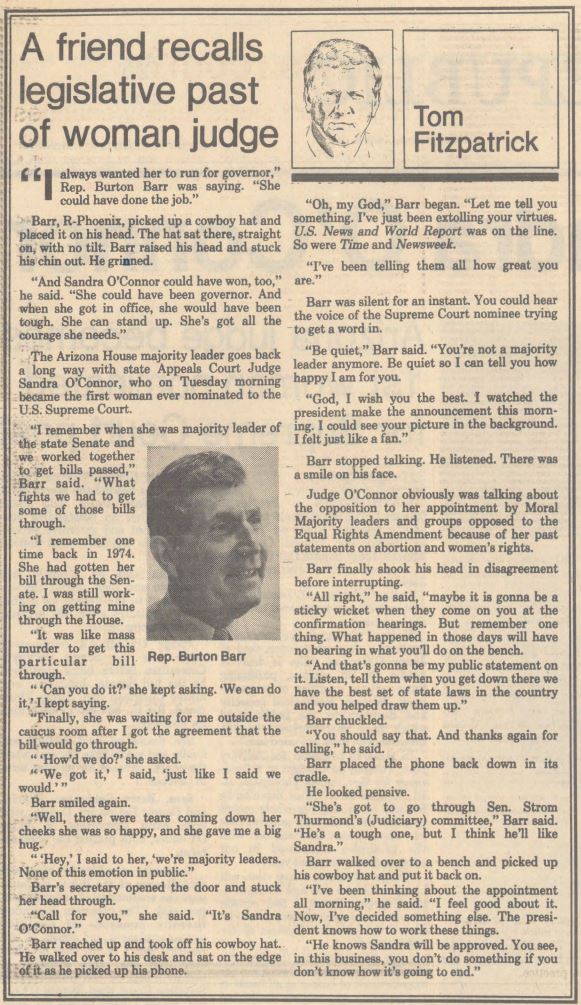
Arizona Appeals Court Judge Sandra Day O’Connor’s court opinions are short, clearly written and stress interpeting the law. That attracted President Reagan and led to her nomination Tuesday to the U.S. Supreme Court, according to her longtime friend and colleague, House Minority Leader Burton Barr, R-PhoeniL “She will judge, she will not legislate,” Barr said. “That’s what Reagan wants. He wants them (justices) to sit up on the bench and decide what the law says. She will do that.” Sources close to Reagan said he saw in Judge O’Connor another Justice William Rehnquist, 56, a fellow Arizonan and solid conservative appointed to the Supreme Court by President Nixon. Rehnquist and Judge O’Connor were classmates at Stanford University and were co-editors of the Stanford Law Review. In her months as a member of the Arizona Court of Appeals, an analysis of her opinions shows that Judge O’Connor has not been faced with controversial legal questions and has not written ihe kind of legal opinions that make history. Instead, she has dealt mainly with routine issues of workmen’s compensation and divorce. However, she has little patience with criminals’ claims that they were denied their rights. In the past 16 months, she has written the court’s opinions in decisions that refused to let a divorced woman share in her ex-husband’s workmen’s compensation payments; declined to create a new right to sue lawyers and witnesses for testimony that comes out at a trial; and opened up the city of Mesa
WASHINGTON – Few would have predicted that President Reagan’s first nominee to the Supreme Court would be greeted by harsh opposition from the National Right to Life Committee and kind words from the American Civil Liberties Union. Yet that is just what happened to the nomination of Sandra Day O’Connor, 51, a conservative Arizona judge and a Stanford Law School classmate of William H. Rehnquist, the U.S. Supreme Court’s most doctrinaire conservative. Anti-abortion groups noted that Reagan had endorsed the Republican platform’s pledge to appoint federal judges who “respect traditional family values and the sanctity of human life.” And now, National Right to Life Committee president J.C. Wilke complained, the nomination of O’- Connor was “a repudiation of the Republican platform.” As a two-term senator in the Arizona legislature, where she was . the first woman in the nation to be a majority leader, O’Connor voted to legalize abortion in 1970 and against a resolution urging Congress to pass an anti-abortion constitutional amendment in 1974, according to the committee’s research. Despite all this flak, lawyers, politicians and journalists in Phoenix describe O’Connor as extremely bright and analytical, a superb political leader – and not controversial. “Senator O’Connor has the reputation of being a conservative but certainly not a doctrinaire conservative.” said Louis Rhodes, director of the liberal American Civil Liberties Union. “I don’t know if she’s ever been involved in anything
Members of the Moral Majority and the nation’s largest anti-abortion group vowed Tuesday to seek to block the nomination of Judge Sandra Day O’Connor to the U.S. Supreme Court. Feminists, on the other hand, said her nomination was a “great victory.” At the core of the controversy is Judge O’Connor’s positions on abortion and the F.qual Rights Amendment while serving from 1969 to 1974 in the Arizona State Senate. Dr. Carolyn Gerster of Phoenix, internal-affairs chairman of the National Right to Life Committee, said her group will appeal to President Reagan to reconsider his nomination of Judge O’Connor, 51, of the Arizona Court of Appeals. “We are dismayed,” Dr. Gerster said. “We will work very, very hard to convince the president that he received erroneous information and ask him to withdraw her name.” Dr. Genter said that during a meeting with Reagan in January she was satisfied that a Supreme Court justice candidate’s position on abortion would be a “prime concern.” She said pro-life factions, which helped elect Reagan, feel betrayed , because he has not fulfilled a promise to appoint judges who ” “respect traditional human values and the sanctity of life.” In anticipation of Judge O’Connor’s appointment, Dr. Gerster on Sunday sent to Reagan a packet detailing the nominee’s voting record on abortion. Judge O’Connor’s nominatioi;1 also has been criticized by the Rev. Jerry Falwell, leader of the Moral Majority, which opposes the F.qual Rights Amendment and abortion. He said
WASHINGTON – Sandra Day O’Connor, the first woman ever nominated to the U.S. Supreme Court, is a modern paragon, juggling a successful legislative and judicial career with a home, a family and an active role as a civic leader. “You get the feeling when you’re talking to her that she’s always between trains,” said Gerald ,Caplan, a former Arizona State University law professor who has worked with her. Her roots, however, are in a far different world. She grew up in a turn-of-the-century adobe house on the 250.square-mile Lazy-B cattle ranch that her grandfather started 100 years ago near Duncan, Ariz. The ranch, in the southeastern corner of the state near the New Mexico border, is a world of empty rangeland, dry creek beds and distant mountains, where the biggest events are the spring and fall roundups. The closest neighbor and nearest Post office are 20 miles away. The nearest dependable water is often 800 feet or more straight down. The isolation of the Lazy-B, where her parents still live, is one reason Harry Day sent his daughter away to a girts school in El Paso, Texas, when she was just a child. During the schoQl months, she lived there with a maternal grandmother, but spent her summers and vacations on the ranch. Sandra Day O’Connor’s exposure to city life and its educational OPPortunities reaped its eventual rewards: She was graduated from Stanford University in 1950 and, two years later, was graduated with great distinction, third in her class, from its law school. Along
For Sandra O’Connor, the U.S. supreme Court Justice-designate born in El Paso and raised on the family ranch ‘straddling the Arizona-New Mexico border, success was part of life that was “just supposed to be,” according to a Houston cousin who shared her childhood.
Born Sandra Day, the girl drove a tractor when she was 10, rode a horse and helped round up the cattle on the Lazy B, her family’s ranch northwest of El Paso and south of Duncan, Ariz., her relatives said. In winters, she attended school In El Paso.
“WE WERE CONSIDERED people. We were not considered little girls who can’t do anything. We played dolls, but were were certainly good with screwdrivers, nails and roundups too,” said Flournoy D. Manzo, who in childhood was always, seemingly, at the side of her year-younger first cousin.
Manzo, now a University of Houston administrator, and Evelyn Wooten, Manzo’s mother and O’Connor’s aunt, Tuesday afternoon were enjoying the thrill of a close relative becoming an historic figure and sharing their joy by opening up the family album. Out spilled photos of two young girls enjoying themselves on a beach, in family and school groups and with horses. Also, out came the O’Connor family holiday cards. One shows her and husband John, an attorney, backpacking.
A 1974 CARD HAS the O’Connors, included the three sons, pictured with powdered wigs and sitting on the “O’Connor Supreme Court.” Sandra O’Connor is listed as “co-chief justice, junior grade,” and her election to the Superior
WASHINGTON – Ending almost two centuries of tradition, President Reagan announced Tuesday that he is nominating the first woman to the United States Supreme Court – Arizona jurist Sandra D. O’Connor. Mrs. O’Connor, 51, a judge on the Arizona Court of Appeals who has received a highly favorable rating from the state bar association, was named to fill the vacancy created by the retirement of Justice Potter Stewart. The President, making the historic announcement in the White House briefing room, called Mrs. O’Connor “truly a person for all seasons” and urged her swift confirmation by the Senate. The Senate Judiciary Committee has not yet scheduled hearings on Mrs. O’Connor’s nomination, which must be confirmed by a majority vote of the Senate. Capitol Hill sources said Tuesday that she would encounter little difficulty getting confirmed by the Republican-controlled Senate despite opposition from the anti-abortion movement MAJORITY LEADER. Howard Baker (R, tenn.) pledged to head the Senate effort backing Mrs O’Connor’s confirmation. “I commend the President for the courage of his decision to name a woman to the U.S. Supreme Court,” Baker said. Reagan’s nomination of Mrs. O’Connor was immediately challenged by the antiabortion lobby because she had supported less restrictive abortion laws. DR. JOHN C. WILLKE of Cincinnati, president of the National Right to Life Committee, said: “The entire pro-life movement will oppose her confirmation.” Reagan, however, told reporters Tuesday that
WASHINGTON President Reagan appealed to a wide range of his constituency – and won back many disaffected Republican women – with his choice for the Supreme Court, but he continued to alienate the far right. The choice of Judge Sandra Day O’Connor to become the first woman on the nation’s highest court was superb politics for Reagan. It strengthens his credibility he pledged early in his presidential campaign that one of his first appointments to the high court would be a woman. REAGAN already has gotten more credit than most of his predecessors for keeping his campaign promises. It wins back to his corner thousands of rank-and-file Republican women who were in near open rebellion over the administration’s meager record of finding women for top jobs in Washington. At the same time, it takes away an argument from Equal Rights Amendment supporters that the ERA is needed because the Reagan administration is no friend of women.
[Photo caption: Gazette Photo Judge Sandra O’Connor’s nomination won back many disaffected Republican women for President Reagan and was hailed as superb politics.] BUT THE nomination outraged the easily outraged Moral Majority, which vowed to fight the nomination on the grounds Mrs. O’Connor, while in the Arizona Senate, took stands indicating support for ERA and abortion. One leader of the anti-abortion movement, theologian Harold O.J. Brown, declared: “Reagan is absolutely finished with pro-life people, absolutely. They are so betrayed by this that he will
Nominated as the first woman to the nation’s highest court, State Appeals Court Judge Sandra O’Connor said she “never thought (her nomination) would be a reality.” But being first is nothing new for the 51-year-old O’Connor, who President Reagan chose Tuesday to fill the vacancy of retired Supreme Court Justice Potter Stewart. In 1969 she became Arizona’s first female legislator, and she went on to become Senate majority leader in 1973. She was the first and only woman to hold the job in either house of the state Legislature. Born March 26, 1930 on a ranch near Duncan, O’Connor has an extensive background in law and politics, and she rates superlatives from her col• leagues in both arenas. Arizona Supreme Court Justice Frank X. Gordon said'()’Connor has “philosophical leanings that a lot of us as well as the president would like to see.” But at least one assistant Arizona attorney general, who describes himself as a liberal, believes O’Connor’s politics haven’t affected her philosophy of the law. “I’ve had several cases before her, and all of her decisions have been fair. I don’t think her political beliefs will have that much to do with her decisions in Washington.” O’Connor was one of only five women in her class at the law school in 1952, and graduated third in her class. She also was a member of the board of editors of the Stanford Law Review. She man:ied another classmate, John Jay O’Connor m, now a Phoenix lawyer. They have three sons. Her first job was as deputy county
PRESIDENT REAGAN made U.S. history yesterday by appointing the first woman to serve on the U.S. Supreme Court. In a brief statement to reporters at the White House, Mr Reagan confirmed that he bad chosen Mrs Sandra O’Connor, a Judge of the Arizona Court of Appeals, to succeed Justice Potter Stewart, who retired last month. Mrs O’Connor, 51, who has been described as “a judicial conservative but flexible,” now faces final clearance by the Federal Bureau of Investigation and Senate confirmation. The choice of a woman fulfills a campaign commitment by the President. But he stressed yesterday that he was not putting her name forward simply because she was female. That would not h ave been fair to women or to future generations. The President described Mrs O’Connor as ” truly a person for all seasons, possessing those unique qualities of temperament, fairness, intellectual capacity and devotion to the public good.” The appointment could be the first of several opportunities that Mr Reagan will have to stamp his conservative beliefs on the face of American society-a chance denied to President Carter, who made no Supreme Court appointments. Service on the court is for life, unless a justice chooses to retire, and five of its nine members are now over 70. The importance of the Supreme Court in moulding American society is often underestimated outside the U.S., where attention tends to focus on Presidents and politicians. An active Republican, Mrs O’Connor served two full terms in the
This article was prepared by Stephen Wenniel, Robert E. Taylor and Monica Langley.
WASHINGTON – President Reagan picked Arizona Court of Appeals Judge Sandra Day O’Connor for the Supreme Court, a selection that may bring about more of a symbolic than a philosophical change on the court. If, as seems likely, she is confirmed as the 102nd Justice in the 191-year history of the Supreme Court Mrs. O’Connor will become its first woman member. While her nomination holds a symbolic importance for women, the philosophical impact is less certain and it may be several years before the effect Is fully realized. The 51-year-old Phoenix Republican Is described by Arizona lawyers as moderate to conservative with much of the independence and judicial restraint that marked her predecessor on the high court. “It’s going to be Potter Stewart all over again,” says John Frank, a Phoenix attorney and longtime Supreme Court watcher. Classmate of Rehnquist Those who know her say she Is less fixed In Ideology than Justice William Rehnquist, the court’s most hard-and-fast conservative, who was a classmate at Stanford University Law School and with whom she has remained in contact. Charles Ares, a University of Arizona law professor, says she isn’t “a right-wing ideologue. I guess that means she’ll be in the middle.” On some specific issues, her views appear to be consistent with the President’s, according to administration aides and others. As a state senator, she helped draft death penalty legislation
SINCE her graduation from law school at the age of 22, Sandra Day O’Connor, nominated Tuesday to . the U.S. Supreme Court, has made her mark both as a judge and as a Republican politician in Arizona Mrs. O’Connor, 51, is a judge on the Arizona Court of Appeals. She was born in 1930, in El Paso, Tex., but she grew up on a cattle ranch in southern Arizona and claims that as her native state. She received a bachelor’s degree in economics with “great distinction” from Stanford University in 1950. She earned her law degree two years later, also from Stanford and also with honors . She ranked third in her law class; the person who ranked No. 1 was fellow Westerner William Rehnquist, who has been on the Supreme Court since 1972. Another classmate was Frank X. Gordon, now an Arizona Supreme Court justice. “‘SHE’S EXCEPTIONALLY well qualified, with a tremendous background in politics,” Gordon said after learning of her nomination. She was married to a classmate, John O’Connor, and remained in CaHfornia while he finished law school. She worked for a time as an assistant district attorney in San Mateo County. She joined the Arizona bar in 1957, practiced briefly in Maryvale, Ariz., and was an assistant attorney general from 1965 to 1969. , In 1969, she was appointed to the state senate and subsequently was elected to two terms as a Republican. She was elected majority leader, the first woman to win such a powerful state position. She received 75 per cent of the vote, more than any other
Washington (News Bureau)-President Reagan’s nomination of a woman to the U.S. Supreme Court has created a major political problem for him by angering some of his staunchest supporters-the “New Right” conservatives of the Moral Majority and the right-to-life movement who form the bedrock ot his political base. The Rev. Jerry Falwell, leader of Moral Majority, predicted that “church people will desert (Reagan) in droves” because of the nomination of Sandra D. O’Connor. “Either the President did not have sufficient information about Judge O’Connor’s background in social issues , or he chose to Ignore the information,” the Rev. Falwell said. DB. CAROLYN GERSTER of Phoenix, former president of the National Right-to-Life Committee, said that O’Connor had twice voted in favor of abortion while a member of the Arizona Senate. Conservatives also contended that O’Connor was a member of a Senate committee that introduced a pro-equal rights amendment bill. Sandra O’Connor had a consistent and strong pro-abortion voting record while a senator in Arizona,” charged J.C. Wilke of Cincinnati, president of the National Right-to-Life Committee. He accused Reagan of Ignoring the pledge of the 1980 GOP platform to appoint judges “who respect traditional family values and the sanctity of innocent human life.” But the President, in announcing O’Connor’s nomination yesterday at the White House, said he was “completely satisfied” with her record on right-to-life Issues. He did not elaborate. WHILE ANTI-ABORTI
Change anticipated •a woman WASHINGTON (AP) – What physical changes would the marble temple the Supreme Court calls home undergo if Sandra D. O’Connor becomes its first female justice? “Absolutely none,” court spokesman Barrett McGurn said Tuesday, minutes after President Reagan nominated Judge O’Connor of the Arizona Court of Appeals to the nation’s highest court. But a rumor persists among court employees that a bathroom fixture “inappropriate” for women will be removed from a small restroom just off the justices’ conference room. The court officially dropped the “Mr. Justice” designation from titles last November, choosing instead just plain “Justice” before the names of members. Speculation was that the change, made without explanation or fanfare, was aimed at making thing.s less complicated in the event of a woman joining the court. If confirmed by the Senate, O’Connor will become the first woman in the court’s 191-year history to serve as a justice.
WASHINGTON – Sandra Day O’Connor, the first woman nominated to the U.S. Supreme Court, doesn’t fit easily into any mold. Though described by friends and associates as politically conservative, she has avoided ideological labels during almost six years as a state trial and appeals court judge in Arizona while winning widespread praise for her careful, concise and judicious approach to legal issues. AND DURING four years as Republican majority leader of the state Senate in the early 1970s, she took several liberal stands – particularly on women’s issues – that already have evoked angry opposition to her nomination from right-wing political groups. “A person for all seasons,” is the way President Reagan described this 51-year-old Arizonan in announcing he wanted her to break the 191-year, male-only tradition of the high court. That view was resoundingly and repeatedly echoed during interviews with some of the people who know Judge O’Connor best. “SANDRA IS NOT a crusader on any issue,” said William Jacquin, who heads the Arizona Chamber of Commerce and was president of the state Senate when Judge O’Connor was majority leader from 1971-1974. “One of her great attributes is that she faces each issue as a problem and then looks for the best possible solutions.” Robert Broomfield, presiding judge of the Maricopa County (Phoenix) Superior Court, where Judge O’Connor served from 1975 until she was named to the Arizona Court of Appeals in 1979, said “she believes in following the law.
Analysis Includes interpretation by the writer
WASHINGTON (AP) – Although she proved herself-a scholarly and lucid writer in her short tenure on Arizona’s appeals court, Judge Sandra O’Connor never really faced the hot legal and constitutional issues of the day. An analysis of nearly all the opinions she’s written in 1½ years on the state bench shows that she dealt mainly with routine matters, such as workmen’s compensation and divorces. That means her supporters and detractors must look elsewhere for the views of President Reagan’s nominee to become the first female member of the Supreme Court – particularly in the areas of abortion and women’s rights. For some, that search already ls over. Within hours of Tuesday’s announcement, the Moral Majority and the nation’s largest anti-abortion group announced they would oppose the nomination of the Republican jurist. A spokesman for the National Right-to-Life Committee said the opposition would be based on stances O’Connor took as a member of the Arizona state Senate. But deputy White House press secretary Larry Speakes said O’Connor had told the president “she ls personally opposed to abortion and that it was especially abhorrent to her. She also feels the subject of the regulation of abortion is a legitimate subject for the legislative area.” Although she declined to discuss “substantive issues” pending her confirmation, O’Connor told a news conference in Phoenix Tuesday she has special “appreciation for the legislative process.”
WASHINGTON – In the long run. the most significant fact about Arizona Court of Appeals Judge Sandra Day O’Connor may turn out to be not that she is a woman but that she has served as a state legislator and state judge. O’Connor’s experience at the state level is almost as unusual for the modern-day Supreme Court ru: is her gender . For the past quartercentury, virtually every person appointed to the Supreme Court has come there from the same national channels: a federal judgeship, a federal government job in Washington or a nationally prominent law practice. Not since Justice William J. Brennan Jr. came to Washington from the New Jersey Supreme Court in 1956 has any justice been appointed with experience in a state court system. None of the members of the current court has ever served in a state legislature. If O’Connor gives the justices a ground-level view of the way state courts and legislatures operate, her voice could prove highly influential. She could, in fact, become a powerful advocate on behalf of President Reagan’s oft-stated desire to give greater power to the states. The Supreme Court is regularly asked to pass judgment on the validity of laws enacted by state legislatures and rulings by state courts. Generally, the justices find it much easier to rule unconstitu- . tional the actions of these state bodies than the laws passed by Congress or the actions of federal agencies. • In the court term that has just ended, for example, the Supreme Court moved further in the
Sandra Day O’Connor, trim and festively clad in cowboy denim and boots, walked quietly away from the dust-stirring clamor of about 700 guests and seated herself on a low, shaded wall while a Western band warmed up.
Last Sept. 20 marked the 100th anniversary of the Lazy B ranch where four generations of the Day family have grown up, never straying too far.
SANDRA, THE OLDEST of Harry Day’s children, earlier took her place beside her mother Ada Mae, brother Alan and sister Ann (Mrs. Scott Alexander) and long-time foreman Webb Cole atop a wagon that was circled by friends, relatives and guests.
Each got up from their folding chair and spoke briefly into a microphone, sharing greetings, a special anecdote or two and some slightly choking sentiments about the landmark gathering.
Sandra, with a permanent and warm smile fixed on her face, had watched her father with clear-eyed adoration as the 83-year-old patriarch stiffly fidgeted with the microphone and then launched past some brief public shyness into a reel of momentum-gathering recollections of ranch life that were lost among the mostly younger crowd, who applauded and laughed eagerly.
SANDRA’S SHORT, WELCOMING remarks were polished, gracious and almost unnoticeably forgotten – the way it was supposed to be. After all, the day was designed for nostalgia and Harry Day.
She sat quietly on the wall in front of her girlhood home and patiently studied the throng in front of her while dust sifted upward in the heat of the breezeless
The nomination of Arizona Appeals Court Justice Sandra D. O’Connor for the vacant U.S. Supreme Court seat drew an almost universal reaction from Michigan jurists, feminists and lawyers Tuesday: applause for President Reagan’s selection of a woman candidate and bewilderment about the candidate herself. Even Cornella Kennedy, the U.S. Court of Appeals judge who was widely regarded as a leading choice for the nomination, said she knew only what she had read in press accounts about O’Connor. Kennedy said she was pleased a woman had been nominated. She added, “I would have been more pleased if it were I.” John Felkens, chief judge of the U.S. District Court iri Michigan’s eastern district, . said he was pleased Reagan Cornfha Kennedy had chosen a woman “but terribly disappointed that it is not my friend Cornella Kennedy.” And former Michigan Republican senator Robert Griffin, who said he had lobbied for Kennedy in Washington “to the extent I could,” praised Reagan for fulfilling his campaign promise by nominating a woman. “Of course,” he said from his Washington office, “I was hoping the choice would be Cornelia Kennedy or (Michigan Supreme Court Chief Justice) Mary Coleman.” LOCAL WOMEN judges and lawyers praised Reagan’s choice of a woman. “I am very pleased to think I will look upon that
Sandra O’Connor may have just won national acclaim, but she’s had the admiration of various Arizona State University professors for a long time. She’s been making friends in Tempe over the years as an active supporter of the College of Law. Besides being on the college’s board of visitors for a year, O’Connor has served on panels critiquing law students’ performances during staged classroom trials. Dean Alan Matheson said O’Connor’s heavy involvement began in the 1970s, when she pushed for a law internship program at the Legislature. Burdened with heavy court dockets, she helped law professor Robert Misner produce a videotape of a mock murder trial he still uses in criminal law classes. “She is very concerned about maintaining the quality of law education in Arizona,” Misner said. “Her time was very valuable as a judge, yet she thought enough about the future of the legal profession to dedicate her time to the law school. “She has been an active supporter in helping to assure that Arizona has a bright, young crop of attorneys.” Misner called O’Connor “extremely bright, forthright and straightforward.” Criminal Justice Professor Peter Haynes said he knows O’Connor through her work in the Legislature for court administration reform. That background and her concern with equal rights will help her “fit in well” with Chief Justice Warren Burger, he said. Haynes remembers a college commencement address in which O’Connor recalled her graduation from law school in 1952. “She said she
Washington
Sandra D. O’Connor’s opinions during her 18 months as an Arizona Court of Appeals judge display careful reasoning and use of precedent.
They do not shed much light on her attitude toward most of the controversial constitutional issues she will face if she is confirmed as an associate justice of the U.S. Supreme Court.
A former Republican majority leader of the Arizona Senate, O’Connor is widely regarded as
conservative in her political outlook. Her legislative record, however.,has been attacked by anti-abortion groups that say she cast pro-abortion votes before she became a judge.
A review of O’Connor’s 30 published opinions for the Arizona Court of Appeals disclosed
none dealing with abortion. Nor did any of the opinions disclose her views on most of the other controversial constitutional issues the Supreme Court has ruled on, such as busing as a means of desegregating schools, prayer in schools, the death penalty, affirmative action and
the constitutional rights of criminal defendants.
Thus it appears to be far too early to determine whether the ideologically divided court will become more conservative or…
I always wanted her to run for governor,” Rep. Burton Barr was saying. “She could have done the job.” Barr, R-Phoenix, picked up a cowboy hat and placed it on his head. The hat sat there, straight on, with no tilt. Barr raised his head and stuck his chin out. He grinned.
“And Sandra O’Connor could have won, too,” he said. “She could have been governor. And when she got in office, she would have been tough. She can stand up. She’s got all the courage she needs.”
The Arizona House majority leader goes back a long way with state Appeals Court Judge Sandra O’Connor, who on Tuesday morning became the first woman ever nominated to the U.S. Supreme Court.
“I remember when she was majority leader of the state Senate and we worked together to get bills passed,” Barr said. “What fights we had to get some of those bills through.
“I remember one time back in 1974. She had gotten her bill through the Senate. I was still working on getting mine through the House.
“It was like mass murder to get this particular bill through.
“‘Can you do it?’ she kept asking. ‘We can do it,’ I kept saying.
“Finally, she was waiting for me outside the caucus room after I got the agreement that the bill would go through.
“‘How’d we do?’ she asked.
“‘We got it,’ I said, ‘just like I said we would.'”
Barr smiled again.
“Well, there were tears coming down her cheeks she was so happy, and she gave me a big hug.
“‘Hey,’ I said to her, ‘we’re majority leaders. None of this emotion in public.”
Barr’s secretary
The woman likely to become the first woman to sit on the United States _Supreme Court doesn’t stand to any side, according to her Houston cousin “She’s almost a middle-of-the-roader. And I don’t think she’s a feminist, either . I think she’s interested in people, rather than men or women per se. That’s just the way we were both brought up,” says Flournoy Manzo, director of the International Trade Institute at the University of Houston and a first cousin to Judge Sandra D. O’Connor. Contacted Tuesday after President Reagan nominated Mrs . O’Connor, an Arizona appellate court Judge and a former Arizona state senator, to fill the vacancy created by the retirement of Supreme Court Associate Justice Potter Stewart, Mrs. Manzo described the cousin she grew up with in El Paso as “a very intelligent and astute person who s interested in everything.” In fact, says Mrs. Manzo, when Reagan first suggested that he might give a woman the Supreme Court nod, we all immediately thought of my cousin.” . Not only has she had an outstanding career, but she’s been extremely active in both the Republican Party and state polltics in Arizona. She was even asked by some people there to run for governor four year s ago, but she decided against that .” Mrs. Manzo says. “At least to us, she seemed a very likely candidate.” Mrs. Manzo, 52, says she and Judge O’Connor have remained very close since the days when they used to alternate spending winters in El Paso at her family home and summers at her cousin’s
Conservative but not an ideologue. Sharpminded, with a thorough knowledge of the law. Intellectual. Organized. Fair. A legal technician. In the words of President Reagan, “a person for all seasons.” The descriptive accolades arrived in torrents Tuesday, just minutes after Reagan nominated Sandra O’Connor, 51, an Arizona appellate court judge who was born and raised on a ranch in the small mining town of Duncan, to be the first woman to take a seat on the United States Supreme Court.
There was widespread praise for the appointment from Republicans and Democrats, feminists and political moderates. Only anti-abortionists and farright political groups like the Moral Majority, alarmed by O’CoMor’s legislative record on abortion and the equal rights amendment, protested the action. It appeared unlikely they would muster the political clout to derail Senate approval of her nomination. O’Connor, who learned the news Monday night when Reagan telephoned her, exhibited a reaction that mirrored both her legislative and court record: subdued. “This is a momentous day in my life and the life of my family,” O’Connor said. “If confirmed I will do my best to serve the court and this nation in a manner that will bring credit to the president, to my family and to all the people of this great nation.” An analysis of her voting and court record, coupled with interviews of professional colleagues, shows O’Connor emerging as a well-qualified, sharp-minded magistrate who has developed a conservative
WASHINGTON – President Reagan broke the all-male tradition on the Supreme Court on Tuesday by nominating Arizona Court of Appeals Judge Sandra Day O’Connor to succeed retired Justice Potter Stewart. Judge O’Connor, 51, becomes the first woman ever nominated to sit on the high court. Reagan, who made the announcement at a news conference, said of Judge O’Connor, “She is truly a person for all seasons, possessing those unique qualities of temperament, fairness, intellectual capacity and devotion to the public good which have characterized the 101 brethren who have preceded her.” In remarks prepared for delivery later Tuesday in Chicago at a fundraiser for Gov. James Thompson, R-Ill., Reagan said, “After listening to her and examining her whole record in public life, I am fully satisfied that her appointment is consistent with the principles enunciated in our party platform this past year. “Judge O’Connor, in my view, will bring new luster and new strength to the Supreme Court. I feel certain that her term upon the bench will be one of the proudest legacies of my presidency.” In its 1980 platform, the Republican Party promised to “work for the appointment of judges at all levels of the judiciary who respect traditional family values and the sanctity of innocent human life.” Judge O’Connor was appointed to the Arizona Court of Appeals, the state’s second highest court, 18 months ago by Gov. Bruce Babbitt. She was elected as a county judge in 1975 and has received one of the highest
Members of the Stanford Law School class of 1952 like to tell the story that one of their professors called them the dumbest law school class he’d ever lectured. , This is the class, they’re happy to point out now, that has,already produced one U.S. Supreme Court justice and is on the verge of providing another. Supreme Court Justice William Rehnquist and President Reagan’s nominee for the court, Sandra Day O’Connor, attended classes together at Stanford Law School and graduated in 1952. Rehnquist was first in the class and O’Connor was third. A classmate, Leon Shields, an attorney practicing in Menlo Park. said the late George Osborne oncE “slammed down a book, said it was the dumbest class he had ever taught at Stanford, and didn’t come back for two weeks.” Osborne, who taught trusts and was an expert on mortgages an
Washington
Sandra D. O’Connor’s opinions during her 18 months as an Arizona Court of Appeals judge display careful reasoning and use of precedent.
They do not shed much light on her attitude toward most of the controversial constitutional issues she will face if she is confirmed as an associate justice of the U.S. Supreme Court.
A former Republican majority leader of the Arizona Senate, O’Connor is widely regarded as
conservative in her political outlook. Her legislative record, however.,has been attacked by anti-abortion groups that say she cast pro-abortion votes before she became a judge.
A review of O’Connor’s 30 published opinions for the Arizona Court of Appeals disclosed
none dealing with abortion. Nor did any of the opinions disclose her views on most of the other controversial constitutional issues the Supreme Court has ruled on, such as busing as a means of desegregating schools, prayer in schools, the death penalty, affirmative action and
the constitutional rights of criminal defendants.
Thus it appears to be far too early to determine whether the ideologically divided court will become more conservative or more liberal if and when Judge ‘ O’Connor fills the vacancy created by the retirement of Potter Stewart, who has been viewed as a moderate leaning to the conservative side of the court’s philosophical balance.
Attorney General William French Smith said Tuesday after President Reagan had announced Judge O’Connor as his choice to be the first woman to sit on the