Media Coverage, Interviews, and Writings

Home > Articles about Justice O'Connor

Media Coverage, Interviews, and Writings by Others

As the first female Supreme Court Justice and the first female state majority leader, Justice O’Connor’s story has inspired many journalists, authors, cartoonists, and groups to celebrate her experience. This catalog explores the media coverage she received throughout her career.

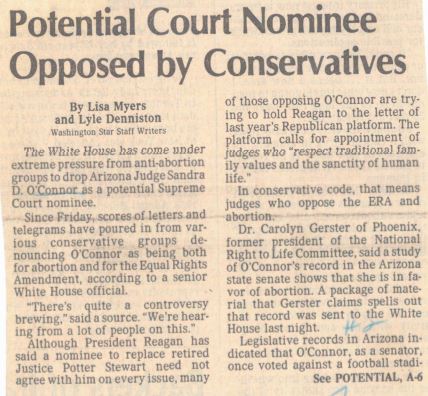
Moral Majority, pro-life unit oppose O’Connor selection

Newspaper article
July 8, 1981

Members of the Moral Majority and the nation’s largest anti-abortion group vowed Tuesday to seek to block the nomination of Judge Sandra Day O’Connor to the U.S. Supreme Court. Feminists, on the other hand, said her nomination was a “great victory.” At the core of the controversy is Judge O’Connor’s positions on abortion and the F.qual Rights Amendment while serving from 1969 to 1974 in the Arizona State Senate. Dr. Carolyn Gerster of Phoenix, internal-affairs chairman of the National Right to Life Committee, said her group will appeal to President Reagan to reconsider his nomination of Judge O’Connor, 51, of the Arizona Court of Appeals. “We are dismayed,” Dr. Gerster said. “We will work very, very hard to convince the president that he received erroneous information and ask him to withdraw her name.” Dr. Genter said that during a meeting with Reagan in January she was satisfied that a Supreme Court justice candidate’s position on abortion would be a “prime concern.” She said pro-life factions, which helped elect Reagan, feel betrayed , because he has not fulfilled a promise to appoint judges who ” “respect traditional human values and the sanctity of life.” In anticipation of Judge O’Connor’s appointment, Dr. Gerster on Sunday sent to Reagan a packet detailing the nominee’s voting record on abortion. Judge O’Connor’s nominatioi;1 also has been criticized by the Rev. Jerry Falwell, leader of the Moral Majority, which opposes the F.qual Rights Amendment and abortion. He said

Judge O’Connor only candidate interviewed by Reagan

Newspaper article by Michael J. Sniffen / Associated Press
July 8, 1981

Conservatives rap court nominee

Newspaper article by Saul Friedman
July 8, 1981

Woman for Supreme Court Bench

Newspaper article by "Our U.S. Editor in Washington"
July 8, 1981

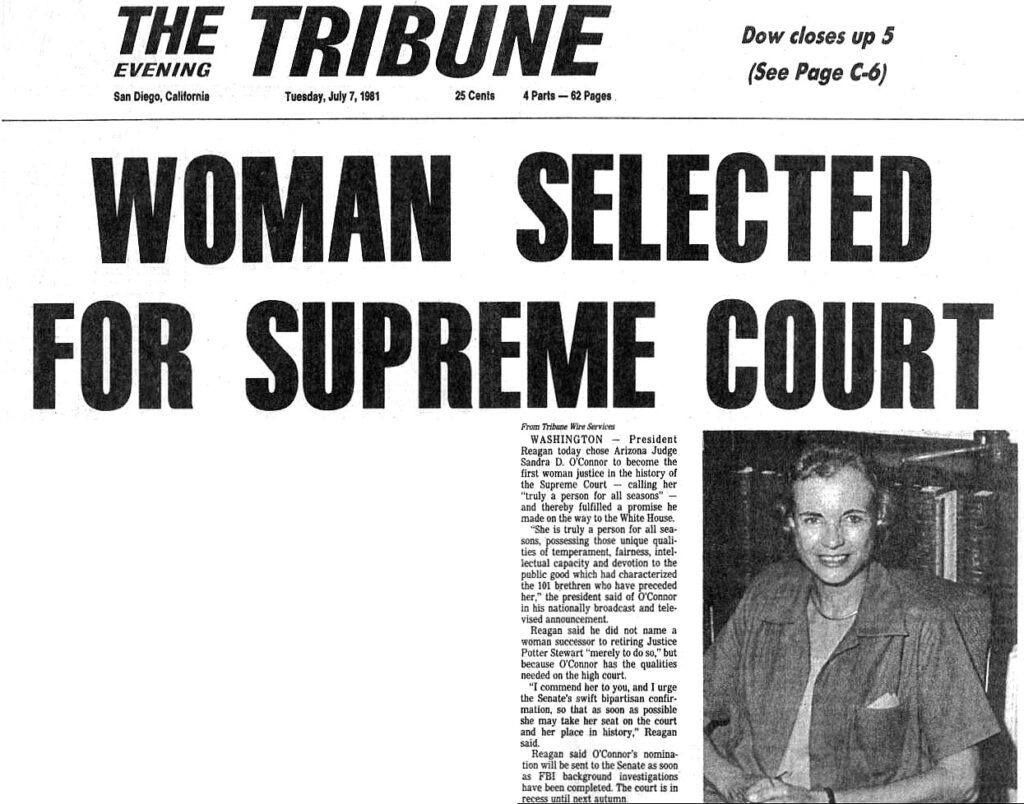
PRESIDENT REAGAN made U.S. history yesterday by appointing the first woman to serve on the U.S. Supreme Court. In a brief statement to reporters at the White House, Mr Reagan confirmed that he bad chosen Mrs Sandra O’Connor, a Judge of the Arizona Court of Appeals, to succeed Justice Potter Stewart, who retired last month. Mrs O’Connor, 51, who has been described as “a judicial conservative but flexible,” now faces final clearance by the Federal Bureau of Investigation and Senate confirmation. The choice of a woman fulfills a campaign commitment by the President. But he stressed yesterday that he was not putting her name forward simply because she was female. That would not h ave been fair to women or to future generations. The President described Mrs O’Connor as ” truly a person for all seasons, possessing those unique qualities of temperament, fairness, intellectual capacity and devotion to the public good.” The appointment could be the first of several opportunities that Mr Reagan will have to stamp his conservative beliefs on the face of American society-a chance denied to President Carter, who made no Supreme Court appointments. Service on the court is for life, unless a justice chooses to retire, and five of its nine members are now over 70. The importance of the Supreme Court in moulding American society is often underestimated outside the U.S., where attention tends to focus on Presidents and politicians. An active Republican, Mrs O’Connor served two full terms in the

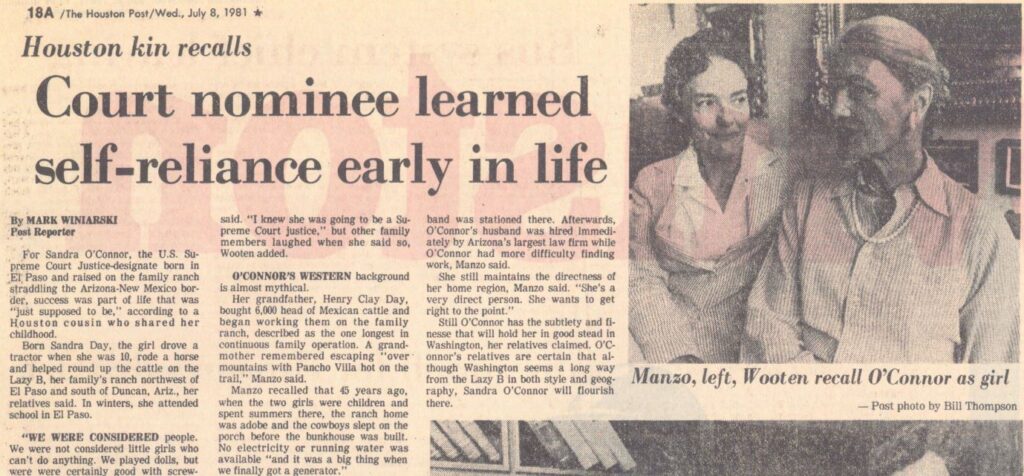
Court Nominee learned self-reliance early in life

Newspaper article by Fred Farris
July 8, 1981

For Sandra O’Connor, the U.S. supreme Court Justice-designate born in El Paso and raised on the family ranch ‘straddling the Arizona-New Mexico border, success was part of life that was “just supposed to be,” according to a Houston cousin who shared her childhood.

Born Sandra Day, the girl drove a tractor when she was 10, rode a horse and helped round up the cattle on the Lazy B, her family’s ranch northwest of El Paso and south of Duncan, Ariz., her relatives said. In winters, she attended school In El Paso.

“WE WERE CONSIDERED people. We were not considered little girls who can’t do anything. We played dolls, but were were certainly good with screwdrivers, nails and roundups too,” said Flournoy D. Manzo, who in childhood was always, seemingly, at the side of her year-younger first cousin.

Manzo, now a University of Houston administrator, and Evelyn Wooten, Manzo’s mother and O’Connor’s aunt, Tuesday afternoon were enjoying the thrill of a close relative becoming an historic figure and sharing their joy by opening up the family album. Out spilled photos of two young girls enjoying themselves on a beach, in family and school groups and with horses. Also, out came the O’Connor family holiday cards. One shows her and husband John, an attorney, backpacking.

A 1974 CARD HAS the O’Connors, included the three sons, pictured with powdered wigs and sitting on the “O’Connor Supreme Court.” Sandra O’Connor is listed as “co-chief justice, junior grade,” and her election to the Superior

Quick approval seen for court’s first woman: President Praised on Nomination

Newspaper article by Steve Neal
July 8, 1981

WASHINGTON – Ending almost two centuries of tradition, President Reagan announced Tuesday that he is nominating the first woman to the United States Supreme Court – Arizona jurist Sandra D. O’Connor. Mrs. O’Connor, 51, a judge on the Arizona Court of Appeals who has received a highly favorable rating from the state bar association, was named to fill the vacancy created by the retirement of Justice Potter Stewart. The President, making the historic announcement in the White House briefing room, called Mrs. O’Connor “truly a person for all seasons” and urged her swift confirmation by the Senate. The Senate Judiciary Committee has not yet scheduled hearings on Mrs. O’Connor’s nomination, which must be confirmed by a majority vote of the Senate. Capitol Hill sources said Tuesday that she would encounter little difficulty getting confirmed by the Republican-controlled Senate despite opposition from the anti-abortion movement MAJORITY LEADER. Howard Baker (R, tenn.) pledged to head the Senate effort backing Mrs O’Connor’s confirmation. “I commend the President for the courage of his decision to name a woman to the U.S. Supreme Court,” Baker said. Reagan’s nomination of Mrs. O’Connor was immediately challenged by the antiabortion lobby because she had supported less restrictive abortion laws. DR. JOHN C. WILLKE of Cincinnati, president of the National Right to Life Committee, said: “The entire pro-life movement will oppose her confirmation.” Reagan, however, told reporters Tuesday that

O’Connor Appointment a Plus for Reagan

Newspaper mention by Clay F. Richards
July 8, 1981

WASHINGTON President Reagan appealed to a wide range of his constituency – and won back many disaffected Republican women – with his choice for the Supreme Court, but he continued to alienate the far right. The choice of Judge Sandra Day O’Connor to become the first woman on the nation’s highest court was superb politics for Reagan. It strengthens his credibility he pledged early in his presidential campaign that one of his first appointments to the high court would be a woman. REAGAN already has gotten more credit than most of his predecessors for keeping his campaign promises. It wins back to his corner thousands of rank-and-file Republican women who were in near open rebellion over the administration’s meager record of finding women for top jobs in Washington. At the same time, it takes away an argument from Equal Rights Amendment supporters that the ERA is needed because the Reagan administration is no friend of women.

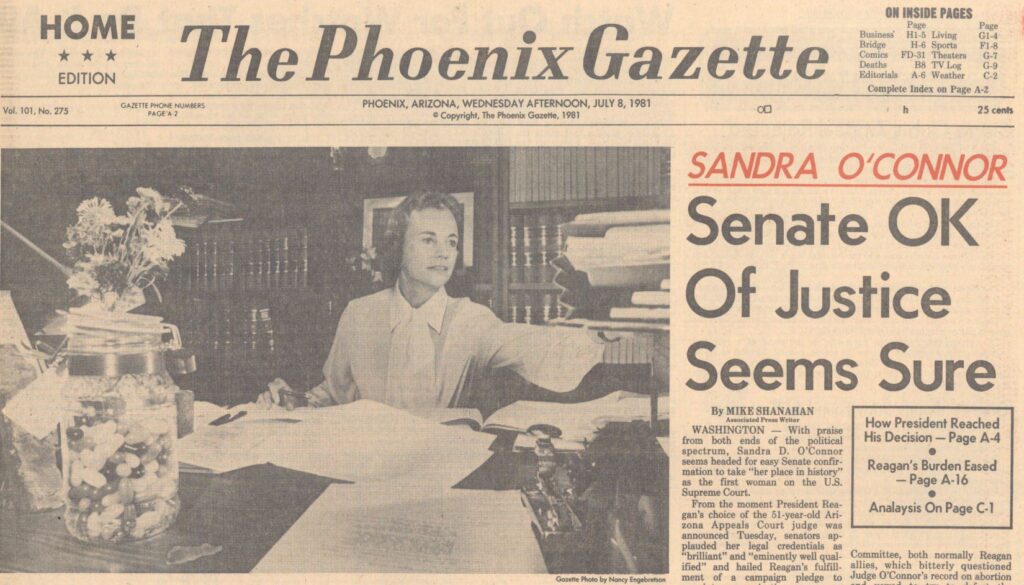
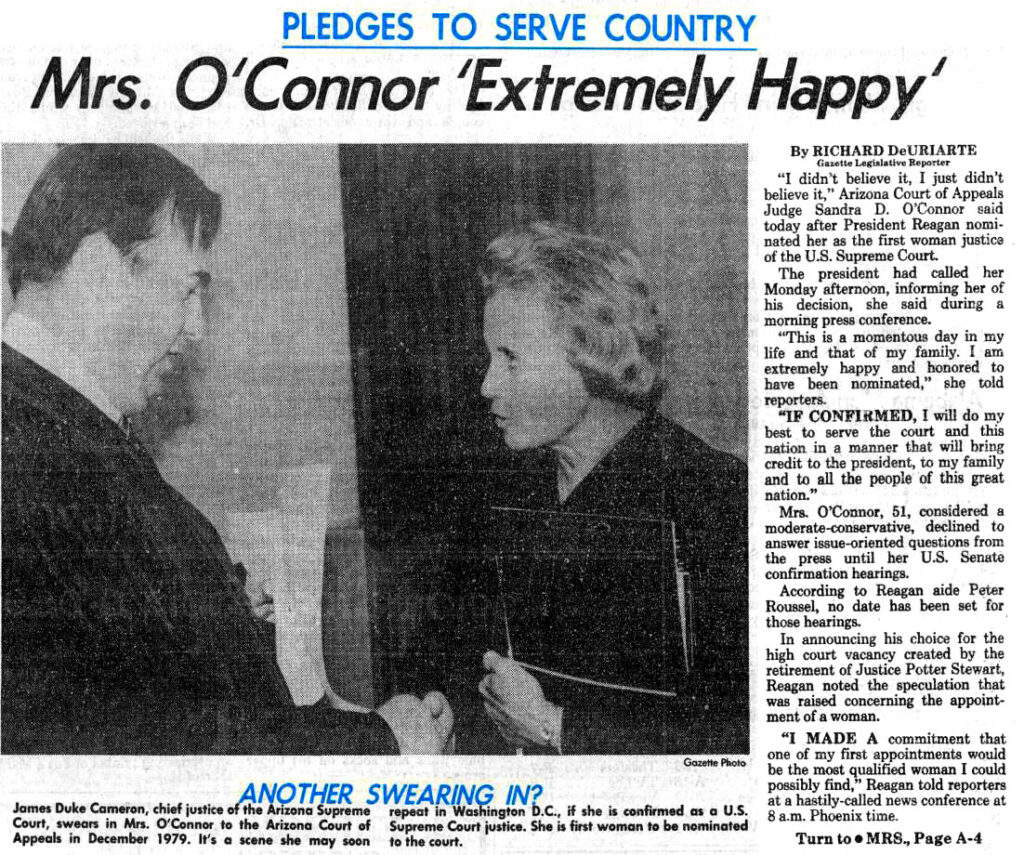
[Photo caption: Gazette Photo Judge Sandra O’Connor’s nomination won back many disaffected Republican women for President Reagan and was hailed as superb politics.] BUT THE nomination outraged the easily outraged Moral Majority, which vowed to fight the nomination on the grounds Mrs. O’Connor, while in the Arizona Senate, took stands indicating support for ERA and abortion. One leader of the anti-abortion movement, theologian Harold O.J. Brown, declared: “Reagan is absolutely finished with pro-life people, absolutely. They are so betrayed by this that he will

Nomination is one of many O’Connor feats

Newspaper article by "From staff and wire reports"
July 8, 1981

Nominated as the first woman to the nation’s highest court, State Appeals Court Judge Sandra O’Connor said she “never thought (her nomination) would be a reality.” But being first is nothing new for the 51-year-old O’Connor, who President Reagan chose Tuesday to fill the vacancy of retired Supreme Court Justice Potter Stewart. In 1969 she became Arizona’s first female legislator, and she went on to become Senate majority leader in 1973. She was the first and only woman to hold the job in either house of the state Legislature. Born March 26, 1930 on a ranch near Duncan, O’Connor has an extensive background in law and politics, and she rates superlatives from her col• leagues in both arenas. Arizona Supreme Court Justice Frank X. Gordon said'()’Connor has “philosophical leanings that a lot of us as well as the president would like to see.” But at least one assistant Arizona attorney general, who describes himself as a liberal, believes O’Connor’s politics haven’t affected her philosophy of the law. “I’ve had several cases before her, and all of her decisions have been fair. I don’t think her political beliefs will have that much to do with her decisions in Washington.” O’Connor was one of only five women in her class at the law school in 1952, and graduated third in her class. She also was a member of the board of editors of the Stanford Law Review. She man:ied another classmate, John Jay O’Connor m, now a Phoenix lawyer. They have three sons. Her first job was as deputy county

Change anticipated a woman

Newspaper mention by Associated Press
July 8, 1981

Change anticipated •a woman WASHINGTON (AP) – What physical changes would the marble temple the Supreme Court calls home undergo if Sandra D. O’Connor becomes its first female justice? “Absolutely none,” court spokesman Barrett McGurn said Tuesday, minutes after President Reagan nominated Judge O’Connor of the Arizona Court of Appeals to the nation’s highest court. But a rumor persists among court employees that a bathroom fixture “inappropriate” for women will be removed from a small restroom just off the justices’ conference room. The court officially dropped the “Mr. Justice” designation from titles last November, choosing instead just plain “Justice” before the names of members. Speculation was that the change, made without explanation or fanfare, was aimed at making thing.s less complicated in the event of a woman joining the court. If confirmed by the Senate, O’Connor will become the first woman in the court’s 191-year history to serve as a justice.

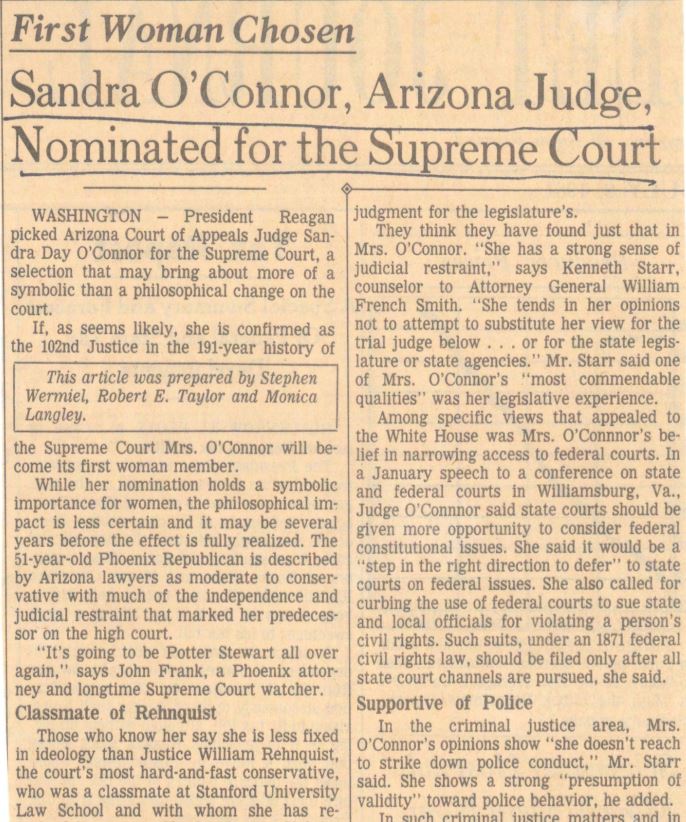
First Woman Chosen: Sandra O’Connor, Arizona Judge, Nominated for the Supreme Court

Newspaper article by Stephen Wermiel
July 8, 1981

This article was prepared by Stephen Wenniel, Robert E. Taylor and Monica Langley.

WASHINGTON – President Reagan picked Arizona Court of Appeals Judge Sandra Day O’Connor for the Supreme Court, a selection that may bring about more of a symbolic than a philosophical change on the court. If, as seems likely, she is confirmed as the 102nd Justice in the 191-year history of the Supreme Court Mrs. O’Connor will become its first woman member. While her nomination holds a symbolic importance for women, the philosophical impact is less certain and it may be several years before the effect Is fully realized. The 51-year-old Phoenix Republican Is described by Arizona lawyers as moderate to conservative with much of the independence and judicial restraint that marked her predecessor on the high court. “It’s going to be Potter Stewart all over again,” says John Frank, a Phoenix attorney and longtime Supreme Court watcher. Classmate of Rehnquist Those who know her say she Is less fixed In Ideology than Justice William Rehnquist, the court’s most hard-and-fast conservative, who was a classmate at Stanford University Law School and with whom she has remained in contact. Charles Ares, a University of Arizona law professor, says she isn’t “a right-wing ideologue. I guess that means she’ll be in the middle.” On some specific issues, her views appear to be consistent with the President’s, according to administration aides and others. As a state senator, she helped draft death penalty legislation

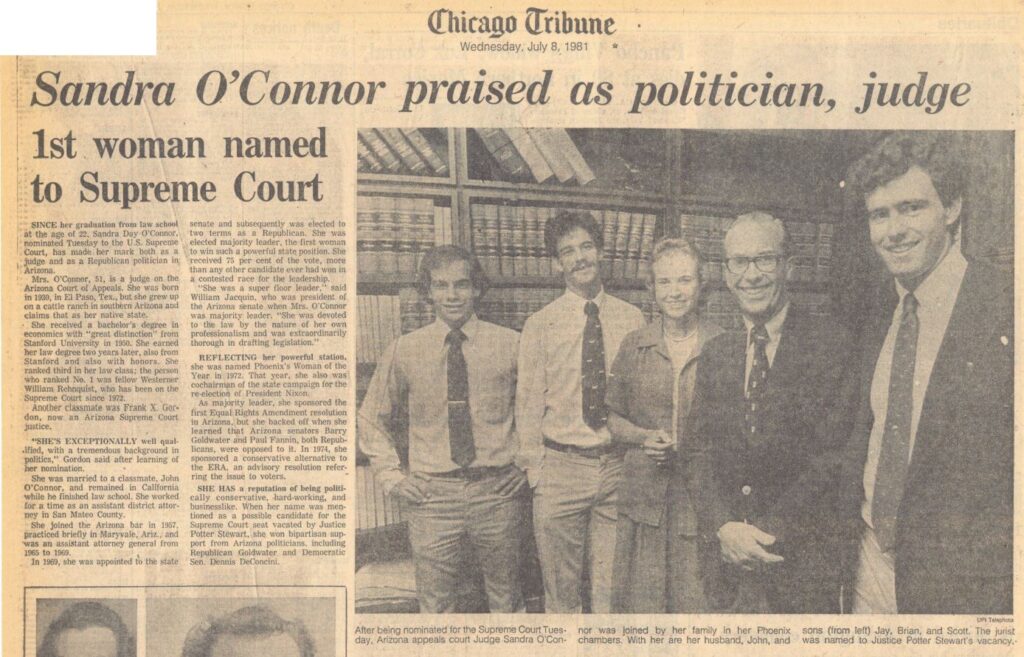
Sandra O’Connor praised as politician, judge

Newspaper article
July 8, 1981

SINCE her graduation from law school at the age of 22, Sandra Day O’Connor, nominated Tuesday to . the U.S. Supreme Court, has made her mark both as a judge and as a Republican politician in Arizona Mrs. O’Connor, 51, is a judge on the Arizona Court of Appeals. She was born in 1930, in El Paso, Tex., but she grew up on a cattle ranch in southern Arizona and claims that as her native state. She received a bachelor’s degree in economics with “great distinction” from Stanford University in 1950. She earned her law degree two years later, also from Stanford and also with honors . She ranked third in her law class; the person who ranked No. 1 was fellow Westerner William Rehnquist, who has been on the Supreme Court since 1972. Another classmate was Frank X. Gordon, now an Arizona Supreme Court justice. “‘SHE’S EXCEPTIONALLY well qualified, with a tremendous background in politics,” Gordon said after learning of her nomination. She was married to a classmate, John O’Connor, and remained in CaHfornia while he finished law school. She worked for a time as an assistant district attorney in San Mateo County. She joined the Arizona bar in 1957, practiced briefly in Maryvale, Ariz., and was an assistant attorney general from 1965 to 1969. , In 1969, she was appointed to the state senate and subsequently was elected to two terms as a Republican. She was elected majority leader, the first woman to win such a powerful state position. She received 75 per cent of the vote, more than any other

Reagan hit by right jabs

Newspaper article by Joseph Volz
July 8, 1981

Washington (News Bureau)-President Reagan’s nomination of a woman to the U.S. Supreme Court has created a major political problem for him by angering some of his staunchest supporters-the “New Right” conservatives of the Moral Majority and the right-to-life movement who form the bedrock ot his political base. The Rev. Jerry Falwell, leader of Moral Majority, predicted that “church people will desert (Reagan) in droves” because of the nomination of Sandra D. O’Connor. “Either the President did not have sufficient information about Judge O’Connor’s background in social issues , or he chose to Ignore the information,” the Rev. Falwell said. DB. CAROLYN GERSTER of Phoenix, former president of the National Right-to-Life Committee, said that O’Connor had twice voted in favor of abortion while a member of the Arizona Senate. Conservatives also contended that O’Connor was a member of a Senate committee that introduced a pro-equal rights amendment bill. Sandra O’Connor had a consistent and strong pro-abortion voting record while a senator in Arizona,” charged J.C. Wilke of Cincinnati, president of the National Right-to-Life Committee. He accused Reagan of Ignoring the pledge of the 1980 GOP platform to appoint judges “who respect traditional family values and the sanctity of innocent human life.” But the President, in announcing O’Connor’s nomination yesterday at the White House, said he was “completely satisfied” with her record on right-to-life Issues. He did not elaborate. WHILE ANTI-ABORTI

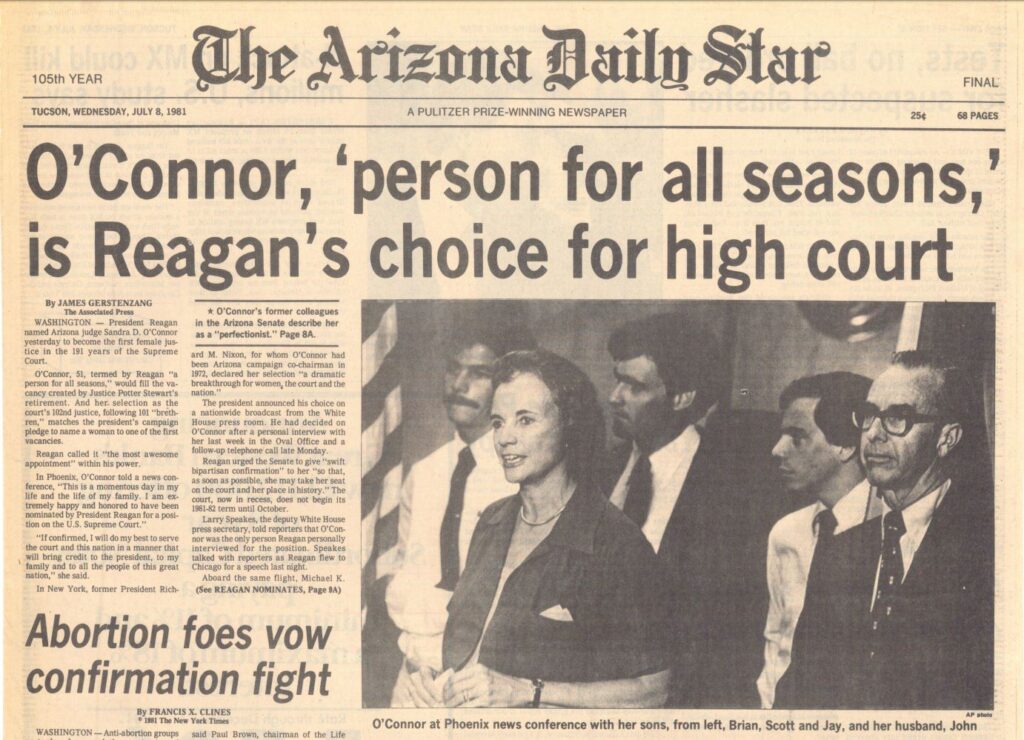
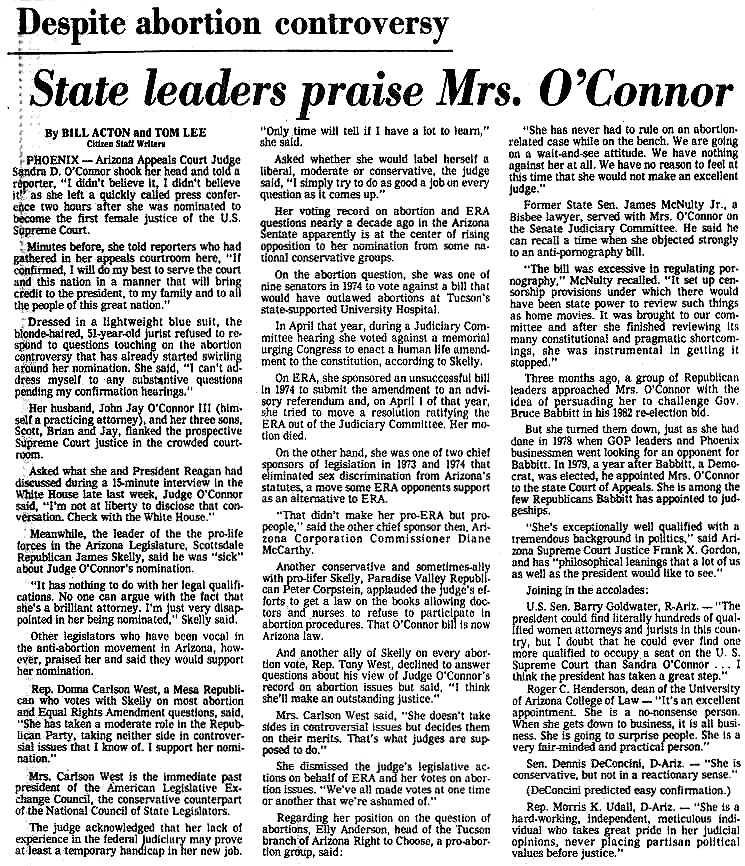
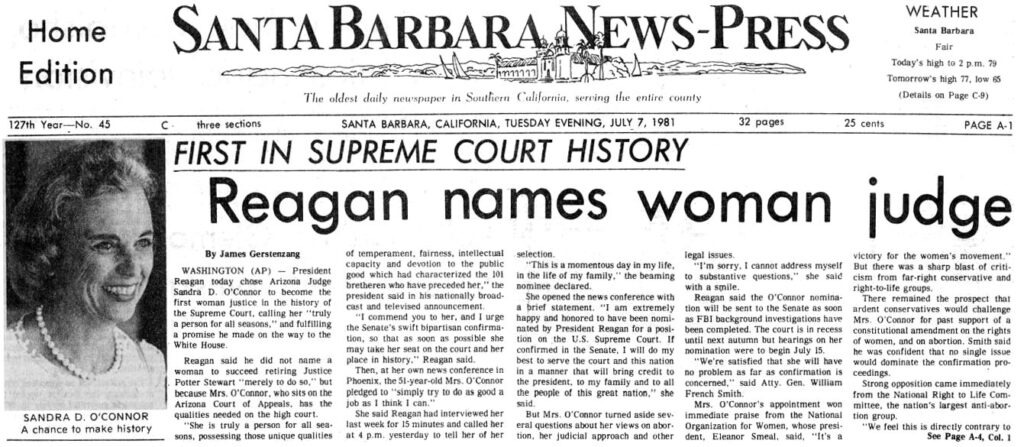
O’Connor, ‘person for all seasons,’ is Reagan’s choice for high court

Newspaper article by James Gerstenzang
July 8, 1981

Sandra O’Connor was warm, gracious and unassuming

Op ed by Peter Brock
July 8, 1981

Sandra Day O’Connor, trim and festively clad in cowboy denim and boots, walked quietly away from the dust-stirring clamor of about 700 guests and seated herself on a low, shaded wall while a Western band warmed up.

Last Sept. 20 marked the 100th anniversary of the Lazy B ranch where four generations of the Day family have grown up, never straying too far.

SANDRA, THE OLDEST of Harry Day’s children, earlier took her place beside her mother Ada Mae, brother Alan and sister Ann (Mrs. Scott Alexander) and long-time foreman Webb Cole atop a wagon that was circled by friends, relatives and guests.
Each got up from their folding chair and spoke briefly into a microphone, sharing greetings, a special anecdote or two and some slightly choking sentiments about the landmark gathering.

Sandra, with a permanent and warm smile fixed on her face, had watched her father with clear-eyed adoration as the 83-year-old patriarch stiffly fidgeted with the microphone and then launched past some brief public shyness into a reel of momentum-gathering recollections of ranch life that were lost among the mostly younger crowd, who applauded and laughed eagerly.

SANDRA’S SHORT, WELCOMING remarks were polished, gracious and almost unnoticeably forgotten – the way it was supposed to be. After all, the day was designed for nostalgia and Harry Day.

She sat quietly on the wall in front of her girlhood home and patiently studied the throng in front of her while dust sifted upward in the heat of the breezeless

Arizona Judge Sanda O’Connor 1st Woman for Supreme Court: Many here wish it were Kennedy

Newspaper mention by Laura Berman
July 8, 1981

The nomination of Arizona Appeals Court Justice Sandra D. O’Connor for the vacant U.S. Supreme Court seat drew an almost universal reaction from Michigan jurists, feminists and lawyers Tuesday: applause for President Reagan’s selection of a woman candidate and bewilderment about the candidate herself. Even Cornella Kennedy, the U.S. Court of Appeals judge who was widely regarded as a leading choice for the nomination, said she knew only what she had read in press accounts about O’Connor. Kennedy said she was pleased a woman had been nominated. She added, “I would have been more pleased if it were I.” John Felkens, chief judge of the U.S. District Court iri Michigan’s eastern district, . said he was pleased Reagan Cornfha Kennedy had chosen a woman “but terribly disappointed that it is not my friend Cornella Kennedy.” And former Michigan Republican senator Robert Griffin, who said he had lobbied for Kennedy in Washington “to the extent I could,” praised Reagan for fulfilling his campaign promise by nominating a woman. “Of course,” he said from his Washington office, “I was hoping the choice would be Cornelia Kennedy or (Michigan Supreme Court Chief Justice) Mary Coleman.” LOCAL WOMEN judges and lawyers praised Reagan’s choice of a woman. “I am very pleased to think I will look upon that

Nominee doesn’t fit any mold

Op ed by Gene Goldenberg
July 8, 1981

WASHINGTON – Sandra Day O’Connor, the first woman nominated to the U.S. Supreme Court, doesn’t fit easily into any mold. Though described by friends and associates as politically conservative, she has avoided ideological labels during almost six years as a state trial and appeals court judge in Arizona while winning widespread praise for her careful, concise and judicious approach to legal issues. AND DURING four years as Republican majority leader of the state Senate in the early 1970s, she took several liberal stands – particularly on women’s issues – that already have evoked angry opposition to her nomination from right-wing political groups. “A person for all seasons,” is the way President Reagan described this 51-year-old Arizonan in announcing he wanted her to break the 191-year, male-only tradition of the high court. That view was resoundingly and repeatedly echoed during interviews with some of the people who know Judge O’Connor best. “SANDRA IS NOT a crusader on any issue,” said William Jacquin, who heads the Arizona Chamber of Commerce and was president of the state Senate when Judge O’Connor was majority leader from 1971-1974. “One of her great attributes is that she faces each issue as a problem and then looks for the best possible solutions.” Robert Broomfield, presiding judge of the Maricopa County (Phoenix) Superior Court, where Judge O’Connor served from 1975 until she was named to the Arizona Court of Appeals in 1979, said “she believes in following the law.

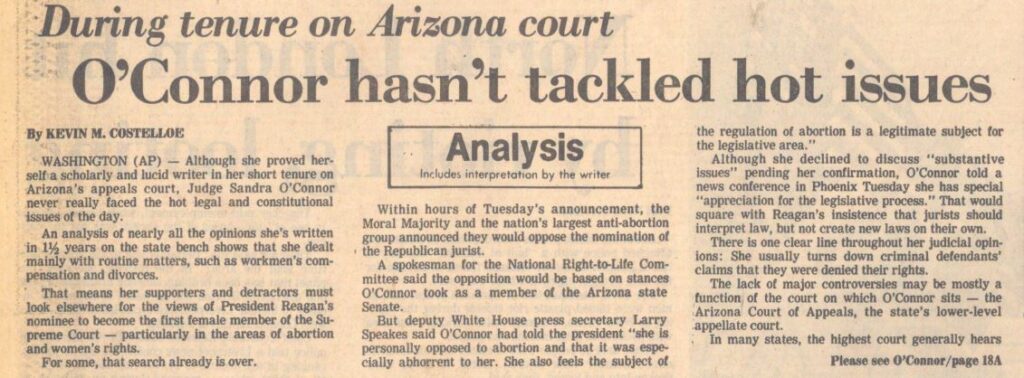
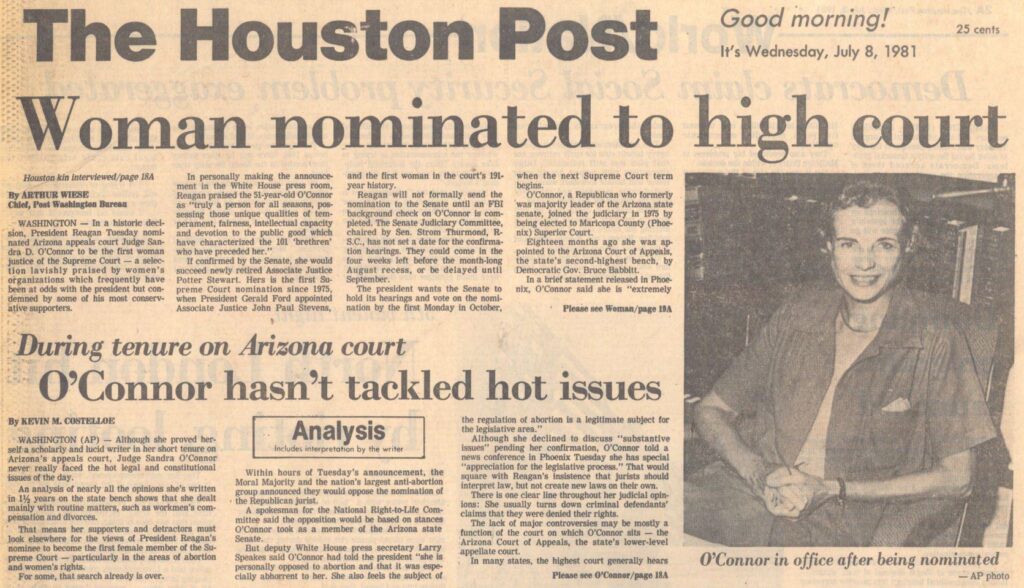
During tenure on Arizona court O’Connor hasn’t tackled hot issues

Newspaper article by Kevin M. Costelloe
July 8, 1981

Analysis Includes interpretation by the writer

WASHINGTON (AP) – Although she proved herself-a scholarly and lucid writer in her short tenure on Arizona’s appeals court, Judge Sandra O’Connor never really faced the hot legal and constitutional issues of the day. An analysis of nearly all the opinions she’s written in 1½ years on the state bench shows that she dealt mainly with routine matters, such as workmen’s compensation and divorces. That means her supporters and detractors must look elsewhere for the views of President Reagan’s nominee to become the first female member of the Supreme Court – particularly in the areas of abortion and women’s rights. For some, that search already ls over. Within hours of Tuesday’s announcement, the Moral Majority and the nation’s largest anti-abortion group announced they would oppose the nomination of the Republican jurist. A spokesman for the National Right-to-Life Committee said the opposition would be based on stances O’Connor took as a member of the Arizona state Senate. But deputy White House press secretary Larry Speakes said O’Connor had told the president “she ls personally opposed to abortion and that it was especially abhorrent to her. She also feels the subject of the regulation of abortion is a legitimate subject for the legislative area.” Although she declined to discuss “substantive issues” pending her confirmation, O’Connor told a news conference in Phoenix Tuesday she has special “appreciation for the legislative process.”

O’Connor’s experience may help states’ rights

Newspaper article by Jim Mann
July 8, 1981

WASHINGTON – In the long run. the most significant fact about Arizona Court of Appeals Judge Sandra Day O’Connor may turn out to be not that she is a woman but that she has served as a state legislator and state judge. O’Connor’s experience at the state level is almost as unusual for the modern-day Supreme Court ru: is her gender . For the past quartercentury, virtually every person appointed to the Supreme Court has come there from the same national channels: a federal judgeship, a federal government job in Washington or a nationally prominent law practice. Not since Justice William J. Brennan Jr. came to Washington from the New Jersey Supreme Court in 1956 has any justice been appointed with experience in a state court system. None of the members of the current court has ever served in a state legislature. If O’Connor gives the justices a ground-level view of the way state courts and legislatures operate, her voice could prove highly influential. She could, in fact, become a powerful advocate on behalf of President Reagan’s oft-stated desire to give greater power to the states. The Supreme Court is regularly asked to pass judgment on the validity of laws enacted by state legislatures and rulings by state courts. Generally, the justices find it much easier to rule unconstitu- . tional the actions of these state bodies than the laws passed by Congress or the actions of federal agencies. • In the court term that has just ended, for example, the Supreme Court moved further in the

What Rulings Tell of O’Connor

Newspaper article by Stuart Taylor Jr.
July 8, 1981

Washington
Sandra D. O’Connor’s opinions during her 18 months as an Arizona Court of Appeals judge display careful reasoning and use of precedent.
They do not shed much light on her attitude toward most of the controversial constitutional issues she will face if she is confirmed as an associate justice of the U.S. Supreme Court.
A former Republican majority leader of the Arizona Senate, O’Connor is widely regarded as
conservative in her political outlook. Her legislative record, however.,has been attacked by anti-abortion groups that say she cast pro-abortion votes before she became a judge.
A review of O’Connor’s 30 published opinions for the Arizona Court of Appeals disclosed
none dealing with abortion. Nor did any of the opinions disclose her views on most of the other controversial constitutional issues the Supreme Court has ruled on, such as busing as a means of desegregating schools, prayer in schools, the death penalty, affirmative action and
the constitutional rights of criminal defendants.
Thus it appears to be far too early to determine whether the ideologically divided court will become more conservative or…

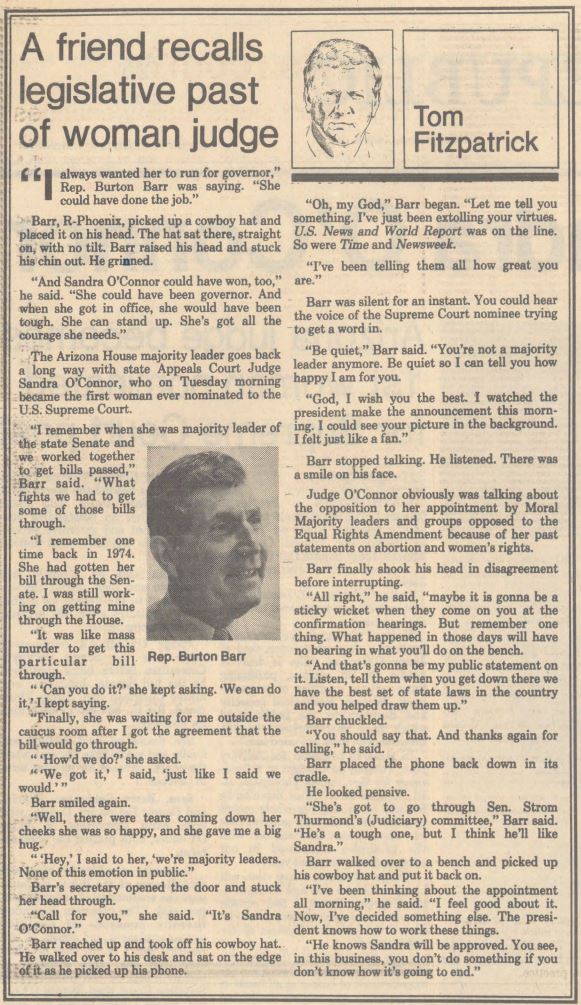
A friend recalls legislative past of woman judge

Newspaper article by Tom Fitzpatrick
July 8, 1981

I always wanted her to run for governor,” Rep. Burton Barr was saying. “She could have done the job.” Barr, R-Phoenix, picked up a cowboy hat and placed it on his head. The hat sat there, straight on, with no tilt. Barr raised his head and stuck his chin out. He grinned.

“And Sandra O’Connor could have won, too,” he said. “She could have been governor. And when she got in office, she would have been tough. She can stand up. She’s got all the courage she needs.”

The Arizona House majority leader goes back a long way with state Appeals Court Judge Sandra O’Connor, who on Tuesday morning became the first woman ever nominated to the U.S. Supreme Court.

“I remember when she was majority leader of the state Senate and we worked together to get bills passed,” Barr said. “What fights we had to get some of those bills through.

“I remember one time back in 1974. She had gotten her bill through the Senate. I was still working on getting mine through the House.

“It was like mass murder to get this particular bill through.

“‘Can you do it?’ she kept asking. ‘We can do it,’ I kept saying.

“Finally, she was waiting for me outside the caucus room after I got the agreement that the bill would go through.

“‘How’d we do?’ she asked.

“‘We got it,’ I said, ‘just like I said we would.'”

Barr smiled again.

“Well, there were tears coming down her cheeks she was so happy, and she gave me a big hug.

“‘Hey,’ I said to her, ‘we’re majority leaders. None of this emotion in public.”

Barr’s secretary

Tempeans praise High Court nominee

Newspaper article by Lori Grzesiek
July 8, 1981

Sandra O’Connor may have just won national acclaim, but she’s had the admiration of various Arizona State University professors for a long time. She’s been making friends in Tempe over the years as an active supporter of the College of Law. Besides being on the college’s board of visitors for a year, O’Connor has served on panels critiquing law students’ performances during staged classroom trials. Dean Alan Matheson said O’Connor’s heavy involvement began in the 1970s, when she pushed for a law internship program at the Legislature. Burdened with heavy court dockets, she helped law professor Robert Misner produce a videotape of a mock murder trial he still uses in criminal law classes. “She is very concerned about maintaining the quality of law education in Arizona,” Misner said. “Her time was very valuable as a judge, yet she thought enough about the future of the legal profession to dedicate her time to the law school. “She has been an active supporter in helping to assure that Arizona has a bright, young crop of attorneys.” Misner called O’Connor “extremely bright, forthright and straightforward.” Criminal Justice Professor Peter Haynes said he knows O’Connor through her work in the Legislature for court administration reform. That background and her concern with equal rights will help her “fit in well” with Chief Justice Warren Burger, he said. Haynes remembers a college commencement address in which O’Connor recalled her graduation from law school in 1952. “She said she

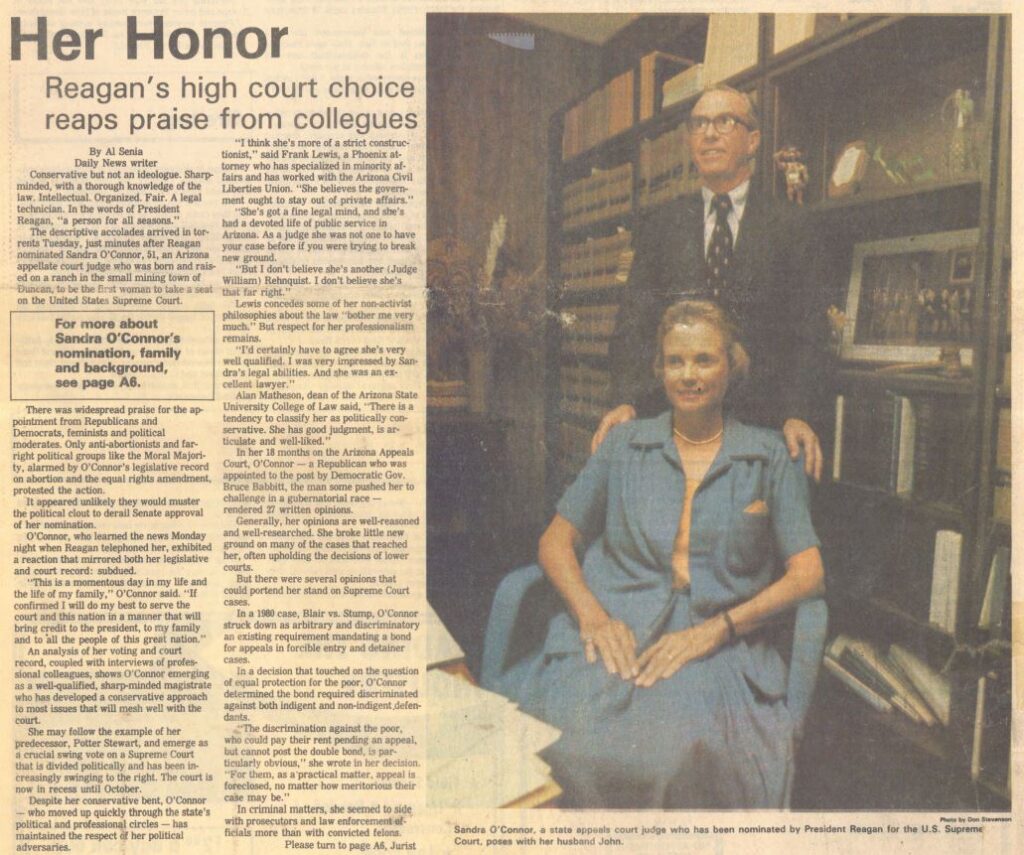
Her Honor: Reagan’s choice reaps praise

Newspaper article by Al Senia
July 8, 1981

Conservative but not an ideologue. Sharpminded, with a thorough knowledge of the law. Intellectual. Organized. Fair. A legal technician. In the words of President Reagan, “a person for all seasons.” The descriptive accolades arrived in torrents Tuesday, just minutes after Reagan nominated Sandra O’Connor, 51, an Arizona appellate court judge who was born and raised on a ranch in the small mining town of Duncan, to be the first woman to take a seat on the United States Supreme Court.

There was widespread praise for the appointment from Republicans and Democrats, feminists and political moderates. Only anti-abortionists and farright political groups like the Moral Majority, alarmed by O’CoMor’s legislative record on abortion and the equal rights amendment, protested the action. It appeared unlikely they would muster the political clout to derail Senate approval of her nomination. O’Connor, who learned the news Monday night when Reagan telephoned her, exhibited a reaction that mirrored both her legislative and court record: subdued. “This is a momentous day in my life and the life of my family,” O’Connor said. “If confirmed I will do my best to serve the court and this nation in a manner that will bring credit to the president, to my family and to all the people of this great nation.” An analysis of her voting and court record, coupled with interviews of professional colleagues, shows O’Connor emerging as a well-qualified, sharp-minded magistrate who has developed a conservative

First Woman Nominated to U.S. Supreme Court

Newspaper article by Associated Press
July 8, 1981

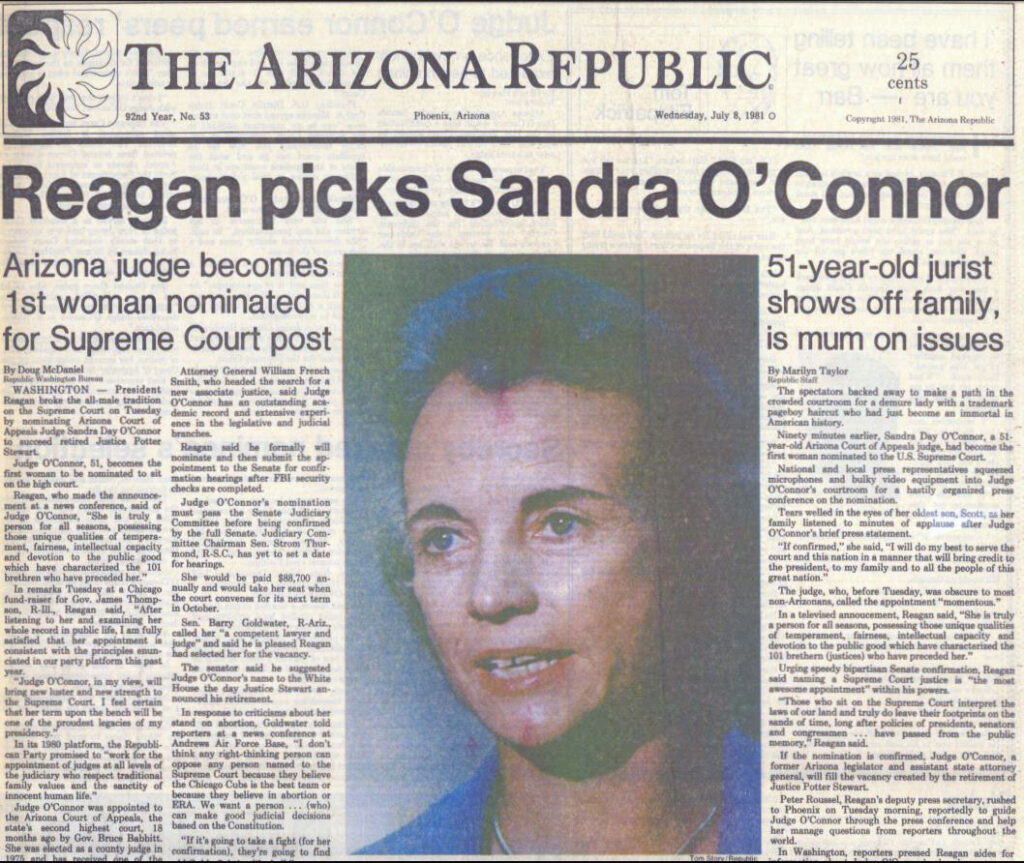
Arizona judge becomes 1st woman nominated for Supreme Court Post

Newspaper article by Doug McDaniel
July 8, 1981

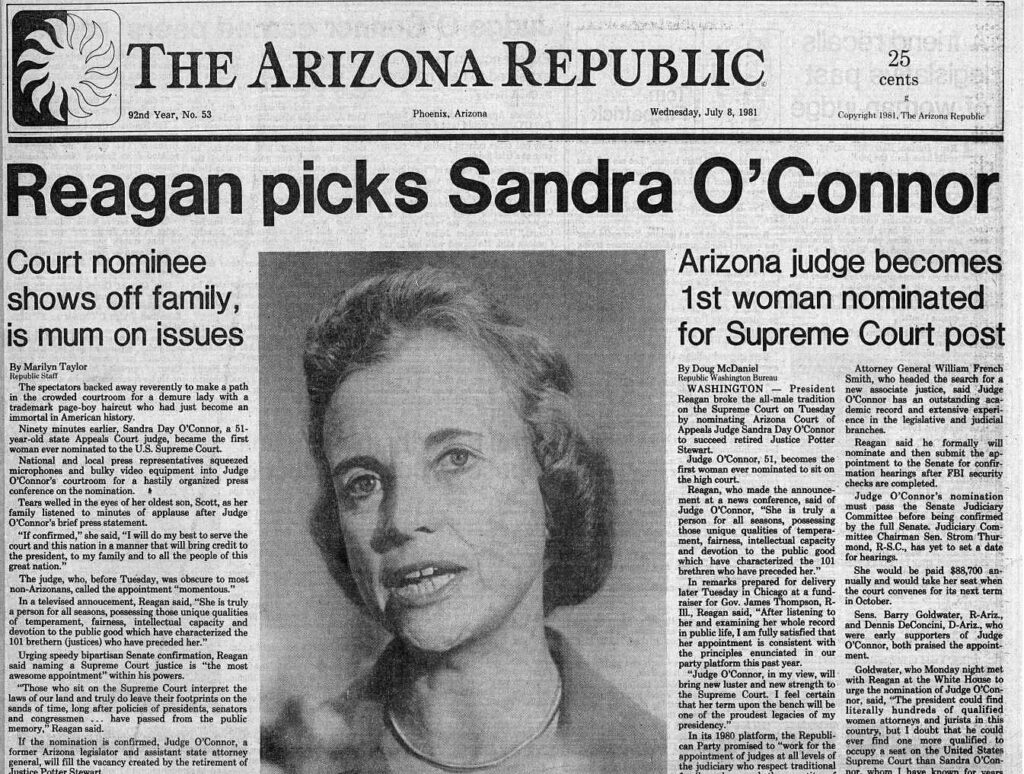
WASHINGTON – President Reagan broke the all-male tradition on the Supreme Court on Tuesday by nominating Arizona Court of Appeals Judge Sandra Day O’Connor to succeed retired Justice Potter Stewart. Judge O’Connor, 51, becomes the first woman ever nominated to sit on the high court. Reagan, who made the announcement at a news conference, said of Judge O’Connor, “She is truly a person for all seasons, possessing those unique qualities of temperament, fairness, intellectual capacity and devotion to the public good which have characterized the 101 brethren who have preceded her.” In remarks prepared for delivery later Tuesday in Chicago at a fundraiser for Gov. James Thompson, R-Ill., Reagan said, “After listening to her and examining her whole record in public life, I am fully satisfied that her appointment is consistent with the principles enunciated in our party platform this past year. “Judge O’Connor, in my view, will bring new luster and new strength to the Supreme Court. I feel certain that her term upon the bench will be one of the proudest legacies of my presidency.” In its 1980 platform, the Republican Party promised to “work for the appointment of judges at all levels of the judiciary who respect traditional family values and the sanctity of innocent human life.” Judge O’Connor was appointed to the Arizona Court of Appeals, the state’s second highest court, 18 months ago by Gov. Bruce Babbitt. She was elected as a county judge in 1975 and has received one of the highest

Stanford’s ‘dumbest’ law class really was a winner

Newspaper article by Alice Z. Cuneo
July 8, 1981

Members of the Stanford Law School class of 1952 like to tell the story that one of their professors called them the dumbest law school class he’d ever lectured. , This is the class, they’re happy to point out now, that has,already produced one U.S. Supreme Court justice and is on the verge of providing another. Supreme Court Justice William Rehnquist and President Reagan’s nominee for the court, Sandra Day O’Connor, attended classes together at Stanford Law School and graduated in 1952. Rehnquist was first in the class and O’Connor was third. A classmate, Leon Shields, an attorney practicing in Menlo Park. said the late George Osborne oncE “slammed down a book, said it was the dumbest class he had ever taught at Stanford, and didn’t come back for two weeks.” Osborne, who taught trusts and was an expert on mortgages an

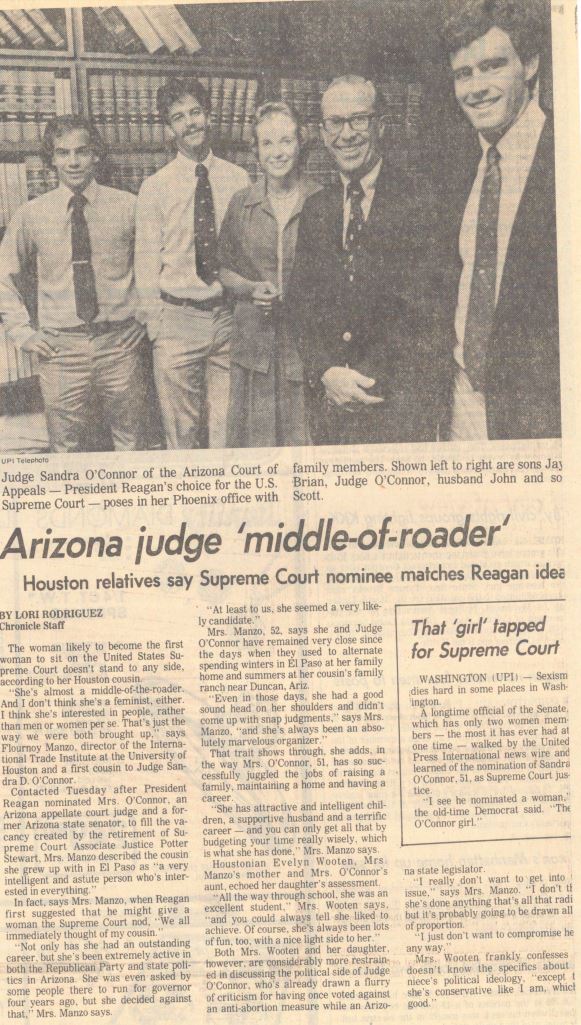
Arizona judge ‘middle-of-roader’: Houston relatives say Supreme Court nominee matches Reagan ideas

Newspaper article by Lori Rodriguez
July 8, 1981

The woman likely to become the first woman to sit on the United States _Supreme Court doesn’t stand to any side, according to her Houston cousin “She’s almost a middle-of-the-roader. And I don’t think she’s a feminist, either . I think she’s interested in people, rather than men or women per se. That’s just the way we were both brought up,” says Flournoy Manzo, director of the International Trade Institute at the University of Houston and a first cousin to Judge Sandra D. O’Connor. Contacted Tuesday after President Reagan nominated Mrs . O’Connor, an Arizona appellate court Judge and a former Arizona state senator, to fill the vacancy created by the retirement of Supreme Court Associate Justice Potter Stewart, Mrs. Manzo described the cousin she grew up with in El Paso as “a very intelligent and astute person who s interested in everything.” In fact, says Mrs. Manzo, when Reagan first suggested that he might give a woman the Supreme Court nod, we all immediately thought of my cousin.” . Not only has she had an outstanding career, but she’s been extremely active in both the Republican Party and state polltics in Arizona. She was even asked by some people there to run for governor four year s ago, but she decided against that .” Mrs. Manzo says. “At least to us, she seemed a very likely candidate.” Mrs. Manzo, 52, says she and Judge O’Connor have remained very close since the days when they used to alternate spending winters in El Paso at her family home and summers at her cousin’s

Abortion foes vow confirmation fight

Newspaper article by Francis X. Clines
July 8, 1981

Senate leaders will seek swift confirmation

Newspaper article
July 8, 1981

WASHINGTON – (AP) – Senate leaders said Tuesday they would seek swift confirmation of Sandra D. O’Connor, President Reagan’s choice for the Supreme Court. In a Republican-controlled Senate, some of the strongest praise of O’Connor was from Democrats, who said they were pleased Reagan had chosen a woman with strong legal credentials. Alan Cranston, D-Calif., the assistant Democratic leader, called O’Connor “a brilliant legal scholar with considerable legal experience.” By naming the first woman justice, Reagan has taken a “major step in the battle to eliminate sex discrimination,” Cranston said.

SENATE MAJORITY LEADER Howard Baker of Tennessee, who also commended Reagan for naming a woman, said he was “delighted” by the choice and promised to work for her confirmation. Sen. Edward M. Kennedy, D-Mass., a senior member of the Senate Judiciary Committee which must confirm the nomination, said he was “extremely pleased” with the decision to choose a woman. Sen. Strom Thurmond, R-S.C., chairman of the committee, learned of the selection less than an hour before it was announced by Reagan. Nonetheless, he said, “I am glad the president has made his choice, and I will do everything Ican to help the president.” Sen. Joseph Biden, D-Del., senior Democrat on the committee, said O’Connor “seems to be eminently qualified for the position.”

ONE REPUBLICAN MEMBER of the judiciary panel, Arlen Specter of Pennsylvania, cautioned against deciding too quickly on O’Connor’s qualifications.

Sandra O’Connor: Senate OK of Justice Seems Sure

Newspaper article by Mike Shanahan / Associated Press
July 8, 1981

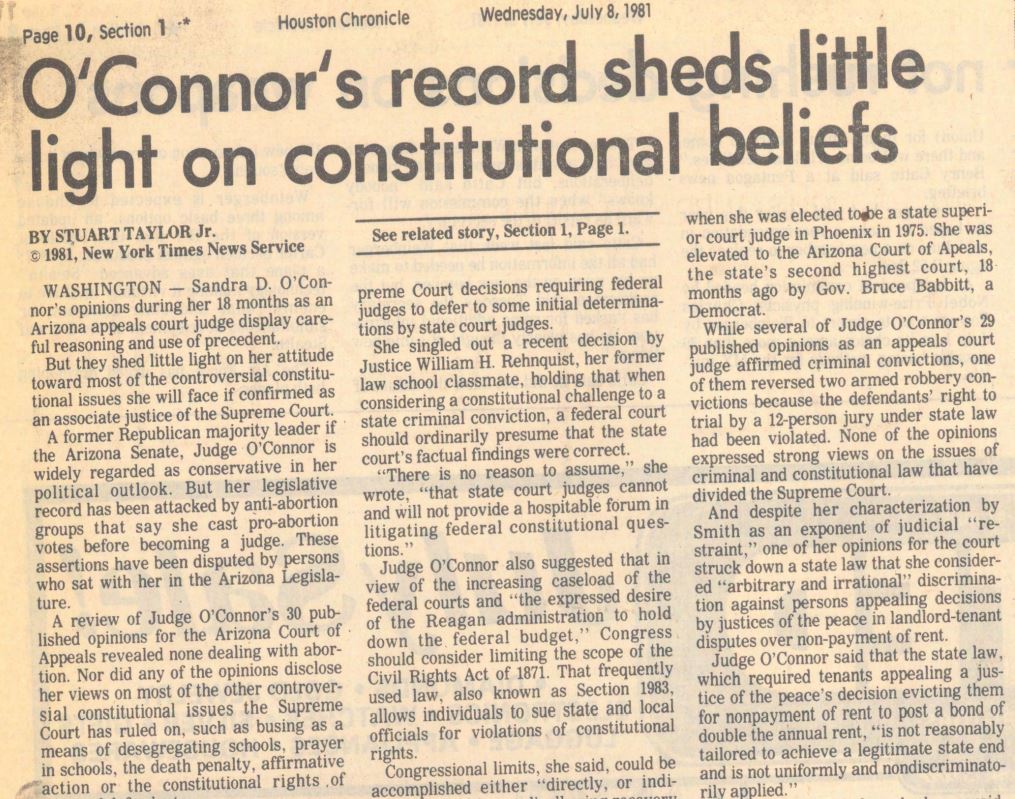
O’Connor’s record sheds little light on constitutional beliefs

Newspaper article by Stuart Taylor Jr.
July 8, 1981

Washington
Sandra D. O’Connor’s opinions during her 18 months as an Arizona Court of Appeals judge display careful reasoning and use of precedent.
They do not shed much light on her attitude toward most of the controversial constitutional issues she will face if she is confirmed as an associate justice of the U.S. Supreme Court.
A former Republican majority leader of the Arizona Senate, O’Connor is widely regarded as
conservative in her political outlook. Her legislative record, however.,has been attacked by anti-abortion groups that say she cast pro-abortion votes before she became a judge.
A review of O’Connor’s 30 published opinions for the Arizona Court of Appeals disclosed
none dealing with abortion. Nor did any of the opinions disclose her views on most of the other controversial constitutional issues the Supreme Court has ruled on, such as busing as a means of desegregating schools, prayer in schools, the death penalty, affirmative action and
the constitutional rights of criminal defendants.
Thus it appears to be far too early to determine whether the ideologically divided court will become more conservative or more liberal if and when Judge ‘ O’Connor fills the vacancy created by the retirement of Potter Stewart, who has been viewed as a moderate leaning to the conservative side of the court’s philosophical balance.
Attorney General William French Smith said Tuesday after President Reagan had announced Judge O’Connor as his choice to be the first woman to sit on the

Udall, Goldwater agree on O’Connor’s abilities

Newspaper article by Anne M. Hyde
July 8, 1981

Reagan Court Choice: ‘Efficient, Conservative’

Newspaper article by Al Senia
July 8, 1981

PHOENIX – Sandra O’Connor, selected by President Reagan to become the first woman justice of the U.S. Supreme Court, had a meteoric rise through the political and judicial ranks of Arizona, where she was raised on a cattle ranch. Colleagues of the 51-year-old Republican, who grew up in the small mining and ranching community of Duncan, say she has impressed them with a sharp mind, efficiency and conservative views. Her voting record in the state Legislature, her opinions from the bench, and comments from those who have worked with and against her, show her as a qualified magistrate who • has developed a conservative approach to most issues. But O’Connor – who graduated third in her 1952 class at Stanford University Law School – has maintained the respect of liberal adversaries. “I think she’s more of a strict constructionist. She believes the government ought to stay out of affairs.” said Frank Lewis, a Phoenix attorney specializing in minority affairs and who has worked with the Arizona Civil Liberties Union. “She’s got a fine legal mind, and she’s had a devoted life of public service in Arizona. As a judge she was not one to have your case before if you were trying to break new ground. But I do not believe she’s another Rehnquist. I don’t believe she’s that far right.” Justice William Rehenquist was in O’Connor’s law school class and ranked first. Alan Matheson, dean of the Arizona State University College of Law, said there “is a tendency to classify” O’Connor “as politically

Judge Sandra O’Connor Gets Another Big First

Newspaper article by Associated Press
July 8, 1981

Her decisions: no clues on fed stance

Newspaper article by Associated Press
July 8, 1981

Appointee Could Give Justices a New Outlook

Newspaper article
July 8, 1981

WASHINGTON In the long run. the most significant fact about Arizona’s Court of Appeals Judge p~ndr~ Day O’Connor may turn out to benot that she is a woman but that she has served as a state legislator and state judge. O’Connor’s long experience at the state level 1s almost as unusual for the modern-day Supreme Court as is her gender. For the last quartercentury, virtually every person appointed to the high court has come through the same channels : a federal judgeship, a federal government job inWashington or a nationally prominent law practice. Not since Justice William J. Brennan Jr . came to Washington from the New Jersey Supreme Court tn 1956 has any court appointee had experience in a state court system. None of the members of the current court has everserved in a state legislature. If O’Connor gives the Justices a ground-level view of how state courts and legislatures operate, her voice could be highly influential. She could, in fact, become a powerful advocate of President Reagan’s oft-stated desire to give greater power to the states. The Supreme Court is asked regularly to judge the validity of laws enacted by state legislatures and rulings by state courts. Generally, the justices fine it much easier to rule unconstitutional the actions of those state bodies than the laws enacted by Congress or the actions of federal agencies. In the court term that has just ended, for example, the Supreme Court moved further in the direction of judicial restraint than at any time in

1st Woman is named to high court

Newspaper article
July 8, 1981

… reporters Tuesday that Mrs. O’Connor ”falls generally within the President’s overall judicial philosophy .., Smith said at the White House that Mrs. O’Connor was a judicial conservative. “We’re satisfied that she considers it the function of the court to apply and interpret the law and not to make it,” Smith said “She recognizes that it is the responsibility of elected representatives to enact laws.”

According to Smith, the names of more than 20 potential nominees were submitted to Reagan. The attorney general declined to say whether Reagan interviewed other candidates for the vacancy.

At a press conference in Phoenix. Judge O’Connor declined to talk about issues, pending her confirmation hearing. Following is a partial transcript:

Q-When did you find out President Reagan would nominate you?
A-He called me yesterday afternoon, about 4 o’clock our time, and spoke with me at that time.
Q-Had you, considered you were a serious contender for the post?
A-I assumed that l was because I was interviewed late last week in Washington.
Q-What kind of questions did the president ask?
A-I’m not at liberty to disclose the contents of the conversation, and you can check with the White House on that.
Q-How do you view yourself as far as the law’s concerned … your legal approach? A-I simply try to do as good a job as I can with each question as it arises.
Q-What were your thoughts when you first realized that you were being considered. that you might be the first woman on the Supreme

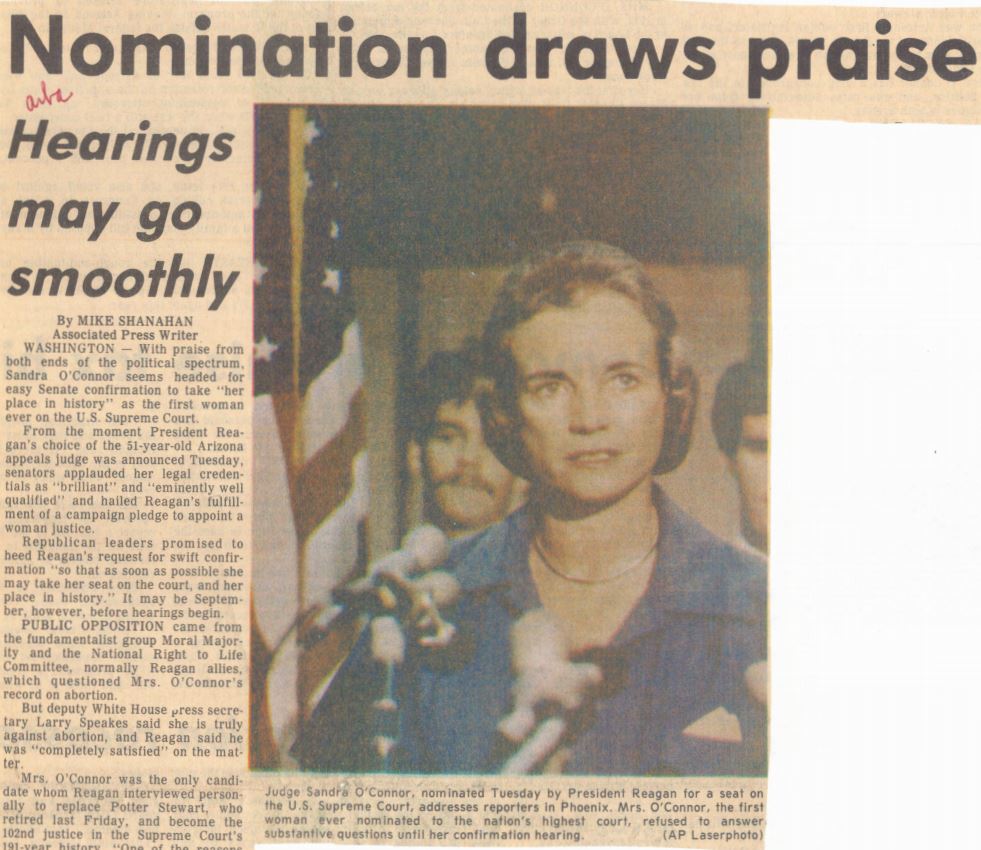
Nomination draws praise: Hearings may go smoothly

Newspaper article by Mike Shanahan
July 8, 1981

Woman nominated to high court

Newspaper article by Arthur Wiese
July 8, 1981

WASHINGTON – In a historic decision, President Reagan Tuesday noml• nated Arizona appeals court Judge San• dra D. O’Connor to be the first woman justice of the Supreme Court – a selection lavishly praised by women’s organizations which frequently have been at odds with the president but condemned by some or his most conservative supporters. In personally making the announcement in the White House press room, Reagan praised the 51-year-old O’Connor as “truly a person ror all seasons, possessing those unique qualities or temperament, fairness, intellectual capacity and devotion to the public good which have characterized the 101 ‘brethren’ who have preceded her.” If confirmed by the Senate, she would succeed newly retired Associate Justice Potter Stewart. Hers is the first Supreme Court nomination since 1975, when President Gerald Ford appointed Associate Justice John Paul Stevens, t and the first woman In the court’s 191 year history. Reagan will not formally send the nomination to the Senate until an FBI background check on O’Connor ls completed. The Senate Judiciary Committee, chaired by Sen. Strom Thurmond, RS.C., has not set a date for the confirmation hearings. They could come in the four weeks lert before the month-long August recess, or be delayed until September. The president wants the Senate to hold Its hearings and vote on the nomination by the first Monday in October, when the next Supreme Court term begins. O’Connor, a Republican who formerly ‘was majority leader

Stewart cheers Reagan choice

Newspaper article by Associated Press
July 8, 1981

Reagan choice wins approval from feminists

Newspaper mention
July 8, 1981

The first nomination of a women for the Supreme Court won applause from feminist groups in the Valley and around the nation. The nomination was saluted by Eleanor Smeal, president of the National Organization of Women, who said “we believe it’s a victory for the women’s movement.” “That she would be sympathetic to women’s rights would be very significant” because recent Supreme Court votes on issues in this area have been close, Smeal said. Iris Mitgang, head of the National Women’s Political caucus, declared “women are breaking the barrier of nearly 200 years of exclusion in decision-making in our nation. Justice O’Connor’s nomination will be a major step in moving toward equal justice … ” Cindy Maybeck, an NWPC spokeswoman, said the group was “satisfied” with O’Connor’s positions on “issues that are of concern to us” like “freedom of choice” on abortion and the ERA. Valley spokesmen for NOW praised the nomination as “a great victory.” “On the heels of 180 pro-ERA rallies around the nation this represents a significant step for women,” said the Arizona coordinator for NOW, whose only name is Baker. “We are very pleased to hear of this appointment.” Baker praised O’Connor as a “strong supporter of the ERA” who sponsored pro-ERA bills in 1972 and 1973 and who “spearheaded the effort to make Arizona laws uniform with regard to the sexes.”

O’Connor survives two-month secret search

Newspaper article by n/a
July 8, 1981

New ground, new directions

Editorial
July 8, 1981

Judge O’Connor earned peers’ respect

Newspaper article by Chuck Hawley
July 8, 1981

Experience on trial bench expected to help nominee

Arizona Appeals Court Judge Sandra Day O’Connor would take a qualification to the U.S. Supreme Court shared by only one other current justice – experience as a trial judge. That experience can be of “inestimable value” to the Supreme Court, several . U.S. District Court judges said Tuesday. Judge O’Connor’s tenure as a Maricopa County Superior Court judge “can be a major contribution (to the Supreme Court),” U.S. District Judge Valdemar Cordova said. He served with her in the Maricopa County Superior Court. “I believe it is important to have a good balance on the Supreme Court,” he said. “The addition of Judge O’Connor can provide that balance. She can shed the light of her trial court experience on the proceedings of the Supreme Court.” Cordova said trial judges must make decisions “in the heat of battle .” They do not have “the lu:r.ury of contemplation” afforded appellate judges. “Almost any competent lawyer can take a court transcript and pick it apart after the fact,” he said. “So-called Monday-morning quarterbacking is easy.” Cordova prai sed Mrs. O’Connor ‘s “knowledge of th e law and e:r.perience on the bench” and said it would be of “inestimable value to t he Supreme Court.” Presiding U.S. District Court Judge Carl A. Muecke agreed that trial e:r.perience “can be an important addition to the Supreme Court, especially in correctly ascertaining just how far an appellate court can go and what the limits of an appellate

How O’Connor was selected

Newspaper mention by Helen Thomas / UPI
July 8, 1981

WASHING TON – Her name came up in “chit chat” a month ago but it was only after an int~rview in the Oval Office that President Reagan decided Sandra O’Connor was his choice for a vacancy on the Supreme Court, White House officials said yesterday. The process that led to the historic decision to name the first woman to the high court was affected by many factors, including the assassination attempt against the president. Also figuring in was Reagan’s campaign promise to name a woman to the high tribunal at one of his first opportunities, although aides insist the president was looking for – and fuund – the best qualified person to fill the vacancy. Since Reagan’s announ cement . that be will send O’Connor’s name to the Senate for confirmation, a picture has emerged of how the administration reacted to Justice Potter Stewart’s declaration that he would retire. The president made the final deci- sion Monday afternoon, culminating a process that began late in March, when Stewart informed Attorney General William French Smith that he planned to resign his seat on the bench at the end of the term. Smith told reporters yesterday that he began considering possible replacements the moment Stewart, 66, mentioned his plans. But he said be held off informing the president of the impending court vacancy because “we had a shooting problem” – the March 30 attempt on Reagan’s life.

Baker Vows Support for Nominee. Foes of Abortion are Upset

Newspaper article by Francis X. Clines
July 8, 1981

WASHINGTON, July 7 – Anti-abortion groups today denounced President Reagan’s decision to nominate Judge Sandra Day O’Connor to the Supreme Court, but initial reaction in the Senate, which will vote on confirmation, was favorable.

”I commend the President for the courage of his decision,” said Howard H. Baker Jr., the Senate Republican majority leader. ”I am delighted with his choice, and I pledge my full support for her confirmation by the full Senate.”

The National Right to Life Committee, an amalgam of anti-abortion lobbying groups in the 50 states, said that it would mobilize its members to ”prevail upon senators to oppose this nomination.” The committee said that Judge O’Connor was ”pro-abortion” as a member of the Arizona State Legislature.

Dr. Carolyn Gerster, a vice president of the National Right to Life Committee, said that the nominee, as a legislator, voted in 1974 not to allow an anti-abortion resolution out of caucus, thus killing it. The resolution asked Congress to pass a Constitutional amendment protecting the fetus except when the mother’s life was in danger, and allowed abortions in the case of rape.

Dr. Gerster based her statement of Judge O’Connor’s record on that and other votes, which were characterized as ”pro-abortion,” on newspaper accounts and the recollections of other legislators, she said. Before 1975, the State Legislature kept no records of committee, subcommittee or caucus votes.

”We feel betrayed by the President,” said Paul Brown

51-year-old jurist shows off family, is mum on issues

Newspaper article by Marilyn Taylor
July 8, 1981

The spectators backed away to make a path in the crowded courtroom for a demure lady with a trademark pageboy haircut who had just become an immortal in American history . Ninety minutes earlier, Sandra Day O’Connor , a 51- year-old Arizona Court of Appeals judge, had become the first woman nominated to the U.S. Supreme Court. National and local press representatives squeezed microphones and bulky video equipment into Judge O’Connor ‘s courtroom for a hastily organized press conference on the nomination. Tears welled in the eyes of her oldest son, Scott as her family listened to minutes of applause after Judge O’Connor’s brief press statement. “If confirmed,” she said, “I will do my best to serve the court and this nation in a manner that will bring credit to the president , to my family and to all the people of this great nation.” The judge, who, before Tuesday, was obscure to most non-Arizonans , called the appointment “momentous.” In a televised announcement, Reagan said, “She is truly a person for all seasons, possessing those unique qualities of temperament, fairness, intellectual capacity and devotion to the public good which have characterized the 101 brethren (justices) who have preceded her.” Urging speedy bipartisan Senate confirmation , Reagan – said naming a Supreme Court justice is “the most awesome appointment ” within his powers. “Those who sit on the Supreme Court interpret the laws of our land and truly do leave their footprints on the sands of time, long after

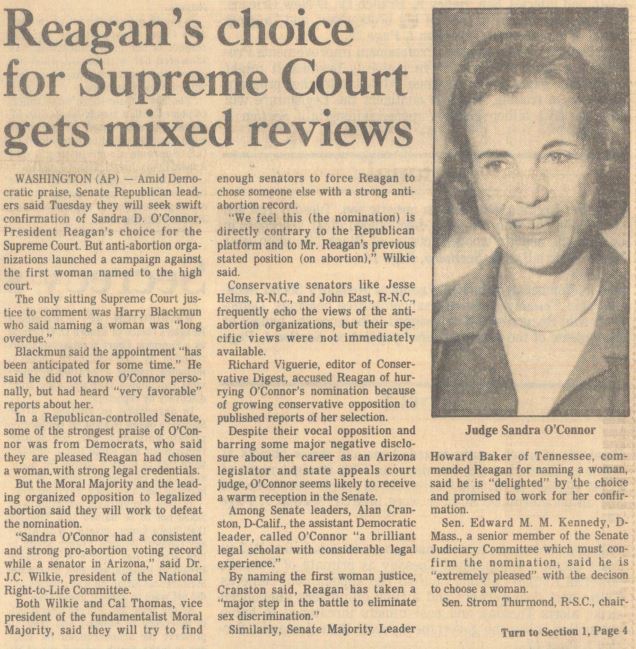
Reagan’s choice for Supreme Court gets mixed reviews

Newspaper article by Associated Press
July 8, 1981

Tough issues ahead for Judge O’Connor

Newspaper article by Kevin M. Costello
July 8, 1981

WASHINGTON (AP) – Although she proved herself-a scholarly and lucid writer in her short tenure on Arizona’s appeals court, Judge Sandra O’Connor never really faced the hot legal and constitutional issues of the day. An analysis of nearly all the opinions she’s written in 1½ years on the state bench shows that she dealt mainly with routine matters, such as workmen’s compensation and divorces. That means her supporters and detractors must look elsewhere for the views of President Reagan’s nominee to become the first female member of the Supreme Court – particularly in the areas of abortion and women’s rights. For some, that search already ls over.

Within hours of Tuesday’s announcement, the Moral Majority and the nation’s largest anti-abortion group announced they would oppose the nomination of · the Republican jurist. A spokesman for the National Right-to-Life Committee said the opposition would be based on stances O’Connor took as a member of the Arizona state Senate. But deputy White House press secretary Larry Speakes said O’Connor had told the president “she ls personally opposed to abortion and that it was especially abhorrent to her. She also feels the subject of the regulation of abortion is a legitimate subject for the legislative area.”
Although she declined to discuss “substantive issues” pending her confirmation, O’Connor told a news conference in Phoenix Tuesday she has special “appreciation for the legislative process.” That would square with Reagan’s insistence that

Step on up, O’Connor’s show is about to begin

Newspaper article
July 8, 1981

She’s Truly Qualified’

Newspaper article by United Press International
July 8, 1981

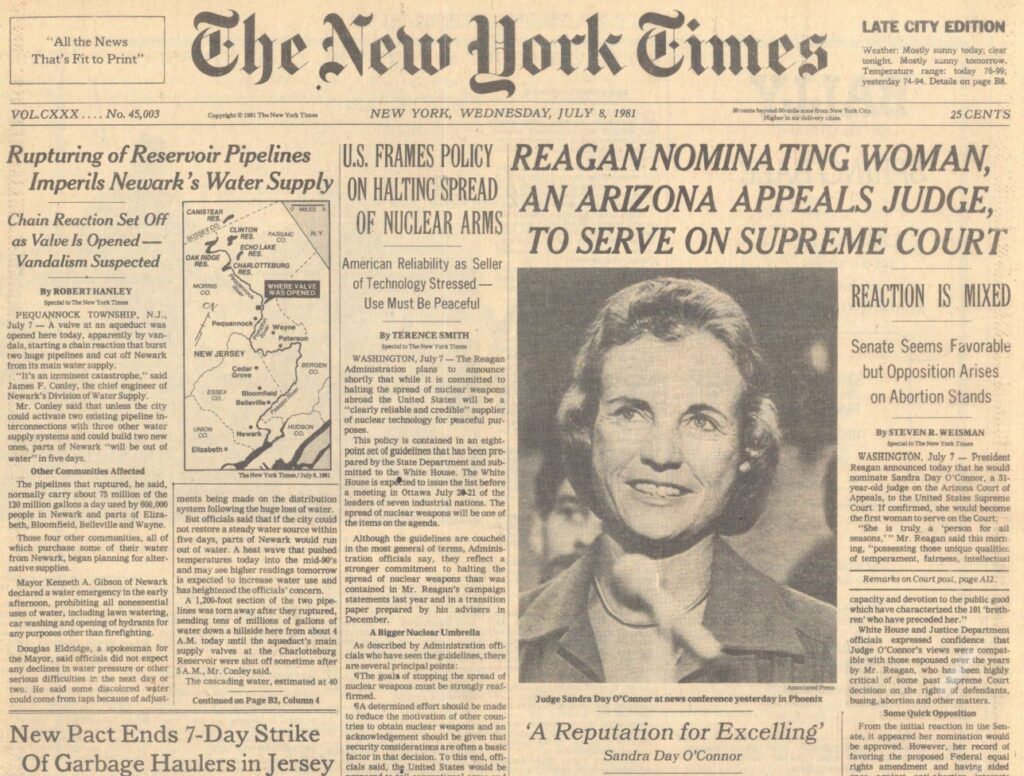
Reagan Nominating Woman, An Arizona Appeals Judge, To Serve On Supreme Court

Newspaper article by Steven R. Weisman
July 8, 1981

REACTION IS MIXED
Senate Seems Favorable but Opposition Arises on Abortion Stands

WASHINGTON, July 7 – President Reagan announced today that he would nominate Sandra Day O’Connor, a 51-year-old judge on the Arizona Court of Appeals, to the United States Supreme Court. If confirmed, she would become the first woman to serve on the Court.
”She is truly a ‘person for all seasons,’ ” Mr. Reagan said this morning, ”possessing those unique qualities of temperament, fairness, intellectual Remarks on Court post, page A12. capacity and devotion to the public good which have characterized the 101 ‘brethren’ who have preceded her.”
White House and Justice Department officials expressed confidence that Judge O’Connor’s views were compatible with those espoused over the years by Mr. Reagan, who has been highly critical of some past Supreme Court decisions on the rights of defendants, busing, abortion and other matters.
Some Quick Opposition
From the initial reaction in the Senate, it appeared her nomination would be approved. However, her record of favoring the proposed Federal equal rights amendment and having sided once against antiabortion interests while she was a legislator provoked immediate opposition to her confirmation by the National Right to Life Committee, Moral Majority and other groups opposed to abortion.
At a brief news conference in Phoenix, Judge O’Connor declined to explain her views, saying that she intended to leave such matters to her confirmation hearings before

Reaction to nominee deeply split

Newspaper article
July 8, 1981

Locals applaud selection

Newspaper article by Michael Murphy
July 8, 1981

Sun City area Republicans show popular support for Arizona Judge Sandra O’Connor’s nomination to the U.S . Supreme Court , a random sampling showed. ” I think it ‘s great ,” said Rep . Jim Ratliff, R-District 15. “I don’t think Reagan could have done better.” Other Sun Ci t y area residents echoed Ratliff’s comments, including Herbert Everett , who worked with Mrs . O’Connor in the Arizona Legislature as a Republican representative . “SHE WAS an outstanding legislator who worked very hard, ” the Youngtown resident said . ” I think she’ll make an outstanding justice. ” Sen. Anne Lindeman , R-District 17, said, ” I think the nomination was super-it couldn’t have happended to a nicer person . I think the Supreme Court will be better for it. ” Myrtle Macy, a Sun City resident , who knew Mrs . O’Connor through the Republican party, added , ” I was so thrilled when it was announced-I don’t think they could have found anyone better .” Mrs . Macy said she is pleased a woman was nominated to the court, a first in U.S . history. “ALL THE women have felt that when a person is qualified and has worked so hard that she should have the job .” Emma Ratliff , wife of Rep. Ratliff , said that her familiarity with Mrs. O’Conner spans a decade . “I’m not a women’s libber but she Is one of the best they could appoint,” she said . “That lady never lacks a word on anything-she really does her homework.” “I think she is the best person Reagan could have picked.” A FORMER Senate majority leader, Mrs.

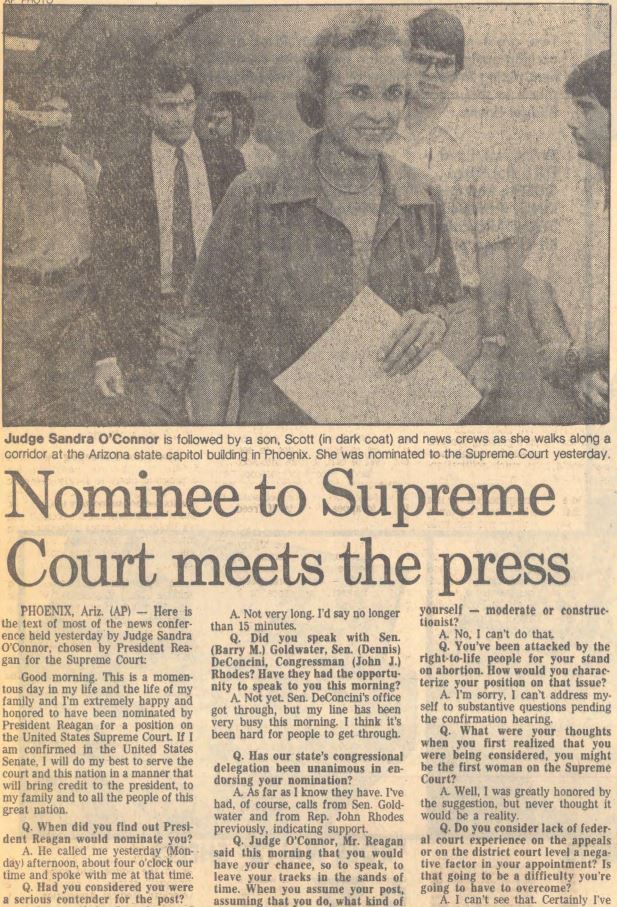
Nominee to Supreme Court meets the press

Newspaper article by Associated Press
July 8, 1981

PHOENIX, Ariz. (AP) – Here is the text of most of the news conference held yesterday by Judge Sandra O'Connor,…

A Reputation for Excelling’ – Sandra Day O’Connor

Newspaper article by B. Drummond Ayres Jr.
July 8, 1981

Judge Sandra Day O’Connor’s place in history is already secure, based on today’s announcement that she will be President Reagan’s nominee as the first woman on the United States Supreme Court.
But if her past is prologue, after her Senate confirmation Judge O’Connor might well go on to leave even larger ”footprints on the sands of time,” as Mr. Reagan, quoting Longfellow, described the mark of United States Justices. Thus far in her 51 years, Judge O’Connor has compiled an impressive list of academic, civic, political and legal achievements.
”She’s finished at the top in a lot of things,” said Mary Ellen Simonson of Phoenix, who was a legislative aide when Mrs. O’Connor was majority leader of the Arizona State Senate, the first woman in the nation to hold such a leadership position.
”She has a reputation for excelling,” Mrs. Simonson continued. ”As a result she’s been one of the state’s leading role models for women. Now she’s a national role model.”
Judge O’Connor, who currently sits on the Arizona Court of Appeals, the state’s second highest court, refused this afternoon to discuss ”substantive issues” when she met with reporters in Phoenix. And, because of her short, 18-month tenure on the appeals court and its somewhat limited docket, she has faced few of the nettlesome issues routinely taken up by the United States Supreme Court. Nevertheless, her past and her acquaintances provide some insights into her mind and personality.
She is said, by friend and foe alike

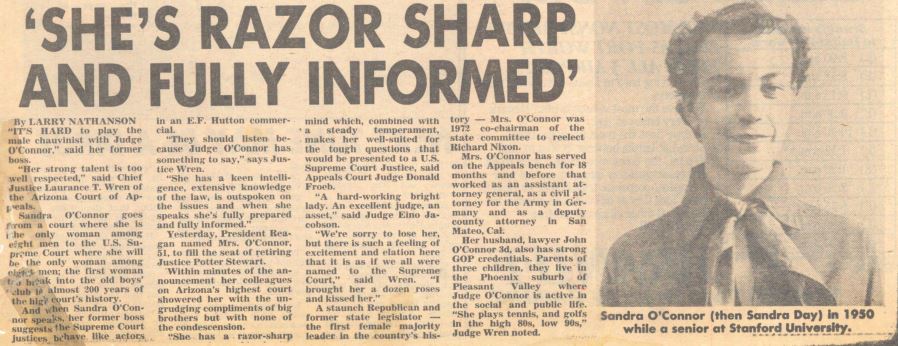
She’s Razor Sharp & Fully Informed

Newspaper article by Larry Nathanson
July 8, 1981
By LARRY NATHANSON ”IT’S HARD to play the male chauvinist with Judge O’Connor,” said her former boss. “Her strong talent is too well respected,” said Chief Justice Laurance T. Wren of the Arizona Court of Appeals. Sandra O’Connor goes from a court where she is the only woman among eight men to the U.S. Supreme Court where she will be the only woman among eight men; the first woman to break into the old boys’ club in almost 200 years of the court’s history. And when Sandra O’Connor speaks, her former boss suggests the Supreme Court justices behave like actors in an E.F. Hutton commercial. “They should listen because Judge O’Connor has something to say,” says Justice Wren. “She has a keen Intelligence, extensive knowledge of the law, Is outspoken on the issues and when she speaks she’s fully prepared and fully informed.” Yesterday, President Reagan named Mrs. O’Connor, 51, to fill the seat of retiring Justice Potter Stewart. Within minutes of the announcement her colleagues on Arizona’s highest court showered her with the ungrudging compliments of big brothers but with none of the condescension. “She has a razor sharp mind which, combined with a steady temperament, , makes her well-suited for the tough questions that would be presented to a U.S. Supreme Court Justice, said Appeals Court Judge Donald Froeb. “A hard-working bright lady. An excellent Judge, an asset,” said Judge Eino Jacobson. “We’re sorry to lose her, but there is such a feeling of excitement and elation here that

Secrecy shrouded search for nominee

Newspaper article by Associated Press
July 8, 1981

President Reagan’s choice of Sandra D. O’Connor as a Supreme Court nominee was surrounded by extraordina ry secrecy, including finding a location to mtcrview candidates that was safe from discovery by reporters. In deference to Justice Potter Stewart’s desire to keep his resignation private until mid-June, top Justice Department and White House officials were told to begin a search for nominees on a contingency basis, without learning that a vacancy was imminent. Justice Department officials who asked not to be named said Tuesday that Stewart met privately with Attor• ney General William French Smith in late March, less than a week before President Reagan was shot March 30. Stewart told Smith he was retiring but did not want to make it public then. As the selection process intensified, in deference to Stewart and later to preserve the announcement for Reagan to make, Smith ordered one of his aides to arrange for a meeting place where top Justice Department officials could interview candidates without being observed by reporters. The aide was not told who was being interviewed. The same secret location was used on the afternoon of June 30 for an interview with O’Connor by Smith, White House chief of staff Jim Baker, his deputy Michael Deaver, presidential counsellor Edwin Meese, and White House counsel Fred Fielding. None of those in the June 30 meeting would say it it was held at a house, government office or hotel room. In an interview, Fielding declined to disclose the location

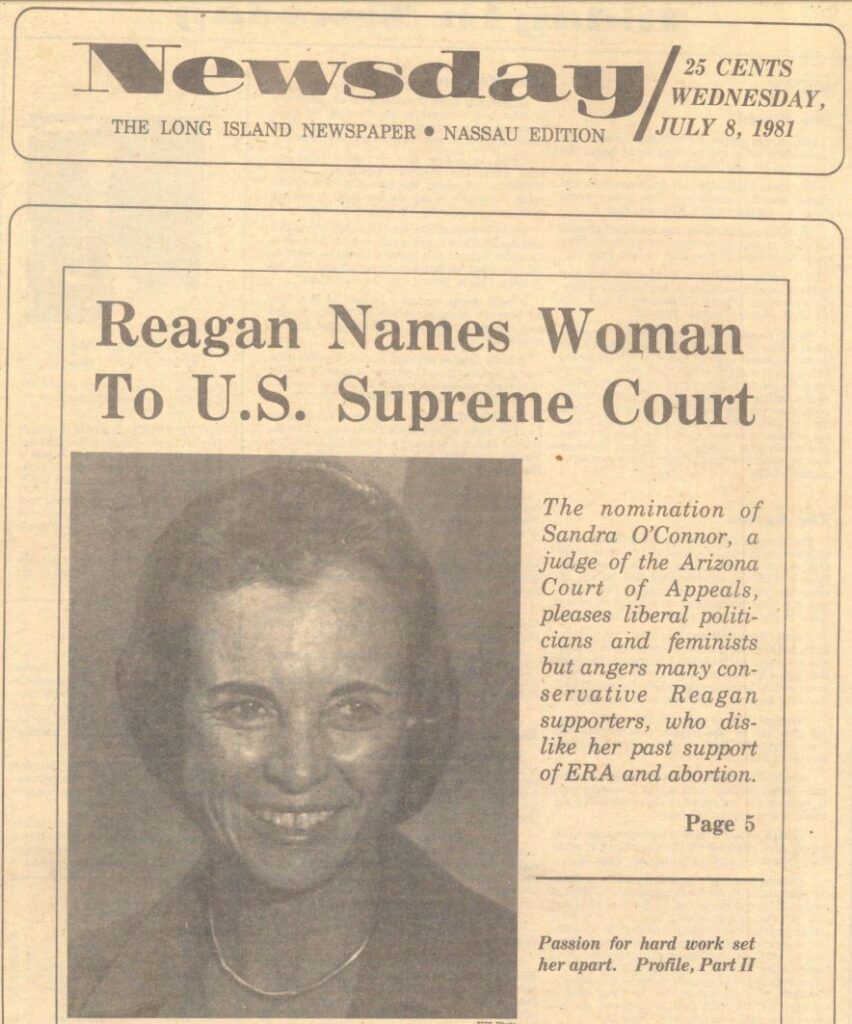
Reagan Nominates Woman

Newspaper article by Associated Press
July 8, 1981

Reagan Choice Angers Right, Please Liberals

Newspaper article by Bill Peterson / Washington Post
July 8, 1981

Honored by Post, Nominee Declares

Newspaper article
July 8, 1981

The first woman to be nominated to the United States Supreme Court declared herself ”extremely honored and happy” today but told reporters at a hastily called 15-minute news conference, ”I can’t address myself to substantive questions pending confirmation.”
”If confirmed, I will do my best to serve the Court and this nation in a manner that will bring credit to the President, to my family and to all the people of this great nation,” Judge Sandra Day O’Connor of the Arizona Court of Appeals said in a brief statement.
Judge O’Connor, who has a reputation for being calm in the most difficult courtroom situation, appeared not only very happy but also a little nervous as she spoke to reporters in the courtroom.
She said the news of her appointment made today ”a momentous day in my life and the life of my family.” She was flanked by her husband, John Jay O’Connor 3d, a Phoenix lawyer; her three sons, Scott, Brian and Jay, and other members of the court.
Although Judge O’Connor spoke with President Reagan for about 15 minutes last week, the news of her appointment came as something of a surprise to her. Background Similar to Rehnquist’s
As late as Saturday, she told a group of friends that she thought the chance of her appointment was remote, partly because of the similarity between her background and that of Associate Justice William H. Rehnquist, another Arizonan. Judge O’Connor was graduated third in the Stanford University Law School class in which Justice William Rehnquist

A voice for the States on Supreme Court:

Newspaper article by Jim Mann
July 8, 1981

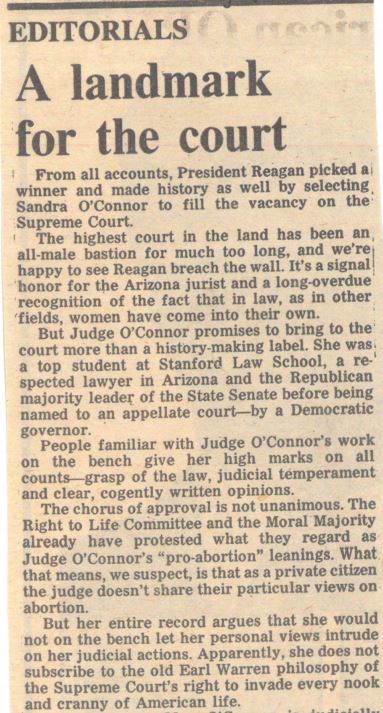
A landmark for the court

Editorial
July 8, 1981

From all accounts, President Reagan picked a winner and made history as well by selecting. Sandra O’Connor to fill the vacancy on the· Supreme Court.

The highest court in the land has been an, all-male bastion for much too long, and we’re! happy to see Reagan breach the wall. It’s a signal, honor for the Arizona jurist and a long-overdue· recognition of the fact that in law, as in other ‘fields, women have come into their own.

But Judge O’Connor promises to bring to the court more than a history-making label. She was, a top student at Stanford Law School, a respected lawyer in Arizona and the Republican majority leader of the State Senate before being named to an appellate court-by a Democratic governor.

People familiar with Judge O’Connor’s work on the bench give her high marks on all counts-grasp of the law, judicial temperament and clear, cogently written opinions.

The chorus of approval is not unanimous. The Right to Life Committee and the Moral Majority already have protested what they regard as Judge O’Connor’s “pro-abortion” leanings. What that means, we suspect, is that as a private citizen the judge doesn’t share their particular views on abortion.

But her entire record argues that she would not on the bench let her personal views intrude on her judicial actions. Apparently, she does not subscribe to the old Earl Warren philosophy of the Supreme Court’s right to invade every nook and cranny of American life.

In this sense, Mrs. O’Connor is judicially nonpartisan

Ranch caught up in historic moment. Nomination brings sense of history

Newspaper article by Peter Brock
July 8, 1981

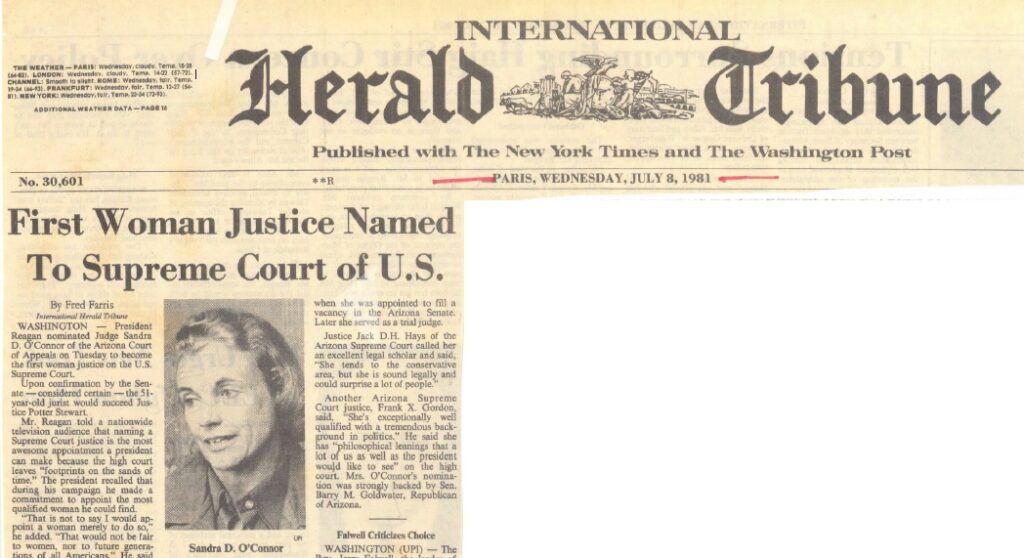
First Woman Justice Named to Supreme Court of U.S.

Newspaper article by Fred Farris
July 8, 1981

WASHINGTON – President Reagan nominated Judge Sandra D. O’Connor of the Arizona Court of Appeals on Tuesday to become the first woman justice on the U.S. Supreme Court. Upon confirmation by the Senate – considered certain – the 51- year-old jurist would succeed Justice Potter Stewart. Mr. Reagan told a nationwide television audience that naming a Supreme Court justice is the most awesome appointment a president can make because the high court leaves “footprints on the sands of time.” The president recalled that during his campaign he made a commitment to appoint the most qualified woman he could find. “That is not to say I would appoint a woman merely to do so,” he added. “That would not be fair to women, nor to future generations of all Americans.” He said Judge O’Connor possesses the qualities of temperament, fairness, intellectual capacity and devotion to the public good that have characterized the 101 “brethren” who have served at the Supreme Court . Active in Republican politics in Arizona, she was co-chairman of Richard M. Nixon’s state campaign committee in 1968. She was majority leader in Arizona’s state senate in 1973 and is the only woman ever to hold that job. Her Legislative Record There was quick opposition to her nomination from the National Right to Life Committee, the largest U .S. anti-abortion group. Mr . Reagan, however, said he is completely satisfied with her record on such issues. Although she is considered a conservative, her legislative record shows a

Secrecy cloaked nominee’s selection

Newspaper article by Associated Press
July 8, 1981

Reagan’s choice for Supreme Court gets mixed reviews

Newspaper article by AP
July 8, 1981

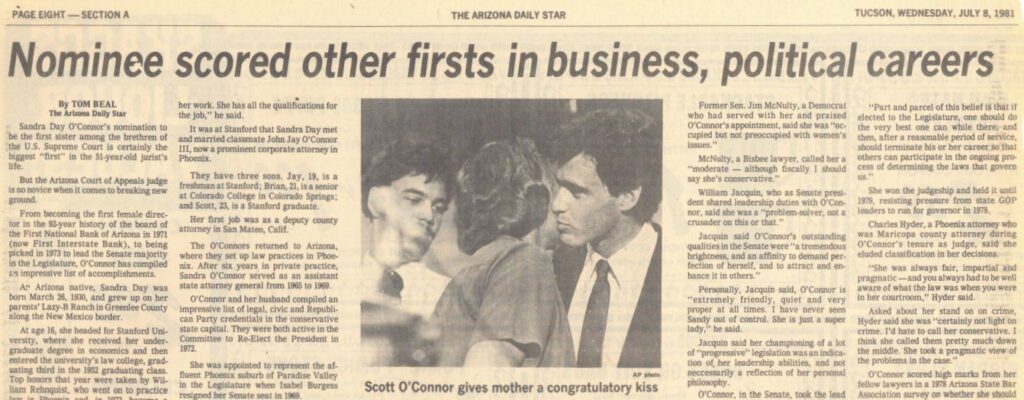
Nominee scored other firsts in business, political careers

Newspaper article by Tom Beal
July 8, 1981

Sandra Day O’Connor’s nomination to be the first sister among the brethren of the U.S. Supreme Court is certainly the biggest “first” in the 51-year-0ld jurist’s life. But the Arizona Court of Appeals judge is no novice when it comes to breaking new ground. From becoming the first female director in the 92-year history of the board of the First National Bank of Arizona in 1971 (now First Interstate Bank), to being picked in 1973 to lead the Senate majority in the Legislature, O’Connor has compiled ~’I impressive list of accomplishments. A… Arizona native, Sandra Day was born March 26, 1930, and grew up on her parents’ Lazy-B Ranch in Greenlee County along the New Mexico border. At age 16, she headed for Stanford University, where she received her undergraduate degree in economics and then entered the university’s law college, graduating third in the 1952 graduating class. Top honors that year were taken by William Rehnquist, who went on to practice law in Phoenix and, in 1972, become a Supreme Court justice. O’Connor was a member of the board of editors of the Stanford Law Review and graduated with the Order of the Coif. Stanford Law School Dean Charles Meyers said yesterday that the appointment of O’Connor is “marvelous for the country, for Stanford, and for the law school.” Meyers said O’Connor is “a woman of great ability; tremendous balance and good political understanding.” Emeritus Professor John Hurlbut of the law school said he remembered O’Connor well from his classes

First woman justice picked for top court

Newspaper article
July 8, 1981

Court nominee: Solid Republican, politically astute

Newspaper article by Ellen Warren / Chicago Sun-Times
July 8, 1981

WASHINGTON – Sandra Day O’Connor – the “person for all seasons” chosen to become the first woman to serve on the 191 year-old U.S. Supreme Court – is a solid Republican who knows which way the political winds blow. O’Connor, 51, an Arizona native reared on a cattle ranch, already faces opposition from anti-abortion groups for what they view as a pro-abortion position when she served in the Arizona Senate. And her flirtation with the Equal Rights Amendment – she later withdrew her support for the ERA – will also come in for criticism from some conserwtive groups. O’Connor, now a state appeals court judge, would bring legisla- tive and judicial credentials to the high court bench. Feminists are heartened by the fact that in her final term in the state Senate she was elected majority leader – the first woman in the nation to hold such a leadership post. THE MOTHER of three sons, O’Connor is married to a Phoenix lawyer, John O’Connor. She graduated third in her class from Stanford University Law School in 1952. Supreme Court Justice William H. Rehnquist, an Arizona native, was first in that class. She served In the state Senate from 1969, when she was appointed to fill a vacancy, to 1975, winning election to two full terms representing a wealthy Phoenix suburb. In 1972, soon after Congress passed the ERA, O’Connor spoke on the state Senate floor, urging ratification. But when she learned that Arizona’s two U.S. senators opposed the measure, her enthusiasm faded and the Issue died

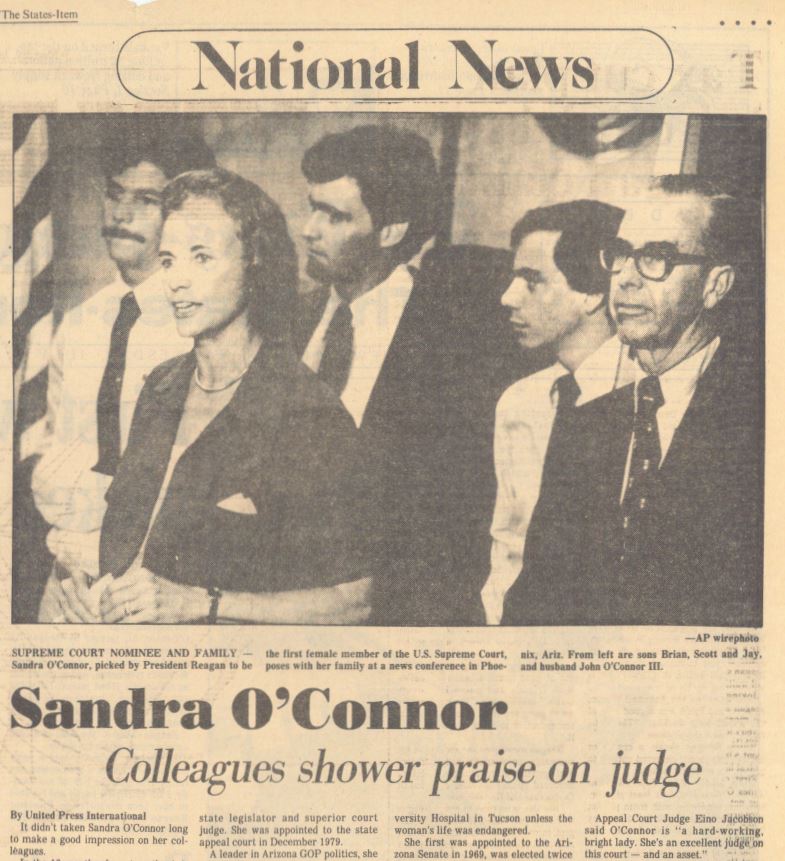
Collegues shower praise on judge

Newspaper article by United Press
July 8, 1981

President’s Move Shows a Deft Political Touch

Newspaper article by Susan Page
July 8, 1981

Washington-Ronald Reagan the politician has shown once again that he has the sure touch of a safecracker, and the nerves. With the announcement yesterday that he will appoint the first woman to the Supreme Court, the President has won the support of liberals and feminists and has undercut growing criticism that he has failed to give women important jobs. National Organization for Women President Eleanor Smeal, who in the past has characterized Reagan’s views on so-called women’s issues as “pathetic” and “medieval,” praised the nomination of Arizona Judge Sandra Day O’Connor as “a major victory.” The criticism this time has come from some longstanding supporters-social conservatives, particularly antiabortion activists-but even that is not necessarily bad news for the President. Reagan’s conservative base is not really threatened, one adviser said, and the right-wing ire makes him look practically moderate. “It does a lot of things for us,” another aide, presidential pollster Richard Wirthlin, said of the appointment. “Somebody told me once that the worst thing you can do in politics is have your most ideological supporters be perfectly happy with you.” When you do, he.went on, it’s likely to mean that just about everybody else is not. Now, by appointing a woman who apparently holds moderate views on social issues, Reagan has managed to win praise from feminists who disagree with his views on the Equal Rights Amendment and abortion rights an:a- criticize his record on appointments.

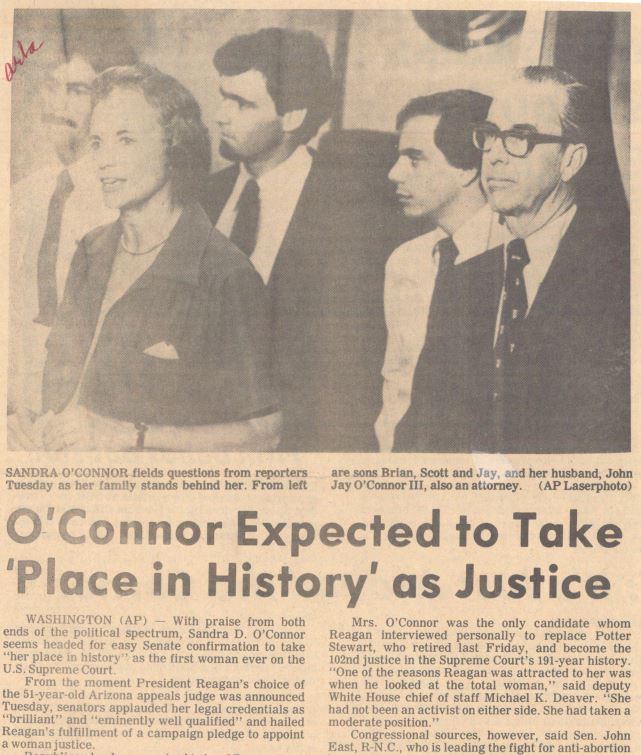
O’Connor expected to take ‘place in history’ as Justice

Newspaper article by Associated Press
July 8, 1981

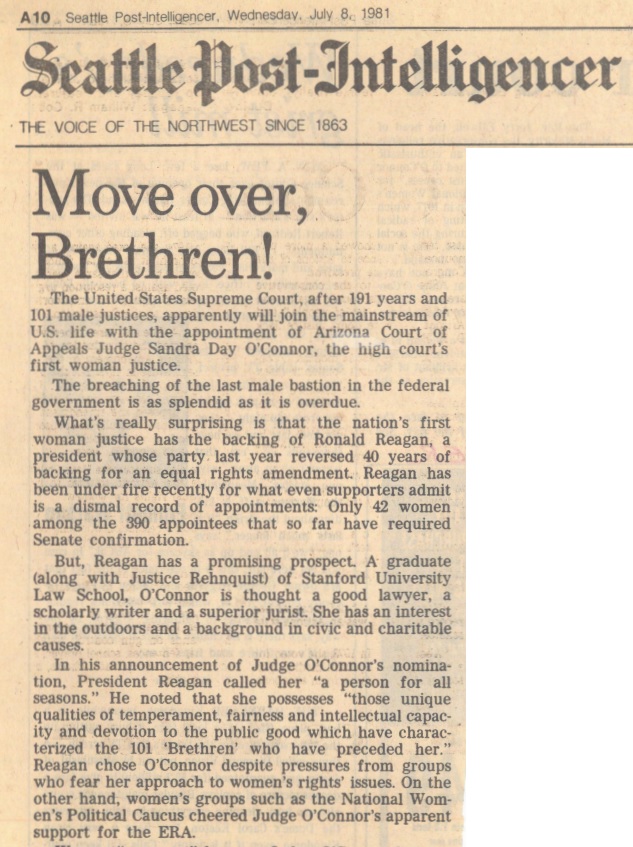
Move over, Brethren!

Editorial
July 8, 1981

The Uniied States Supreme Court, after 191 years and 101 male justices, apparently will join the mainstream of U;S. life with the appointment of Arizona Court of Appeals Judge Sandra Day O’Connor, the high court’s first woman justice. The breaching of the last male bastion in the federal government is as splendid as it is overdue. What’s really surprising is that the nation’s first woman justice has the backing of Ronald Reagan, a president whose party last year reversed 40 years of backing for an equal rights amendment. Reagan has been under fire recently for what even supporters admit is a dismal record of appointments: Only 42 women . among the 390 appointees that so far have required Senate confirmation. But, Reagan has a promising prospect. A graduate (along with Justice Rehnquist) of Stanford University Law School, O’Connor is thought a good lawyer, a scholarly writer and a superior jurisL She has an interest in the outdoors and a, background in civic and charitable causes. In his announcement of Judge O’Connor’s nomiria- . tion, President Reagan called her “a person for all seasons.” He noted that she possesses “those unique qualities of temperament, fairness and intellectual capacity and devotion to the public good which have characterized the 101 ‘Brethren’ who have preceded her.” Reagan chose O’Connor despite pressures from groups who fear her approach to women’s rights’ issues. On the other hand, women’s groups such as the National Women’s Political Caucus cheered

She doesn’t make waves

Newspaper article by Lars-Erik Nelson
July 8, 1981

Reagan picks Sandra O’Connor:

Newspaper article by Doug McDaniel
July 8, 1981

Reagan Nominates a Woman to Serve on the Supreme Court

Newspaper article by Combined News Services
July 8, 1981

ombined News Services Washington-President Reagan, a break with 191 years of tradition, yesterday ~ominated Judge Sandra Day O’Connor of the Arizona Court of Appeals to be the first woman to serve on the U.S. Supreme Court. The nomination, in fulfillment of a campaign promise to name a woman to one of the first vacancies on the nation’s highest court, was hailed by women’s groups. But it also drew immediate fire from some of the President’s conservative allies, including the politically potent Moral Majority, which says O’Connor has taken stands favoring abortion and the Equal Rights Amendment. Calling the 51-year-old O’Connor “a person for all seasons,” Reagan brushed aside the criticisms of antiabortion groups, some of which plan a campaign against her confirma-. ,tion. “I am completely satisfied with her,” a smiling Reagan said as he announced her appointment in the White House press briefing room. Reagan urged the Senate to give “swift bipartisan confirmation” to her “so that, as soon as possible, she may take her seat on the court and her place in history.” Early reaction from the Senate indicated that her confirmation would be easy. Attorney General William French Smith said he hoped the FBI checks on O’Connor could be completed so that the actual nomina: tion could be sent to the Senate in less than four weeks. Referring to his campaign pledge to make one of his first Supreme Court appointments “the most qualified woman I could possibly find,” the” President said he was

Reagan calls her ‘a person for all seasons’

Newspaper article by Saul Friedman
July 8, 1981

WASHINGTON – President Reagan Tuesday nominated Sandra Day O’Connor, 51, an Arizona appeals court judge, to be the first woman to wear the robes of a U.S. Supreme Court justice. As the president put it in an announcement in the White House press room: “She is truly a ‘person for all seasons,’ possessing those unique qualities of temperament, fairness, intellectual capacity and devotion to the public good which have characterized the 101 ‘brethren’ who have preceded her.” O’CONNOR, WHO will succeed retiring Justice Potter Stewart if she is confirmed by the Senate, responded in Phoenix: “I will do my best to serve the court and this nation in a manner that will bring credit to the president, to my family and to all the people…”

Reagan said the appointment kept a campaign promise he made last Oct. 14. He had pledged then that “one of for the U.S. Supreme Court, Court vacancies in my administration will be filled by the most qualified woman I can find.” The president said Tuesday that he had not meant that “I would appoint a woman merely to do so. That would not be fair to women, nor to future, generations of all Americans whose lives are so deeply affected by the decisions of the court. “Rather, I pledged to appoint a woman who meets the very high standards demand of all court appointees.” SMILING HAPPILY at her Phoenix press conference, O’Connor avoided giving her views on current legal and political issues such as abortion and the Equal Rights Amendment. She explained that

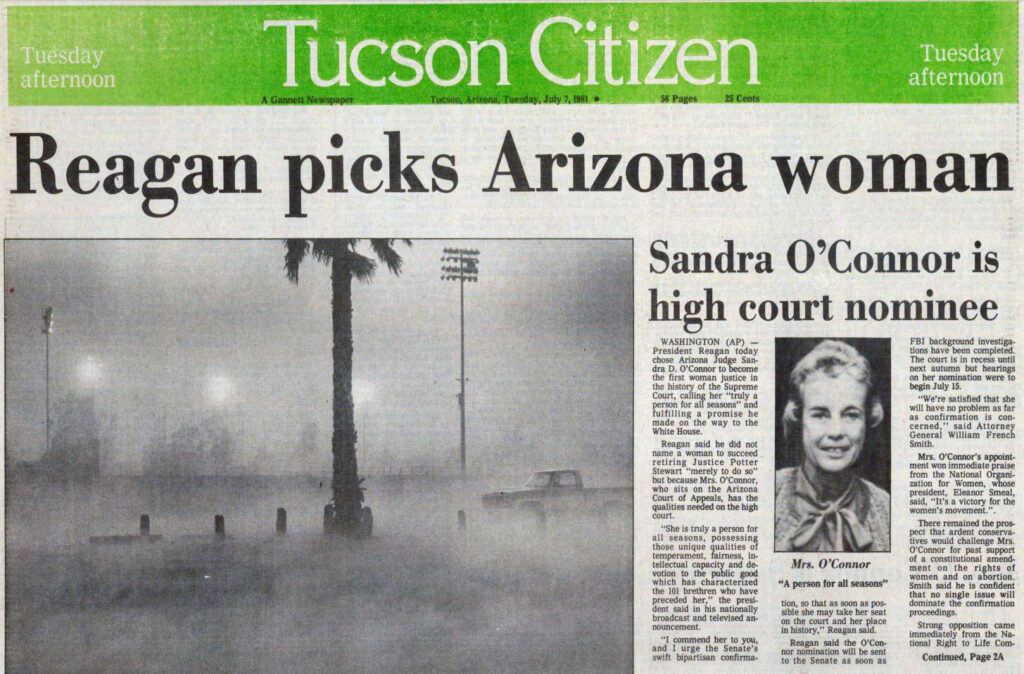
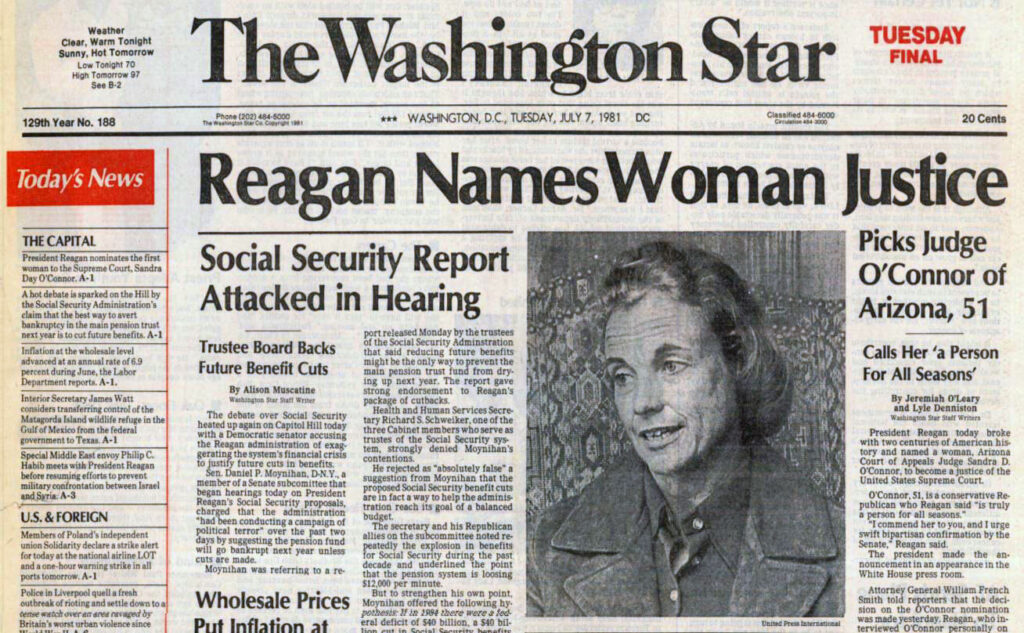
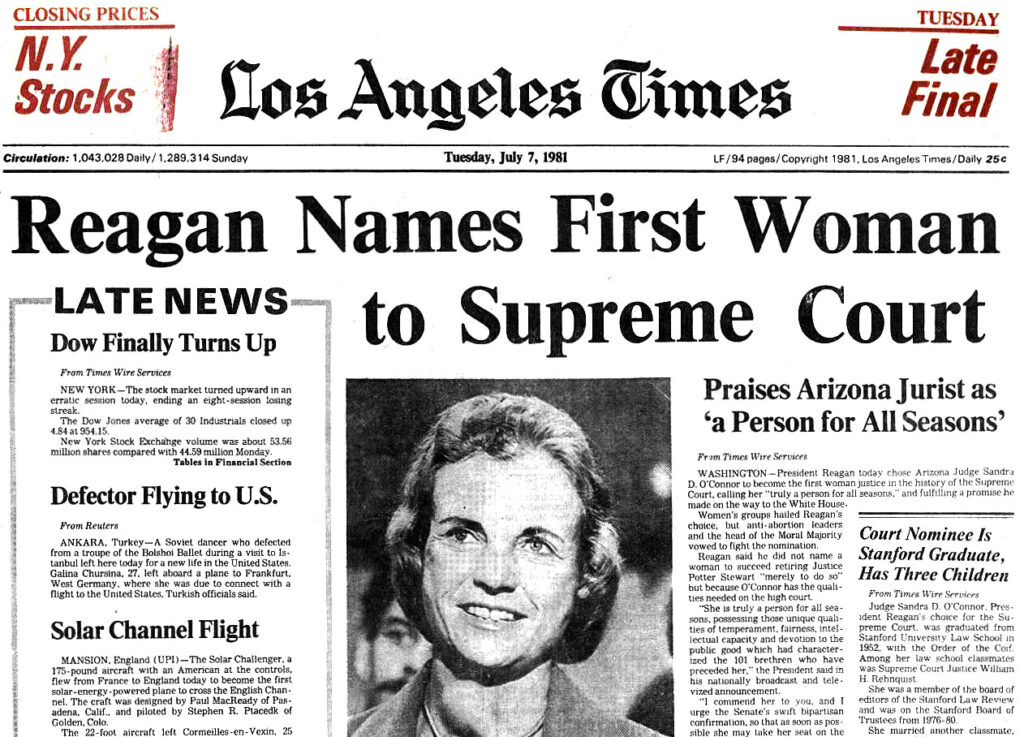
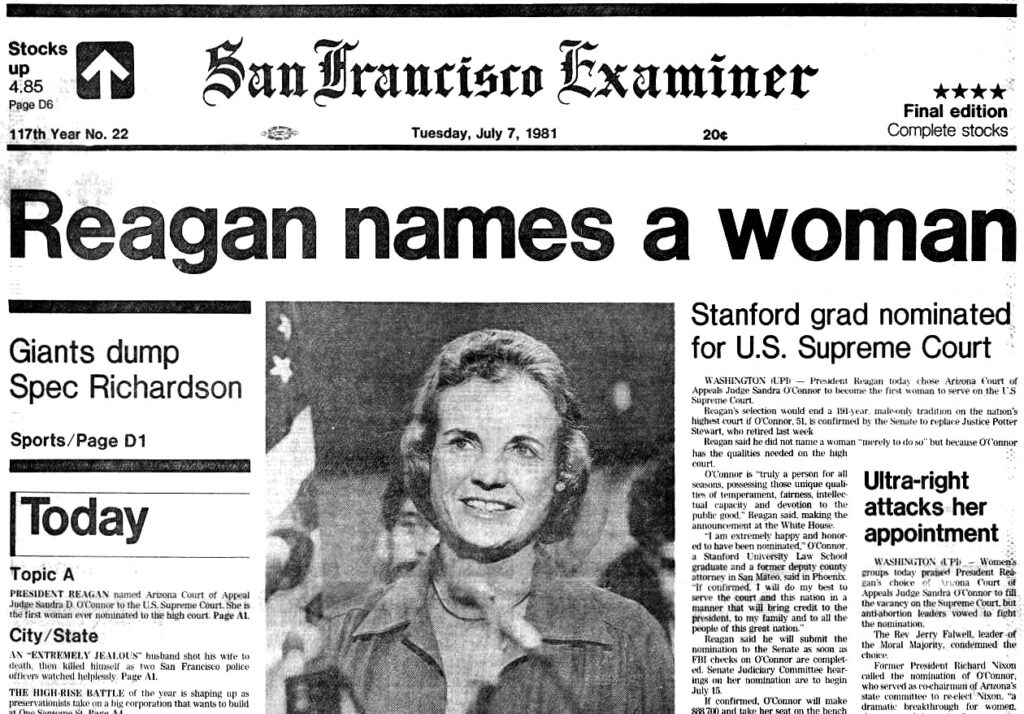
Reagan Picks Arizona Woman: Sandra O’Connor is High Court Nominee

Newspaper article by Washington (AP)
July 7, 1981

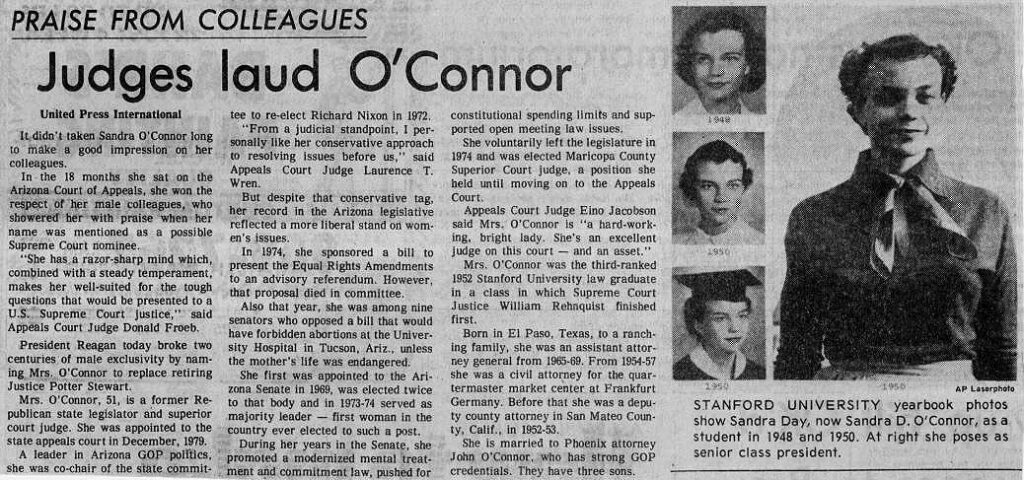
Praise from Colleagues: Judges laud O’Connor

Newspaper article by United Press International
July 7, 1981

It didn’t taken Sandra O’Connor long to make a good Impression on her colleagues. In the 18 months she sat on the , Arizona Court of Appeals, she won the respect of her male colleagues, who , showered her with praise when her , name was mentioned as a possible Supreme Court nominee. “She has a razor-sharp mind which, combined with a steady temperament , makes her well-suited for the tough questions that would be presented to a U.S. Supreme Court justice,” said Appeals Court Judge Donald Froeb. President Reagan today broke two centuries of male exclusivity by naming Mrs. O’Connor to replace retiring Justice Potter Stewart. Mrs. O’Connor, 51, is a former Republican state legislator and superior court judge. She was appointed to the state appeals court in December, 1979. A leader in Arizona GOP politics, she was co-chair of the state commit – tee to re-elect Richard Nixon in 1972. “From a judicial standpoint, I personally like her conservative approach to resolving issues before us,” said Appeals Court Judge Laurence T. Wren. But despite that conservative tag, her record in the Arizona legislative reflected a more liberal stand on women’s issues. In 1974, she sponsored a bill to present the Equal Rights Amendments to an advisory referendum. However, that proposal died in committee. Also that year, she was among nine senators who opposed a bill that would have forbidden abortions at the University Hospital in Tucson, Ariz., unless the mother’s life was endangered . She first was

Mrs. O’Connor ‘Extremely Happy’

Newspaper article by Richard DeUriarte
July 7, 1981

“I didn ‘t believe it, I just didn’t believe it,” Arizona Court of Appeals Judge Sandra D. O’Connor said today after President Reagan nominated her as the first woman justice of the U.S. Supreme Court. The president had called her Monday afternoon, informing her of his decision, she said during a morning press conference. “This is a momentous day in my life and that of my family. I am extremely happy and honored to have been nominated,” she told reporters. “IF CONFIRMED, I will do my best t.o serve the court and this nation in a manner that will bring credit to the president, to my family and to all the people of this great nation.” Mrs. O’Connor, 51, considered a moderate-conservative, declined to answer issue-oriented questions from the press until her U.S. Senate confirmation hearings. According to Reagan aide Peter Roussel, no date has been set for those hearings. In announcing his choice for the high court vacancy created by the retirement of Justice Potter Stewart, Reagan noted the speculation that was raised concerning the appointment of a woman. “I MADE A commitment that one of my first appointments would be the most qualified woman I could possibly find,” Reagan told reporters at a hastily-called news conference at 8 a.m. Phoenix time to answer specific issue questions, but that didn’t deter reporters from asking politically sensitive questions. MRS. O’CONNOR, described by associates as a moderate-conservative, refused to categorize herself on the political spectrum.

Court Nominee is Stanford Graduate

Newspaper article by Times Wire Services
July 7, 1981

Judge Sandra D. O’Connor, President Reagan ‘s choice for the Supreme Court, was graduated from Stanford University Law School in 1952, with the Order of the Coif. Among her law school classmates was Supreme Court Just ice William H. Rehnquist. She was a member of the board of editors of the Stanford Law Review and was on the Stanford Board of Trustees from 1976-80. She married another classmate, John Jay O’Connor III, now a Phoenix lawyer. They have three sons. Born in Duncan, Ariz., to a ranching family, she was a politician before her appointment to the Arizona bench, becoming majority leader of the Senate in 1973- the first and only woman to hold the job in either house of the state Legislature. “She was a super floor leader for lots of reasons, ” said Republican William Jacquin , president of the Arizona Chamber of Commerce and president of the Senate when O’Connor was majority leader .

State Leaders praise Mrs. O’Connor

Newspaper article by Bill Action and Tom Lee, Citizen staff writers
July 7, 1981

PHOENIX – Arizona Appeals Court Judge Sandra D. O’Connor shook her head and told a r~rter, “I didn’t believe It, I didn’t believe it’ as she left a quickly called press confere(lce two hours after she was nominated to become the first female justice of the U.S. Supreme Court. Minutes before, she told reporters who had gathered in her appeals courtroom here, “If confirmed, I will do my best to serve the court and this nation in a manner that will bring credit to the president, to my family and to all the people of this great nation.” Dressed in a lightweight blue suit, the blonde-haired, 51-year-old jurist refused to respond to questions touching on the abortion controversy that has already started swirling around her nomination. She said, “l can’t address myself to any substantive questions pending my confirmation hearings.” Her husband, John Jay O’Connor III (himself a practicing attorney), and her three sons, Scott, Brian and Jay, flanked the prospective Supreme Court justice In the crowded courtroom. Asked what she and President Reagan had discussed during a !~minute interview in the White House late last week, Judge O’Connor said, “I’m not at liberty to disclose that conversation. Check with the White House.” Meanwhile, the leader of the the pro-life forces in the Arizona Legislature, Scottsdale Republican James Skelly, said he was “sick” about Judge O’Connor’s nomination. “It has nothing to do with her legal qualifications. No one can argue with the fact that she’s a brilliant

Reagan Names Woman Justice: Picks Judge O’Connor of Arizona, 51

Newspaper article by Jeremiah O'Leary and Lyle Denniston
July 7, 1981

President Reagan today broke with two centuries of American history and named a woman, Arizona Court of Appeals Judge Sandra D. O’Connor, to become a justice of the United States Supreme Court. O’Connor, 51, is a conservative Republican who Reagan said “is truly a person for all seasons.” “I commend her to you, and I urge swift bipartisan confirmation by the Senate,” Reagan said. The president made the announcement in an appearance in the White House press room. Attorney General William French Smith told reporters that the decision on the O’Connor nomination was made yesterday. Reagan, who interviewed O’Connor personally on July 1, said he would send a formal nomination to the Senate as soon as the FBI checks are completed . O’Connor, if confirmed, would take the place of retiring Justice Potter Stewart, who announced on June 18 that he was stepping down. She would make $88,700 and take her seat when the court convenes for its next term in October. Her name was the only one submitted to the White House by Sen. Barry Goldwater, R-Ariz., who four years ago urged her to leave the bench to run for governor. Both Goldwater and Senate Judiciary Committee member Dennis DeConcini, D-Ariz., as well as former House Republican Minority Leader John J. Rhodes, R-Ariz., had urged her appointment to the court. But the White House had come under extreme pressure in recent days from anti-abortion groups to drop O’Connor as a,potential nominee. Since Friday, scores of letters and telegrams had

Reagan Names Woman Judge: First in Supreme Court History

Newspaper article by James Gerstenzang
July 7, 1981

El Pasoan Wins Court Nod: She Would Serve as First Woman

Newspaper article by UPI
July 7, 1981

WASHINGTON (UPI) – President Reagan said today he plans to nominate Arizona Judge Sandra O’Connor – “a person for all seasons” – to become the first woman to serve on the Supreme Court. Reagan’s historic selection would end a 191-year, male-only tradition on the nation’s highest court if Mrs. O’Connor, 51, is approved by the Senate to replace Justice Potter Stewart, who retired last week. JUDGE O’Conor is “truly a person for all seasons, possessing those unique qualities of temperament, fairness, intellectual capacity and devotion to the public good,” the president said, making the announcement in the White House press briefing room. “I am extremely happy and honored to have been nominated,” Mrs. O’Connor said in a statement. “If confirmed, I will do my best to serve the court and this nation in a manner that will bring credit to the president, to lfi1 ~ n’ir.i BflJ !”ll the people of this great nation.” At a news conference in Phoenix, Mrs. O’Connor said Reagan telephoned her Monday afternoon and told her she was his choice. She repeatedly refused to discuss abortion, equal rights for women or any other “substantive questions pending the confirmation hearings.” MRS. O’CONNOR, beaming happily, kissed her husband and three sons and told reporters who questioned her lack of federal judicial experience: “Time will tell whether I have a lot to learn.” Asked to describe her feelings on being the first women appointed, she said: “I don’t know that I can. In approaching the work on

A Momentous day’ woman gets nomination

Newspaper article by Associated Press
July 7, 1981

WASHINGTON (AP) – President Reagan today named Arizona judge Sandra D. O’Connor to become the first woman justice in the 191 years of the Supreme Court. Mrs. O’Connor, 51, who Reagan called “a person for all seasons,” would fill the vacancy created by Justice Potter Stewart’s retirement. And her selection as the court’s 102nd justice, following 101 “Brethren,” matches the president’s campaign pledge to name a woman to one of the first vacancies. Reagan called it “the most awesome appointment” within his power. In Phoenix, Mrs. O’Connor told a news conference that “This is a momentous day in my life and the life of my family. I am extremely happy and honored to have been nominated by President Reagan for a position on the U.S. Supreme Court.” “If confirmed, I will do my best to serve the court and this nation in a manner that will brmg credit to the president, to my family and to all the people of this great nation,” she said . The president announced his choice on a nationwide broadcast from the White House press room . He had decided upon Mrs. O’Connor following apersonal interview with her last week in the Oval Office and a followup telephone call late Monday . Reagan urged the Senate to give “swift bi-partisan confirmation” to her “so that, as soon as possible, she may take her seat on the court and her place in history.” The court, now in recess, does not begin its 1981-82 term until October. Some opposition already was brewing among the far right to her prospective nomination,

Reagan Names First Woman to Supreme Court

Newspaper article by Times Wire Services
July 7, 1981

El Pasoan wins court nod: Judge’s El Paso family thrilled.

Op ed by Virginia Turner
July 7, 1981

“Excitement is the only word that explains how I feel,” said Mrs. John Kipp, of El Paso, cousin of Judge Sandra Day O’Connor. Judge O’Connor, . a native of El Paso, was recommended today for the U.S. Supreme Court vacancy by President Ronald Reagan. “IT’S WONDERFUL and I am so happy for Sandra,” Mrs. Kipp said. “It’s a Mrs. John Kipp milestone in history!” Mrs. Kipp and her father, Scott Wilkie, president of PB&S Inc., El Paso, have been tuned anxiously to the news for the past week. Judge O’Connor was born here, attended Radford School for Girls and was graduated from Austin High School. “I haven’t seen Sandra in some time,” Mrs. Kipp said. “She and her husband do quite a bit of traveling. They both took up skiing when he was stationed in Germany as a member of the Judge Advocate General’s Corps. They go to various ski areas during the winter – Colorado California, Utah. ‘ “They also like to get up early in the morning and play tennis. “The O’Connors have three sons: Scott Hampton (named after my father), Brian, a student at Colorado College in Colorado and John Jay who is entering Stanford this fall. Scott is 23 and was graduated from Stanford last year with a degree in business administration. John Jay is involved in sky diving and I think Brian is too.” IN SPITE OF Judge O’Connor’s enjoyment of skiing, tennis and riding horseback, Mrs. Kipp said the judge really isn’t athletically inclined. “She likes water coloring,” Mrs. Kipp said. “I was closer to her sister, Mrs. Scott

Campaign Pledge Kept by Reagan

Newspaper article by Steve Neal
July 7, 1981

WASHINGTON-Breaking two centuries of male exclusivity on the Supreme Court, President Reagan disclosed Tuesday that he will nominate Sandra D. O’Connor for the high court . Mrs. O’Connor, 51, a judge on the Arizona Court of Appeals, was named to fill the vacancy created by the retirement of Justice Potter Stewart.

Reagan made the precedent-setting announcement Tuesday morning in the ‘ White House briefing room. The President described Mrs. O’Connor as “truly a person for all seasons, possessing those unique qualities of temperament, fairness. intellectual capacity, and devotion to the public good.”

IN PHOENIX, Judge O’Connor called the nomination a “momentous” day in her life and the life of her family, and said she was “extremely happy.” “If I am confirmed in the United States Senate,”she said, “I will do my best to serve the court and this nation in a manner that will bring credit to the President, to my family, and to all.the people of this great nation.” In making the nomination, Reagan kept a campaign pledge to appoint a woman to one of the first vacancies on the Supreme Court. At the time, Reagan had been under fire from women’s organizations for his opposition to the Equal Rights Amendment. REAGAN INTERVIEWED Mrs. O’Connor last Wednesday in the Oval Office. According to administration officials, Reagan was highly impressed and put her at the top of his short list of potential nominees. The President reportedly made the decision on Monday. Mrs. O’Connor is a moderate

Reagan names a woman: Stanford grad nominated for U.S. Supreme Court

Newspaper article by Washington UPI
July 7, 1981

It’s Sandy’s Day’: Family Pleased, Overwhelmed

Newspaper article by Clay Thompson
July 7, 1981

Court Barber Draws the Line

Newspaper article by Lyle Denniston
July 7, 1981

Court Barber Draws the line John Shaw is the last remnant of the Supreme Court’s 191-year history as a male• only institution. Shaw is the court’s barber. There is no beauty parlor and no beautician. But, asked today if he could cut future Justice Sandra O’Connor’s hair, he replied, “Yes, sir.” If she wants her hair done more elaborately, however, she will have to go elsewhere. “I don’t do permanents,” Shaw said. The most important indicator of maleness at the court was put to an end at 3 p.m. last Nov 14. That is when the court decided, after a secret discussion, to drop all refer• ences in opinions and other official orders to “Mr. Justice.” The public first became aware of the change on the following Monday, when the court issued an opinion in the case of Dennis v. Sparks, writ• ten by “Justice White.” The change reportedly was adopted in anticipation that, someday, a woman would be joining the brethren. Although the court has a gymnasium, it has not been segregated by sex. Women employers of the court have been having an exercise class there, and they have access to the showers. The bathrooms in the individual justices’ chambers are configured for unisex use. – Lyle Denniston

President Reagan’s Remarks Announcing the Intention To Nominate Sandra Day O’Connor To Be an Associate Justice of the Supreme Court

Speech by President Ronald Reagan / Reagan Library
July 7, 1981

The President. Ladies and gentlemen, I have a statement to make. And then following that statement, if there are any questions you might have, I shall refer you to the Attorney General.

As President of the United States, I have the honor and the privilege to pick thousands of appointees for positions in Federal Government. Each is important and deserves a great deal of care for each individual called upon make his or her contribution, often at personal sacrifice, to shaping the policy of the Nation. Thus each has an obligation to you, in varying degrees, has an impact on your life.

In addition, as President, I have the privilege to make a certain number of nominations which have a more lasting influence on our lives, for they are the lifetime appointments of those men and women called upon to serve in the judiciary in our Federal district courts and courts of appeals. These individuals dispense justice and provide for us these most cherished guarantees of protections of our criminal and civil laws. But, without doubt, the most awesome appointment is a guarantee to us of so many things, because it is a President — as a President, I can make an appointment to the United States Supreme Court.

Those who sit in the Supreme Court interpret the laws of our land and truly do leave their footprints on the sands of time. Long after the policies of Presidents and Senators and Congressmen of any given era may have passed from public memory, they’ll be remembered.

What’s Next? Pink Taffeta Justice Robes?

Newspaper mention by United Press International
July 7, 1981

WASHINGTON (UPI) – Sexism dies hard in some places in Washington. A longtime official of the Senate, which has only two women members – the most it has ever had at one time – walked by the United Press International news wire and learned of the nomination of Sandra .O’Connor, 51, as Supreme Court justice. The old-time Democrat, a high-ranking member of the sergeant-at-arms staff who did not wish to be quoted by name, said, “I see he nominated a woman … the O’Connor girl.”-

Arizona Judge’s Opinions Clear

Newspaper article by Associated Press
July 7, 1981

WASHINGTON (AP) – Restraint and clear writing are the key traits of the decisions written by Judge Sandra D. O’Connor, but they give little indication of her stance on the major issues now being waged In the federal courts. Mrs. O’Connor, a judge on the Arizona Court of Appeals, was nominated by President Reagan today to become the first woman on the Supreme Court, following the retirement last week of Justice Potter Stewart. In criminal matters, Mrs. O’Connor, 51, generally has ruled against defendants’ claims, deferring to the rulings of trial court judges. An analysis of 14 of her opinions shows no cases Involving any of the major issues that are bound to come up during her Senate confirmation hearings: abortion, women’s rights, homosexual rights and the rights of the accused. – That may be explained in part by the fact that the highest courts in many states tend to hear the most important disputes, while the simpler disputes are relegated to lower-level appeals courts. The Arizona Court of Appeals is the lower-level appellate court in that state. “The power of a court to render a valid judgment is limited by the nature of the suit, and the issues raised in the pleadings. If the court’s judgment exceeds those limits, it is void,” Judge O’Connor wrote in May 1980 overturning a trial court money award In a dispute ov~r support payments in a divorce. Of the 14 opinions reviewed, only two appeared to break new ground. In one the court in September 1980 struck down as unconstitutional

Reagan names a woman: Ultra-right attacks her appointment

Newspaper article by UPI
July 7, 1981

O’Connor gets high praise for politics and the law

Newspaper article
July 7, 1981

PHOENIX, Ariz. – ‘Arizona Appeals Court Judge Sandra D. O’Connor, President Reagan’s nominee to the Supre,me Court, has a long background in the law and politics, and she rates superlatives from her colle-c1gues in both arenas. O’Connor’s abilities foster respect from people in both major political parties. Attorneys, legislators and others praised her nomination to fill the vacancy created by retirement of Justice Potter Stewart. Dean Roger C. Henderson of the University of Arizona Law School called the nomination an “excellent appointment.” “She is a no-nonsense person,” he said. “When she gets down to business. it’s all busines.<;. •She will call them as she sees them, that's for sure. She's Just going to be great." Bob Begam, a Phoenix attorney, said he was .. surprised and delighted. 1 would say she is a conservative person but that she will approach each issue on its merit which is what any judge, particularly a Supreme Court judge, should do. "She won't fall into any pattern. Some of her opinions may be embraced by conservatives, others embraced by liberals. She will, in my opinion, decide each case on its merits." Despite her conservative bent. she has supported abortion legJSlation and the Equal Rights Amendment. The president of the National Right to Life Committee immediately announced "the entire pro-life movement will oppose her confirmation." O'Connor. 51, was graduated from Stanford University Law School in 1952, with the Order of the Coif. She was a member of

Potential Court Nominee Opposed by Conservatives

Newspaper article by Lisa Myers and Lyle Denniston, Washington Star Staff Writers
July 7, 1981

… who happens to be a woman

Editorial
July 7, 1981

By naming Arizona Judge Sandra O’Connor to the U.S. Supreme Court, President Reagan nominated a first-rate justice who will add to the court more than a profound theoretical knowledge of the law. A judge of the Arizona Court of Appeals, Mrs. O’Connor is a respected legal scholar. During a distinguished political and legal career in Arizona, however, she also has demonstrated a deep sensitivity to the practical aspects of law. She is no ivory tower theorist who regards the law as the exclusive realm of a special priesthood of attorneys, something apart from the ordinary people who must live by that law. She developed that outlook not only through a logic generated by a superior intellect but also because she has been so much a part of the lawmaking process and so involved in community affairs. She is the first and only woman to hold a high leadership position in the Legislature, selected as Senate majority leader in 1973, not out of any zeal on the part of her colleagues to set an example for equal opportunity but rather because her constant pursuit of excellence earned the admiration of other senators. Because Justice-select O’Connor happens to be a woman, President Reagan gets credit for keeping a campaign promise and may gain some political leverage m the women’s movement. Be that as it may, the U.S. Supreme Court and the nation stand to benefit from the appointment.

Arizona Judge Named to Supreme Court

Newspaper article by AP
July 7, 1981

WASHINGTON (AP) President Reagan today chose Arizona Judge Sandra D. O’Connor to become the first woman justice in the history of the Supreme Court, calling her “truly a person for all seasons,” and fulfilling a promise he made on the way to the White House. Reagan said he did not name a woman to succeed retiring Justice Potter Stewart “merely to do so,” but because Mrs. O’Connor has the qualities needed on the high court. “She is truly a person for all seasons, possessing tpose unique qualities of temperament, fairness, intellectual capacity and devotion to the public good which had characterized the 101 bretheren who have preceded her,” the president said in his nationally broadcast and televised announcement. “I commend you to her, and I urge the Senate’s swift bipartisan confirmation, so that as soon as possible she may take her seat on the court and her place in history,” Reagan said. Then, at her own news conference in Phoenix, the 51- year-old Mrs. O’Connor pledged to “simply try to do as good a job as I think I can .” She said Reagan had interviewed her last week for 15 minutes and called her at 4 p.m. Monday to tell her of her selection. “This is a momentous day in my life, in the life of my family,” the beaming nominee declared. “I can’t believe it, I still can’t believe it,” Mrs. O’Connor said as she slipped out of the jammed appeals court room in which her news conference was held. Poised but looking a bit weary, Mrs. O’Connor answered only routine questions during

Woman Selected for Supreme Court

Newspaper article by Tribune Wire Services
July 7, 1981

Judge O’Connor has Peninsula background

Newspaper article by Mary Madison
July 7, 1981

Praise for Judge Sandra Day O’Connor’s keen analytical mind and legal ability came today from her friends at Stanford University, where she received her L.L.B. in 1952, and from Keith Sorenson, San Mateo County district attorney, who was her first boss. “She’s got a steel-trap mind, she’s ‘cool hand Luke’ and never gets rattled,” said Dean Charles Meyers of the Stanford Law School. “Whenever she spoke, we all listened,” said William Kimball, chairman of the Stanford Board of Trustees . “She is a super person. O’Connor. 51, nominated today to become the first woman justice of the U.S. Supreme Court, was a Stanford trustee from 1976 to 1980. She graduated number three in the Stanford law class that was headed academically by current Supreme Court Justice William Rehnquist. O’Connor was among the friends invited by Rehnquist to his swearing in ceremony after he was named to the Supreme Court. O’Connor worked during 1953 and 1954 for Sorenson while her husband, John, now a Phoenix lawyer, was completing his law degree at Stanford. Her duties consisted mainly of researching legal issues. Sorenson said today, “She was exceptionally bright, very quick at catching on to questions to be researched, and she analyzed the law very carefully. “I was very sorry to see her leave the office when she and her husband moved out of the state. I’ve kept track of her over the years through mutual friends, an Dean Meyers predicted less than three weeks ago that O’Connor would be seriously considered

Presenting, ‘The wonderful world of the Supreme Court’

Newspaper article by Ellen Goodman/The Washington Post Company
July 7, 1981

Happy O’Connor saves answers for hearings

Newspaper article by Tribune Wire Services
July 7, 1981

WASHINGTON – Many people hailed President Reagan’s choice today of Arizona Judge Sandra O’Connor to fill the vacancy on the Supreme Court, but anti-abortion leaders and the head of the Moral Majority vowed to fight the nomination. At a news conference in Phoenix O’Connor said Reagan telephoned her yesterday afternoon and told her she was his choice. But she repeatedly refused to discuss abortion, equal rights for women or any other “substantive questions pending the confirmation hearings.” A beaming O’Connor kissed her husband and three sons and told reporters who questioned her lack of federal judicial experience: “Time will tell whether I have a lot to learn.” Asked to describe her feelings on being the first women appointed she said: “I don’t know that I can. In approaching the work on the bench I will approach it with care and effort and do the best job I can do.” Former President Nixon called the nomination of O’Connor, who served as co-chairman of Arizona’s state committee to re-elect Nixon “a dramatic breakthrough for women, the court and the nation.” But the Rev. Jerry Falwell of Moral Majority condemned the selection, saying: “Either the president. did not have sufficient information about. Judge O’Connor’s background on social issues or he chose to ignore that information.” Her “record indicates she is not an opponent of abortion on demand and is opposed to attempts to curb this biological holocaust … ,” he said. The National Right to Life Committee, which voiced

First woman is named to U.S. Supreme Court: Praised as Politician and Judge

Newspaper article
July 7, 1981

SINCE her graduation from law school at the age of 22. Sandra Day O’Connor, nominated Tuesday to the U.S. Supreme Court, has made her mark both as a judge and as a Republican. politician in Arizona. Mrs. O’Connor, 51, is a judge on the Arizona Court of Appeals. She was born in 1930, in El Paso, Tex., but she grew up on a cattle ranch in southern Arizona and claims that as her native state. She received a bachelor’s degree in economics with “great distinction” from Stanford University in 1950. She earned her law degree two y.ears later, also from Stanford and also with honors. She ranked third in her law class; the person who ranked No. 1 was fellow Westerner William Rehnquist, who has been on the Supreme Court since 19’62. Another classmate was Frank X. Gordon, now an Arizona Supreme Court justice. “SHE’S EXCEPTIONALLY well qualified, with a tremendous background in politics,1′ Gordon said after learning of her nomination. She was married to a classmate, John O’Connor, and remained in California while he finished law school. She worked for a time as an assistant district attorney in San Mateo County. She joined the Arizona bar in 1957, practiced briefly in Maryvale, Ariz., and was an assistant attorney general from 1965 to 1969. In 1969, she was appointed to the state senate and subsequently was elected to two terms as a Republican. She was elected majority leader, the first woman to win such a powerful state position. She received 75 per cent of the vote, more than any other

Women’s groups endorse O’Connor

Newspaper article
July 7, 1981

recognized she was not going to be acceptable to conservatives so they rushed this thing.” An associate of Falwell said, “The church people would desert him (Reagan) in droves .” “President Reagan’s nomination of Judge Sandra O’Connor of Arizona to the Supreme Court is a mistake.” Falwell said in a statement released by associate Cal Thomas. “Either the president did not have sufficient information about Judge O’Connor’s background in social issues or he chose to ignore that information.

“Judge O’Connor’s record indicates she is not an opponent of abortion on demand and is opposed to attempts to curb this biological holocaust that has taken the lives of more than 10 million innocent babies since the 1973 Roe v. Wade decision by the Supreme Court” that legalized abortion. “Judge O’Connor also has been active in feminist causes and is a supporter of the Equal Rights Amendment, which Moral Majority believes would be a disaster for men and women and would further undermine the traditional family … ”

Nancy Kramer, executive director of the Committee for Public Justice, a New York-based affiliate of the American Civil Liberties Union, urged that O’Connor’s background be checked before Senate confirmation hearings begin. Kramer is also head of a project called “Supreme Court Watch” which the committee set up last January to compile dossiers on who were considered to be the likeliest nominees for the Supreme Court vacancy. The nomination of O’Connor, a 51-year-old former state

Father beams, mother cries at daughter’s nomination

Newspaper article by Peter Brock
July 7, 1981

By PETER BROCK Herald-Post Staff Writer Copyright 1981 El Paso Herald-Post

RAILROAD DRAW, GREENLEE COUNTY, Ariz. – The quiet Lazy B ranchhouse suddenly erupted early today with a flurry of congratulatory phone calls to Harry and Ada Mae Day, who were trying to watch President Ronald Reagan nominate their daughter, Sandra Day O’Connor, as the 102nd Associate Justice of the U.S. Supreme Court.

Day, a retired 83-year-old rancher and Greenlee County native, beamed while watching Reagan call his daughter “a person for all seasons.”

“SHE SURE LOOKS LIKE HER father doesn’t she,” Day laughed proudly while watching television pictures of his daughter. “That’d be a shame if the Senate didn’t confirm her, wouldn’t it?” he joked with his wife, who dabbed tears from her eyes.

Day and his wife became slightly irritable as White House reporters badgered Attorney General William French Smith about Judge O’Connor’s position on abortion. “I basically know what it is,” he said, and then refused to explain his daughter’s abortion philosophy. “She’s so conscientious, though, she won’t even give me a legal opinion any more. As a judge, she can’t. So she refers me to her husband.”

“SHE’S A VERY THOUGHTFUL person. I’ve never known anyone who didn’t like her. She is a dear person, and she isn’t the type who would try to high-hat anybody,” said her mother. “She’s excelled in everything she’s done.”

“I don’t suppose it would be any use to try to call her now,” said Day, who added Judge O’Connor

Woman Named for High Court

Newspaper article
July 7, 1981

… secretary, who was with the judge in Phoenix today. Saying she was “extremely happy and honored,” the judge promised in a statement from Phoenix this afternoon that, if confirmed, she would do her “best to serve the court and this nation in a manner that will bring credit to the president, to my family and to all people of this great nation.”

Attorney General William French Smith told reporters at the White House that the final decision was made yesterday. Reagan, who interviewed O’Connor personally July 1, said he would send a formal nomination to the Senate as soon as the FBI checks are completed. O’Connor would take the place of Justice Potter Stewart, who retired last Friday. She would make $88,700 a year and would take her seat for the first time publicly when the court starts a new term Oct. S. On the bench, she will sit next to a fellow Arizonan and a former law school classmate, Justice William H. Rehnquist.

Today, the judge was in her chambers in Phoenix, taking telephone calls and visiting with court aides according to White House aide Roussel. He said she was in her car going to the courthouse when Reagan appeared on TV this morning to announce his choice. Earlier in the day, O’Connor “hardly got to eat her breakfast” – scrambled eggs and orange juice – because the telephone rang so often at her borne in Phoenix’s Paradise Valley section, Roussel reported. He said she did not know when she would come to Washington. The judge would not comment on any controversy

President Nominates Woman Judge From Arizona For U.S. Supreme Court

Newspaper article by James Gerstenzang, Associated Press
July 7, 1981

Anti-Abortionists to Oppose O’Connor

Newspaper article by Mike Feinsilber
July 7, 1981

WASHINGTON – The Moral Majority and the nation’s largest anti-abortion organization said today they would seek to block Senate confirmation of Arizona Court Of Appeals Judge Sandra D. O’Connor as a Supreme Court justice because of her views on abortion. “Sandra O’Connor had a consistent and strong pro-abortion voting record while a senator in Arizona,” said Dr. J.C. Wilkie, president of the National Right -to-Life Committee. President Reagan, in announcing Mrs. O’Connor’s nomination, said he was completely satisfied with her record on right-to-life issues. He did not elaborate. WILKIE AND Richard Viguerie, publisher of the Conservative Digest, spoke bitterly of Reagan’s choice, charging that the president had ignored the pledge of the Republican 1980 platform to name judges “who respect traditional family values and the sanctity of innocent human life.” Douglas Badger, a lobbyist for the Christian Action Council, a Protestant group that opposes abortion, explained the opposition to Mrs. O’Connor by citing three votes which he said she cast in the Arizona Senate. Badger said that in 1970 – before the Supreme Court ‘s 1973 abortion decision – she voted for a bill that would have legalized abortions in Arizona under certain circumstances. He was unable to detail those circumstances. THEN IN 197 4, he said, she voted in the Senate Judiciary Committee and in the Republican caucus against a resolution calling on Congress to amend the Constitution to outlaw abortions. Also in 1974,

Supreme Court nominee is a woman

Newspaper article by "Our own correspondent"
July 7, 1981

President Reagan ended two centuries of male exclusivity in the Supreme Court today by nominating Mrs Sandra O’Connor, a judge on the Arizona Court of Appeals, to succeed Justice Potter Stewart, who is retiring. If confirmed she will be the first appointment to the Supreme Court for six years. President Reagan announced her nomination in the White House press office, describing her as ” truly a person for all seasons, possessing those unique qualities of temperament: fairness, intellectual capacity and devotion to public good “. During last year’s election campaign, President Reagan said he would name a woman to the Supreme Court, but yesterday he emphasized he had chosen Mrs O’Connor mainly because she agreed with his judicial philosophy that it is the court’s duty to interpret the law and not to make it. Mrs O’Connor, who is 51, has enjoyed a meteoric rise through Arizona’s political and judicial circles . She served two full terms in the Arizona State Sen ate, where she became majority leader, the first woman in the United States to be elected to such a post. In 1975, she was elected a superior court judge in Phoenix, and was promoted to the Arizona Court of Appeals 18 months ago. Despite her conservative inclinations, she has supported feminists on abortion legislation and the equal rights amendment. The National Right to Life Committee has already announced that anti-abortionists will oppose her confirmation. Just ice Stewart, whom she will be replacing, often swung between

Officials Hail O’Connor Nomination

Newspaper article
July 7, 1981

U.S. Sen. Barry Goldwater found out Arizona Appeals Court Judge Sandra O’Connor had been chosen for the U.S. Supreme Court when President Reagan called the senator’s airborne plane this morning. “I think the president has taken a great step,” Goldwater later told his Washington staff which also contacted the senator during his Washington to El Paso flight. “The president could find literally hundreds of qualified women attorneys and jurists in this country, but I douf>t that he could ever find one more qualified to occupy a seat on the United States Supreme Court than Sandra O’Connor, whom I have known for years and greatly respect and admire,” the senator said. Goldwater, R-Ariz., met Monday night with Reagan to again urge the appointment and had been one of Judge O’Connor’s earliest endorsers for the appointment. Goldwater’s support today set the pace for other Arizonans when they heard the news. Gov. Bruce Babbitt, who appointed Judge O’Connor to the appeals court, said, “I am confident that Sandra O’Connor will distinguish herself as a member of the Supreme Court. President Reagan is to be congratulated for making an outstanding selection.” The governor noted, “After I became governor, I appointed Sandra to fill the first vacany that came open on the Court of Appeals. Her abiliities were so obvious that I actively sought her out to serve on the court. That was the only time I have done that.” “Her judicial temperment, knowledge of the law and her willingness to work long

Judge Not Packing Yet

Newspaper article by Virginia Turner
July 3, 1981

“Very flattering, but I’m not packing my bags,” said Judge Sandra Day O’Connor, Arizona Court of Appeals, about being considered for the U.S. Supreme Court vacancy. ” I don’t have the appointment and I still have a long way to go.” SHE TALKED TO the Herald-Post about her El Paso background today by phone from Phoenix, just before she and her husband left for the northern Arizona mountains on a vacation. “My parents are Harry and Ada Mae Day,” she said. “They live on the Lazy B Ranch in the New Mexico and Arizona area , where they’ve always lived. My folks have lived on the Lazy B since 1880. “When I went to El Paso to school, I lived with my grandmother, Mrs. W. W. Wilkey. I went to Radford School for Girls for many, many years and then to Austin High School for the last two years .” SHE WAS GRADUATED from Austin in 1946 and recalls her school days as very happy. She remembers some old schoolmates : “Cita Fletcher was one of my close friends,” she said. “I remember Sam Young Jr .. .. Rondy Hill … Paquita Schwartz.” My aunt Evelyn Wooten lived in El Paso, but she’s now in Houston. My uncle Scott Wilkey still lives in El Paso.

“My cousin, Flornoy Davis, married Sal Manzo, and they lived in El Paso after his retirement from the military. They now live in Houston. Another El Paso cousin is Mrs. John (Amanda) Kipp.” She visits El Paso on occasion, she said. MEANWHILE HER former classmates and friends were excited over the prospect of her appointment to the U.S. Supreme Court.

The

Arizona Judge Reported on List for Supreme Court

Magazine article by Edward C. Burks
July 3, 1981

WASHINGTON, July 1 – Sandra D. O’Connor, a 51-year-old judge of the Arizona Court of Appeals, is a top contender to fill the Supreme Court vacancy, Reagan Administration sources said last night.

They confirmed that Judge O’Connor was on the so-calk!d “short list” of possible nominees by President Reagan to fill the vacancy caused by the retirement of Justice Potter Stewart and said that she was one of a very few persons who were interviewed by Administration officials in the past few days.

An administration official said today that the “short list” contained fewer than five names, winnowed by the Attorney General from an original “long list” of about 25 names. The official declined to say how many names on the “short list were women.

Judge O’Connor has been an active member of the Republican Party, and is described by party members as politically conservative. She was appointed to the Arizona Court of Appeals, the state’s second highest court, 18 months ago by Gov. Bruce Babbitt, a Democrat.

She earlier served two full terms in the Arizona State Senate and was elected majority leader before being elected a Superior Court Judge in Phoenix in 1975. In 1972 she was co-chairman of the Arizona state committee in behalf of President Nixon’s re-election.

A well-placed Administration source indicated last night that Judge O’Connor had emerged as one of the top candidates for the post.

There was no indication how many more potential nominees would be interviewed nor when the President

Woman Tops List For Court

Newspaper article by Lou Cannon
July 2, 1981

Arizona Judge Has Strong Credentials, Conservative Views

Arizona Woman Heading List For Supreme Court Vacancy

Sandra D. O’Connor, a prominent Arizona jurist with Republican political credentials, has emerged as a leading candidate for the Supreme Court vacancy that will be created Friday when Justice Potter Stewart retires. Well-placed administration officials confirmed that O’Connor, who received a high ranking from the Arizona Bar Association and was third in the Stanford law school class in which Justice William H Rehnquist finished first, had been interviewed for the job. She is believed to be the only potential nominee interviewed so far, and hers is one of a few names, most of them of women, on a “short list” reposing now with a handful of top White House aides and Attorney General William French Smith. “She hasn’t been chosen yet, but she’s close,” said one source. O’Connor, a 51-year-old judge of the Arizona Court of Appeals, has enjoyed a meteoric rise through the state’s political and professional circles, impressing colleagues with her intellect, demeanor, organizational abilities and conservative views. She received one of the highest ratings of any judge evaluated in a 1980 state bar poll – 90 percent favorable. In addition to her legal credentials, O’Connor has strong backing from Arizona’s senators, Barry Goldwater (R) and Dennis DeConcind (D), a member of the Senate Judiciary Committee, and from former House Republican leader John J. Rhodes.

“She’s what