Media Coverage, Interviews, and Writings

Home > Articles about Justice O'Connor

Media Coverage, Interviews, and Writings by Others

As the first female Supreme Court Justice and the first female state majority leader, Justice O’Connor’s story has inspired many journalists, authors, cartoonists, and groups to celebrate her experience. This catalog explores the media coverage she received throughout her career.

Woman Judge a Top Contender to Fill Supreme Court Vacancy

Newspaper article
July 2, 1981

Sandra D. O’Connor, a 51-year-old judge of the Arizona Court of Appeals, has moved into position as a top contender to fill the Supreme court vacancy, administration sources said last night. They confirmed that Judge O’Connor was on the so-called “short list” of possible nominees by President Reagan to fill the vacancy caused by the retirement of Justice Potter Stewart and said that she was one of •a very few that had already been interviewed by the administration in the past few days. These sources declined to disclose how many names were on the “short list” and how many of those were women, but an original “long list” had about 25 possible candidates for the vacancy. Judge O’Connor wife of a Phoenix attorney, has been an active member ,of the Republican Party, and is described by party members as politi- ‘cally conservative. She served two ‘full terms in the Arizona state senate and was elected majority leader before being elected a county judge in that state in 1975I.n 1972s he was cochairman of the Arizona state committee in behalf of President Nixon’s re-election. While acknowledging that various prominent women have been mentioned for the vacancy in keeping with a campaign promise by Reagan that he would name a woman to the high court, a well-placed administration source indicated last night that Judge O’Connor was more than just one of those many names. She has emerged as one of the very leading candidates for the post, he said. There was no indication how many more potential

High court frontrunner is native El Pasoan

Newspaper article by UPI
July 2, 1981

El Pasoan is court frontrunner

WASHINGTON (UPI) – Judge Sandra D. O’Connor of the Arizona Court of Appeals , a native El Pasoan, is on the short list of Potential nominees to fill the upcoming Supreme Court vacancy, it was learned today.

Administration sources said the choice would be made “very soon,” possibly next week, of a new Supreme Court justice for the opening that will occur Friday with the resignation of Justice Potter Stewart.

MRS. O’CONNOR WAS born in El Paso. Her parents had a ranch that crossed the New Mexico Arizona line in the area of Duncan, Ariz., and Lordsburg, N.M.

When it came time, Mrs. O’Connor’s mother traveled to El Paso to have the baby and stayed with Mrs. O’Connor’s grandmother, who lived in El Paso at the time.

David Gergen, White House director of communications, today ruled out any announcement of a new Supreme ‘ Court justice this weekend. He would not confirm that Judge O’Connor had been interviewed at the White House for the vacancy.

“I DON’T WANT TO speculate on names or the process” of selection, be said. “It’s not a fruitful exercise .”

The Washington Post, quoting well-placed administration officials, reported Ms. O’Connor has been interviewed for the high court opening and is being eyed as the frontrunner to fill the vacancy,

Aides to Sen. Barry Goldwater , R-Ariz., said today the senator immediately notified the White House about Judge O’Connor when Stewart announced his resignation.

“THE SENATOR HAS really pushed for her and

Arizonan Is On List for Justice Post

Newspaper article by Associated Press
July 2, 1981

WASHINGTON( AP) – Judge Sandra D. O’Connor of the Arizona Court of Appeals is on a narrow list of candidates to succeed Justice Potter Stewart on the U.S. Supreme Court. It could not be learned how many other names were on the narrow list. But one administration official who declined to be named said that a decision by President Reagan on his choice was expected soon. This source said that Attorney General William French Smith had developed an initial list of 20 to 25 names from many more who had been suggested. One Justice Department source said the administration had been given the names of about 50 different people by various congressmen, lawyers, interest groups and others. The administration source said that the attorney general culled the names to 20 to 25 by reviewing the background of the individuals suggested, reading their opinions and writings and discussing them with acquaintances and colleagues. Smith and Reagan then narrowed the list and are well along in the selection process, this source said. Those who are under serious consideration have been interviewed or are about to be interviewed by the attorney general or other top Justice Department officials. In today’s editions, the Washington Post said Mrs. O’Connor has emerged as a leading candidate. “She hasn’t been chosen yet, but she’s close,” the newspaper quoted one unnamed Reagan administration source as saying. The Post said Mrs. O’Connor, 51, was interviewed for the vacancy by an administration official and

Reagan expected soon to select High court name

Newspaper article by AP
July 2, 1981

WASHINGTON (AP) – President Reagan is expected soon to announce his nominee to fill the first vacancy on the nine-member Supreme Court since 1975. The retirement of Associate Justice Potter Stewart was effective at the end of today and there are hints his successor could be named within a few days. Among those on a narrow list of candidates is Sandra D. O’Connor, an Arizona appeals court judge. She would be the first woman to serve on the court. Bill Jacquin, president of the Arizon Chamber of Commerce, said she was interviewed at the White House on Wednesday. The New York Times reported Saturday that Mrs. O’Connor is among “fewer than five” people in contention for the job. The Washington Star said others on the so-called short list include former Solicitor General Robert H. Bork, Judge J . Clifford Wallace of the 9th U.S. Circuit Cort of Appeals and Utah Supreme Court Justice Dallin Oaks. Here, at a glance, is the lineup of Supreme Court justices, listed according to the president who nominated them; giving dates of their birth, of Senate action on their nomination, and when they took office. Retiring Judge Potter Stewart: Born Jan . 23, 1915,i n Jackson, Mich., he was appointed during a Senate recess Oct. 14, 1958, taking office that day. He was then nominated by Presi• dent Eisenhower Jan. 17, 1959; confirmed by the Senate May 5, 1959; and again took the oath of office May 15, 1959. Stewart retired effective Friday in letter to Reagan dated May 18. Reagan accepted Stewart’s

Arizona Judge Heads Field for High Court

Newspaper article
July 2, 1981

Sandra D. O’Connor, a prominent Arizona jurist with Republican political ties, has emerged as a leading candidate for the Supreme Court vacancy that will be created tomorrow when Justice Potter Stewart retires. Administration officials confirmed that O’Connor had been interviewed for the job.

She is believed to be the only potential nominee interviewed so far, and she is one of a few candidates, most of them of women, whose name appears on a “short list” kept by top White House aides and Attorney General William French Smith. “She hasn’t been chosen yet, but she’s close,” said one source.

O’Connor, a judge of the Arizona Court of Appeals, has risen quickly through the state’s political and professional circles, impressing colleagues with her intellect, demeanor, organizational ability and conservative views.

The 51-year-old jurist was third in the Stanford law school class in which Justice William Rehnquist finished first. She received one of the highest ratings of any judge evaluated in a 1980 state bar poll — 90 percent favorable. In addition to her legal credentials, O’Connor has strong backing from Arizona’s senators — Barry Goldwater (R) and Dennis DeConcind (D), a member of the Senate Judiciary Committee — and from former House Republican leader John Rhodes.

“She’s what the president’s looking for,” DeConcini said. “She believes in the court, interpreting the law, not making it.”

This was the criterion President Reagan laid down when he announced Stewart’s

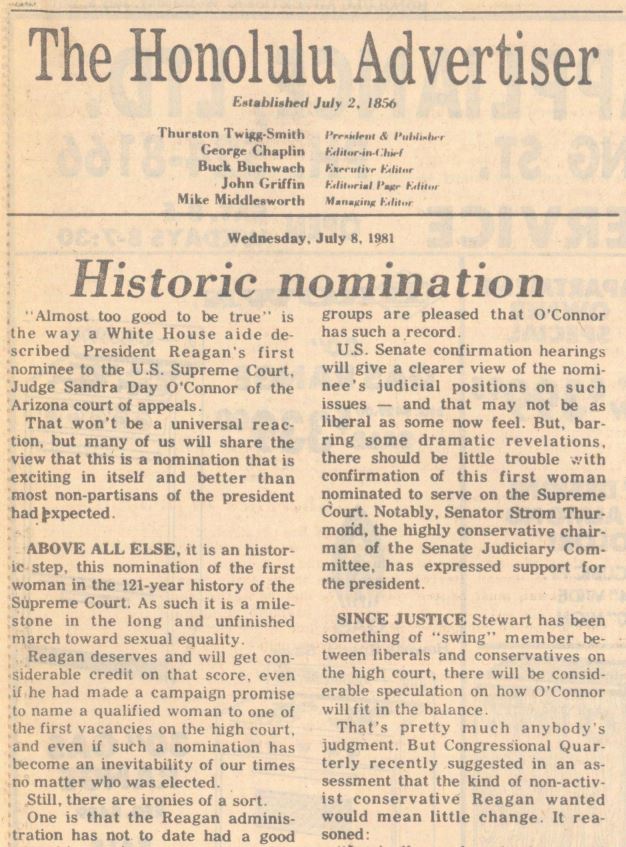
Historic Nomination

Editorial
July 2, 1981

O’Connor surprises as high court candidate

Newspaper article
July 2, 1981

WASHINGTON (AP) – Judge Sandra D. O’Connor of the Arizona Court of Appeals has emerged as a leading candidate to succeed Justice Potter Stewart on the U.S. Supreme Court, the Washington Post reported today. “She hasn’t been chosen yet. but she’s close,” the newspaper quoted one unnamed Reagan administration source as saying. The Post said Mrs. O’Connor, 51, was interviewed for the vacancy by an administration official and was believed to be the only potential nominee to be interviewed. In another development, the New York Daily News quoted Reagan administration sources in today’s editions as saying that U.S. District Judge Lawrence W. Pierce, a 56-year-old black. is also being considered for the high-court seat. Administration officials said Mrs. O’Connor is on a “short list” of leading candidates – most of them women – for Stewart’s seat, which becomes vacant when he retires Friday, according to The Post. During his campaign last year. President Reagan said he wanted to name a woman to one of the first vacancies on the nine-member court. The White House, however, has kept open the possibility that a man could be named to succeed Stewart. Until now, one of the women mentioned most often as Stewart’s likely successor has been Cornelia Kennedy of Detroit, a member of the 6th U.S. Circuit Court of Appeals. The Post said Mrs. O’Connor has support from both of Arizona’s senators, Republican Barry Goldwater and Democrat Dennis DeConcini, a member of the Senate Judiciary Committee.

Mrs. Justice’ from Arizona?

Newspaper article
July 1, 1981

No sooner had U.S. Supreme Court Justice Potter Stewart announced that he will retire next month than Sen. Dennis DeConcini was campaigning for Sandra O’Connor of the Arizona Court of Appeals as a worthy replacement.

DeConcini’s quick move made sense. For President Reagan has said he will move quickly to fill the vacancy, hoping the Senate can confirm his appointment before the high court reconvenes in October. The promotion of a qualified woman jurist also made sense, because Reagan has indicated the Supreme Court will seat its first female member during his administration. Actually, Democrat DeConcini, who seldom misses a political trick, stole the march on Sen. Barry Goldwater. It would seem that Republican Goldwater should have seized the opportunity to drop the name of Mrs. O’Connor, a conservative Republican and a near-neighbor from Paradise Valley. In any event, Tucsonian DeConcini, facing a statewide re-election race in 1982, no doubt endeared himself to many people in Maricopa County through his alertness. Mrs. O’Connor, 51, an appellate court judge since 1979, is highly regarded. We trust Reagan will give Mrs. O’Connor careful consideration. We were impressed by her five-year performance as a state senator (1969- 74), especially her final two years as a bright and effective Senate pres ident, and we have heard good reports of her even-handedness as a judge, beginning with her Maricopa County Superior Court stint (1974-79). As a clear sign of her popularity, Mrs. O’Connor

Judge Sandra D. O’Connor Nominated to U.S. Supreme Court

Newspaper article
July 1, 1981

President Reagan broke the all-male tradition of the Supreme Court on Tuesday, July 7, by nominating Arizona Court of Appeals Judge Sandra Day O’Connor to succeed retiring Justice Potter Stewart. Judge O’Connor, 51, becomes the first woman to be nominated to sit on the high court. President Reagan said of Judge O’Connor, “She is truly a person for all seasons, possessing those unique qualities of temperament, fairness, intellectual capacity and devotion to the public good which have characterized the 101 brethren who have preceded her. Judge O’Connor, in my view, will bring new luster and new strength to the Supreme Court. I feel certain that her term upon the bench will be one of the proudest legacies of my presidency.”

Judge O’Connor was appointed to the Arizona Court of Appeals eighteen months ago by Governor Bruce Babbitt. She was elected as a county judge in 1975 and has served as President of the Arizona State Senate. Commenting on the nomination, officials of the bar issued a statement that read, “The State Bar of Arizona is honored and extremely proud of the nomination by President Reagan of Judge Sandra O’Connor to be an associate Justice of the U.S. Supreme Court. Judge O’Connor is an outstanding member of the Arizona legal community, and we know that she will be an outstanding Supreme Court Justice as well.”

She was an accomplished trial court judge and has proven herself to be one of Arizona’s most able appellate court judges as evidenced by the high ratings

Time For A Woman

Newspaper article
June 21, 1981

THERE have been 101 justices on the United States Supreme Court since it was formed nearly 200 years ago.

All men.

Now a woman may make it.

It’s high time.

During his campaign for the presidency, Ronald Reagan promised one of his first appointments to the highest court in the land would be a woman.

He will make his first appointment, to fill the forthcoming resignation of Justice Potter Stewart, before Oct. 1.

While Justice Stewart said that appointing a judge on the basis of sex “was antithetical to the very idea of what a judge is supposed to be,” being a female won’t hurt any candidate for the Supreme Court now.

Here are some who undoubtedly will be considered:

Anne Armstrong, of Texas, a Republican dynamo who has served as ambassador to Great Britain.

Carla Hills, a Republican lawyer from California who has served in the Cabinet. At one time President Reagan was considering her for solicitor general.

Cornelia Kennedy and Amalya Kerase, appellate federal judges in Michigan and New York. While available reference books do not give the political party affiliations of either, both are black.

The opportunity of breaking the female barrier with a black woman must have great attraction to any politically inclined president, which Reagan certainly is. But Justice Thurgood Marshall is black, and there might be political problems with having two black justices on a nine-member court. We suspect Kennedy and Kerase will have to wait until Justice Marshall leaves the court.

Arizona Appellate Court Judge Sandra O’Connor has been suggested as a possible candidate.

One of her main problems, of course, is that Arizona already has one Supreme Court Justice, William Rehnquist, and it would be unusual indeed for a small state to have two members of the court.