
Law review article

Reply to Professor Tarpley’s Comment Regarding Justice Sandra Day O’Connor

ESSAY

REPLY TO PROFESSOR TARPLEY’ SCOMMENT REGARDING JUSTICE SANDRA DAY O’CONNOR

JEAN HOEFER TOAL•

INTRODUCTION 267

BACKGROUND 268

PROFESSOR TARPLEY’S ATTACK ON JUSTICE O’CONNOR 270

THE EVOLUTION OF THE STRICT SCRUTINY STANDARD FOR EQUAL PROTECTION CHALLENGES TO RACE-BASED

CLASSIFICATIONS 271

POST-CROSON: METROBROADCASTINGANDADARAND 275

THE IMPACT OF PERSONAL ATTACKS ON JUDICIAL INDEPENDENCE. 279

CONCLUSION 282

INTRODUCTION

The Fall 2001 book of the South Carolina Law Review contains an essay by Joan Tarpley, J.D., Professor of Law at the Walter F. George School of Law, Mercer University entitled,A Comment on Justice O’Connor’s Quest for Power and Its Impact on African American Wealth.1 The essay is an overheated, sensational personal attack masquerading under the guise oflegal scholarship. Its thesis is that Justice O’Connor is a white supremacist who, through her opinion in City of Richmond v. J.A. Croson Co.,2 seeks to dismantle affirmative action jurisprudence and strengthen her position as the swing vote on the United States Supreme Court in order to exercise the power of Chief Justice, in fact, if not in name.

Selection to the editorial staff of the South Carolina Law Review in the spring ofmy first year oflaw school remains one of the proudest events ofmy

•Chief Justice, Supreme Court of South Carolina.

Joan Tarpley, A Comment on Justice O’Connor’s Quest/or Power and Its Impact on African American Wealth, 53 S.C. L. REv. 117 (2001).

2. 488 U.S. 469 (1989).

267

Law review article

Judicial Deference to Educational Judgment: Justice O’Connor’s Opinion in Grutter

JUDICIAL DEFERENCE TO EDUCATIONAL JUDGMENT:

JUSTICE O’CONNOR’S OPINION IN GRUTTER

REAPPLIES LONGSTANDING PRINCIPLES, As SHOWN BY RULINGS lNVOLYING COLLEGE STUDENTS IN THE

EIGHTEEN MONTHS BEFORE GRUTTER

EDWARD N. STONER II*

J. MICHAEL SHOWALTER**

It is the business of a university to provide that atmosphere which is most conducive to speculation, experiment and creation. It is an atmosphere in which there prevail “the four essential freedoms” of a university-to determine for itself on academic grounds who may teach, what may be taught, how it shall be taught, and who may be admitted to study.1

The Law School’s educational judgment that such diversity is essential to its educational mission is one to which we defer. The Law School’s assessment that diversity will, in fact, yield educational benefits is substantiated by respondents and their amici…. Our holding today is in keeping with our tradition of giving a degree of deference to a university’s academic decisions, within constitutionally prescribed limits. We have long recognized that, given the important purpose of public education and the expansive freedoms of speech and thought associated with the university environment, universities occupy a

* B.A., DePauw University, 1969; J.D., University of Virginia, 1972. Mr. Stoner, a lawyer in the Pittsburgh office of Reed Smith LLP, is a member of the Pennsylvania and Florida Bars. He is a past President and Chair of the Board of Directors of the National Association of

Law review article

Women of the Highest Court: Does Gender Bias or Personal Life Experiences Influence Their Opinions?

COMMENT

WOMEN OF THE HIGHEST COURT: DOES GENDER BIAS OR PERSONAL LIFE EXPERIENCES INFLUENCE THEIR OPINIONS?

Brenda Kruse

I. INTRODUCTION

MANY feminist commentators have theorized that judges’ gender and life experiences influence their decisions.1 This comment hypothesizes that this phenomenon is particularly apparent in Justice Sandra Day O’Connor’s and Justice Ruth Bader Ginsburg’s decisions pertaining to employment discrimination. Before becoming Supreme Court Justices, both faced many obstacles in their professional and personal lives. In order to understand the effects of the Justices’ gender and personal experiences on their decisions, the analysis focuses on the Title VII of the Civil Rights Act of 1964 (Title VII), Americans with Disabilities Act (ADA), and Age Discrimination in Employment Act(ADEA) opinions where both Justices were members of the Supreme Court. Because the specific factors of gender and life experiences influence Justice O’Connor’s and Justice Ginsburg’s decisions, they are useful indicators to predict the Justices’ opinions in future Title VII cases.

Part II of this comment consists of two sections that discuss the gender and life experiences of the Justices in detail. Part III examines how the factors involved in these experiences influence the Justices’ employment discrimination opinions. Specifically, section A addresses Title VII cases, section B addresses ADA and ADEA cases, and section C discusses how the Justices’ Title VII opinions

Law review article

Federalism on the High Seas: The Admiralty Jurisprudence of Justice Sandra Day O’Connor

Federalism on the High Seas: The Admiralty Jurisprudence of Justice Sandra Day O’Connor

BYMATTHEW J. KITA*

INTRODUCTION 132

THE PERFECT STORM: MARITIME LAW, THE CONSTITUTION, CONGRESS, ANDTHECOURTS 133

Maritime Law’s Federalism Paradox 133

Sandra Day O’Connor’s Views on Federalism 135

The Traditional Role of the Admiralty Judge 138

ROUGH SEAS: THE COURT AND MARITIME FEDERALISM BEFORE 1981 143

Moragne v. States Marine Lines, Inc 43

Sea-Land Services, Inc. v. Gaudet 145

Mobil Oil Co. v. Higginbotham 146

THE TIDE SHIFTS: MARITIME FEDERALISM IN THE O’CONNOR ERA 148

Foremost Insurance Co. v. Richardson 148

Offshore Logistics, Inc. v. Tallentire 150

Miles v. Apex Marine Corp 153

American Dredging Corp. v. Miller 155

Yamaha Motor Corp. U.S.A. v. Calhoun 156

Lewis v. Lewis & Clark Marine 158

Norfolk Shipbuilding & Drydock Co. v. Garris 161

STORM FRONT: CRITICISM OF JUSTICE O’CONNOR’S COURSE 163

A DIFFERENT TACK?: WHERE SHOULD WE Go FROM HERE? 168

Boston College (A.B. Political Science 1998); University of Maryland (Higher Education Policy 2000); University of Houston Law Center (J.D. 2005). The author would like to thank two distinguished members of the University of Houston Law Center faculty: Professor Craig Joyce for his guidance in the composition of this article, and Professor Gus A. Schill, Jr. for his instruction in admiralty and maritime jurisprudence, his dedication to teaching his students the importance of ethics and civility in the practice of law, and

Law review article

A Curious Choice: Hibbs v. Winn as a Case Study of Justice Sandra Day O’Connor’s Balancing Jurisprudence

Note

A CURIOUS CHOICE: Hibbs v. Winn as a Case Study of Justice Sandra Day O’Connor’s Balancing Jurisprudence

C. Lincoln Combst

INTRODUCTION

At first glance, the United States Supreme Court opinion in Hibbs v. Winn1 is a seemingly innocuous discussion of a highly technical issue: the statutory interpretation and legislative history of the Tax Injunction Act.2 A closer look, however, reveals that the case subtly demonstrates the deep ideological divisions of the Rehnquist Court, and gives some insight into arguably the Court’s most crucial decisionmaker. As is typical of many controversial decisions of the current Court, the Court split 5-4 along familiar lines with the liberal justices on one side and the conservative wing of the Court on the other.3 And, as is not unusual during her time on the Court,4 Justice Sandra Day O’Connor is in the five-Justice majority.5 What

t J.D. Candidate, May 2006, Arizona State University College of Law; B.A., University of California at San Diego, 1994; Master of Sports Administration. Ohio University, 1997. The author would like to thank Arizona Supreme Court Justice and The College of Law at Arizona State University Adjunct Professor of Law Andrew Hurwitz for his guidance and insight in selecting this topic and writing this article.

I. 124 S. Ct. 2276 (2004).

2. 28 u.s.c. § 1341 (2004).

See, e.g., Bush v. Gore, 531 U.S. 98 (2000); United States v. Lopez, 514 U.S. 549 (1995); Planned Parenthood ofS.E. Pa. v. Casey, 505 U.S. 833 (1992).

NANCY

Law review article

In Praise of Contextuality: Justice O’Connor and the Establishment Clause

IN PRAISE OF CONTEXTUALITY – JUSTICE O’CONNOR AND THE ESTABLISHMENT CLAUSE

Marie A. Failinger*

Among Justice Sandra Day O’Connor’s lasting conttibutions to Supreme Court jurisprudence has been her attempt to contextualize Religion Clause jurisprudence, to move the Court in the direction of considering the circumstances surrounding government action in assessing its constitutionality. Her two decades of work in Establishment Clause law, in particular, is book ended by Lynch v. Donnelly, in which she introduced the “non-endorsement” test’ and one of the Ten Commandment cases, McCreary County, Kentucky v. American Civil Liberties Union, 2 where it was most recently employed.3

The non-endorsement test, officially adopted by the Court as a doctrine in County of Allegheny vs. American Civil Liberties Union,4 has served as one of the two commonly competing tests in Establishment Clause cases not involving financial aid5 ever since. It requires that a reviewing court examine government action to determine whether it demonstrates a purpose to endorse or disapprove of a particular religion, or to promote religion over non-religion. Next, the Court must determine whether, regardless of its intent, the effect of the government’s action endorses or approves of religion in the eyes of a “reasonable, well-informed” or

•

I

concurrin )

Professor of Law, Hamline University School of Law.

Lynch v. Donnelly, 465 U.S. 668, 687-88, 690-91 (1984) (O’Connor, J.,

McCreary County, Kentucky v.

Newspaper article, The Kauffman-Henry Collection

Woman for Supreme Court Bench

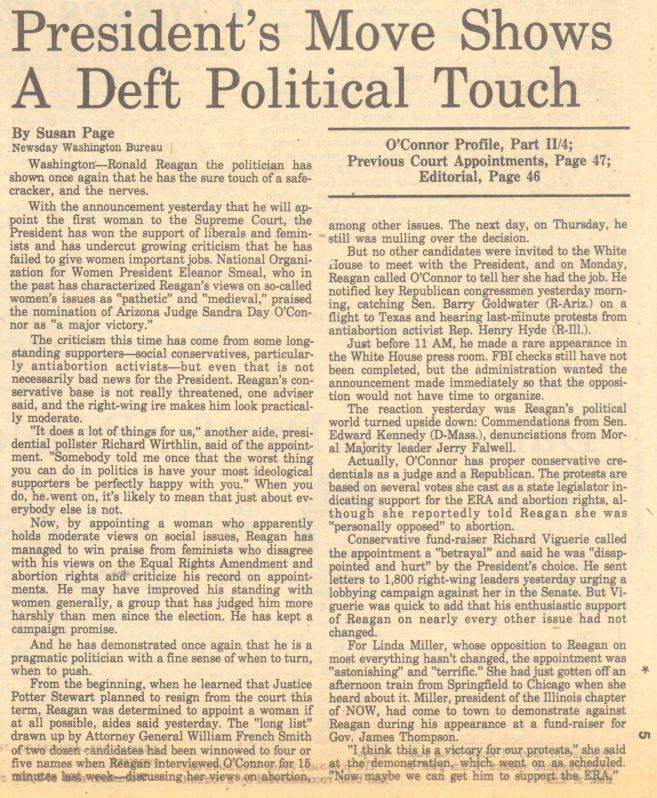
PRESIDENT REAGAN made U.S. history yesterday by appointing the first woman to serve on the U.S. Supreme Court. In a brief statement to reporters at the White House, Mr Reagan confirmed that he bad chosen Mrs Sandra O’Connor, a Judge of the Arizona Court of Appeals, to succeed Justice Potter Stewart, who retired last month. Mrs O’Connor, 51, who has been described as “a judicial conservative but flexible,” now faces final clearance by the Federal Bureau of Investigation and Senate confirmation. The choice of a woman fulfills a campaign commitment by the President. But he stressed yesterday that he was not putting her name forward simply because she was female. That would not h ave been fair to women or to future generations. The President described Mrs O’Connor as ” truly a person for all seasons, possessing those unique qualities of temperament, fairness, intellectual capacity and devotion to the public good.” The appointment could be the first of several opportunities that Mr Reagan will have to stamp his conservative beliefs on the face of American society-a chance denied to President Carter, who made no Supreme Court appointments. Service on the court is for life, unless a justice chooses to retire, and five of its nine members are now over 70. The importance of the Supreme Court in moulding American society is often underestimated outside the U.S., where attention tends to focus on Presidents and politicians. An active Republican, Mrs O’Connor served two full terms in the

Newspaper article, The Kauffman-Henry Collection, Washington Star

Court Barber Draws the Line

Court Barber Draws the line John Shaw is the last remnant of the Supreme Court’s 191-year history as a male• only institution. Shaw is the court’s barber. There is no beauty parlor and no beautician. But, asked today if he could cut future Justice Sandra O’Connor’s hair, he replied, “Yes, sir.” If she wants her hair done more elaborately, however, she will have to go elsewhere. “I don’t do permanents,” Shaw said. The most important indicator of maleness at the court was put to an end at 3 p.m. last Nov 14. That is when the court decided, after a secret discussion, to drop all refer• ences in opinions and other official orders to “Mr. Justice.” The public first became aware of the change on the following Monday, when the court issued an opinion in the case of Dennis v. Sparks, writ• ten by “Justice White.” The change reportedly was adopted in anticipation that, someday, a woman would be joining the brethren. Although the court has a gymnasium, it has not been segregated by sex. Women employers of the court have been having an exercise class there, and they have access to the showers. The bathrooms in the individual justices’ chambers are configured for unisex use. – Lyle Denniston

Newspaper article, San Francisco Examiner, The Kauffman-Henry Collection

O’Connor gets high praise for politics and the law

PHOENIX, Ariz. – ‘Arizona Appeals Court Judge Sandra D. O’Connor, President Reagan’s nominee to the Supre,me Court, has a long background in the law and politics, and she rates superlatives from her colle-c1gues in both arenas. O’Connor’s abilities foster respect from people in both major political parties. Attorneys, legislators and others praised her nomination to fill the vacancy created by retirement of Justice Potter Stewart. Dean Roger C. Henderson of the University of Arizona Law School called the nomination an “excellent appointment.” “She is a no-nonsense person,” he said. “When she gets down to business. it’s all busines.<;. •She will call them as she sees them, that's for sure. She's Just going to be great." Bob Begam, a Phoenix attorney, said he was .. surprised and delighted. 1 would say she is a conservative person but that she will approach each issue on its merit which is what any judge, particularly a Supreme Court judge, should do. "She won't fall into any pattern. Some of her opinions may be embraced by conservatives, others embraced by liberals. She will, in my opinion, decide each case on its merits." Despite her conservative bent. she has supported abortion legJSlation and the Equal Rights Amendment. The president of the National Right to Life Committee immediately announced "the entire pro-life movement will oppose her confirmation." O'Connor. 51, was graduated from Stanford University Law School in 1952, with the Order of the Coif. She was a member of