Law review article

Justice O’Connor and the Rule of Law

JUSTICE O’CONNOR AND THE RULE OF LAW

Eric J. Segall*

INTRODUCTION 107

‘ THE RULE OF LAW 109

JUSTICE O’CONNOR’S DECISIONS AND THE RULE OF LAW 112

Allen v. Wright 112

New York v. United States & Printz v. United States 115

Abortion, Affirmative Action, and Establishment 118

Abortion 118

Affirmative Action 120

Establishment of Religion 122

A Few Other Examples 129

N. CONSTITUTIONAL DECISIONMAKING AND THE

RULE OF LAW 134

CONCLUSION 137

What distinguishes the rule of law from the dictatorship of a shifting Supreme Court majority is the absolutely indispensable requirement that judicial opinions be grounded in consistently applied principle. This is what prevents judges from ruling now this way, now that – thumbs up or thumbs down – as their personal preferences dictate.1

INTRODUCTION

In the wake of Justice O’Connor’s retirement from the Court, there will undoubtedly be a flurry of books and articles devoted to the first female

* Professor of Law, Georgia State College of the Law. Versions of this Essay have been presented at a faculty workshop at American University, and at the 2004 Conference of the Southeastern Association of American Law Schools. I would also like to thank Sandy Levinson, Steve Kaminshine, Tom McCoy, Neil Kinkopf and Mark Tushnet for helpful comments on a previous draft.

McCreary County v. ACLU, 125 S. Ct. 2722, 275 l (2005) (Scalia, J., dissenting).

107

108 UNIVERSITY OF FLORIDA JOURNAL OF LAW & PUBLIC POLICY [Vol. 17

Justice and her many

Arizona Business Gazette, Newspaper article, The Kauffman-Henry Collection

O’Connor urges state control in civil rights damage cases

WASHINGTON – A Supreme Court justice has hinted strongly to Congress that a key case will be decided in favor of keeping federal courts open for the growing volume of civil rights damage claims. The highly unusual hint came March 9 in testimony by the newest justice, Sandra Day O’Connor, before the House Appropriations Subcommittee that is studying the court’s $14.9 million budget request. The issue arises in a pending Florida case that has the potential of cutting off many civil rights cases. She did not say, in so many words, how the court would rule. But she did urge Congress to pass a law to achieve that result by requiring most civil rights cases to be pursued first with state agencies, instead of going directly to the federal courthouse. It would not be necessary for Congress to act, of course, if the justices were to interpret present law to give state agencies priority in handling such cases. Asked after the hearing if the issue she had discussed were not the same one now under review by the court in the Florida case, O’Connor replied: “I will rest on what I said.” Just two weeks ago, the court heard lawyers argue the case. Under normal procedures, the justices would have cast their preliminary vote on the case at their secret conference on Friday. O’Connor’s promotion of a federal law to shunt more civil rights cases to state agencies echoed a proposal she made in a law review article last summer, before she was chosen for the Supreme Court. An Arizona appeals court

Interview

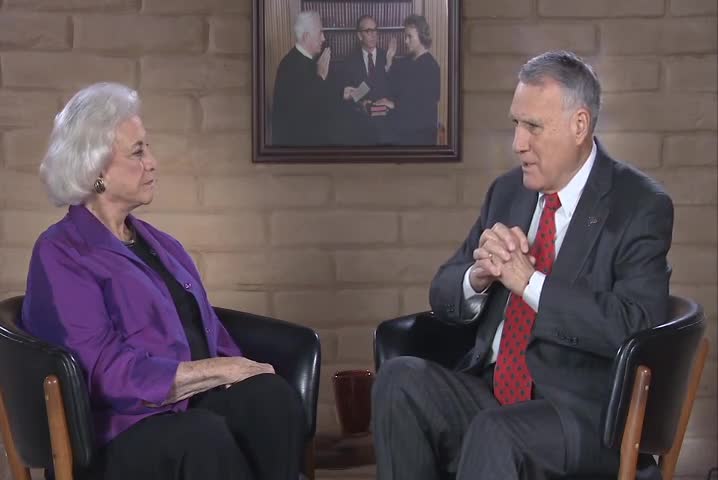
Interview with Sen. Dennis DeConcini and Rep. John Shadegg

Sandra Day O’Connor It’s so nice to have you both at O’Connor house. And we have two significantly political figures with us at O’Connor house today. And they’re helping us celebrate Arizona centennial. We’ve had 12 United States senators from Arizona over the last hundred years. And only three of them are alive today. And we have one of them here today. And it is senator Dennis Deacon see me and Dennis served three terms in the United States Senate. So welcome, Dennis Dennis DeConcini O’Connor to O’Connor. Thank you, Your Honor. Be Sandra Day O’Connor careful about that. Dennis DeConcini I’m so used to saying that because my father was a judge as you know And Sandra Day O’Connor he was on the Arizona Supreme Court. John Shadegg Forgive me for going Dennis DeConcini off the subject. But I always say, you know, in my house, you always address your father. Your Sandra Day O’Connor Honor, honor. Yes. Good. Good. And congressman john Shattuck is also here with us today. He served eight terms in the House of Representatives. And you’re still there. Isn’t that right? John Shadegg No, I retired at the beginning of this term Sandra Day O’Connor and you were replaced. I was replaced. Nobody can replace that. Somebody holds an office. Somebody holds my see. Okay. Well, we welcome you to well, Connor house today. It’s a pleasure. And both of you come from politically active families. You weren’t the first In either case and your families to be interested in Arizona’s political

Interview

Interview with Secretary of Homeland Security Janet Napolitano

Sandra Day O’Connor
Secretary Napolitano. What a pleasure it is to be back in Arizona and talk a little on this occasion of Arizona’s hundredth birthday. Can you believe we’re 100 years old? I feel about that old myself.
Janet Napolitano
(laughs) 100 years young, maybe!
Sandra Day O’Connor
No. Anyway, I’m really glad that you could come. When did you take over as head of Homeland Security?

Janet Napolitano
I took over at the very beginning of President Obama’s term just about three years ago.

Sandra Day O’Connor
Does it seem like 100 years?

Janet Napolitano
We’ve packed a lot into three years. You know, it’s, it is the third-largest department of the federal government. We cover everything and it has been challenging and interesting and has really been a wonderful experience.

Sandra Day O’Connor
It’s very difficult. I’m going to come back to that. Yeah, later, because it’s an amazing job that you took on. But what brought you to Arizona in the first place? When did you come to Arizona?

Janet Napolitano
Well, you know, I grew up in New Mexico. So I’m from the southwest. But I’d gone to college in California and and spent time in in Virginia for law school, and I decided I wanted to move back West somewhere. And I got a judicial clerkship with Judge Mary Schroeder of the US Court of Appeals for the
Ninth Circuit.
Sandra Day O’Connor
How fun
Janet Napolitano
Yeah, we’re in the Ninth Circuit, you know, it covers most of the western states.

Interview

Interview with Senator Jon Kyl

Sandra Day O’Connor Good morning, Senator Kyl.

Jon Kyl Thanks.

Sandra Day O’Connor Just, I’m so glad you’re once again back in Arizona and have time to talk to us today. Jon Kyl It is great to be home. What a beautiful day. Sandra Day O’Connor We it’s a great day. And I’m glad you’re here. Thanks very much. Now, as I understand it, you’ve made a decision not to run for the Senate. Again, you’re getting out of electoral politics Jon Kyl is right, right after after 26 years, next January 3. I will no longer be in the Senate. I’ll go back into the private sector. And I’m looking forward to that. Although there are a lot of things I have yet to do in 10 months and four days or but Sandra Day O’Connor that’s a long period of service. We’ve had several people in Arizona who served a long time, who has served longer than you looking at our Jon Kyl history. Our birthday. This year I did a little research there only been 10 senators in Arizona’s history in the hundred years in the hundred years, served the longest stealing that I think that Earl Earl Hayden clearly served the longest. And then Ernest McFarland, Barry Goldwater, but you also had our first two senators, I love the name Marcus for really Smith. And Henry found Asher both of whom were great orators. In fact, Ashurst is the one who is bragging on the Senate floor, you know, all Arizona needs is a few good men and little more water and somebody said, well, they could say the same about hell. So they were there a long

Interview

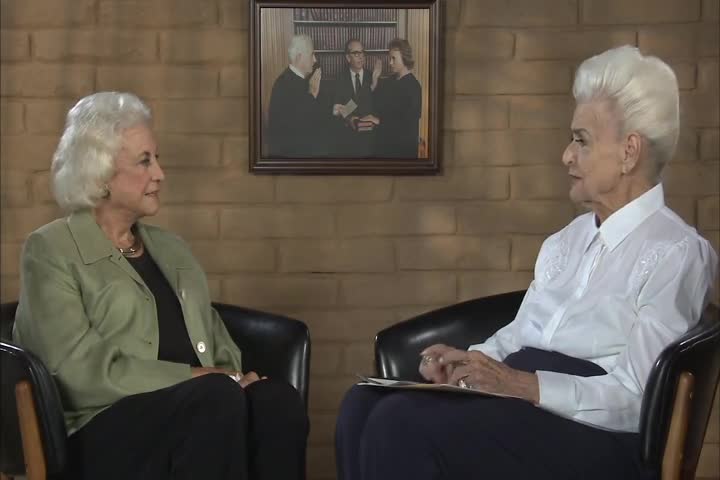
Interview with former Arizona Governor Rose Mofford

Sandra Day O’Connor I am very happy to welcome Arizona’s first woman governor, Rose Mofford, to O’Connor House to have a conversation. I’m really pleased you could be here for this. Rose Mofford Now, I’m going to have preference today. Age before beauty today. I’d like– Sandra Day O’Connor I don’t know, I think we’re both in the age category. But I’m so glad you’re here and I’ll tell you one reason. You and I both grew up out in the hinterlands of Arizona. You grew up, you were born in Globe, Arizona, and went to school there. I was on a ranch over in Greenlee County, Arizona and Hidalgo County, New Mexico. And my parents sent me off to El Paso to go to school. We were pretty far away from any school. So we both had rural Arizona upbringings. Rose Mofford And I’ll tell you, that’s the greatest thing that ever happened to me in my life. I was raised by two of the finest parents in the world. Sandra Day O’Connor That’s great. Rose Mofford And I had, there were six of us, four girls and two boys. And we never lost track, but they all turned out, and I’m the last of the six. Sandra Day O’Connor You were the youngest. Rose Mofford I was the youngest. And I was “Baby Rose” to my mother until I was 50 years old. Sandra Day O’Connor Did she still call you “Baby Rose”? Rose Mofford Baby Rose. Now I’d like to tell you that I told several people I was coming out to be with you. And I told them how much fun we had when we were here before.

Sandra Day O’Connor That’s right.

Rose

New Times, Newspaper article, The Kauffman-Henry Collection

The Bar’s stamp of approval becomes an after-thought

NATIONAL-The American Bar Association is taking a long, hard look at Sandra O’Connor’s qualifications to sit on the U.S. Supreme Court

But the U.S. Senate that is expected to routinely confirm O’Connor before the court’s fall session begins in October will know what the ABA thinks of the Arizona Court of Appeals judge before the_public does. The Reagan administration apparently has ordered the ABA’s Standing Committee on the Federal Judiciary to keep the report under wraps until the hearings.

Chairwoman Brooksley Landau, a Washington lawyer, is refusing to say if Reagan has authorized the ABA to release the report when it’s completed – a polite way of saying it won’t be. Reagan waited until the last minute to inform the ABA he was nominating O’Connor, coming perilously close to ignoring a Presidential tradition of seeking a pre-nomination imprimatur from the nation’s largest association of lawyers, but the national press doesn’t seem interested in asking why.

Some skeptics in the legal community are suggesting the committee might designate O’Connor as a judicial lightweight, whose relatively brief trial court tenure doesn’t give her the length and depth in constitutional law expected of justices. O’Connor doesn’t have as many years on the bench as Reagan’s other female finalists, the skeptics note.

On the other hand, O’Connor brings to the court the kind of nuts-and-bolts trial experience ~at could keep the Supremes from wandering too often into legal esoterica that reads