Newspapers around the country comment on O’Connor nomination
“This precedent-setting appointment … marks another welcome advance for equal treatment of women under the law. A final judgment on Mrs. O’Connor’s qualifications must await the Senate confirmation process. But it can already be said that in acting t.o end the male-only monopoly on the Supreme Court, President Reagan has achieved a longneeded first for America.” Buffalo Evening News “President Reagan has shown great courage and a sense of balance . The president refused t.o be bullied by the nation’s far right and pro-life groups who fear that Judge O’Connor will not bend the law in their direction. The president has made a wise choice in Sandra O’Connor. She appears t.o be well qualified and it is long past time for a woman to take a seat on the Supreme Court.” Fort Lauderdale News . “Mrs. O’Connor’s political beliefs are probably more conservative than we would like; after all, she is a Republican . But indications are that she is nuly a ‘class’ person who can handle the challenge. Her being the first woman nominated t.o the Supreme Court . , . – is historic, but more important than her sex is that she be qualified for the job. At this time, she surely appears to be.” Atlanta Constitution “President Reagan’s choice … fulfills Mr. Reagan’s campaign pledge t.o put a woma.n on the nation’s highest tribunal. Americans will hope that the appoint – ment represents something more and there is reason t.o believe it does. Judge O’Connor commands legal and judicial credentials that
O’Connor nomination fuels rally
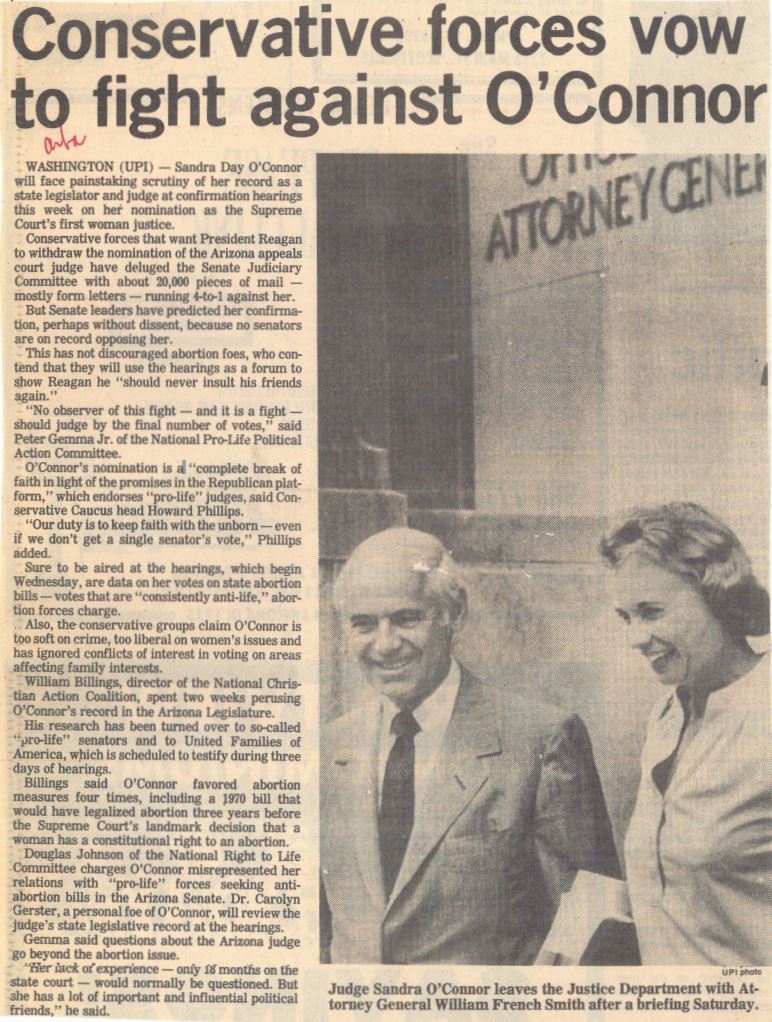
DALLAS – The president of the National Roundtable said a giant anti-abortion rally planned for today, featuring the Rev. Jerry Falwell, was organized in part in reaction to the nomination to the Supreme Court of Judge Sandra O’Connor. “The O’Connor nomination was part of the catalyst for the meeting,” Ed E. McAteer said. “Mrs. O’Connor’s legislative record is proabortion. I believe all the evidence shows she is pro-abortion.” McAteer, who heads the conservative organization, said he would like to see President Reagan take back the nomination of the Arizona judge , whose Senate confirmation hearings begin next week, but he did not have much hope that would happen. I Promoters said they expect more than 12,000 people to attend today’s meeting, featuring Falwell, , founder of the Moral Majority; Paul Weyrich, a conservative political fund-rpiser; Phyllis Schlafly, a opponent of the feminist movement ; and James Robison, a Fort Worth, Texas, evangelist. In addition, officials said the Roundtable’s state organizations will sponsor vigils today at federal buildings in every state capital and in major cities across the country. Judge O’Connor was in Washington on Wednesday, prepar ing for Senate hearings on her nomination . The Arizona appeals court judge flew to the nation’s capital Tuesday and said she planned to spend her time prepar – ing for three days of confirmation hearings before the Senate Judiciary Committee next week. When asked if she expects much trouble from critics
O’Connor moves easily toward confirmation
WASHINGTON – Judge Sandra Day O’Connor yesterday moved easily toward confirmation as an associate justice of the U.S. Supreme Court, emphasizing before a generally appreciative Senate Judiciary Committee her belief that “the proper role of the judiciary is one of interpreting and applying the law, not making it.” The first of three scheduled days of confirmation hearings contained few surprises. The members of the committee asked the Arizona Court of Appeals judge questions she seemed to have expected, and she provided answers the senators seemed pleased to hear. Members of the committee, including its chairman, Republican Sen. Strom Thurmond of South Carolina, indicated that confirmation was a virtual certainty. But if the hearing lacked doubt as to outcome, it did not lack drama or a sense that history was being made by the imminent confirmation of the first woman Supreme Court justice in the court’s 191-year history. “Better 190 years late than never,” Republican Sen. Robert Dole of Kansas told the nominee, adding: “You are among friends.” “As the first woman to be nominated as a Supreme Court justice, I am particularly honored,” O’Connor told the committee in her opening statement. “But I happily share the honor with millions of, American women of yesterday and today whose abilities and conduct have given me this opportunity for service.” O’Connor’s opening statement, which followed an hour of comments by members of the committee, set the tone for much of what followed. She
O’Connor: More than just keeping a campaign promise
A president’s overriding responsibility in selecting a nominee for the United States Supreme Court is to choose someone whose talent, temperament and experience most qualify for service on the nation’s highest court. Measured against this demanding criteria, President Reagan’s choice of Arizona Appeals Court Judge Sandra O’Connor can be called meritorious, perhaps even distinguished. That the judge is also a woman, the first nominated in the 191-year history of the United States Supreme Court, lends Mr. Reagan’s choice a historical significant that is as momentous as it is obvious. By all accounts, Judge O’Connor has compiled an excepti?nally fine record in a succession of iegal and iudicial posts: assistant state attorney general, superior court judge, and, most recently, a member of Arizona’s second highest court. Her written opinions, described by colleagues as lucid and brilliantly reasoned, reportedly reflect Mr. Reagan’s philosophical preference for judicial decisions that interpret the law rather than make it. Judge O’Connor’s academic background is every bit as solid as her subsequent achievements. In 1952, she graduated from Stanford law school along with William H. Rehnquist, now among the Supreme Court’s most respected justice. The one obvious gap in Judge O’Connor’s qualifications is her lack of experience at the federal court level. But this need hardly be a significant drawback for a nominee possessing so many other worthy attributes. In Judge O’Connor’s case,
O’Connor Justice Breaks Ranks with Conservatives on Gender Issues
Two years ago, when Sandra O’Connor was nominated as the first sister to join The Brethren, Reagan called her a “person for all seasons.” The political commentators, on the other hand, called her “a person for all reasons.” She was a two-fer: a conservative and a woman. Now Justice O’Connor has completed her second term at the court with a remarkable finish: She walked down the middle of the road with one foot on each sidewalk. In the Court’s closing week, O’Connor cast the swing votes in the Norris pension case. First she agreed with one quartet of justices that pension plans can’t pay smaller monthly benefits to women than to men. Then she agreed with the other quartet of justices that this decision should not be retroactive, that equality would start from today. As Judith Lichtman of the Women’s Legal Defense Fund reads it, “She gave us half a loaf.” And this is, in many ways, a decent summary of the First Woman’s first two years on the bench. O’Connor has sliced the legal bread on her table in an intriguing way. In most cases, O’Connor voted with conservative Justice William Rehnquist.Indeed their nickname, “the Arizona twins” could be changed to “the Arizona Siamese twins.” She voted with conservatives on the death penalty issues, and on many civil rights issues. She helped narrow the standard for class-action suits and agreed that a plaintiff had to prove an employer’s “intent” to discriminate. Finally, in the long-awaited abortion case, she wrote the minority opinion
O’Connor joins Burger in plea for new court
NEW ORLEANS (UPI) -Arguing the quality of American justice is at stake, Chief Justice Warren Burger is asking Congress to create a new federal court to decide some of the Supreme Court’s cases . Burger said the flow of cases is so overwhelming that the court is threatened with a “breakdown of the system – or of some of the justices” and “patchwork remedies” cannot solve the problem. ” It is the most important single, immediate problem facing the judicial branch, ” he declared. Denying he was “crying wolf,” the nation’s top jurist recommended setting up a temporary panel of judges to settle conflicting rulings among the circuit courts of appeal, and perhaps disputes over federal statutes . Justice Sandra Day O’Connor, like Burger addressing tl-ie American Bar Association’s annual. mid-winter meeting Sunday, made a similar proposal for a new court. “There is no one single, permanent solution,” Mrs O’Connor said. “Ea ch time the court’s caseload increases , congressional action is necessary to make some significant change in th~ court’ s jurisdiction or_ its procedures to reduce the numbers . It’s been 58 years smce the last maj or changes .” Burger’s proposal, made in his annual State of the Judiciary address, was the first time he has endorsed such a major change to reduce th€’ court :,, case burdl’n – a topic that eight of the nme justice><; have spoken about publicly smce lac;tsummer Proposals tor a ne\, judicial layer between the appeals courts and the-Supreme Court have.