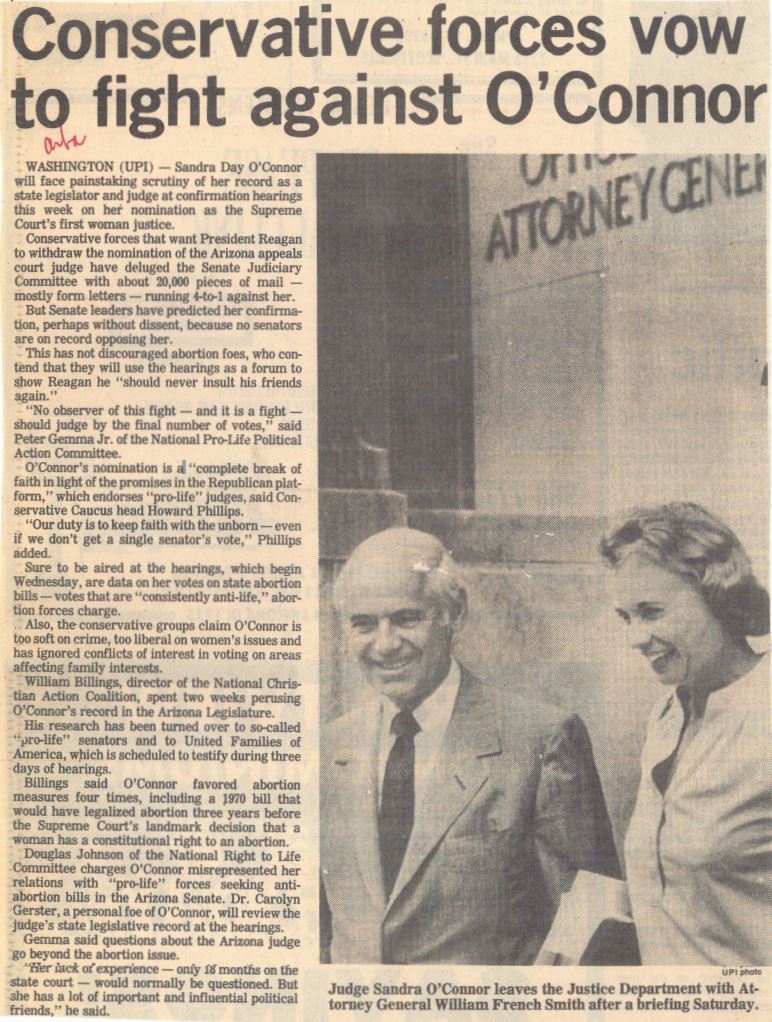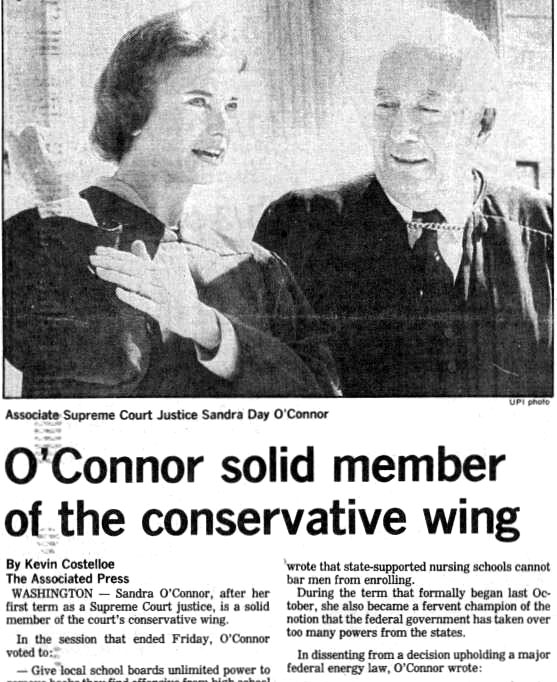
Kingman Daily Miner, Newspaper article, The Kauffman-Henry Collection

Falwell to testify against O’Connor

w ASHINGTON (AP) – Jerry Falwell , leader of the fundamentalist Moral Majority, will testify next. week in opposition to the nomination of Sandra Day O’Connor to become the first woman Supreme Court justice . Mrs . O’Connor, who has been in Washington since Monday, will lead off hearings next Wednesday before the Senate Judiciary Committee which is considering her nomination. Once her appearance ls over, an additional 25 persons have been scheduled to appear either in support or opposition to President Reagan’s first high court nominee, according to a witness list released Friday. The list includes Faliwell , and officials of a nwnber of anti-abortion groups , including tbe National Right to Life Committee, who oppose Mrs. O’Connor’s nomination because they believe she supports tbe Supreme Court’s 1973 decision legalizing abortion. Among those testifying in support of tbe nomination will be representatives of the American Bar Association, the National Organization for Women, the National Women’s Political Caucus, the National Bar Association, the National Association of Women Judges and Dlok C. P. Lantz , a Florida federal appeals court judge. From Arizona will come Gov. Bruce Babbitt, once a potential political rival to Mrs. O’Connor, and 10 other legislators and other public officials. Over the last several days, Mrs . O’Connor has been preparing for tbe hearings by reading briefing books prepared by Justice Department officials, including testimony of previous Supreme Court

Denver Post, Newspaper article, The Kauffman-Henry Collection

O’Connor Asks Restrictions on Federal Civil Rights Suits

WASHINGTON (AP) – Judge Sandra O’Connor, by President Reagan for a Supreme Court ,eat. bas suggested that Congress act to restrict the Dumber of federal civil rights suits against states and munidpallties. In an article in the summer 1981 issue of the William and Mary Law Review, O’Connor suggested that federal courts should defer to state courts in IOme cases on constitutional questions. She also noted “acute confrontations” between ltate and federal courts in some school busing cases and said tensions between the two judicial systems could increase in some areas. The 51-year-old Arizona appeals court judge wrote the article before Tuesday’s announcement of lier nomination to the Supreme Court, which must be confirmed by the senate. O’Connor’s nomination bas come under heavy attack from conservative and anti-abortion groups, for what they perceive to be ber stands on abortion and the proposed Equal Rights Amendment They argue that Reagan betrayed th em by lelecting O’Connor for the court. HOWEVER, her statements in the article re nect • conservattve theme shared by the president: the move to give states more freedom from the federal aovernment. “It is a step in the right direction to defer to the courts and give finality to their judgments on ral constitutional questions where a full and fair udication bas been given in the state court,” ‘Connor wrote in the article, titled “trends in the tionship Between the Federal and State Courts m the Perspective of a State Court Judge.”

Newspaper article, Scottsdale Daily Progress, The Kauffman-Henry Collection

O’Connor appointment tops state stories

Sandra Day O’Connor’s appointment as the first U.S. Supreme Court justice easily led the I allot for the top Arizona news in 1981, but even ‘ ,en the vote was far from unanimous. Though not really in the running for the Top n, Arizona Associated Press member editors and news directors gave at least some consideration to such other events as the successful transcontinental SuperChicken balloon journey and the unsuccessful predictions in Tucson for “rapture,” the day when all Christians were to be taken up bodily into beaten. It was an eventful year and the diversity of the voting reflected the variation . But with a few exceptions, the events deemed the most newswor – thy over the past 12 months centered more on individuals than on situations. Arizona’s economy, the copper industry’s depression, an Apache Cowity tax revolt, a variety of natural gas leaks, plane crashes, murder trials, a group suicide and other deaths – these all drew a scattering of votes but wound up far down the list. • Second place went to the return of Marine Sgt. James Lopez, career diplomat Robert Ode and the other Americans held hostage in Iran for 444 days. A strong third was the Arizona lottery and its ticket sales that far exceeded expectations . The Orme Dam controversy and its resolution was No. 4 in the voting, followed by Arizona’s passage of its alternative to Medicaid. Eight of those voting gave top honors to the O’Connor story, and only the hostage return drew more than one first-place vote. Selected

Newspaper mention, Phoenix Gazette, The Kauffman-Henry Collection

O’Connor Appointment a Plus for Reagan

WASHINGTON President Reagan appealed to a wide range of his constituency – and won back many disaffected Republican women – with his choice for the Supreme Court, but he continued to alienate the far right. The choice of Judge Sandra Day O’Connor to become the first woman on the nation’s highest court was superb politics for Reagan. It strengthens his credibility he pledged early in his presidential campaign that one of his first appointments to the high court would be a woman. REAGAN already has gotten more credit than most of his predecessors for keeping his campaign promises. It wins back to his corner thousands of rank-and-file Republican women who were in near open rebellion over the administration’s meager record of finding women for top jobs in Washington. At the same time, it takes away an argument from Equal Rights Amendment supporters that the ERA is needed because the Reagan administration is no friend of women.

[Photo caption: Gazette Photo Judge Sandra O’Connor’s nomination won back many disaffected Republican women for President Reagan and was hailed as superb politics.] BUT THE nomination outraged the easily outraged Moral Majority, which vowed to fight the nomination on the grounds Mrs. O’Connor, while in the Arizona Senate, took stands indicating support for ERA and abortion. One leader of the anti-abortion movement, theologian Harold O.J. Brown, declared: “Reagan is absolutely finished with pro-life people, absolutely. They are so betrayed by this that he will

Mesa Tribune, Newspaper article, The Kauffman-Henry Collection

O’Connor and her spouse have $1.1 million assets

WASHINGTON (AP) – Sandra O’Connor, in town a week early to prepare for Senate hearings on her nomination to the Supreme Court, has disclosed that she and her husband are worth more than $1 million. . In a written response to a Senate Judiciary Committee questionnaire, O’Connor endorsed “neutral” enforcement of equal rights and said she is “keenly aware of the problems associated with ‘judicial activism.”‘ “The separation of powers principle also requires judges to avoid substituting their own views of what is desirable in a particular case for those of the legislature,” she wrote. “Judges are not only not authorized to engage in executive or legislative functions, they are also ill-equipped to do so. Serious difficulties arise when a judge undertakes to act as an administrator or supervisor in an area requiring expertise, and judges who purport to decide matters of public policy are certainly not as attuned to the public will as are the members of the politically accountable branches.” O’Connor’s view on equal rights is likely to gladden opponents of affirmative action. ”The essence of equal justice under the law, in my view, is that neutral laws be applied in a neutral fashion,” she wrote. She said she has worked for equal rights for women by seeking repeal of “a nwnber of outmoded Arizon~ statutes” including one that barred women from working more than eight hours a day. She said she also developed model legislation to allow women to manage property held jointly with their

Newspaper article, Tempe Daily News, The Kauffman-Henry Collection

O’Connor adds new perspectives

Feminine view on family law, bias

WASHINGTON – The first woman on the Supreme Court probably won’t sway many cases. But she will bring new perspectives to legal questions – especially in the areas of family law and discrimination. If Sandra O’Connor is confirmed and takes her seat on the bench this fall, she will face touchy legal issues ranging from what states must prove in order to remove neglected children from parents to whether the government may bar colleges from discriminating on the basis of sex. The court – composed of male lawyers, five of whom are 72 or older – has been criticized as lacking experience, understanding and compassion when it comes to sex discrimination in employment and other areas of society. Women’s groups say recent court rulings – particularly excluding females from draft registration, and probably the draft – are particularly harmful to women. More importantly, these groups charge, some of the justifications for the court rulings reflect hopelessly outdated views of woman’s place in society. They cite the ruling that allowed California to punish only males for having sexual relations with minors of the opposite sex, which the court said was justified by the state’s need to protect unwed women from pregnancy . Judge O’Connor has shown sensitivity to women’s rights – perhaps because despite graduating third in her class from Stanford Law School, her only job offer was as a legal secretary. At 51, she also will be the youngest justice. But her rulings

Arizona Republic, Op ed, The Kauffman-Henry Collection

Foes of nomination man the ramparts

w ASHINGTON – There were hundreds of them. Each carried a . placard proclaiming opposition to Sandra O’Connor’s nomination to the Supreme Court. Most had spent the previous night sitting up on chartered buses. They had made their uncomfortable but impassioned journeys from 12 states. Now they were marching in front of the Dirksen Senate Office Building. There were grim looks on their faces. The men seemed angrier than the women. Somehow, they had transferred their revulsion for abortion to a fear and dislike of Judge O’Connor, a woman they no doubt would be unable to recognize if she walked into their midst. While they were marching up and down and screaming about their revulsion for abortion, a remarkable thing happened. Supreme Court Associate Justice Harry Blackmun, the man who authored the court’s majority opinion favoring abortion in the Roe vs. Wade case, walked right through their parade on his way to work. The justice who had received thousands of hate letters from right-to-life adherents after his decision was published in 1973 was not recognized by a single demonstrator. The messages on the signs were irrational. They demanded defeat for Judge O’Connor’s nomination. To these marchers, the tiny appeals-court judge from Arizona was not the first woman in history nominated to sit on the Supreme Court. They saw in Judge O’Connor, if their signs were a true indication, a mixture of Adolf Hitler and Charles Manson. For the signs spoke of murder and betrayal. “Sandra Is An

Arizona Republic, Op ed, The Kauffman-Henry Collection

Not only a person for all seasons but a person for all reasons

You might have called it an eyeopening week. First President Reagan, a man notoriously myopic toward women, actually found one to nominate for the Supreme Court . Sandra O’Connor was not only a woman, he said, she was a “person for all seasons.” Then we watched as controversy over this person brewed between the extreme right and the merely right. To see Barry Goldwater representing the moderate middle was enough to clarify anyone’s vision. The coalition of groups alternately labeled “pro-family” or “moral majority” disapproves of Sandra O’Connor. They maintain that her voting record as majority leader in the Arizona Senate was not pure enough to pass the test of the Republican Party Platform. That platform, you may recall, deiwmded judges who “respect traditio11al family values and the sanctity of innocent human life.” But antiH)lt . . ” …. abortion groups, the Moral Majority Inc., and others criticized Judge O’Connor as suspiciously pro-abortion and pro-ERA. This attitude was enough to put Goldwater’s famous jaw out of joint. “I’m getting a little tired of people in this country raising hell because they don’t happen to subscribe to every thought that person has,” he said. “You could offer the Lord’s name for some of these positions and you’d fmd some of these outfits objecting ,, In any case, it was quite a stroke for Reagan, in the midst of all the budget cuts, to find an appointment criticized as too “liberal.” Meanwhile, Judge O’Connor’s real record turned out to be about

Newspaper article, Scottsdale Daily Progress, The Kauffman-Henry Collection

Noted women talk about prayer

By The Associated Press NEW ORIEANS – Life has its crossroads its searing intervals when a person momenta~ily isn’t sure which way to go or what to do, but in which the situation compels a choice. Out of experiencing such crises, four noted women say the answers come through prayer . “In faith , you turn to the source in times of stress and there’ll always be direction ,” says Coretta Scott King. “It may not be what you asked for, but it’s what God wants you todo.” She says that was the determining factor after a 1956 fire-bombing of her home where she and her first child were alone, that forged her initial fateful commitment to the civil rights cause led by her late husband, Martin Luther King.

Shaken directly by the danger of it, “I had to do some deep soul searching about my commitment to the struggle. I knew I would have to be as committed as my husband. ” Then and there, in earnest prayer, cradling her child outside their blasted bedroom, she made her commitment “prepared for whatever might take place.” ‘ “It ultimately did,” she adds of the 1968 assassination of King.

She and other women – including Supreme Court Justice Sandra O’CoMor – appeared on a panel at the recent Episcopal Church convention here, describing differing critical times in their lives when they say they found God’s guidance through prayer. Justice O’CoMor’s hour of decision came when the offer of the Supreme Court appointment came, the first ever to a woman. “It was like a ~underbolt,” she said.

Newspaper article, Scottsdale Daily Progress, The Kauffman-Henry Collection

No strings, O’Connor says of appointment

WASHINGTON (AP) – Sandra Day O’Connor, in the second round of Senate committee questioning on her Supreme Court nomination, said today she personally opposes mandatory school busing and favors the death penalty. In a tense exchange with Sen. Charles E. Grassley, R-Iowa, she also asserted that President Reagan had not asked for any commitments in exchange for the nomination. “I was not asked to make any commitments . . . about what I would do or how I would resolve any issue to come before the court,” she told the Senate Judiciary Committee. The conservative Grassley twice asked her to say that she had not been asked for any commitments. O’Connor said she feels school busing to achieve integration can be “disruptive” to children, citing her own long treks to school when she was a child. “I just think that isn’t a system that often is terribly beneficial to the child,” she said of school busing. She also noted that during her tenure in the Arizona state Senate she voted for a resolution urging action “at the federal level” that would “terminate the use of forced busing in desegregation cases.” O’Connor also said that while in the Arizona state Senate she had voted in favor of a death penalty bill. “I felt that it was an appropriate vote then, and I have not changed my views,” she told Sen. Arlen Specter, R-Pa. She helped draft the bill to respond to the Supreme Court decision striking down the death penalty laws in many states. The 51-year-old Arizona appeals court judge also