El Paso Times, Newspaper article

Day – O’Connor Wedding Will Be Held On Dec. 29

Of wide interest is announcement of the engagement of Miss Sandra day to John Jay O’Connor III, son of Dr. and Mrs. J.J. O’Connor, San Francisco, Calif.

The betrothal is being announced by the bride-elect’s parents, Mr. And Mrs. Harry A. Day of the Lazy B Ranch near Lordsburg, N.M. The couple will be married on Dec. 20.

Miss Day attended Radford School for Girls here and was graduated from Austin High School where she was a member of National Honor Society and active in school affairs.

She has two degrees from Stanford University, having received a BA in economics in 1950 and a LLB in law in June of this year.

The bride-elect was elected to the Order of the Coif, legal honorary society, and has served as a member of the Stanford Law Review. In her senior year she was president of Union Unit and a member of Cap and Gown honorary society.

She is the granddaughter of Mrs. W.W. Wilkey of El Paso and the late Mr. Wilkey, prominent cattleman of the Southwest. Her paternal grandparents, the late Mr. And Mrs. H.C. Day, established the Lazy B Ranch in 1880.

Miss Day accompanied her family on a five-week trip to Alaska in June, after which she returned to Stanford to study for the California bar examination, which she has just taken in San Francisco.

Mr. O’Connor is the grandson of Mrs. J.J. O’Connor of San Francisco and the late Dr. O’Connor, who founded St. Francis Hospital there.

The prospective bridegroom is a graduate of Stanford University and is now studying for a law degree

Newspaper article, Phoenix Gazette, The Kauffman-Henry Collection

Court scraps restrictions on abortions

WASHINGTON – The Supreme Court struck down today a set of state and local government regulations that could have made abortions more difficult to obtain, including a requirement that abortions for women more than three months pregnant be performed in hospitals. In separate decisions resolving controversies over abortion regulations in Virginia, Missouri and Ohio – the court struck down most of the regulations that had been challenged. } The justices said, however, that states and communities may require that abortions for women more than three months pregnant be performed in licensed abortion clinics or “outpatient hospitals.” In the Missouri case, the court upheld portions of a state law requiring the presence of a second physician during abortions for women in their last three months pregnancy, requiring minors to obtain the consent of a parent or a.. judge before an abortion and requiring a pathology report for every abortion performed. The court, building on its landmark 1973 decision that legalized abortion, struck down as an unconstitutional infringement of women’s rights to privacy any regulations that would have required: • Women to receive abortions in a “fullservice hospital” after their pregnancy has reached its second trimester . • Doctors to tell women seeking abortions about possible alternatives and to tell their patients that the fetus is “a human life.” • Doctors to wait at least 24 hours after a woman signs an abortion consent form before performing the requested

Mesa Tribune, Newspaper article, The Kauffman-Henry Collection

Court reaffirms abortion rights

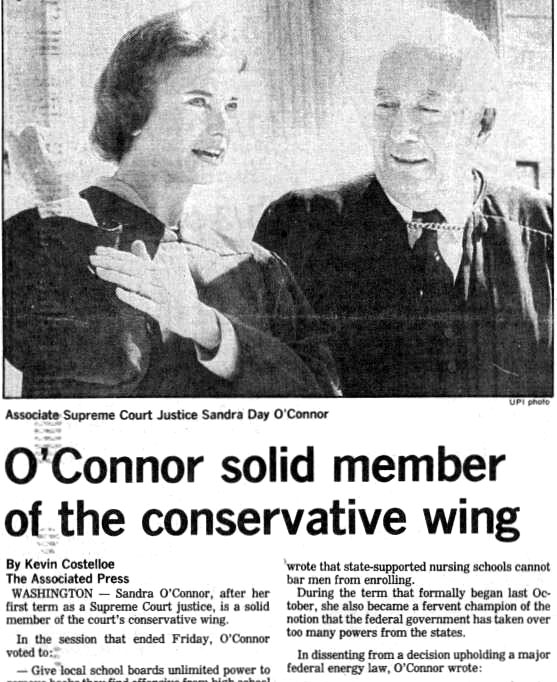
WASHINGTON – In its most important pronouncement on abortion in a decade, the Supreme Court Wednesday strongly reaffirmed its 1973 decision that women have a constitutional right to end their pregnancies and struck down a far-reaching ordinance in Akron, Ohio, restricting that right. Led by President Reagan’s appointee, Justice Sandra O’Connor, three dissenters on the court made a frontal attack on Roe vs. Wade, the 10-year-old ruling. The nation’s first woman justice, who had not taken part in any of the court’s prior abortion rulings, contended that the government has a “compelling” interest in protecting “potential human life” at all stages of a woman’s pregnancy.

But O’Connor’s effort, supported by Justices William H. Rehnquist and Byron R. White, fell short. The rest of the court members pointed out that the Roe decision had been “considered with special care” before it was issued and said that they abide by it as a precedent under the doctrine of “stare decisis” (Latin for “let the decision stand”). The 6-3 decision, written by Justice Lewis Powell, appeared designed to lay to rest any speculation that the present Supreme Court will change its stance on abortion. The ruling was immediately denounced as a major disappointment by right-to-life groups and praised as a broad victory by groups supporting the right of women to choose an abortion. The justices ruled unconstitutional all the disputed provisions of the detailed anti-abortion ordinance enacted in 1978 in Akron,

Detroit Free Press, Newspaper article, The Kauffman-Henry Collection

Court nominee: Solid Republican, politically astute

WASHINGTON – Sandra Day O’Connor – the “person for all seasons” chosen to become the first woman to serve on the 191 year-old U.S. Supreme Court – is a solid Republican who knows which way the political winds blow. O’Connor, 51, an Arizona native reared on a cattle ranch, already faces opposition from anti-abortion groups for what they view as a pro-abortion position when she served in the Arizona Senate. And her flirtation with the Equal Rights Amendment – she later withdrew her support for the ERA – will also come in for criticism from some conserwtive groups. O’Connor, now a state appeals court judge, would bring legisla- tive and judicial credentials to the high court bench. Feminists are heartened by the fact that in her final term in the state Senate she was elected majority leader – the first woman in the nation to hold such a leadership post. THE MOTHER of three sons, O’Connor is married to a Phoenix lawyer, John O’Connor. She graduated third in her class from Stanford University Law School in 1952. Supreme Court Justice William H. Rehnquist, an Arizona native, was first in that class. She served In the state Senate from 1969, when she was appointed to fill a vacancy, to 1975, winning election to two full terms representing a wealthy Phoenix suburb. In 1972, soon after Congress passed the ERA, O’Connor spoke on the state Senate floor, urging ratification. But when she learned that Arizona’s two U.S. senators opposed the measure, her enthusiasm faded and the Issue died

Dallas Morning Star, Newspaper article, The Kauffman-Henry Collection

Court nominee plans to confer with senators

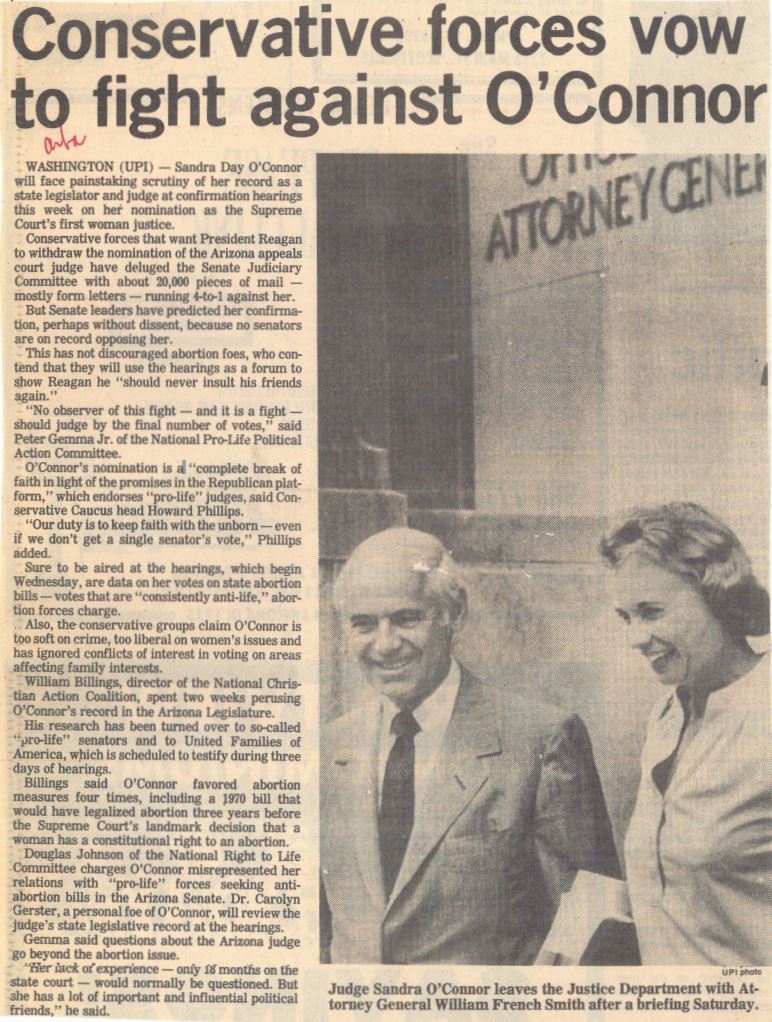
WASHING TON – Hoping to head off any serious opposition to her Supreme Court nomination from conservatives, the White House has arranged for Sandra D. O’Connor to meet with several key senators, including Sen. Jesse Helms, R-N.C. President Reagan’s choice to replace retiring Supreme Court Justice Potter Stewart was scheduled to arrive in Washington late Monday. Among others , the Arizona appeals court judge will meet with Sen. Strom Thurmond, R-S.C., chairman of the Senate Judiciary Committee; Senate Majority Leader Howard Baker of Tennessee; various members of the judiciary panel; Helms, a conservative Republican leader in the Senate, and Sen. John East, R-N.C., a leader among abortion opponents. Judge O’Connor planned to visit the Justice Department Tuesday for a meeting with Atty. Gen. William French Smith. Later, she was to be escorted by Arizona Sens. Barry Goldwater, a Re• publican, and Democrat Dennis DeConcini, a Democrat, to Capitol Hill, where talks were planned with Baker and Senate Minority Leader Robert Byrd. Sources said there was a tentative plan for Judge O’Connor to meet the steering committee, a group of about 20 conservative senators including Helms and Thurmond, to persuade the members that her views on abortion and other social issues are in line with their own. The fundamentalist Moral Majority and various anti-abortion organizations have expressed militant opposition to Judge O’Connor’s nomination because they believe she supports legalized abortions and

Los Angeles Times, Newspaper article, The Kauffman-Henry Collection

Court Nominee is Stanford Graduate

Judge Sandra D. O’Connor, President Reagan ‘s choice for the Supreme Court, was graduated from Stanford University Law School in 1952, with the Order of the Coif. Among her law school classmates was Supreme Court Just ice William H. Rehnquist. She was a member of the board of editors of the Stanford Law Review and was on the Stanford Board of Trustees from 1976-80. She married another classmate, John Jay O’Connor III, now a Phoenix lawyer. They have three sons. Born in Duncan, Ariz., to a ranching family, she was a politician before her appointment to the Arizona bench, becoming majority leader of the Senate in 1973- the first and only woman to hold the job in either house of the state Legislature. “She was a super floor leader for lots of reasons, ” said Republican William Jacquin , president of the Arizona Chamber of Commerce and president of the Senate when O’Connor was majority leader .

Arizona Republic, Newspaper mention, The Kauffman-Henry Collection

Council Oks resolution backing Judge O’Connor

The Phoenix City Council passed a resolution Tuesday urging the confirmation of Arizona Appeals Judge Sandra O’Connor to the U.S. Supreme Court . Copies of the resolution were sent to Senate leaders and members of the Senate Judiciary Committee, which will hold hearings on the nomination. Council members said Judge O’Connor’s work as a staff member of the Arizona Attorney General’s Office, the Maricopa County Superior Court and the Appeals Court qualify her for the appointment .

Christian Science Monitor, Interview, Newspaper article

Conversations with Outstanding Americans: Sandra Day O’Connor

Conversations with Outstanding Americans: Sandra Day O’Connor

Elected in 1981 as the first woman to sit on the Supreme Court, Justice O’Connor has proved to be both a pragmatic, conservative voice and a coalition-builder. Her “swing vote” has often tilted major rulings.

January 28, 1997

By Robert Marquand, Staff writer of The Christian Science Monitor

WASHINGTON

Sandra Day O’Conner inhabits one of the loftiest spots in American law. As the third-senior member of the Supreme Court, the former ranch girl from Arizona who used to “get up at 3 a.m. and be in the saddle by sunup,” as she puts it, has more than come a long way. But what Justice O’Connor wants today is more common sense in the interaction between law and ordinary people.

In a wide-ranging conversation with the Monitor, the practical minded O’Connor backs a number of reform ideas. She wants courts to not only seem more accessible, but to actually be so. She would be willing, for example, to allow people to serve on juries who have seen or heard news reports of a crime. (See comments at right.) Otherwise, “you get hear-nothing, see nothing people. Is that really a jury of your peers?” as she says one afternoon recently in her comfortable chambers. Likewise, she’s investing hope in new methods of conflict resolution that give people the feeling “they’ve been heard” by the justice system.

O’Connor, arguably the most influential woman in US government until last week, when Madeleine Albright became secretary of

Arizona Daily Star, Newspaper article

“Conversation starter”

Relocated Sandra Day O’Connor house to be a center for civil talk that leads to civic action

Imagine an Arizona where political and ideological differences did not create antagonism and polarization, but were the basis for conversation that built bridges. Think of an Arizona in which shouting and snarky remarks were replaced by thoughtful, respectful, congenial discourse. Envision the inclusive, forwardthinking public policy and actions that could evolve from such amiable interaction. Helping Arizona find compromises to move solutions forward is the purpose of the O’Connor House, which embraces the house of former U.S. Supreme Court Justice Sandra Day O’Connor and an organization, activities and programs “where civil talk leads to civic action.” Chalupafed conversation The project’s genesis is the house O’Connor and her husband, John, built of sundried adobe bricks made from mud from the Salt River. In 1957, the O’Connors “scraped joints, painted walls and sealed the walls with skim milk,” Sandra Day O’Connor said May 29 in Phoenix during a preliminary meeting of state stakeholders. They were gathered to brainstorm an O’Connor House discussion topic for Arizona’s centennial, “good government for Arizona’s second century.” (In case you’re furrowing your brow and wondering “Why skim milk?” it has a protein that prevents dust motes from flaking off.) The house was designed by architect D.K. Taylor, who was influenced by Frank Lloyd Wright. The bricks were formed by George Ellis,