
Post-Retirement Opinions

US v Meyer

O’CONNOR, Associate Justice (Ret).

Mark Lou Meyer appeals the district court’s revocation of his probation. Because the district court’s factual findings on the two grounds on which it justified revoking Meyer’s probation were not clearly erroneous, we affirm the judgment below.

I.

On January 22, 2004, Mark Lou Meyer was indicted for being an unlawful drug user in possession of a firearm, in violation of 18 U.S.C. § 922(g)(3). After Meyer pleaded guilty to this charge, the district court sentenced him to a term of three years’ probation on September 2, 2004. As relevant to this appeal, Meyer’s probation came with two conditions. First, Meyer was prohibited from possessing or using unlawful drugs. Second, Meyer was prohibited from leaving Iowa’s Northern District without first obtaining permission from a probation officer or the court.

While he was on probation, Meyer participated in two distinct methods of drug testing. Under the first method, a probation officer affixed sweat patches to Meyer’s skin to monitor whether he was using illegal drugs. The sweat patch technology at issue here is a relatively novel drug testing device. The sweat patch, which is “marketed by PharmChem, Inc., is composed of an absorbent pad and an outer membrane. After the skin is cleaned with alcohol, the patch is applied to the wearer[ ], and the absorbent pad collects the wearer’s sweat, over a period of a week or more.” United States v. Bentham, 414 F.Supp.2d 472, 473 (S.D.N.Y.2006). “The [wearer]’s
Post-Retirement Opinions

US v Novak

O’CONNOR, Associate Justice (Retired).

The government in this case brings an extraordinary appeal: It asks us to reverse a district court ruling barring from evidence recordings of phone calls made between an attorney and his client. These calls were recorded in clear violation of state and federal regulations. But appellee, the attorney, has not raised a Sixth Amendment challenge, and for Fourth Amendment purposes, his client consented to the monitoring of his calls. On these narrow facts, we reverse the determination of the district court that the calls must be excluded.

I.

Scott Holyoke was a prisoner held in pretrial detention at the Barnstable County Jail in Massachusetts. Holyoke was represented by the Federal Defenders, and planned to plead guilty to charges of methamphetamine trafficking. He did not, however, wish to face sentencing with his state convictions on his record, because under the Sentencing Guidelines, the effect of those convictions on his criminal history would result in a longer prison sentence.

For assistance with these state convictions, Holyoke turned to appellee Lawrence Novak in 2005. Novak was a Massachusetts attorney. All of Holyoke’s contact with Novak was conducted through telephone calls made from the County Jail, which randomly records and monitors inmate calls.

Inmates are informed of the monitoring in two ways. First, phones in the jail contain signs which state, “Calls are subject to monitoring and recording.” Second, an automated message

Post-Retirement Opinions

Walker v Prince Georges County MD

O’CONNOR, Associate Justice (Retired):

This is a case about a wolf named Dutchess. Concerned that the wolf’s presence on residential property posed a risk to the public, a Prince George’s County Animal Control Officer seized Dutchess and left word for her absent owners. Those owners sued the officer and the county for monetary damages, arguing that the seizure violated their civil rights. The district court concluded that the officer was entitled to qualified immunity and that the plaintiffs failed adequately to plead a claim against the county. We agree and consequently affirm the court’s judgment.

I

Because plaintiffs-appellants Robert and Courtney Walker’s claims were rejected on summary judgment, we view the factual evidence in the light most favorable to them. Anderson v. Liberty Lobby, Inc., 477 U.S. 242, 255, 106 S.Ct. 2505, 91 L.Ed.2d 202 (1986).

In February 2006, Robert Walker obtained an animal that he believed was a dog. Walker and his wife, Courtney Walker, named the animal Dutchess and had her vaccinated for rabies. The veterinarian who performed the vaccination determined that Dutchess was an Alaskan Malamute, a breed of dog that looks like a husky. He gave the Walkers proof of the vaccination, which identified Dutchess as a dog. The Walkers used this report to obtain a “dog/ferret/cat license” from Prince George’s County.

In July, Robert Walker and his sister, Antonia Payne, had a heated confrontation in front of his home. Walker struck and cracked the windshield

Post-Retirement Opinions

Wernert v Green

Affirmed by unpublished opinion. Justice O’CONNOR wrote the opinion, in which Chief Judge TRAXLER and Judge KEENAN joined.

Unpublished opinions are not binding precedent in this circuit.

O’CONNOR, Associate Justice:

Charles Edward Wernert II, the Appellee, filed suit against Fluvanna County Police Department Deputy Joshua Greene,1 alleging that Greene used excessive force against him. Appellant Greene invoked a defense of qualified immunity and moved for summary judgment. For the reasons explained herein, we affirm the district court’s denial of summary judgment.

I

On the evening of May 4, 2007, Fluvanna County Police Department Deputy Joshua Greene was on patrol with auxiliary Deputy Francis Ferki. The deputies heard over their radio first that an individual had jumped onto an ambulance on Kents Store Road and then that a man had committed an assault at a residence on the same road. The man who committed the assault was described as being approximately six feet tall, wearing a white tee shirt and blue jeans, and carrying one or two suitcases. Near the location of the assault, the deputies saw Appellee Wernert, who matched the description they had received.

When Wernert saw the deputies, he started walking away, carrying a bag. The deputies stopped him and asked for identification, which Wernert provided. Wernert, who appeared to be intoxicated, explained that he was on parole in Pennsylvania and therefore was not supposed to leave that state. The radio dispatcher confirmed

Speech

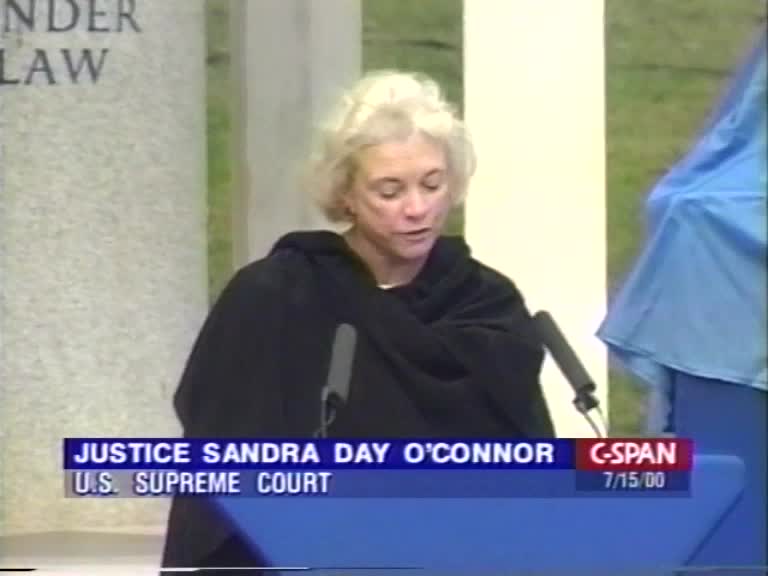
Remarks celebrating the Magna Carta at the Runnymeade Memorial

Sandra Day O’Connor Thank you President, Bill Paul, and the Lord Chief Justice Harry volts my friend from even before my days on the Supreme Court, and Lord justice Norse, it’s good to see you again. And to see all of the members and brands of the American Bar Association, who were able to come to this remarkable place today. I don’t know about you. But when I walked today, across this Meadow to this historic spot, I was deeply moved. This Bob resonates with historical significance to everyone here today. And every citizen of the United states and of the United Kingdom, and indeed far beyond the boundaries of those two nations. And it’s a wonderful privilege to speak today in commemoration of one of the most momentous occasions in legal history. In many ways, the story of English liberties, and therefore the story of American liberties began on this very meadow, when King john affix the Great Seal of the realm to the Magna Carta. In truth, the grievances of the barons who impelled King john to come here in June of that year, were rather mundane concerns the barons were generally unlettered and self interested man, who sought practical concessions from the king and return for their allegiance to the crown. The Magna Carta bottom is an intensely practical document. tailored to the problems of feudal times, spelling out one by one concrete remedies or actual abuses. But in addressing the specific grievances, the great chart or use language that transcended the barons parochial

Letter

Form letter on Equal Rights Amendment

February 18, 1974 Dear Mrs. __________: Thank you for your letter concerning the Equal Rights Amendment. There is a saying that two things are certain-death and taxes. A third certainty is that the Thirty-first Legislature will not ratify the Equal Rights Amendment. I find myself in a difficult position concerning the Equal Rights Amendment. I do not share the concern expressed by some that its ratification would threaten family life as we know it or that it would deprive women of their freedom. On the contrary, the Equal Rights Amendment recognizes the fundamental dignity and individuality of each human being and rests on the basic principle that sex should not be a factor in determining the legal rights of men or women. The Amendment affects only governmental action. It does not affect private actions or the private and personal relationships of families and husbands and wives. The Senate Congressional Judiciary Committee report on the Equal Rights Amendment merits consideration. It reports that “equality” does not mean “sameness.” The report states that the Amendment would not prevent reasonable classifications based on characteristics unique to one sex, nor does it prohibit the states from requiring separation of the sexes under certain circumstances, as in public hospitals, institutions, or restrooms. On the other hand, many sincere and genuine questions have been raised about the interpretation of the broad general language of the Amendment, and these questions would, no