Law review article

In Memoriam: A Tribute to Warren E. Burger

A TRIBUTE TO WARREN E. BURGER

The Honorable Sandra Day O’Connor*

A Chief Justice is always a special figure in American history, and indeed, only sixteen Justices have held that position since our Constitution was ratified. Warren E. Burger was the fifteenth Chief Justice, and his seventeen years in that capacity were distinguished by his energy and his efforts to improve the judicial system throughout the United States. His life and his service as Chief Justice have left their imprint on many aspects of our legal system.

Chief Justice Burger graduated magna cum laude in 1931 from Saint Paul College of Law, the earliest forerunner of William Mitchell College of Law. He was the president of his law school fraternity, Phi Beta Gamma, which, in uncanny foresight, conferred upon him the title of “Chief Justice.” Warren Burger could not have attended a traditional day law school. He had married and started a family and found it necessary to hold a full-time job in the insurance industry to support his family. If it were not for the opportunity that Saint Paul offered him to attend law school classes at night, he would have been unable to enter the legal profession.

Throughout his career, Chief Justice Burger had a profound interest in raising the quality of the work of the judicial branch by improving the management of the courts. As Chief Justice, he worked to make the Supreme Court-and all courts-more responsive to the needs of those who used them. He left a legacy to the most
Law review article

Tribute to Justice Souter

Abstract

When the U.S. Supreme Court Justices took their seats at the beginning of the 2009 Term, the Bench looked different. Gone from the Bench, after nineteen years, was David H. Souter. He returned to his home in New Hampshire, a state he likes enormously. Justice Souter will be missed by his former colleagues and by advocates before the Court, by legal scholars nationwide and by all who follow the Court’s work and activities.

I was privileged to serve on the Court with Justice Souter for more than fifteen years. He was an admirable Justice and is a cherished friend. While serving on the Court, Justice Souter produced 157 majority opinions, 121 dissenting opinions, and 83 concurring opinions. He served as the Circuit Justice for both the First and the Third circuits. His opinions were always thoroughly researched and written, with full explanations of the facts, the issues, and the governing principles. He cut no corners and explained his reasoning in depth.

His writing was evidence of his scholarly nature. He was, after all, a Harvard Law School graduate, a Rhodes Scholar, a former New Hampshire trial court judge, a New Hampshire supreme court justice, and a judge on the First Circuit Court of Appeals. His opinions, written while he was on the Supreme Court of the United States, were as methodical as they were measured. Justice Souter’s concurring opinion in Washington v. Glucksburg1 captured his judicial philosophy nicely. He wrote: “[T]he usual thinking of the common

Speech

Speech to International Association of Lawyers

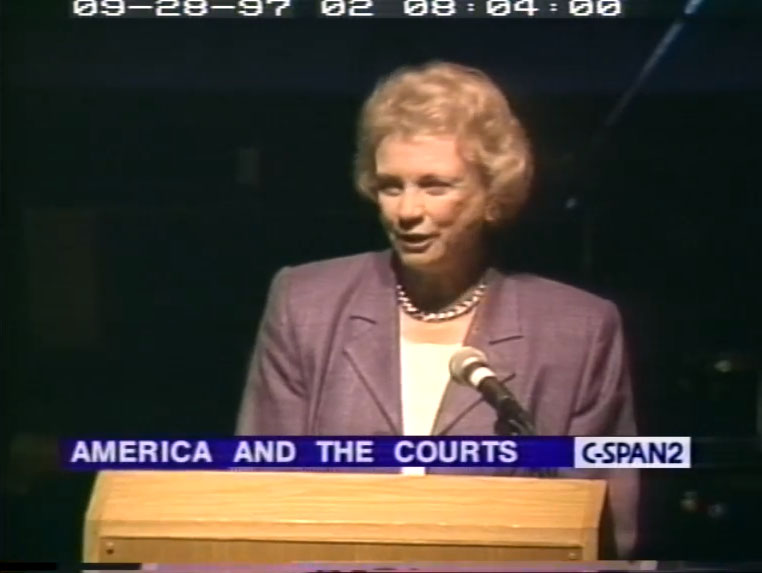
Sandra Day O’Connor Thank you so much. Thank you. Thank you President Venugopal. I have the privilege of meeting your president Venugopal in India a couple of years ago when I went to give a lecture there named for his father, who was also a most distinguished attorney in India. And I’m so pleased to be able to come here to this wonderful city of Philadelphia tonight. The birthplace of our nation’s constitution and an absolutely wonderful city. So you chosen a great place for your making. Technology is constantly shrinking our world. From cellular phones to fax machines, beepers to email, satellite communications to the internet. new forms of communication have enabled us to talk to each other, whenever and wherever we happen to be. But it takes more than technological capability to enable people from different nations to communicate effectively with each other. People from all nations need language skills, they need a deeper understanding of foreign cultures, and they need deeper familiarity with foreign traditions and values. A nation’s ability to meet these needs will largely determine its ability to cope, and what has become an increasingly multinational environment. The United States is just beginning to recognize these needs. High Schools here, which wants only talk French and Spanish, as foreign languages now offer Russian, Japanese, Chinese, Arabic and a host of other languages as well. American businesses have also responded to the increasing globalization of brain,

Law review article, Speech

Speech on judicial independence at Georgetown University

Sandra Day O’Connor I’m going to get you on my next book tour if I ever have one. That’s fun. And thank you my wonderful former colleagues for showing up today. Justice Thomas Justice Souter, and I think Justice Alito is going to join us if he’s not already here. And thank every one of you for coming and participating in this conference. I think you’ve already heard from President to Julia, and Michael trainer, why we’re doing this.

And it’s already been mentioned that 100 years ago this year, Roscoe pound, who went on to become dean of the Harvard Law School, gave his well publicized address to the American Bar, call the causes of popular dissatisfaction with the administration of justice. And he warned in that speech that we must not be deceived into overlooking or underwriting the real and serious dissatisfaction with courts and lack of respect for the law, which exists in the United States today. And I think that statement holds true today as well. We have promoted in this country, the notion of the rule of law as a means for helping ensure peace around the world, in our work with the emerging nations with the breakup of the Soviet Union, and in other countries we have actively urged upon every nation that we be concerned with the rule of law and The key component to that is a fair, impartial and independent judiciary. For a long time, I think the federal judiciary in this country has certainly been noted in other countries and admired and many would want to copy it. I

Law review article

A Tribute to Justice Lewis F. Powell, Jr.

VOLUME 101 DECEMBER 1987 NUMBER 2

HARVARD LAW REVIEW

A TRIBUTE TO JUSTICE LEWIS F. POWELL, JR.

Sandra Day O’Connor*

Changes in the composition of the Supreme Court are both inevitable and inevitably significant. As the law and the nation are to some degree shaped by the Court, so the Court is shaped by the Justices who serve on it. It is fitting, on the occasion of Justice Lewis F. Powell’s retirement, to reflect on the role of individual character in the work of the Court.

Justice Powell’s decision to retire, which came as a surprise to his eight colleagues, provides a particularly apt moment for such reflection because of Justice Powell’s extraordinary personal qualities. His departure from the Court is an important event for many different reasons, and I leave others to speculate about the effects on the publicly visible aspects of the Court’s work. I wish to focus instead on the man himself and especially on why his leaving is so poignant for those of us who remain.

Few people join the Court without their fair share of outstanding personal accomplishments. With respect to how many of the Justices, however, could their colleagues say, years later, “His very presence among us, day to day and on the bench, was something each of us valued – indeed, treasured”? I can say that about Justice Powell, for I have known no one in my lifetime who is kinder or more courteous than he. If at times he was unhappy or frustrated with one of us, he never expressed a harsh thought or