
Newspaper article, The Kauffman-Henry Collection

Court’s historic day: Now it’s Mrs. Justice O’Connor

Then followed the special session of the high court, which began with the traditional rap of the gavel by Court Marshal Alfred Wong and the entrance of the eight black-robed justices. Mrs. O’Connor sat in the “well” of the courtroom at the start of the ceremony, in a chair used by Chief Justice John Marshall more than 150 years ago. Reagan sat on the other …

Harry Day, left his wheelchair and walked with the aid of a cane. Wearing the black, knee-length robe from her days as an Arizona appeals court judge, Mrs. O’Connor smiled at well-wishers on her historic day. Under her judicial robes she wore a pink, long-sleeved dress and a gold choker. Asked about the robe, Mrs. O’Connor replied : “I’ ll buy a new one eventually, when this one gets frayed. They do, you know.” The 52-year-old Arizona jurist carved her place in American history in the dramatic setting of the solemn, velvet-draped, marble-columned courtroom where sit the nine justices who ma~e up the Supreme Court of the United States. Viewing the historic moment were more than 300 dignitaries – led by Ronald Reagan, the man who broke the male-only tradition with his nomination of Mrs. O’Connor to the highest tribunal. She became the 102nd member of the 191-year-old court, replacing Potter Stewart, 67, who resigned from the bench in July and gave Reagan the opportwiity to fuliill his campaign promise to appoint a woman. In addition to Reagan and his wife Nancy, others invited included Vice President George Bush; Stewart
Newspaper article, The Kauffman-Henry Collection

Court Issues

WASHINGTO N – When the Supreme Court begins its 1981-82 term Oct. 5, it will ag, n find itself poised on the cuttmg edge between the status quo and a new political order. As the Reagan administration moves to reduce the sweep of much of the landmark legislation enacted in the 1960s and 1970s, the court will review many of those same laws in the 102 cases already set for argument in the new term. The justices also are likely to address a number of perennially touchy issues, including school busing, church-state separation, the death penalty and the obligation of a state to educate children of illegal aliens. President Reagan’s policies are not directly at issue in most of the cases, but the way in which the justices resolve the issues could accelerate or brake the administration’s momentum in certain areas. Historically, the court has served as a balance wheel within the federal system . It has moved to the “conservative ” side when Congress or the president shifted sharply to the left, as in the early New Deal days. And the rulings in the last term indicate the court may be taking a more liberal stance on certain issues as the Reagan administration and the 97th Congress move to the right. For example, in the last term, the justices ruled repeatedly in favor of broad federal regulatory power – directly countering a major administration thrust . The Reagan regime already has sharply reversed the government ‘s position on two key issues before the court , school busing and the education

Law review article

Constitutional Sunsetting? Justice O’Connor’s Closing Comments in Grutter

Constitutional Sunsetting?: Justice O’Connor’s Closing Comments in Grutter

by VIKRAM DAVID AMAR* AND Ev AN CAMINKER **

Most Supreme Court watchers were unsurprised that Justice Sandra Day O’Connor’s vote proved pivotal in resolving the University of Michi gan affirmative action cases; indeed, Justice O’Connor has been in the ma jority in almost every case involving race over the past decade, and was in the majority in each and every one of the 5-4 decisions the Court handed down across a broad range of difficult issues last Term. Some smaller number of observers were unsurprised that Justice O’Connor decided (along with the four Justices who in the past have voted to allow latitude with regard to race-based affirmative action programs) to uphold the kind of flexible and individualistic use of race to promote a diverse student body embodied in the University of Michigan Law School’s admissions policy. Justice O’Connor had often cited Justice Powell’s opinion in Bakke1 fa vorably,2 and just two terms ago she had voted with the more “liberal” Jus tices in a 5-4 decision that permitted race consciousness in a voting redis

tricting setting. 3 But perhaps most were surprised by a comment Justice

O’Connor made for the Court at the end of the Grutter opinion: “We expect that 25 years from now, the use of racial preferences will no longer be nec essary to further the interest approved today.’,4 In this short essay, we ex plore that provocative sentence, and tease out some of the doctrinal

Magazine article

Center Court

Justice Sandra Day O’Connor got her job through affirmative action. It was obvious to officials in the Reagan Justice Department, as they searched for a Supreme Court justice in the summer of 1981, that she lacked the usual qualifications for the high court. “No way,” Emma Jordan, an assistant to the then Attorney General William French Smith, recalls thinking. “There were gaps in her background where she had clearly been at home having babies. She had never had a national position. Under awards, she had something like Phoenix Ad Woman of the Year.” No matter. President Reagan wanted to appoint the first woman justice, so he named O’Connor.

Last week O’Connor in a sense returned the favor by playing the critical role in the most important affirmative-action case in decades. She cast the fifth and deciding vote and wrote the court’s opinion in upholding the right of the University of Michigan Law School to use race as a factor in admissions. As a practical matter, her ruling in Grutter v. Bollinger gives a powerful judicial boost to affirmative action in education, a source of legal confusion and bitter debate in recent years. O’Connor, a moderate Republican, was hailed as a somewhat unlikely hero by liberal groups. She is seen as living proof that affirmative action works. There are now two female Supreme Court justices (the other is Ruth Bader Ginsburg, who did have the usual qualifications), and half the seats in America’s law schools are filled by women. And one of the Bush

Newspaper mention, The Kauffman-Henry Collection

But can Sandra O’Connor type?

One more Sandra O’Connor story …. The woman who is the president’s pick to serve as the first female Supreme Court justice didn’t always find her legal skills in demand. After she graduated from Stanford Law School with high marks and impeccable credentials, private law firms in California still closed their doors to her. “They had never hired a woman,” she said in a 1978 interview with Today’s Living. “They weren’t prepared to change. I was offered a job as a secretary provided I could type well.” So instead, she went to work as a deputy county attorney in San Mateo. Now for a chorus of Who’s sorry now?

Law review article

Balancing Act

COURT IN

anc1n

RICHARD BRUST

HEN SHE LOOKS BACK ON IT, TULANE UNIVER

sity professor Nancy Maveety senses a wist ful quality to Justice Sandra Day O’Connor’s opinion in one of the two Ten Command ments cases decided this June.

“It reads like a parting shot,” says Maveety, who chronicled O’Connor’s career in a 1996 biography, Justice Sandra Day O’Connor: Strat

egist on the Supreme Court. “It was philosophical and reflective. It hit on the large themes of religion in American life.”

O’Connor’s opinion in McCreary County v. American Civil Liberties Union of Kentucky, 125 S. Ct. 2722, was among the 75-year-old justice’s last, is sued just four days before the announcement that she would retire from the court. As befits a valedictory, the writing sounded pensive, Maveety says, different from the justice’s usual straightforward style. An example:

“At a time when we see around the world the violent consequences of the assumption of religious authority by government, Americans may count themselves fortunate: Our regard for constitutional boundaries has protected us from similar travails, while allowing private religious exercise to flourish Given the history of this particular display of

the Ten Commandments, the court correctly finds an establishment clause violation Thepurpose behind the counties’ display is rele

vant because it conveys an unmistakable message of endorsement to the reasonable observer.”

Richard Brust is an assistant managing editor for the ABA Journal.

Law review article

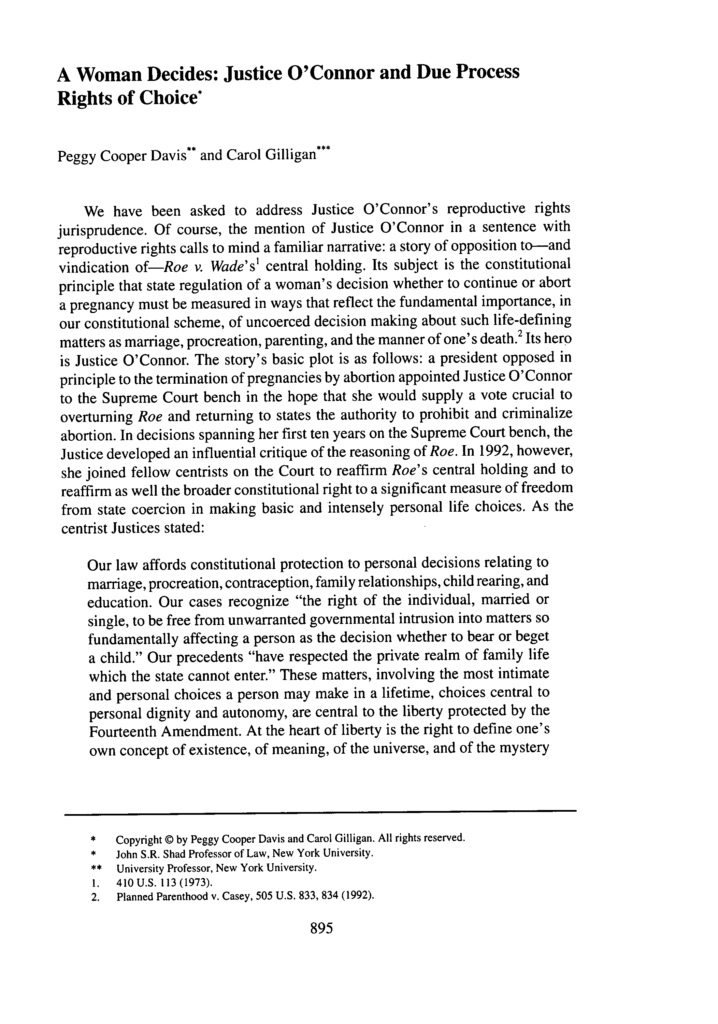
A Woman Decides: Justice O’Connor and Due Process Rights of Choice

A Woman Decides: Justice O’Connor and Due Process Rights of Choice*

Peggy Cooper Davis•• and Carol Gilligan•••

We have been asked to address Justice O’Connor’s reproductive rights jurisprudence. Of course, the mention of Justice O’Connor in a sentence with reproductive rights calls to mind a familiar narrative: a story of opposition to-and vindication of-Roe v. Wade’s I central holding. Its subject is the constitutional principle that state regulation of a woman’s decision whether to continue or abort a pregnancy must be measured in ways that reflect the fundamental importance, in our constitutional scheme, of uncoerced decision making about such life-defining matters as marriage, procreation, parenting, and the manner of one’s death.2 Its hero is Justice O’Connor. The story’s basic plot is as follows: a president opposed in principle to the termination of pregnancies by abortion appointed Justice O’Connor to the Supreme Court bench in the hope that she would supply a vote crucial to overturning Roe and returning to states the authority to prohibit and criminalize abortion. In decisions spanning her first ten years on the Supreme Court bench, the Justice developed an influential critique of the reasoning of Roe. In 1992, however, she joined fellow centrists on the Court to reaffirm Roe’s central holding and to reaffirm as well the broader constitutional right to a significant measure of freedom from state coercion in making basic and intensely personal life choices. As the

Law review article

A Pragmatist on the Bench

The Pragmatist on the Bench: The Western and Political Roots of Justice Sandra Day O’Connor Samuel Kleiner and Julius Taranto* Yale Law School

* Samuel Kleiner and Julius Taranto are students at the Yale Law School. We wish to thank the editors of the Arizona Journal of Interdisciplinary Studies for originally publishing this article and thank the O’Connor Institute and Sarah Suggs for publishing an updated version of the article. We thank the many individuals who read versions of this article as we developed it and, of course, all errors are our own. In her dedication of the courthouse named in her honor in downtown Phoenix, Justice Sandra Day O’Connor closed her remarks by quoting Winston Churchill’s famous adage that, “We shape our buildings and afterwards our buildings shape us.”2 As she stood at the Courthouse that would bear her name in the center of Phoenix, she couldn’t help reflecting on how she had been shaped by her own history in the state. She had not aspired to be a lawyer, let alone a Justice on the Supreme Court, and had wanted to be a “cattle rancher” like her father when she grew up.3 Her legal career began in 1957 in Phoenix when she went into practice on her own after finding that none of the established firms in town would hire a woman.4 Perhaps more so than any recent Supreme Court Justice, Justice O’Connor’s rise to the Court was intimately bound up with the state from which she came. She lacked any experience in Washington D.C.; her entire professional

Magazine article

All Eyes on Justice O’Connor

When the nine Supreme Court justices convene in their imposing marble courtroom this Wednesday, more than 100 reporters will be there to record their every word, study every facial expression, scrutinize any perceived change in body language. The hourlong session is the only part of the court’s procedure carried out in public, and the journalists and small crowd of spectators will be searching for clues — however, speculative — that the court is leaning toward changing the law on abortion. No justice will be more carefully analyzed than Sandra Day O’Connor, the first woman to serve on the country’s highest court. With her male colleagues believed to be deadlocked 4 to 4 on abortion, O’Connor could be the pivotal voice in the current case. “If Justice O’Connor wants to continue protecting abortion rights, they will be protected,” says Prof. Walter Dellinger of Duke University Law School. “If she does not, they will not. It is her decision.”

Through a quirk of timing, the first woman justice in the 200-year-old history of the Supreme Court may be in a position to settle the most controversial women’s issue of the modern era. Since President Reagan appointed O’Connor eight years ago, her role in many divisive issues — thanks in part to the arrival of two additional conservatives — has evolved from that of habitual dissenter to that of frequent swing voter. Now she has become the focal point in the public’s battle to influence the court’s first critical abortion ruling in 16