
“Why Judges Wear Black Robes” in Smithsonian magazine
Magazine article | November 1, 2013
In this catalog, we invite you to explore Justice O'Connor's speeches, interviews, and writing throughout her career.
Justice Sandra Day O’Connor on Why Judges Wear Black Robes
The Supreme Court icon breaks down the tradition
By Sandra Day O’Connor
Smithsonian magazine,
November 2013.
The simple black judicial robe has been a part of my life for nearly four decades. I first wore one in 1975 when I became a trial judge in Arizona. When I was appointed to the Supreme Court of the United States, in 1981, I brought that same robe with me to Washington and wore it on my first day on the bench. Although I retired in 2006, I still wear a robe in my role as a “circuit-rider,” sitting frequently , as many retired justices do, on various federal Courts of Appeals across the country.
It is surprising to me how little we know about where this plain black judicial uniform comes from. Colonial judges in England wore robes, and the tradition took off on American soil as well. But English judges also wore colorful robes and ornate wigs—a tradition that was not adopted in the United States. Some speculate that the Supreme Court began with more colorful attire; the court’s official portrait of the first chief justice, John Jay, shows him in a robe of black and red with white borders. The story, perhaps apocryphal, is that Thomas Jefferson himself objected to such unnecessary pomp: As an ardent supporter of modest republican citizenship, Jefferson was against “any needless official apparel,” especially “the monstrous wig which makes the English judges look like rats peeping through bunches of oakum.” It is
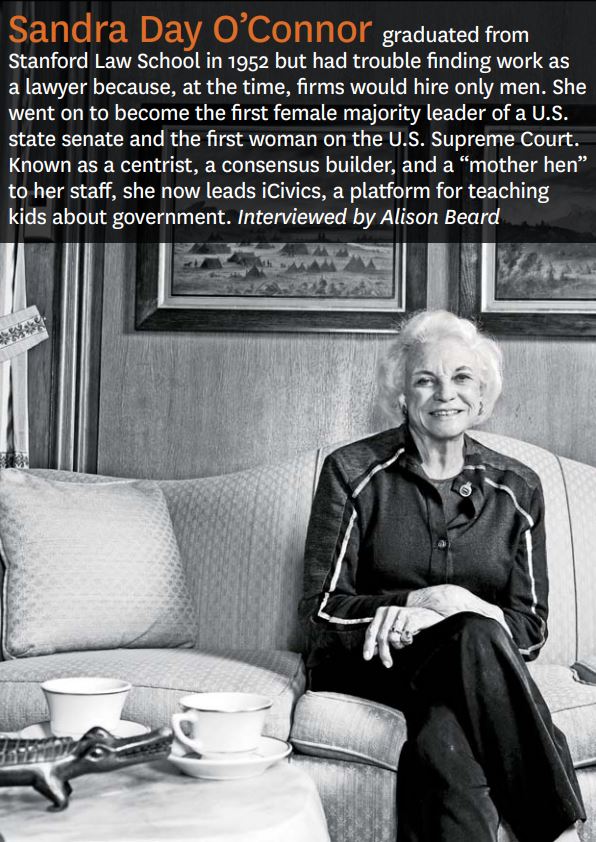
Sandra Day O’Connor graduated from Stanford Law School in 1952 but had trouble finding work as a lawyer because, at the time, firms would hire only men. She went on to become the first female majority leader of a U.S. state senate and the first woman on the U.S. Supreme Court. Known as a centrist, a consensus builder, and a “mother hen” to her staff, she now leads iCivics, a platform for teaching kids about government.
You grew up on a ranch that straddled Arizona and New Mexico—a long way from Washington, DC, and the Supreme Court. How did that upbringing influence you?
Growing up on a ranch, you’re assigned certain tasks, and you’d darned well better do them and do them right. Everyone was expected to help and to do their best. I’ll tell you a little story. Once, when I was a teenager, the workers were rounding up the cattle in an area very far from the ranch headquarters. We had to get lunch to them, and the roundup cook for some reason wasn’t going to be there. So I got up extremely early, my mother and I fixed the lunch, and I got in a pickup truck alone to drive to the place where they were. I was going along, when all of a sudden I got a flat tire. So I stopped the truck and got out. I knew how to jack a car up—I’d seen it done—so I found the jack and did that. I worked so hard. Then I got the flat tire off and the spare tire on, put the lug bolts in tight, and got everything working again. But it took me a long time. By the time I got to the men, it was several hours
FOR THE RECORD Sandra Day O’Connor “My time as a state legislator was a wonderful experience.” A former two-term Arizona state senator, Sandra Day O’Connor was nominated to the U.S. Supreme Court by President Ronald Reagan in 1981 and was confirmed unanimously by the U.S. Senate. She became the first woman Supreme Court Justice and one of the most influential members of the court who was often the swing vote. She retired from the Court in 2006 and turned her energy to writing and civic education. Today, she is the author of five books, including Out of Order: Stories from the History of the Supreme Court, published this year. President Obama honored her with the Presidential Medal of Freedom in 2009. State Legislatures: What do you think the average reader will be most surprised to learn from your new book, Out of Order: Stories from the History of the Supreme Court? Justice O’Connor: I think people generally don’t know that for a long time in the Court’s history, the justices had to ride the circuit. They had to go around the country and sit on cases. And they weren’t sitting in Washington, D.C, all the time as they are now. That was extremely challenging for the justices. None of them liked it, and it was very burdensome. SL: When you were doing the research for your book, did you wonder how the Court survived with all the things that went on? Justice O’Connor: It had to survive. We had to have a Supreme Court. But the challenges in those days were so substantial that
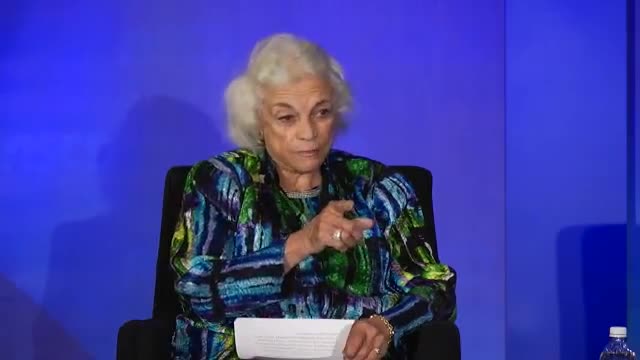
Jeff Curley
Thank you all for being here this morning, Sunday am St. Patrick’s Day weekends impressive show here in Chicago especially. My name is Jeff Curley. I’m co-founder of iCivics. And I have the pleasure of introducing Justice O’Connor this morning, and having a chance to have a question and answer with you all. Obviously, Justice O’Connor requires no introduction. So you can keep my remarks very brief and then let her take the floor. But Justice O’Connor was the first woman to serve on the United States Supreme Court,
Sandra Day O’Connor
but not the last.
Jeff Curley
Her incredible accomplishments are extraordinary particularly given the era in which she began her career. Sandra Day O’Connor was born in El Paso, Texas. Now let’s see if we have any Arizonans here. She, she grew up on her family ranch the Lazy B In Arizona
Sandra Day O’Connor
And New Mexico. And New Mexico. Lots of places to call home. You know the ranch was within both states. Yes. And the only reason I got to El Paso was there wasn’t any town near the lazy be no hospital. I was the first child. My mother thought it would be good to have a hospital. So off we went to El Paso and I ended up going to school in El Paso. So, so all the things you hear today, that might be kind of crazy. It’s because I went to school male pastor.
Jeff Curley
Well, when she left El Paso in 1946 she was accepted at Stanford University, where she earned her bachelor’s
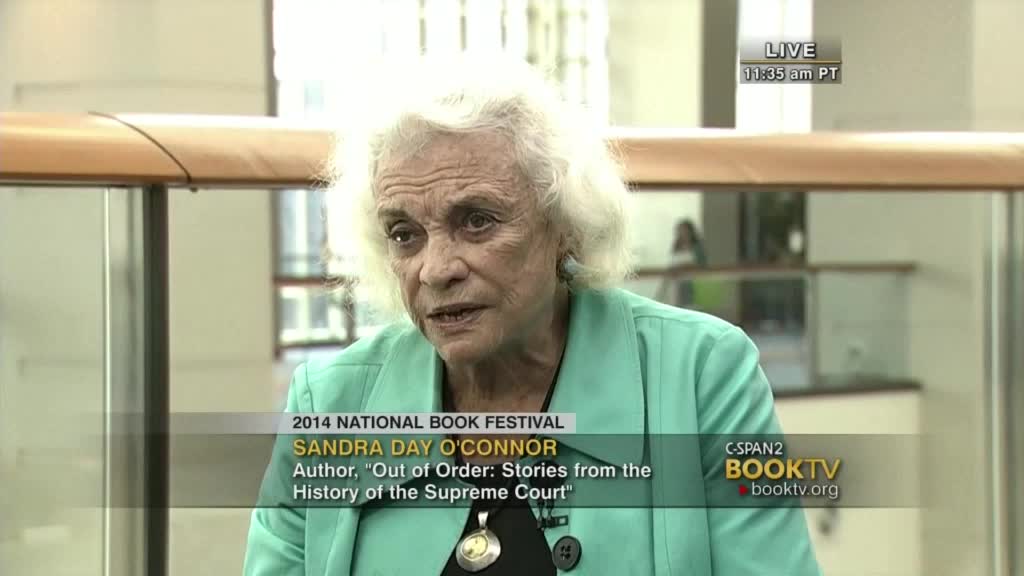
Host: We are pleased to be joined on set outside the history and biography room by former justice of the supreme court Sandra Day O’Connor. This is her fifth book, the history of the Supreme Court, “Out of Order.” Five books. When did you discover you enjoyed writing?
Sandra Day O’Connor: nothing changed, lots of things to write about and tell about.
Host: would be doing at the book festival? You are not talking about your book.
Sandra Day O’Connor: not really. I know jim billington at the wall street — my brother has a new book out. And so Jim told me I had to bring my brother so I said I would and that is why we are here.
Host: you are in conversation with alan. Your brother. What is his book about?
Sandra Day O’Connor: for a long time he had them in North Dakota where he could take these and keep them for a while. The federal government had the responsibility for them so he did that for quite a while. It was so simple. Host: let’s talk about out of water and some of the stories year. One of the first stories you tell is former chief justice John Marshall and Thomas Jefferson were related and did not like each other.
Sandra Day O’Connor: isn’t that amazing?
Host: was the relationship?
Sandra Day O’Connor: it was amazing that they didn’t like each other and it was so difficult to manage but they did.
Host: the *Marbury v. Madison* case was during President Jefferson’s tenure. Exactly what did that case establish?
Sandra Day O’Connor: I don’t know that today we say much of anything.
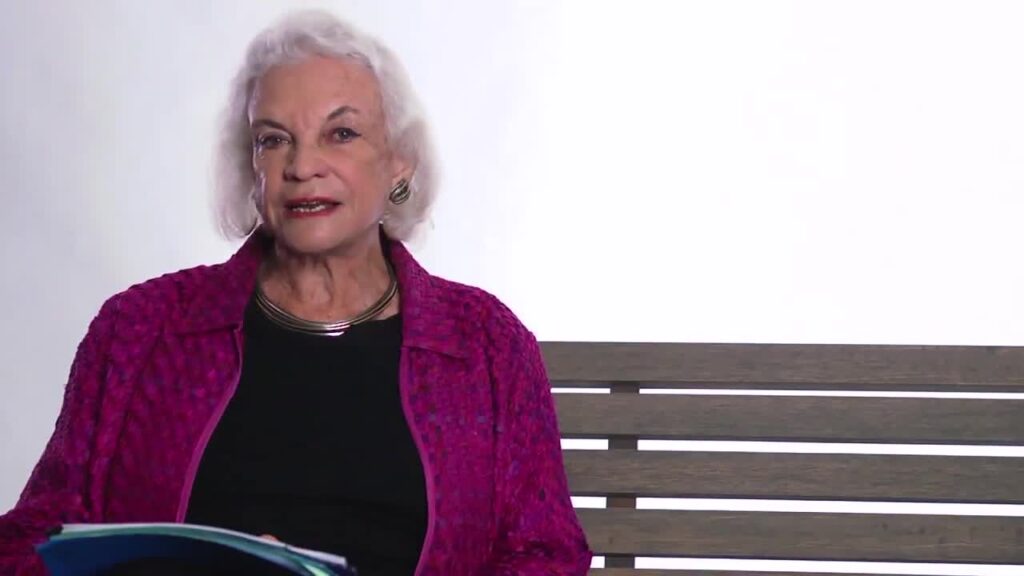
Sandra Day O’Connor The uniform law commission plays a very special role in the laws of this country. As all of you know, we have a national government, we have a National Constitution. But what it did was to bring together the separate states. And most Americans aren’t totally unaware of how complex our legal system is. And the reason it has worked fairly well, I think, is due in large measure to the existence and work of the uniform law commission. It’s interesting that at least four members of the Supreme Court have given some time to serve on the uniform state law commission. And I think the members of the Supreme Court are keenly aware of the role play by having uniform state laws in the areas in which otherwise there’d be total conflict. I was privileged to be a state senator in Arizona, from 1969 to 1975. And for part of that time, I was the senate majority leader. And during my time of service in the Arizona State Senate, we passed more than a dozen of the uniform law Commission Act. And I was very much aware of the work of the Commission. Without it, I don’t think my state could have or would have enacted the laws dealing with commercial transactions, issues affecting child custody and support of the handling of trusts and estates. And it could be very difficult, duplicative and costly, without the existence of uniform acts passed by the various state. Now, at the time I lived in Arizona, I had a former law school classmate who also lived in Arizona. His name was William
HON. SANDRA DAY O’CONNOR JUSTICE, U.S. SUPREME COURT An Interview with Marci A. Hamilton Paul R. Verkuil Chair in Public Law, Benjamin N. Cardozo School of Law Barbara Bennett Woodhouse…
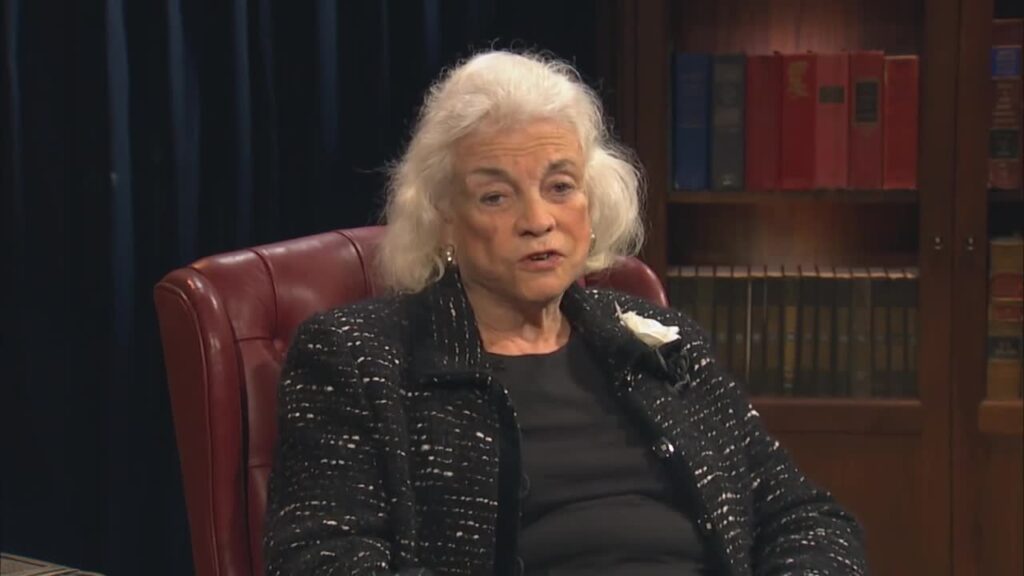
Sandra Day O’Connor Good evening. And I’m sorry, I wasn’t able to join you in person for this exciting event. Although I can’t say I’m sorry to be spending this winter evening, in a warmer climate. I dedicate much my time working to teach our school children about the importance of civic knowledge, including the importance of our nation’s charter our Constitution. A few years ago, I was speaking to a large group of young people. My purse was sitting next to my chair. I’m told it was even trending on Twitter, on Twitter for a time, one of the students asked me what I kept in that purse. I told her that of course, I keep the usual sorts of things there, a wallet, Kleenex tissues, a compact. I also told her that one thing I never forget to include is a copy of the Constitution. And just like I never forget my copy of the Constitution, I also never forget that we need to care and learn about the whole constitution, not just the original articles drafted in Philadelphia, and the Bill of Rights ratified soon after, but also the later amendments, including the vital amendments that we’re celebrating here tonight, amendments that ended slavery that secured equality for every one of us, and expand it the right to vote. This is an important lesson to keep in mind tonight, as we celebrate Celebrate President Lincoln’s constitutional legacy, and in particular, his role in the ratification of the 13th amendment to our Constitution, as well as an over the next five years, as we celebrate
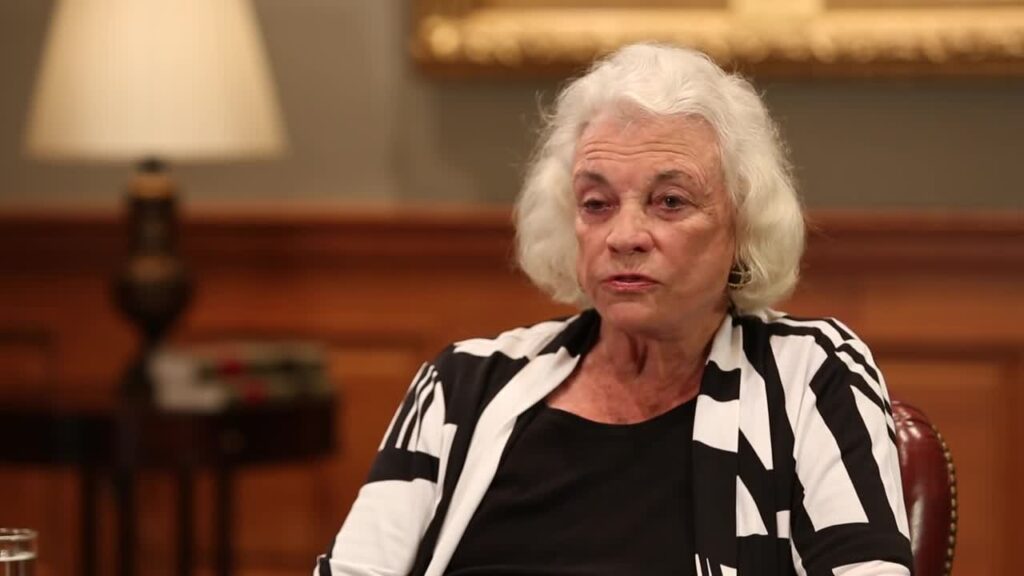
Sandra Day O’Connor
I wanted since I was the first not to be the last, and I wanted to do the job well, so would provide encouragement for women to serve in the future.
Unknown Speaker
When Justice Sandra Day O’Connor became the first woman to serve on the US Supreme Court, she had traveled a long road from the cattle ranch in the southwest where she was raised last major gender discrimination roadblocks in the beginning of her legal career.
Sandra Day O’Connor
I didn’t know there was a problem out on the ranch, there certainly wasn’t a problem. So I was unaware of any gender discrimination, if you will, was not in my scope of experience at all.
Unknown Speaker
When did you first become aware?
Sandra Day O’Connor
I don’t know probably much later in life when I tried to get a job.
Unknown Speaker
Were you surprised how limited the possibilities were when you graduated from law school?
Sandra Day O’Connor
I was shocked because I did very well in law school. I was way up here. And I assumed everything would be perfect. And it wasn’t I couldn’t get a job offer. And I was shocked by that.
Unknown Speaker
After graduating from Stanford Law School when she could not get a job as a lawyer at a law firm, she finally started working as a deputy county attorney in California, so to be nominated to the top court in the country almost three decades later.
Sandra Day O’Connor
Well, it was of course, a surprise that I was and it was very demanding because I had to put forward a demeanor