
Newspaper mention, The Kauffman-Henry Collection
Your Opinion: John Q. Public offers approval of Judge O’Connor
With the nomination of Judge Sandra O’Connor to the Supreme Court , controversy has arisen from those objecting to abortion . Whether a woman can handle the job. or will be a “proper “‘ representative , also has been floating around the atmosphere of some conservatives . O’Connor is the first woman ever nominated for a position as Associate Justice of the Supreme Court. thus you can see the reasoning for doubt – tradition. Evidently the reason President Ronald Reagan chose her wasn’t because she was a woman, but because she was the best qualified for the position . Conside ring she is from Arizona expands the spotlight of att ention in this state ‘s press. But, what do the people from Arizona think ? Was it a wise choice for Reagan to nominate her? We asked some-westside people their opinions. and the reaction was completely positive Joan Hogue : ” I think it’ s wonderful. rm glad to see a woman have a chance to get in.”
Josett Dobbs: “I think it’s good.”
Mike O’Keefe: ” I think it’s good to have a woman representative on t he Supre me Court. Women can make decisions just as well as men.”
Tina Engel: ” I think it’s OK, as long as she’s qualified. There’s nothing wrong wit h a woman being appointed.” Jules Ketcham : ” Well. I’ m not rea l qualified – issues I heard her opinions about make me favor her .” Russe ll Par ker: ” l think it”s great. Sure. there’s nothing wrong with a woman being in there.”
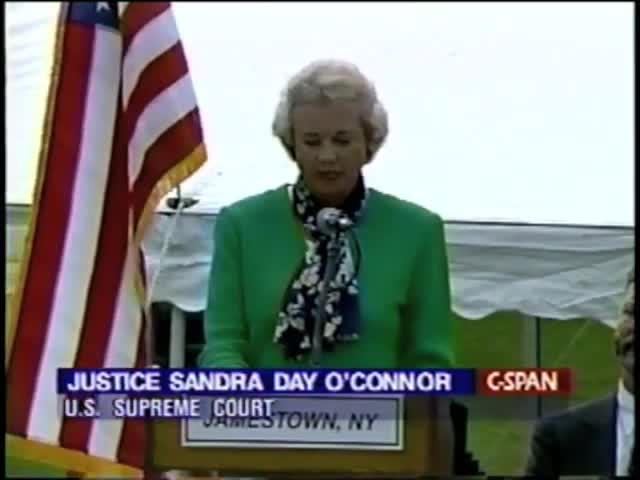
Speech at dedication of statue to the memory of Justice Robert H. Jackson
Sandra Day O’Connor This is a wonderful occasion for Jamestown and for all of us who are lucky enough to be here and see the unveiling of this absolutely handsome and strong statue of Justice Jackson. We’re remembering today a product of this community and of its public schools. The most treasured honor that anyone can receive is one that comes from one’s own town, from those who knew the honorary first and best, so it is today, Robert Jackson, one of the finest justices ever to sit on the bench of the United States Supreme Court, grew up on a farm close to Jamestown. It was here that he attended the Jamestown elementary and high school that he married, had his children and practice law. It was here that he spoke in 1935. At the dedication of the new Jamestown high school building, he said them. If you believe as I believe that democracy is the form of government best adapted to our people, then you must regard the public school as the most fundamental concern of our society. Democracy well. Democracy will always call most of its leaders from the ranks of humble man, and to equip them It must provide free education to the sons and daughters of disadvantaged homes. Robert Jackson was born as you heard in 1892, I thought it was in Pennsylvania, not New York. Early in his life, the family did move to a farm in this area. His father was a farmer, a lumber man and a stock breeder. He advised his son Robert to become a doctor. Instead, on graduating from Jamestown High School, Jackson
Law review article
Keynote address (Conference on Compelling Government Interests: The Mystery of Constitutional Analysis)
KEYNOTE ADDRESS-CONFERENCE ON COMPELLING GOVERNMENT INTERESTS†
Sandra Day O’Connor*
I. INTRODUCTION BY HON. JAMES L. OAKES**
I have been instructed to make a few remarks and then to get to the more important business of these remarks.
First, I want to congratulate Albany Law School and particularly Dean Belsky, Professor Gottlieb and Dean Baker for honoring Justice Robert H. Jackson in this fashion. You will recall, this evening is in honor of the memory of Justice Jackson. No finer writer ever on the Supreme Court, Justice Jackson is a hero to me because he was the original, you might.say, county/country lawyer. Since I come from across the hills here in Vermont, and did a little general practice my self, I appreciate just how far he went with the background that he had. He has been a great inspiration to me and to the rest of us in this business of judging, and he always will be.
Second, I want to particularly congratulate Professor Gottlieb on the choice of a subject matter of burning importance in constitutional law and for assembling the outstanding group of scholars and jurists participating in this conference and who have written some outstanding papers of which I have had the benefit of reading, some, if not all. The mystery of constitutional analysis is the subtitle of this conference and I think you ought to bear that in mind as you are listening to some of the presentations. I am acquainted with several of the
† © 1992 by Sandra Day O’Connor. These remarks were
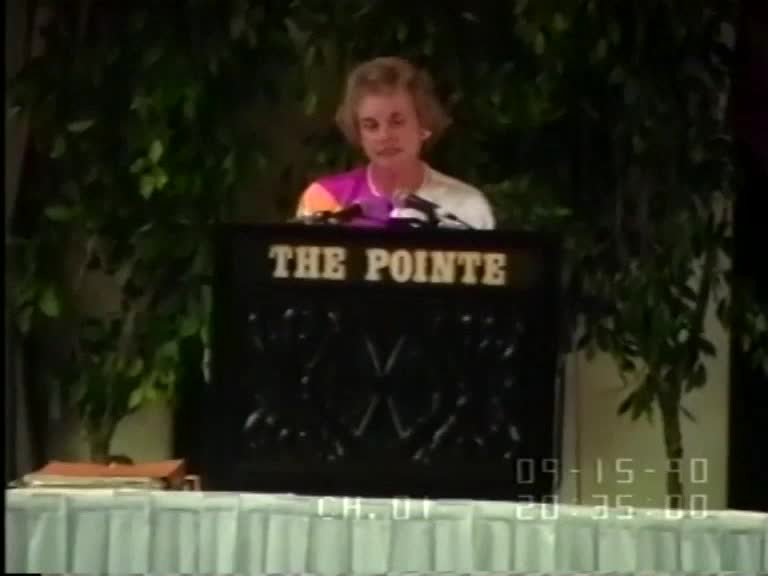
Speech to the National Conference on Court Management sponsored by the National Center for State Courts
Sandra Day O’Connor I’m delighted to help open this second National Conference on court management. Over the next few days, you’re going to examine how to strengthen court management’s contribution to the performance of the American judicial system. The insights you gain here, combined with your strong implementation efforts, when you go home, will benefit all of us for years to come. People look at the American judicial system in many different ways. There’s considerable attention paid to the court on which I now sit, for better or for worse. But those who see the administration of justice and the United States only in terms of the work of the Supreme Court, only in terms of what some people call the broad and cutting issues of the law. Those people really have a very narrow focus on the American judicial system. I know as a former state court judge, that the amount of and the quality of justice in this country are determined and large measure by the day to day workings of our trial courts, far away from the Supreme Court and in fact, far away from most appellate courts generally. The great majority of cases filed in the courts of the United States are filed and are limited in specialized jurisdiction courts. Day in and day out, those courts and the general jurisdiction trial courts decide what contracts will be enforced, who will pay damages, who will be punished for criminal acts. The appellate courts day in and day out, review the trial courts work and refine the many elements
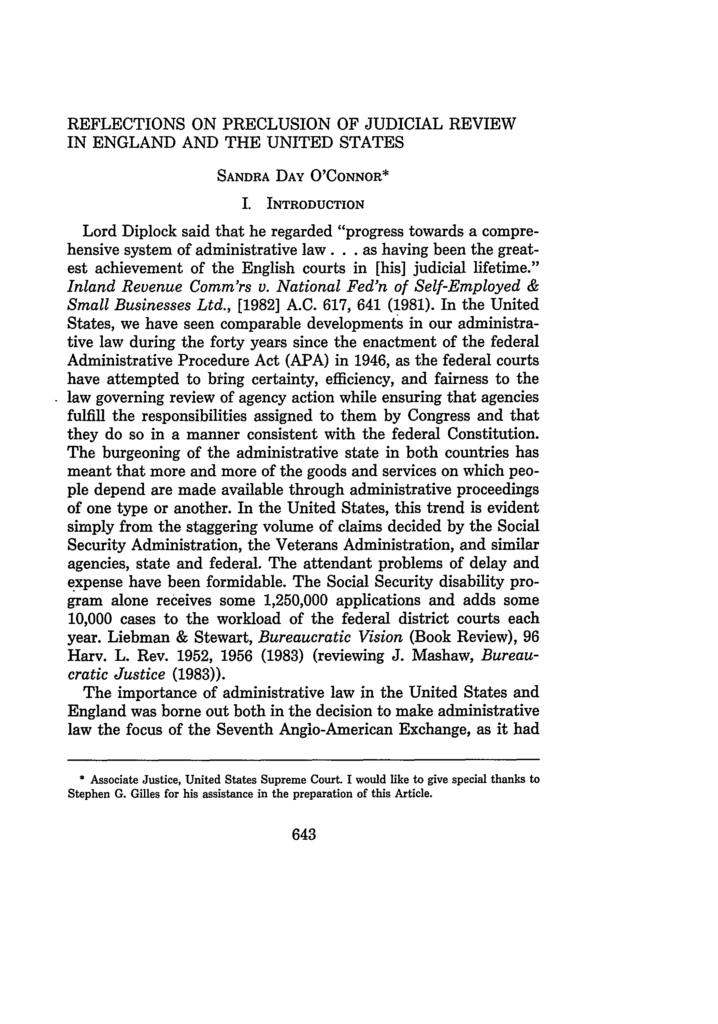
Reflections on Preclusion of Judicial Review in England and the United States
REFLECTIONS ON PRECLUSION OF JUDICIAL REVIEW IN ENGLAND AND THE UNITED STATES
SANDRA DAY O’CONNOR*
INTRODUCTIONLord Diplock said that he regarded “progress towards a compre hensive system of administrative law… as having been the great est achievement of the English courts in [his] judicial lifetime.” Inland Revenue Comm’rs v. National Fed’n of Self-Employed & Small Businesses Ltd., [1982] A.C. 617, 641 (1981). In the United States, we have seen comparable developments in our administra tive law during the forty year.s since the enactment of the federal Administrative Procedure Act (APA) in 1946, as the federal courts have attempted to bring certainty, efficiency, and fairness to the law governing review of agency action while ensuring that agencies fulfill the responsibilities assigned to them by Congress and that they do so in a manner consistent with the federal Constitution. The burgeoning of the administrative state in both countries has meant that more and more of the goods and services on which peo ple depend are made available through administrative proceedings of one type or another. In the United States, this trend is evident simply from the staggering volume of claims decided by the Social Security Administration, the Veterans Administration, and similar agencies, state and federal. The attendant problems of delay and xpense have been formidable. The Social Security disability pro gram alone receives some 1,250,000 applications and adds some 10,000 cases to the