Op ed, The Kauffman-Henry Collection, Tucson Citizen

Mark Russell

We are about to witness the biggest plus of the Reagan adminstration thus far – the end of unisex facilities at the Supreme Court • • • The nomination of Judge Sandra O’Connor to the court should end all that nonsense about the administration being anti-Irish. .. . . Reagan had found a black, female, Jewish Republican judge for the court, but her Hispanic husband Ernesto didn’t vant to quit his job as a preacher for the Moral Majo1 Â¥ to move to Washington. • • • It’s not in our nature a~ a pPople to be pacified by the nomination of a woman for the Supreme Court. We’ll no doubt be hearing crie~ of “Only one?”, “Hohum, another white” and “No justice, we say, until a justice is gay!”

Arizona Republic, Newspaper article, The Kauffman-Henry Collection

Luncheon honors Judge O’Connor

WASHINGTON – Sandra O’Connor, on the eve of her historic ascendancy to the nation’s highest court; was honored Thursday by President Reagan during a Rose Garden reception and at a White House luncheon. Judge O’Connor – who today will become the 102nd member and first woman on the Supreme Court – stood beaming in the brilliant sunshine outside the Oval Office as Reagan promised he will strive to “enhance the prestige and quality of the federal bench.” Judge O’Connor will take two oaths today from Chief Justice Warren Burger, the first a “constitutional oath” in the justices’ conference room – the private sanctum where the members of the court meet to hammer out the nuances of the law of the land. That will be followed by a “judicial oath” administered in a public ceremony at 2 p.m. in the huge, marble-columned courtroom which will be filled with court personnel, the O’Connor family, reporters, and dignitaries, including the president.

Newspaper article, Scottsdale Daily Progress, The Kauffman-Henry Collection

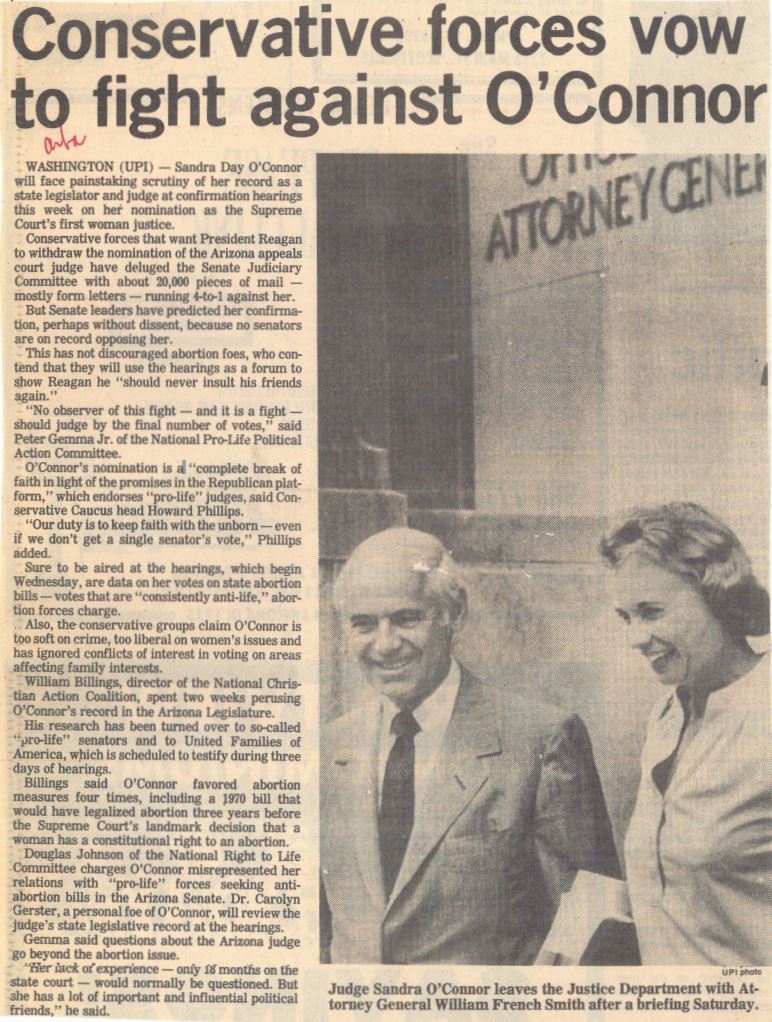
Local comment on the nomination of Arizona’s Sandra O’Connor

“I don’t buy this idea that a justice of the Supreme Court has to stand for this, that or the other thing. And I’m getting a little tired of people in this country raising hell because they don’t happen to subscribe to every thought that person has.” SEN BARRY GOLDWATER — “I’ve known Judge O’Connor for many, many years, having worked with her professionally as far back as 1965 before she was in the state senate and on the bench ‘ . . . She is conservative and I think she meets all the criteria the president has had in mind.” SEN DENNIS DECONCINI — “I am confident that Sandra O’Connor will distinguish herself as a member of the Supreme Court. President Reagan is to be congratulated for making an outstanding selection. Her judicial temperment, knowledge of the law and her willingness to work long and hard are the perfect blend of qualities for a member of the Supreme Court. She will serve America well.” GOV. BRUCE BABBITT — ”President Reagan has selected the best person for the job. Judge O’Connor will make an outstanding Supreme Court justice. She has established a distinguished record of public and community service in Arizona. Our country will be fortunate to have the benefit of her knowledge and integrity in service on the Supreme Court.” ‘ MAYOR MARGARET HANCE

Arizona Republic, Newspaper mention, The Kauffman-Henry Collection

Lobbyist against gun control praises choice for high court

WASHINGTON – A lobbyist Friday commended Arizona Court of Appeals Judge Sandra O’Connor, President Reagan’s choice for the Supreme Court, for what he said was an anti-gun-control record. Judge O’Connor is strongly opposed by the Moral Majority and anti-abortion groups. They believe her record favors abortion rights and the Equal Rights Amendment. But John M. Snyder, chief lobbyist for the Citizens Committee for the Right to Keep and Bear Arms, said Judge O’Connor “so far looks pretty good.” “As a state senator,” Snyder said, “she signed a resolution opposing more federal gun control, and she also voted for a measure to make it easier for Arizona residents to obtain concealed-weapons permits. “This could be very important because there may be a case involving the Morton Grove, Ill., ban on handgun possession coming before the court within the next couple of years,” he said. Snyder refened to a Morton Grove City Council vote June 8 to make handgun possession and sales a misdemeanor punishable by a $500 fine and six months in jail.

Newspaper article, Phoenix Gazette, The Kauffman-Henry Collection

Law Clerk Praises New Justice

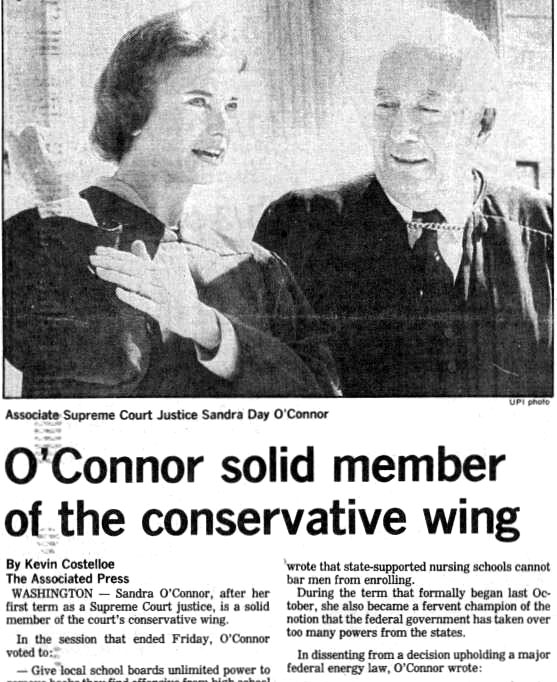
~r, three mon~hs at her new job, Arizona s Sandra O Connor is working IO-hour days, lunching at her desk and has quickly become “one of the guys” on the U.S. Supreme Court. “Within the court itself, she has fit in very easily,” Justice O’Connor’s law clerk, Ruth V. McGregor, a Phoenix resident, said today. “On the world outside, though she is the first woman on the court’ and that is historic.” Mrs. McGregor, who was Justice O’Connor’s hand-picked choice for the prestigious one-year clerkship, told JUSTICE O’CONNOR RUTH McGREGOR The Phoenix Gazette the new justice has not aligned herself with any philosophical group on the ninemember high court. “SHE ANALYZES each case individually and very carefully,” said Mrs. McGregor, who was a partner in the Phoenix firm of Fennemore, Craig, von Ammon & Udall. In the 11 rulings already issued since Oct. 1, Justice O’Connor “has not lined up with the traditional liberal or traditional conservative bloc,” Mrs. McGregor said. If there has been a surprise for the 38-year-old attorney, a 1974 graduate of Arizona State University College of Law, it has been the heavy workload. “Most Americans think that since the court is in session 14 weeks a year, and hand down about 160 decisions, that they don’t work the rest of they year,” she said. “Actually, the workload is incredible, and the justices work very long hours,” Mrs. McGregor said . EACH WEEK, the court receives about 100 petitions for review, making for a three-foot-high stack of reading –

El Nuevo Dia, Newspaper article, The Kauffman-Henry Collection

La juez O’Connor, mujer decidida pero no dogmática

PHOENIX – Sandra Day O’Connor dedicó mu-::ho tiempo la semana pasada a revisar las leyes estatales y las decisiones judiciales que _constituyen el historlal de gran parte de su vida publica. Su oflcina en el Tribunal de Apelaciones de Arizona estaba llena de ramos de flores enviados tras el anuncio de su nombramiento al estrado del Tribunal Supremo. “Cincuenta aiios es mucho tiempo”, dilo durante una interrupcion de su revision, “y es diffcil recordar todo lo que se ha hecho”. Dlferenclas de temperamento La revision no ha terminado todavra, pero la mujer que ha surgido del examen de ese historial y de conversaciones que se han sostenido con amigos, colegas y adversarias, resulta a la vez similar y diferente de la gran mayorfa de los votantes que eligieron al Presidente Ronald Reagan. Estas diferencias y similitudes se pueden encontrar en su instinto polftico, en su filosoffa judicial, en su posición económica yen su temperamento personal. La Juez O’Connor es una cc:,nservadora la mayor parte del tiempo, aunque con ciertos visos moderados y aun progresistas; una mujer decidida pero no dogmatica. Es acomodada, pero no rica; con una gran curiosidad intelectual, aunque no exactamente osada en este terreno y maleable a la vez que tradicional. El Presidente Reagan describió a la Juez O’Connor como “una persona para todos los tiempos’ pero sin embargo parece ser menos activista de lo que han dicho los que la apoyan dentro del movimiento feminista. Al mismo tiempo es mucho mas complela

Op ed, The Kauffman-Henry Collection, The New York Times

Justice Rehnquist: Firm Ways, Witty Means

Throughout the speculation that preceded President Reagan’s selection of Sandra Day O’Connor for the Supreme Court last week, the prediction most often heard was that, regardless of gender, Mr. Reagan was looking for “another Rehnquist.” Despite similarities in origins and education – both Judge O’Connor and Justice Rehnquist practiced law in Arizona and were classmates at Stanford law school – it is too early to tell if that is what the President has found. But there is little doubt as to what “another Rehnquist” means.
William H. Rehnquist is a symbol. People who have trouble naming all nine Supreme Court Justices quickly identify him as its doctrinaire, right-wing anchor, the very model of a Reagan appointment. In many respects, the image is not far off the mark. After nine and a half years, Justice Rehnquist is the Court’s most predictably conservative member, using his considerable intelligence, energy and verbal facility to shape the law to his vision of the proper relationship between the states and Washington, legislatures and judges, citizens and government. In one respect, however, the image is inaccurate. President Reagan said he wants Justices who “interpret” rather than “make” law. But as one of the Court’s creative users – some say abusers – of precedent, Justice Rehnquist has done more than his share of “law-making,” in the sense of leading the Court into new areas of doctrine.
Unlike Judge O’Connor, William Rehnquist was a known quantity at the moment President