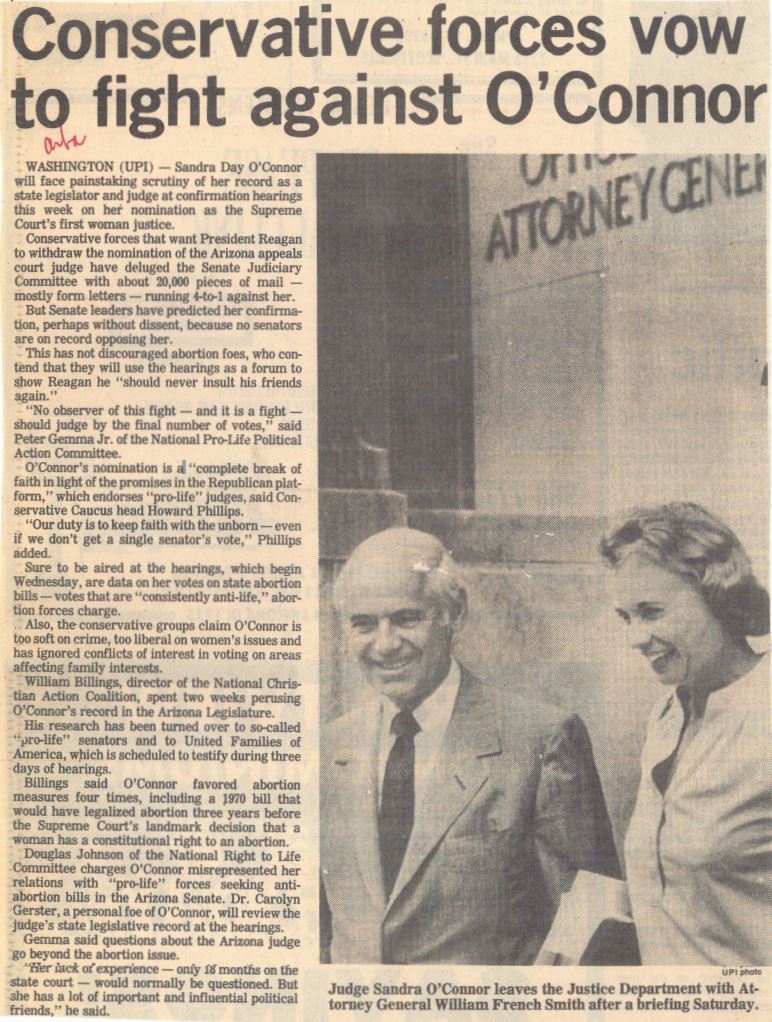
Justice O’Connor will speak at ASU
TEMPE (AP ) – Justice Sandra Day O’Connor of the U.S. Supreme Court will be the keynote speaker Nov. 27 at a College of Law conference at Arizona State University, the school announced Wednesday. The conference is designed to hear findings of a six-month ASU study of the state’s municipal and justice court system . Justice O’Connor’s speech is entitled , “Don’t Just Stand There,” and is expected to urge state lawmakers to take action on improvements in lower courts . Others listed speakers include state senators Jones Osborn, Jim Kolbe and Leo Corbet; Presiding Judge William J. Carter of the Phoenix City Court and Jon M. Memmott, research director of the Utah Legislature .
Justice O’Connor to be honored at ceremonies, luncheon, dinner
Supreme Court Justice Sandra O’Connor will be the guest at the state Capitol today in a day designated by Gov. Bruce Babbitt to honor her. Justice O’Connor, the first female justice, will attend a welcoming ceremony on the Capitol grounds, a luncheon and a black-tie dinner. Mayor Margaret Hance will be host for the luncheon, and Babbitt will have the same role at the dinner, which will be telecast live on Channel 8 beginning at 9 p.m. Babbitt, Arizona Chief Justice Fred Struckmeyer Jr. and legislators will greet .Justice O’Connor at a ceremony at 9:30 a.m. on the Capitol mall. Babbitt will present a proclamation to the former state senator and Arizona Court of Appeals judge naming today Sandra O’Connor Day. At noon, representatives of the Maricopa County Bar Association, Junior League, National Conference of Christian and Jews and the Soroptimist Club of Phoenix will deliver brief remarks at a luncheon at the Lath House in Heritage Square. Justice O’Connor, the 102nd Supreme Court justice, also will speak, according to the mayor’s office. About 400 people are expected to attend the luncheon, she said. The $50-a-plate dinner at the Arizona Biltmore will be preceded by a reception at 6:30 p.m. About 850 guests are expected to attend, the governor’s office reported.
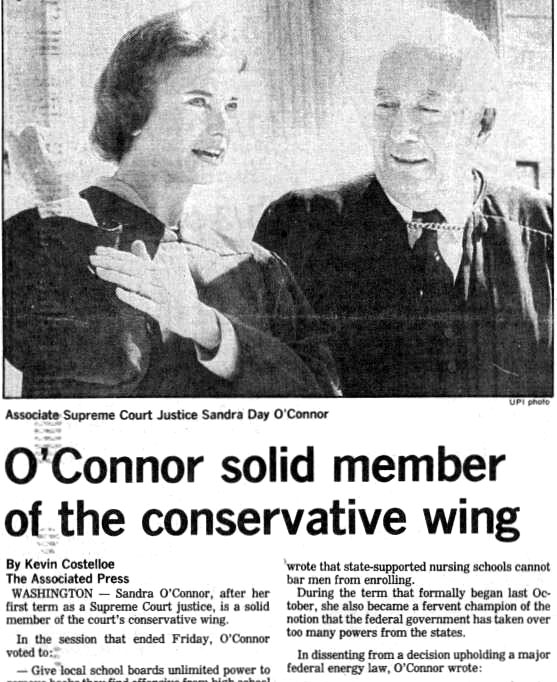
Justice O’Connor Still Independent of Court’s Blocs
WASHINGTON – As the Senate considered Sandra Day O’Connor’s nomination to the Supreme Court; Sen. Joseph Biden iold his colleagues that “all bets are of.r’ once a justice takes the oath of office .. The Delaware Democrat was right on target in his reminder last Septem ber that no one in the Senate can predict how a new member of the nation’s highest court will vote once he or she “dons that robe and walks into that sanctum across the way.” . ‘ After three months on the court, Justice O’Connor shows no signs of aligning herself with either its liberal or conservative bloc. SHE told the Senate last summer that her job would be “one of interpreting and applying the law, not making it.” That philosophy has led the high court’s first woman member on occasion to side with the cQurt’s liberals, its conservatives and sometimes mixtures of both. Since she was sworn in Sept. 25, Justice O’Connor: • Joined three of the court’s more conservative members in dissenting from part of a decision allowing most confidential secretaries and other workers with access to an employer’s confidential information to join labor unions. • Joined Justice John Paul Stevens and liberal Justices Thurgood Marshall and William J. Brennan in dissenting from a decision barring federal courts from hearing virtually all laws uas seeking money damages because of allegedly discriminatory property tax assessments. • Joined overwhelming majorities – made up of both liberals and conservatives – in several decisions
Justice O’Connor on the right side
When President Reagan nominated Sandra O’Connor for the Supreme Court last year, there was a good deal of grumbling. It turned out to be a political masterstroke that sailed through the confirmation process in the Senate, but conservatives weren’t so sure. Her record was sketchy, and what there was of it caused alarm among anti – abortion groups. , Afte~ Justice O’Connor’s six months on the Court, however, The New Republic concludes after an examination of her record that “her vote has not always been predict – able. But she has cast her lot often enough with lawschool classmate William Rehnquist and with Chief Justice Burger to help forge a clear conservative majority on a number of crucial issues … Mrs. O’Connor’s record so far suggests she will not alter the steady conservative momentum of the Court … And as the youngest member of the Supreme Court, Justice O’Connor may be with us until well into the 21st century.”
The key cases in her six-month record were not of the headline variety, but they do indicate that Justice O’Connor takes a restricted view of activist interventions by the Supreme Court. On January 12, for example, her vote helped provide a bare five-vote majority in a ruling that ordinary taxpayers could not sue in federal court to block the government from giving property to a religious group. The case was Valley Forge Christian College versus Americans United for Separation of Church and State. It turned on the issue of “standing,” that is, who is entitled
Justice O’Connor looks perfectly natural weighing an issue of life-or death
W ASHINGTON – After a while, you begin to wonder , why we get ourselves into suqi a state every time we make a breakthrough that should have come years before. It makes no sense. The most significant thing about wai<:hing Supreme Court Justice Sandra Day O'Connor sitting at the far enl of the U.S. Supreme Court bench he(e Monday was that it all seemed so perfectly natural. justice O'Connor wore the same type of black robe that the other eight jualices wore. Her questions were every bit as probing. Her demeanor wu every bit as serious. If anything, th• new justice appeared even more ~ive in her pursuit of details, more interested in the cases up for con1ideration than some veteran me)n.bers of the court - who sat back and let her do the probing. With its marble pillars, red velvet baekdrop, heavy wooden benches and wine-colored carpets, the Supreme ' Thursday, November 12, 1981 Tom Fitzpatrick Court is more than a little impressive. Each time the court goes into session, long lines form. Lawyers from all parts of the country, law students and tourists wait patiently outside the building, hoping to gain entrance to the limited and always packed seating area. Monday was no exception. The mood of the court was somber. The case under consideration was a death penalty given to a 16-year-old by an Oklahoma court. The question that brought the case of Monty Lee Eddings this far was whether the imposition of the death penalty on a 16-year-old constituted "cruel and unusual punishment."