Op ed, Prescott Courier, The Kauffman-Henry Collection

High court chair game complicated

Geography is destiny, as Freud said – or was that Rand & McNally? Anyway, everybody ‘s paying a lot of attention to the fact that President Reagan has nominated a woman to the Supreme Court and overlooking the fact that he has nominated an Arizonan, which is also significant. If she is { {,nl1r med, Sandra O’Connor will I,{ 111ily the eighth justice from west of the 100th meridian, which is where the West begins. Two of the others are still on the court – Rehnquist of Arizona and White of Colorado – so the contemporary court is a third Western, for the first time. Geography was an important criteria in selecting the early justices. George Washington picked half from the North and half from the South. From 1789 till 1932 there was a ” New England seat.” There was a “New York seat” from 1806 till 1890. There was a “Maryland -Virginia seat” from 1789 till the Civil War. In this century, geography has been less honored. There have been some extreme imbalances. On the famous “nine old men” court that President Franklin D. Roosevelt attacked in 1937, three of the nine justices had been New York City lawyers, a fourth was from Massachusetts, a fifth from Pennsylvania. The Nine Old Men were 61, 64, 66, 70, 74, 74, 75, 77 and 80. Within a year after FDR’s attack on them, four had retired and one died. Today’s eight justices are 56, 60, 64, 72, 73, 73, 73 and 75. Ronald Reagan may get to name two or three more justices. The person second on the list O’Connor was first on was J. Clifford

Op ed, The Kauffman-Henry Collection, The Washington Post

He’s Done it Again

BOSTON- You might have called it an eye-opening week. First President Reagan. a man notoriously myopic toward women, actually found one to nominate for the Supreme Court. Sandra O’Connor was not only a woman, he said, she was a •µerson for all ~ea~ons.” Then we watched as controversy over this person brewed between the extreme right and the merely right. ‘l’o see Barry Goldwater representing the moderate middle was enough to clarify anyone’s vision. The coalition of groups alternately labeled “pro-family” or “moral majority” disapproves of Sandra O’Connor. They maintain that her voting record as majority leader in the Arizona Senate was not pure enough to pass the test of the Republican Party Platform. That platform, you may recall, demanded judges who “respect traditional family values and the sanctity of innocent human life.” But anti -abortion groups, t.he Moral Majority, fnc., and others criticized O’Connor as suspiciously pro-abortion and.pro-ERA. This attitude was enough to put Goldwater’s famous jaw out of joint. “I’m getting a little tired of people in this country raising hell because they don’t happen to subscribe to every thought that person has,” he said. “You could offer the Lord’s name for some of these positions and you’d find some of these outfits objecting … ” In any case, it was quite a stroke for Reagan, in the midst of all the budget cuts, to find an appointment criticized as too “liberal.” Meanwhile, O’Connor’s real record turned out to be about as middle-ofthe-

Newspaper article, Tempe Daily News, The Kauffman-Henry Collection

Her Honor: Reagan’s choice reaps praise

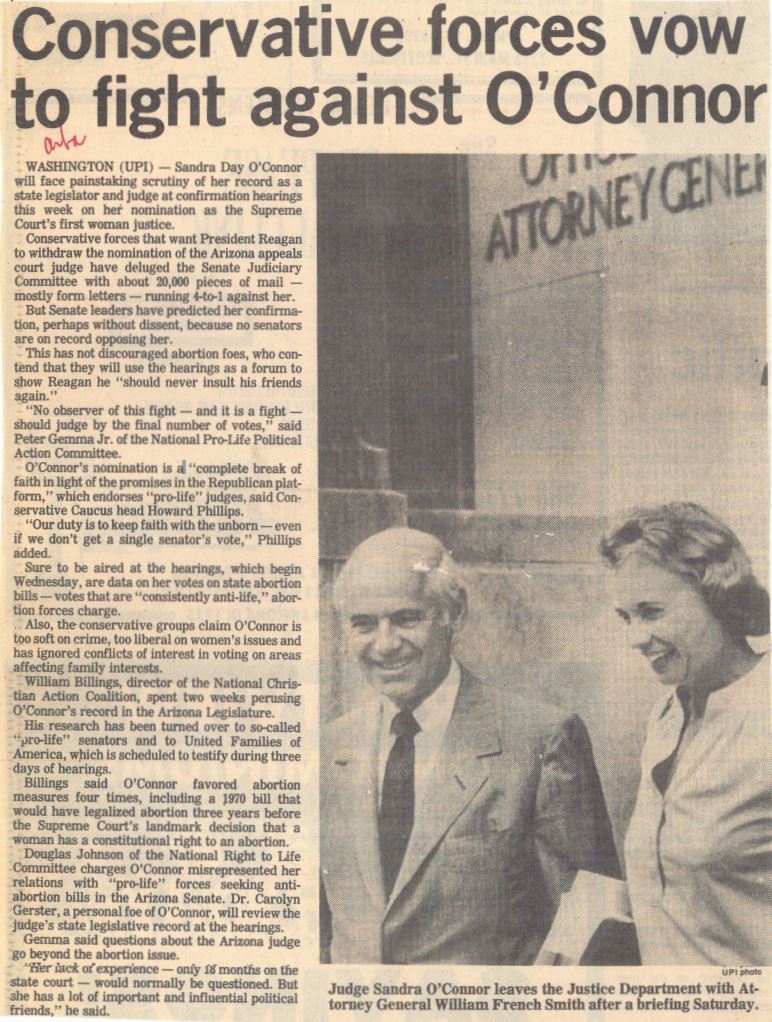
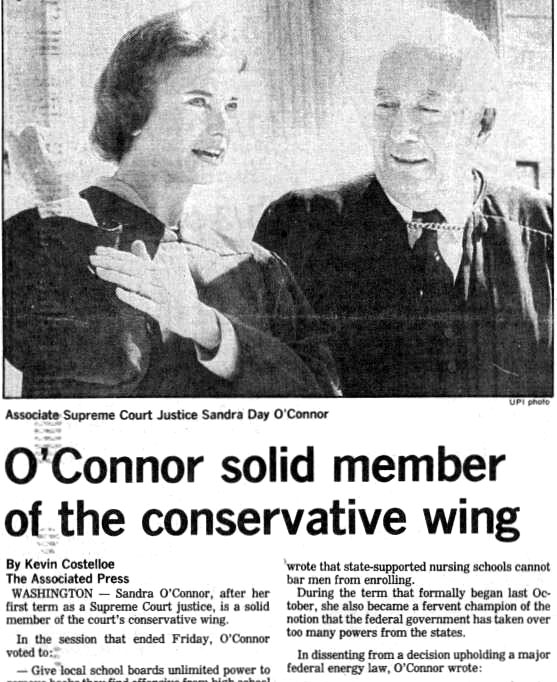
Conservative but not an ideologue. Sharpminded, with a thorough knowledge of the law. Intellectual. Organized. Fair. A legal technician. In the words of President Reagan, “a person for all seasons.” The descriptive accolades arrived in torrents Tuesday, just minutes after Reagan nominated Sandra O’Connor, 51, an Arizona appellate court judge who was born and raised on a ranch in the small mining town of Duncan, to be the first woman to take a seat on the United States Supreme Court.

There was widespread praise for the appointment from Republicans and Democrats, feminists and political moderates. Only anti-abortionists and farright political groups like the Moral Majority, alarmed by O’CoMor’s legislative record on abortion and the equal rights amendment, protested the action. It appeared unlikely they would muster the political clout to derail Senate approval of her nomination. O’Connor, who learned the news Monday night when Reagan telephoned her, exhibited a reaction that mirrored both her legislative and court record: subdued. “This is a momentous day in my life and the life of my family,” O’Connor said. “If confirmed I will do my best to serve the court and this nation in a manner that will bring credit to the president, to my family and to all the people of this great nation.” An analysis of her voting and court record, coupled with interviews of professional colleagues, shows O’Connor emerging as a well-qualified, sharp-minded magistrate who has developed a conservative

Editorial, San Diego Union, The Kauffman-Henry Collection

Her Gender Will Mean Less than Her Legal Skills

Two centuries of national history suggest that Sandra O’Connor will be confirmed in due time and take her seat on the U.S. Supreme Court unless a continuing investigation unearths something wholly unexpected. Her nomination by President Reagan has given the political far right and opponents of abortion per se another megaphone, which will be exploited thoroughly. However, her conservative credentials are nearly impeccable and, after all, didn’t Mr. Reagan himself sign an bill permitting abortion when he was governor of California? After the thunder on the right diminishes, the U.S. Senate will confront an inexorable historical fact: Except in rare cases, only egregious-, ly unqualified persons have been rejected and O’Connor clearly is qualified. Since 1787, U.S. presidents have nominated 139 persons to the court. Only 26 were considered unfit by the Senate. Most recently denied confirmation were Clement F. Haynsworth in 1969 and G. Harrold Carswell in 1970, both named by President Nixon. It’s a reasonable assumption that the Senate will not compound President Reagan’s historic landmark by rejecting the first female court appointee over a single issue. So speculation deepens on how O’Connor’s presence will influence the court. Published analyses suggest that O’Connor will have more understanding of state and local issues and problems, given her background in the Arizona legislature and on the Arizona bench. President Reagan apparently believes that O’Connor will “interpret !he_

Arizona Republic, Newspaper article, The Kauffman-Henry Collection

Helms calls Judge O’Connor fine lady, is silent on support

WASHINGTON – Sen. Jesse Helms, R-N.C., the chief Senate crusader against abortion, Thursday called Sandra O’Connor a “very fine lady” but declined to say if he will oppose her confirmation as the first woman Supreme Court justice. After a 35-minute meeting with President Reagan’s choice for the high court, Helms – who has declined to “prejudge” Judge O’Connor despite opposition to her from his right-wing allies across the country – was careful in mnswering reporters’ questions. When Helms and Judge O’Connor emerged from his office to have their pictures taken, Helms was asked about the meeting, and the usually articulate senator, searching for the right words, replied, “Well, I hope we have many more meetings. I look forward to following this lady’s career.” Asked if he is going to help her career he replied, “Why should I do othe~? She’s a very fine lady.” But he would not say whether be will vote to confirm her or lead any opposition. When reporters pressed Helms for elaboration, the senator retreated foto bis office without answering, and aides shut the door on reporters. Judge O’Connor would say only, “We had a productive meeting.” Before meeting with Judge O’Connor, Helms met at the White House with Reagan, a Helms aide confirmed Thursday. The aide would not say if Helms discussed the O’Connor nomination with Reagan. But the president has urged Helms repeatedly not to oppose the nomination, the aide said, and there has been widespread speculation that White House aides

Editorial, Phoenix Gazette, The Kauffman-Henry Collection

Hearings were significant event

Whatever else the Senate Judiciary Committee confirmation hearings may have accomplished they provided a rare insight into the workings of the American legal system. _ As Supreme Court justice nominee ,Sandra Day O’Connor cautiously threaded her way through the barrage of senatorial questions, televison viewers received an education in constitutional law. Questions of constitutionality, formerly . the province of legal scholars and lawyers, took on meaning for thousands of event television viewers and a whole lexicon of , legal terms was added to the nation’s vocabulary. The give and take between , the senators and Judge O’Connor provided a lesson in the landmark cases which influenced the course of American history. Politics and senatorial showmanship aside, the hearings were important for another reason. In contrast to so much of the world where justice has been replaced by slave labor camps or worse, the Senate proceedings were a living example of the American commitment to rule by law.

Copper Era, Newspaper article, The Kauffman-Henry Collection

Greenlee Family contributes to national history: daughter does what dad longed to do

DUNCAN – On July 22. Mr. and Mrs. Harry Day took time out of their busy s~hedule to be interviewed at their hbme on the Lazy B Ranch. Needless to say Harry and Ada Mae are very proud and overwhelmed with the honor that has been bestowed on their daughter Judge Sandra Day O’Connor. “The word spread quickly June 28 through Greenlee County and the entire nation, that Judge O’Connor had been nominated by President Reagan u the 1st women to be nominated to serve on the United States Supreme Court. Judge O’Connor spent many or her ‘ happiest days on the ranch riding horses and roping steers. Her parents Harry and Ada are natives of Arizona, they operate a 260 square mile cattle spread straddling the Arizona and New Mexico border. The LazyB Ranch has been in the Day family since 1881, thtree decades before Arizona became a State. Mr. Day said his father traveled from Vermont where he operated the Lazy B which is 670/o public domaine. The name was acquired because of the brand that was on the cattle when Sandra’s Grandfather purchased them in Mexico, the “B” lying down created the ‘ nnme Lazy B for the ranch. Four gEinerations have lived on the Lazy B during its 100 years. The Days hosted Crentennial celebration last year for tl!1e community of Duncan, Sandra was hr:>me for the festive occasion. Mr. and Mrs. Day were married in Las Cruces in 1929, Ada Mae was born in Douglas and Harry was delivered by a midwife on a ranch. Education seems to be a tradition in the family as Mrs. Da1