El Paso Times, Op ed, The Kauffman-Henry Collection

GOP O’Connor criticism rings false

WASHINGTON – The ruckus touched off between the Reagan White House and the new right by the U.S. Supreme Court nomination of Arizona Court of Appeals Judge Sandra Day O’Connor is a tempest in a teapot. Even so, it’s a sign of tensions that could play a key role in the politics of the early 1980s. There will be no great fight. Mrs. O’Connor embodies all of the Republican virtues – affluence, tennis, the presidency of the Junior League of Phoenix, a husband who belongs to the World Affairs Council of Phoenix and serves as president of the Phoenix-Scottsdale United Way. Judge O’Connor herself is also a former ma• jority leader of the Arizona Senate. Democrats have breathed a sigh of relief: The Reagan revolution does not extend to the Supreme Court. The new right is angry, though, predicating its anger on Mrs. O’Connor’s alleged softness on the abortion and Equal Rights Amendment issues. Tactically at least, they have a point. Although the New Right doesn’t have a prayer of defeating Mrs. O’Connor’s nomination, she is so clearly not one of them, so clearly an establishment Republican, that if they don’t skirmish on the nomination, they signal weakness – and they are too skilled a group of politicians to do that. So what they will do is “Mau-Mau” the issue: Yell a lot, make a lot of noise, shake their fists, brandish a few weapons, but not mount a knockdown fight. This Mau-Mauing should make clear to the administration that the new right feels aggrieved, and that new and additional

Newspaper article, Phoenix Gazette, The Kauffman-Henry Collection

Goldwater tells foes: ‘Back off,’ Cut the ‘Claptrap’

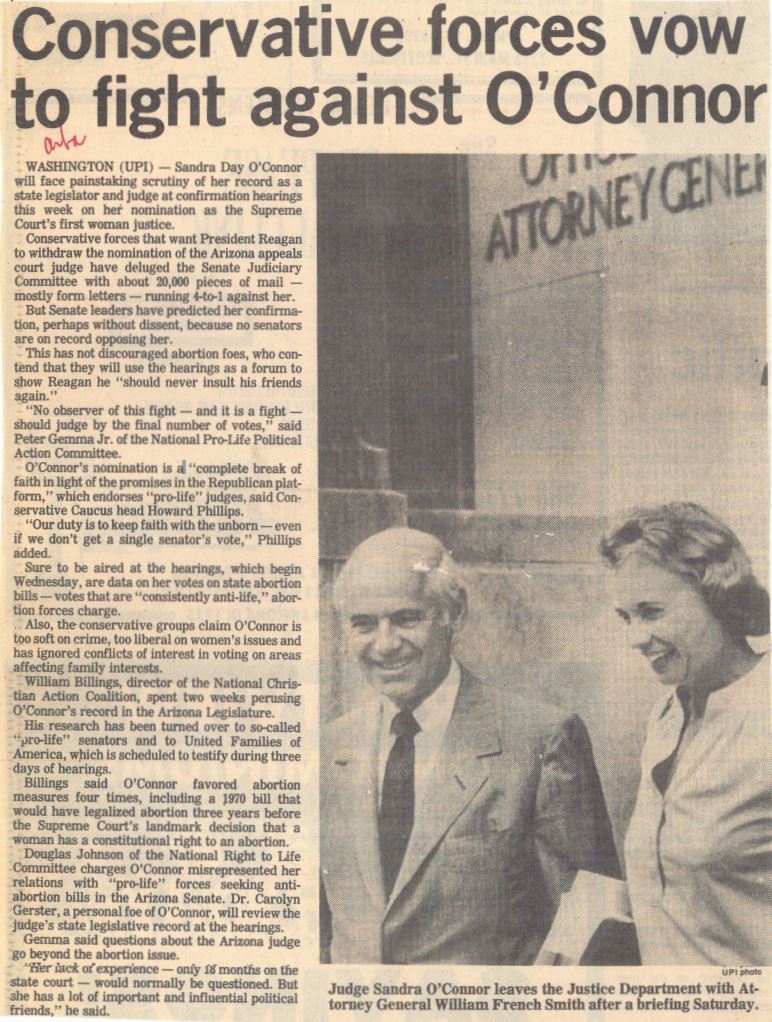
WASHINGTON (UPI) – Sen. Barry Goldwater warned the Moral Majority and other foes of Supreme Court nominee Sandra O’Connor ‘ today to “back off,” and said “a lot of foolish claptrap” had been circulated to undermine her chance for approval. In a speech to the Senate, the Arizona Republican said groups opposing Judge O’Connor “are totally off base.” Although stern, the language was more polite that Goldwater already has used against the Rev. Jerry , Falwell, who plans to use the political clout of his Moral Majority against the nominee. FALWELL CONCEDES he may not be able to stop Judge O’Connor from becoming the first woman in the high court. But the Moral Majority and other conservative groups that normally back -President Reagan have lashed out .against the selection. The opposition is based on her perceived past support for abortion and the Equal Rights Amendment but, speaking to the Senate, Goldwater said, “A lot of foolish claptrap has been written and spoken about President Reagan’s Supreme Court nominee by people who do not know what they are talking about. “I ask these critics, who are associated with moral causes, to show the same Christian decency and fairness to Judge O’Connor that they expect of others,” he said. “Instead of jumping to conclusions about her views, on the basis of years’-old positions … why can’t these people wait until the nomination hearings and let Mrs. O’Connor discuss her views personally,” asked Goldwater, who is the No. 1 backer of the nominee.

Newspaper article, Phoenix Gazette, The Kauffman-Henry Collection

Goldwater Raps ‘Political Preachers’

WASHING TON – Declaring that “religion has no place in public policy,” Sen. Barry Goldwater, R-Ariz., today warned “political preachers” he will “fight them every step of the way.” The 1964 Republican presidential nominee, considered by many to be one of the fathers of modern conservativism, said in a speech prepared for delivery to the Senate that single issue religious groups, such as the Moral Majority, pose “a very serious threat to our liberty.” He said he was upset with the opposition to Arizona Judge Sandra O’Connor as Supreme Court justice based on her stand on abortion. “Of course, the saddest part of the whole dispute was that Judge O’Con- nor was attacked by these religious factions for a position she doesn’t hold. She opposes abortion and said so.”

Goldwater said no single issue should ever decide the fitness of a Supreme Court justice. In a reference to Moral Majority leader Jerry Falwell, Goldwater said, without mentioning his name: “I’m frankly sick and tired of the political preachers across this country telling me as a citizen that if I want t.o I be a moral person, I must believe in ‘A,’ ‘B,’ ‘C’ and ‘D.’ Just who do they think they are? And from where do they presume to claim the right to dictate their moral beliefs to me? “And I am even more angry as a legislator who must endure the threats of every religious group who thinks it has some God-granted right to control my vote on every roll call in the Senate. “I am warning them today: I will fight them every

Honolulu Advertiser, Newspaper article, The Kauffman-Henry Collection

From the Lazy-B to the Arizona Bench

WASHINGTON – Sandra Day O’Connor, the first woman ever nominated to the U.S. Supreme Court, is a modern paragon, juggling a successful legislative and judicial career with a home, a family and an active role as a civic leader. “You get the feeling when you’re talking to her that she’s always between trains,” said Gerald ,Caplan, a former Arizona State University law professor who has worked with her. Her roots, however, are in a far different world. She grew up in a turn-of-the-century adobe house on the 250.square-mile Lazy-B cattle ranch that her grandfather started 100 years ago near Duncan, Ariz. The ranch, in the southeastern corner of the state near the New Mexico border, is a world of empty rangeland, dry creek beds and distant mountains, where the biggest events are the spring and fall roundups. The closest neighbor and nearest Post office are 20 miles away. The nearest dependable water is often 800 feet or more straight down. The isolation of the Lazy-B, where her parents still live, is one reason Harry Day sent his daughter away to a girts school in El Paso, Texas, when she was just a child. During the schoQl months, she lived there with a maternal grandmother, but spent her summers and vacations on the ranch. Sandra Day O’Connor’s exposure to city life and its educational OPPortunities reaped its eventual rewards: She was graduated from Stanford University in 1950 and, two years later, was graduated with great distinction, third in her class, from its law school. Along

Newspaper article, Phoenix Gazette, The Kauffman-Henry Collection

For High Court: O’Connor Wins Panel’s Approval

WASHING TON – Arizona Judge Sandra Day O’Connor today won overwhelming approval from the Senate Judiciary Committee for her nomination t.o become the first woman justice on the Supreme Court. The vote was 17-0, with one member voting present. Sen. Jeremiah Denton, R-Ala., said he could not vote for the nomination without knowing Judge O’Connor’s specific views on abortion. Sixteen senat.ors initially voted to approve the nomination. Denton and Sen. John East withheld their votes while they made statements explaining their decisions. East, R-N.C., then voted yes. Denton voted “present.” DENTON, WHO HAD questioned Judge O’Connor at length about her views on abortion, has said he felt frustrated because he could not determine where she was “coming from philosophically” on abortion. “I know very little about Judge O’Connor’s opinions on the grave legal issues of the day,” Denton said in his statement today. Denton said Judge O’Connor is a “fine lady and distinguished jurist,” but added he was unable to support her nomination without knowing more about her beliefs concerning abortion. East said he was similarly troubled but cast his vote for the nomination because he believes Judge O’Connor to be “a conservative woman ofconservative instincts.” The full Senate is likely to consider the nomination with only nominal opposition on Friday. Prior to today’s committee action, Judge O’Connor’s swearing-in ceremony was scheduled for Sept. 25. The high court begins its fall session 10

Mesa Tribune, Newspaper article, The Kauffman-Henry Collection

Foes take last O’Connor shot

WASHINGTON -The anti-abortion forces opposing the Supreme Court nomination of Sandra Day O’Connor fired their last shot Friday in a hopeless bid to persuade the Senate Judiciary Committee to reject the Arizona judge.

In its third day of testimony, the committee heard from pro-life groups opposed to the 51-year-old Arizona Appeals Court judge and listened to legal organizations and Arizona political leaders laud the qualifications of the first female nomination in the 190-year history of the high court. At a luncheon break, Sen. Dennis DeConcini, D-Ariz., one of the first to push for O’Connor’s nomination, said it appeared that at most three committee members were wavering – Sens. Jeremiah Denton, R-Ala.; John East, R-N.C.; and Charles Grassley, R-Iowa. “My gut feeling is that they’re going to come around,” DeConcini said. He added that when he conferred with Denton on Friday morning, the Alabama senator said he’d like to vote for O’Connor, but that he had “to satisfy my conscience” about the abortion issue. After listening to some three dozen witnesses, committee chairman Strom Thurmond, R-S.C., told reporters, “In my judgment she will be confirm~d overwhelmingly with few, if any, votes against her in committee or in the Senate.” A decision could come when the Judiciary Committee meets Tuesday, although any member could force a one-week delay. As O’Connor walked out of the hearing room, she was asked how she thought the hearings went. “I thought it went OK,” she replied.

Bisbee Review, Newspaper mention, The Kauffman-Henry Collection

First working day set for O’Connor

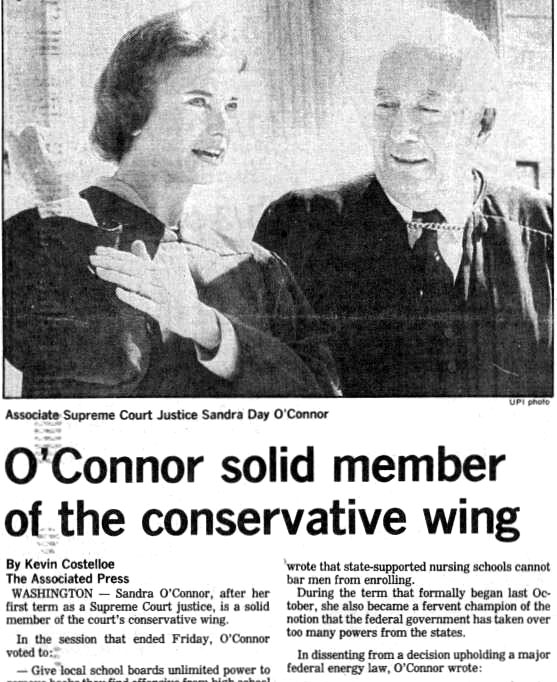
WASHINGTON – Sandra Day O’Connor today served her first working day on the bench as the first woman on the United States Supreme Court. The 51-year-old former Arizona appeals court judge, state court trial judge and Arizona Senate majority leader, took her oath of office Sept. 25. She promised then to be “very busy, very fast” and spent last week reviewing cases with the court’s other justices. But today was her first working day on the bench hearing arguments. Justice O’Connor – as she will be addressed by her eight brethren on the nation’s highest court – occupies the seat traditionally taken by the court’s most junior justice, to the far right of the bench u viewed from the courtroom. After Mrs . O’Connor’s swearing-in ceremony, Chief Justice Warren E. Burger announced that she would take over the supervisory duties of the 6th U.S. Circuit Court of Appeals, which covers Kentucky, Michigan, Ohio and Tennessee. Mrs. O’Connor was confirmed by the Senate Sept. 21 In a victory both for her and for Ronald Reagan the first president to nomirmte a woman to the Supreme Court. Although there had been considerable debate before the confirmation vote, particularly on Mrs. O’Connor’s previous position on abortion, when the day came she was approved unanimously .

Editorial, San Francisco Chronicle, The Kauffman-Henry Collection

First Woman On the Court

AS THE 105TH member of the United States Supreme Court in its almost two centuries of existence, Mrs. Sandra O’Connor will make history simply by taking the oath of office after her anticipated Senate confirmation. Admission of the first woman to that most exclusive of all men’s clubs is a notable and important event. The surprising development to us is, however, not that President Reagan has appointed the first woman member of the court. but that it seemed such a logical, practical and predictable thing to do. No one fell off a chair. We could be mistaken in assessing initial responses, but our observation is that the nation simply believed that appointing a woman was a proper response to a vacancy on the court. The nation has made its acceptance without reluctance or amazement, save in very few special-interest quarters. President Reagan -has thus shown once again, his native ability to read the popular mood and to act upon it. Not too many years ago, the idea of a woman sitting on the high court – or on any court – might have been regarded not just as anathema but as blasphemy. * * * THAT THE NATION is so relaxed if not to say receptive, to the O’Connor appointment is testimony to the status women have achieved before the bar in recent decades. And, we might add, tribute to the legal profession’s acceptance of thousands of new women colleagues. In Mrs. O’Connor, the president has found a nominee of good schooling with high academic honor in, that schooling, a well-rounded