Newspaper mention, San Francisco Chronicle, The Kauffman-Henry Collection

Classmates Recall Nominee’s Husband

Genesis II, the alumni quarterly issued by St. Ignatius College Preparatory School in San Fran<'isco, recently published a photograph of a self-assured 17-year-old with two classmates and asked if anyone could identify them. John Jay O'Connor III, Class of 47 and husband of the first woman nominated for the U.S. Supreme Court , knew at once. He was that 17-year-old. His classmates were Jim Fitzpatrick and Joe Boyd, and they were all members of the school's debating society at the time , the 51-year-old attorney wrote from his hume m Phoenix . Other classmates included the late Mayor George Moscone and attorney Charles Clifford, former president of the California Bar Association. "l have many wonderful memories of St. Ignatius and will always be deeply indebted to the faculty there for the superb educational experience they provided," O'Connor said in his letter. Word that O'Connor's wife, Sandra Day O'Connor, had been nominated by President Reagan for the nation's highest judicial office is also stirring memories of him among friends and classmates here of more than 30 years ago. O'Connor. who dated his future wife when they were students at Stanford and served as fellow editors of the Stanford Law Review. is a member of a distinguished San Francisco family. He was born in San Francisco on January 10, 1930. O'Connor's late father, Dr. John Jay O'Connor, was a member of the St. Francis Hospital board of trustees and previously a resident physician at the hospital before going

Newspaper article, Wall Street Journal

Change of Venue: In Retirement, Justice O’Connor Still Rules

Sonia Sotomayor just became the third woman to move from the appellate bench to the U.S. Supreme Court. The first woman on the nation’s highest court has gone in the opposite direction.

Though she retired in 2006 to look after her ailing husband, Justice Sandra Day O’Connor is still out there judging. Unbeknown even to some of her former colleagues on the Supreme Court, the 79-year-old jurist has been visiting federal appellate courts across the country, filling in as a substitute judge when vacations or vacancies leave their three-member panels understaffed.

“It’s nice to keep your hand in a bit,” she said in an interview in the chambers she still keeps at the Supreme Court.

As a substitute judge, Justice O’Connor has heard nearly 80 cases and written more than a dozen opinions. In her 24-year Supreme Court tenure, she often provided the pivotal vote on such issues as abortion, affirmative action and religious freedom. Nowadays, she decides such matters as whether a drug dealer could escape punishment because a search warrant listed one household trash can instead of two.

O’CONNOR ON U.S. V. LABOY-TORRES

STEPHEN VOSS FOR THE WALL STREET JOURNAL

Sitting as a substitute judge on the Third U.S. Circuit Court of Appeals in Philadelphia, Justice O’Connor delivered the opinion in U.S. v. Laboy-Torres. At issue: Are Puerto Rican courts foreign or domestic? See the key documents:

Marco Laboy-Torres’s appeal brief

Fritz Ulrich, a public defender from Harrisburg, Pa., came

Arizona Republic, Op ed, The Kauffman-Henry Collection

Caterwauling is damaging pro-lifers

The harsh criticism and rejection of Judge Sandra O’Connor as nominee t.o the Supreme Court by Rightt.o-Life leaders and the Moral Majority is pecksniffery at it.s worst. It is also unjust. Some of these Jacobins have become first-st.one throwers and are damaging the Right-to-Life movement. Peter Gemma, a leading Pro-Life politician, but not necessarily a prolife thinker, is absurd when he calls O’Connor “a hard-core pro-abortion proponent.” The Rev. Jerry Falwell, likewise, when he claims she “is opposed t.o attempt.s t.o curb the biological holocaust”. that has caused the death of 10 million babies since 1973. My pro-life reputation dates t.o 1973 when I wrote “The Abortion Culture” for Newsweek, so I take no back seat. I argued that the chore is t.o explain what a grisly matter abortion is, how it diminishes respect for human life, and can corrode a society. I always was against people crying “murder,” although I never opposed showing those telling, honest phot.os of the fetus. In the years since, the pro-life movement has grown and become strong. Inevitably, its leaders became obsessed with political power, highspeed computer mailings, “hit” list.s and a narrowness which could only please severe Calvinist.s, Madame Defarge or Menachem Begin. Like the cost-benefit-analysis martinet.s that they should scorn, some pro-life zealots pick over Judge. O’Connor’s “record” and condemn her. President Reagan says that he has discussed the abortion question with Judge O’Connor, and

Chicago Tribune, Newspaper article, The Kauffman-Henry Collection

Campaign Pledge Kept by Reagan

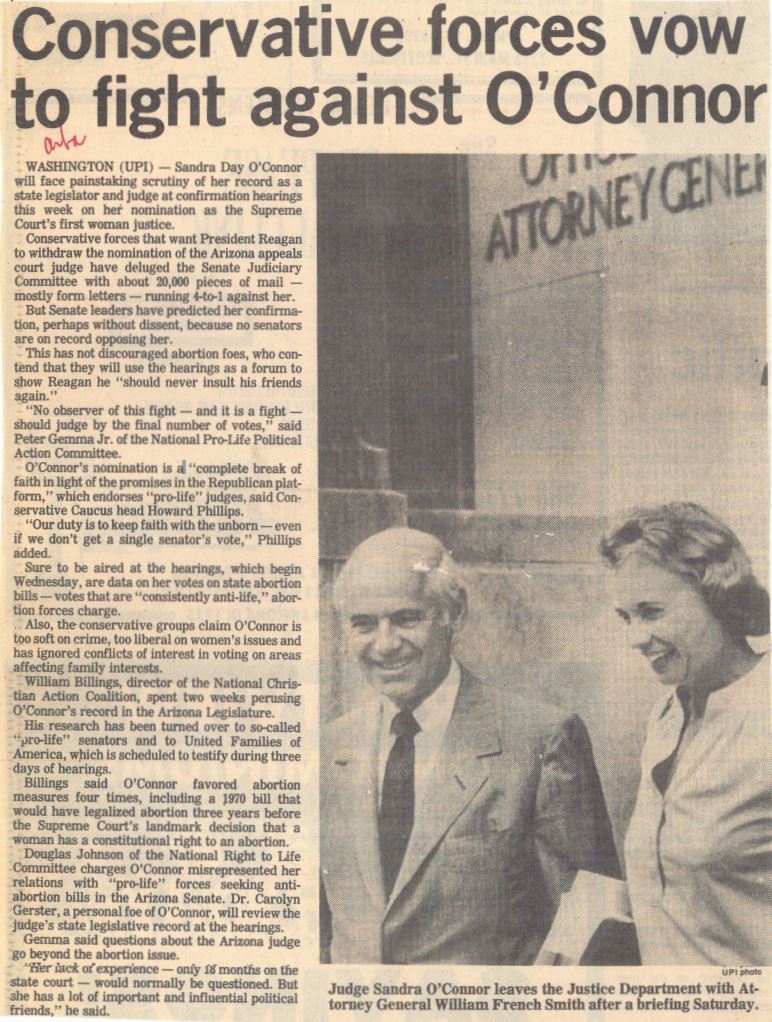
WASHINGTON-Breaking two centuries of male exclusivity on the Supreme Court, President Reagan disclosed Tuesday that he will nominate Sandra D. O’Connor for the high court . Mrs. O’Connor, 51, a judge on the Arizona Court of Appeals, was named to fill the vacancy created by the retirement of Justice Potter Stewart.

Reagan made the precedent-setting announcement Tuesday morning in the ‘ White House briefing room. The President described Mrs. O’Connor as “truly a person for all seasons, possessing those unique qualities of temperament, fairness. intellectual capacity, and devotion to the public good.”

IN PHOENIX, Judge O’Connor called the nomination a “momentous” day in her life and the life of her family, and said she was “extremely happy.” “If I am confirmed in the United States Senate,”she said, “I will do my best to serve the court and this nation in a manner that will bring credit to the President, to my family, and to all.the people of this great nation.” In making the nomination, Reagan kept a campaign pledge to appoint a woman to one of the first vacancies on the Supreme Court. At the time, Reagan had been under fire from women’s organizations for his opposition to the Equal Rights Amendment. REAGAN INTERVIEWED Mrs. O’Connor last Wednesday in the Oval Office. According to administration officials, Reagan was highly impressed and put her at the top of his short list of potential nominees. The President reportedly made the decision on Monday. Mrs. O’Connor is a moderate

Arizona Republic, Newspaper article, The Kauffman-Henry Collection

Burger won’t block proposal by U.S. Steel to buy Marathon

Chief Justice Warren Burger refused Wednesday to block U.S. Steel Corp.’s proposed takeover of Marathon Oil Co. Burger turned down an emergency request by rival bidder Mobil Corp. to postpone the Jan. 7 date that U.S. Steel expects to begin buying Marathon’s shares under its $125-a-share tender offer. But the chief justice’s action left open the chance that Mobil could return to him soon. Burger denied the request “without prejudice,” citing a Supreme Court rule that disallows such emergency motions that have not been denied first by appropriate lower courts. Mobil, the nation’s second-largest oil company, asked Justice Sandra O’Connor on Tuesday to freeze the takeover fight until the full Supreme Court has a chance to hear a formal appeal the company filed Tuesday. The appeal challenges a ruling by the 6th U.S. Circuit Court of Appeals preventing Mobil from buying Marathon stock. Last week, the appeals court ruled that Mobil’s aoouisition of Marathon probably would- violate federal antitrust laws. Justice O’Connor, who hand les all emergency matters coming to the high court from the states encompassed by the 6th circuit, disqualified herself. Following court custom, Justice O’Connor did not explain why she took herself out of the case. Justice O’Connor and her husband, attorney John J. O’Connor III, are spending part of the holidays at their Paradise Valley home. O’Connor, contacted by phone at their home, said he could not comment on court matters in which his wife is involved.

Arizona Republic, Newspaper article, The Kauffman-Henry Collection

Burger warns of high-court overload

Angeles Times NEW ORLEANS – Chief Justice Warren Burger, warning that the Supreme Court’s swelling workload is approaching “disaster” level, called Sunday for a new national tribunal to decide all conflicts between federal appeals courts – now one of the Supreme Court’s major tasks. If Congress enacted Burger’s proposal, which he presented to the American Bar Association’s midwinter meeting here, it would mark the most sweeping change in the nation’s judicial structure since Congress established the federal courts of appeals 92 years ago. “We can no longer tolerate the vacuous notion that we can get along with the present structure ‘because we have always done it that way,’ ” Burger said in his annual State of the Judiciary speech. Burger proposed that the new court have only a five-year life to provide immediate relief to the caseload, during which time a commission would work out longer-term solutions for the “tidal wave” of new cases that, Burger said, threatens to engulf the Supreme Court. “Only fundamental changes in structure and jurisdiction will … avoid a breakdown of the system – or of some of the justices,” he said. Burger noted that the 5,311 cases on the docket in the term that ended last July represented an increase of 270 percent from the caseload in 1953, the year that his predecessor Earl Warren, took command of the court. Ove; the same 19-year span, signed opinions by the justices that, Burger said, are the best measure of the court’s workload, more than