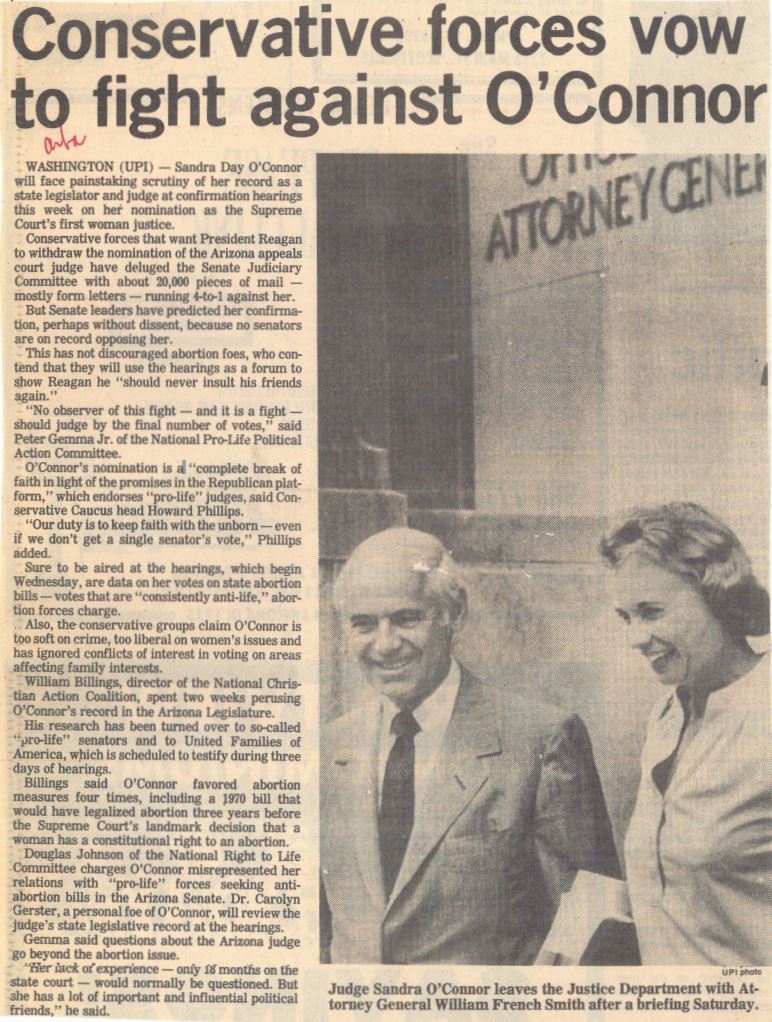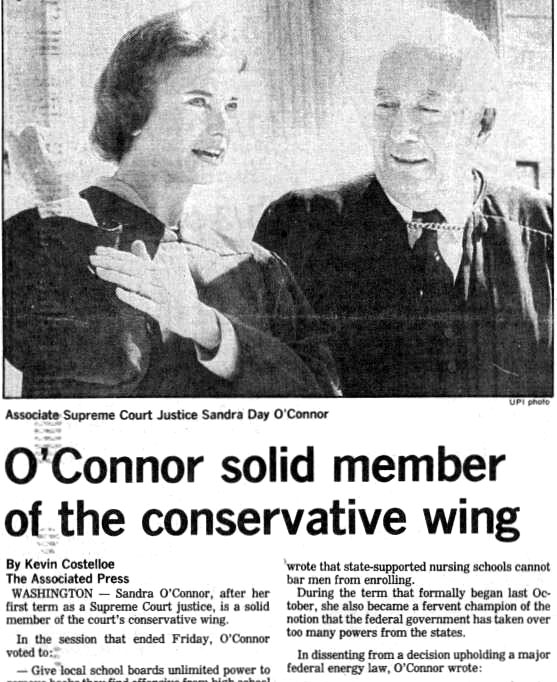
Newspaper article, Phoenix Gazette, The Kauffman-Henry Collection

Burger proposes creating new court

NEW ORLEANS (UPI) – Arguing the quality of American justice is at stake, Chief Justice Warren Burger is asking Congress to creat e a new federal court to decide some of the Supreme Court’s cases. Burger said the flow of cases is so overwhelming the court is threatened with a ” breakdown of the system – or of some of the justices.” He said “patchwork remedies” cannot solve the problem. “It is the most important single, immediate problem facing the judicial branch ,” Burger declared. Denying he was “crying wolf,” the nation’ s top DAI LY jurist recommended setting up a temporary panel of judges to settle conflicting rulings among the circuit courts of appeal, and perhaps disputes over federal statutes. Justice Sandra Day O’Connor, who also addressed the American Bar Association’s annual midwinter meeting Sunday, made a similar proposal for a new court. “There is no one single, permanent solution,” O’Connor said. “Each time the court’s caseload increases, congressional action is necessary to make some significant change in the court’s jurisdiction or its procedures to reduce the numbers. It’s been 58 years since the last major changes.” Burger’s proposal, made in his annual State of the Judiciary address, was the first time he has endorsed such a major change to reduce the court’s case burden – a topic that eight of the nine justices have spoken about publicly since last summer. Proposals for a new judicial layer between the appeals courts and the Supreme Court have been floated

Editorial, Scottsdale Daily Progress, The Kauffman-Henry Collection

Blunt Barry speaks out

Sen. Barry Goldwater recommended Judge Sandra O’Connor for the Supreme Court and was unamused when the Rev. Jerry Falwell of Moral Majority criticized her as not far enough right. With the blunt language of the Southwest, Goldwater growled, “Every good Christian ought to kick Jerry Falwell right in the ass.” That caused a bit of heartburn in the news business because Goldwater’s little word is listed as vulgar in the dictionary. Even so, three TV networks and many ;newspapers quoted Goldwater verbatim. The Christian Science Monitor, with its usual firmness, reported that Goldwater had said something “not printable in this newspaper.” The New York Times faced a dilemma: It wanted to run the story but it had to protect its genteel audience from a rude word. The Times could have written, “right in the a-” It used this dodge when President Carter threatened to whip Ted Kennedy’s a–. Or it could have slipped into indirect quotation, saying that Goldwater urged the faithful to chastise Falwell in the seat, rear or duff. Instead the Times wrote, “Every good Christian ought to kick Falwell in the posterior.” Now this may seem a minor fudge but it isn’t. Every journalism student learns to put within direct quotes only what a person actually said. Worse yet, the Times is reputed to be the nation’s newspaper of record and is much consulted by librarians, historians and other dusty types. Someday one of them will come across the bowdlerized quotation and write a book proving that Goldwater

Newspaper article, The Kauffman-Henry Collection, The New York Times

Baker Vows Support for Nominee. Foes of Abortion are Upset

WASHINGTON, July 7 – Anti-abortion groups today denounced President Reagan’s decision to nominate Judge Sandra Day O’Connor to the Supreme Court, but initial reaction in the Senate, which will vote on confirmation, was favorable.

”I commend the President for the courage of his decision,” said Howard H. Baker Jr., the Senate Republican majority leader. ”I am delighted with his choice, and I pledge my full support for her confirmation by the full Senate.”

The National Right to Life Committee, an amalgam of anti-abortion lobbying groups in the 50 states, said that it would mobilize its members to ”prevail upon senators to oppose this nomination.” The committee said that Judge O’Connor was ”pro-abortion” as a member of the Arizona State Legislature.

Dr. Carolyn Gerster, a vice president of the National Right to Life Committee, said that the nominee, as a legislator, voted in 1974 not to allow an anti-abortion resolution out of caucus, thus killing it. The resolution asked Congress to pass a Constitutional amendment protecting the fetus except when the mother’s life was in danger, and allowed abortions in the case of rape.

Dr. Gerster based her statement of Judge O’Connor’s record on that and other votes, which were characterized as ”pro-abortion,” on newspaper accounts and the recollections of other legislators, she said. Before 1975, the State Legislature kept no records of committee, subcommittee or caucus votes.

”We feel betrayed by the President,” said Paul Brown

Arizona Republic, Newspaper article, The Kauffman-Henry Collection

Attorney praises quick mind, record of Judge O’Connor

Discussion about the nomination of Sandra O’Connor to the U.S. Supreme Court will go on for years and, for a time, it will center on her sex – simply because she was the first woman named to the court. If she is confirmed, conclusive insight on her tenure may _have to wait for historians who are given the luxury of hindsight rather than the risk of foresight. Phoenix attorney John P. Frank, a Democrat, is a nationally recognized scholar on the Supreme Court and lias written and spoken extensively on its history. Shortly after the announcement of Judge O’Connor’s nomination July 7, the following interview was taped at Frank’s office: Question: What, in your opinion, are Judge O’Connor’s strengths and weaknesses? Answer: An extraordinary brightness of the intellect, an incredible capacity for hard work and a very great thoroughness. As with all of us, her strengths are the flip side of her weaknesses. The extreme care with which she comes to her conclusions makes her somewhat inelastic after she has reac.,hed them. The brightness and quickness of her mind also means that she has in it the element that she will not suffer fools gladly. An appellate bench is the ideal place for this composite of talents and limitations because she won’t have to suffer many fools for very long Q: Is Judge O’Connor truly a “distinguished jurist” as some have , called her? : A: Judge O’Connor is qualified for ,this position. The president wanted to keep his promise to put a woman on the Supreme

Newspaper article, Tempe Daily News, The Kauffman-Henry Collection

Astute Pick: Nominee’s many qualities lauded

“She is truly a person for all seasons, possessing those unique qualities of temperament, fairness, intellectual capacity and devotion to the public good.” – President Ronald Reagan By J. Patterson O’Neill Daily News writer “Multifaceted” might be a better way to describe Sandra O’Connor, the nation’s first female Supreme Court nominee. She’s managed to master the difficult roles of wife, mother and professional,. apparently without a hitch. She’s also socially and athletically active. O’Connor has shot the rapids of several Western rivers, helped build her own home, raised three children and handled the pressures of a fulltime career. She’s a member of the board of directors of several non-profit Arizona organizations and belongs to at least one country club. O’Connor lives with her husband John, a Phoenix attorney, and a son in a sprawling rustic-contemporary Paradise Valley ranch house. The home is secluded and quiet, as is O’Connor. The couple built much of it themselves ahnost 3J yean ago, and her fingerprints still can be seen on the adobe walls. Her son Jay, 19, is & freshman at Stanford; Brian, 21, is a senior at Colorado College in Colorado Springs, Colo.; and Zi-year-old Scott is a Stanford graduate, and, as O’Connor put it, “now happily among the employed.” She plays tennis regularly, is an excellent golfer and reads extensively in her spare time, which she manages carefully Friends call O’Connor loyal, thoughtful and considerate. She shuns elaborate social functions

Arizona Republic, Editorial, The Kauffman-Henry Collection

A Shoo-In

THE only remaining question now seems to . be just how lopsided the Senate will vote -be in confirming Sandra O’Connor as the first ,. woman justice of the U.S. Supreme Court. She easily and obviously has won over the Senate Judiciary Committee, despite generally testy questions from three members, John East, R-N.C., Jeremiah Denton, R-Ala., and Charles Grassley, R-Iowa. This is not to say that members of the committee, or others in the Senate who must act on her confirmation, were totally pleased with all her answers. She obviously did not please some of them when she refused to condemn abortion – outright. She did not please opponents of the Equal Rights Amendment when she refused to withdraw her support for it. “- Nor did she please senators when she ‘ .. -consistently declined to reveal how she would , … tule on specific issues that might reach the high court’s docket in future years, correctly contending that public opinions now might compromise her role as a justice later. ‘) ,j • But the senators saw in Sandra O’Connor, :~!18 others_ watching her two days of testimony -: m Washington saw, a person of exceptional ~, integrity, high judicial temperament and ..:.• .. impeccable personal character. Her unfaltering recall of complicated and obscure court cases also revealed a scholarly preparation for her.new adventure on the high court. By contrast, the handful of opponents who showed up to oppose her confirmation – mainly anti-abortionists – showed not only ineptness,