Newspaper article, Phoenix Gazette, The Kauffman-Henry Collection

Arizonans Support O’Connor

WASHINGTON – Arizona politicians rallied around Sandra Day O’Connor today before the Senate Judiciary Committee as an antiabortionist from Scottsdale attacked her nomination to the U.S. Supreme Court. Gov. Bruce Babbitt called the Arizona Court of Appeals judge a “nominee for this season in our constitutional history,” and Phoenix Mayor Margaret Hance said Judge O’Connor has “unimpeachably good character.” James McNulty, Board of Regents member from Bisbee, described for the panel Judge O’Connor’s legislative efforts to have alcoholics treated as sick people, rather than as criminals. REP. TONY WEST, R-Phoenix, said the nominee has gone through a “conversion process” since voting for an ill-fated attempt in 1970 to repeal Arizona’s law against abortion. But Dr. Carolyn Gerster, vice president of the national Right To Life Committee Inc., disagreed with West. “I wish, with all my heart, that I could support the nomination of this fellow Arizonan,” she said. She said Judge O’Connor’s record on abortion was misrepresented to President Reagan and has not been cleared in the three days of confirmation hearings before the Senate committee. Misrepresentation , evasion and distortion of fact have no place in this confirmation process,” she said. The committee will vote Tuesday, and the full Senate is expected to decide whether to confirm the nation’s first woman high court justice the same day. “WE FEEL THAT if the Senate confirms you, you will make an outstanding associate justice of

Casa Grande Dispatch, Newspaper article, The Kauffman-Henry Collection

Arizonan Is On List for Justice Post

WASHINGTON( AP) – Judge Sandra D. O’Connor of the Arizona Court of Appeals is on a narrow list of candidates to succeed Justice Potter Stewart on the U.S. Supreme Court. It could not be learned how many other names were on the narrow list. But one administration official who declined to be named said that a decision by President Reagan on his choice was expected soon. This source said that Attorney General William French Smith had developed an initial list of 20 to 25 names from many more who had been suggested. One Justice Department source said the administration had been given the names of about 50 different people by various congressmen, lawyers, interest groups and others. The administration source said that the attorney general culled the names to 20 to 25 by reviewing the background of the individuals suggested, reading their opinions and writings and discussing them with acquaintances and colleagues. Smith and Reagan then narrowed the list and are well along in the selection process, this source said. Those who are under serious consideration have been interviewed or are about to be interviewed by the attorney general or other top Justice Department officials. In today’s editions, the Washington Post said Mrs. O’Connor has emerged as a leading candidate. “She hasn’t been chosen yet, but she’s close,” the newspaper quoted one unnamed Reagan administration source as saying. The Post said Mrs. O’Connor, 51, was interviewed for the vacancy by an administration official and

Mesa Tribune, Newspaper article, The Kauffman-Henry Collection

Arizona legislators praise O’Connor

bet to cast a negative vote. Most endorsed her, and several predicted she will be approved overwhelmingly by the full Senate next week and sworn in before the court convenes Oct. 5. The small groups of picketers who had appeared outside the previous day did not return Thursday atla for the first time all the spectators standing line were able to obtain seats. Turley said he thought opposition was aimed at President Reagan rather than O’Connor. “I think they feel the president let them down a little bit in temlS of this appointment and they want to let him to know they’ve noticed it and they don’t want it to happen again.” Op~sition in _testimony today could provide the only fireworks m the proceedings. On the agenda ~e Dr. Car?lyn Gerster of the National Right to Life CoDlJlllttee and other pro-life and likely anti-O’Connor, witnesses. ‘ But first Gov. Bruce Babbitt is scheduled to add his praise. He’ll be followed by Phoenix Mayor Marga~et Hance, Arizona Regent James McNulty and Arizona Chamber of Commerce Director Bill Jacquin. Hamilton told the committee he came to support O’Coru_ior because_ “she is totally and resolutely COIDDlltted to the ideal of equal justice under the law.” He called her a “good and decent person of compassion and good will.” After the Ari~o~ House members spoke, Grassley, an unyielding pro-life advocate asked them if they would speculate about how o•’connor would vote in a Supreme Court abortion decision. All said they could not be sure. But Tony

Casa Grande Dispatch, Newspaper article, The Kauffman-Henry Collection

Arizona Judge’s Opinions Clear

WASHINGTON (AP) – Restraint and clear writing are the key traits of the decisions written by Judge Sandra D. O’Connor, but they give little indication of her stance on the major issues now being waged In the federal courts. Mrs. O’Connor, a judge on the Arizona Court of Appeals, was nominated by President Reagan today to become the first woman on the Supreme Court, following the retirement last week of Justice Potter Stewart. In criminal matters, Mrs. O’Connor, 51, generally has ruled against defendants’ claims, deferring to the rulings of trial court judges. An analysis of 14 of her opinions shows no cases Involving any of the major issues that are bound to come up during her Senate confirmation hearings: abortion, women’s rights, homosexual rights and the rights of the accused. – That may be explained in part by the fact that the highest courts in many states tend to hear the most important disputes, while the simpler disputes are relegated to lower-level appeals courts. The Arizona Court of Appeals is the lower-level appellate court in that state. “The power of a court to render a valid judgment is limited by the nature of the suit, and the issues raised in the pleadings. If the court’s judgment exceeds those limits, it is void,” Judge O’Connor wrote in May 1980 overturning a trial court money award In a dispute ov~r support payments in a divorce. Of the 14 opinions reviewed, only two appeared to break new ground. In one the court in September 1980 struck down as unconstitutional

Newspaper article, The Kauffman-Henry Collection, The Washington Post

Arizona Judge Heads Field for High Court

Sandra D. O’Connor, a prominent Arizona jurist with Republican political ties, has emerged as a leading candidate for the Supreme Court vacancy that will be created tomorrow when Justice Potter Stewart retires. Administration officials confirmed that O’Connor had been interviewed for the job.

She is believed to be the only potential nominee interviewed so far, and she is one of a few candidates, most of them of women, whose name appears on a “short list” kept by top White House aides and Attorney General William French Smith. “She hasn’t been chosen yet, but she’s close,” said one source.

O’Connor, a judge of the Arizona Court of Appeals, has risen quickly through the state’s political and professional circles, impressing colleagues with her intellect, demeanor, organizational ability and conservative views.

The 51-year-old jurist was third in the Stanford law school class in which Justice William Rehnquist finished first. She received one of the highest ratings of any judge evaluated in a 1980 state bar poll — 90 percent favorable. In addition to her legal credentials, O’Connor has strong backing from Arizona’s senators — Barry Goldwater (R) and Dennis DeConcind (D), a member of the Senate Judiciary Committee — and from former House Republican leader John Rhodes.

“She’s what the president’s looking for,” DeConcini said. “She believes in the court, interpreting the law, not making it.”

This was the criterion President Reagan laid down when he announced Stewart’s

Arizona Republic, Newspaper article, The Kauffman-Henry Collection

Arizona judge becomes 1st woman nominated for Supreme Court Post

WASHINGTON – President Reagan broke the all-male tradition on the Supreme Court on Tuesday by nominating Arizona Court of Appeals Judge Sandra Day O’Connor to succeed retired Justice Potter Stewart. Judge O’Connor, 51, becomes the first woman ever nominated to sit on the high court. Reagan, who made the announcement at a news conference, said of Judge O’Connor, “She is truly a person for all seasons, possessing those unique qualities of temperament, fairness, intellectual capacity and devotion to the public good which have characterized the 101 brethren who have preceded her.” In remarks prepared for delivery later Tuesday in Chicago at a fundraiser for Gov. James Thompson, R-Ill., Reagan said, “After listening to her and examining her whole record in public life, I am fully satisfied that her appointment is consistent with the principles enunciated in our party platform this past year. “Judge O’Connor, in my view, will bring new luster and new strength to the Supreme Court. I feel certain that her term upon the bench will be one of the proudest legacies of my presidency.” In its 1980 platform, the Republican Party promised to “work for the appointment of judges at all levels of the judiciary who respect traditional family values and the sanctity of innocent human life.” Judge O’Connor was appointed to the Arizona Court of Appeals, the state’s second highest court, 18 months ago by Gov. Bruce Babbitt. She was elected as a county judge in 1975 and has received one of the highest

Los Angeles Times, Newspaper article, The Kauffman-Henry Collection

Appointee Could Give Justices a New Outlook

WASHINGTON In the long run. the most significant fact about Arizona’s Court of Appeals Judge p~ndr~ Day O’Connor may turn out to benot that she is a woman but that she has served as a state legislator and state judge. O’Connor’s long experience at the state level 1s almost as unusual for the modern-day Supreme Court as is her gender. For the last quartercentury, virtually every person appointed to the high court has come through the same channels : a federal judgeship, a federal government job inWashington or a nationally prominent law practice. Not since Justice William J. Brennan Jr . came to Washington from the New Jersey Supreme Court tn 1956 has any court appointee had experience in a state court system. None of the members of the current court has everserved in a state legislature. If O’Connor gives the Justices a ground-level view of how state courts and legislatures operate, her voice could be highly influential. She could, in fact, become a powerful advocate of President Reagan’s oft-stated desire to give greater power to the states. The Supreme Court is asked regularly to judge the validity of laws enacted by state legislatures and rulings by state courts. Generally, the justices fine it much easier to rule unconstitutional the actions of those state bodies than the laws enacted by Congress or the actions of federal agencies. In the court term that has just ended, for example, the Supreme Court moved further in the direction of judicial restraint than at any time in

Editorial, Scottsdale Daily Progress, The Kauffman-Henry Collection

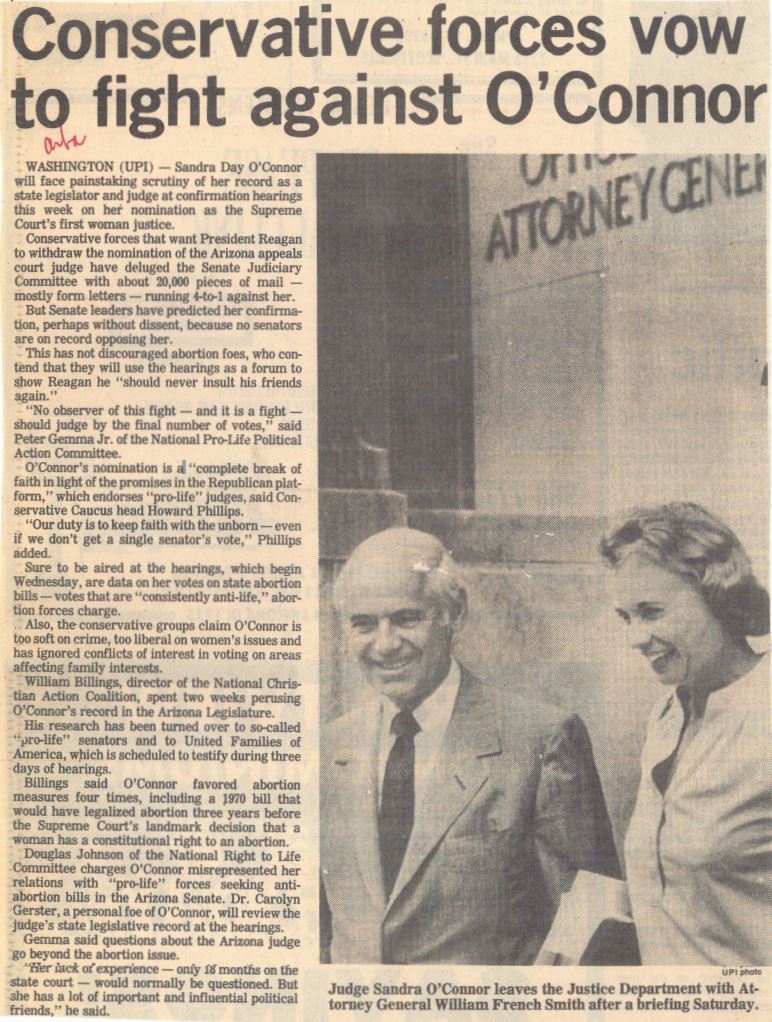
Anti-O’Connor Mail Heavy

An organized mail campaign is being conducted against Sandra O’Connor, who has been nominated by President Ronald Reagan for a seat on the U.S. Supreme Court. It is easy to spot because letters use the same phrases and often are mimeographed. Such campaigns are common, and this one is no different than others . It contains the usual mudslinging, distortion of facts, innuendoes and character assassination. Fortunately, O’Connor has been in the political arena for a long time, and she probably is paying little attention to the misguided and misinformed attacks. Having known O’Connor for many years, and having worked with her on civic and political projects, we are amused that attacks are coming from the far right. Her record shows that she is a member of Arizona’s conservative establishment, and she definitely is not a liberal. The worst smearing and distorting is coming from anti-abortionists. The truth is that she is not an advocate of abortion and took a middle ground as a state senator. It is probable that the nomination will be approved without serious opposition. In the process, members of the Senate should recognize that it is not judicially appropriate for a prospective justice to give opinions on issues which the court will have to decide. If O’Connor is forced to do this, she may have a conflict of interest when related cases come up. Narrow issues do not detennine judicial fitness. Rather, the Senate must weigh O’Connor’s knowledge of law, understanding of the Constitution