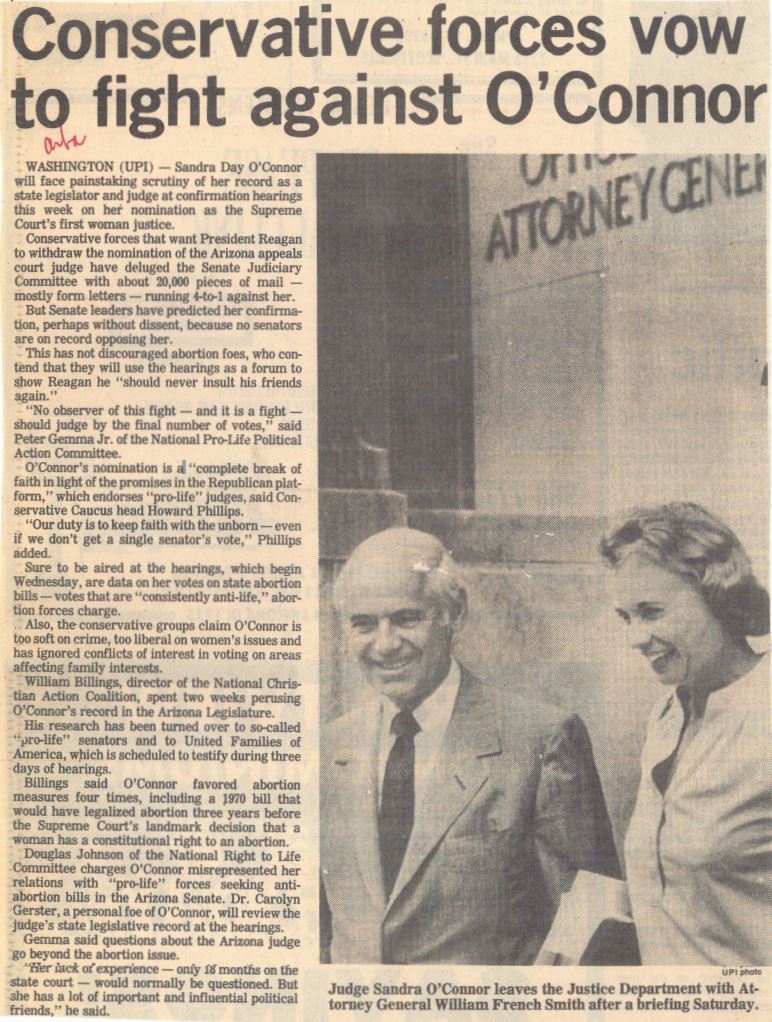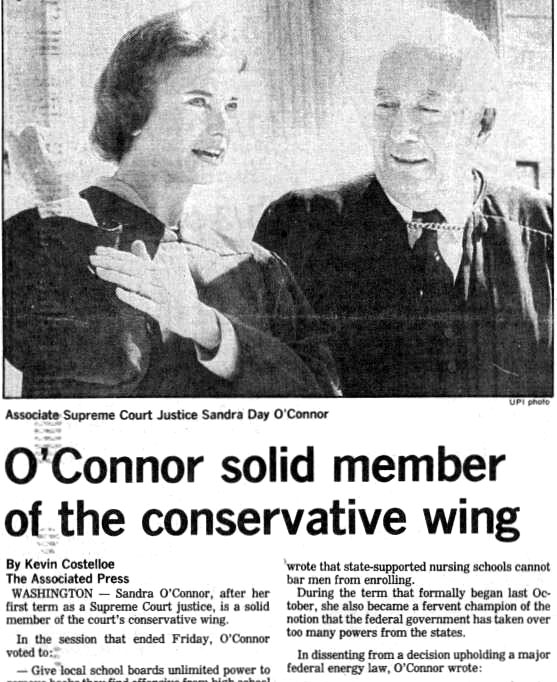
Newspaper mention, Scottsdale Daily Progress, The Kauffman-Henry Collection

Agents track bullet letter

PHOENIX (AP) – U.S. Postal inspectors and Secret Service agents are investigating the mailing this week of dozens of letters, most containing a bullet taped to a picture of President Reagan. A postal inspector in Phoenix, R.D. Kanoy, said the letters are almost identical to a batch sent out in July, allegedly by a Scottsdale man. They were addressed to several Phoenix judges, some U.S. congressmen, Sen. Dennis DeConcini, D-Ariz., and several newspapers, including the Scottsdale paily Progress. Mailing explosives is a federal crime, pwiishable by up to 20 years in prison and a $100,000 fine. The author of the latest letters listed a return address of a Tucson post office box and said they were from “Mr. A. Melvin McDonald,” officials said. McDonald is U.S. Attorney for Arizona. The Scottsdale man who allegedly sent similar letters did so in an apparant attempt to be readmitted to the Air Force after being discharged because of mental problems , Kanoy said. The latest three-page letters included a photocopied photo of Supreme Court Justice Sandra D. O’Connor appears to be dripping blood, The Tucson Citizen said. The words “Kill Ronald Reagan” were coming from her mouth. Blood also was shown dripping from a photo of Reagan, with a .22 caliber bullet taped to his chin.

Law review article

Abortion Politics: Writing for an Audience of One

ABORTION POLITICS: WRITING FOR AN AUDIENCE OF ONE

SUSAN R. ESTRICHt AND KATHLEEN M. SULLIVANtt

INTRODUCTION: WEBSTER AND THE ART OF SPIN CONTROL “Spin doctors,” as they came to be known in the last presidential

campaign, practice a not-so-fine art of press manipulation. The goal is generally to make bad news hurt less (e.g., “third in Iowa, my God, we’re delighted; it’s a springboard for New Hampshire!”) and good news help more (e.g., “the real test will be in… [pick state where you’ve already spent twice as much as the opposition]”). The press generally knows the doctors are working (“what’s your spin?” or “spin me” the reporters say), but the process works anyway, particu larly if the spinners can look appropriate in the end (e.g., “aides were plainly pleased with their candidates third place finish “).

Lawyers, of course, have been “spinning” judicial decisions for years. In court, it’s called advocacy. Rarely, though, has a court decision been “spun” as forcefully and effectively as the United States Supreme Court’s decision last Term in Webster v. Reproductive Health Services. 1 The spin was, surprisingly, the same on both sides. The right-to-lifers said victory was at hand. The pro-choicers said the sky was falling.

What was most surprising about this, at least at first glance, was that it bore almost no relation to what had actually been decided in Webster. Which was, according to all sides of the Court, at least, not much. As Justice Blackmun put it, “[£]or today,

Arizona Republic, Newspaper article, The Kauffman-Henry Collection

Abortion has become key political issue, Rev. Falwell says

LITILE ROCK, Ark. – The Rev. Jerry Falwell said Sunday he believes Moral Majority and other anti-abortion groups have made abortion a national issue that will become part of every election. In a few years, Falwell said that he hopes a candidate “couldn’t run for dogcatcher, much less president, without being pro-life.” Falwell was in Arkansas to preach in Vilonia at the home church of the state president of Moral Majority, the group Falwell founded. He conducted a news conference after his private twin-engine jet landed at the Little Rock airport. Falwell greeted about a dozen protesters who stood on the airport ramp carrying signs that read “So-called pro-life is anti-woman” and “ERA Yes; Reagan No.” “You don’t like Mr. Reagan?” Falwell asked the group. “He’s a nice guy.” The protesters retorted that Reagan opposed equal rights for women. But Falwell said Reagan, like himself, opposed only the Equal Rights Amendment “because he doesn’t believe in homosexual marriage or women in combat.” Falwell said abortion has become “th~ sensitive, priority issue in the nation” through the efforts of conservatives. He said evidence of this was the intense questioning of Supreme Court nominee Sandra Day O’Connor, who repeatedly was asked to explain her views on abortion during her Senate confirmation hearings last week. Although Falwell said Moral Majority had remained neutral on the O’Connor appointment, he indicated he was relieved by Judge O’Connor’s apparent conservatisn “Everybody

Arizona Republic, Newspaper mention, The Kauffman-Henry Collection

65% in survey back nominee; 6% are opposed

NEW YORK – By an overwhelming margin, Americans approve of President Reagan’s choice of Judge Sandra O’Connor to be the first female justice of the Supreme Court, an Associated Press-NBC News Poll says.

Republicans and Democrats, liberals and conservatives, those who support abortion and those who oppose it all approve of the choice of the Arizona Court of Appeals judge for the high court.

The major opposition to Judge O’Connor’s nomination has come from the leaders of conservative groups that oppose abortion and the Equal Rights Amendment. They say Judge O’Connor’s record in the Arizona Legislature shows she supports abortion on demand and the ERA. Nearly two-thirds of those questioned – 65 percent – said they approved of Reagan’s choice of Judge O’Connor to fill the vacancy on the nation’s highest court created by the retirement of former Justice Potter Stewart. Only 6 percent said they opposed the nomination.

Arizona Republic, Newspaper article, The Kauffman-Henry Collection

51-year-old jurist shows off family, is mum on issues

The spectators backed away to make a path in the crowded courtroom for a demure lady with a trademark pageboy haircut who had just become an immortal in American history . Ninety minutes earlier, Sandra Day O’Connor , a 51- year-old Arizona Court of Appeals judge, had become the first woman nominated to the U.S. Supreme Court. National and local press representatives squeezed microphones and bulky video equipment into Judge O’Connor ‘s courtroom for a hastily organized press conference on the nomination. Tears welled in the eyes of her oldest son, Scott as her family listened to minutes of applause after Judge O’Connor’s brief press statement. “If confirmed,” she said, “I will do my best to serve the court and this nation in a manner that will bring credit to the president , to my family and to all the people of this great nation.” The judge, who, before Tuesday, was obscure to most non-Arizonans , called the appointment “momentous.” In a televised announcement, Reagan said, “She is truly a person for all seasons, possessing those unique qualities of temperament, fairness, intellectual capacity and devotion to the public good which have characterized the 101 brethren (justices) who have preceded her.” Urging speedy bipartisan Senate confirmation , Reagan – said naming a Supreme Court justice is “the most awesome appointment ” within his powers. “Those who sit on the Supreme Court interpret the laws of our land and truly do leave their footprints on the sands of time, long after

Newspaper mention, The Kauffman-Henry Collection

25 most intriguing people of 1981

~ HOENIX (AP)-The nation’s first female U.S. Supreme Court Justice – Sandra O’Connor of Phoenix-and University of Arizona astronaut Bradford Smith are among “the 25 most intriguing people of 1981” as listed by People magazine. Smith, 50, said he was surprised by his inclusion. He is noted for his work with the university’s Lunar and Planetary Laboratory and with Jet Propulsion Laboratory in Pasadena, Calif., as head of the photo-imagery team for the Voyager spacecraft missions to Jupiter and Saturn.

Arizona Republic, Newspaper article, The Kauffman-Henry Collection

A Courtly discussion with Justice O’Connor

There was a fantastic outpouring of enthusiasm from people all over this country, from all walks of life and, surprisingly enough, even from people from other countries. It
was very touching to see that excitement.
It doesn’t take long for the steeliness to emerge from Supreme Court Justice Sandra Day O’Connor’s apparently gentle manner. As the conversation strays onto a subject she dislikes, she firmly chops it off.
“I don’ think that would be appropriate,” she says, and a taut smiles ensures that, suddenly, you don’t think it would be, either.
Arizona’s favorite daughter already is setting a precedent by granting an interview, not encouraged among Supreme Court justices. But she almost is bound to be a trend setter: the 102nd person appointed to the highest judicial branch of U.S. government, and its first female.
Justice O’Connor’s record after a year in office is characterized primarily by its conservatism. Apart from Chief Justice Warren Burger, the principal voice from the right is that of the court’s other Arizonan, Justice William Rehnquist. In 139 decisions, O’Connor has concurred with him 123 times.
But she also has joined the court liberals on some decisions, notable in cases concerned with sexual discrimination.
She has attracted comment with her apparent leaning toward state power vs federal power.
What caught her most by surprise during her first year was the volume of mail that greeted her.
“I was inundated with it in the early months here,” she said, “far more than I had anticipated.”

Newspaper article, The Kauffman-Henry Collection, The Washington Post

Abortion Vote Called Mistake by O’Connor

Supreme Court nominee Sandra D. O’Connor, facing her first day of confirmation hearing questioning, said she made a mistake 11 years ago when she voted in the Arizona legislature to decriminalize abortion. ‘ It was her one important concession, in a day filled with questions about abortion, to the conservatives who have challenged her nomination. But she declined repeatedly to go any further and say how she would rule on that or any other issue on the high court. She assured the Republican-dominated Senate Judiciary Committee, however, that she believes in a limited role for the federal judiciary in American life. “I do not believe it is the function of the judiciary to step in and change the law because the times have changed,” she said. “I do well understand the difference between legislating and judging. “As a judge,” she said, “it is not my function to develop public policy.” The opening of the O’Connor hearings, as senator after senator noted yesterday, was a historic event: the first time the Senate has ever considered a woman for the Supreme Court. Easy Senate confirmation is expected within the next three weeks. It was also the first time since her nomination that O’Connor has explained her record and her views publicly, though she began the hearings by telling the senators that it would be improper for her to be too specific in answer to questions about specific issues she might confront on the court. She did get specific about her actions as an Arizona state senator