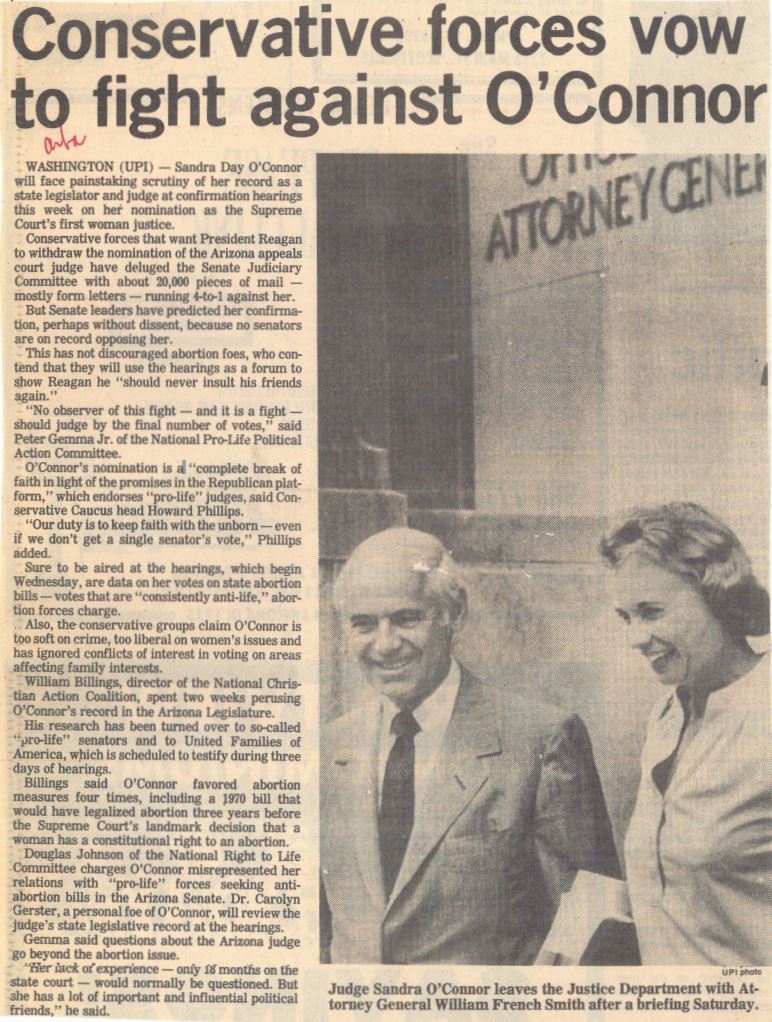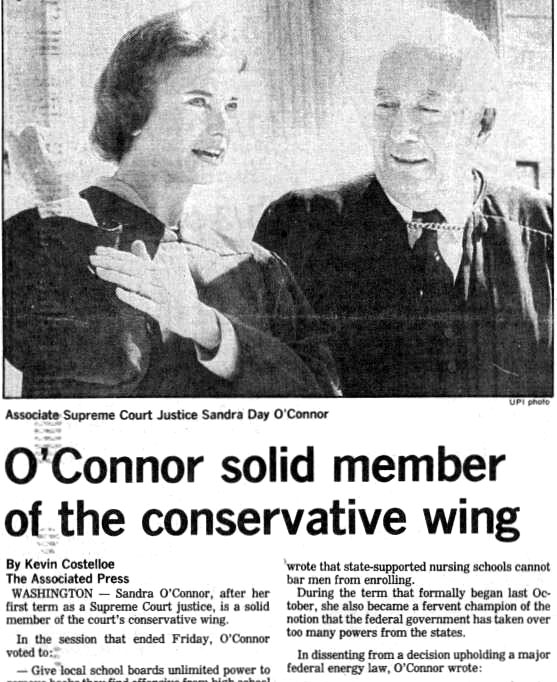
Arizona Daily Star, Newspaper article, The Kauffman-Henry Collection

Abortion foes ask O’Connor to quit

DALLAS (AP) – Anti-abortion leaders urged yesterday that Supreme Court nominee Sandra Day O’Connor remove herself from consideration or that President Reagan withdraw her name before Senate confirmation hearings begin next week. Nellie Gray of March for Life assailed O’Connor’s nomination at a news conference beginning a 12-hour rally by a coalition of conservative Christians. She called the upcoming confinnation process for the Arizona judge “fatally flawed.” Gray said if Reagan and O’Connor ignore her ~roup’s deman~s’. “The Senate should recognize its out~ as an adv1smg and consenting body to bring the important questions about the nomination before the hearings and to get the full facts before the Senate.” _About 200 people showed up at a Rally for Choice to counter the anti-abortionists . Pro-choice activist Bill Baird told the crowd that the Moral Majority ‘s attempt to block O’Connor’s nomination was “tyrannical.” Baird challenged the Moral Majority’s founder, the Rev. Jerry Falwell, to a debate at a “celebration of freedom” get-together later in the day. Falwell was here for the conservative gathenng. Convention center officials said about 1,200 P:DPle were at the afternoon anti-abortion rally, with 6,800 attending the main evening event. Religious Roundtable President Ed McAteer organizer of the anti-abortion rally, said: “Here i~ a woman who has dealt out the death penalty, yet the official anti-death penalty crowd and the ACLU praise the nomination, and only right -to-life

Newspaper mention, Scottsdale Daily Progress, The Kauffman-Henry Collection

Abortion foe backs O’Connor

PHOENIX (AP) – A conservative Republican legislator with a record as one of the most persistent sponsors of anti-abortion bills gave unqualified suppo rt Thursday to the nomination of Arizona Appeals Court Judge Sandra O’Connor to the U.S. Supreme Court. “Those who have attacked her have done more damage to the right-to-life cause than anybody else could do,” said Rep. Tony West, R-Phoenix. “I’m just furious about their attack on a woman who will be the best thing that ever r happened to the high court.” West’s attitude about abortions has not changed. He has sponsored countless proposals to ban abortions, including resolutions to put the prohibition in the U.S. ,Constitution.

Newspaper article, Scottsdale Daily Progress, The Kauffman-Henry Collection

Abortion dominates O’Connor hearing

O’Connor also parried, without providing a substantive answer, Denton’s solicitation for her views on the legality of discriminating against homosexuals. Arizona Gov. Bruce Babbitt, who appointed O’Connor to her current judicial post, endorsed her nomination. He told the committee she is a “splendid” example of “a new generation of state and local leaders .” Representatives from women’s rights groups and the American Bar Association, as well as Phoenix Mayor Margaret Hance, also were called to the witness table to urge approval of O’Connor’s nomination. But two physician witnesses, Carolyn Gerster of Phoenix and J.C. Wilkie of New York City, voiced their opposition based on the abortion issue. “I wish with all my heart that I could support the nomination of this fellow Arizonan,” said Gerster, a vice president of the National Right to Life Committee. But she said that O’Connor’s record as a member of the Arizona Senate is one “consistently supportive of legalized abortion.” Wilkie, president of the National Right to Life Committee, said that those people who do not recognize the constitutional rights of fetuses are “not qilalified to sit on the federal courts.” O’Connor spent most of Thursday establishing that she shares the views of many conservatives . But the committee has yet to find out – even though most of its members appear anxious to know – if she will be a truly conservative Supreme Court justice.

Newspaper mention, Scottsdale Daily Progress, The Kauffman-Henry Collection

A Black Tie Event

A black tie event honoring the new U.S. Supreme Court Justi ce Sandra O’Connor at the Heard Museum was highlighted by four paintings by Arizona artist Fritz Scholder. The ima ges in the series are a rose done in reds and purples, a simple white blossom edged in purples on a green background, a tulip in blues, yellows and grays, and a dahlia in white with green edges against an oxblood background. . . The series may be seen at Maril yn Butler Fme Art, 7157 E. Main St. , for the coming two montl-is .

Arizona Republic, Newspaper article, The Kauffman-Henry Collection

365 Days: ’81 brought moments of joy, anguish and humor to state

In Arizona, 1981 started with a bang. A few minutes after the year had begun, Gilbert Dixon, 35, was walking in an alley next to a UTotem convenience store at 602 N. First Ave. Into the alley came a car, with one of its two occupants firing a pistol into the air. “Happy New Year,” Dixon cried, and the man with the gun shot him in the leg. In a way, 1981 was a year that both justified Dixon’s optimism and reflected his fate. On the bright side, a warrior came home from captivity to a hero’s welcome, an Arizonan made history by becoming the first woman member of the U.S. Supreme Court, and a Mesa woman survived a drastic heart-lung transplant. On the dark side, two men were convicted of a brutal contract killing that occurred on the eve of the new year, a Tucson bank was the target of the largest bank robbery in the nation’s history, and a valley in southern Arizona crackled with tension as longtime residents clashed with gun-toting members of a religious cult. It also was a year for offbeat items – topped by the story of true belitJvtrs who planned to end the year in heaven but who had to Republic. settle for Arizona. An oddball entry was one of the first in line for the year. In January, Granvel Downing, a 40- year-old Phoenix construction worker, said he had received a $500 settlement in a lawsuit that he filed after finding a lizard in a bottle of Coke on Sept. 7, 1978. The defendants were the Phoenix Coca-Cola Bottling Co. and Circle K Corp. Downing’s lawyer said one of the

Newspaper article, Scottsdale Daily Progress, The Kauffman-Henry Collection

26 pro-life lawmakers support judge

PHOENIX (AP) – Sandra O’Connor, the first woman nominated to the U.S. Supreme Court, has the firm support of 26 Arizona legislators who have consistently voted for a constitutional convention in behall of a Right-to-Life amendment banning abortions. Several stand ready to go to Washington to testify for her. Rep. Pete Corpstein, R-Paradise Valley, said Monday that letters in her behall have been sent to U.S. Senate Judiciary Chairman J. Strom Thurmond, R-S.C.; Senate Majority Leader Howard Baker and Sens. Orrin Hatch, R-Utah, and Jesse Helms, R-N .C. “We’re doing this to lay to rest some of the unfounded rumors and innuendos about her stand on abortion,” Corpstein said. O’Connor has been attacked by national Right-to-Life and moral majority leaders for her voting record on abortion in the Arizona Senate, in which she served as majority leader in 1973-74. “I wish hall the people in the moral majority had hall the morality and christianity of O’Connor,” Corpstein said. Rep. Donna Carlson West, a Mesa Republican and leader of the anti-abortion and anti-Equal Rights Amendment movements in Arizona, also gave her unqualified support to O’Connor. “I’ve had a number of calls from around the country from people who claim she’s anti-religion, pro-gun control, proabortion and was keynote speaker at the International Women’s Conference,” said Carlson West. “None of that is true.”

Interview

Press conference after announcement of nomination to Supreme Court

Judge O’Connor Remarks
Good morning. This is a momentous day in my life and the life of my family and I’m extremely happy and honored to have been nominated by President Reagan for a position on the United States Supreme Court. If I am confirmed in the United States Senate I will do my best to serve the Court and this nation in a manner that will bring credit to the President, to my family and to all the people of this great nation.
Q. (Unintelligible.) A. We haven’t even thought about questions like that pending the confirmation hearing. Q. When did you find out President Reagan would nominate you? A. He called me yesterday afternoon, about 4 o’clock our time and spoke with me at that time.
Q. Had you considered you were a serious contender for the post? A. I assumed that I was because I was interviewed late last week in Washington. Q. By the President? A. Yes.
Q. What kind of questions did the President ask? A. I’m not at liberty to disclose the contents of the conversation and you can check with the White House on that. Q. How long did the conversation last? A. Not very long. I’d say no longer than 15 minutes.
Q. Did you speak with Senator Goldwater, Senator DeConcini, Congressman Rhodes? Have they had the opportunity to speak to you this morning?
A. Not yet. Senator DeConcini’s office got through, but my line has been very busy this morning. I think it’s been hard for people to get through. Position of Congressmen
Q. Has our state’s Congressional delegation been unanimous

Speech

Speech to American Bar Association

Host
Ladies and gentlemen, the conference. we’re privileged this morning to be graced by the presence of Justice Sandra Day O’Connor, who, through her graciousness, has agreed to participate and be with us in this our work today.
Justice O’Connor, having been born in Texas, and educated in California, finally decided to settle them, Arizona or she built an outstanding body of work in public service service to her community. She was an assistant attorney general of Arizona in the late 60s before serving on the State Senate, or eventually she became the Minority Leader of the Senate. In 1975, she left the state senator of Arizona, one election to the Maricopa County Superior Court soon elevated to the Court of Appeals in 1975 and served there until 1981. On July 7, that year, President Reagan nominated Justice O’Connor to the Supreme Court. She took her oath of office on September 25 of that year. And for more about this remarkable person. I command to your attention justice economist VI, which appears in the material for the conference. That way, 13 years since her elevation to the nation’s highest court, she has distinguished herself as a jurist, as we all know. Her superb judge and superb mind have been the hallmarks of our service, to the bar, to the profession, and to our country. Ladies and gentlemen, I asked you to join with me in welcoming Justice Sandra Day O’Connor O’Connor, Associate Justice, the Supreme Court of the United States.

Sandra Day O’Connor
Thank you.

Op ed

“To defend Anwar is to defend Malaysian democracy”

We know Anwar Ibrahim well and have the highest regard for him. For that reason, we are very concerned about recent developments in Malaysia that seem aimed at defaming him and threatening him with imprisonment in a manner reminiscent of the campaign to defame him in 1998.

The power to prosecute is one of the most awesome powers of the state. Without proper checks and balances it can easily be abused by those in power to humiliate and discredit innocent people. Even when the injustice is corrected, its victims are often left with their reputations permanently damaged. In Malaysia, the power to prosecute is being used to try to discredit Mr Anwar, the remarkable leader of the opposition, victim of a similar attack 10 years ago. If this effort were to succeed it would be a tragedy for Mr Anwar personally, for the people of Malaysia and for the world.

In 1974 Mr Anwar was jailed for 20 months, under Malaysia’s notorious internal security act, for leading demonstrations against rural poverty. Invited later to join the government, he rose to become Malaysia’s finance minister in 1991. His performance was recognised internationally. As deputy prime minister he was admired for his commitment to accountability and good governance. Many Malaysians wanted him to replace Mahathir Mohamad, the aging prime minister.

Poised to lead the nation towards greater transparency and the rule of law, his agenda for reform was clearly perceived as a threat by some. In 1998, as he was on the brink

Op ed

“The Threat to Judicial Independence”

In November, South Dakotans will vote on a state constitutional amendment being advocated by a national group called “JAIL 4 Judges.” If the amendment passes, it would eliminate judicial immunity, and enable a special grand jury to censure judges for their official legal determinations. Although the amendment’s supporters claim they seek a “judicial accountability initiative law” (JAIL), they aspire to something far more sinister — judicial intimidation. Indeed, the national Web site of JAIL 4 Judges boasts with striking candor that the organization “has that intimidation factor flowing through the judicial system.”

It is tempting to dismiss this proposed amendment as merely an isolated bout of anti-judge angst. But while the JAIL 4 Judges initiative is unusually venomous, it is far from alone in expressing skepticism of the judiciary. In addition to South Dakota, this election cycle has witnessed efforts in at least three other states that are designed to rein in judges who have supposedly “run amok.”

Not to be completely outdone, Congress also has engaged in recent efforts to police the judiciary. Seeking to constrain the legal sources that are available to judges, some members of Congress have advocated measures that would forbid judges from citing foreign law when they are interpreting the Constitution. In addition, bills have been introduced in both houses of Congress supporting the creation of an inspector general to investigate and monitor the federal bench. Finally,