Interview, TV appearance

Interview on PBS NewsHour

GWEN IFILL:

The book is Lazy B: Growing up on a Cattle Ranch in the American Southwest. The author is Supreme Court Justice Sandra Day O’Connor. Justice O’Connor, of course, was the first woman appointed to sit on the Supreme Court. But long before she got to Washington, she lived a life we read about only in westerns. In Lazy B, she joins her brother, Alan, in recalling their memories of those times. Welcome, Justice O’Connor.

SANDRA DAY O’CONNOR, Author, Lazy B:

Thank you. Well, it is a joint effort with my brother, Alan. And Alan ended up running the ranch for most of his adult years. And so he had lots of institutional memories of that amazing place.

GWEN IFILL:

Well, tell us about the ranch, for those of us easterners or those of us who aren’t native to the Arizona-New Mexico border.

SANDRA DAY O’CONNOR:

Well, it’s… It’s in the semi-arid high desert plateau region on the New Mexico-Arizona border, along the Gila River. And it gets very little rainfall a year, about ten inches a year — about 5,000 feet in elevation, other than the higher mountains to the South. And it’s just… It has a subtle beauty that the desert can have. But it’s maybe difficult for someone in the Northeast who’s used to seeing greenery all the time to appreciate that desert scene.

GWEN IFILL:

What was unique about growing up on a ranch like that?

SANDRA DAY O’CONNOR:

We were isolated. We had no neighbors, really. It was 35 miles to town. We would go to town once a week to get the

Interview

Interview with NPR journalist Cokie Roberts

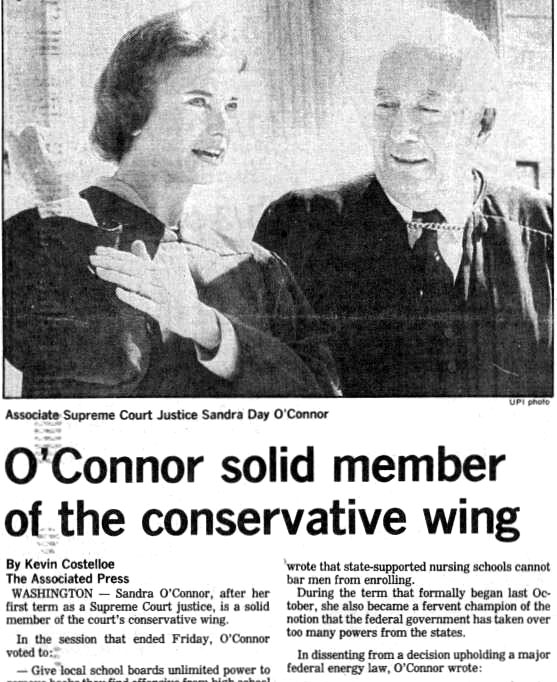
Cokie Roberts O’Connor became the first woman to sit on the bench of the United States Supreme Court making women’s history and becoming a role model to millions of women and girls. So Justice O’Connor is no longer on the Supreme Court. She’s still keeping very busy. I recently spoke with her about what she’s doing now, as well as what it’s like to be a pioneer. Just a sec honor for us ladies of a certain age who were so excited when you were nominated for the court. It is impossible to believe that it’s 30 years ago, it’s been a long time. Can you tell us the story? What was it like when you found out? Sandra Day O’Connor Well, it was a shock. I mean, who would think for a moment that some cowgirl from southeast Arizona would be asked to serve on the Supreme Court? It was a shock. Cokie Roberts That’s how you see yourself? a cowgirl. That’s what Sandra Day O’Connor it was. I mean, I had a little education along the way. So I hope I learned something in the process. But I never expected to be asked to serve on the Supreme Court. I was very honored. I wasn’t sure I should do it. I had never argued a case the court I had not been a law clerk of the court. Did the President himself call you? He did. My phone rang, and it was ronald reagan on the phone. And he said, Sandra, I’d like to announce your nomination for the court tomorrow. And frankly, my heart sank. Really? Yes. It really did. Because I was not at all sure that I could do the job well enough. I didn’t know if I could.

Panel discussion

Discussion on the state and federal judiciary systems with the National Association of Women Judges

Susan Herman
Let me say to start that I cannot claim to be a non woman, but I certainly can claim to not be a judge. And I’m looking at the three pictures in the program. I thought, well, you know, law professor takes you pretty far when you’re the front of a classroom. But yeah, I was feeling said about ranked until my daughter said to me, Mom, for tonight you can outrank anyone, you’re Oprah.

Judith Kaye So I let’s talk

Susan Herman
I guess we’ve all been around court circles long enough to know that you never get to start by talking to the judges on the highest court first. So I would like to ask judge Kaye to start us off our reminiscences by reminiscing, your husband referred to your decision to go to law school. Would you like to share some of how you went into the law and why you decided on that?

Judith Kaye
May I say, first, that I think the evidence is incontrovertible that I married very well. Excellent. And indeed, I I never, never for a moment growing up, wanted to be a lawyer. In fact, I did grow up as you’ve heard so much about me already in a small community. I think there was one woman lawyer there once but I never saw her. Talk about private people. So being a lawyer was not something I ever saw or aspire to infect. What I aspire to was a career in journalism. I sort of saw myself as critic of the decision makers. That was what I yearn to be. But it was impossible to find work back in the year 1958 when I graduated, just like you from Barnard

Interview, Panel discussion

Discussion at the Ninth Circuit Court of Appeals Judicial Conference

Host Ladies and gentlemen, please take your seats. Ladies and gentlemen, will you please take your seats as we’re ready to begin the last segment of the program today. Thank you. Welcome to what has become a highlight of the Ninth Circuit Judicial Conference. And that’s our conversation with Justice O’Connor. Now based on what we heard from the last panel, the internet panel, I’m thinking that perhaps we can protect this segment of the program under a Judicial Conference methods patent, but we will leave that maybe for the Federal Circuit. Our panel this morning includes Chief Judge [Terry] Hatter from the Central District of California, Peter Benvenutti partner from San Francisco firm of Heller Ehrman and Professor Kathleen Sullivan, Dean of Stanford Law School. Although we are listed in the program as interviewers, I think that’s somewhat of a misnomer, because we don’t really intend to interview Justice O’Connor. The Sandra Day O’Connor that’s news to me. Host But you’re not off the hook because we will ask you some questions. We just won’t call them interviews. Courts last term certainly was an interesting one. And the cases resonated, I think, not only with judges and lawyers, but with the public at large. They dealt with everything from the Boy Scouts in the First Amendment, tobacco, the Violence Against Women in Act. Two, of course, Miranda warnings. Some of the legal commentators and pundits of which you know, there are many have called it a blockbuster term. I’m not

Interview, TV appearance

CNN interview with Wolf Blitzer

Wolf Blitzer Let’s look back a little bit, some history. Bush v. Gore. You remember that case? Oh, I remember that. What are you looking back? You know, we have some time to look back, what, nine years now? Was that the right decision? Sandra Day O’Connor I don’t know, it was a hard decision to make. But I do know this. There were at least three separate recounts of the votes, the balance in the four counties where it was challenged. In not one of the recounts with the decision has changed. So I don’t worry about Wolf Blitzer it. So you know, regrets this decision. So when you have changed anything, the right man wasn’t elected president, the man Sandra Day O’Connor who got the most votes. That’s the that’s the that’s, that’s that’s the what it comes down to at the end of the day. Wolf Blitzer I guess what some people have been concerned about on the current Supreme Court, this four to four split with Justice Kennedy being the swing voter, however, is that to have a divided court, sensitive vicious, Sandra Day O’Connor when I was nominated and went on the court in 1981, when I arrived, a large number of the cases, were coming around four to four. Indeed, the very first time that I sat in the Justice conference room to talk about the merits of cases argued that week, and for each justice to say how it should be decided. I was the junior justice. So I was the last to speak. And the very first case came to me for to four. So it’s not a new problem. Wolf Blitzer I can’t tell

Op ed

“Celebrate America by learning about her”

By Sandra Day O’Connor and George Nethercutt Jr.

Pop quiz: How many people signed the Declaration of Independence? (Answer: 56)

According to numerous studies conducted by the Pew Research Center, Intercollegiate Studies Institute and the National Assessment of Educational Progress, among others, there is a serious lack of knowledge among Americans when it comes to the important events that have shaped our nation’s history and heritage.

One study showed that only about 35% of Americans can name all three branches of the federal government, let alone state what they do. More evidence may be found simply by watching the “Jaywalking” segment of The Tonight Show With Jay Leno, which reveals glaring examples of the lack of basic civic literacy of those interviewed.

Today, cultural movements within the United States continue to undermine our reverence for the founding documents, taking a swipe at all that has come before our modern culture. A June 9 news report chronicled the story of one Virginia publishing company putting warning labels on such iconic documents as the Declaration of Independence, the U.S. Constitution and the Federalist Papers, foolishly asserting that they do not represent “modern thought” or adequately take into account social issues on which the United States has evolved since our country’s beginnings. It’s time America got back to basics.

Our common journey

Our legal system is just one example. Fundamental to our system of government is an appreciation for

Newspaper article, Op ed

“A Democracy Without Civics?”

When asked, a third of eighth-graders didn’t know the significance of the Declaration of Independence.

September 18, 2008

By Sandra Day O’Connor Lee H. Hamilton

Washington

September 17 marked the 221st anniversary of the signing of the Constitution. Students across the country spent a few minutes of their day learning about the remarkable work of our nation’s founders.

This is nice, but America’s schools should be doing a much more thorough job of honoring the civic mission that was the reason for their founding.

Benjamin Rush, a signer of the Declaration of Independence and one of the first advocates for public education in America, argued forcefully that schools play a crucial role in preparing the citizens of a democracy. “There is but one method of rendering a republican form of government durable,” he wrote, “and that is by disseminating the seeds of virtue and knowledge through education.”

With young people voting at higher rates than ever before, it might seem that the founders would be pleased with our progress. Yet civic engagement requires more than voting in presidential elections every four years. A healthy democracy demands sustained citizen participation, and our schools must give students the knowledge and tools to participate.

Sadly, civic education has been in steady decline over the past generation, as high-stakes testing and an emphasis on literacy and math dominate school reforms. Too many young people today do not understand how our political system

Speech

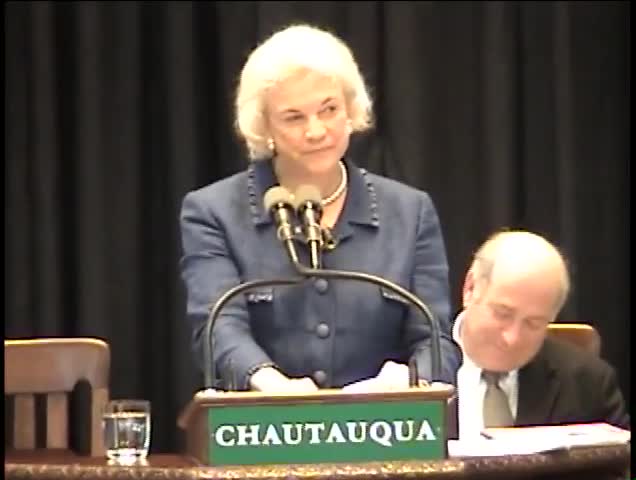
Speech at the Chautaqua Institution

Sandra Day O’Connor
Thank you, Tom. And what a pleasure it is to be back here at Chautaqua. This such a special place, tucked under Lake Erie and along our border with Canada. The United States has only two next-door neighbors, Canada, and Mexico. I lived most of my life closer to the Mexican side of our border. I was born in El Paso, Texas and grew up on a ranch. And it was mostly in Arizona, and partly in New Mexico. And it’s a far cry from the shores of Lake Erie and Lake Chautaqua to that dry, semi-arid desert where I spent my early years.

When I first moved from Arizona to Washington, DC, John and I lived in an apartment in the Watergate that was kindly secured for us by my colleague Justice Lewis Powell as a temporary residence. We could look out our window, a view of a splendid statue of President Benito Juarez of Mexico, the former president. It’s inscribed with his words, “Respect for the rights of others is peace.” President Juarez has a place in Mexico’s pantheon of heroes, just as President Abraham Lincoln has in ours.

I thought of these two men as I reviewed one of the themes you’ve been considering this week, that human progress and human violence have been linked historical forces. In the 1860s, both these leaders, Juarez and Lincoln, led their countries out of violence and deadly conflict. Mexico faced a threat from outside in the form of the French intervention led by Napoleon [III]. The United States faced a threat from within. Now, having led their young

Op ed, The Kauffman-Henry Collection

Courtesy Calls

Seemingly polite practice by presidential nominees is really sabotage of Senate’s checks and balance

WASHINGTON – They are graciously termed ”courtesy calls,” but the practice of Presidential nominees’ private visits with Senators before confirmation hearings corrupts the constitutional requirement that the Senate provide advice and consent on Presidential appointments.

The practice, dating perhaps to the late 1960’s, is also degrading to nominees who may be pressured in a private conversation to discuss subjects that are, from the standpoint of the public interest, better dealt with in open hearings.
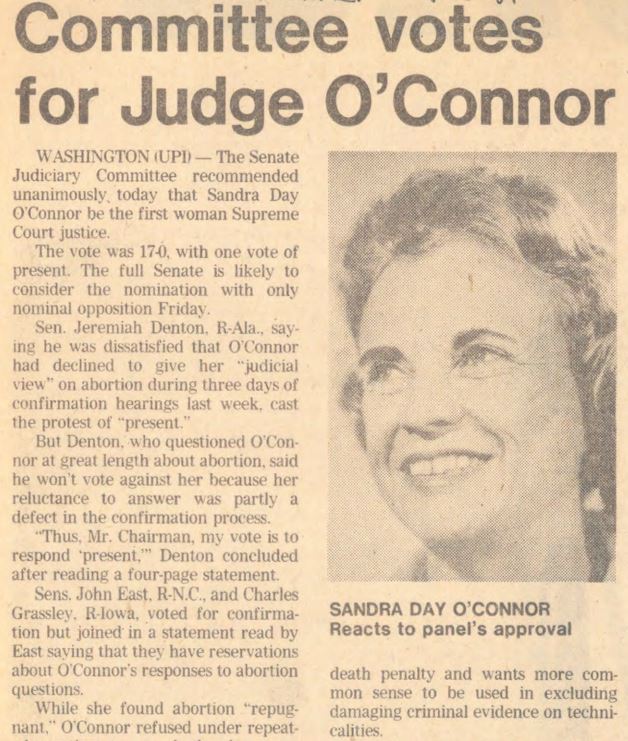
One newspaper reported on July 17 that ”the third day of Sandra O’Connor’s round of Congressional courtesy calls was capped by a session with conservative Senator Jesse Helms.” The public and other Senators do not know what President Reagan’s nominee to the United States Supreme Court said to Mr. Helms nor what Mr. Helms said to her.

Let it be writ large: I am not objecting to the nomination of Mrs. O’Connor. Rather, my objection is to the now common practice by which nominees request courtesy calls on Senators, who find it ungracious not to accept.

It is possible that these calls are purely social. On the other hand, there is nothing to prevent a Senator from doing what comes naturally – asking an ambassadorial nominee, for example, to look carefully into a problem that some constituent may have in the country to which the ambassador is going.

And there is nothing to prevent