Speech

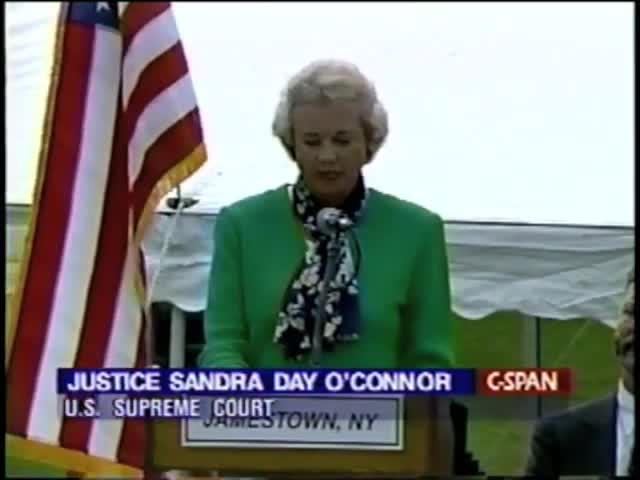
Speech at groundbreaking ceremony for New York University Law School’s new building

Unknown Speaker Justice Sandra Day O’Connor is next. She recently spoke at the groundbreaking ceremony of New York University Law Schools new building in Manhattan. She reflected on the American spirit after seeing the ruins of the World Trade Center. Unknown Speaker When we scheduled this event, there was only one person our community wanted to deliver the principal address. Remember the faculty lunch at which she spoke to us that stimulated the idea for a conference that just the other day as we celebrated the success of the global law school initiative, was referred to as the seminal intellectual event of that program, now widely recognized as having transformed all of legal education, not just this law school. But Justice Sandra Day O’Connor didn’t just do that one act of beneficence to this school. She has been an integral part of this law school community at every turn. She has visited our campus during my time as Dean, this is now I think, her seventh time. And every time she comes, she meets with faculty as she will today. She meets with students as she will today. And she enhances our world. But equally, she’s been there as counselor and advisor throughout the evolution of this law school. There is no one outside of the immediate law school community, who is a great friend to this law school, and Justice Sandra Day O’Connor. And I’m delighted to introduce her to you today. Justice O’Connor. Unknown Speaker Thank you. Thank you. Thank you. Thank you. Unknown Speaker

Panel discussion

Roundtable discussion on Native American legal issues at National Judicial College

Host What you’ve seen in the last three days? What are your impressions? Sandra Day O’Connor I guess we’d both like to share some thoughts on what the impressions are. And it was a short trip. So I’m sure that what we saw is only a fraction of what’s available to see. And I would not think that we gained an insurer knowledge about anything, but we did have some impressions. And the first thing my I noted is that nothing in Indian country is said briefly. And the second thing is that if you’re going to visit Indian country, you have to be prepared to eat heartily. And I noticed I have to confess a general unhappiness with some recent Supreme Court jurisprudence in the area of Indian law. I think that was clear. We also saw a tribal court system in a small tribe setting in the Spokane tribe, and a tribal court system in a very large setting in the Navajo Nation. And the tribal courts that we saw small and large, were functioning and functioning very well. The Navajo court is suffering from a horrendous caseload. Well over 70,000 cases annually And 14 trial court judges now how can you have the left and the facilities in Window Rock, which is probably the best facility? We’re limited. So here are judges in need of some additional judges and some enhanced facilities. I think, nevertheless, we met some wonderful judges in, in both tribal court systems that we saw, and people who cared and are determined to function well, and it was very impressive to see that. And we saw some real

Speech

Speech at General Services Administration award ceremony for architects of federal buildings

Sandra Day O’Connor Thank you so much, Mr. Anderson. And Acting Deputy Administrator bib and Mr. Kiss Delaney and my friend Bill IV. Now, they’ve already said everything I was going to say to you. So I’m a little bit of trouble. You know, there are about 370 federal courthouses in the United States. And there have been, as I count them, about 60 funding requests for new federal courthouse construction, actually approved by Congress in the brief period from 1986 to 2001. That’s a lot of courthouses, when you think they’re only 370 to begin with. And those funding requests total, by my calculation, about 501 million or half a billion dollars. Each of these projects has required architectural engineering, design, and other construction expertise, expertise of all kinds, which will be recognized today. I don’t know about you, I’m not talking to the architects now, because you probably already think this. But I place a very high value on architectural services. I care about my surroundings, whether it’s my home, or where I work, I feel better, and I work better. If I’m in a place that I think is handsome, and that I enjoy, it makes a real difference to me. I suspect it makes a real difference to everybody. And I think that good design matters in courthouses and elsewhere. It must, of course, accommodate the basic functional needs of the structure in a courthouse, that means court rooms. And I have to say they’re pretty know by and large these days, maybe you can figure out something

Speech

Remarks at the American Bar Association’s Woman Lawyer of the Year award ceremony

Sandra Day O’Connor Thank you. Thank you. Thank you. Thank you. Thank you. Thank Thanks. Thank you so much. What a special day this is for all of your honorees and how happy I am to be in the company today with such a remarkable group of women honorees, I can’t imagine a better group and I have sat today fascinated with every single one of them and everything they had to say. I’ve heard how special this event always is. And I’ve not been able to attend all these luncheons, but I think I’m gonna have to come back because I grew up as a cowgirl in the southwest. And I learned out there that the only thing that mattered was whether you could lend a hand and do it well. It didn’t matter whether you were black, white, or brown, male or female, young or old, you’re just had to do your job. And it was a place where everything around you could hurt you. If you didn’t watch out. You could run into a rattlesnake. You shook your shoes out to get rid of the scorpions. Every time you fell off your horse, you were in danger of falling into a cactus. I mean everything out there could bite, prick, tear, cut, or whatever it was. And all I ever wanted to be was a cattle rancher. That was all I knew. My grandparents had done the same, and my family. And it’s been a long road from that dry, barren Southwest cattle ranch, to the marble courtroom, where I often find myself sitting today. It’s been a very long and often a very hard road for women lawyers, since Margaret brand became the first woman

Panel discussion

Panel discussion on U.S. and European Courts at Yeshiva University Cardozo School of Law

Sandra Day O’Connor Thank you very much all. We’re not going to take much time now because we want to leave time for discussion. But I wanted to say how much it means to those of us in the United States that members of the European Union’s Court of Justice were willing to take the time in their break to visit this country to come to New York and visit us in Washington DC starting Tuesday and Wednesday, and then to have a state court experience when they conclude their visit in the state of Texas. And we had those of us in the United States learned a great deal from our visit to the European union summer before last. It was invaluable to those of us who were privileged to make that journey. And we’re just so delighted that you Paul and Judah and john Sexton and the others who have participated in making this visit begins so well in the city of New York. Thank you. And I think my colleague Justice Breyer has a word in French.

Sandra Day O’Connor It’s rather interesting because the concept of proportionality, as you described it, which you apply in looking at actions of the member states, resonates for us with the kind of language we use and applying strict scrutiny for an action, or eight that might be said to infringe some fundamental individual liberty in this country. That’s the same kind of inquiry we make. Whether it’s the least restrictive means whether it was necessary to achieve the objective, how important the objective was. These are the kinds of things we look

Speech

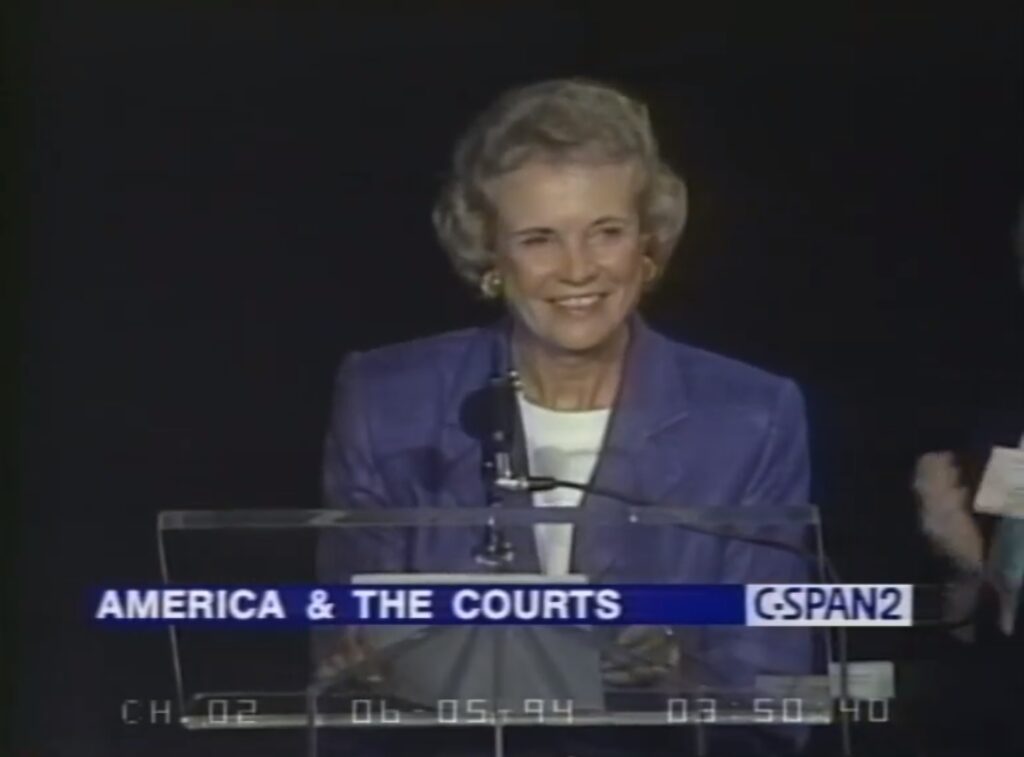
Speech at dedication of new building for University of Oregon Law School

Unknown Speaker I hope you all have a wonderful afternoon the meeting is adjourned. And Unknown Speaker you’re watching c spans America and the courts. Next associate Supreme Court Justice Sandra Day O’Connor helps dedicated new building at the University of Oregon law school and Eugene defense about 25 minutes. Unknown Speaker It is rare that a speaker so perfectly fits the occasion, as does our speaker in this dedication. As we dedicate to Wm W. Night Law Center, we do so building on a legacy of qualities that we aim to carry into the future. qualities that have served our state so well, and qualities that will continue we hope to do so. There are many but I think particularly of three that are most applicable today, a pioneering session spirit of boldness in thought and action, and a wisdom that is deep and lasting in its vision. Since our beginnings as Law School of the West, the University of Oregon School of Law has worked hard to be at the forefront of legal needs and new areas of practice, not content simply to follow, we have aim to lead and to prepare legal practitioners to do the same. Along with this pioneering leadership, we’ve encouraged the boldness of thought and action, and ability to move beyond the ordinary two ways and means of achievements not yet considered, let alone practice. This has been a Center for Public Service and law reform. And we’ve encouraged and nurtured a worldview that sees beyond letters to the words beyond words to the entire text, beyond

Speech

Remarks to National Center for State Courts on public trust and confidence in the justice system

Unknown Speaker Sandra Day O’Connor Thank you very much, Chief Justice Lackett of my home state Supreme Court, Chief Justice Veasey of Delaware with whom I had the privilege of being with back in November when I went to Delaware for an event of the state bar there. And all of the chief justices, justices, judges, great Americans and others here at this conference today, I’m so glad to be with you. But I’m also very nervous because I haven’t been able to attend your conference. And I told Tom’s Lakha that I thought I had a lot of nerve to come here and talk to you on your last day when I didn’t know what you would been talking about. And I hope you will Give me because I haven’t been privileged to be part of your conversations and I surely wish I had, because there’s a lot I could learn. And I’ve been a little bit out of touch with things in the state court systems lately, as you might have noticed. So I think those of you here are in tune with what’s going on much more than I am. I work in a building which bears a marble inscription over the entrance that says equal justice under the under law. The subject of this conference shows an admirable awareness of the importance of public trust as a dimension of equal justice. This is the first national conference on this subject, and it’s very impressive that so many state Chief Justices and state court administrators are here. Also impressive is the hosting array of National Court organizations, the American Bar Association, state

Speech

Remarks at the awards ceremony for the national finalists of the Center for Civic Education’s We the People program

Sandra Day O’Connor This is the most impressive group all assembled to work and think and celebrate the Constitution. And I’m really pleased to have a chance to stay at say a few words to you tonight about justice, which is a very elusive concept. And it’s been the subject of human aspiration throughout the history of the human race. 1998 marks the 200 and eighth anniversary of the adoption of the Bill of Rights. Our Bill of Rights comes closest to our American notion of personal freedom and justice. And my appreciation for the Bill of Rights. It’s understandable because I spend a significant portion of my life working life thinking, arguing and writing about what it allows the government to do and what it does not allow. And yet after 17 years as a Supreme Court justice, I’m still awed by that document adopted 208 years ago. It’s as vital and timely today as it’s ever been. And I want to talk just a little bit about the history of the Bill of Rights, how it came to exist, and how our perspective on it has evolved. It was June of 1789 when James Madison stood up in the House of Representatives, and gave the speech in which he set out his first draft of what would eventually become the Bill of Rights. What prompted him to do that? History tells us that the Bill of Rights was not an accident. It represented the culmination of a long standing struggle between two groups. Trying to find the proper balance between the rights of individuals and states and the need for a strong central
Speech

Introduction to a speech on the life of President and Chief Justice William Howard Taft

Unknown Speaker Society. Professor post lecture runs for an hour and 15 minutes and followed production by Justice Sandra Day O’Connor Sandra Day O’Connor am so pleased that the Supreme Court has or Historical Society is sponsoring this series of lectures on former chief justices. Now I have a special interest, of course, justices, but I think everybody should. And what really pleases me is that the lectures are held in this court room, and especially tonight going to hear about Chief Justice William Howard Taft. I mean, what better for us to hear about Taft, he was the person that thought Supreme Court should have a home of its own, instead of meeting in the basement in that Burt over in the capital that most of you have visited and he thought we had Court and a building of our own. And it had been talked about day but never approved, and Taft as the only person to ever President of the United States and later as Chief Justice, still have some clout politically with the Congress. He persuaded Congress to appropriate money for this building. And Taff did more than that he hired the architect for it, Cass Gilbert, and he was influential in forming the design and getting it carried out. I think we have one of the most wonderful buildings in all country, inspired every single day when I walk in here, and so it is special that we’re in this court room that Taft helped make possible to here at this lecture. I think there have been two chief justices who really deep About judicial

Speech

Speech to American Bar Association Annual Convention on efforts to assist emerging democracies in central and eastern Europe

Unknown Speaker Well, I always thought I was the perfect person to introduce Justice O’Connor, because although it might not be obvious, if you look at our resume side by side, she and I do share two very important qualities. First, we are both women of the Southwest. Secondly, we have the most marvelous patient husbands on the face of the planet. Unknown Speaker But the other reason, Justice O’Connor that I assumed that I was given the honor of introducing you today is that although you don’t know it, you look over my shoulder every single day at work. One of the pleasures of being a president of the American Bar Association is that you meet magnificent people from all over the world. And very often you have your photographs taken with them. I’ve even had my photograph taken with Mickey Mouse. But I have only one picture of a famous person in my office. And it isn’t with me. It’s looking at me right above my desk, behind my chair. When I come into my office and Albuquerque every morning and turn on the lights and pull up the blinds. Justice O’Connor is looking right at me with her very direct gaze, that Brooks no dilly dallying, and says to me every day, I expect you to do more than your best because your best isn’t quite good enough. I know that you will hear this afternoon when Justice O’Connor receives the ABA medal about her magnificent contribution to American jurisprudence. And introducing her today. To all of you who care so deeply about the cause of democracy around