Speech

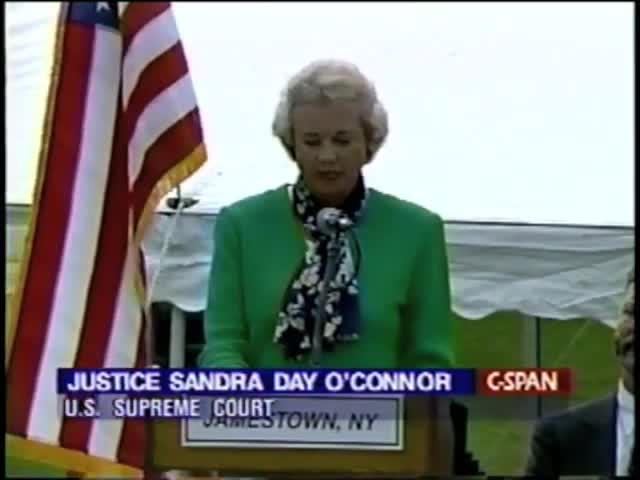
Speech at dedication of statue to the memory of Justice Robert H. Jackson

Sandra Day O’Connor This is a wonderful occasion for Jamestown and for all of us who are lucky enough to be here and see the unveiling of this absolutely handsome and strong statue of Justice Jackson. We’re remembering today a product of this community and of its public schools. The most treasured honor that anyone can receive is one that comes from one’s own town, from those who knew the honorary first and best, so it is today, Robert Jackson, one of the finest justices ever to sit on the bench of the United States Supreme Court, grew up on a farm close to Jamestown. It was here that he attended the Jamestown elementary and high school that he married, had his children and practice law. It was here that he spoke in 1935. At the dedication of the new Jamestown high school building, he said them. If you believe as I believe that democracy is the form of government best adapted to our people, then you must regard the public school as the most fundamental concern of our society. Democracy well. Democracy will always call most of its leaders from the ranks of humble man, and to equip them It must provide free education to the sons and daughters of disadvantaged homes. Robert Jackson was born as you heard in 1892, I thought it was in Pennsylvania, not New York. Early in his life, the family did move to a farm in this area. His father was a farmer, a lumber man and a stock breeder. He advised his son Robert to become a doctor. Instead, on graduating from Jamestown High School, Jackson
Law review article, Speech

Religious Freedom: America’s Quest for Principles

It is an honour and a great pleasure to be standing here today in Belfast to deliver the MacDermott Lecture. In the inaugural lecture in 1972, Lord MacDermott suggested that the lectures be used to examine “our principal legal concepts” insofar as they impact on the “progress and happiness” of our communities. 1 My topic today is one that is central to the harmony and happiness of pluralistic western democracies, and one that, in very different forms, is a recurring concern in both Northern Ireland and America: religious freedom.

I shall focus on that with which I have some experience: the jurisprudence of the First Amendment to the US Constitution. In doing so, I make no pretence that American solutions can be imported lock, stock and barrel into other nations with quite different cultures, traditi_ons, and diverse religious groups. And I certainly do not claim to have a solution for this country’s problems of sectarian rivalry and conflict. But an American illustration of some key general features of a regime of religious freedom may, perhaps, stimulate thought and dialogue about what should be a goal shared by diverse religious and non-religious groups.

• • • • •

There is, as Justice Holmes once icily remarked, something “perfectly logical” about attempting to use the power of government to promote and impose upon others one’s own opinions. As Holmes explained, “if you have no doubt of your premises or your power and want a certain result with all your heart you naturally

Speech

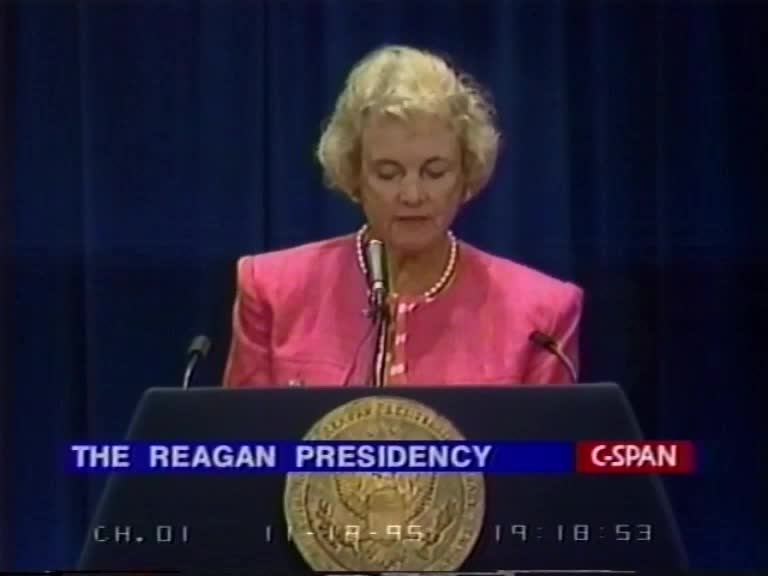
Speech to the Republican Governors Association on the impact of the Reagan presidency on the federal judiciary

Sandra Day O’Connor
Thank you. Thank you. Thank you.

Sandra Day O’Connor
Now, please sit. It’s too hot to stand up. This is the first time that john and i have been privileged to visit the Ronald Reagan Presidential Library. And it’s such a treat to be here today and to see this wonderful spot, the building and a bit of the program that is displayed here. I’m very excited about it. It’s simply lovely. And I’m sure it’s no surprise, if I say that as President Reagan’s first appointment to the Senate Supreme Court. The invitation to speak at his library was one that I very happily accepted. President Reagan instilled in this country of fresh pride in the principles that underlie our democratic system. He has always been a great champion of democracy. And as president he spoke often and forcefully about implementing our framers vision. He also pursued a vigorous and a successful foreign policy. Ronald Reagan held this country together through the last days of the Cold War. Through his resolute leadership, he paved the way for the collapse of communism in Eastern Europe. It is only fitting that a man of such great accomplishment should have this wonderful facility dedicated to the study of his legacy. scholars will no doubt come here to debate the significance of the Reagan era era for years to come. But at least in one respect, Ronald Reagan’s legacy is a more immediate significance.

One of the greatest opportunities that our president has to guide the future of the nation

Speech

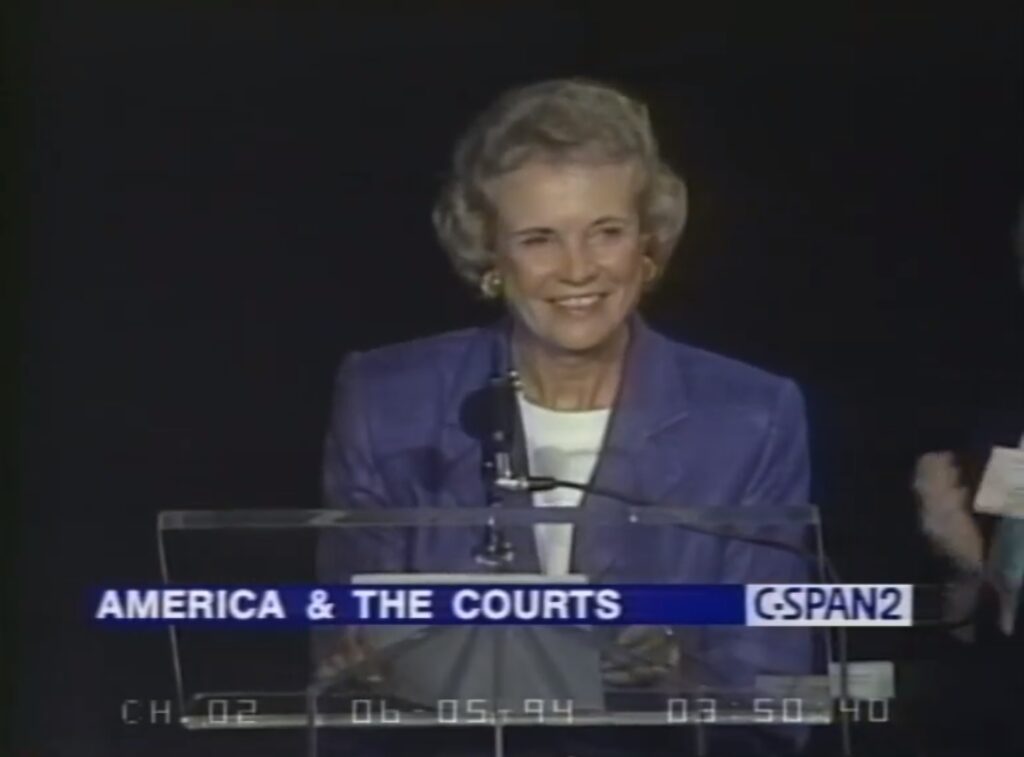
Speech to the Women’s Bar Association of the District of Columbia on women in the legal profession

Sandra Day O’Connor My wonderful colleague, Justice Ginsburg, and judge green and President Sabbath, and the other judges who were kind enough to be here tonight for this event. And all the distinguished guests who are here, including one of the two women on the Supreme Court of Israel, and half the membership of the most distinguished organization in the area, the male auxiliary of the United States Supreme Court. If you think I was happy when Justice Ginsburg was appointed, You Oughta Know how happy my husband was. Well, it’s a special treat to participate in this particular meeting of the women’s Bar Association of the District of Columbia. And the foundation, as well. And to join you here tonight to honor my newest colleague, Justice Ginsburg. And to look out at this audience tonight, which includes so many distinguished women in the legal profession, gives me a sense of achievement and a change. When I first started to practice law in Phoenix, Arizona, in 1958, the women lawyers in that area would gather occasionally to have lunch with justice Laurin on Lockwood, the first woman to serve on the Arizona supreme Court, we could, and we did all fit around one round table for eight. But it was a start. And our numbers have multiplied in Arizona and across the land. I’m often asked whether it makes a difference that we have women judges, and whether the Justice dispensed by women judges is somehow different than that, that we would expect from men and answering such questions.

Law review article, Speech

“Portia’s Progress”

In 1981, Sandra Day O’Connor became the first woman appointed to the United States Supreme Court. Through her wide-ranging career, Justice O’Connor personally witnessed the evolution of the legal world from a time when a top Stanford Law School graduate could gain employment only as a legal secretary, to one in which the law has recognized a heightened consciousness of women’s rights. She also has witnessed the development of a “new feminism,” which posits that women and men have particular ways of looking at the world. In this lecture, Justice O’Connor outlines the Supreme Court’s jurisprudence in the area of women’s rights and takes on the new feminism, calling it a throwback to the “myths we have struggled to put behind us.”

I am very happy to be celebrating with you the One Hundredth Anniversary of Women Graduates from New York University School of Law. New York University showed great foresight by admitting women law students before the turn of the century. It was one of the first major law schools to do so. Columbia Law School did not admit women until 1927; Harvard Law School did not admit women until 1950. In fact, New York University flouted the wishes of Columbia Law School committee member George Templeton Strong, who had written in his diary: “Application from three infatuated Young Women to the [Columbia] Law School. No woman shall degrade herself by practicing law in New York especially if I can save her.”[1]

New York women wouldn’t be saved, however. The first

Law review article

Keynote address (Conference on Compelling Government Interests: The Mystery of Constitutional Analysis)

KEYNOTE ADDRESS-CONFERENCE ON COMPELLING GOVERNMENT INTERESTS†

Sandra Day O’Connor*

I. INTRODUCTION BY HON. JAMES L. OAKES**

I have been instructed to make a few remarks and then to get to the more important business of these remarks.

First, I want to congratulate Albany Law School and particularly Dean Belsky, Professor Gottlieb and Dean Baker for honoring Justice Robert H. Jackson in this fashion. You will recall, this evening is in honor of the memory of Justice Jackson. No finer writer ever on the Supreme Court, Justice Jackson is a hero to me because he was the original, you might.say, county/country lawyer. Since I come from across the hills here in Vermont, and did a little general practice my self, I appreciate just how far he went with the background that he had. He has been a great inspiration to me and to the rest of us in this business of judging, and he always will be.

Second, I want to particularly congratulate Professor Gottlieb on the choice of a subject matter of burning importance in constitutional law and for assembling the outstanding group of scholars and jurists participating in this conference and who have written some outstanding papers of which I have had the benefit of reading, some, if not all. The mystery of constitutional analysis is the subtitle of this conference and I think you ought to bear that in mind as you are listening to some of the presentations. I am acquainted with several of the

† © 1992 by Sandra Day O’Connor. These remarks were

Speech

Speech to the National Conference on Court Management sponsored by the National Center for State Courts

Sandra Day O’Connor I’m delighted to help open this second National Conference on court management. Over the next few days, you’re going to examine how to strengthen court management’s contribution to the performance of the American judicial system. The insights you gain here, combined with your strong implementation efforts, when you go home, will benefit all of us for years to come. People look at the American judicial system in many different ways. There’s considerable attention paid to the court on which I now sit, for better or for worse. But those who see the administration of justice and the United States only in terms of the work of the Supreme Court, only in terms of what some people call the broad and cutting issues of the law. Those people really have a very narrow focus on the American judicial system. I know as a former state court judge, that the amount of and the quality of justice in this country are determined and large measure by the day to day workings of our trial courts, far away from the Supreme Court and in fact, far away from most appellate courts generally. The great majority of cases filed in the courts of the United States are filed and are limited in specialized jurisdiction courts. Day in and day out, those courts and the general jurisdiction trial courts decide what contracts will be enforced, who will pay damages, who will be punished for criminal acts. The appellate courts day in and day out, review the trial courts work and refine the many elements

Law review article

Reflections on Preclusion of Judicial Review in England and the United States

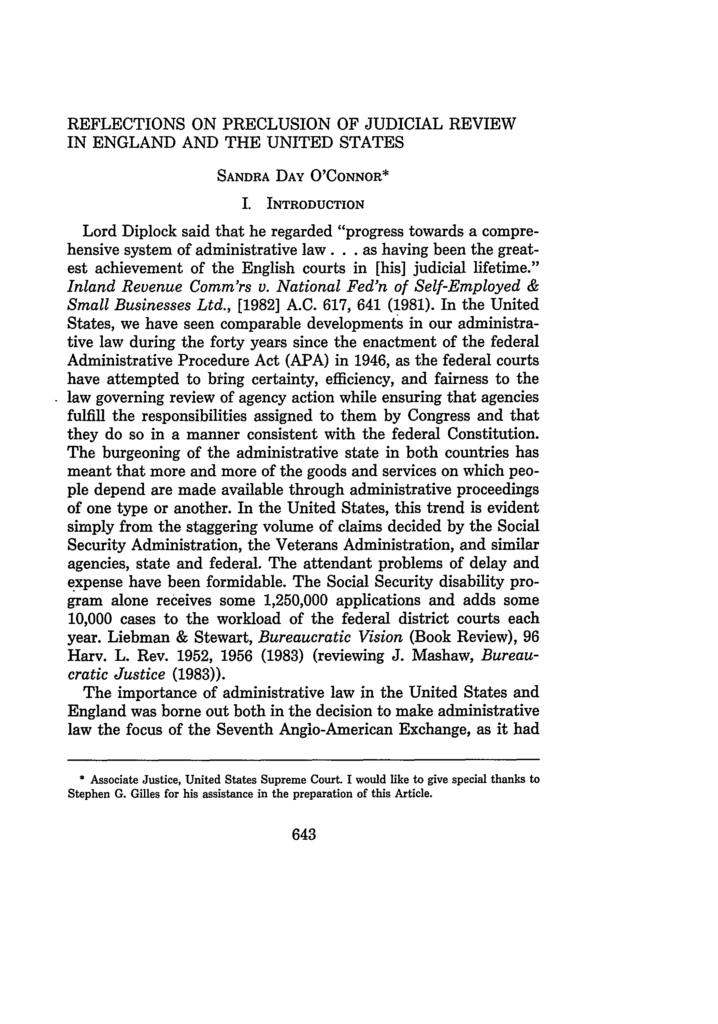
REFLECTIONS ON PRECLUSION OF JUDICIAL REVIEW IN ENGLAND AND THE UNITED STATES

SANDRA DAY O’CONNOR*

INTRODUCTIONLord Diplock said that he regarded “progress towards a compre hensive system of administrative law… as having been the great est achievement of the English courts in [his] judicial lifetime.” Inland Revenue Comm’rs v. National Fed’n of Self-Employed & Small Businesses Ltd., [1982] A.C. 617, 641 (1981). In the United States, we have seen comparable developments in our administra tive law during the forty year.s since the enactment of the federal Administrative Procedure Act (APA) in 1946, as the federal courts have attempted to bring certainty, efficiency, and fairness to the law governing review of agency action while ensuring that agencies fulfill the responsibilities assigned to them by Congress and that they do so in a manner consistent with the federal Constitution. The burgeoning of the administrative state in both countries has meant that more and more of the goods and services on which peo ple depend are made available through administrative proceedings of one type or another. In the United States, this trend is evident simply from the staggering volume of claims decided by the Social Security Administration, the Veterans Administration, and similar agencies, state and federal. The attendant problems of delay and xpense have been formidable. The Social Security disability pro gram alone receives some 1,250,000 applications and adds some 10,000 cases to the

Testimony

Confirmation hearings in the United States Senate on Justice O’Connor’s nomination to the Supreme Court

The CHAIRMAN. Judge O’Connor, we will now give you the opportunity to present an opening statement if you care to do so.

TESTIMONY OF HON. SANDRA DAY O’CONNOR, NOMINATED TO BE ASSOCIATE JUSTICE OF THE U.S. SUPREME COURT Judge O’CONNOR. Thank you, Mr. Chairman. I would like to do so, with your leave and permission. Mr. Chairman and members of the Senate Judiciary Committee, I would like to begin my brief opening remarks by expressing my gratitude to the President for nominating me to be an Associate Justice of the U.S. Supreme Court, and my appreciation and thanks to you and to all the members of this committee for your courtesy and for the privilege of meeting with you. As the first woman to be nominated as a Supreme Court Justice, I am particularly honored, and I happily share the honor with millions of American women of yesterday and of today whose abilities and whose conduct have given me this opportunity for service. As a citizen and as a lawyer and as a judge, I have from afar always regarded the Court with the reverence and with the respect to which it is so clearly entitled because of the function it serves. It is the institution which is charged with the final responsibility of insuring that basic constitutional doctrines will always be honored and enforced. It is the body to which all Americans look for the ultimate protection of their rights. It is to the U.S. Supreme Court that we all turn when we seek that which we want most from our Government: equal justice under

Arizona Republic, Op ed, The Kauffman-Henry Collection

There are a couple of questions the Judge will have to answer

Washington Judge Sandra O’Connor, President Reagan’s favorite nominee at this point, privately explained her views to key senators this week, particularly those on abortion. That’s good. Judge O’Connor’s reputation for integrity will only be strengthened after she clarifies her record and views on this controversial question. Last week, I criticized those in the Pro-Life and Moral Majority movements who used extravagant rhetoric to denounce Judge O’Connor’s record. At that point, I had no evidence that she deserved to be excoriated in such fashion. I still support the O’Connor nomination, and also urge those in the Pro-Life movement to be more measured in their estimate of Judge O’Connor. I also agree with ProLifers who raise two questions about her record. On this score, I am more interested in how she answers these questions than in her pro- or antiabortion “record.” The first concerns a memo prepared in the Justice Department for the attorney general in response to early criticism of O’Connor by ProLifers. The memo, written by Counselor Kenneth W. Starr, reports that Judge O’Connor indicated 11that she has no recollection of how she voted” in 1970 as a member of the Arizona State Judiciary Committee on a bill to remove all legal sanctions on abortion in that state. The committee majority favored the bill, though the vote was not recorded. But a reporter for The Arizona Republic was present, and his published story listed Sandra O’Connor as voting for the bill to legalize abortion.